The short answer
Does homeowners insurance cover water damage? It turns on one test: was the loss sudden and accidental? A burst supply line generally is. A pipe that has been weeping behind a cabinet for months generally is not, because that reads as gradual damage and a maintenance failure. Flood is excluded from standard policies entirely and needs separate cover, and mould arising from a covered loss is usually capped by a sublimit.
Key takeaways
- Sudden and accidental is the test. The cause of loss decides the outcome, not how much water there was.
- Flood means rising surface water from outside the building. It is excluded from standard homeowners policies and requires a separate product.
- Sewer and drain backup is usually excluded unless a backup endorsement was added to the policy.
- Mould from a covered water loss is commonly capped by a sublimit far below the dwelling limit, so a large dwelling limit does not mean large mould cover.
- Standard policies impose a duty to prevent further damage. Document first, then mitigate. Waiting days for an adjuster can become a coverage argument and can worsen the loss.
- Actual cash value pays depreciated value. Replacement cost pays to replace, often releasing recoverable depreciation after the work is finished.
On this page
- The sudden and accidental test
- Scenario table: covered and not covered
- Flood is a separate product
- Sewer and drain backup
- The mould sublimit
- Your duty to mitigate
- ACV against RCV, with a worked example
- Endorsements worth checking for
- What to document, and when
- If a claim is denied
- Questions people actually ask
This page describes general patterns in standard United States homeowners forms, not condo insurance and water damage. It is not advice on any specific policy. Your own policy language governs, including its definitions, exclusions, endorsements and limits, and only your insurer or a licensed adviser can tell you how it applies to your loss. Read the exclusions section rather than the marketing summary.
The sudden and accidental test
Water is the most common property claim and the most commonly misunderstood one. The confusion is almost always about cause rather than amount: a small amount from a covered cause is paid, a large amount from an excluded cause is not.
The organising idea in standard forms is that insurance covers fortuitous events, not deterioration. A supply line that fails without warning is fortuitous. A fitting that has been seeping for months, leaving staining and swelling that were visible to anyone who looked, is deterioration that the homeowner was expected to address.
| Characteristic | Reads as covered | Reads as excluded |
|---|---|---|
| Onset | Abrupt, with an identifiable moment of failure | Progressive, with damage accumulating over weeks or months |
| Visibility | Hidden until it failed, or immediately obvious when it did | Signs were present and observable before the damage spread |
| Cause | Component failure, freezing, an appliance discharging suddenly | Wear, corrosion, deferred repair, poor maintenance |
| Origin | Water escaping from a system inside the building | Water arriving from outside at ground level, or from the ground |
Why the word gradual does so much work
Most water coverage arguments, such as those over water heater leak damage, are arguments about how long something had been happening. The insurer looks for evidence of duration: staining, rot, mineral deposits, delaminated material. The homeowner usually describes the moment they noticed it. Those are different questions, and the file is decided on the first.
The same water, two different outcomes
A supply line under a sink that bursts and floods a kitchen is a covered event. The same supply line, dripping into the cabinet base for six months until the floor beneath it fails, is generally not. The water, the fitting and the room are identical. Only the timeline differs, and the timeline is the whole case.
Scenario table: covered and not covered
| Scenario | Usually covered? | Why |
|---|---|---|
| Burst supply line under a sink | Yes | Sudden and accidental discharge from a plumbing system. |
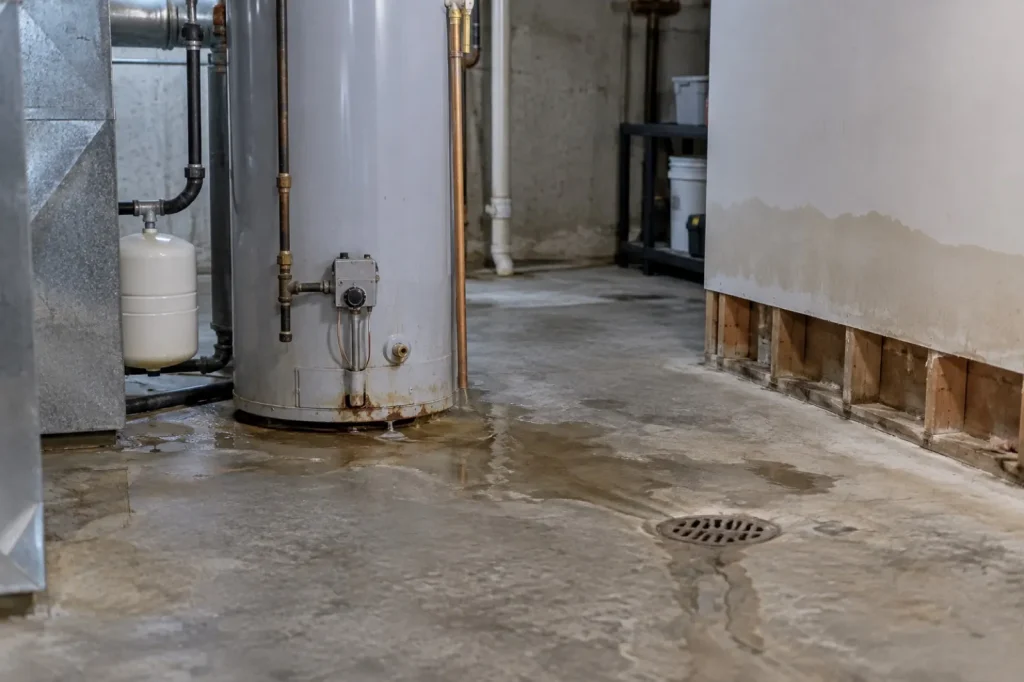
| Water heater tank failure | Yes | Sudden failure. The tank itself is often excluded even where the resulting water damage is covered. |
| Washing machine or dishwasher hose failure | Yes | Sudden discharge from an appliance, though some forms exclude the appliance. |
| Slow leak behind a cabinet over months | No | Treated as gradual damage and a maintenance failure. |
| Surface flooding or storm surge | No | Flood is excluded from standard homeowners forms and requires separate cover. |
| Sewer or drain backup | Only with an endorsement | Usually excluded unless backup cover has been added. |
| Seepage through the foundation | No | Treated as a drainage and maintenance issue, not a sudden event. |
| Rain entering through a storm-damaged roof | Yes | The opening was created by a covered peril, so the resulting water damage follows. |
| Pipe freezing and bursting while the house was empty | Usually, with a condition | Commonly covered, but many forms require heat to have been maintained or the water supply shut off and drained. |
Two rows cause most of the surprise. Surface flooding, because people reasonably assume a policy that covers water covers water. And the empty-house freeze, because the condition attached to it is easy to miss until it is being applied to a claim.
Flood is a separate product
In insurance terms, flood means rising surface water arriving from outside the building: a river leaving its channel, storm surge, runoff that overwhelms drainage. It is excluded from standard homeowners policies and is written as a separate product, through the FEMA, National Flood Insurance Program or a private equivalent.
The distinction is about direction and origin, not about severity. Water escaping a pipe inside the building is a different peril from water arriving at the building from outside at ground level, even when both end up as the same wet carpet. A property owner who has only a homeowners policy has no flood cover, regardless of the dwelling limit.
Where the line gets genuinely blurry
- Wind-driven rain through a storm-created opening. Generally covered, because the opening came from a covered peril. Rain entering through a pre-existing gap is a different argument.
- Water entering through a window well or door sill during heavy rain. Frequently treated as surface water, therefore flood, therefore excluded.
- Groundwater rising through a slab. Generally excluded from both standard homeowners and some flood policies for certain below-grade areas.
- A sump pump failing during a storm. Depends entirely on whether a sump overflow or water backup endorsement is on the policy.
Sewer and drain backup
Backup is water that comes up through drains, toilets or a sump rather than escaping from a pressurised line. Standard forms generally exclude it, and it is offered as an endorsement that has to be added deliberately.
This catches people out because a backup does feel sudden and accidental. The exclusion is specific to the mechanism rather than the suddenness, so the test above does not save the claim. Anyone with a finished basement, a sump pump, or a property on an older municipal sewer should check for the endorsement before they need it.
Backup losses also tend to be contaminated, which changes what the restoration scope has to include. Our guide to the IICRC water categories covers how contamination is classified, and our cost guide covers what that classification does to the price.
The mould sublimit
Where mould results from a covered water loss, many policies still cap mould remediation at a sublimit that is a small fraction of the dwelling limit. This is the single most commonly missed line in a homeowners policy, because the dwelling limit is prominent and the sublimit is not.
A homeowner with substantial dwelling cover can still find mould remediation capped at a few thousand dollars. If a delayed dry-out has produced mould through a wall cavity, that cap can be reached before the work is finished, with the balance falling to the homeowner.
| Situation | How mould is usually treated |
|---|---|
| Mould following a promptly mitigated covered water loss | Generally covered, but subject to the mould sublimit rather than the dwelling limit. |
| Mould following a covered loss that was left wet for a long period | Insurers may argue the mould resulted from the delay rather than the loss, which makes prompt mitigation evidence important. |
| Mould from long-term humidity or condensation | Typically excluded. There is no covered cause of loss behind it. |
| Mould from an excluded cause such as flooding or seepage | Follows the exclusion. If the water was not covered, the mould generally is not either. |
Our mould remediation cost guide covers what the work actually costs, which is the number worth holding next to whatever sublimit appears on the declarations page.
Your duty to mitigate
Standard policies impose a duty on the insured to take reasonable steps to prevent further damage. This is an obligation, not an option, and failing it can reduce or defeat a claim for the damage that the delay caused.
The sequence that satisfies both the duty and the evidence problem is to document first and mitigate immediately afterwards. Photographs and moisture readings taken before anything moves are what supports the scope later, because once demolition starts the original condition is gone.
Waiting for the adjuster is the expensive instinct
Holding off on drying until an adjuster has physically attended feels cautious. It carries two risks running at once. The first is the coverage argument: the policy required reasonable steps, and days of standing water is difficult to describe as reasonable. The second is physical. Water left standing degrades, and a clean-water loss attended several days late can be classified as contaminated by the time work begins, which is a larger and more expensive scope.
What reasonable steps usually means
- Stop the source. Shut off the supply, or the main if the isolation valve will not hold.
- Document before touching anything. Wide and close photographs, dated, with the source visible where it is safe to do so.
- Report promptly. Notify the insurer, and note when you did.
- Start mitigation. Extraction and drying, by a restoration contractor for anything beyond a small contained spill.
- Keep everything. Invoices, moisture logs, photographs and any written instruction the insurer gives you.
ACV against RCV, with a worked example
Two policies can cover the same loss and pay very different amounts, because they value the damaged property differently. This is a settlement basis question rather than a coverage question, and it appears on the declarations page.
| Settlement basis | What it pays | What the homeowner carries |
|---|---|---|
| Actual cash value, ACV | Replacement cost less depreciation for age and wear. | The depreciation. On older finishes this can be a large share of the replacement cost. |
| Replacement cost value, RCV | The cost to replace with like kind and quality, commonly paid in two parts. | The deductible, plus cash flow, since recoverable depreciation is usually released only after the work is completed and invoiced. |
A worked example, with illustrative numbers
The figures below are illustrative round numbers chosen to show the mechanism. They are not benchmarks, averages or quotes.
| Step | ACV policy | RCV policy |
|---|---|---|
| Replacement cost of the damaged flooring | $10,000 illustrative | $10,000 illustrative |
| Depreciation applied, flooring half through its life | $4,000 illustrative | $4,000 illustrative |
| Deductible | $1,000 illustrative | $1,000 illustrative |
| First payment | $5,000 illustrative | $5,000 illustrative |
| Released after work is completed and invoiced | Nothing further | $4,000 illustrative, the recoverable depreciation |
| Total received | $5,000 illustrative | $9,000 illustrative |
Two things follow. An RCV policyholder who never does the work receives the ACV amount, because depreciation is released against completion. And the homeowner funds the gap in the meantime, which is why contractors on insurance work watch which basis a file is written on.
Endorsements worth checking for
Several of the gaps above are closable, and most homeowners do not know whether they have closed them. These are worth locating on the declarations page before there is a loss.
- Water backup and sump overflow. Closes the sewer and drain backup exclusion, usually with its own limit.
- Service line cover. Addresses buried supply and sewer lines on the property, which standard forms commonly exclude.
- Flood, as a separate policy. Through the NFIP or a private carrier. Waiting periods commonly apply, so buying it as a storm approaches generally does not work.
- Increased mould limits. Available on some forms, worth pricing against the cost of remediation.
- Ordinance or law cover. Pays the additional cost of rebuilding to current code, which matters in older housing where a repair triggers upgrades.
- Replacement cost on contents. Contents are often settled on ACV by default even where the dwelling is RCV.
What to document, and when
Coverage disputes are decided on evidence of cause and timing. The homeowner who can show what the condition was on day one is in a different position from the one describing it from memory.
| When | What to capture | What it proves later |
|---|---|---|
| Before anything is moved | Wide and close photographs, dated, with the source visible where safe. | The condition at discovery, which is the baseline for every scope argument. |
| Before mitigation starts | Moisture readings on affected material and on unaffected material of the same type. | The extent of the loss, and a baseline without which affected readings mean little. |
| At the point of reporting | Date and time of notification, and who you spoke to. | That the duty to report promptly was met. |
| Every day equipment runs | Daily moisture logs from the contractor. | That the drying duration was driven by readings rather than assumption. |
| Throughout | Invoices, written instructions from the insurer, and a list of damaged contents. | The claim total, and that costs incurred were reasonable. |
If the loss is being estimated on the platform most carriers use, our guide to how Xactimate pricing works covers why scope and quantity documentation, rather than unit price, is what decides the number.
If a claim is denied
A denial is a position, stated in writing with reference to specific policy language. The first useful step is to read which provision was cited, because the response to a gradual damage exclusion differs from the response to a flood exclusion.
- Get the denial in writing, citing the provision. Then read that provision in your own policy rather than in the letter’s paraphrase.
- Identify whether the dispute is cause or amount. Cause disputes turn on evidence of what happened and when. Amount disputes turn on scope and quantities.
- Produce the documentation you took on day one. Contemporaneous photographs and readings carry more weight than a later account.
- Ask about appraisal. Many policies contain an appraisal clause for disputes about the amount of loss, which is a different route from disputing coverage.
- Use the state insurance regulator. Every US state has a department of insurance that accepts consumer complaints.
- Take advice for anything significant. A public adjuster or an attorney is the appropriate route for a large or contested loss. This page is not a substitute for either.
Questions people actually ask
Does homeowners insurance cover water damage?
Generally yes where the loss is sudden and accidental, such as a burst supply line or a failed water heater, and generally no for gradual leaks, maintenance failures and surface flooding. The cause of loss decides it, and your policy language governs.
Is flood damage covered by homeowners insurance?
No. Flood means rising surface water from outside the building, and it is excluded from standard homeowners forms. It requires a separate policy through the NFIP or a private carrier, and waiting periods commonly apply.
Will insurance pay for mold removal?
Often only up to a mould sublimit, and usually only where the mould followed a covered water loss. Mould from long-term humidity or deferred maintenance is typically excluded, and the sublimit is frequently a small fraction of the dwelling limit.
Is a sewer backup covered?
Usually not under a standard form. It is generally offered as a water backup and sump overflow endorsement that has to be added deliberately, with its own limit. Check the declarations page rather than assuming.
Should I start drying before the adjuster arrives?
Usually yes. Standard policies require the insured to take reasonable steps to prevent further damage. Document the condition thoroughly first with photographs and moisture readings, then let mitigation begin, and keep every record.
What is the difference between ACV and RCV?
Actual cash value pays replacement cost less depreciation. Replacement cost pays to replace with like kind and quality, commonly in two parts, with recoverable depreciation released after the work is completed and invoiced. The basis appears on your declarations page.
How long do I have to report a water damage claim?
Standard policies require prompt notice rather than a fixed number of days, and some states impose their own limits. Delay is itself a risk, because it complicates both the duty to mitigate and the evidence of when the loss occurred. Report as soon as you discover it.
Sources
- FEMA, National Flood Insurance Program, on the separation of flood cover from standard homeowners policies and on the definition of flood. Retrieved 23 September 2026.
- Coverage patterns on this page describe common structures in standard United States homeowners forms. They are not a substitute for policy language, and we have not reviewed any specific carrier’s current forms or any specific claim file.
- Water category definitions referenced in the backup section follow ANSI/IICRC S500, Standard for Professional Water Damage Restoration, 5th edition. The standard text is sold by IICRC; we describe its framework rather than reproduce it.
- The ACV and RCV worked example uses illustrative round numbers chosen to demonstrate the mechanism. They are not averages, benchmarks or quotes, and no figure in that table is drawn from any policy or claim.
- Our methodology sets out the standing rules on what we will and will not assert.