The short answer
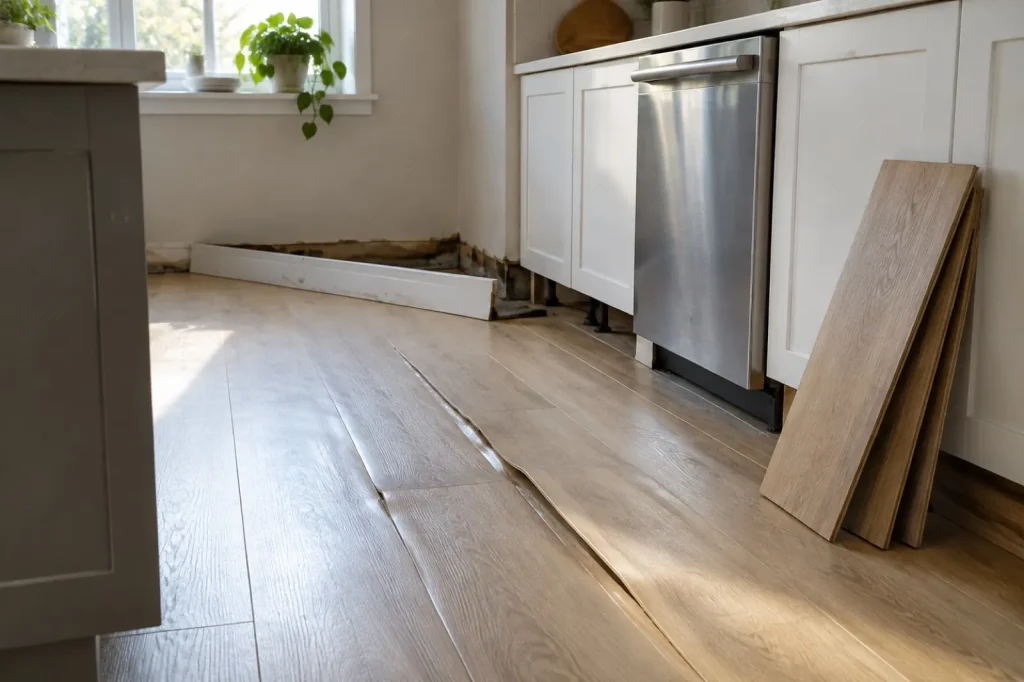
Laminate floor water damage is the fibreboard core swelling once water reaches its edges, and edge swell that survives drying is treated as permanent. Planks with only surface water, wiped within the warranty window of 24 to 72 hours, usually survive. Boards with peaked seams or edge swell are replaced, and the wet underlayment under them comes out.
Key takeaways
- The core is the weak point: NALFA defines high density fiberboard as denser than 800 kg/m³, and the industry swell test measures laminate at its edges.
- The swell limit is not zero: according to ANSI/NALFA LF-01-2018, residential grade may swell under 18% after a 24-hour soak, about 1.44 mm on an 8 mm plank.
- ‘Waterproof’ is a warranty term, not a physics claim. STAINMASTER defines it as topical water not entering the seams for up to 72 hours.
- Every warranty read for this page excludes flooding, plumbing and appliance leaks, and water underneath the floor.
- Several warranties tie water coverage to a sealed perimeter or sealed cut edges, so an unsealed edge can end the claim.
- Replacement boards come from current lines, not your dye lot: Shaw and Mannington both say so in writing.
On this page
- What you are looking at
- Why laminate swells
- Water-resistant versus waterproof
- Warranty water terms, brand by brand
- What can be dried, what must go
- The method for a floating floor
- Underlayment and subfloor
- A few boards or the whole floor
- Laminate versus vinyl plank in water
- Signs it is bigger than it looks
- For contractors
- Questions people actually ask
What you are looking at: swell, peaking or cupping
Swollen laminate shows itself at the seams first. Name the shape before deciding anything: the NALFA glossary of the North American Laminate Flooring Association defines each one.
| What you see | NALFA term and definition | Common look-alike | What it usually points to |
|---|---|---|---|
| Raised ridge along a seam, both boards up | Peaking: seams risen above the horizontal plane from installation or environmental effects | An installation cause, which the definition also names | Water at the joint or an expansion problem; check for wet underlayment |
| Board edges higher than the centre | Cupping: concave shape, ‘end-lift or horns up’ | Crowning, its mirror image | Moisture from below; Shaw names lift from vapour pressure underneath |
| Centre higher than the edges | Crowning: convex shape, ‘horns down’ | Cupping seen against the light | Record which shape it is before drying changes it |
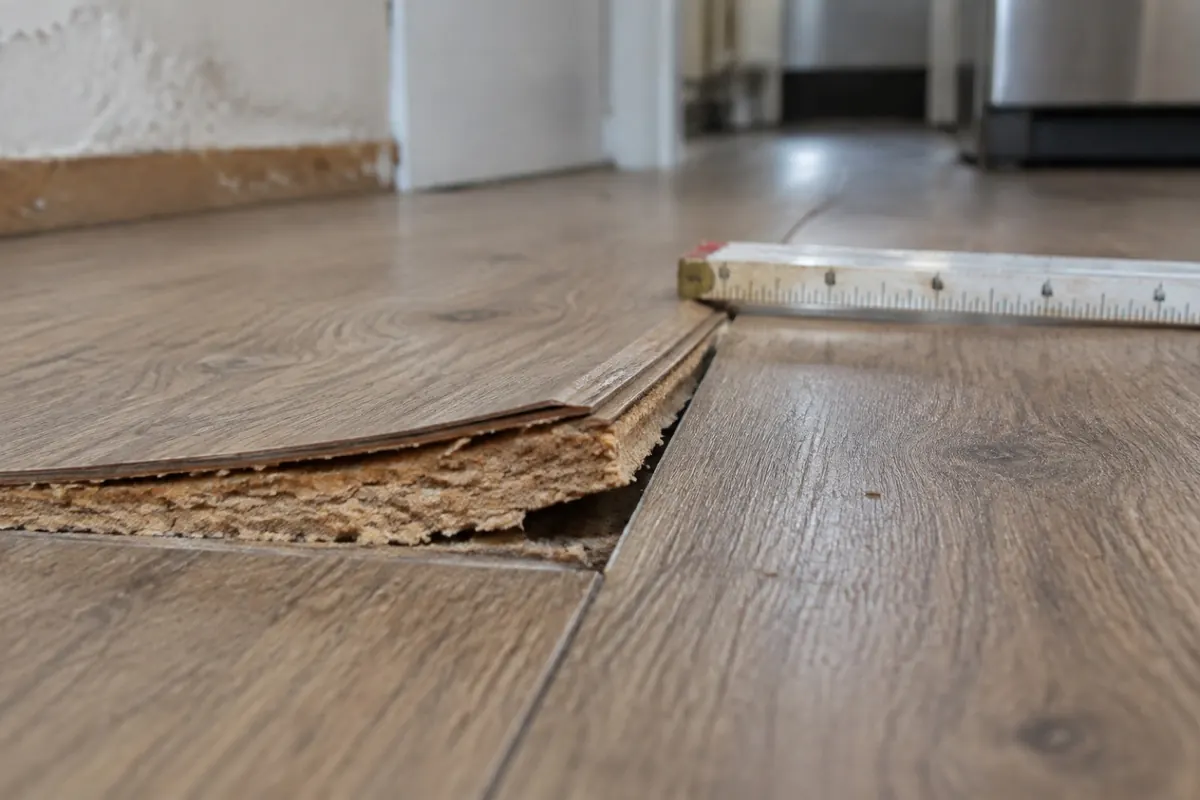
| Rough, puffy edge with a lip you can feel | Thickness swell, the LF-01 test property | A chipped or worn bevel | Core has absorbed water at the edge |
| Surface layer bubbling or separating | Delaminating: separation of the layers | A film left by a cleaner | Layer bond lost; board is finished |
Run a hand across each seam. Thickness swell is the property LF-01 measures at the edge, so a lip you can feel is the core; a mark you can only see, with tight flat seams, is a surface question.
Why laminate swells: the HDF core and its edges
NALFA describes laminate as a wear layer and décor layer pressed over a wood-based core, with a backing layer typically of melamine. Its standards define high density fiberboard (HDF) as fibreboard denser than 800 kg/m³ and say the core shall be wood based, such as HDF or MDF. The warranties treat the edge as the weak point: Shaw excludes water that flows over an edge or a cut board, and Mannington requires cut planks in wet areas to be sealed.
The industry test treats swelling as expected, within a limit. Under ANSI/NALFA LF-01-2018 section 3.2, a 150 by 150 mm specimen with its edges trimmed is held 25 mm under water for 24 hours, then measured at the middle of each edge. Wood-composite research has long separated reversible from irreversible swell in fibreboard and particleboard, according to a study in the Forest Products Journal, which is why a dried edge can stay proud of its neighbour.
| LF-01 usage level | Max swell, per the standard | Swell on an 8 mm plank | Swell on a 12 mm plank |
|---|---|---|---|
| Residential | under 18% | 1.44 mm | 2.16 mm |
| Light commercial | under 16% | 1.28 mm | 1.92 mm |
| Commercial | under 16% | 1.28 mm | 1.92 mm |
| Heavy commercial | under 12% | 0.96 mm | 1.44 mm |
NALFA also runs an add-on NALFA Surface Swell Test for the assembled joint: 100 mL of dyed water, about 9 mm deep, held in a 4 inch ring sealed over a locked joint for 24 hours, according to NALFA.
Water-resistant versus waterproof, as the paperwork defines them
The labels mean what each warranty says they mean, and the definitions are narrower than the box. NALFA’s own FAQ says laminate is not suitable for areas with excessive moisture such as bathrooms unless the manufacturer specifies it as waterproof.
| Label | Definition, per the document | Source |
|---|---|---|
| Waterproof | Topical water/moisture ‘will not infiltrate plank seams for a period of up to 72 hours’ | STAINMASTER waterproof laminate warranty |
| Water resistant | Top surface water from normal activities ‘for up to 24 hours, will not damage the structural integrity’ | LifeProof laminate warranty |
| Waterproof | Covers topical moisture ‘as long as the water does not flow over the edge of the surface (edge of the room, cut boards, etc.)’ | Shaw Residential Waterproof Laminate warranty |
| Waterproof system | Resists spills and pet accidents; ‘complete waterproof coverage requires the perimeter of the floor to be sealed’ | Pergo Outlast+ warranty |
| 100% waterproof | Retail page: ‘No amount of water, moisture, or spills will harm these floors’ | Floor & Decor AquaGuard page |
The AquaGuard row is a retail page; we could not obtain its warranty text, so it is not in the table below.
Manufacturer warranties on water, side by side
| Brand and document | Water claim | Hours | Water exclusions | Conditions |
|---|---|---|---|---|
| Pergo Outlast+ warranty, effective 11 March 2024 | Resists topical spills and pet accidents; damp or wet mopping | None printed | Flooding, plumbing accidents, leaking appliances, water under the floor, moisture from outside the room | Perimeter sealed per instructions |
| Pergo WetProtect laminate warranty, effective March 2026 | ‘No-exclusions’ wet warranty for spills, pet accidents, steam mopping; subfloor covered | None printed | Same list; subfloor only if water came through a properly installed joint | Perimeter sealed |
| Shaw Residential Waterproof Laminate warranty, undated | Will not swell, cup or crack from cleaning or everyday spills | None printed | Casualty events ‘normally covered by homeowners’ insurance’, standing water, hydrostatic pressure | Water must not flow over an edge |
| Mannington laminate warranty (Restoration, rev. 21 April 2023) | Not damaged by localized spills ‘removed within a reasonable period of time’ | None printed | Storms, floods, excessive plumbing leaks, water trapped beneath | Cut planks in wet areas need SpillShield applicator or silicone |
| STAINMASTER waterproof laminate warranty, undated | No damage from wet mopping and everyday spills | 72 | Flooding, leaking appliances, pipe damage, saturation, mold; structure and subfloor | Claim in writing within 30 days |
| allen + roth water-resistant warranty, item 1944763, undated | Resists mopping and everyday spills | 24 | Flooding, water left over 24 hours, leaking appliances or pipes, pet urine, water underneath | Moisture test assumed; claim within 30 days |
| LifeProof laminate warranty, Home Legend, effective 17 March 2021 | Top surface water will not damage structural integrity | 24 | Flooding, standing water, leaks of pipes, appliances, doors or windows, water below | Do not remove flooring before inspection |
Across all seven documents, none covers a supply line, a dishwasher or a flood, and several tie coverage to perimeter or edge sealing. Shaw calls its exclusions failures normally covered by homeowners’ insurance; how a policy responds is for its wording, see our page on homeowners insurance and water damage.
What can be dried and what must be replaced
Laminate flooring water damage is judged per board, not per room. EPA advises drying water-damaged areas within 24 to 48 hours to prevent mould growth, and the water source sets the outer limit: grey or black water ends the salvage question for the underlayment, as our page on water categories explains.
| Condition | Decision | Why |
|---|---|---|
| Surface water only, seams tight, wiped promptly | Dry in place | Within every warranty’s topical window |
| Water under the floor, boards flat | Lift, dry underneath, reassess the boards | The underlayment holds water against the core and the deck |
| Cupping, edges dry to the touch | Dry the subfloor, then decide | Cupping points to moisture below; fix the source first |
| Peaked seams or a lip you can feel | Replace those boards | Edge swell in a composite is partly irreversible |
| Delamination or bubbling | Replace | Layer bond is gone |
| Category 2 or 3 water | Replace underlayment; boards case by case | Porous pad holding contaminated water |
The method for a floating laminate floor
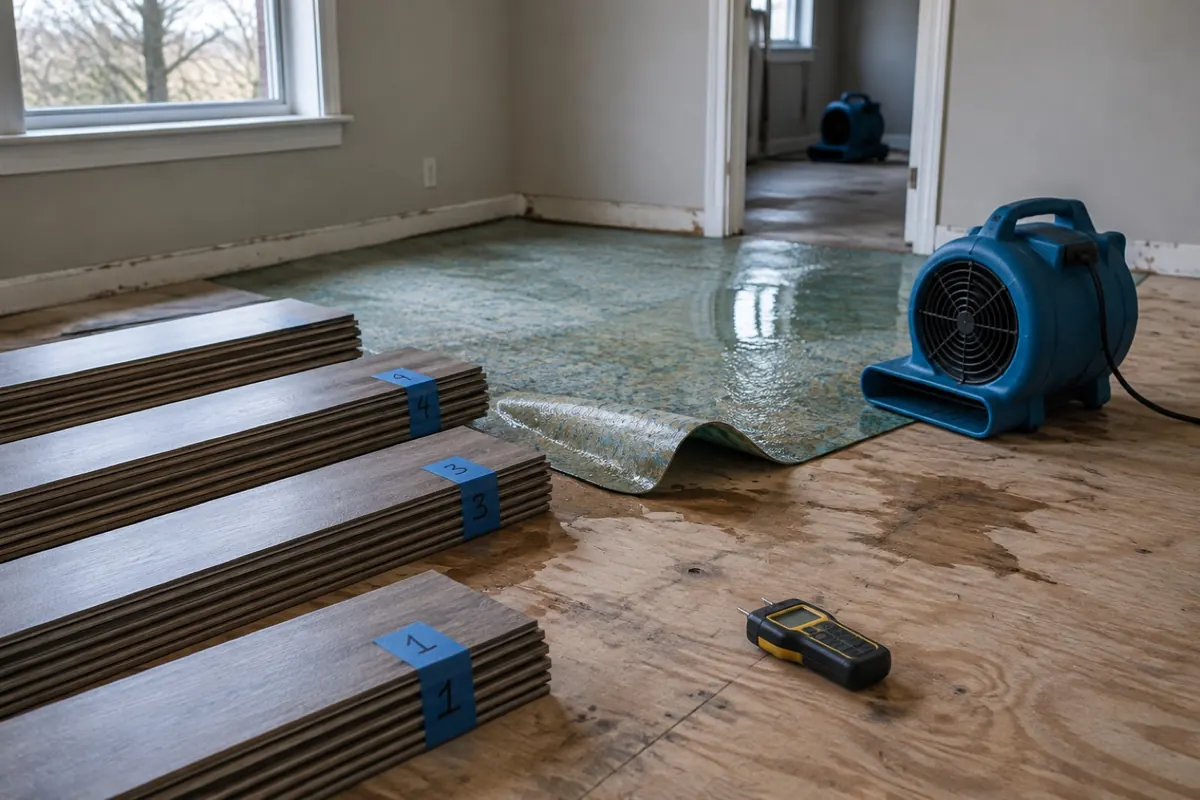
Laminate is usually a floating, click-locked floor, which changes the generic water-damage sequence. Each step notes why.
| Step | What to do | Why this differs from generic advice |
|---|---|---|
| 1. Stop the source, lift standing water | See water extraction | A floating floor hides water beneath it; surface extraction is only the start |
| 2. Photograph before touching | Every seam, plank label, receipt | LifeProof says removal before inspection voids its warranty |
| 3. Pull trim and check the perimeter | Look for sealant at walls and cut edges | Pergo, Shaw and Mannington tie coverage to the edge |
| 4. Unclick boards back from the nearest wall | Number them as they come up | So each board returns to its own place |
| 5. Remove wet underlayment | Bag foam pads | Pad holds water against the subfloor |
| 6. Dry and measure the deck | Against an unaffected reading | The subfloor finishes the job, not the planks |
| 7. Sort the boards | Flat and tight edges go back; lipped edges go | Swell that survives drying is permanent |
| 8. Reinstall with matching stock | Spare planks first | Warranty replacements come from current lines |
Drying equipment and targets are covered on our structural drying page; solid and engineered wood follow a different path on our hardwood floor water damage page.
The underlayment and the subfloor
The pad under laminate decides how long water stays. NALFA’s NALFA LF-03 underlayment standard has two tiers; only Tier 2 carries a water vapour and mould requirement.
| Property, per the LF-03 standard | Tier 1 | Tier 2 | Test method |
|---|---|---|---|
| Thickness | 1 mm or more | 1 mm or more | ASTM D3575 |
| Water vapour transmission | Not required | 3 lbs/1,000 ft² per day or less | ASTM E96 or F1249 |
| Mould growth rating | Not required | 9 or higher | ASTM D3273 |
| Sound (IIC and STC) | 50 or more | 50 or more | ASTM E492, E90 |
STAINMASTER and allen + roth both make a moisture barrier underlayment a warranty condition on concrete, below grade or in moisture-prone areas. Once the pad is out, the deck is its own problem: see our sibling page on subfloor water damage.
Replacing a few boards versus the whole floor
You can replace just a few pieces of laminate if matching boards exist. The warranties say plainly that the manufacturer will not guarantee a match.
| Document | What replacement means | Matching risk |
|---|---|---|
| Shaw Residential Waterproof Laminate warranty | ‘Current running-line products comparable to the warranted product’ | Discontinued décor is swapped |
| Mannington laminate warranty | ‘Only new flooring from the current product range’ | Same |
| allen + roth water-resistant warranty | Original décor if available, else equal or greater value | Different look if discontinued |
| LifeProof laminate warranty | Another customer-approved design, or a refund | Customer chooses a new design |
| Pergo WetProtect laminate warranty | Colour and gloss differences from later additions excluded | Even the same line may not match |
Spare cartons from the original install are worth more than any warranty remedy, and Pergo recommends keeping excess planks for repairs. Without them, a discontinued line turns a few boards into a whole-floor matching question.
Laminate versus vinyl plank in water
FEMA’s flood-resistance classes are the clearest public comparison. In FEMA Technical Bulletin 2 (2008) Table 2, ‘plastic laminate flooring’ is Class 2, unacceptable below flood elevation: not resistant to clean water damage and unable to survive wetting and drying. Homogeneous vinyl sheets or tiles with chemical-set adhesives are Class 4, acceptable. FEMA’s 2025 edition replaced the 2008 one; we could not open the 2025 table, so treat these rows as the 2008 position.
| Material in TB-2 Table 2 | Class | FEMA verdict |
|---|---|---|
| Plastic laminate flooring | 2 | Unacceptable |
| Engineered wood flooring | 2 | Unacceptable |
| Wood flooring, solid | 1 | Unacceptable |
| Vinyl sheets or tiles, homogeneous, chemical-set adhesive | 4 | Acceptable |
| Vinyl sheets or tiles on cork or wood backings | 1 | Unacceptable |
TB-2 lists homogeneous sheet and tile, not rigid-core vinyl plank, so the class does not transfer automatically. FEMA also notes that vinyl tile over a plywood floor loses acceptability, because the tile must be removed to let the plywood dry.
Signs it is bigger than it looks
- Peaking that keeps spreading after the source is off, which suggests water moving under the floor.
- Cupping across a whole room: moisture from below, which Shaw excludes as vapour pressure from underneath.
- A musty odour when boards come up, or staining on the underside of the pad.
- Soft or discoloured subfloor at the lifted area.
- Water that came from a neighbouring room, which Pergo excludes as moisture from outside the room.
- Wet drywall at the baseboard line; see our sibling page on water damage in walls.
For contractors: scope, documentation, line items
- Scope: detach and reset versus remove and replace per board, underlayment removal, trim detach and reset, and the matching question priced separately.
- Documentation: photos of seams before lifting, plank labels or carton codes, the warranty edition, and moisture readings of the deck against an unaffected area.
- Warranty traps: LifeProof voids coverage if flooring is removed before inspection; STAINMASTER and allen + roth want a written claim within 30 days. Tell the owner before demolition.
- What an adjuster asks for: the source and its date, why boards cannot be reset, and evidence that a match is not available when a full-room replacement is proposed.
What this page does not cover. Subfloor repair, mould remediation and insurance coverage decisions. More water guides sit in our water hub.
Questions people actually ask
Can water damage on laminate flooring be repaired?
Partly. Boards that only had surface water and still have tight, flat seams can be dried and kept. Boards with peaked seams, a raised lip at the edge or bubbling layers are replaced, because fibreboard swell is partly irreversible. The underlayment beneath wet boards is usually replaced rather than dried.
Is laminate flooring ruined if it gets wet?
Not if the water stays on top and is wiped up. The warranties read here cover topical water for 24 hours (allen + roth, LifeProof) or 72 hours (STAINMASTER), and Pergo and Shaw cover everyday spills with no hour figure. Water that reaches the edges or runs under the floor is excluded by all of them.
My laminate floor has lifted from water. What can I do?
Stop the water, photograph the seams, then unclick boards from the nearest wall to reach the wet area. Remove wet underlayment and dry the subfloor before judging the boards. Lifting that settles once the deck is dry can be reset; edges that stay raised are replaced.
Can you replace just a few pieces of laminate flooring?
Yes, on a click-locked floating floor, if matching boards exist. Warranties do not promise a match: Shaw and Mannington replace from current product lines, and Pergo excludes colour and gloss differences on later additions. Spare cartons from the original installation are the best match available.
Will water under laminate dry out on its own?
Rarely in time. The underlayment traps water against the subfloor and the core, and EPA advises drying water-damaged materials within 24 to 48 hours to prevent mould. Lifting boards and removing a wet pad is usually what lets the deck dry.
How long does it take for water to damage laminate flooring?
The published windows are 24 to 72 hours for topical water in the warranties read here. According to NALFA, its LF-01 swell test soaks a sample for 24 hours and allows under 18% swell at residential grade, so one day at an edge is enough to measure swelling.
Laminate vs vinyl for water: which is better?
For flood resistance, FEMA’s 2008 bulletin classes plastic laminate flooring as Class 2, unacceptable, and homogeneous vinyl with chemical-set adhesive as Class 4, acceptable. Rigid-core vinyl plank is not listed, so check its own warranty.
Sources
- Pergo Outlast+ warranty, Pergo Outlast+ limited lifetime residential warranty, effective 11 March 2024. Retrieved 19 October 2026.
- Pergo WetProtect laminate warranty, laminate wood flooring limited warranty with WetProtect, effective March 2026. Retrieved 19 October 2026.
- Shaw Residential Waterproof Laminate warranty, Shaw Industries, via the Shaw laminate warranty page; undated. Retrieved 19 October 2026.
- Mannington laminate warranty, Mannington Mills, revision 21 April 2023. Retrieved 19 October 2026.
- STAINMASTER waterproof laminate warranty, Lowe’s product document, undated. Retrieved 19 October 2026.
- allen + roth water-resistant warranty, Lowe’s item 1944763, undated. Retrieved 19 October 2026.
- LifeProof laminate warranty, Home Legend, LLC, effective 17 March 2021. Retrieved 19 October 2026.
- Floor & Decor AquaGuard page, Floor & Decor product page. Retrieved 19 October 2026.
- NALFA glossary and NALFA laminate FAQ, North American Laminate Flooring Association. Retrieved 19 October 2026.
- ANSI/NALFA LF-01-2018, Specifications and Test Methods, sections 2.1 and 3.2, and the NALFA Surface Swell Test for assembled joints. Retrieved 19 October 2026.
- NALFA LF-03, underlayment standard, Table section 2. Retrieved 19 October 2026.
- FEMA Technical Bulletin 2 (2008), Flood Damage-Resistant Materials Requirements, August 2008, via Montana DNRC. Retrieved 19 October 2026.
- EPA, A Brief Guide to Mold, Moisture and Your Home. Retrieved 19 October 2026.
- Forest Products Journal, Impregnation to Control Dimensional Stability of Particleboard and Fiberboard, 1966, 16(11):45-53, abstract. Retrieved 19 October 2026.
- Millimetre swell values are arithmetic on the LF-01 percentages, done when this page was built. Our methodology sets out the standing rules.
Warranty terms change by product and edition. Read the warranty that shipped with your floor, and for coverage questions read your policy and ask your state insurance department or a licensed professional.