The short answer
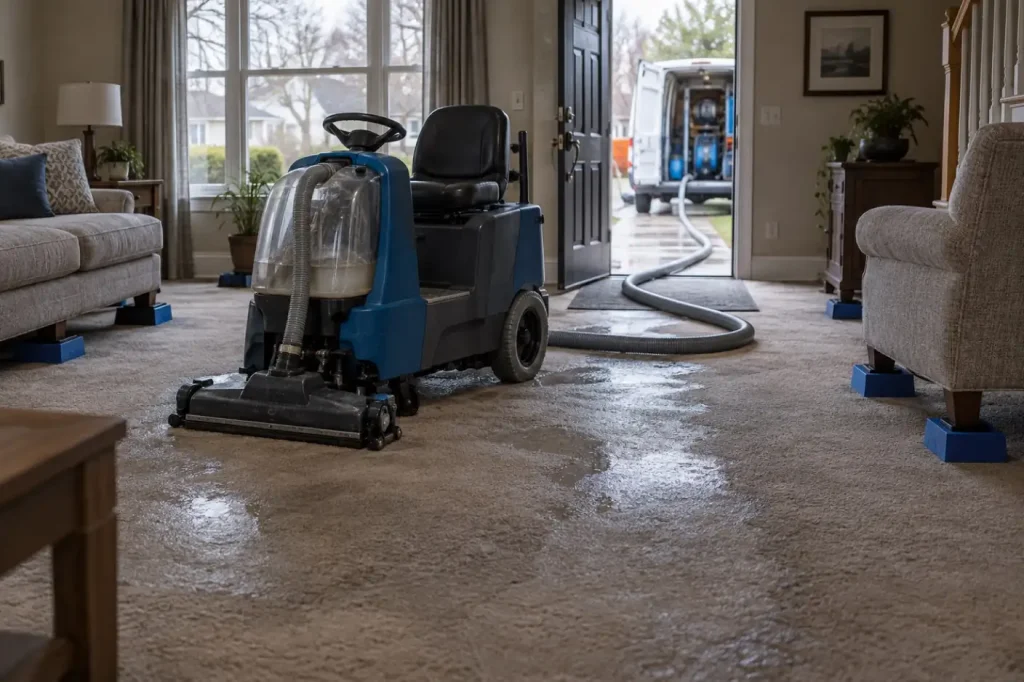
Water extraction is the restoration step that pulls liquid water out of carpet, pad and floors with vacuum before any drying begins. It comes first because evaporating one gallon takes about 2.57 kWh of heat, while suction lifts it as liquid. A truckmount or portable extractor supplies the vacuum; a wand, weighted tool or subsurface tool applies it to the floor.
Key takeaways
- Evaporating one US gallon of room-temperature water takes about 2.57 kWh (8,785 BTU), per the published latent heat and NIST gallon figures. Extraction skips that cost.
- A dehumidifier rated 80 pints a day (AHAM), per the Dri-Eaz catalogue, removes 10 gallons a day. Water left in the pad waits in that queue.
- Spec sheets print vacuum lift in inches of mercury or inches of water. One inch of mercury is about 13.6 inches of water, per NIST conversion factors.
- Subsurface and ride-on tools reach the pad; a cleaning wand mainly reaches the face fibre.
- Per a university guideline that follows S500, carpet wet with Category 3 water for any time is removed. Dri-Eaz advises keeping black water out of the truckmount tank.
- Published Xactimate codes for extraction equipment start with WTREXT, per Dri-Eaz and Legend Brands. Check suffixes in your price list.
On this page
- Why lifting beats evaporating
- The vacuum source: truckmount or portable
- The tool on the floor
- Carpet, pad, hardwood and concrete
- How much water extraction removes
- Category 2 and 3 change the job
- Choosing the setup: a decision path
- What extraction costs
- For contractors: codes and the file
- Questions people actually ask
In building restoration, extraction is one step with one job: remove water while it is still liquid. It sits inside the mitigation phase described in what is water mitigation. Everything that evaporates afterwards belongs to structural drying, which is sized against whatever extraction left behind.
Scope: vacuum extraction in buildings. Not water withdrawal from rivers or aquifers, atmospheric water generators, or plant extraction, which share the search term.
Why lifting water beats evaporating it
Turning liquid water into vapour takes a fixed amount of energy per kilogram, the latent heat of vaporisation. According to the Engineering ToolBox table it is 2,453.5 kJ/kg at 20 C and 2,256.4 kJ/kg at the boiling point, so water leaving a room-temperature floor needs slightly more energy per kilogram than a boiling kettle. A drying system pays that cost for every kilogram it evaporates, then a dehumidifier condenses the vapour back out of the air.
Per gallon: NIST Handbook 44, Appendix C defines the US gallon as 231 cubic inches, or 3.785411784 litres, and the USGS table gives a density of 0.99802 g/cm3 at 70 F, so a gallon weighs 3.78 kg (8.33 lb). According to that arithmetic, one gallon needs about 9,269 kJ to evaporate: 2.57 kWh, or 8,785 BTU using the ToolBox value of 1,054.8 BTU per pound.
For scale, that energy would run an HVE 3000 flood extractor at the nameplate draw on the Dri-Eaz HVE 3000 spec sheet (13.5 A at 115 V, both blowers) for about 100 minutes. Nameplate amps times volts is not a measured efficiency, but the direction is clear: a vacuum moves liquid water without paying the phase-change bill.
The dehumidifier queue
The second cost is time. The Dri-Eaz restoration catalogue (November 2025) rates the LGR 5000Li at 80 pints a day under AHAM test conditions and 164 at maximum. At 8 pints a gallon, per NIST, that is 10 to 20.5 gallons a day. Every gallon a wand leaves in the pad is a gallon the dehumidifier pulls out of the air later.
The same extract-first principle, applied to the carpet itself, is in how to dry wet carpet.
The vacuum source: truckmount or portable
The vacuum source sets two numbers. Vacuum lift is the pressure difference the blower holds with the inlet sealed, which pulls water out of the pile and up the hose. Airflow, in cubic feet per minute, is the volume of air moved, which carries the water to the tank.
The Sapphire Scientific 370 truckmount flyer lists vacuum to 13 in. Hg and flow up to 317 CFM, with a 120 gallon waste tank. The Mytee Speedster LX spec sheet gives 180 inches of water lift and 225 to 250 CFM. Using the 60 F factors in NIST SP 811, Appendix B.9, one inch of mercury is 13.57 inches of water, so the truckmount’s figure is about 176 inches of water.
| Unit | Type | Lift as printed | Inches of water | Airflow | Other published specs |
|---|---|---|---|---|---|
| Sapphire Scientific 370 | Truckmount | 13 in. Hg | 176 (converted) | Up to 317 CFM | 120 gal waste tank |
| Dri-Eaz HVE 3000 | Portable flood extractor | 12 in. Hg, both blowers | 164 (printed) | Not printed | 50 gpm pump-out, 12 gal tank, 132 lb, HEPA exhaust |
| Mytee Speedster LX | Portable carpet extractor | 180 in. water lift | 180 (printed) | 225 to 250 CFM | Dual vacuum motors |
Why portables exist when the truck has more air
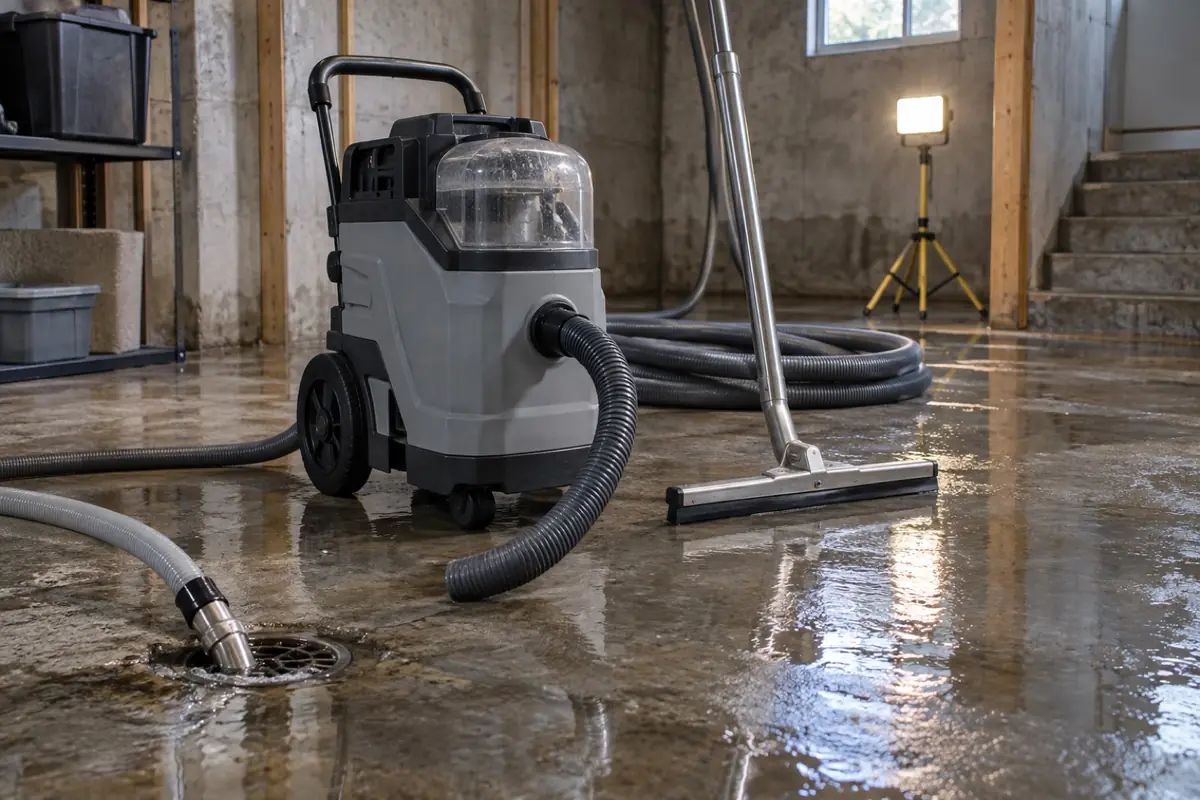
The truckmount brings airflow and tank size, but it stays at the curb while the loss may be several floors up. Sylvane describes the HVE 3000 as commonly used for portable extraction in multi-level units and as a truckmount booster, and the Dri-Eaz sheet says it can intercept extracted water so the truck tank does not fill, with automatic pump-out to a drain.
The tool on the floor: wand, weighted, ride-on, subsurface
A cleaning wand pulls water from the face fibre. Cleanfax, in a 2014 piece by Jeremy Reets, notes that most restorers’ staple rig is a truckmount and wand, and that wanding followed by pad removal can be effective but is not always efficient. Weighted and subsurface tools reach the pad without lifting the carpet.
| Tool | How it works | Published detail | Best fit |
|---|---|---|---|
| Carpet wand | Open head drawn across the face fibre | Standard truckmount tool, per Cleanfax | Surface water, final passes |
| Stationary subsurface tool | Sealed plate pressed into the carpet; the technician stands on it | Bane-Clene reports the Water Claw removes up to 90% of water from carpet and pad | Pad-in extraction, strong vacuum source |
| Ride-on or self-propelled tool | Weighted head wrings the pad as it travels | Rover HVE: 19.75 in. path, 67 lb, per Legend Brands | Large carpeted areas |
| All surface tool | Wand with a replaceable glide for hard floors | 12 in. head, 1.5 in. hose, per Legend Brands | Tile, stone, LVT, polished concrete |
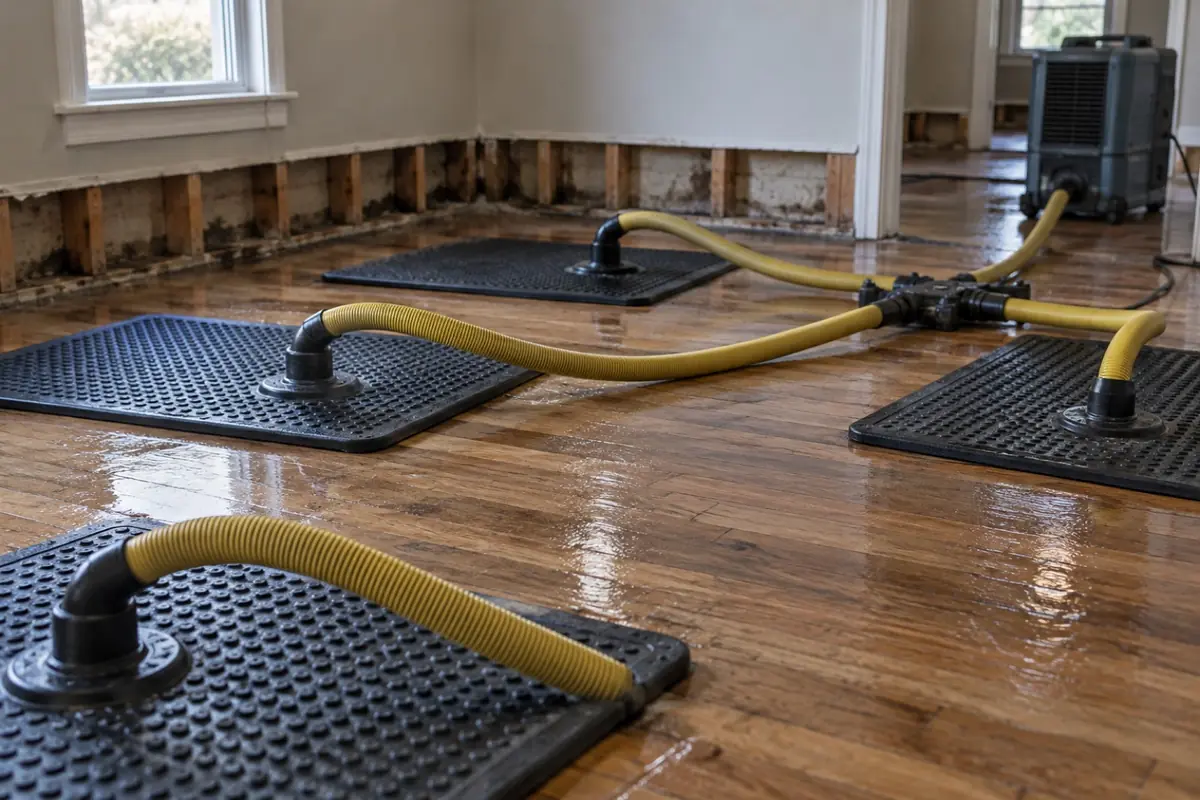
| Floor drying panels | Mats sealed to the floor, connected to extraction hoses | Described for hardwood by R&R magazine | Wood flooring |
Per Cleanfax, a stationary tool is held for a five count at each position, and a ride-on tool runs into each corner and back. The stop test for both: if you can squeeze water out of the pad, you can still extract it.
Carpet, pad, hardwood and concrete
Extraction technique follows the material. R&R magazine‘s KnowHow team (April 2024) separates heavy extraction for soaked carpet, which makes later pad removal easier, from standard extraction on less saturated carpet, and calls for a secondary extraction on the carpet after the pad comes out.
| Surface | Method | Stop signal | Source |
|---|---|---|---|
| Carpet over pad, pad staying | Subsurface or ride-on tool, repeated passes over the whole wet area | Pad yields no water when squeezed | Cleanfax; Bane-Clene |
| Carpet over pad, pad coming out | Heavy extraction first, pad out, secondary extraction on the carpet | Carpet stops releasing water to the wand | R&R magazine |
| Hardwood | Floor panels connected to extraction hoses to limit damage to the wood | Readings against an unaffected area during drying | R&R magazine |
| Painted concrete or epoxy | Squeegee water to a central point, then a metal wand with a protective cover | No standing water or film | R&R magazine |
| Tile, stone, LVT, polished concrete | All surface tool with replaceable glide; avoid unfinished or exposed aggregate | No standing water in grout lines or joints | Legend Brands |
For wood, the cupping and replacement decision is in hardwood floor water damage repair.
How much water extraction removes
No independent test with accessible results was found for this page; the SCRT Water Extraction efficiency Test that Cleanfax recommends could not be retrieved. What is published are manufacturer claims, to be read as claims, not measurements.
| Claim | Who makes it | What it is not |
|---|---|---|
| Removes up to 90% of water from carpet and pad | Bane-Clene, Water Claw flood tool page | Not a third-party test; no test conditions given |
| Extracts 1,200 sq ft of carpet and pad in under 2 hours with a truckmount or transport extractor | Sylvane listing for the Dri-Eaz Rover HVE | A retailer’s product copy, not a rate guarantee |
| Cuts up to a third off extraction time | Dri-Eaz catalogue, extraction tool #104221 | No baseline tool or test named |
Category 2 and 3 change the job
ANSI/IICRC S500 (fifth edition, 2021) sorts water by contamination. The Northern Arizona University water damage guideline, written to follow S500, defines Category 2 as water with significant contamination and Category 3 as grossly unsanitary water, including sewage and rising water from rivers or streams, and says grey water left untreated beyond 48 hours may become black. Definitions are in our IICRC water categories guide.
| Category | What extraction is for | Carpet and pad outcome | Equipment handling |
|---|---|---|---|
| 1, clean | Remove liquid so materials can dry in place | Can be dried if wet no more than 48 hours, per NAU | Truckmount or portable |
| 2, grey | Same goal, with sanitising | Same 48 hour test, per NAU | Technicians trained in exposure risks, per NAU |
| 3, black | Bulk removal before tear-out | Carpet wet with Category 3 for any time is removed, per NAU | Rubber gloves, eye protection, suit and boots (NAU); black water kept out of the truck tank, HEPA exhaust (Dri-Eaz) |
The Dri-Eaz HVE 3000 spec sheet lists both black water features, and says its HEPA exhaust conforms to the 2015 S500 recommendation in section 13.3.3. On a Category 3 job extraction does not save the pad; it lightens the tear-out. The cost side is in water damage restoration cost.
Choosing the setup: a decision path
Six questions, in order, settle most setups. Keep this list in the truck.
- Name the category before the hose comes off the truck. Category 3 means bulk removal ahead of tear-out, black water out of the truck tank, and the PPE the NAU guideline lists.
- Check the clock. On Category 1 or 2, the NAU guideline allows carpet drying only if it has been wet no more than 48 hours. Past that, plan removal and extract for weight.
- Pick the source by distance and water. Short hose run and clean water: truckmount. Upper floors, long runs or black water: a portable flood extractor pumping out to a drain.
- Pick the tool by what is wet. Pad staying: subsurface or ride-on tool. Pad coming out: heavy extraction, pad out, second pass on the carpet. Hard floors: squeegee and all surface tool. Hardwood: floor panels.
- Extract to the squeeze test. Keep passing until the pad yields no water when squeezed, then photograph and log tool, passes and area.
- Hand over to drying. Take baseline readings on unaffected material and size drying to what is left.
What extraction costs
Fixr and Bob Vila publish extraction rates per square foot by category (Bob Vila’s date from 2023). HomeAdvisor publishes a restoration-wide figure, shown for contrast only.
| Per the source | Clean, per sq ft | Grey, per sq ft | Black, per sq ft | Updated |
|---|---|---|---|---|
| Fixr (extraction) | $3.75 to $4.25 | $4.10 to $6.50 | $7 to $7.50 | 31 January 2025 |
| Bob Vila (extraction) | $3 to $4 | $4 to $6.50 | $7 to $7.50 | 30 May 2023 |
| HomeAdvisor (restoration) | $3.50 | $5.25 | $7.50 | 17 June 2026 |
Applied to a 250 square foot room, the two extraction-specific guides span $750 to $1,062.50 for clean water, $1,000 to $1,625 for grey and $1,750 to $1,875 for black, according to the Fixr and Bob Vila rates multiplied out. Other published price points sit beside those rates.
| Item | Published figure | Per the source |
|---|---|---|
| Removing one inch of clean water | $500 to $1,500 | HomeAdvisor |
| Restoration company labour, per hour | $70 to $200 | Fixr |
| Emergency response fee | $50 to $200 | Fixr |
| Minimum dispatch charge | $100 to $200 | Fixr |
| Dri-Eaz HVE 3000 flood extractor, to buy | $4,194 | Sylvane listing |
| Dri-Eaz Rover HVE ride-on tool, to buy | $4,919 | Sylvane listing |
For contractors: Xactimate codes and the file
In the Xactware category code list, WTR is the category “Water extraction & remediation”. Manufacturers print the selector codes they associate with their equipment, and those are the only extraction codes published openly that this page could find.
| Code as printed | Where it is printed | Equipment |
|---|---|---|
| WTR | Xactware category code list | Category: Water extraction & remediation |
| WTR EXT (+ & W) | Dri-Eaz HVE 3000 spec sheet | Portable flood extractor |
| WTREXTW | Legend Brands Rover HVE page | Self-propelled extraction tool |
| WTRDHM>>>XXL | Dri-Eaz LGR 3500i spec sheet | Dehumidifier, a drying line shown for contrast |
One caution: the Legend Brands All Surface Extraction Tool page lists WTRDHM, the dehumidifier prefix on the LGR sheet, as its code. That looks like a page error, and it is the reason to match every line to the selector description in your current price list, suffixes included, not to a spec sheet. Pricing mechanics are in how Xactimate pricing works.
What an adjuster asks to see
- Category and its basis: the source, photographed before extraction starts.
- Area extracted, by room and surface, matching the sketch.
- Tool and vacuum source, so the line matches the equipment on site.
- Pad decision and reason: kept and extracted in place, or removed for category or time.
- Baseline readings on unaffected material, taken before drying equipment is set.
More on how the extraction line connects to everything that follows is in the water damage hub.
Questions people actually ask
What does water extraction mean?
In restoration, water extraction means removing liquid water from carpet, pad, hard floors and standing pools with vacuum or pumps, before evaporative drying starts. It is one step inside water mitigation. The phrase also describes taking water from rivers or aquifers, which is a different subject.
How much does it cost to extract water?
Fixr reports extraction at $3.75 to $4.25 per square foot for clean water, $4.10 to $6.50 for grey and $7 to $7.50 for black, and Bob Vila’s 2023 figures are similar. HomeAdvisor reports that removing one inch of clean water costs around $500 to $1,500. Fixr reports emergency fees of $50 to $200 on top.
How much does a water extractor cost?
Professional units cost thousands of dollars. Per the Sylvane listings, the Dri-Eaz HVE 3000 portable flood extractor is $4,194 and the Rover HVE ride-on tool is $4,919; the Rover also needs a truckmount or portable vacuum to run. Both prices are to buy, not hire.
How long does water extraction take?
It depends on area, tool and saturation. Per the Sylvane listing, the Rover HVE extracts 1,200 square feet of carpet and pad in under 2 hours with a truckmount or transport extractor. That is product copy, not a guarantee. The stop rule Cleanfax gives is practical: keep passing until the pad yields no water when squeezed.
Why not just run fans and a dehumidifier?
Because evaporation is slow and costly. One gallon needs about 2.57 kWh of heat to evaporate, per published latent heat and NIST figures, and a dehumidifier rated 80 pints a day (AHAM) by Dri-Eaz removes about 10 gallons a day. Lifting water as liquid first shortens the dry.
Can extraction save the carpet pad?
Sometimes, on clean or grey water caught early. Subsurface and ride-on tools are built to extract the pad in place. The NAU guideline, which follows S500, allows carpet drying only when it has been wet with Category 1 or 2 water for no more than 48 hours, and never with Category 3.
Sources
- Engineering ToolBox, Water Properties: Vaporization Heat vs. Temperature. Retrieved 13 October 2026.
- USGS, Water Density, Water Science School. Retrieved 13 October 2026.
- NIST Handbook 44, Appendix C, 2023, gallon, pint and pound definitions; NIST SP 811, Appendix B.9, pressure conversion factors. Retrieved 13 October 2026.
- Dri-Eaz HVE 3000 spec sheet; Dri-Eaz restoration catalogue (November 2025); Dri-Eaz LGR 3500i spec sheet. Retrieved 13 October 2026.
- Legend Brands Rover HVE page and Legend Brands All Surface Extraction Tool page. Retrieved 13 October 2026.
- Sapphire Scientific 370 truckmount flyer, hosted in the 2018 R&R buyer’s guide, and Mytee Speedster LX spec sheet. Retrieved 13 October 2026.
- Bane-Clene Water Claw page. Retrieved 13 October 2026.
- Sylvane HVE 3000 listing and Sylvane Rover HVE listing. Retrieved 13 October 2026.
- Cleanfax, Extraction Tools and Procedures, Jeremy Reets, 8 December 2014. Retrieved 13 October 2026.
- R&R magazine, How to extract water from carpet and hard surfaces, 15 April 2024. Retrieved 13 October 2026.
- Northern Arizona University water damage guideline, undated, uploaded March 2020; ANSI/IICRC S500, fifth edition, 2021. Retrieved 13 October 2026.
- Xactware category code list. Retrieved 13 October 2026.
- Fixr, updated 31 January 2025; Bob Vila, updated 30 May 2023; HomeAdvisor, updated 17 June 2026. Retrieved 13 October 2026.
- Energy, conversion and scenario figures are arithmetic on the published values above. No tool was tested for this page. Our methodology sets out the standing rules.
Spec sheets, prices and Xactimate codes change. Confirm the current figure with the manufacturer, the provider or your price list before relying on it.