The short answer
A water damage dehumidifier is a restoration unit, usually a low grain refrigerant (LGR) or desiccant machine, that removes the water air movers evaporate into a closed drying area. Compare units by AHAM pints per day, measured per the 80 F and 60% RH test, not the bigger 90 F and 90% figure. Per R&R Magazine, LGRs stall near a 32 F dew point and desiccants dry further.
Key takeaways
- Per the six Dri-Eaz spec pages compared here, the 90 F and 90% figure is 1.6 to 2.2 times the AHAM figure for the same machine.
- Sizing and billing both use AHAM: the IICRC factor sheet divides by it, and according to Legend Brands Xactimate prices four refrigerant capacity ranges.
- According to ENERGY STAR, DOE moved household testing from 80 F to 65 F with the June 2019 standards, so an old 70 pint unit now reads about 40 to 45.
- Per the NWS formulas, air at 80 F and 60% RH holds about 92 grains per pound; air at a 32 F dew point about 26. That gap is an LGR’s working range.
- Per the Phoenix D385 spec sheet, a desiccant needs its reactivation duct run out of the room and two circuits of 12 amps.
On this page
- What the machine is for
- Refrigerant, LGR and desiccant
- AHAM, saturation and the DOE change
- Eight units from their spec sheets
- Sizing, in one sentence
- Placement, power and discharge
- Can a household unit do it?
- Rent, buy or bill
- Pick the machine in five questions
- For contractors
- Questions people actually ask
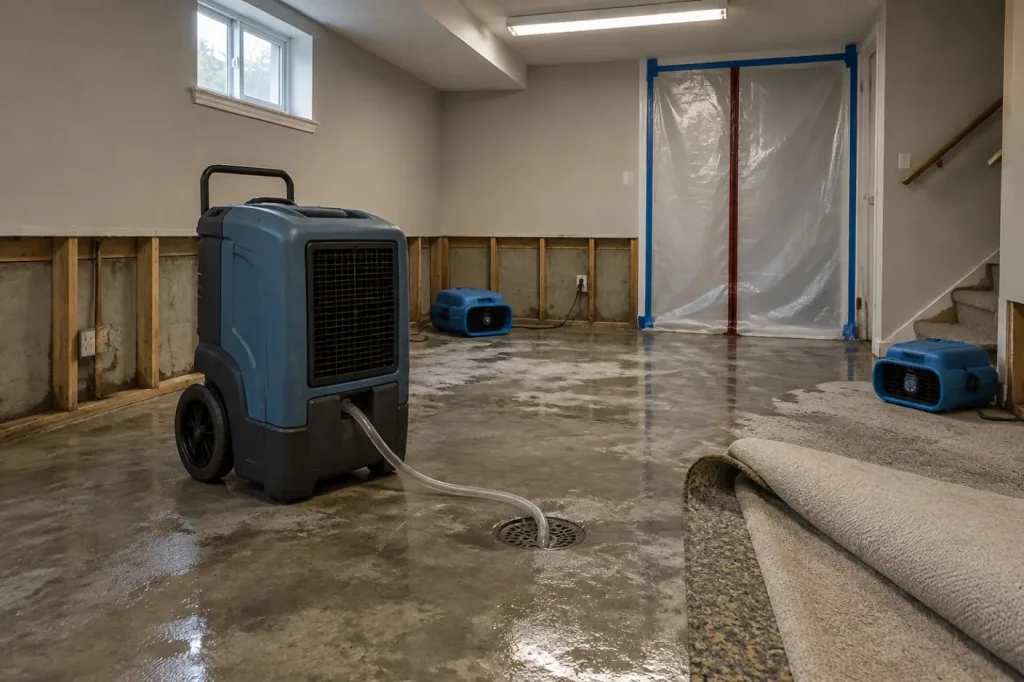
Air movers do not remove water from a building. They move it from carpet, drywall and framing into the room air, and the dehumidifier takes it out of the air and down a drain. Without one, a closed room climbs toward saturation and evaporation stalls. EPA's mold and moisture guide sets the urgency: EPA says to dry wet materials within 24 to 48 hours.
What the machine is for on a water loss
Early in a dry any dehumidifier collects plenty. Late in the dry, when the remaining water is inside a subfloor or a stud, the air must be held drier than the material for the material to give it up. That low-grain end is where machine types separate. How the whole dry is planned is on our structural drying explainer; whole-home units for routine basement humidity are an HVAC purchase outside this page. More is on the water hub.
Refrigerant, LGR and desiccant
| Type | How it removes water | Where it struggles | Typical use |
|---|---|---|---|
| Conventional refrigerant | Air crosses a cold coil and vapour condenses. | Output falls as air dries; the IICRC factor sheet gives it no Class 4 factor. | Small or early-stage losses |
| Low grain refrigerant (LGR) | Coil built to keep condensing at lower humidity. | Per R&R Magazine, cannot dry air below a 32 F dew point. | Most residential losses |
| Desiccant | A desiccant adsorbs vapour; heated reactivation air carries it out. | Per R&R, electric models give about 1 to 2 pints per kilowatt. | Cold spaces, dense materials, crawl spaces |
How low each type can take the air
Per the NWS formulas, saturated air at 32 F holds about 26 grains per pound. That is the floor R&R Magazine puts under an LGR, because a colder coil frosts instead of condensing. The same article says desiccants reach single-digit grains, about 4% RH at 70 F (about 4 grains per the same formulas), and are the only reasonable option below 65 F.
According to Legend Brands, which makes Dri-Eaz, its LGRs are tested at 80 F and 20% RH and 70 F and 30% RH, the lowest-grain conditions an LGR meets on a job: about 30 and 33 grains per the NWS formulas.
AHAM, saturation and the 2019 DOE change
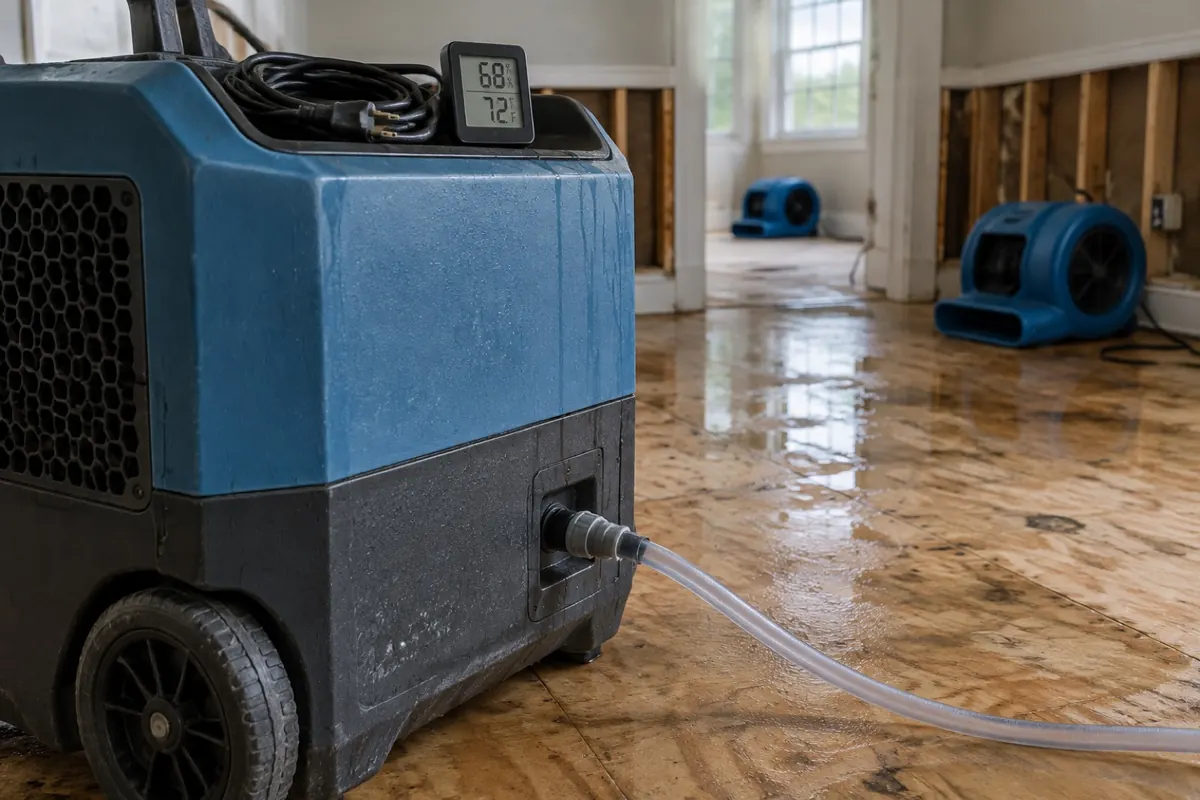
According to Legend Brands, which makes Dri-Eaz, the Association of Home Appliance Manufacturers set a 24 hour test at 80 F and 60% RH in 1992, and restoration makers print that AHAM figure because Xactimate prices refrigerant units by capacity range. According to the same page, the 90 F and 90% “Max” rating is a unit’s highest capacity and is not useful in restoration.
| Rating | Test condition | Grains per pound | Where you meet it |
|---|---|---|---|
| AHAM | 80 F, 60% RH | 92 | Restoration spec sheets, IICRC sizing, Xactimate ranges |
| Saturation or Max | 90 F, 90% RH | 195 | Restoration headline figure |
| DOE portable | 65 F, 60% RH | 55 | Household cartons since 2019 |
| DOE whole-home | 73 F, 60% RH | 73 | Ducted household units |
What DOE changed
Per the DOE test procedure, 10 CFR 430 Appendix X1, portable units are tested at 65 F and 60% RH and whole-home units at 73 F and 60% RH. Per the eCFR record it was published 31 July 2015 and amended 26 July 2023. The standards in 10 CFR 430.32(v) apply to units made on or after 13 June 2019. Per ENERGY STAR, the cooler test lowered printed capacities from early 2020. The hardware did not shrink; the test got harder.
| Old rating, through 2019 (pints/day) | Approximate new rating, 2020 (pints/day) |
|---|---|
| 30 | 20 |
| 40 | 25 |
| 50 | 30 |
| 55 | 30 to 35 |
| 60 | 35 |
| 70 | 40 to 45 |
| 90 | 55 |
Restoration makers still print AHAM, so compare restoration units with each other at AHAM and never against a household carton.
Choosing a dehumidifier for water damage: eight spec sheets
Six Dri-Eaz and two Phoenix units, chosen because both makers publish amp draw and Xactimate codes beside pints per day. Inclusion is not a recommendation.
| Unit, per the maker’s page | Type | Pints/day, AHAM | Pints/day, 90 F 90% | Amps | CFM | Xactimate code |
|---|---|---|---|---|---|---|
| Dri-Eaz DrizAir 1400 | Refrigerant, not sold as LGR | 64 | 130 | 4.7 | 215 | WTRDHM |
| Dri-Eaz Revolution LGR | LGR | 80 | 144 | 5.5 | 180 | WTRDHM>L |
| Dri-Eaz LGR 5000Li | LGR | 80 | 164 | 5.1 | 215 | WTRDHM>L |
| Dri-Eaz LGR 6000Li | LGR | 100 | 219 | 6.5 | 320 | WTRDHM>L |
| Dri-Eaz LGR 7000XLi | LGR | 130 | 235 | 8.8 | 280 | WTRDHM>>XL |
| Dri-Eaz LGR 3500 | LGR | 170 | 270 | 10.8 | 400 | WTRDHM>>>XXL |
| Phoenix DryMAX XL Pro+ | LGR | 135 | Not published | 6.7 | 300 | Not on page |
| Phoenix D385 | Desiccant | 130 | Not published | 24 on 2 cords | 385 | WTRDHMD |
Spec sheets drift. Per the older LGR 3500i spec sheet, that unit made 240 pints at 90 F and 90% on 11.2 amps; per the current Dri-Eaz LGR 3500 page, it makes 270 on 10.8 amps, with AHAM still 170. Log the model year.
Sizing, in one sentence
The IICRC dehumidification factor sheet divides cubic feet by a class factor to get pints per day, then by the unit’s AHAM rating to get the number of machines; the factor table and a worked room are on our structural drying page, and the AHAM column above, never the 90/90 one, is the number that goes in.
Placement, power and discharge
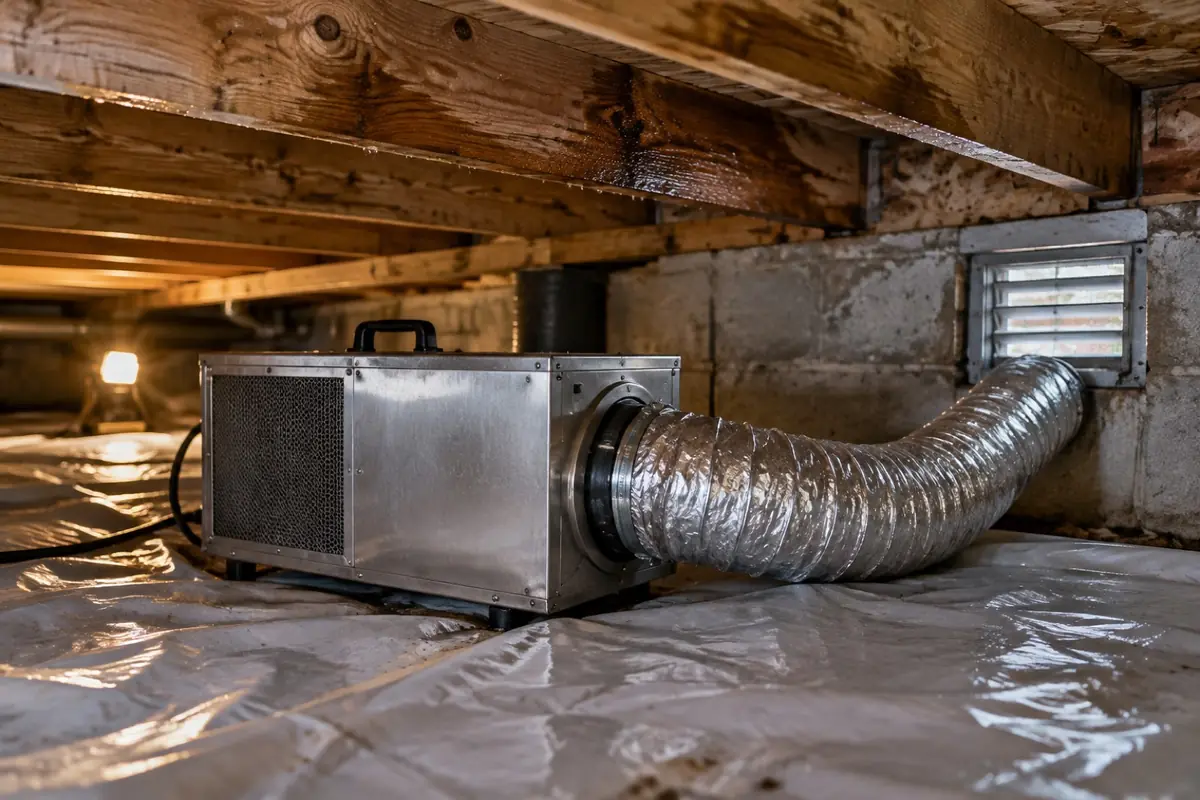
Per the Phoenix DryMAX BLE manual, the set-up is one line: unit inside the structure, hose to a drain or a very large container, windows and doors closed, wet area sealed off from unaffected rooms.
| Check | What the published specs say | Why it matters |
|---|---|---|
| Closed chamber | Phoenix: close windows and doors, seal off the wet area. | Humid outdoor air adds water to remove. |
| Ground fault | Phoenix: a GFI is required in a wet area. | Standing water and cords share the floor. |
| Circuit load | Phoenix: the DryMAX BLE uses a 15 amp circuit and draws 5.7 amps at AHAM. | Add up dehumidifier and air mover amps per circuit. |
| Extension cords | Phoenix: 14 gauge up to 25 feet, 12 gauge beyond. | Thin cords drop voltage and run hot. |
| Pump lift and hose | Phoenix: lifts up to 23 feet; Dri-Eaz pages: 40 foot hose. | Decides where a basement unit can discharge. |
| Desiccant exhaust | Phoenix D385: 6 inch reactivation outlet duct required. | Wet reactivation air must leave the chamber. |
Check the hose end on every visit: one that slipped out of a sink puts the water back on the floor. Per the Phoenix manual, flush units to limit biological growth. Per R&R Magazine, desiccant reactivation air is a quarter to two-thirds of process airflow and leaves hot and moist, so duct it outside.
Can a household dehumidifier dry a flooded room?
For a small clean spill caught early, sometimes. For a real flood, rarely, and the manuals say why.
| Limit | Household unit | Restoration LGR |
|---|---|---|
| Capacity | Per ENERGY STAR, an old 70 pint unit rates 40 to 45 on today’s test. | 80 to 170 AHAM pints across the Dri-Eaz LGRs above. |
| Temperature | 41 to 89 F per the Frigidaire manual. | 33 to 100 F per Dri-Eaz pages. |
| Drainage | Bucket; shuts down when full. Gravity hose optional. | Built-in pump and 33 to 40 foot hose. |
| Readouts | Room humidity only. | Temperature, RH and grain depression on Command Hub models. |
Per a current Frigidaire use and care manual, performance “will fall greatly” outside its range, so a cold basement can defeat it. The real test is the materials: room humidity can fall while the subfloor stays wet, and EPA’s water damage table pairs dehumidifiers with fans for concrete and with gentle heat for wood. Our guides to drying wet carpet and basement flood cleanup cover the larger job.
Rent, buy or bill: what a dehumidifier costs
A day of drying has three prices: the rental counter, ownership and the contractor’s bill. Sunbelt Rentals pages opened for this article showed no public rate, so they are not quoted.
Renting: according to Simplex, a Canadian rental chain, a compact LGR rated 45 to 75 litres a day rents for $57 a day, $84 a weekend, $190 a week or $528 a month, plus a 9.9% damage waiver. Per that list a week costs 3.3 daily rates.
| Unit as listed by Sylvane | Price | AHAM pints/day | Price per AHAM pint |
|---|---|---|---|
| Dri-Eaz DrizAir 1400 | $2,249.99 | 64 | $35.16 |
| Dri-Eaz LGR 6000Li | $2,599.99 | 100 | $26 |
| Dri-Eaz LGR 5000Li | $2,698 | 80 | $33.73 |
| Dri-Eaz LGR 7000XLi | $3,499 | 130 | $26.92 |
| Phoenix DryMAX XL Pro | $3,799 | n/a | n/a |
| Dri-Eaz LGR 3500i | $4,389.99 | 170 | $25.82 |
| Dri-Eaz DriTec 4000i (desiccant) | $4,615 | n/a | n/a |
| Phoenix D385 (desiccant) | $5,056 | 130 | $38.89 |
Billing: according to the Phoenix LGR specification chart, the daily rate for each Xactimate category runs from $54.59 for medium to $133.15 for XXL, and the Phoenix D385 page lists $230.00 for desiccant code WTRDHMD. The chart is undated and names no price list. According to Disaster Response by Ryan, a Michigan restoration firm, it bills $85 to $125 a day for standard LGRs and $150 to $250 for desiccants, three day minimum.
Our guides to how Xactimate pricing works and water damage restoration cost cover the rest of the bill.
Pick the machine in five questions
Work down in order; the first yes usually decides it.
- 1. Below about 65 F, or an unheated crawl space? Desiccant. Per R&R Magazine it is the only reasonable option there, and per Phoenix the D385 runs from minus 10 to 140 F.
- 2. Dense materials: hardwood, plaster, slab? LGR first, then desiccant or heat. The IICRC sheet gives conventional units no Class 4 factor.
- 3. An ordinary room of wet carpet and drywall? An LGR, sized on AHAM by the IICRC formula.
- 4. One small clean spill, same day, warm room? A household unit on a drain hose, if you measure the materials.
- 5. Only one or two household circuits? Count amps. Two smaller LGRs on separate circuits can beat one large unit that trips a breaker.
For contractors: the line item and the log
An adjuster wants the category billed, the unit on site and the readings for each billed day to agree.
| Record | Detail | Why |
|---|---|---|
| Unit | Model, model year, AHAM rating, printed Xactimate code | Per Legend Brands, Xactimate ranges key off AHAM |
| Sizing | Cubic feet, class, IICRC factor, AHAM used | Shows the unit count was formula-based |
| Daily psychrometrics | Chamber, outdoor and outlet temperature and RH; grain depression | Shows water came out each day |
| Material readings | Against a dry standard from unaffected material | Ends the job, and the billing, on evidence |
| Power and discharge | Circuits, GFCI, hose termination | Covers a tripped breaker or a loose hose |
Our guide to how long drying takes explains why readings, not the calendar, end the dry.
Questions people actually ask
How long should a dehumidifier run after water damage?
Until the wet materials, not the air, read dry against unaffected material of the same type. EPA says to dry wet materials within 24 to 48 hours to prevent mold, which sets the urgency, but a subfloor or slab can take days longer. Keep the room closed and stop on the readings.
Can a dehumidifier dry out water damage?
Not alone. It removes water from the air, so it needs extraction first and air movers to evaporate water out of materials. Together in a closed room they dry carpet, drywall and framing; a dehumidifier alone in a flooded room mostly lowers humidity while the materials stay wet.
Will a dehumidifier pull moisture out of the floor?
Indirectly. Holding the air drier than the floor lets water leave wood or concrete as vapour. EPA’s water damage table pairs dehumidifiers with fans for concrete and with gentle heat for wood. Dense floors are slow, and per R&R Magazine an LGR cannot take air below a 32 F dew point.
How often should I dump water from my dehumidifier?
Whenever the bucket fills. Per the Frigidaire manual cited here, the unit shuts down and lights a bucket full indicator, so after a flood that can be several times a day. A gravity hose to a drain avoids it. Restoration units pump; per Phoenix, its pump lifts up to 23 feet.
What is an LGR dehumidifier?
A low grain refrigerant unit built to keep condensing water as the air gets dry, which conventional units do poorly. Per the Dri-Eaz pages compared here, restoration LGRs are rated from 80 to 170 pints a day at the AHAM condition of 80 F and 60% RH.
When is a desiccant dehumidifier better for water damage?
When the space is cold, the target is very dry air, or materials are dense. Per R&R Magazine, desiccants are the only reasonable option below 65 F and reach single-digit grains per pound. They use more power and need their reactivation air ducted out.
What are the top-rated dehumidifiers for water damage recovery?
No independent body publishes a ranking. Compare spec sheets: AHAM pints, amps, operating range, pump lift and hose. Per the manufacturer pages in our table, the eight units run from 64 to 170 AHAM pints and 4.7 to 10.8 amps for single-cord models.
Does insurance pay for dehumidifier rental after water damage?
That depends on the policy wording and the cause of loss, so read the policy and ask the adjuster or your state insurance department. Xactimate carries dehumidifier line items by capacity. Our guide to whether homeowners insurance covers water damage explains the policy language.
Sources
- DOE test procedure, 10 CFR 430 Appendix X1, US Department of Energy, via eCFR (80 FR 45826, 31 July 2015, amended 88 FR 48052, 26 July 2023). Retrieved 18 October 2026.
- 10 CFR 430.32(v), dehumidifier standards from 13 June 2019, via eCFR. Retrieved 18 October 2026.
- ENERGY STAR, Dehumidifier Testing and Capacity, US EPA; undated, table labelled 2020. Retrieved 18 October 2026.
- Legend Brands, which makes Dri-Eaz, The Secrets Behind the Best LGR Dehumidifiers, 23 June 2025. Retrieved 18 October 2026.
- Dri-Eaz product pages (LGR 3500, 7000XLi, 6000Li, 5000Li, Revolution, DrizAir 1400) and the older LGR 3500i spec sheet. Retrieved 18 October 2026.
- Phoenix (Therma-Stor): Phoenix LGR specification chart (undated), Phoenix D385 page, D385 spec sheet, DryMAX XL Pro+ page, Phoenix DryMAX BLE manual. Retrieved 18 October 2026.
- R&R Magazine, What You Need to Know About Desiccant Drying, Carlson and Steffes, 10 May 2017 (first published 2013). Retrieved 18 October 2026.
- IICRC dehumidification factor sheet, revision 3.1.22. Retrieved 18 October 2026.
- NWS vapor pressure and mixing ratio formulas; NIST Handbook 44, Appendix C. Retrieved 18 October 2026.
- Sylvane listings; Simplex VE1144 rates; Disaster Response by Ryan, reviewed 20 April 2026. Retrieved 18 October 2026.
- a current Frigidaire use and care manual, document 16120100A16032. Retrieved 18 October 2026.
- EPA's mold and moisture guide and EPA's water damage table, US EPA. Retrieved 18 October 2026.
- Grains per pound, ratios and per-pint prices are arithmetic on the figures above. Our methodology sets out the standing rules.
Specs and prices change by model year and seller; confirm before relying on them. Nothing here says what an insurance policy pays.