The short answer
Xactimate pricing comes from Verisk price lists keyed to a region and refreshed monthly, not from a national rate card. Each line item is a composite of labour, material, equipment and a labour burden component. Because both sides of a claim read the same list, disputes almost never turn on unit price. They turn on scope and on overhead and profit.
Key takeaways
- The price list is a choice. Region and month are both selections, and both change the total before you write a line.
- A line item bundles four components. Arguing a total without knowing which one is moving is arguing blind.
- Overhead and profit is a judgement about trade coordination, not an automatic entitlement. It is decided by what you documented when you wrote the estimate.
- The most common self-inflicted error is writing a supplement against the list the estimate started on rather than the current month’s list.
- Certification is not a legal requirement. It functions as a commercial one, because carriers and programme networks use it as a panel filter.
On this page
- Where the numbers actually come from
- Selecting the list is a pricing decision
- What is inside a line item
- Scope is the argument, not unit price
- Overhead and profit, and what earns it
- Supplements and the stale list problem
- Documentation that settles disputes
- How a water mitigation estimate is built
- Certification, panels and commercial access
- What it costs to use, and why we are not printing a number
- Errors that cost contractors money
- Questions people actually ask
Xactimate pricing is the mechanism most property insurance claims in the United States pass through, and it is one of the least well-documented things in the restoration trade. The available explainers describe the software rather than the pricing model, which leaves the two questions that decide whether an estimate gets approved untouched: where the numbers come from, and why two competent people reading the same list reach different totals. Our guide to Xactimate software covers the platform itself: its variants, its cost and what replaces it.
This page covers the mechanics from both sides of the file: the contractor who wants an estimate approved first pass, and the adjuster or owner who wants to know what is negotiable.
Where the numbers actually come from
There is no single Xactimate price for anything. The platform holds price lists, and a price list is keyed to a geography and to a point in time. Verisk researches local material and labour costs and republishes lists on a monthly cycle, so the same line item carries different numbers in different markets and different numbers in the same market three months apart.
That design is the point. Drywall hangers do not cost the same in rural Alabama and coastal California. A national rate card would be wrong everywhere; a regional list refreshed monthly is wrong less often, at the cost of requiring the estimator to know which list they are sitting in.
| Property of the list | What it means in practice | What goes wrong when it is ignored |
|---|---|---|
| Keyed to a region | Material and labour research is conducted per market, so the same item carries a different unit price across metros. | Pricing a job on an adjacent metro’s list because that list was already loaded in the file. |
| Refreshed monthly | Lists carry a month designation. An estimate prices against the list active when it was written. | A supplement written months later against the original list, which no longer matches the carrier’s review list. |
| Composite unit pricing | Each item already contains labour, material, equipment and burden, so the unit price is not a material cost. | Comparing an Xactimate unit price to a supplier invoice and concluding the number is inflated. |
| Item-scoped definitions | Every item has a written scope and unit of measure defining what it includes. | Selecting an item whose description does not match the work performed. |
What Verisk does not publish
The research methodology behind the lists is not public. Verisk publishes what the lists are and how often they refresh, not the sampling or weighting that produce a given unit price. That matters when a dispute escalates: neither party can audit the derivation, only agree they are reading the same published list, which is why the productive argument moves to scope. See Verisk, Xactimate product information.
Selecting the list is a pricing decision
When an estimator opens a new estimate, the region and price list month are set before any line is written. Those two choices are usually treated as administrative setup. They set every number that follows.
| Decision point | Why it moves the total | The defensible habit |
|---|---|---|
| Price list region | Labour and material research is market-specific. | Select the list for the loss location, not the office location, and record which list was used on the estimate itself. |
| Price list month | Lists refresh monthly, so the active list changes underneath an open file. | Note the list designation in the file at the time of writing, and check it again before any supplement. |
| Line item selection | Each item carries a defined scope and unit of measure. | Read the description, not the name. The scope lives in the description. |
| Quantity derivation | Units drive the total more than unit price does. | Derive quantities from sketch and measurement so the number can be reproduced. |
| Overhead and profit | Applied at the estimate level, typically as two ten percent components. | Justify with trade count and sequencing at the time of writing, not after a denial. |
What is inside a line item
A line item is not a single number with a markup on it. It is a composite. Understanding the composition is what lets an estimator explain a total rather than defend it.
| Component | What it covers | Why the number looks high in isolation |
|---|---|---|
| Labour | Hours the item’s defined scope requires, at a researched market rate. | It is a production rate for the full scope, setup and cleanup included, not one technician’s hourly wage. |
| Material | The materials the item consumes, including waste allowance. | It carries waste and incidental materials that a supplier invoice for the primary material does not show. |
| Equipment | Tools and equipment the scope requires, allocated to the item. | Real but invisible, so it looks like padding next to a material receipt. |
| Labour burden | Payroll tax, insurance and employer cost sitting on top of a wage. | The largest reason a billed labour figure exceeds any wage number a claimant looked up. |
The receipt comparison that goes nowhere
An unproductive conversation starts when someone compares a line item unit price to what the material costs at a supply house. The gap is not margin. It is labour at a production rate, waste allowance, equipment allocation and burden, all inside the item by design. Arguing a line down on that basis argues three of the four components should be zero.
Scope is the argument, not unit price
This is the part most short explainers miss. When an adjuster and a contractor disagree about a total, they are almost never disagreeing about what a line item costs. Both are reading the same published list. They are disagreeing about which items belong in the estimate and how many units of each.
That reframing changes how you prepare. Time spent arguing unit price is time spent on the one variable neither party controls. Time spent documenting why an item is in scope, and how the quantity was derived, is time spent on what actually decides the file.
| What is disputed | Who controls it | How it gets resolved |
|---|---|---|
| Unit price of an item | Neither party: it is published in the list both are reading. | Confirm both sides are on the same region and month, then move on. |
| Whether an item belongs in scope | The estimator, through documentation of the condition. | Photographs, moisture readings and notes taken before work started. |
| How many units of an item | The estimator, through measurement. | A sketch that reproduces the quantity, so a reviewer can check it. |
| Whether overhead and profit applies | Judgement, informed by the documented trade count. | A written record of trades required, sequencing and supervision. |
| Whether a supplement is justified | The condition found, and when. | Dated documentation, priced on the current list. |
Overhead and profit, and what earns it
General contractor overhead and profit, discussed in the trade as ten and ten, applies where a job requires genuine coordination of multiple trades. It is a judgement about the nature of the work, not a line a contractor may add because the job was large.
A large share of estimating disputes live here, and almost all are decided by what was written down at the time. Arguing afterwards that a job required coordination is weak. Having recorded the trades, the sequencing and the supervision while the job was in front of you is strong, because it is contemporaneous rather than reconstructed.
What a coordination argument looks like when it is documented
- Trade count. Name the trades the scope requires and what each does. Three trades that must be sequenced is a different file from one crew doing everything.
- Sequencing dependency. Record where one trade cannot begin until another finishes, and where a delay in one pushes the whole programme. Dependency is the substance of coordination.
- Supervision. Record who schedules, inspects and signs off between trades. Coordination nobody performs is not coordination.
- Occupancy and access constraints. Occupied property, restricted hours and shared access all add coordination that is invisible in the line items.
Why arguing it after a denial rarely works
Once a file is in dispute, anything produced to support a position reads that way. Contemporaneous notes do not, because they existed before there was anything to argue about. Write the coordination case into the file on the day you write the estimate, whether or not you expect a challenge.
Supplements and the stale list problem
Supplements are normal. A crew opens a wall, finds the damage extends further than the inspection could see, and the estimate has to grow. The mechanics of writing one are where contractors most often lose money to nobody in particular.
The error is writing the supplement against the price list the estimate started on. Lists refresh monthly, so an estimate supplemented several months later is reviewed against a list that has moved. The mismatch surfaces as a discrepancy that looks like an estimating error rather than a calendar one, and it generates correspondence that produces no new information and delays payment.
Documentation that settles disputes
Every dispute category above resolves the same way: the party with contemporaneous documentation wins the point. The documentation is not elaborate. It is just taken at the right moment, which means before work starts rather than after a challenge arrives.
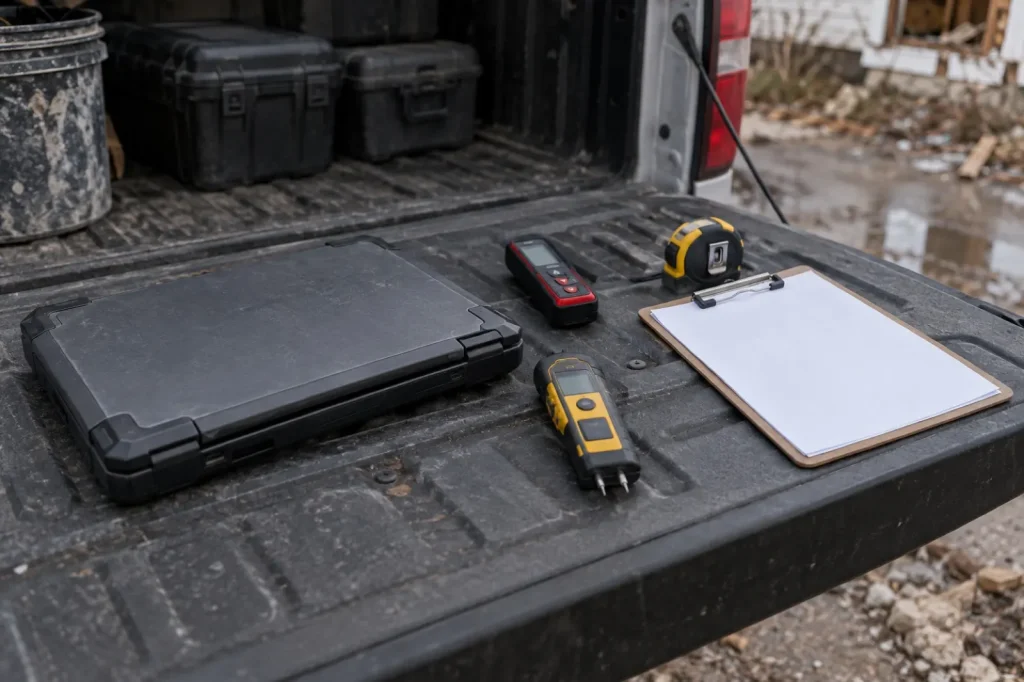
- Before anything moves. Photographs of the affected area, wide and close, with the source of loss visible where possible. Once demolition starts, the original condition is gone.
- Moisture readings with a baseline. A reading on unaffected material of the same type, then readings on affected material. Without the baseline, an affected reading means nothing.
- Daily monitoring. Readings for every day equipment is set. That is what supports the equipment day count.
- The price list designation. Region and month, recorded on the estimate. It costs nothing and prevents a whole class of correspondence.
- The coordination note. Trades, sequencing and supervision, written when the estimate is written.
A useful test: could someone who has never seen the property reconstruct your scope and quantities from the file alone? If not, the file relies on the estimator being available and persuasive later, which is weaker than it feels while the job is fresh.
How a water mitigation estimate is built
Mitigation quantities behave differently from reconstruction quantities. Reconstruction is mostly area: square feet of drywall, linear feet of trim. Mitigation is mostly time multiplied by equipment count, which is why drying duration is the largest variable in a mitigation invoice.
| Estimate section | What drives the quantity | Where it gets challenged |
|---|---|---|
| Extraction | Affected area and volume of standing water. | Rarely disputed: short duration, visibly necessary. |
| Equipment, air movers and dehumidifiers | Units set, multiplied by days running. | The most challenged section on a mitigation file. Daily moisture logs are the answer. |
| Selective demolition | Footage of porous material removed. | Turns on water category. Contaminated losses require removal that clean losses do not. |
| Antimicrobial application | Treated area. | Challenged where the water category in the file does not justify it. |
| Containment and PPE | Whether the loss is contaminated. | Follows from the documented category, which is why recording it on arrival matters. |
| Disposal | Volume of material removed. | Weak without photographs of what came out. |
The water category recorded on arrival drives several of these sections at once, so it is worth documenting rather than assigning by habit. Our water damage restoration cost guide covers how category moves the underlying price, and our coverage guide covers which causes of loss get paid in the first place.
Certification, panels and commercial access
Xactimate certification is not legally required to write an estimate. Anyone with access to the platform can produce one, and nothing in law conditions that on holding a credential.
In practice it operates as a commercial requirement, because carriers and programme networks use certification level as a filter for panel membership. A contractor without it is not prohibited from estimating. They are often excluded from the referral flow that makes estimating worth doing at volume, which is a different barrier with the same practical effect. Our guide to Xactimate training compares the certification levels and the routes to them.
What it costs to use, and why we are not printing a number
Xactimate is sold by subscription, with tiers that differ by platform access and by whether the full desktop application is required. Pricing changes, and a figure printed in an article will be wrong within a few quarters while continuing to be quoted.
So we are not printing one. Check Verisk's own pricing page for the current tiers. That is not evasion, it is the same standard we apply to every other number on this site: if we cannot keep a figure current, we point at the source that can. Our methodology sets out the standing rules on that.
Errors that cost contractors money
These recur, and all of them are avoidable with habits rather than expertise.
- Supplementing against the original list. The most common self-inflicted error. Check the current month’s list before writing any supplement.
- Selecting items by name rather than description. The scope lives in the description, so mismatches produce a clean-looking estimate for the wrong work.
- Quantities that cannot be reproduced. If a reviewer cannot derive it from the sketch, it is the first thing cut.
- Claiming overhead and profit without a documented coordination case. It converts a reasonable position into an argument you have to win twice.
- Undated photographs. A photograph that cannot be placed in time cannot establish that a condition was found rather than created.
This topic is under-covered. The available trade-press explainers tend to run around a thousand words, describe the software rather than the pricing model, and go years without revision. A contractor trying to understand why an estimate was cut will not find the answer in them.
Questions people actually ask
How are Xactimate prices determined?
Verisk researches local labour and material costs and publishes price lists keyed to a region, refreshed monthly. Your estimate prices against the list you select, so region and month set every number in the file before you write a line.
How often do Xactimate price lists update?
Monthly. That cadence is the reason supplements written against an older list can differ from the current list even when the scope has not changed, and it is the most common source of avoidable correspondence on a file.
What is O and P in Xactimate?
General contractor overhead and profit, commonly applied as two ten percent components, where a job requires coordinating multiple trades. Whether it applies to a specific file is a judgement, so document trade count, sequencing and supervision at the time you write the estimate rather than after a challenge.
Why is the Xactimate price higher than what the material costs me?
Because a line item is a composite. It contains labour at a production rate, material including waste, an equipment allocation and a labour burden component. Comparing it to a supplier invoice for the primary material compares one of four components to all four.
Do I need Xactimate certification to write estimates?
Not legally. It functions as a commercial requirement, because carriers and programme networks commonly use certification level as a filter for panel membership. Without it you can still estimate, but you may be outside the referral flow.
What should I do when an adjuster cuts my estimate?
Find out whether the cut is to a unit price or to a quantity. If it is unit price, confirm you are both on the same region and month. If it is quantity or item selection, the resolution is documentation: photographs, moisture readings and a sketch that reproduces the number.
Sources
- Verisk, Xactimate product information. Price list regionality, monthly refresh cadence, line item composition and product tiers as described in Verisk’s published product documentation. Retrieved 23 September 2026.
- Verisk does not publish the research methodology, sampling or weighting behind individual price list values. We describe the structure of the system as documented and do not characterise the derivation of any specific unit price.
- No unit price figures appear on this page, and subscription pricing is not reproduced here because it changes. The vendor’s own pricing page is the current source.
- Water mitigation scope structure and category definitions follow ANSI/IICRC S500, Standard for Professional Water Damage Restoration, 5th edition. The standard text is sold by IICRC; we describe its framework rather than reproduce it.
- Dispute patterns and documentation practices described here reflect commonly published industry guidance. They are general practice, not the outcome of any claim file review.