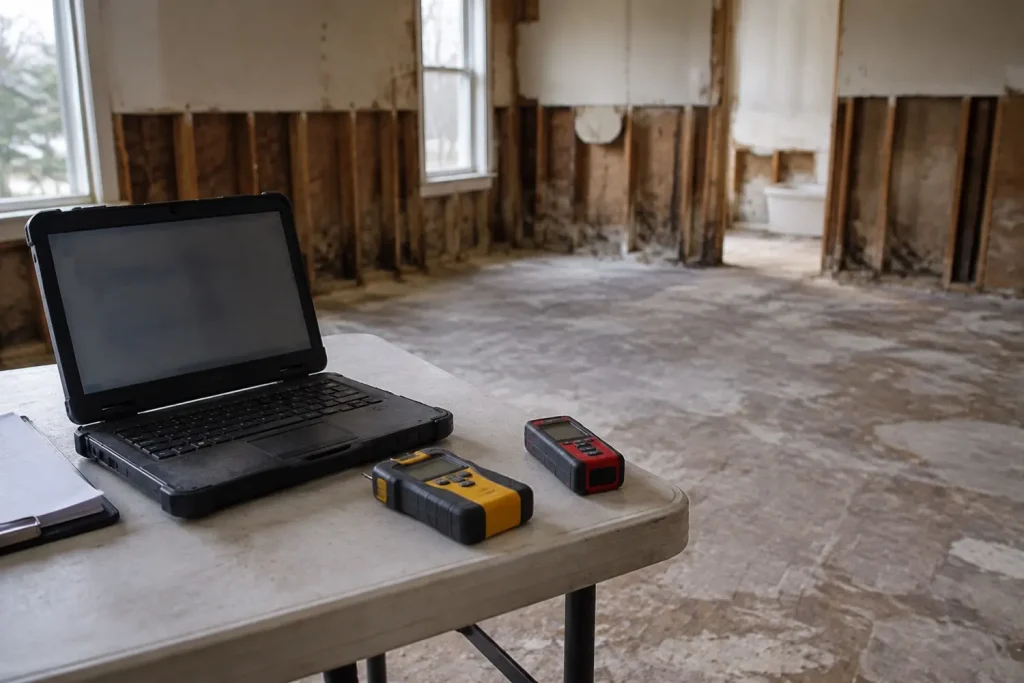
The short answer
Xactimate software is Verisk’s property claims estimating platform and the de facto standard for US property insurance claims, because carriers expect estimates in that format. The buying decision is rarely about the platform alone. It is about whether the tools around it hand data over cleanly, because re-keying costs more than they save.
Key takeaways
- It is a commercial standard, not a legal one. Carrier and programme-network expectation does the work no statute does.
- Variants split three ways: desktop, browser-based, and mobile field capture. They differ in capability, not in the price list model.
- We are not printing subscription prices. They change, and a stale figure gets quoted for years. Verisk’s own page is the source.
- Interoperability is the constraint that matters. A tool that cannot export into your estimating platform, in a format the carrier accepts, adds labour instead of removing it.
- Cash and retail firms have real alternatives. The case tracks how much revenue arrives through a claim file.
On this page
- What Xactimate software actually is
- The platform variants
- What it costs, and why we are not printing a figure
- The estimating stack around it
- Sketching and measurement: the input layer
- Documentation and moisture logging
- Job management is a separate purchase
- Interoperability is the buying constraint
- Who actually needs it
- What replaces it, and where that holds
- Certification as a panel filter
- How to evaluate a stack before you buy
- Buying errors that cost real money
- Questions people actually ask
Most coverage of Xactimate software is a feature list or a tutorial. Neither answers what a restoration owner is asking: whether to buy it, what has to sit around it, and whether a different mix of work can run something else. The mechanics of how Xactimate pricing works sit on a separate page.
What Xactimate software actually is
Xactimate is a property claims estimating application published by Verisk. It turns a described scope of repair work into a priced estimate, using a regional price list Verisk maintains, in a file format carriers and adjusters can open and compare. Verisk, Xactimate product information sets out the positioning and platform options.
Why it became the standard is circular. Carriers standardised on it to compare estimates across thousands of independent contractors on a common basis. Contractors adopted it because carriers had. The lock-in is a market structure fact, not a product claim.
| What the platform does | How it does it | What it does not do |
|---|---|---|
| Prices a repair scope | Applies a regional, periodically refreshed price list to line items you select. | It does not decide your scope for you, and it does not verify that your quantities are right. |
| Produces a carrier-readable estimate file | Exports in the formats carrier claims systems and adjusters expect. | It does not guarantee approval. Scope and documentation do that. |
| Holds a sketch and attaches documentation | Room geometry drives quantities; photos travel with the file. | It does not measure the building, log moisture or run the job. |
| Keeps both sides on a common basis | Both read the same line item library. | It relocates disagreement to scope. |
Platform versus price list
Two things get called Xactimate: the application, and the pricing data it reads. Changing variant changes nothing about the numbers, because the price list is keyed to region and time rather than to which version opened it. Choosing a variant is ergonomics.
The platform variants, and what separates them
The product splits three ways: a full desktop application, a browser-based version, and a mobile field capture tool. Verisk renames and repackages these periodically, so the split is the useful thing to understand, not the current product names.
Why most production firms run two variants
On site, someone captures rooms and readings on a phone with wet gloves on. In the office, someone writes a defensible scope with full sketch control. One variant cannot be both, so capture in the field, write in the office, and treat the sync as a process with an owner.
What it costs, and why we are not printing a figure
Xactimate is sold by subscription, with tiers by platform access and seat count, revised periodically.
We are not printing a price. Check Verisk's own product and pricing page for current tiers. That is deliberate, and stated rather than hidden: a subscription figure in an article is wrong within a few quarters, then gets quoted for years by people who found it in a search result. Our methodology sets the rule. If we cannot maintain a figure, we point at the source that can.
Building a budget: ask Verisk for a quote against your actual seat count and variant mix, and ask what happens at renewal. The renewal trajectory matters more to a three-year plan than year one does.
The licence is rarely the largest line in year one, and a plan that counts only the subscription errs in one direction.
- Certification and training. Looks like an HR cost, behaves like market access.
- Capable hardware. Sketch work on a full desktop build is not light.
- Measurement equipment and a documentation platform. Both usually get bought after the first disputed file.
- Re-keying labour. It arrives as hours, never as an invoice.
The estimating stack around it
The estimate is the last step. Before an estimator writes a line item, someone measured the building, photographed the damage and recorded moisture conditions. The platform consumes all of it, which is why judging it alone is the common error.
A firm buying the platform and nothing else can still produce a priced file from data collected on paper. That is how many firms start, and it fails at the volume where transcription becomes full-time work.
Sketching and measurement: the input layer
Sketch quantities drive the estimate. Every square foot of drywall in the file traces back to a room someone measured, so a wrong dimension produces a clean-looking estimate for the wrong building.
| Measurement method | What it gives you | Where it struggles | Handoff into the sketch |
|---|---|---|---|
| Tape measure or laser distance measure | Control, low equipment cost, accurate distances. | One dimension at a time, with a person recording it. | Manual entry, or Bluetooth into a capture app. |
| Mobile capture app or 360 camera | Rough room geometry, plus a navigable record of the site as found. | Accuracy varies with lighting, clutter and surface texture. | Exports a sketch, usually needing cleanup. |
| Photogrammetry or lidar scan | Dense capture of complex geometry. | File handling, processing time, learning curve. | Depends on export support. Verify before you buy. |
Reproducibility beats accuracy
A reviewer challenging a quantity is not asking whether your tape was accurate. They are asking whether they can derive the number from the file. A sketch that reproduces it survives review. A number that exists only in the estimator’s memory does not.
The 360 camera is a documentation purchase
360 capture is sold on measurement capability and bought for that reason. Its real value is establishing what the site looked like before anyone touched it. Budget it as documentation, and treat its dimensions as a starting point rather than a survey.
Documentation and moisture logging
On a water file, documentation is what makes the estimate defensible. ANSI/IICRC S500 frames drying as verified against measured moisture conditions rather than a fixed number of days, so daily readings are the evidence that the equipment days were necessary. Equipment is the most challenged section of a mitigation file, and the log is the answer. Our water damage restoration cost guide covers how the water category moves the underlying price.
| Documentation type | What it establishes | When it must be captured |
|---|---|---|
| Pre-work photographs plus category observation | Conditions found not created, and which scope the job requires. | On arrival, before anything is moved. |
| Baseline plus daily moisture readings | What dry means here, and that equipment days were needed. | First visit, then every day equipment is on site. |
| Removal photographs | What came out, supporting demolition and disposal. | As material leaves, not after the skip is gone. |
| Final verification readings | That the job finished rather than stopped. | Before equipment is pulled. |
Job management is a separate purchase
An estimate is not a job. Scheduling crews, tracking which files wait on an adjuster, knowing what is unbilled, and chasing collections all sit outside an estimating platform. Job management products also hold documentation, and documentation products hold job status, so the same photograph lands in three systems or in none. Decide the record of truth before you own the second system.
- Estimating platform. Prices a scope, produces the carrier-readable file.
- Job management platform. Schedules crews, tracks file status, reports unbilled revenue.
- Contested ground. Which one holds the documentation chain.
Interoperability is the buying constraint
This decides whether a purchase pays back. Where a handoff is clean, the tool saves labour. Where it is broken, a person retypes the data and the tool has added a subscription and a step without removing work. Two questions need a yes: does the tool export into the estimating platform in a form that arrives usable rather than as an attachment someone retypes, and does the carrier accept that format. Passing the first and failing the second is worse than no handoff, because it produces a file that looks complete and gets returned.
| Handoff | Clean version | Broken version | Cost of broken |
|---|---|---|---|
| Measurement into sketch | Geometry imports, needing minor cleanup. | Dimensions read off a screen and typed in. | Estimator time, plus transcription errors that surface at review. |
| Moisture readings into the estimate file | Logs attach as a report the reviewer can follow. | Readings sit in an app nobody links to the file. | Equipment days challenged, payment delayed. |
| Photographs into the claim file | Dated, labelled, attached to the right line items. | A folder of undated images emailed separately. | Photographs that cannot place a condition in time. |
| Estimate into the carrier system | Native format the reviewers already use. | A PDF re-entered on the carrier side. | Slower review, more rounds, more chances to cut. |
The question to ask a vendor, in these words
Ask: show me this data arriving inside the estimating platform, on a file, not on a slide. Vendors use the word integration for everything from a genuine data handoff to attaching a PDF, and that difference is the whole value of the purchase. The second question goes to your carriers, not the vendor: format acceptance varies by carrier and programme, so ask your largest referral sources before signing.
Who actually needs it
The honest answer is narrower than the market’s framing. The platform is close to mandatory where revenue arrives through property insurance claim files, because that is the format the people paying expect. Outside that flow it is optional and sometimes a poor fit. The requirement is commercial, not legal: no statute names an estimating platform. Carrier expectation produces the same outcome as a rule for anyone dependent on referral flow, while staying formally a preference.
| Firm type | Is it effectively required? | Why |
|---|---|---|
| Insurance restoration, carrier or programme referrals | Yes, in practice. | Reviewers read the same line item library and expect that format. |
| Mixed insurance and retail | Yes for the insurance side. | Claim files still arrive in the expected format. |
| Cash and retail restoration or remodelling | No. | The customer pays and does not read price lists. Proposal and job costing tools fit better. |
| Commercial and large loss | Usually, plus more. | Carrier expectation applies, and consultants in between raise the documentation bar. |
| New firm, no carrier relationships yet | Not yet. | Buy it when the first claim file demands it. Our guide to starting a restoration business covers the sequence. |
What replaces it, and where that holds
Alternatives are real. They fit work outside the claim flow and badly inside it, and the distinction is who reads the output.
| Alternative category | Where it works | Where it fails | What to check first |
|---|---|---|---|
| General construction estimating software | Retail restoration, remodelling, cash work. | Carrier review, where the line item basis is not shared. | Whether any revenue needs carrier-format output. |
| Proposal and quoting tools | Consumer jobs sold on scope, not line items. | Anything that becomes a claim file. | How a job that converts mid-project gets handled. |
| Spreadsheet templates | Very small firms, simple repeatable scopes. | Volume, review, anyone else reading the file. | Whether you can reproduce a quantity later. |
| Competing claims estimating platforms | Where your carriers accept the output. | Where they do not, which is the whole question. | Ask your largest referral sources first. |
| Job management suites with estimating modules | One-system firms doing mostly retail. | Estimating depth under carrier review. | Whether it exports carrier-readable files. |
The mid-project conversion is the trap
A cash job that becomes a claim partway through catches firms running only a retail toolset. The scope now needs a format it was never captured for, on retail-standard documentation. If that happens at all, only the timing is open.
Certification as a panel filter
Certification is not legally required to write an estimate. Anyone with platform access can produce one. It acts as a filter: carriers and programme networks commonly use certification level as a condition of panel membership, and panel membership is where the referral flow lives. Our guide to Xactimate training and certification compares the levels and the routes to them.
The effect is commercial. An uncertified contractor is not prohibited from estimating, just often outside the flow that makes estimating at volume worth doing. Budget it as market access, and attach it to the people writing and defending files rather than to every technician with the mobile app.
How to evaluate a stack before you buy
- What share of revenue arrives through a claim file? This one answer settles most of the platform question.
- Which carriers do you depend on, and what do they accept? Their answer outranks any vendor claim.
- Where does data get retyped today? Those steps are the only places a new tool can save anything.
- Does the handoff work on a real file? Ask for an actual job, not a prepared example.
- Who owns each artefact? Decide the record of truth before you own two systems that both claim it.
- What is the renewal trajectory? Ask what the price does in years two and three across the whole stack.
Buy in the order the pain arrives: estimating platform when the first claim file demands it, documentation when the first file gets cut, job management when open files outrun one person, advanced measurement last.
Buying errors that cost real money
- Buying the estimating platform and stopping. It prices a scope. It does not collect the evidence that defends it.
- Taking integration claims on trust. Make someone show you, on a file.
- Not asking carriers what they accept. The vendor cannot answer the question that decides whether the output is usable.
- Buying measurement before documentation. Faster measuring on an undocumented file still gets cut.
- Costing only the subscription. Training, hardware and re-keying labour are part of the number.
- Letting each department pick its own tool. Three tools nobody hands data to cost more than two that talk.
The theme is that the estimating platform consumes other people’s work. Judged alone it looks like a pricing tool. Judged in place it is where everything collected upstream becomes visible to somebody who can reduce the payment.
Questions people actually ask
What is Xactimate software used for?
It turns a described scope of repair work into a priced estimate using a regional price list, in a file format carriers and adjusters expect. It is the estimating layer, not the measurement, documentation or job management layer.
How much does Xactimate software cost?
It is sold by subscription with tiers by platform access and seat count. We are deliberately not printing a figure, because pricing changes and a stale number gets quoted for years. Verisk’s own page carries current tiers. Budget training, certification, hardware and a documentation tool alongside it.
Is there a free alternative to Xactimate?
For cash and retail work, general estimating and proposal tools cost less, and small firms run spreadsheets. For claim work the constraint is not price but whether the carrier accepts the output, so ask your largest referral sources before switching.
Do I need Xactimate if I only do cash jobs?
Generally no. If no revenue arrives through a claim file, the customer is paying and does not read line item libraries, so proposal and job costing tools fit better. That changes the first time a cash job turns into a claim mid-project.
What is the difference between the desktop and online versions?
The desktop application carries the deepest sketch control and is where complex files get written. The browser-based version trades capability for access anywhere, which matters most to reviewers. Check Verisk for the current line-up.
Do I need certification to use it?
Not legally. It acts as a commercial filter, because carriers and programme networks commonly use certification level as a condition of panel membership. You can estimate without it and may sit outside the referral flow.
What should I buy first if I am starting out?
The estimating platform when the first claim file requires it, then a documentation tool for moisture readings and photographs, then job management when open files outgrow one person’s memory. Advanced measurement last.
Sources
- Verisk, Xactimate product information. Platform purpose, the desktop, browser-based and mobile variant split, and price list regionality as described in Verisk’s published product documentation. Retrieved 23 September 2026.
- Subscription pricing is not reproduced on this page, and product names and packaging tiers are not stated, because Verisk revises both. Verisk’s own product and pricing page is the current source.
- Institute of Inspection, Cleaning and Restoration Certification, ANSI/IICRC S500, 5th edition, 2021, on drying verified against measured moisture conditions. The standard text is sold by IICRC; we describe its framework rather than reproduce it.
- Stack layer model, handoff failure costs and buying-error patterns are structural analysis drawn from commonly published industry workflow guidance, not a vendor comparison or product testing. Measurement tool capabilities are summarised at category level from published vendor documentation.