The short answer
Restoration estimating turns a documented loss into priced line items, and in United States insurance work it mostly runs through Xactimate, priced from regional lists Verisk refreshes monthly. Because both sides read the same list, disputes turn on scope, quantities, overhead and profit, and supplements, which is why the inspection, moisture map and photographs decide most files.

Start here
- How Xactimate pricing works: price lists, line items and the O and P argument in one place.
- Water damage inspection: the moisture map and dry standard every water estimate rests on.
- IICRC water categories: the classification that decides what is removed and what is dried.
What restoration estimating is, and what it is not
A restoration estimate translates a documented condition into priced work. It sits between two other things that people confuse with it. Before it comes the inspection, which records where the water went, how wet each material is, and what category and class the loss is. After it comes the invoice, which bills what was actually done. A good estimate can be traced backwards to the inspection and forwards to the invoice without anyone having to remember the job.
In United States insurance work the estimate is usually written in Xactimate. Our Xactimate software guide describes it as Verisk’s property claims estimating platform and the de facto standard, not because any law requires it but because carriers expect estimates in that format. Cash and retail work has real alternatives, and the case for the platform tracks how much of a firm’s revenue arrives through a claim file.
Cash and retail estimates follow the same logic with a different reader. A homeowner paying directly wants to know what will be done, in what order, and what is excluded, more than which line item code was used. The discipline that makes an insurance estimate defensible, a documented condition, a reproducible quantity and a clear boundary between mitigation and rebuild, makes a retail quote easier to accept and harder to dispute later.
The practical skills are narrow and learnable. Choose the right price list for the location and month. Pick line items whose written scope matches the work. Derive quantities that someone else could reproduce. Document the conditions that justify overhead and profit at the time of writing. Price supplements on the current list. The rest of this hub takes those skills in order.
The inspection and moisture map come first
Every line on a water estimate rests on the inspection. Our water damage inspection guide sets out what that means: a map of where the water travelled, a reading for each affected material, and a baseline reading on unaffected material of the same type in the same building. Without the baseline there is no defensible definition of dry, and without a definition of dry the equipment days on the estimate are an opinion.
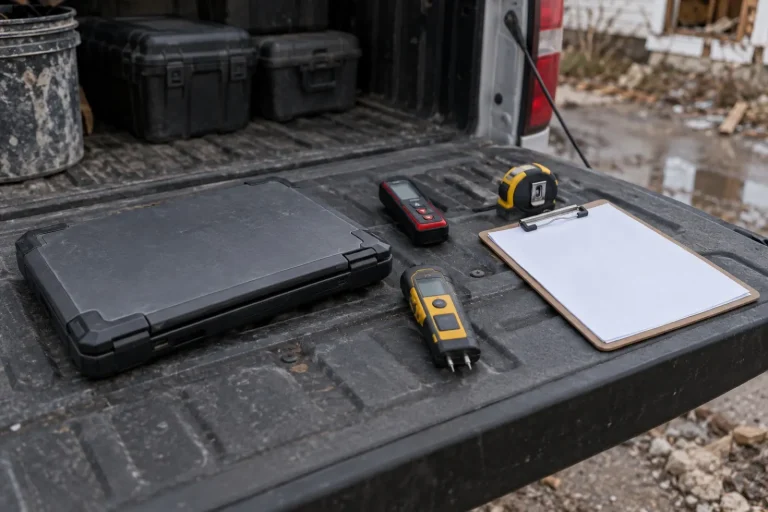
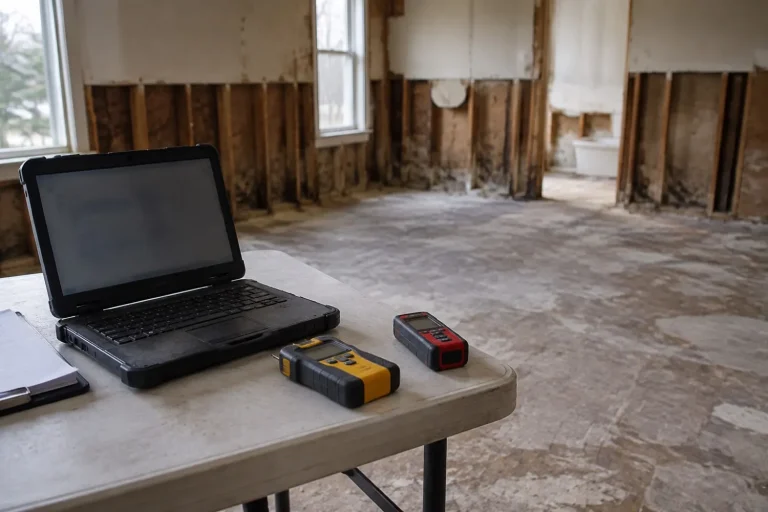
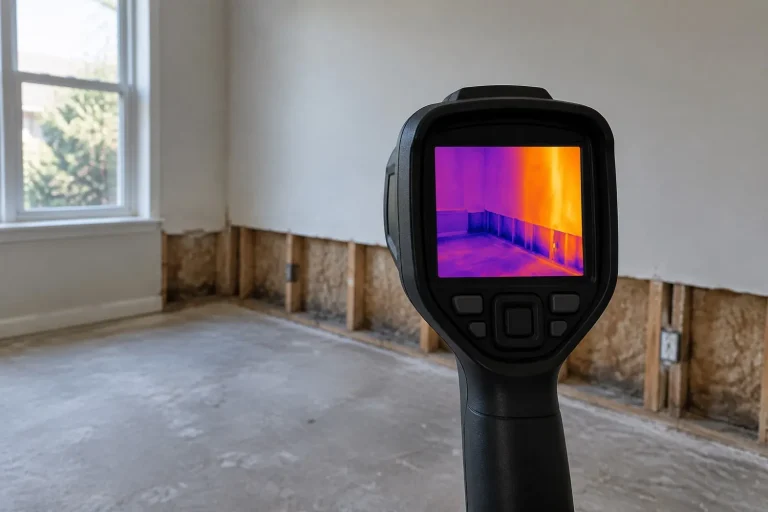
The instruments do different jobs. A thermal camera detects temperature difference, not moisture, so a cool patch on a wall is a hypothesis that a moisture meter then tests. Pin meters give an exact point reading and leave small holes; pinless meters scan without damage but read whatever sits behind the surface. The inspection guide treats them as a sequence rather than a preference. It also notes that a free inspection from the firm hoping to win the mitigation is a sales visit with instruments, which can still be a good inspection if the incentive is visible.
Documentation that settles disputes
- Photographs of the affected area before anything moves, wide and close, with the source of loss in frame where possible.
- A baseline moisture reading on unaffected material, then readings on affected material, recorded on a moisture map.
- Daily monitoring readings for every day equipment is set; that is what supports the equipment day count.
- The water category and class observed on arrival, with the evidence for each.
- The price list region and month, written on the estimate.
The test our pricing guide proposes is a good one: could someone who has never seen the property reconstruct the scope and quantities from the file alone? If not, the estimate depends on its author being available and persuasive later.
Scope writing: category and class decide the line items
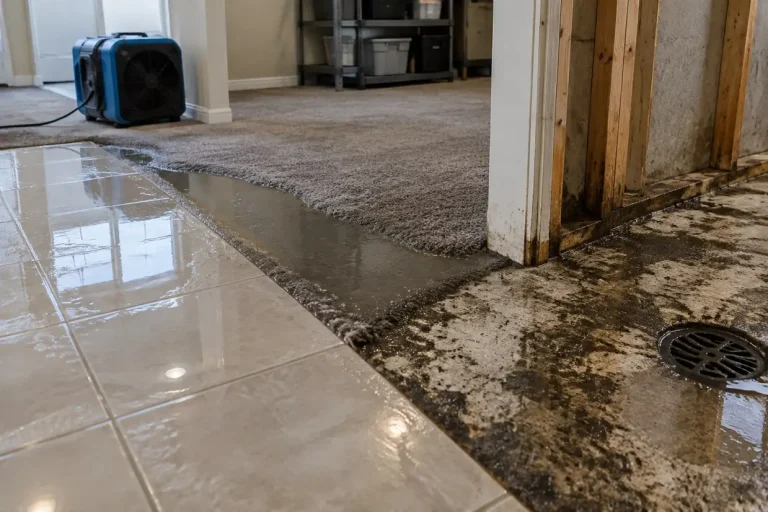
ANSI/IICRC S500 gives two classifications that drive a water scope, and our IICRC water categories explainer keeps them apart. Category describes contamination: clean, grey or black water. Class describes the evaporation load: how much material is wet and how much of it resists drying. Category decides what is removed and whether containment, PPE and antimicrobial lines belong on the estimate. Class decides how much equipment is set and for how long.
Category is not fixed at the moment of loss. The explainer notes that clean water degrades with time, temperature and contact with building materials, and water standing beyond roughly three days is commonly treated as Category 3. An estimator who assigns the category by habit, or from the phone call, writes the wrong scope. One who records the category observed on arrival, with readings and photographs, writes a scope that survives review.
| Estimate section | What drives the quantity | Where it gets challenged |
|---|---|---|
| Extraction | Affected area and volume of standing water | Rarely disputed |
| Equipment (air movers, dehumidifiers) | Units set multiplied by days running | The most challenged section; daily moisture logs answer it |
| Selective demolition | Footage of porous material removed | Turns on the documented water category |
| Antimicrobial application | Treated area | Challenged where the recorded category does not justify it |
| Containment and PPE | Whether the loss is contaminated | Follows from the category recorded on arrival |
| Disposal | Volume of material removed | Weak without photographs of what came out |
Notice where the challenges cluster. Extraction is rarely argued because it is short and visibly necessary. Equipment is argued constantly because it is time multiplied by units, and time is invisible unless the daily log makes it visible. Reconstruction quantities behave differently: they are mostly area and length, derived from the sketch.
Reconstruction is a second estimate
Once drying is verified against the dry standard, the rebuild is scoped as its own estimate: drywall to the cut line, insulation, flooring, trim, paint, cabinetry and the fixtures that came out. It is priced by area and finish level rather than by equipment days, often by a different crew or a general contractor, and it is where overhead and profit is most often claimed because several trades have to be sequenced. Keeping the two estimates separate lets each be reviewed on its own logic. It also lets an owner see that a mitigation figure and a rebuild figure are answers to different questions, which our restoration pricing hub covers from the cost side.
Price lists and line items
There is no single Xactimate price for anything. Our guide to how Xactimate pricing works explains that Verisk publishes price lists keyed to a region and refreshed monthly, which means the same line item carries different numbers in different markets and in the same market three months apart. The region and month are chosen before any line is written, so they are pricing decisions, not setup. Select the list for the loss location rather than the office location, and record which list was used on the estimate.
Each line item is a composite of four things: labour at a researched production rate, material including waste, an equipment allocation, and labour burden. That is why comparing a unit price with a supplier receipt for the primary material goes nowhere: it compares one of four components with all four. Verisk does not publish the sampling or weighting behind a given unit price, so neither party can audit the derivation. Both can confirm they are reading the same list, and then the useful argument moves to scope.
Item selection is where clean-looking estimates go wrong. The scope of a line lives in its description, not its name, so an estimator who picks items by name can produce a tidy estimate for the wrong work. Quantities should come from a sketch and measurement that a reviewer can reproduce, because an unreproducible quantity is the first thing cut.
| What is disputed | Who controls it | How it gets resolved |
|---|---|---|
| Unit price of an item | Neither party: it is published in the list both are reading | Confirm the same region and month |
| Whether an item belongs in scope | The estimator, through documentation | Photographs, moisture readings, notes made before work started |
| How many units | The estimator, through measurement | A sketch that reproduces the quantity |
| Whether overhead and profit applies | Judgement, informed by the documented trade count | A written record of trades, sequencing and supervision |
| Whether a supplement is justified | The condition found, and when | Dated documentation, priced on the current list |
Who reads the estimate
An estimate is written for a reader, and on an insured loss there are several. A field adjuster may walk the property. A desk adjuster or reviewer may see only the file. On programme work, a third-party administrator may apply the carrier’s own guidelines before anyone with authority to pay reads it. The property owner reads it to understand what will happen to the house, and in some disputes a public adjuster or an appraiser reads it on the owner’s behalf. Each reader needs the same thing: a scope they can follow from condition to line item without calling the estimator.
That has practical consequences for how an estimate is laid out. Group line items by room and by phase so mitigation and reconstruction can be read separately. Put the category, class and price list designation where a reviewer will see them first. Attach the moisture map and the photographs that justify each removal decision rather than describing them. Notes that explain why an item is in scope are worth more than notes that argue it should be paid. Carrier and programme guidelines differ, and they change, so the guidelines attached to a specific assignment govern that file; where coverage itself is in question, the policy, the insurer and the state insurance department are the authorities, not the estimate.
Overhead and profit
General contractor overhead and profit, discussed in the trade as ten and ten, applies where a job needs genuine coordination of several trades. Our pricing guide treats it as a judgement about the nature of the work rather than an entitlement that follows from size. A large share of estimating disputes live here, and almost all are decided by what was written down when the estimate was written.
A documented coordination case has four parts: the trades the scope requires and what each does, the sequencing dependencies between them, who schedules, inspects and signs off between trades, and any occupancy or access constraints that add coordination invisible in the line items. Written on the day, that record is contemporaneous. Written after a denial, the same words read as advocacy.
Supplements and the stale list
Supplements are normal. A crew opens a wall, finds damage the inspection could not see, and the estimate has to grow. The self-inflicted error our pricing guide calls the most common is writing the supplement against the list the estimate started on. Lists refresh monthly, so a supplement written months later against the original list no longer matches the carrier’s review list, and the mismatch looks like an estimating error rather than a calendar one. Check the current list before writing any supplement, and attach dated photographs of the condition that justifies it. A photograph that cannot be placed in time cannot show that a condition was found rather than created.
What the claims data says about scope
Estimators work one file at a time. The federal claims files show what thousands of files look like together, and three patterns in them bear directly on how a flood or water scope is written.
Depth: the first two feet do most of the damage
According to our water depth damage curve, built from NFIP claims since 2015, median building damage rises from $18,842 under one foot of water to $63,020 at two feet, 3.3 times as much, and then flattens. For an estimate that means the flood cut line, the height to which drywall and insulation come out, carries most of the structural cost of a shallow flood. Recording the water line with photographs and a measurement on arrival is what supports it.
Contents: a second scope that needs its own estimate
Contents are estimated separately from the structure, and the flood file lets the proportion be sized. Per the NFIP data in our contents restoration report, the median paired claim records contents damage at 28.3% of building damage, $14,816 against $60,366, across 230,560 claims. According to the same FEMA NFIP data, the ratio peaks at 34.0% at 2 feet of water, so a contents inventory and pack-out scope belongs on most flood files above the first foot.
| Water depth | Paired claims | Median building damage | Median contents damage | Median contents to building |
|---|---|---|---|---|
| Under 1 ft | 44,202 | $21,137 | $8,204 | 22.8% |
| 1 ft | 75,267 | $42,511 | $14,503 | 28.1% |
| 2 ft | 32,790 | $63,926 | $25,284 | 34.0% |
| 3 ft | 16,267 | $69,666 | $28,051 | 33.8% |
| 4 ft | 9,134 | $73,370 | $27,341 | 32.4% |
| 5 ft | 5,124 | $70,190 | $25,264 | 31.2% |
| 6 ft | 3,496 | $55,752 | $21,602 | 30.4% |
| 7 ft | 2,329 | $52,701 | $19,351 | 28.9% |
| 8 ft | 2,211 | $50,633 | $17,445 | 25.7% |
| 9 ft | 1,399 | $56,354 | $18,409 | 27.3% |
| 10 ft | 1,315 | $58,115 | $18,378 | 26.8% |
A second, independent estimator reaches a similar split. SBA loss verifiers separate each damaged home into real estate and contents, and according to the SBA disaster loan statistics report, contents make up 24.8% of verified home loss in SBA Disaster Loan Data, FY2015 to FY2022, retrieved 6 October 2026. Two agencies, two methods, the same lesson: an estimate that stops at the walls leaves out a material share of the loss.
Volume: most files are small
According to FEMA housing inspection data summarised in our restoration job size distribution, 68.3% of 7,974,241 owner-occupied inspections from 2002 to 2026 recorded $1 to $10,000 of inspected damage. Those are assistance assessments rather than contractor estimates, but the shape is the point: estimating is mostly a high-volume, small-file discipline, and the habits that make small files fast and reproducible matter more than the rare catastrophic loss.
Software, training and the panel gate
The estimating platform is one layer of a stack. Our guide to Xactimate software splits the variants into desktop, browser-based and mobile field capture, which differ in capability rather than in the price list model, and argues that interoperability is the real buying constraint: a sketching, photo or moisture tool that cannot hand data over cleanly adds re-keying labour instead of removing it. We do not print subscription prices on any page because Verisk revises them; its own pricing page is the current source.
Training splits the same way. Our Xactimate training and certification guide separates learning to drive the software from holding a certification a carrier panel recognises. The certification ladder is commonly described as three tiers, the senior tier representing unsupervised competence on complex losses. None of it is a licence and no jurisdiction requires it to write an estimate. It works as a commercial gate, because carriers and programme networks often use certification level to filter panel membership. What makes an estimator good is mostly not on the exam: sketching speed, line item fluency in one trade, and scope logic that reasons from condition to required action, the same way S500 does.
Errors that cost money
- Supplementing against the original list instead of the current month’s list.
- Selecting items by name rather than by their written scope.
- Quantities that cannot be reproduced from the sketch.
- Claiming overhead and profit without a documented coordination case.
- Undated photographs, and no baseline moisture reading.
- Assigning water category by habit rather than from what was observed on arrival.
If you are on the owner’s side of the file, the same structure tells you what to ask for: the category and class the estimate is written for, the moisture map, the daily logs, the price list used, and separate figures for mitigation and rebuild. Coverage questions belong with the policy, the insurer and the state insurance department rather than with the estimate.
Every guide in this section
 How Xactimate Pricing Works: Price Lists, Line Items, O and PPrice lists, line item composition, overhead and profit, supplements.
 Xactimate Software: What It Does, What It Costs, What Replaces ItThe platform variants, the stack around them, and interoperability.
 Xactimate Training and Certification: Levels, Routes and CostCertification tiers, routes to competence, and the panel filter.
 IICRC Water Categories: Category 1, 2 and 3 ExplainedCategory 1, 2 and 3, why category degrades, and why it is not class.
 Water Damage Inspection: What It Covers and What the Report Should SayMoisture mapping, the dry standard and what the report must contain.
Related hubs
- Pricing. What each job type costs, with the source behind every range.
- Water. Drying, categories and the standard most water scopes are written against.
- Insurance and claims. Which causes of loss are paid, described rather than advised.
- Operations. Starting and running a restoration firm, from federal data.
Questions people actually ask
What does a restoration estimator do?
Turns a documented condition into priced work: reads the inspection and moisture map, sets the price list region and month, selects line items whose written scope matches the work, derives quantities from a sketch, and documents any overhead and profit case. In insurance work this is usually done in Xactimate.
How are Xactimate prices set?
According to our Xactimate pricing guide, which draws on Verisk’s published product documentation, Verisk researches local labour and material costs and publishes regional price lists refreshed monthly. An estimate prices against the list selected for it.
What is O and P in restoration estimating?
General contractor overhead and profit, commonly described as two ten percent components, applied where a job requires coordinating several trades. Whether it applies is a judgement, decided mostly by documentation written when the estimate was written.
Why was my estimate cut by the adjuster?
Find out whether the cut is to unit price or to quantity and item selection. Unit price disputes usually dissolve once both sides confirm the same region and month. Quantity and scope disputes are settled by photographs, moisture readings and a reproducible sketch.
Do you need certification to write restoration estimates?
No jurisdiction requires Xactimate certification to write an estimate. Carriers and programme networks often use it to filter panel membership, so it works as a commercial gate rather than a legal one.
Does water depth change a flood estimate much?
Yes, mostly in the first two feet. According to NFIP claims data analysed in our water depth damage curve, median building damage rises from $18,842 under one foot to $63,020 at two feet before flattening.
What is a supplement?
An addition to an approved estimate for damage found after work began, such as wet framing behind a wall. It should be priced on the current month’s list and supported by dated documentation of the condition found.
Sources
- Remediation Insider guides linked above: how Xactimate pricing works, Xactimate software, Xactimate training, IICRC water categories and water damage inspection.
- Verisk, Xactimate product information. Price list regionality, monthly refresh and line item composition as described in Verisk’s published documentation.
- Institute of Inspection, Cleaning and Restoration Certification, ANSI/IICRC S500 Standard for Professional Water Damage Restoration, 5th edition, 2021. Described, not reproduced.
- FEMA OpenFEMA, NfipClaims v3 and HousingAssistanceOwners v2. Retrieved 3 and 4 October 2026.
- US Small Business Administration, Disaster Loan Data, fiscal 2015 to 2022. Retrieved 6 October 2026.
This product uses the Federal Emergency Management Agency’s OpenFEMA API, but is not endorsed by FEMA. The Federal Government or FEMA cannot vouch for the data or analyses derived from these data after the data have been retrieved from the Agency’s website(s).
How this page is maintained
This hub is a maintained page, last reviewed on 7 October 2026. No unit prices or subscription prices are printed here, because Verisk revises both. Every figure on it is either quoted from the linked guide with the source that guide names, or computed at build time from the public dataset behind the linked research report, so a change in either flows through here. Our methodology sets out the standing rules for sourcing and labelling, and if anything here is wrong, tell us through the corrections page.