The short answer
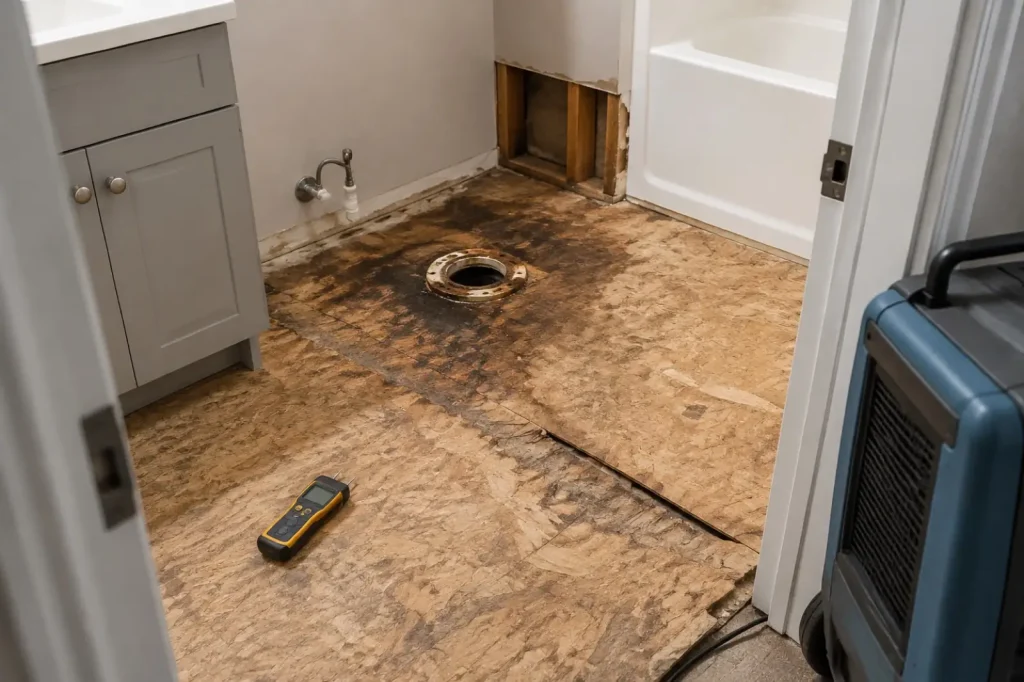
Subfloor water damage is usually survivable: APA says plywood and OSB normally stay structurally sound once re-dried, even with swollen edges. Lift vinyl or pad so the deck can dry, measure on a grid, and finish when readings meet the flooring maker’s limit. Replace delaminated plywood, soft or rotted areas, and OSB soaked by floodwater.
Key takeaways
- APA: wet plywood and OSB lose no structural capacity from swelling or flaking once re-dried, but are less stiff while saturated.
- Exposure 1 means built to resist moisture during construction delays, not permanent exposure, and it gives no decay resistance, according to APA.
- FEMA’s flood classes split the panels: Exterior or Exposure 1 plywood is Class 4, OSB is Class 2 or lower.
- According to APA, decay and mould risk starts at about 20 to 25% moisture held for a prolonged period.
- Vinyl over plywood must come up for the plywood to dry, according to FEMA.
- According to NWFA, take 20 readings per 1,000 sq ft and keep a 4% gap for strip flooring, 2% for boards 3 in or wider.
On this page
- What you are looking at
- OSB versus plywood when wet
- Under tile, carpet, hardwood and vinyl
- How to measure a wet subfloor
- Target moisture before the floor goes back
- Drying it in place
- Drying versus replacing
- When it is bigger than the floor
- What repair costs
- The decision path
- For contractors
- Questions people actually ask
Most subfloor damage is found through something else: a tile that rings hollow, a hardwood board that cups, a vinyl seam that lifts. The panel itself is rarely visible until the floor comes up, so start with what the finish floor is telling you.
What you are looking at, from the room
| Over the subfloor | Water sign | Dry look-alike | Separating them |
|---|---|---|---|
| Ceramic tile | Cracked grout lines, hollow-sounding or loose tiles near a tub, toilet or dishwasher. | Grout cracking from joist deflection. | Fluke notes moisture under tile is usually in the subfloor and may not show on a thermal image; use a meter. |
| Carpet | Damp or musty pad, a soft spot underfoot. | A worn pad. | Lift a corner at the tack strip and read the deck. |
| Hardwood | Cupping or crowning, gaps opening after drying. | Seasonal humidity movement. | According to APA R280F, hardwood arrives under 10% MC; a wet deck beneath it pushes it out of range. |
| Vinyl or LVP | Bubbles, lifting seams, a sponge feel. | Adhesive failure on a dry deck. | FEMA notes vinyl over plywood must come up for the plywood to dry, so read through an open seam. |
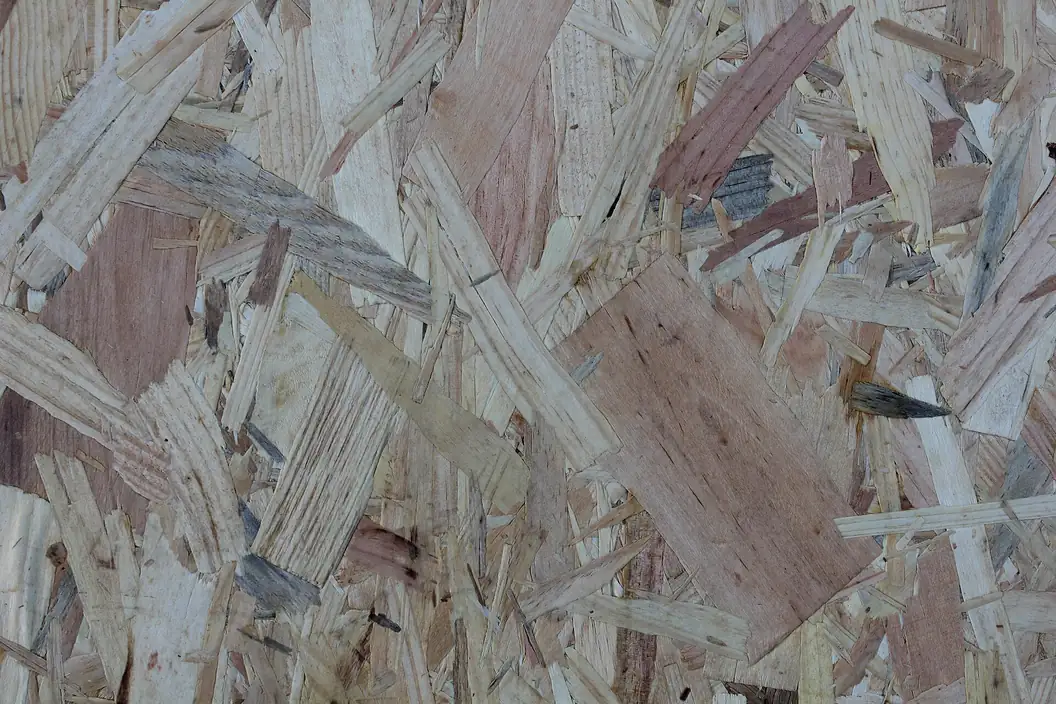
| Bare OSB | Swollen edges, flaking surface strands. | Construction-phase rain swell, already dry. | APA and West Fraser treat dry edge swell as cosmetic. Read the panel before judging. |
OSB subfloor water damage versus plywood
Almost every subfloor is one of two panels, and the APA grade stamp says which bond classification it carries. APA's OSB product page defines Exposure 1 as panels that resist the effects of moisture on structural performance during construction or conditions of similar severity, but are not for permanent outdoor exposure. Exposure 1 and Exterior panels use the same exterior adhesives, and APA says bond classification does not provide decay resistance.

| Property when wet | OSB | Plywood | Source |
|---|---|---|---|
| Bond classifications | Exterior or Exposure 1 | Exterior or Exposure 1 | APA OSB page |
| Surface response | Rough surface, lifting or flaking of surface strands, thickness swelling | Rough surface, thickness swelling | APA Help Desk FAQ |
| Strength after re-drying | No loss of structural capacity from swelling or flaking once dry | Same | APA Help Desk FAQ |
| Plywood-specific check | Not applicable | Delamination: X501 has sections on spotting it and whether it recurs | APA Form X501, May 2021 |
| Swollen edges | West Fraser: sand level once the house is dry; sanding early opens cells and adds swelling | Ridges at panel edges sanded smooth before hardwood | West Fraser; APA R280F |
| While saturated | Less stiff; avoid heavy loads | Same | APA Help Desk FAQ |
| Minimum thickness under hardwood, 16 in joists | 23/32 in | 19/32 in | APA R280F Table 1 |
| FEMA flood class | Exterior or edge-swell resistant: Class 2; other OSB: Class 1 | Exterior or Exposure 1: Class 4; other plywood: Class 1 | FEMA TB 2 Table 2 |


Why this differs from generic advice: forums say OSB is ruined by water and plywood is fine. APA’s position is that both are normally sound after re-drying. FEMA’s flood classes still rank Exposure 1 plywood well above OSB, and the gap matters most for floodwater, not a supply-line leak.
The subfloor under tile, carpet, hardwood and vinyl
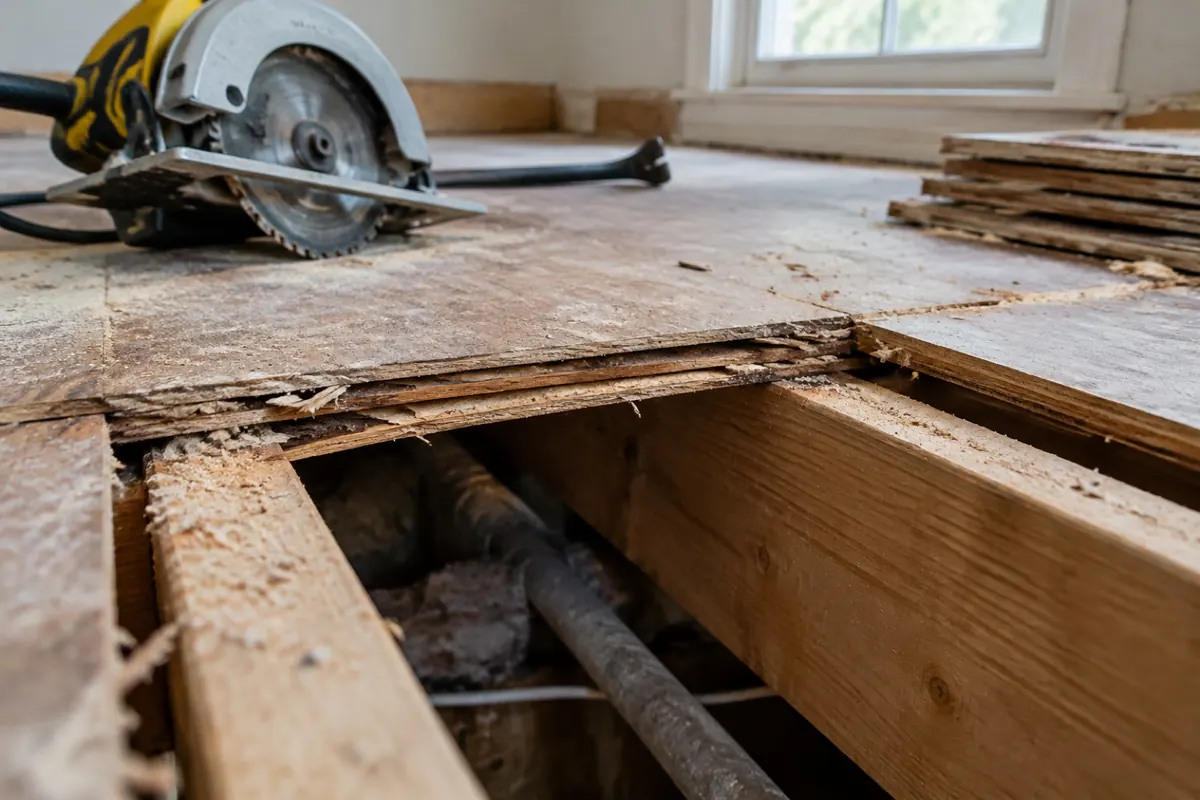
The finish floor decides whether the subfloor can dry at all. EPA Table 1 says to check that the underflooring is dry under linoleum, ceramic tile and vinyl, and NDSU Extension says vinyl and floor tile may need removing to let the subfloor dry.
| Finish floor | Can the deck dry through it? | Usual move | Owned in detail by |
|---|---|---|---|
| Sheet vinyl, glued LVT | No. FEMA TB 2 says vinyl tile over plywood must be removed to let the plywood dry. | Lift the affected area. | This page |
| Ceramic tile | Slowly. FEMA rates tile set in organic adhesive Class 2, mortar set Class 4. | Read through grout; remove tile where the deck stays wet. | This page |
| Carpet and pad | Only once the pad is out. | Pull the pad, float the carpet. | Drying wet carpet |
| Solid or engineered hardwood | Through the boards, slowly; NDSU says dry gradually. | Panel or mat drying from above. | Hardwood floor repair |
| Floating laminate | No; FEMA rates plastic laminate flooring Class 2. | Lift it. | Laminate floor water damage |
How to measure a wet subfloor
Measure the panel, not the finish. A pin meter reads %MC in wood directly; Protimeter colours its readings dry from 7 to 16.9, at risk from 17 to 19.9 and wet at 20 and above. APA Technical Note R280F warns that results vary by panel and meter type, so calibrate the meter to its maker’s instructions.
| Step | Published rule | Why this differs from generic advice |
|---|---|---|
| Sample density | At least 20 readings per 1,000 sq ft, averaged, according to NWFA; Lifeproof uses the same count. | One reading proves nothing; NWFA says a single high reading flags a problem to correct. |
| Where | Exterior doorways, foundation walls, plumbing walls, room centre (Lifeproof); exterior and plumbing walls (NWFA). | Leaks sit at walls; centre-only readings miss them. |
| What to compare | A dry area of the same panel type. | OSB and plywood read differently on the same meter, per APA. |
| Through tile | Pinless scan, then pins at grout or an open seam. | Fluke: tile can hide a wet deck from a camera. |
| From below | Read the underside from the crawl space or basement. | The underside is the only face visible without lifting the floor. |
Target moisture content before refinishing or reinstalling
There is no single number. APA R280F says a wet subfloor must dry to within the range the hardwood maker recommends before installation. APA gives the in-service range and the danger zone; each flooring maker sets its own ceiling and gap.
| Publisher | Subfloor limit | Gap to flooring | Applies to |
|---|---|---|---|
| According to the APA Help Desk FAQ | In service 6 to 14%; design values drop at 16% or more | Not stated | Plywood and OSB |
| According to the APA Help Desk FAQ | Decay and mould risk at about 20 to 25% if prolonged | Not stated | Plywood and OSB |
| NWFA Guidelines | Within the flooring maker’s range | 4% for solid strip under 3 in; 2% for 3 in or wider | Solid wood flooring |
| Somerset | No wood reading above 12% | 4%; 2% for 3-1/4 in or wider | Somerset solid hardwood |
| Lifeproof | Less than 13% | 2% or less | Lifeproof rigid core vinyl |
Why this differs from generic advice: “dry” is relative. According to these sheets, a deck at 13% passes APA’s in-service range but fails Somerset’s 12% ceiling, and the gap rule can fail a deck that looks dry. Read the sheet for the floor going back down.
Drying a wet subfloor in place, step by step
| Step | What to do | Why this differs from generic advice |
|---|---|---|
| 1. Stop and extract | Remove standing water; EPA’s window for drying wet materials is 24 to 48 hours. | The pad, vinyl or tile holds water against the deck after the surface looks dry. |
| 2. Uncover the deck | Lift vinyl, pad or laminate over the wet area. | FEMA and NDSU both say coverings can stop the subfloor drying. |
| 3. Keep loads off | No heavy traffic or loaded carts. | APA: saturated panels are less stiff until dry. |
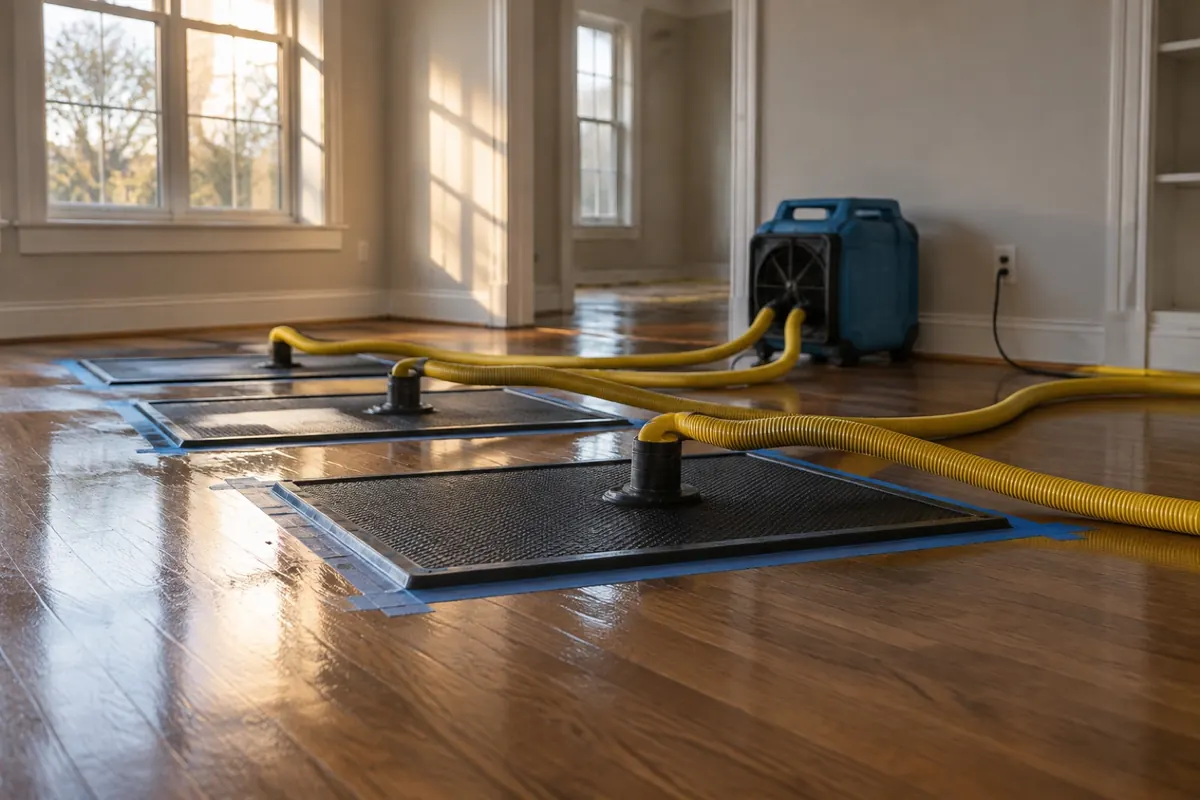
| 4. Dry both faces | Air on top; air or a dehumidifier below from the crawl space or basement. | The underside is half the panel’s drying surface. |
| 5. Use suction where flooring stays | Negative-pressure panels, which Injectidry Vac-It panel guide says can sit 2 to 4 ft apart. | Injectidry gives drying times from 1 day to over 10. |
| 6. Hold off on sanding | Sand OSB edge swell only once the house is dry. | West Fraser: early sanding opens the cells and adds swelling. |
| 7. Finish on numbers | Readings at or under the flooring maker’s limit and inside its gap rule. | NDSU: do not refinish until thoroughly dry. |
Dehumidifier sizing and airflow belong to structural drying.
Water damaged subfloor repair: dry or replace
| Finding | Published position | Call |
|---|---|---|
| Swollen OSB edges, dry panel | West Fraser: does not affect structural properties; sand level. | Keep and sand. |
| Flaking surface strands | APA: no loss of structural capacity once re-dried. | Keep; level if the finish floor needs it. |
| Plywood delaminated, floor buckled | NDSU: sections may need replacing or new plywood nailed over. | Cut out or overlay. |
| Soft or spongy under load after drying | APA: severe or prolonged exposure may need a qualified expert. | Probe; replace the soft area. |
| Readings at about 20 to 25% for weeks | According to APA, a decay and mould risk. | Open, dry, assess for rot. |
| Particle board underlayment | FEMA TB 2: Class 1. | Replace. |
| Sewage or floodwater soaked | FEMA TB 2: OSB Class 2 cannot survive flood wetting and drying. | Replace OSB; assess plywood. |
Mould on the panel follows the wood-surface rules in our guide to mold on wood.
Signs it is bigger than the floor
- Wet joists or rim board when read from below: the framing is now involved.
- A damp crawl space. APA R280F calls for a dry, drained crawl space with 6-mil polyethylene on the ground before hardwood goes in. See crawl space mold remediation if it has grown.
- Water at the wall line. The bottom plate and drywall wick it up; see water damage in walls.
- A floor that stays soft after drying. Decay, not water, is now the problem.
- Readings that climb back. A slow leak is still running.
What subfloor repair costs, from one published source
Fixr, updated 31 January 2025, is the only cost guide this page could open. According to Fixr’s text, plywood runs $3.75 to $6 per sq ft, while according to its table it runs $2.75 to $6, so both appear.
| Material | Installed per sq ft, according to Fixr | Note |
|---|---|---|
| Plywood | $2.75 to $6.00 | Text elsewhere says $3.75 to $6 |
| OSB | $3.00 to $4.40 | Fixr notes OSB swells with water |
| High-performance panel | $3.50 to $10.50 | Engineered moisture-resistant panels |
The decision path
- What water? Floodwater or sewage: plan to replace OSB (FEMA Class 2).
- What panel? Read the stamp: OSB or plywood, Exposure 1 or Exterior.
- What covers it? Vinyl, glued tile or laminate over the wet area comes up.
- Measure on a grid, top and underside, against a dry area of the same panel.
- Probe soft spots and check plywood for delamination.
- Dry and re-read until the flooring maker’s limit and gap rule are met. Then sand edges and reinstall.
For contractors: what the adjuster asks for
- Panel identity. A photo of the grade stamp: OSB or plywood, bond classification, thickness.
- Moisture grid. At least 20 readings per 1,000 sq ft according to NWFA, dated, with meter make, scale and the dry reference.
- Why coverings came up. Cite FEMA TB 2 on vinyl over plywood, and EPA on underflooring.
- Replacement justification. Delamination, soft spots or floodwater, each photographed; swelling alone is not one under APA’s guidance.
- Protection costs. The California Department of Insurance claims guide says insurers reimburse reasonable protection costs with receipts, and to avoid extensive permanent repairs before the adjuster visits.
Questions people actually ask
Is the subfloor ruined if it gets wet?
Usually not. APA says wood construction is durable and will normally be structurally sound after severe exposure to moisture, and swelling or flaking does not reduce structural capacity once the panel dries. Ruin comes from staying wet: APA puts decay and mould risk at about 20 to 25% moisture content held for a prolonged period, and FEMA rates OSB as unable to survive flood wetting.
Can a water damaged subfloor be repaired?
Yes, in most clean-water cases. Dry it in place, then sand swollen OSB edges level once the house is dry, as West Fraser advises. Where plywood has delaminated and buckled, NDSU Extension says sections may need replacing or new plywood nailed over. Soft or rotted areas are cut out rather than dried.
Does homeowners insurance cover water damage to the subfloor?
That depends on your policy and the cause, so check your policy and ask your insurer. The California Department of Insurance notes homeowners policies exclude flood but cover other kinds of water damage, and that you should take reasonable steps to prevent further damage. Your state insurance department can help; see also our water damage coverage guide.
How long does it take a subfloor to dry after water damage?
It varies with panel, covering and equipment. Injectidry’s panel guide gives drying times from 1 day to over 10 with suction panels, and NDSU Extension tells flood-affected homeowners to expect several weeks. The finish line is a reading, not a date: inside the flooring maker’s moisture limit and gap rule, such as the 2 or 4% difference according to NWFA.
Is OSB or plywood better if a subfloor gets wet?
Under APA guidance both re-dry without structural loss, but OSB shows more edge swell and surface flaking. In FEMA’s flood classes, Exterior or Exposure 1 plywood is Class 4, acceptable, while even edge-swell-resistant OSB is Class 2, unacceptable. For areas that can flood, plywood is the more water-tolerant panel.
What moisture content should a subfloor be before new flooring?
Whatever the flooring maker states. According to Somerset’s solid hardwood sheet, no reading may exceed 12%; according to Lifeproof’s rigid core vinyl sheet, under 13% and within 2% of the flooring. According to NWFA, a 4% gap for solid strip under 3 in wide and 2% for wider boards. According to APA, in-service wood sits at 6 to 14%.
Sources
- APA's OSB product page, APA, bond classifications. Retrieved 19 October 2026.
- APA Help Desk FAQ, APA: wet jobsites, in-service moisture, swelling. Retrieved 19 October 2026.
- APA Form X501, Questions About Wood Structural Panel Exposure to Excessive Moisture, revised May 2021 (summary page and contents). Retrieved 19 October 2026.
- APA Technical Topic TT-028, Moisture-Related Dimensional Stability, revised February 2021 (summary page). Retrieved 19 October 2026.
- APA Technical Note R280F, Performance Rated Panel Subfloors under Hardwood Flooring, June 2010, hosted by Tolko. Retrieved 19 October 2026.
- FEMA Technical Bulletin 2, FEMA, August 2008, Tables 1 and 2. Retrieved 19 October 2026.
- West Fraser's subfloor FAQ, West Fraser OSB. Retrieved 19 October 2026.
- NWFA Installation Guidelines, National Wood Flooring Association, revised 2007 and 2008, hosted by a retailer; newer editions are sold by NWFA. Retrieved 19 October 2026.
- Somerset solid hardwood instructions and Lifeproof rigid core instructions, hosted by The Home Depot. Retrieved 19 October 2026.
- EPA Table 1, Mold Remediation in Schools and Commercial Buildings Guide, Chapter 4, US EPA. Retrieved 19 October 2026.
- NDSU Extension, Flood-Damaged Walls, Ceilings and Floors, hosted by ND Response. Retrieved 19 October 2026.
- Fluke, Detecting Problems In Buildings Using Thermal Imagers, reprint hosted by TestEquity. Retrieved 19 October 2026.
- Injectidry Vac-It panel guide, revised March 2018; Protimeter Surveymaster manual, June 2023. Retrieved 19 October 2026.
- Fixr, subfloor installation cost, updated 31 January 2025. Retrieved 19 October 2026.
- California Department of Insurance claims guide, 2015 edition. Retrieved 19 October 2026.
- Limits appear as each publisher prints them. No reading here was taken by us. See our methodology and the water damage hub.
Published guidance only. A subfloor’s condition is settled by readings and probing on that floor.