The short answer
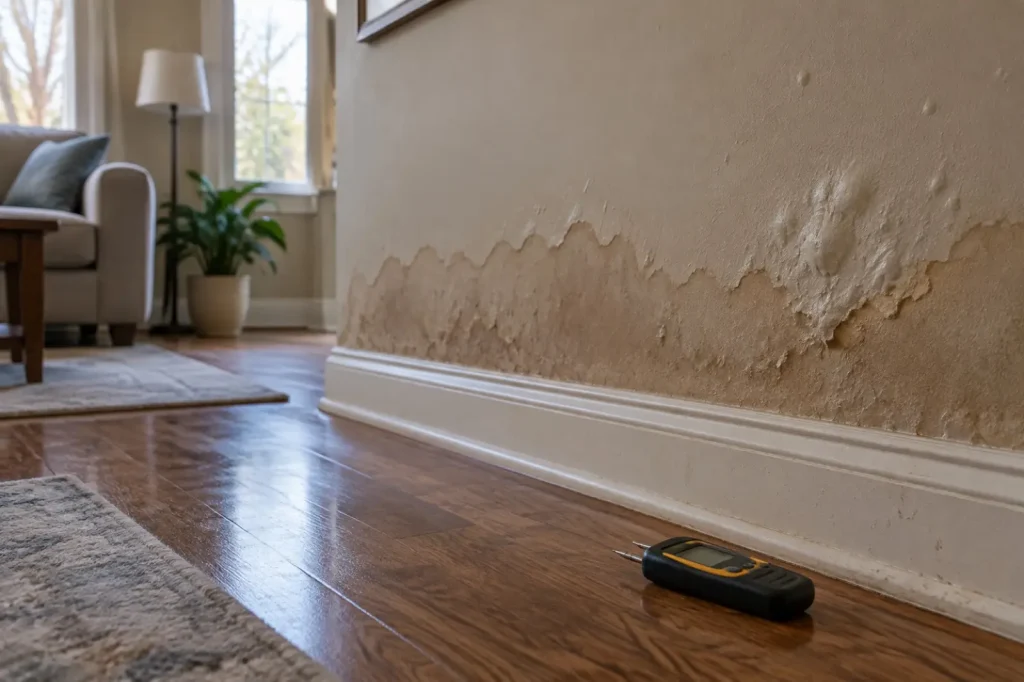
Water damage in walls shows differently on each finish: bubbled paint and a soft base on drywall, bulging or flaking plaster, bowing paneling, loose tiles. Confirm it with a moisture meter, since a thermal camera only sees temperature. Dry the cavity in place through small holes when the board is sound; open the wall when it is swollen, the insulation is wet or the water was floodwater.
Key takeaways
- A thermal camera does not see moisture. Fluke’s own application article says so; it finds the cooling that evaporation causes, and a meter has to confirm it.
- EPA lists wet fibreglass and cellulose insulation as discard and replace. Wet batts behind the board usually settle the job.
- According to Delmhorst, drywall is optimal at 1% or lower on its gypsum scale and should be replaced above 2%.
- Protimeter’s pin bands: under 17 dry, 17 to 19.9 at risk, 20 and over wet. Brands’ scales do not convert into each other.
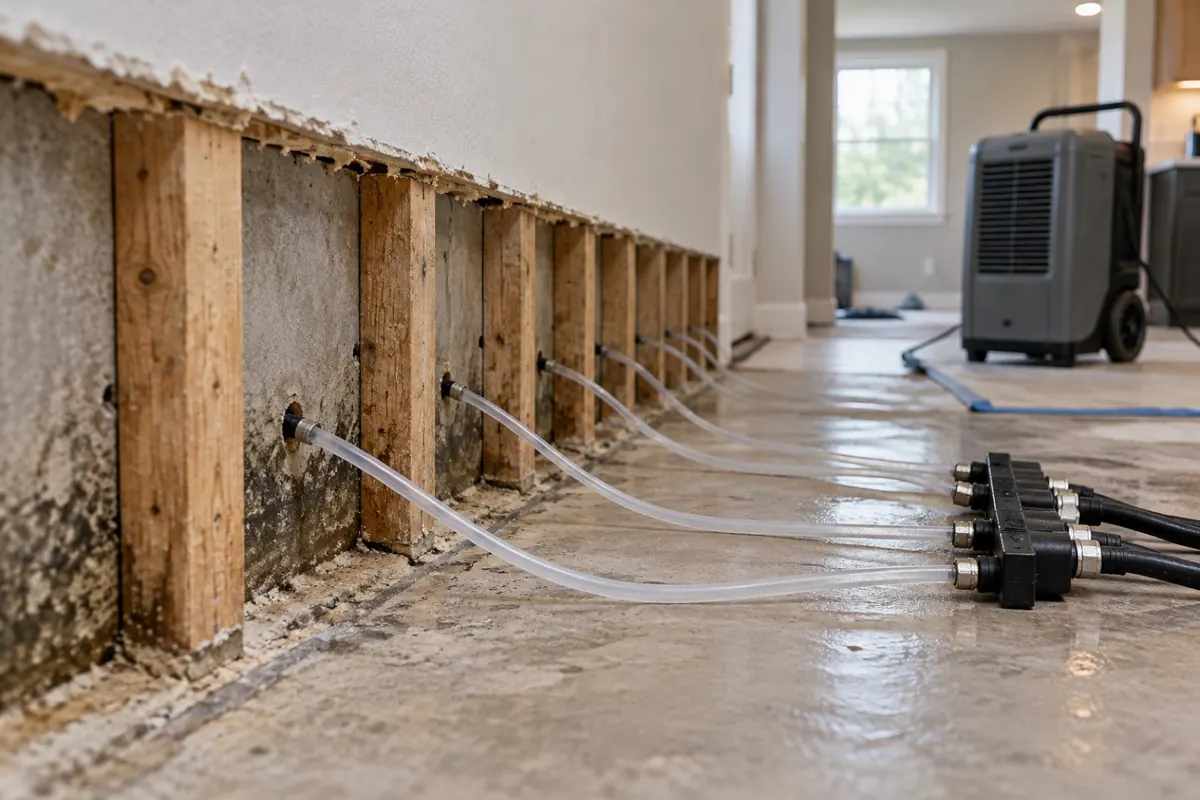
- Dri-Eaz’s published method is one 3/16 in hole per stud bay about 2 in above the floor, behind trim, plus a vent hole above the wet line.
- Plaster usually survives water that would condemn drywall, but it dries far slower, and metal lath makes pinless meters read high.
On this page
Signs of water damage in walls, by wall type
The finish decides what the water looks like, and several classic signs have a dry explanation.
| Wall finish | What water damage looks like | Dry look-alike | How to tell them apart |
|---|---|---|---|
| Painted drywall | Tide-line stain, bubbled paint, a soft or swollen base, seams opening. EPA Table 1 treats swelling and failed seams as the removal line. | Condensation on a cold exterior wall, or surface mould from it. | Protimeter says surface condensation barely affects its pinless Search mode; a wet core still reads. |
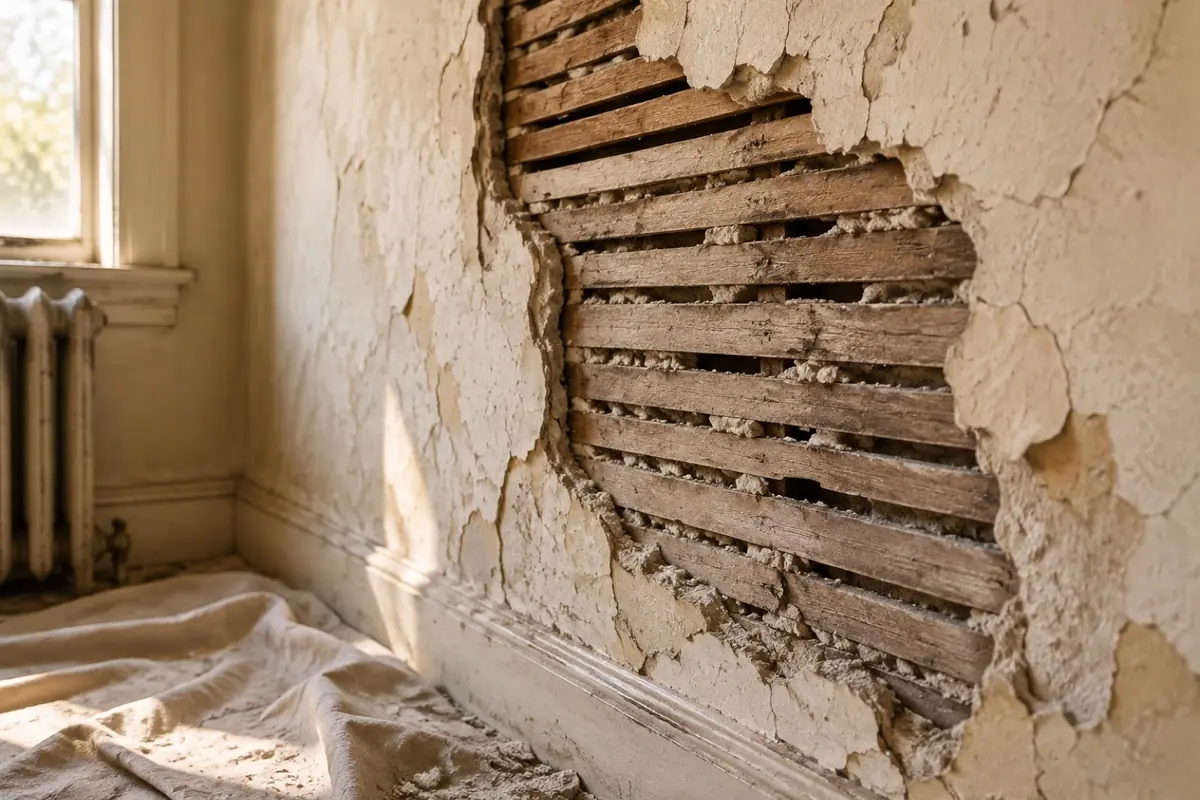
| Plaster on lath | Flaking paint and finish coat, bulging areas, crumbling plaster. Over masonry, salts migrate out as dry bubbles or efflorescence, per National Park Service Preservation Brief 21. | Horizontal lath-movement cracks and diagonal settlement cracks, which NPS lists as non-water causes. | A crack with no reading behind it is movement. A bulge that gives under the palm has lost its key. |
| Wood paneling | Panels bowing off the wall, separating at joints, dark edges at the floor line. | Seasonal movement in a humid room. | EPA says to pry wet paneling away from the wall to dry, which exposes the backing. |
| Ceramic tile | Little at the face: loose or hollow tiles, stained grout, a soft wall behind a tub. | Grout discoloured by soap and cleaners. | Protimeter names readings behind shower tile as a Search mode use, so no holes are needed in the tile. |
| Wallpaper or vinyl covering | Lifting seams, blisters, staining that shows through. | Old paste failing on its own. | Protimeter Surveymaster manual suggests Search mode under quality wallpaper where pinholes are unacceptable. |
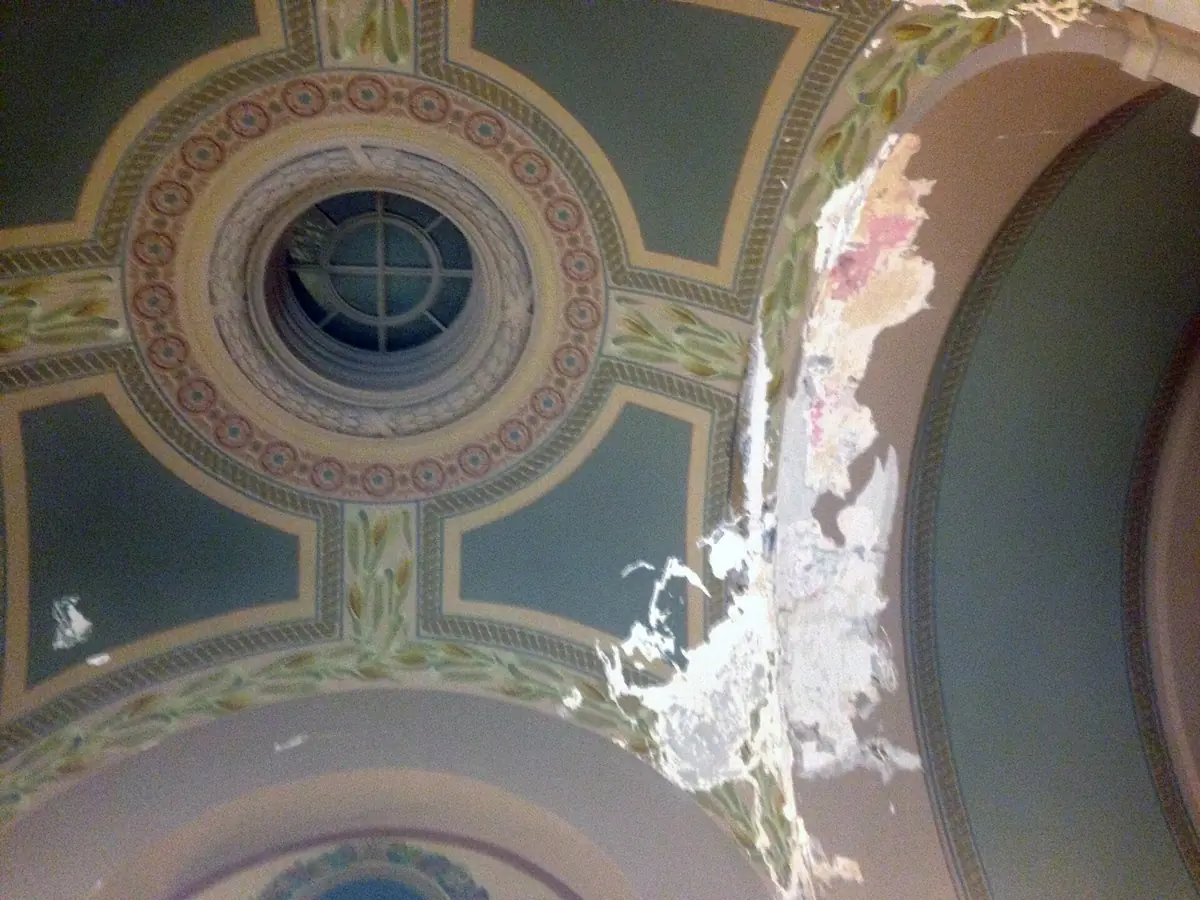

A stain only proves water reached the face once. The meter says whether board, studs and plate are wet now.
Finding it: pin versus pinless meters, and thermal imaging
Three tools, three different measurements.
| Tool | What it actually measures | Depth | What fools it |
|---|---|---|---|
| Pin meter | Resistance between two pins. Protimeter says it reads actual %MC in wood and Wood Moisture Equivalent (WME) in other materials, at the spot between the tips. | Pin length. Deep wall probes reach the studs and plate. | According to Protimeter, readings above 30% are relative only. |
| Pinless meter | A relative signal from the material under the pad, Protimeter’s Search mode, scaled 70 to 999. | Up to 19 mm (3/4 in) below the surface, per Protimeter. | Protimeter says conductors other than water, such as metal lath, foil or a corner bead, can cause high readings. |
| Thermal camera | Surface temperature. a fluke application article states that a thermal imager is not a moisture meter and does not see moisture; it sees the cooling that evaporation causes. | Surface only. | Fluke lists air movers masking wet areas, cold supply air faking one, and missing insulation on a cold day. |
Why a thermal camera is a map, not a measurement
The same Fluke article reports wet to dry differences from 0.5°F to more than 10°F, largest in the first 24 to 36 hours, and says a meter must confirm moisture. Use the camera to place the pins, then let the pins decide.
The reference scales meter makers publish
Each maker prints its own scale, and they do not convert cleanly. Protimeter colours pin readings green, yellow and red; Delmhorst publishes a gypsum scale with very small numbers.
According to Delmhorst, board in very humid air still equalises below 1% on the gypsum scale, so a reading well above that is liquid water, not humidity. According to Delmhorst, about 1% on its drywall scale matches roughly 20% on its wood scale.
What a reading means, material by material
The table to keep. Each row pairs a material with its meter maker’s published scale and the call that follows. Compare against a dry standard from an unaffected wall, which Protimeter’s Reference mode stores.
| Wall material | Reading and scale | Published meaning | Dry in place or open |
|---|---|---|---|
| Gypsum board | 1% or lower, gypsum scale | Optimal, according to Delmhorst. | Dry in place if EPA’s conditions also hold: no swelling, seams intact. |
| Gypsum board | Above 1% up to 2%, gypsum scale | According to Delmhorst, may be saveable if drying is fast. | Dry in place only with the cavity ventilated, and re-read daily. |
| Gypsum board | Above 2% at any point, gypsum scale | Replace, according to Delmhorst. | Open. |
| Any wall material, pin WME | 7 to 16.9 / 17 to 19.9 / 20+ | Dry, at risk, wet, per Protimeter. | Green with a matching dry standard ends drying. Red means keep drying or open. |
| Studs and bottom plate | %MC, wood scale | According to Delmhorst, about 20% is the accepted wood decay threshold. | The plate, not the board, usually ends the job. |
| Plaster on wood lath | WME, pin, against a dry standard | NDSU: plaster usually need not be replaced but takes a very long time to dry. | Dry in place unless bowed or crumbling. |
| Plaster on metal lath, or foil-backed board | Pinless reads high | Protimeter: conductors inflate Search readings. | Confirm with pins before deciding. |
| Tile over backer | Pinless Search mode through tile | Relative only. | Check the backer from behind before removing tile. |
Water in the wall cavity: the insulation decides
Behind the board is usually insulation, and it often decides the job. EPA Table 1 lists wet fibreglass and cellulose insulation as discard and replace. FEMA Technical Bulletin 2 classes the same materials by how they survive water, a different question.
Why this differs from generic advice: most guides say wet insulation always goes. FEMA rates closed-cell foam Class 5, the exception, though the wood behind it still needs readings. Mineral wool shares fibreglass’s Class 3 row. NDSU adds why batts are not worth saving: they hold water for months.
How to dry water in walls without opening them
Wall-cavity drying pushes or pulls air through small holes so the cavity dries with the face. Equipment makers publish the method, and their hole sizes differ.
| Instruction | Dri-Eaz DriForce InterAir (F211) | Injectidry | Why it differs from generic advice |
|---|---|---|---|
| Hole size | Carpet awl or 3/16 in bit; injector hole under 1/4 in. | SA-5 wall vents: at least one 0.75 to 1.5 in hole per cavity. | The two systems need very different bits. |
| Placement | At least one hole between each pair of studs, about 2 in above the floor. | Vents screwed to the bottom plate with the baseboard off. | Hiding holes behind the base saves the patch and repaint. |
| Steel studs | Drill about 1/2 in from the floor at a downward angle; the track holds water. | Not stated. | The track traps water. |
| Venting | Small vent hole just above the highest moisture point. | Seal the floor expansion gap. | Air needs a way out. |
| Sizing | One 12-injector manifold per 14 ft of interior 2×4 wall; per 7 ft for 2×6, double-sheeted or dense walls. | Ceilings: drill at 45 degrees or more so injectors stay in. | Thick or layered walls need twice the air. |
| Sequence | Extract (vacuum) until cavity exhaust humidity matches an unaffected area, then inject room air. | Drill with extreme caution; walls hide wiring and pipes. | Pulling first removes the wettest air. |
Dri-Eaz says its setup delivers 25 to 30 air exchanges per hour in each cavity. The room still needs dehumidification, and our guide to structural drying covers that equipment math. In a home built before 1978, drilling painted walls for pay falls under the EPA Renovation, Repair and Painting rule.
When the wall must be opened instead
Any one trigger below, each from a published source, moves the job to removal. Where and how high to cut is in our wet drywall cut heights guide.
| Trigger | Source | Why drying in place fails |
|---|---|---|
| Board swollen or seams open | EPA Table 1 | EPA allows drying in place only without those signs. |
| Wet fibreglass or cellulose behind it | EPA Table 1 | The insulation is discarded anyway, so the board comes off. |
| Floodwater or sewage | FEMA TB 2 | TB 2 treats floodwater as black water and rates paper-faced gypsum Class 3: survives clean water, not floodwater. |
| Vinyl wallcovering or wallpaper | FEMA TB 2 | TB 2 says sheet wall coverings restrict drying of what they cover. |
| Low-permeability paint on a wood wall | FEMA TB 2 | TB 2 cites Oak Ridge studies finding it can inhibit drying. |
| Cavity you cannot reach with air | Dri-Eaz manual | Dri-Eaz says cabinets may need removal if interior spaces cannot be accessed. |
| Plaster bowed, crumbling or rotted | NPS Brief 21 | NPS says rotted plaster has no cure. |
Plaster and lath versus drywall
Older walls are not drywall, and the decision runs the other way. National Park Service Preservation Brief 21 describes three lath types: wood lath, metal lath and rock lath (gypsum board lath). Plaster pushed through the lath forms keys that hold it on.
| Question | Gypsum drywall | Plaster on lath |
|---|---|---|
| What it is | Paper-faced gypsum board | Lime or gypsum plaster on wood, metal or rock lath |
| FEMA TB 2 class | Paper-faced board: Class 3 | Keene’s cement or plaster: Class 3; other plaster: Class 2 |
| How it fails wet | Paper and core soften; swelling and seam failure, per EPA | Loses its key and bows; NPS says gypsum plaster is more vulnerable to water than lime |
| Drying speed | Usually days with cavity air | NDSU: a very long time |
| Usual call | Dry in place only under EPA’s conditions | NDSU: usually does not need replacing |
| Meter caution | Gypsum scale, or pin WME | Metal lath inflates pinless readings |
| Opening it | Cut and replace in sections | Heavy demolition dust; pre-1978 paint brings the RRP rule |
Why this differs from generic advice: the cut-it-out reflex comes from cheap drywall. Plaster is costly to rebuild, tolerates more, and earns a longer dry.
Signs it is bigger than the visible stain
- Readings above the stain. Water climbs past what shows, which is why Dri-Eaz vents above the highest moisture point.
- Wet on both faces. If the room behind reads wet too, the source is in the cavity, not on one side.
- A bottom plate near 20%, according to Delmhorst the decay threshold. Framing is now the issue.
- An exterior wall that wets when it rains. The cladding is the source. Our sibling page on stucco remediation covers that wall from outside.
- A musty smell with dry-looking paint. Growth on the back of the board; see mold on walls.
- Wet floor at the wall line. Water reached the deck; see subfloor water damage.
The decision path, in order
Stop at the first step that says open.
- Stop the water and name it. Floodwater or sewage means open; FEMA says Class 3 board like paper-faced gypsum may not clean up after floods. Our guide to the IICRC water categories sorts the source.
- Read the finish. Use the wall-type table. Swelling or open seams on drywall means open.
- Map with pinless, confirm with pins. Take a dry standard on an unaffected wall of the same build first.
- Find out what is in the cavity. One small inspection hole. Wet fibreglass or cellulose means open.
- Check the coverings. Vinyl wallcovering or low-perm paint over wood: strip or open.
- Dry in place and prove it. One hole per bay, vent above the wet line, daily readings until board and plate match the dry standard.
For contractors: the file that survives review
- Scope. Wall type, insulation and covering per wall, plus the removal trigger for anything opened.
- Moisture map. Readings by location and date, the meter make and scale, and the dry standard you compared against. A gypsum-scale percentage and a WME number are not the same unit; label which.
- Cavity method. Hole size and count per bay, the system and its published spec, and exhaust hygrometer readings.
- Temporary repairs. The California Department of Insurance claims guide says insurers reimburse reasonable protection costs with receipts, and warns against extensive permanent repairs before the adjuster assesses the damage.
- Thermal images as support. Pair each with a meter reading.
Questions people actually ask
How do you tell if you have water damage in your wall?
Look for finish-specific signs: bubbled paint and a soft, swollen drywall base; bulging or flaking plaster; paneling bowing off the wall; loose tiles. Then measure. A pinless meter scans about 3/4 in deep, a pin meter confirms, and an unaffected wall gives the dry standard.
How do I dry out my walls after water damage?
If the board is not swollen, seams are intact and the cavity holds no wet fibreglass or cellulose, dry it in place: one small hole per stud bay about 2 in above the floor, behind the baseboard, a vent hole above the highest wet reading, air forced or pulled through the cavity, and a dehumidifier in the room. Finish on readings, not days.
Does insurance cover water damage in walls?
It depends on your policy wording and on the cause, so read your own policy and ask your insurer. The California Department of Insurance notes homeowners policies exclude flood but cover other kinds of water damage, and that ensuing damage may not be covered without reasonable steps to protect the property. Your state insurance department can help. More in our water damage coverage guide.
Can a thermal camera find water in walls?
It shows where to look, not whether a wall is wet. A Fluke article states a thermal imager is not a moisture meter and does not see moisture; it sees evaporative cooling. Missing insulation on a cold day can look like water, and drying equipment can hide it. Confirm every cool spot with a meter.
Do I have to replace wet insulation inside a wall?
For fibreglass and cellulose, EPA’s guidance is discard and replace, and FEMA rates both as unacceptable for flood exposure. Closed-cell spray foam is the exception: FEMA’s bulletin rates it Class 5, the most water-resistant class. The studs behind any insulation still need readings before the wall closes.
Can plaster walls be dried instead of replaced?
Usually. NDSU Extension says plaster usually does not need to be replaced, though it takes a very long time to dry. Remove it where it has lost its grip on the lath and bowed, or where it is crumbling; the National Park Service says rotted plaster has no cure. Metal lath can make pinless meters read high, so confirm with pins.
Sources
- EPA Table 1, Mold Remediation in Schools and Commercial Buildings Guide, Chapter 4, US EPA, updated 8 September 2026. Retrieved 19 October 2026.
- FEMA Technical Bulletin 2, Flood Damage-Resistant Materials Requirements, FEMA, August 2008, Tables 1 and 2. Retrieved 19 October 2026.
- Protimeter Surveymaster manual, INS5375 Rev. A, Amphenol, June 2023. Retrieved 19 October 2026.
- Delmhorst, How To Accurately Measure Moisture in Gypsum Wall Board, Tom Laurenzi, 26 April 2018. Retrieved 19 October 2026.
- Delmhorst's drywall guidance, How to Determine the Optimal Moisture Content of Drywall and Gypcrete, Tom Laurenzi, 16 April 2024. Retrieved 19 October 2026.
- a fluke application article, Detecting Problems In Buildings Using Thermal Imagers, Regan Brown and David Brown for Fluke, reprint hosted by TestEquity; undated. Retrieved 19 October 2026.
- Dri-Eaz DriForce InterAir manual, Owner’s Manual, Model F211-115V, Dri-Eaz Products (07-00274J), hosted by Sylvane. Retrieved 19 October 2026.
- Injectidry SA-5 guide, SA-5 Specialty Adapter Operation Guide, Injectidry Systems, 2017; and the Injectidry FAQ. Retrieved 19 October 2026.
- National Park Service Preservation Brief 21, Repairing Historic Flat Plaster: Walls and Ceilings, Marylee MacDonald, National Park Service. Retrieved 19 October 2026.
- NDSU Extension flood guidance, Flood-Damaged Walls, Ceilings and Floors, NDSU Extension, hosted by ND Response. Retrieved 19 October 2026.
- California Department of Insurance claims guide, Residential Property Claims Guide, California Department of Insurance, 2015 edition. Retrieved 19 October 2026.
- EPA Renovation, Repair and Painting rule programme page, US EPA, last updated 17 June 2026. Retrieved 19 October 2026.
- Meter scales appear as each maker publishes them, unconverted. No reading here was taken by us. See our methodology and the water damage hub.
This page describes published guidance. It is not a site assessment; a wall’s condition is settled by readings taken on that wall.