The short answer
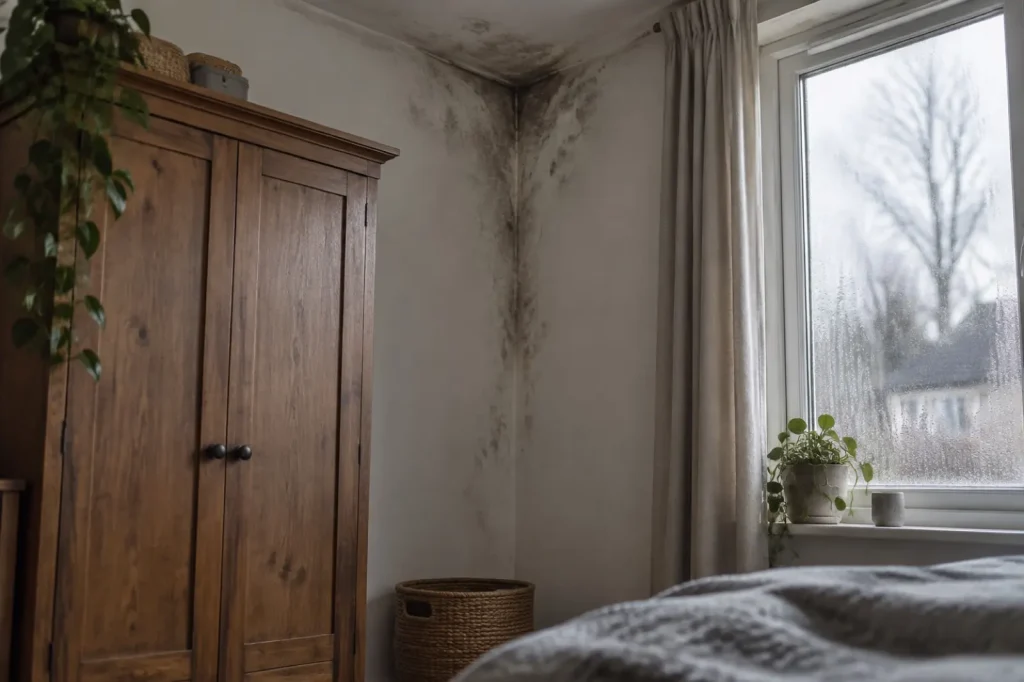
Mold on walls has one of three causes: condensation on a cold wall, a leak wetting the board, or growth inside the cavity showing through. Corners and spots behind furniture point to condensation. A patch shaped around a window, pipe or ceiling line points to a leak. Under 10 square feet on dry, sound board, EPA says most owners can clean it; wet or soft board is cut out.
Key takeaways
- Where it grows tells you why. EPA Mold Course, Chapter 2 says mold is frequently found in cold corners behind furniture, where condensation forms.
- Air at 70 F and 40% RH puts any surface below 54 F at the 70% surface humidity that Building Science Corporation report RR-0203 calls the mold limit.
- The paper is the food. Loukou and colleagues (Journal of Fungi, 2024) name the paper layer of gypsum board as an especially good substrate; paper-free materials are less susceptible.
- New York City's 2008 mold guidelines say wallboard is cleaned or removed at least 6 inches beyond visible growth.
- A D3273 score of 10 is a 4-week chamber result; ASTM's published scope of D3273-21 says a rating implies no specific period free of mold.
- Mold-resistant paint protects the paint film only, per the Perma-White technical data sheet.
On this page
Pages ranking for this search mostly list cleaners. The cleaner is the last decision. The first is which of three moisture problems put the mold there, because cleaning a wall that is still wetting brings it back.
What this page does not cover. Health effects of mold are outside our scope; see CDC's mold page and the EPA mold pages, or ask a clinician. Flood-damaged drywall is covered on our wet drywall page.
Three causes that look alike
EPA's Brief Guide to Mold, Moisture and Your Home lists where hidden mold sits: the back side of drywall, wallpaper or paneling, inside walls around leaking or condensing pipes, and on wall surfaces behind furniture where condensation forms. Those three locations map onto three causes with different fixes.
| Cause | Typical pattern | When | Meter reading | Fix first |
|---|---|---|---|---|
| Condensation | Cold corners, behind furniture, exterior walls | Heating season; humid rooms | Board usually dry inside | Humidity, air movement, warmth |
| Leak | Shaped around a window, pipe, roof line or wet wall | Any season; after rain or plumbing use | Wet, rising toward the source | Stop the water; dry or cut |
| Cavity growth | Musty smell, staining or bubbling with little surface growth | Long-running leak or vapor trap | Often wet inside | Open the wall |
Reading the pattern
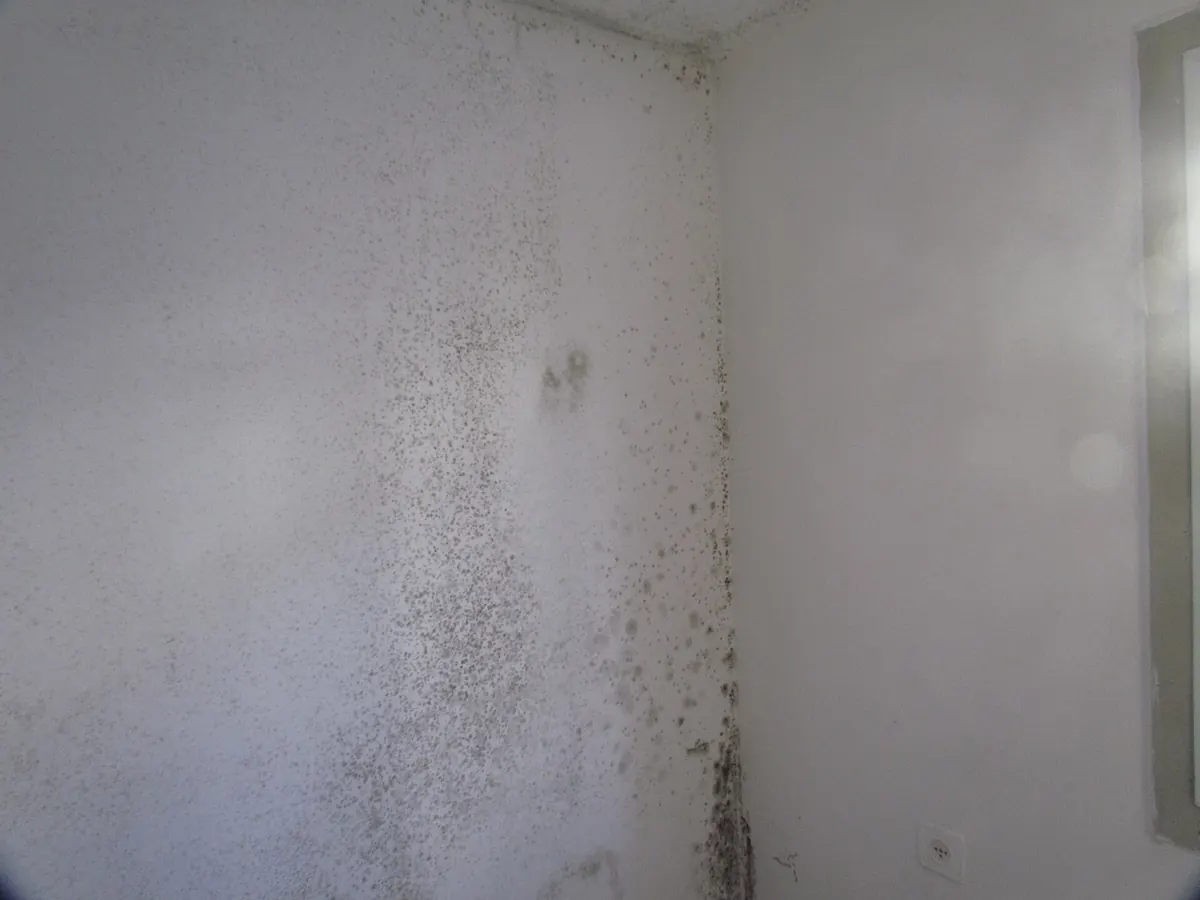
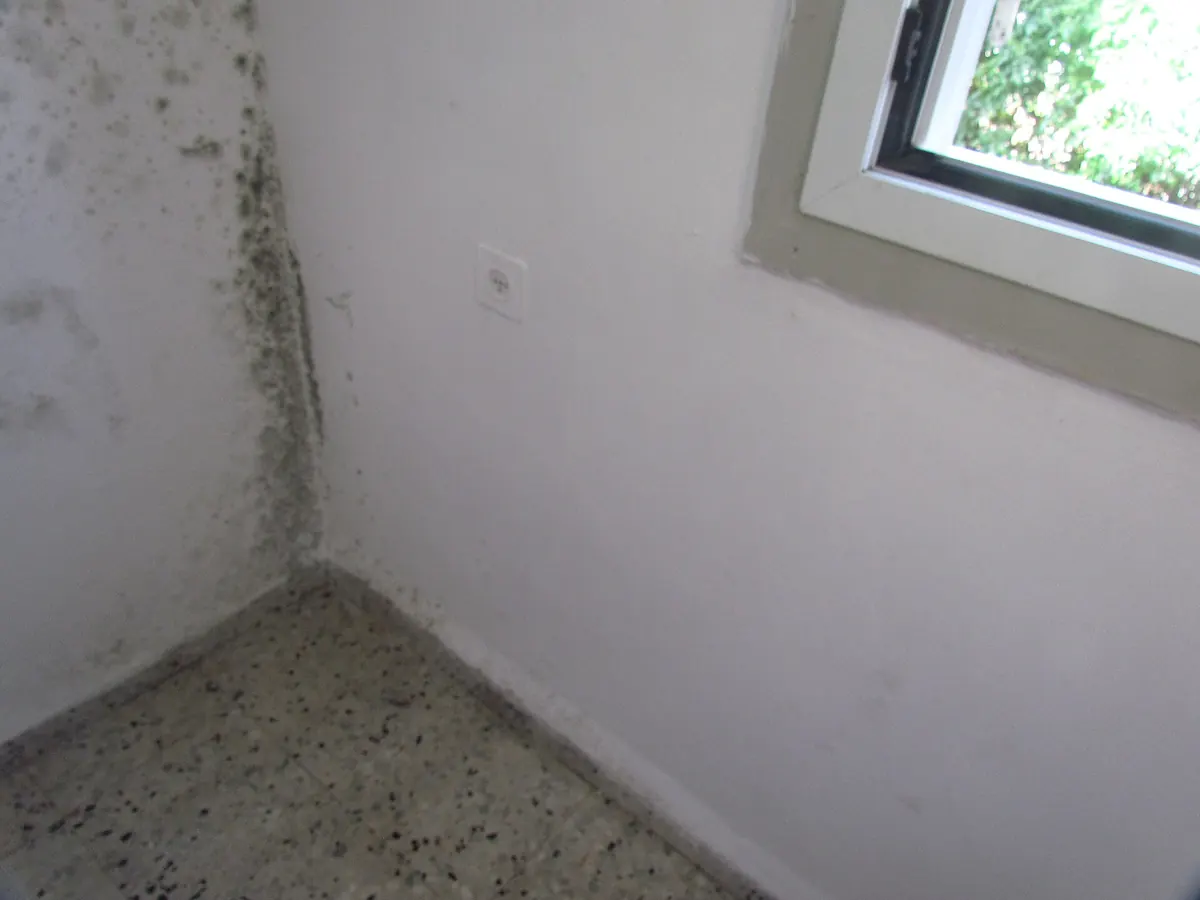
Condensation mold is diffuse and follows cold surfaces: spotting that thickens toward a corner and fades. Leak mold follows water: a defined patch with a source above or beside it. Cavity mold shows little on the face until the paper or paint stains, bubbles or softens.

| Where you find it | Most likely cause | Why |
|---|---|---|
| Corner where two exterior walls meet | Condensation | Cold corners behind furniture (EPA course) |
| Behind a wardrobe, bed or sofa | Condensation | EPA: walls behind furniture, where condensation forms |
| Under wallpaper, bubbling or lifting | Trapped moisture | Vinyl wallpaper acts as a vapor barrier (EPA) |
| Below a window, fanning down | Leak | Water follows gravity from the opening |
| Around a pipe or a shared bathroom wall | Leak or condensing pipe | EPA: inside walls around pipes |
| Ceiling line of a top-floor room | Roof leak or cold ceiling | EPA: insufficient insulation or roof leak |

Wallpaper needs care. EPA's remediation guide, Chapter 3 says vinyl wallpaper and wood paneling can act as vapor barriers, trapping moisture underneath, and that stripping wallpaper can release a massive amount of spores if mold is growing on its back. EPA advises a more cautious approach where extensive hidden mold behind vinyl wallpaper is expected.
Why a cold wall grows mold
The humidity that matters is at the wall, not in the middle of the room. Building Science Corporation report RR-0203, by Joseph Lstiburek, puts the critical surface humidity at 70%, and works an example: with room air at 70 F and 40% RH, any surface below 45 F can condense water and any surface below 54 F has air beside it at 70% RH. With the room at 25% RH, the report says, those thresholds fall to 32 F and 40 F.
In heating climates, the same report says, mold on interior surfaces happens in the heating season because exterior walls are cooled by heat loss while indoor moisture is too high. EPA’s mold course names the result: cold corners behind furniture.
The fix is the reverse of the cause. EPA's Brief Guide to Mold, Moisture and Your Home lists reducing humidity, increasing air movement, insulating cold surfaces and raising air temperature. The humidity target depends on climate: BSC suggests 25% at 70 F in a Minneapolis winter, 35% in Cincinnati and 45% in a mixed climate, all below the EPA ceiling of 60%.
The spread is 35 points between the coldest-climate winter figure and EPA’s ceiling: by BSC’s reasoning, a room within EPA’s limit can still be too humid for a cold exterior wall in a very cold winter. In cooling climates BSC describes the mirror case: cold air blown onto drywall, or humid outdoor air meeting cooled board behind vinyl wallpaper.
Paint and paper are the food
Mold needs moisture and an organic surface. New York City's 2008 mold guidelines list the paper on gypsum wallboard, paint and wallpaper among the materials it grows on. Loukou and colleagues (Journal of Fungi, 2024) explain why paper-faced board is the classic substrate: the paper layer is rich in complex organic polymers, and the starch adhesive in it can aid growth, while paper-free materials are less susceptible.
| Material | What the source says | Source |
|---|---|---|
| Paper face of gypsum board | Especially good substrate; starch adhesive in the paper can aid growth | Loukou and colleagues (Journal of Fungi, 2024) |
| Paper-free materials, gypsum core | Less susceptible | Loukou and colleagues (Journal of Fungi, 2024) |
| Paint and plaster | Cladosporium and Wallemia dominate; Aspergillus and Penicillium common | Loukou and colleagues (Journal of Fungi, 2024) |
| Paper on drywall, paint, wallpaper | Listed as materials mold grows on | New York City's 2008 mold guidelines |
| Porous materials generally | Need surface RH above 80% | Loukou and colleagues (Journal of Fungi, 2024) |
The practical reading: mold on a glossy painted face over dry board is a surface problem. Mold that has eaten into the paper is a board problem, because paper cannot be scrubbed clean.
Clean the paint or cut the board
EPA's Mold Cleanup in Your Home sets the owner threshold at about 10 square feet and says absorbent materials may have to be thrown away, because mold fills the crevices of porous materials. New York City's 2008 mold guidelines are blunter: porous materials, including wallboard with more than a small area of mold, should be removed and discarded, while small isolated areas on walls can be cleaned with soap or detergent. Our guide on how to kill black mold explains why removal beats killing on each surface.
| Situation | What the guidance says | Source |
|---|---|---|
| Under 10 sq ft, board dry and sound | Owner can usually clean | EPA's Mold Cleanup in Your Home |
| Small isolated wall areas, under 10 sq ft | Soap or detergent; N-95, gloves, eye protection | New York City's 2008 mold guidelines |
| Wallboard wet under 48 hours, no swelling | May be dried in place | EPA Table 1 |
| Swollen board or open seams | Remove, discard, replace | EPA Table 1 |
| Moldy wallboard, 10 to 100 sq ft | HEPA vacuum and discard; limited containment | EPA Table 2 |
| Over 100 sq ft | Full containment | EPA Table 2 |
| Any moldy wallboard removed | Cut at least 6 in past visible growth | New York City's 2008 mold guidelines |
One detail in EPA Table 2 is easy to miss: hard surfaces are listed for damp wiping, but wallboard is not. At the small size it is HEPA vacuumed; above it, it is bagged and discarded. EPA's Mold Cleanup in Your Home also says not to paint over mold, since paint over a moldy surface is likely to peel.
How to cut a flood line is on our wet drywall page, and the owner method and gear are on our DIY mold remediation page.
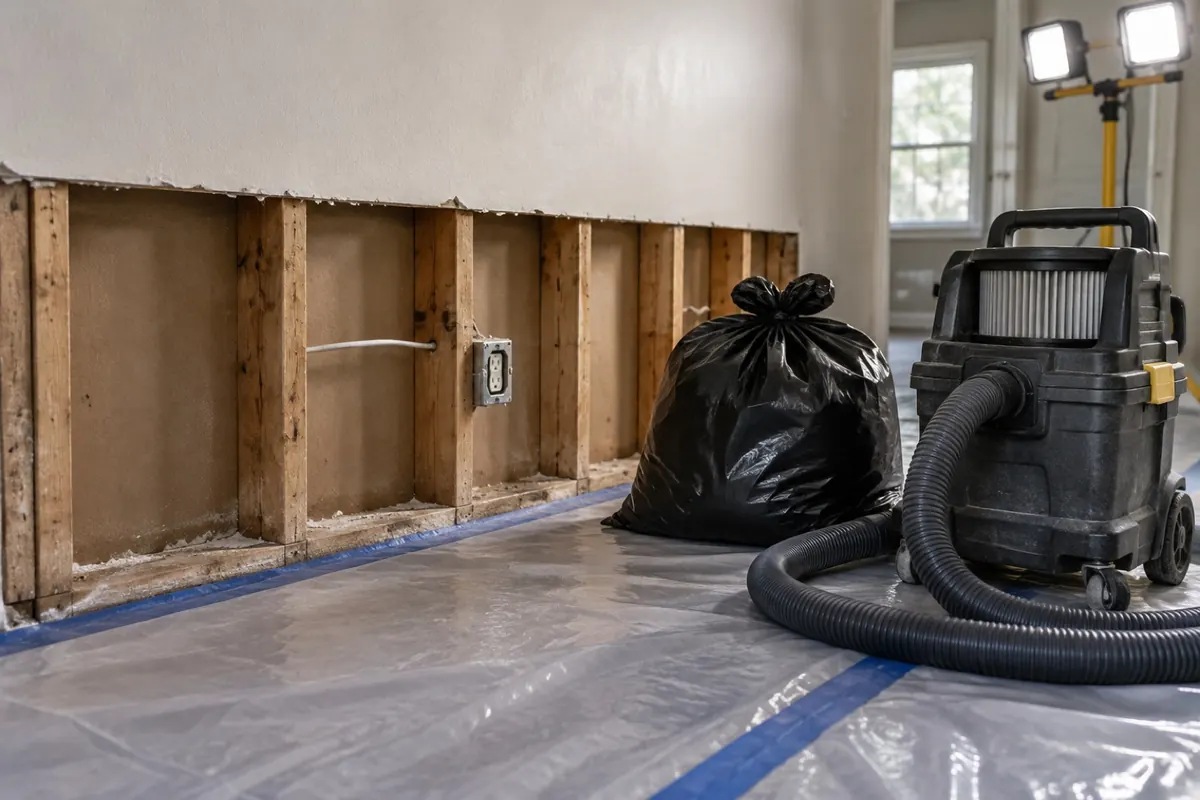
What mold-resistant really means
Mold-resistant board and paint are rated with ASTM D3273. According to ASTM's published scope of D3273-21, it runs coatings for 4 weeks in a chamber held above 93% RH at 32.5 C (90 F). The standard says a rating implies no specific period free of fungus, though a better-rated coating nearly always performs better in use.
| Product | Claim | Caveat in the maker’s own text | Source |
|---|---|---|---|
| DensArmor Plus (paperless) | Fiberglass mats replace paper; scored 10 under D3273 | No material can be considered mold proof | Georgia-Pacific's DensArmor Plus product page |
| Sheetrock Mold Tough (paper-faced) | Treated core and surface; tested Firecode panels scored 10 | Lab test may not represent actual use | USG's Sheetrock Mold Tough data sheet |
| Perma-White paint | Mildewcide in the film; film guaranteed 5 years | Film only; not for active leaks | Perma-White technical data sheet |
The USG result is the telling one: a paper-faced board also scored 10, so a 10 does not separate paper from paperless board. GP says its paperless panels give increased resistance compared with standard paper-faced gypsum. The paint sheet says to remove all existing mould before painting and to call a remediation professional if mold may be behind the wall.
The moisture check
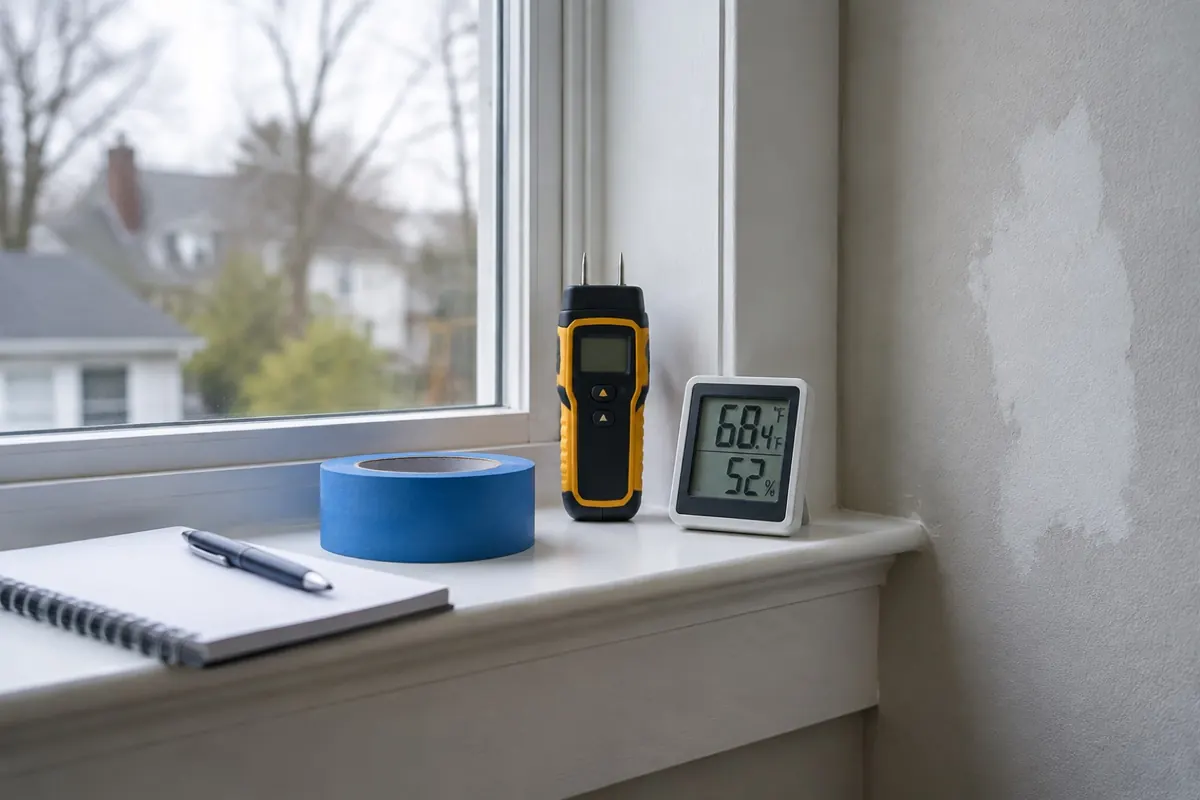
EPA's remediation guide, Chapter 3 describes moisture meters as direct-reading tools, probed into or pressed against a material, usable on wallboard and for monitoring drying. On a gypsum scale, according to Delmhorst, a moisture meter maker, 1% or lower is optimal for drywall; over 1% the board is compromised, and replacing it is safer if it reads over 2% at any point. That is manufacturer guidance, not a standard.
Without a gypsum scale, Delmhorst's drywall meter guide says to read a known-dry piece of the same drywall first and compare. Three readings settle most walls:
- Dry board under the growth, dry reference matches: the water came from room air. Treat it as condensation and fix humidity and air movement.
- Readings rise toward a window, pipe or ceiling: a leak is feeding it. Stop the water before any cleaning.
- Board wet, soft or swollen: per EPA Table 1 and Delmhorst, it is removed rather than dried.
Add a hygrometer. EPA's Brief Guide to Mold, Moisture and Your Home prices one at $10 to $50. A room above EPA’s 60% ceiling points to condensation; a dry room with a wet wall points to a leak.
The decision matrix
Find the row that matches your wall. Thresholds are EPA’s and New York City’s; the causes follow the patterns above.
| What you see | What it is | What to do |
|---|---|---|
| Spots in a cold corner, board dry, under 10 sq ft | Condensation | Clean with detergent; cut humidity; pull furniture away |
| Same, returning after cleaning | Condensation not fixed | Hygrometer; dehumidify; insulate the cold surface |
| Bubbling wallpaper or paint, musty smell | Trapped or hidden growth | Do not strip it dry; treat as hidden mold |
| Patch under a window or around a pipe, wet reading | Leak | Stop the water; then dry or cut |
| Soft, swollen or stained-through paper | Board failed | Cut out at least 6 in past growth |
| 10 to 100 sq ft of moldy board | Remediation | Limited containment per EPA Table 2 |
| Over 100 sq ft, or sewage water | Professional job | Full containment; experienced remediator |
| Musty smell, nothing visible | Unknown | Inspection before opening walls |
For the last row, our mold inspection cost page covers what an assessment involves, and our mold remediation cost page covers the price of the larger rows.
For contractors
The cause statement is the scope. Condensation jobs end with a humidity and ventilation recommendation; leak jobs need the leak repaired and documented first. Record meter readings on a sketch with a dry reference, photograph the growth before and after, and set cut lines at least 6 inches (0.5 ft) past visible growth, per New York City's 2008 mold guidelines. Disinfectants are seldom needed, the same guideline says.
Duration matters to the claim. A commercial policy quoted in a 2023 Tenth Circuit opinion excludes continuous or repeated seepage or leakage of water over 14 days or more. Wording varies; the owner’s policy, state insurance department and a qualified professional decide what applies. Bathroom walls with tile are handled on our mold in shower page.
Questions people actually ask
Is mold in walls harmful?
Health effects are outside this page; CDC and EPA publish guidance and a clinician can advise on a specific person. For the building, EPA’s position is plain: mold damages what it grows on, so fix the moisture source and remove the growth, cutting out wallboard that is wet, swollen or moldy beyond a small area.
Is it okay to sleep in a room with mold?
That depends on the people involved, which is a health question for a clinician, with CDC and EPA guidance as background. What the building guidance says is to fix the moisture and remove the growth. NYC’s guideline asks for an unoccupied work area during cleanup of even small isolated areas.
Can I stay in my house if it has mold?
Occupancy decisions involving health belong to a clinician, with CDC and EPA guidance. On scope: under 10 square feet, EPA says most owners can clean it; between 10 and 100 square feet EPA Table 2 calls for limited containment, and above 100 full containment.
Will mold go away on its own in walls?
No. EPA says mold gradually destroys what it grows on and that controlling moisture controls growth. Drying the wall stops new growth, but the growth already in the paper stays until it is cleaned off or the board is removed.
What causes mold on bedroom walls?
Usually condensation. EPA’s mold course says mold is frequently found on walls in cold corners behind furniture where condensation forms. Building Science Corporation reports that in winter, room air at 70 F and 40% RH reaches 70% humidity at any surface below 54 F.
Does mold-resistant paint kill mold?
No. The Perma-White data sheet says its mildewcide prevents growth on the paint film only, says to remove all existing mould before painting, and says it is not designed to stop active leaks. EPA says paint over a moldy surface is likely to peel.
Sources
- EPA's Mold Cleanup in Your Home, US EPA, updated 4 June 2026. Retrieved 13 October 2026.
- EPA's Brief Guide to Mold, Moisture and Your Home, US EPA, updated 18 February 2026. Retrieved 13 October 2026.
- EPA Mold Course, Chapter 2, US EPA, updated 1 December 2025. Retrieved 13 October 2026.
- EPA's remediation guide, Chapter 3, EPA Table 1 and EPA Table 2, EPA 402-K-01-001. Retrieved 13 October 2026.
- New York City's 2008 mold guidelines, NYC Department of Health, November 2008. Retrieved 13 October 2026.
- CDC's mold page, CDC, 26 September 2024. Retrieved 13 October 2026.
- Building Science Corporation report RR-0203, Relative Humidity, Joseph Lstiburek, 23 April 2002. Retrieved 13 October 2026.
- Loukou and colleagues (Journal of Fungi, 2024), Journal of Fungi 10(2): 108, via Europe PMC. Retrieved 13 October 2026.
- ASTM's published scope of D3273-21, ASTM International, Committee D01. Retrieved 13 October 2026.
- Georgia-Pacific's DensArmor Plus product page and Georgia-Pacific submittal sheet (dated 1/14). Retrieved 13 October 2026.
- USG's Sheetrock Mold Tough data sheet, WB2390 rev. 9-10, 2010. Retrieved 13 October 2026.
- Rust-Oleum's Perma-White product page and Perma-White technical data sheet (distributor copy, undated). Retrieved 13 October 2026.
- Delmhorst, a moisture meter maker (16 April 2024) and Delmhorst's drywall meter guide (13 March 2018). Retrieved 13 October 2026.
- US Court of Appeals for the Tenth Circuit, a 2023 Tenth Circuit opinion, No. 22-8059, filed 23 June 2023. Retrieved 13 October 2026.
- Differences and unit conversions are arithmetic on the figures above; nothing was tested by Remediation Insider. See our methodology and the mold hub.
Product claims are the makers’ own. Confirm the current data sheet before specifying a board or paint.