The short answer
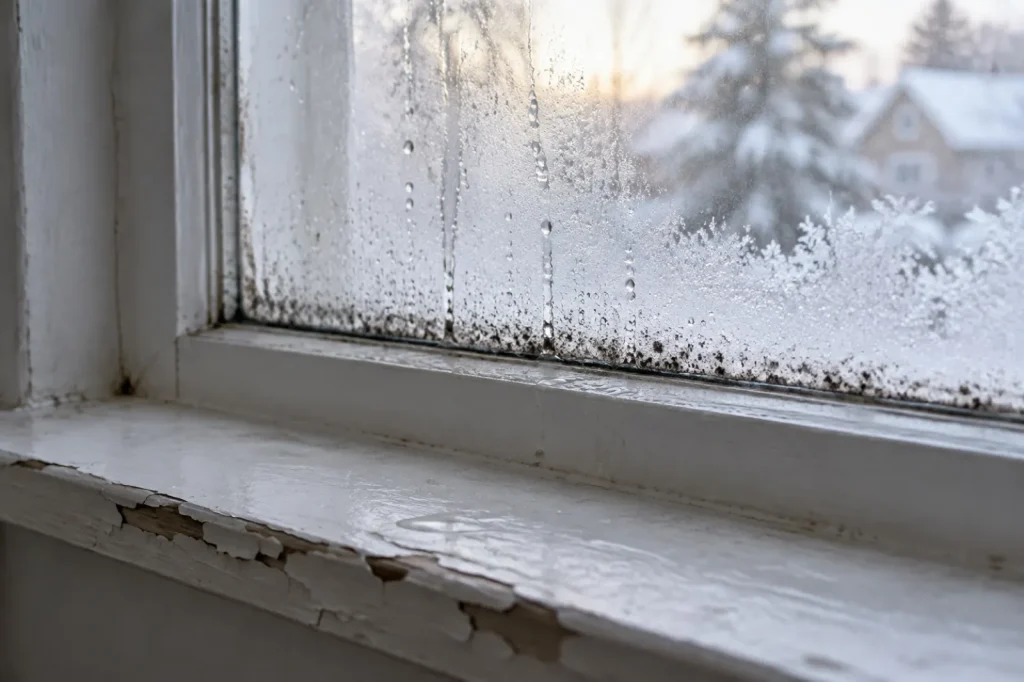
Mold on window sills grows where condensation runs off cold glass and sits on the sill, so the lasting fix is keeping indoor humidity below what your window can handle. According to FGIA’s industry table, that is 40% when it is 20 to 40°F outside, falling to 15% below minus 20°F. Wash the sill with detergent and water, dry it, and clear the weep holes.
Key takeaways
- The window sets the limit. According to FGIA, below 20°F outside the maximum indoor humidity drops 5 points for every 10 degrees colder, assuming 70°F indoors.
- Andersen recommends 30 to 35 percent indoor humidity in winter and says condensation is more common where January averages 35°F or colder.
- Aluminum conducts about 160 W/mK against 0.2 for insulating spacer material, per Lawrence Berkeley National Laboratory report LBNL-5099E: why the glass edge and metal frames condense first.
- Water in a vinyl sill track is normal; water over the interior sill is not, per ProVia's vinyl window care and warranty card.
- A soft wood sill is a carpentry repair, and in a pre-1978 home, a lead paint job too.
On this page
The humidity limit, by outdoor temperature
Lstiburek's 2020 Moisture Control for Residential Buildings calls the window the first condensing surface in most rooms, and notes it works as a dehumidifier, pulling vapor out of the air onto the glass. The water then runs down to the lowest horizontal surface: the sill. So window condensation mold is a humidity problem with a temperature limit, and the industry publishes that limit.
| Outside | FGIA maximum indoor RH | Cardinal recommended | Dew point at FGIA limit |
|---|---|---|---|
| 20 to 40°F | 40% or less | 35% to 40% (20 F and above) | 45°F |
| 10 to 20°F | 35% or less | 30% (+10 F) | 41°F |
| 0 to 10°F | 30% or less | 25% (0 F) | 37°F |
| Minus 10 to 0°F | 25% or less | 20% (minus 10 F) | 33°F |
| Minus 20 to minus 10°F | 20% or less | 15% (minus 20 F) | 27°F |
| Below minus 20°F | 15% or less | Not listed | 20°F |
The two published tables agree below 20°F and differ only at the warm end, where Cardinal Glass Industries' glossary gives 35 to 40 percent and FGIA allows up to 40. The computed column says the same thing in temperature: at the FGIA limit for a 10 to 20°F day, room air has a dew point near 41°F, so any part of the glass or frame colder than that will wet. Real windows vary with glazing, spacers, wind and coverings, so treat the table as a ceiling, not a target. Cardinal Glass Industries' glossary also cites ENERGY STAR advice of 30 to 40 percent in colder climates.
NFRC's ratings page describes the optional Condensation Resistance rating, on a 1 to 100 scale, on the bottom left of the NFRC label: higher means less condensation, which matters most in cold climates.

What you are looking at on a window sill
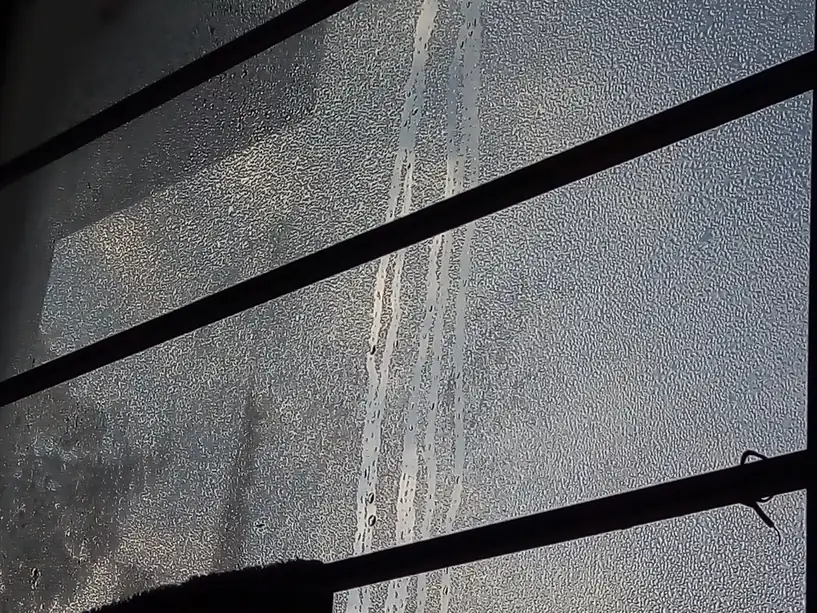
Black mold on window frames and sills is common, but sills also collect things that look like it. Check where the marks sit relative to the water’s path before cleaning.
| What you see | Usually | Check |
|---|---|---|
| Dark spots along the bottom edge of the glass and the sash joint | Mold on condensation runoff | Wet on cold mornings |
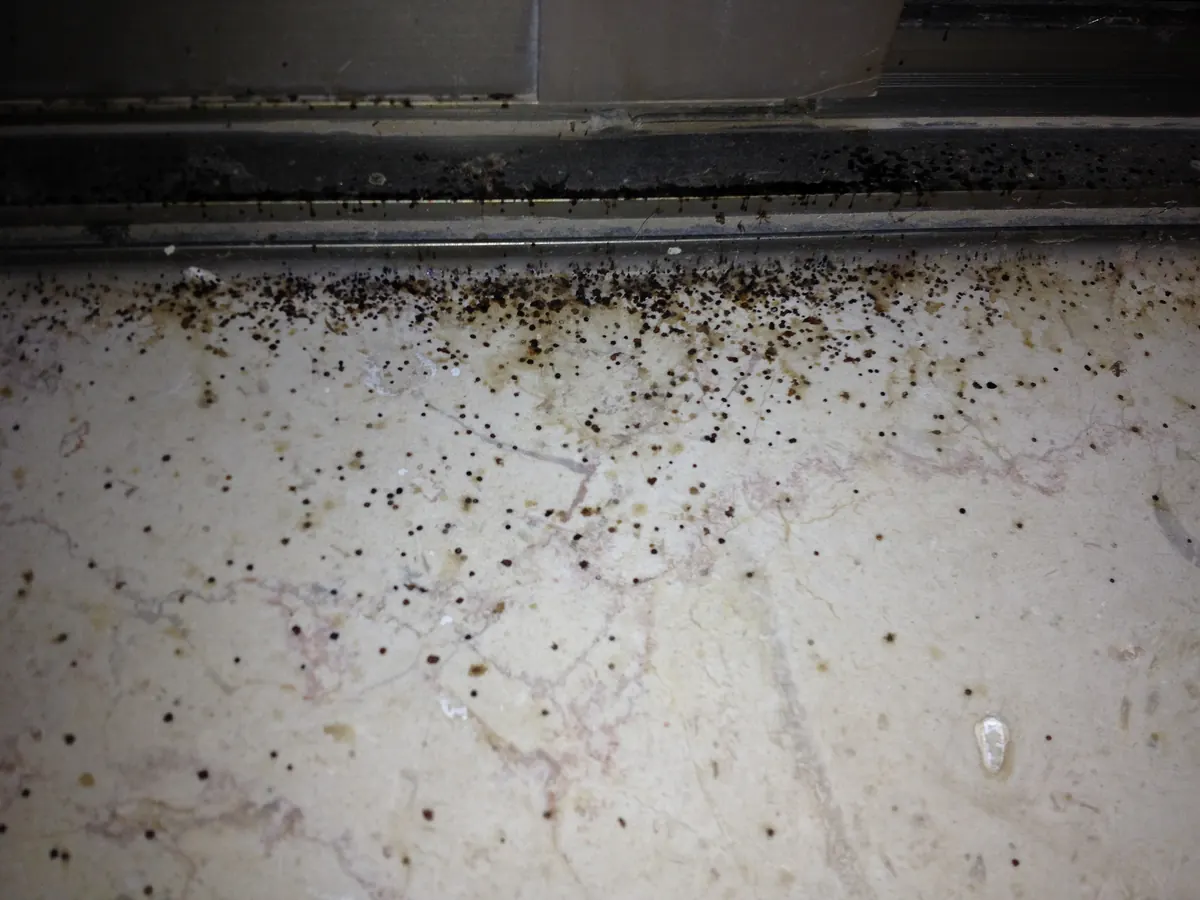
| Black specks in a slider track or on the rubber gasket | Mold on dirt held wet in the channel | Track drains slowly |
| Loose dark grains, pollen, dead insects | Debris | Vacuums up dry |
| Fog or droplets between the panes | Failed insulating glass seal | Cannot be wiped from either side |
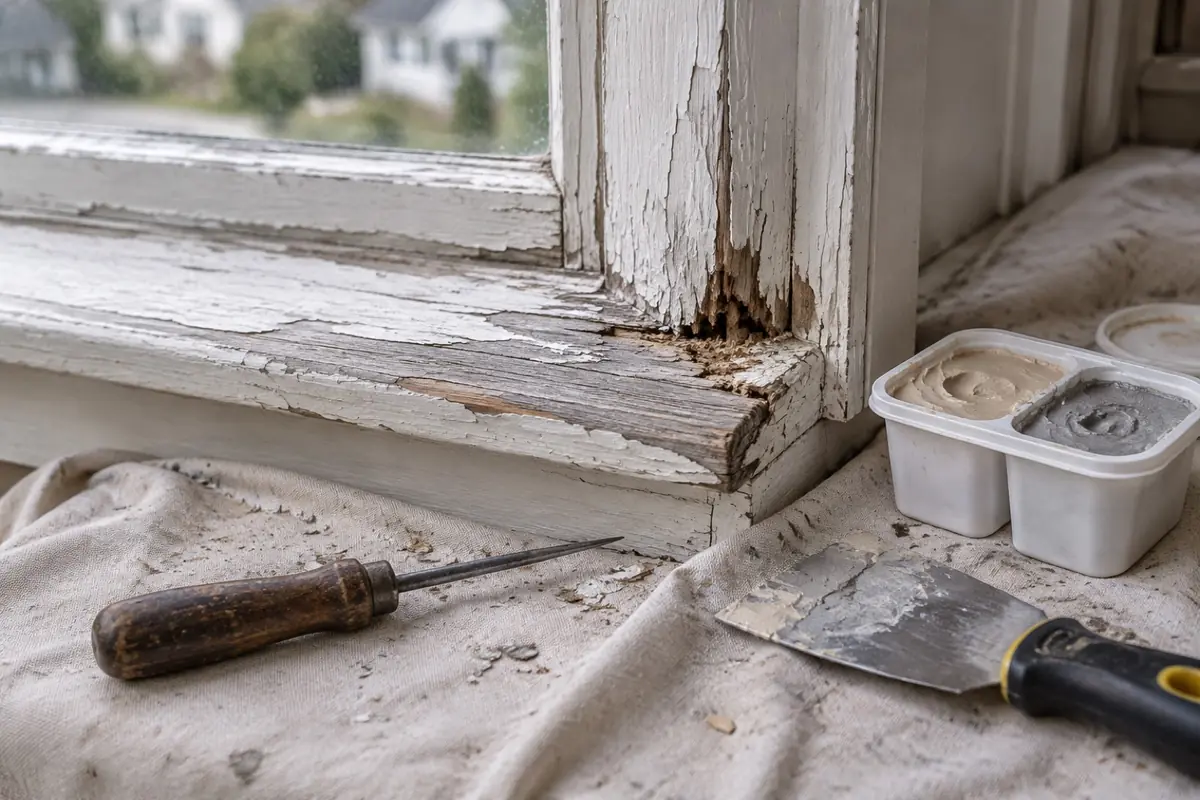
| Peeling paint, grey soft wood at the front corner | Water damage, possibly decay | Ice pick test below |
| White fuzz or powder | Mold or efflorescence | See white mold |
NFRC's condensation article notes that condensation leads to mold around windows, especially on frames made of wood rather than vinyl or metal. On vinyl and aluminum, growth sits on whatever film is on the surface; on wood it can go into the grain.

Wood, vinyl, aluminum: how each frame holds up
Frames are not a detail. According to Gustavsen and colleagues at Lawrence Berkeley National Laboratory, frames typically make up 20 to 30 percent of a window’s area, and their effect on heat loss can be much larger. The same paper reports earlier measured frame U-values from 2.1 W/m2K for a wooden frame to 11.2 W/m2K for an aluminum one: about 5 times the heat flow, and a colder inside face.
| Frame | Where condensation shows | How it holds up wet | Cleaning tolerance |
|---|---|---|---|
| Aluminum, no thermal break | On the frame itself as well as the glass | Does not rot; growth sits on surface film | Detergent and water |
| Aluminum, thermally broken | Less on the frame: the break cuts heat flow | As above | Detergent and water |
| Vinyl | Glass edge and track | Does not rot; holds water in tracks | Mild soap; no abrasives (ProVia) |
| Painted or stained wood | Glass edge, putty line, sill joints | Absorbs water; finish fails, then decay | Detergent and water; no dry sanding pre-1978 |
The glass edge is the other cold line. Lawrence Berkeley National Laboratory report LBNL-5099E gives pure conductivities of 160 W/mK for aluminum, 17 for stainless steel and about 0.20 for the insulating elements in insulated spacers. A metal spacer holding the panes apart chills the bottom inch of glass, which is why NFRC's glossary defines warm-edge technology as low conductance spacers that reduce heat transfer near the edge. Andersen names metal components and bay or bow windows as cold spots too.
Weep holes and sill tracks
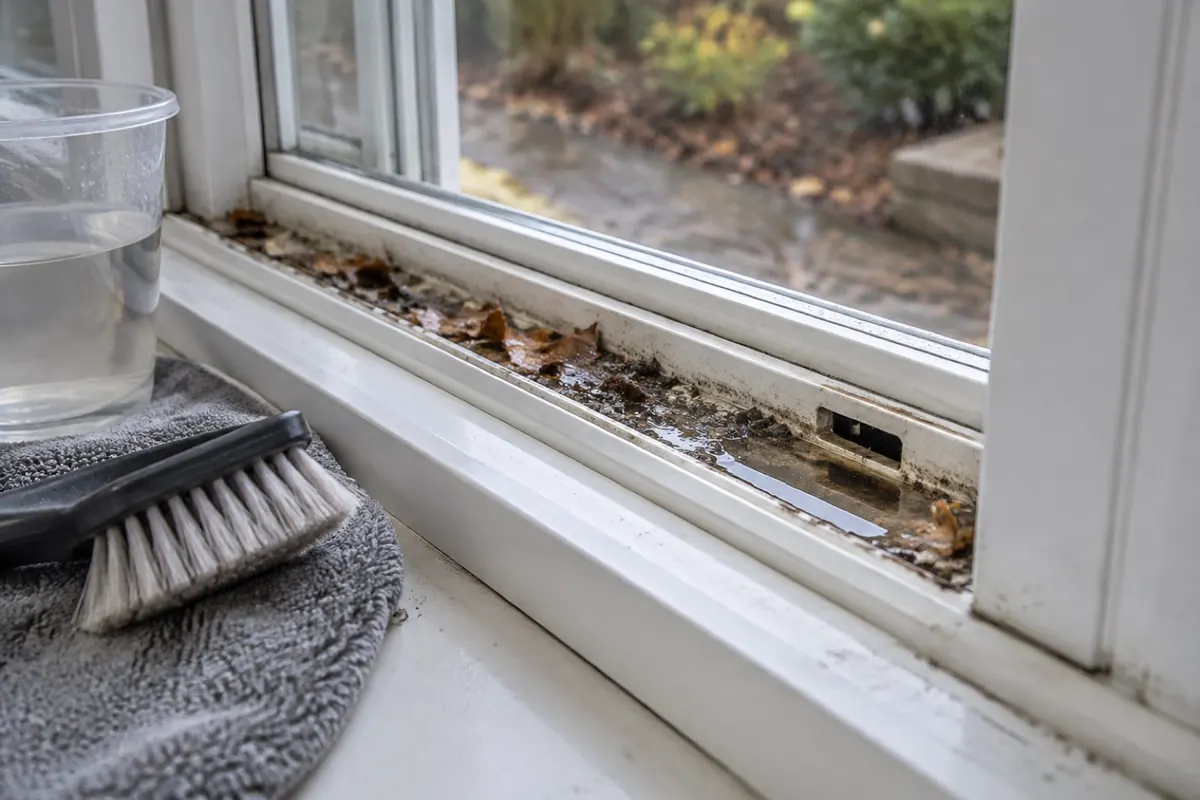
NFRC's glossary defines a weep hole as a small opening in a wall or window sill member through which water may drain to the exterior, and a sill track as the track at the sill of a sliding unit. ProVia's vinyl window care and warranty card explains that many windows are designed to catch water in the sill and drain it outside, and that water in the sill is not a problem unless it overflows onto the interior sill or wall. Then check for debris blocking the drainage holes.
- Vacuum the track dry first, so washing does not carry dirt into the weeps.
- Find the weeps. Small slots at the outer edge of the track or on the exterior face of the frame.
- Pour a little water into the track. It should drain away. Water that sits means a blocked weep.
- Clear gently with a soft brush or pipe cleaner rather than a screwdriver.
- Check outside. Paint, caulk or insect nests can seal the exterior opening. ProVia also says to inspect exterior caulking regularly.
A blocked weep turns the track into a tray of standing water and dirt, which is where black specks on vinyl usually start.
Cleaning mold off a window sill, by material
EPA’s 10 square foot line and the generic method are on our DIY mold remediation page; a sill is almost always smaller. What changes is the material.
| Step | Why this differs from generic advice |
|---|---|
| 1. Dry the glass and sill first; note where water collects | The wet line is your map of the condensation path. |
| 2. Vacuum the track and corners | Loose debris on a sill is mostly dirt; washing it smears it. |
| 3. Vinyl and aluminum: mild soap and water, soft cloth | ProVia warns abrasive cleaners scratch vinyl; scratches hold dirt and regrowth. |
| 4. Painted wood: detergent and water, damp cloth, no soaking | Water in the end grain at sill joints is how decay starts, per NPS. |
| 5. Pre-1978 paint: no dry sanding or scraping | Sills are friction surfaces EPA singles out for lead dust. |
| 6. Dry completely, then fix the humidity | EPA: dry completely. Cleaning alone resets the clock. |
For vinegar, see our page on whether vinegar kills mold; on bleach and black mold generally, see how to kill black mold. CDC's mold page says to remove mold whatever its type. If the paint is failing, re-finish only after the wood is dry, and EPA's Mold Cleanup in Your Home warns that paint over moldy surfaces is likely to peel.
When rot has set into a wood sill
Moisture thresholds and the general probe test for wood are on our mold on wood page. A sill has its own test. National Park Service Preservation Brief 9 (John H. Myers, 1981) describes jabbing an ice pick into wetted wood at an angle and prying up a sliver: sound wood separates in long fibrous splinters, decayed wood lifts in short irregular pieces. Pushing the pick straight in finds decay hidden under a sound skin, which the brief calls especially useful for sills.
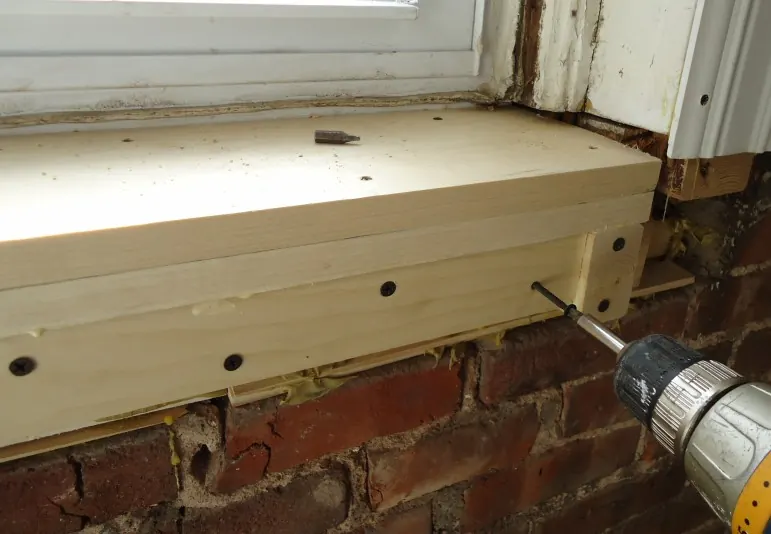
The brief notes decay usually starts where water collects: the sill, the sill to jamb joints and the bottom rail corners. It sets out three repair classes: routine maintenance, structural stabilization (consolidating with semi-rigid epoxy, then patching, sanding and painting), and parts replacement or splicing in new wood. It also says to check that the sill slopes away from the building and to consider a dripline cut under it.

Fixing the condensation itself
| Fix | Why it works | Source |
|---|---|---|
| Vent bath and kitchen fans, dryers and gas appliances outside | Removes vapor at the source | Andersen |
| Run exhaust fans while cooking and showering | Cuts peaks that wet the glass | Renewal by Andersen |
| Run a dehumidifier | Lowers room RH below the window’s limit | ProVia's vinyl window care and warranty card |
| Open blinds and drapes; run ceiling fans | Warm room air reaches the glass | Andersen |
| Store firewood outside; limit plants and aquariums | Fewer moisture sources | Renewal by Andersen |
| Be wary of deep thermostat setbacks | Cooler air means higher relative humidity | Lstiburek's 2020 Moisture Control for Residential Buildings |
| Seal interior storm panels, let the prime window breathe | Trapped moisture condenses on the outer pane | National Park Service Preservation Brief 9 |
| Replace with a higher CR rated window | Warmer glass and frame surfaces | NFRC's ratings page |
Renewal by Andersen puts the moisture from cooking three meals a day at four or five pints, and NFRC says household water use often adds more than a gallon a day. EPA's Brief Guide to Mold, Moisture and Your Home advises keeping indoor humidity below 60 percent, ideally 30 to 50, but in a cold snap the window’s limit in the table above is lower. For sizing a dehumidifier, see our water damage dehumidifier page; equipment selection beyond that is an HVAC question.
One caution from Lstiburek's 2020 Moisture Control for Residential Buildings: higher performance glazing let houses run more humid without visible condensation, which it links to more moisture problems in the enclosure. A sill that stopped fogging after new windows does not prove the house is dry; see mold on walls.
Signs it is bigger than the sill
- Water over the interior sill or down the wall below.
- Stains on the drywall or trim under the window, which suggest a leak, not condensation.
- A soft sill, or an ice pick that sinks in.
- Mold on several windows plus closets or a bathroom ceiling: whole house humidity.
- Fog between panes: seal failure, which Andersen says calls for replacement.
- Growth back within days of cleaning in mild weather.
For contractors: lead, warranty language and documentation
Window sills are where lead rules bite. EPA's RRP program page requires certification for paid work disturbing paint in homes built before 1978 and names window sills as friction surfaces. Under 40 CFR 745.83, the minor repair exemption (6 square feet interior per room, 20 exterior) never applies to window replacement. According to 40 CFR 745.85, the certified renovator verifies each window sill in the work area with a wet disposable cloth compared against a cleaning verification card.
The hazard bar moved. According to 40 CFR 745.65, from 12 January 2026 a dust-lead hazard on interior window sills is any reportable level, and EPA's lead hazard standards page lists the sill clearance level as 40 micrograms per square foot, down from 100.
Read the window warranty before promising anything. ProVia's vinyl window care and warranty card states it ‘does not cover condensation, nor frost or freezing from condensation’, and excludes paint or stain damage caused by condensation. Document indoor humidity and outdoor temperature at the visit, weep hole and track condition, ice pick results, year built and painted area disturbed.
What this page does not cover. Health effects of mold are out of scope; see CDC's mold page and EPA and NIH guidance. Coverage questions belong with your policy, your state insurance department or a licensed professional. More in our mold coverage.
Which situation are you in?
| What you find | What it means | Do this |
|---|---|---|
| Spots on the glass edge, sill wet on cold mornings | Room RH above the window’s limit | Clean, then hold RH under the table value |
| Specks in a slider track, water standing | Blocked weeps | Vacuum, water test, clear weeps |
| Wet on one window only | Cold spot: metal frame, bay window or failed seal | Check the frame and the seal |
| Paint peeling, ice pick lifts short pieces | Decay | Consolidate and patch, or replace the sill |
| Stains below the window after rain | Leak, not condensation | Exterior flashing and caulk; check the wall |
| Pre-1978 house and paint must be disturbed | Lead rules apply to paid work | Certified renovator |
Questions people actually ask
Is it normal for mold to grow on window sills?
It is common because the window is usually the first condensing surface in a room, and water runs down onto the sill. Common is not normal: regular growth means indoor humidity is above what the window tolerates at that outdoor temperature, or the sill track is not draining.
How do I get rid of mold on window sills?
Vacuum loose debris, then wash with detergent and water and dry completely, as EPA’s cleanup guide describes. On vinyl use mild soap and no abrasives. On painted wood avoid soaking the joints, and in a pre-1978 home do not dry sand. Then lower indoor humidity or the mold returns.
Is window sill mold toxic?
Health questions are outside this page’s scope; CDC and EPA publish that guidance. CDC’s position is that mold should be removed whatever its type, so a lab result does not change how a sill is cleaned. What matters for the sill is stopping the condensation that feeds it.
How do I prevent mold on window sills?
Keep indoor humidity under the limit for the outdoor temperature: according to FGIA, 40% at 20 to 40 degrees Fahrenheit and 30% at 0 to 10 degrees. Vent fans outside, open blinds so warm air reaches the glass, keep weep holes clear and wipe the sill dry on cold mornings.
Why is there mold on my windows from condensation in winter?
Cold outdoor air chills the glass and frame below the dew point of the room air, so vapor condenses and runs down. Andersen says condensation is more common where January averages 35 degrees Fahrenheit or colder. Metal frames and spacers make the edge of the glass coldest, which is where mold lines usually start.
What humidity should I keep my house at in winter to stop window condensation?
Andersen recommends 30 to 35 percent in winter. According to FGIA’s table, which assumes 70 degrees indoors, you can allow 40% when it is 20 to 40 degrees outside, 25% at minus 10 to 0, and 15% below minus 20. Cardinal Glass gives near identical figures. Both assume 70 degrees indoors.
Sources
- FGIA's Understanding Indoor Condensation, Fenestration and Glazing Industry Alliance, undated. Retrieved 19 October 2026.
- Cardinal Glass Industries' glossary, Indoor Condensation, updated 1 August 2024. Retrieved 19 October 2026.
- Andersen, Condensation on windows, and Renewal by Andersen, Window Condensation Questions and Answers; both undated. Retrieved 19 October 2026.
- the NFRC consumer guide, NFRC's condensation article, NFRC's ratings page and NFRC's glossary, National Fenestration Rating Council. Retrieved 19 October 2026.
- Lawrence Berkeley National Laboratory report LBNL-5099E, Gustavsen, Grynning, Arasteh and others. Retrieved 19 October 2026.
- Gustavsen and colleagues at Lawrence Berkeley National Laboratory, Developing Low-Conductance Window Frames. Retrieved 19 October 2026.
- Lstiburek's 2020 Moisture Control for Residential Buildings, Building Science Corporation, 30 September 2020. Retrieved 19 October 2026.
- ProVia's vinyl window care and warranty card, S-MK-04055-25, January 2025. Retrieved 19 October 2026.
- National Park Service Preservation Brief 9, The Repair of Historic Wooden Windows, 1981. Retrieved 19 October 2026.
- National Weather Service dewpoint equations, NWS El Paso. Retrieved 19 October 2026.
- EPA's Mold Cleanup in Your Home (4 June 2026) and EPA's Brief Guide to Mold, Moisture and Your Home (18 February 2026). Retrieved 19 October 2026.
- EPA's RRP program page (17 June 2026) and EPA's lead hazard standards page (19 December 2025). Retrieved 19 October 2026.
- 40 CFR 745.65, 40 CFR 745.83 and 40 CFR 745.85, via Cornell LII. Retrieved 19 October 2026.
- CDC's mold page, 26 September 2024. Retrieved 19 October 2026.
- Dew points are arithmetic on the NWS equations at 70°F. See our methodology.
Window warranties and condensation guidance differ by manufacturer and product line; check your own.