The short answer
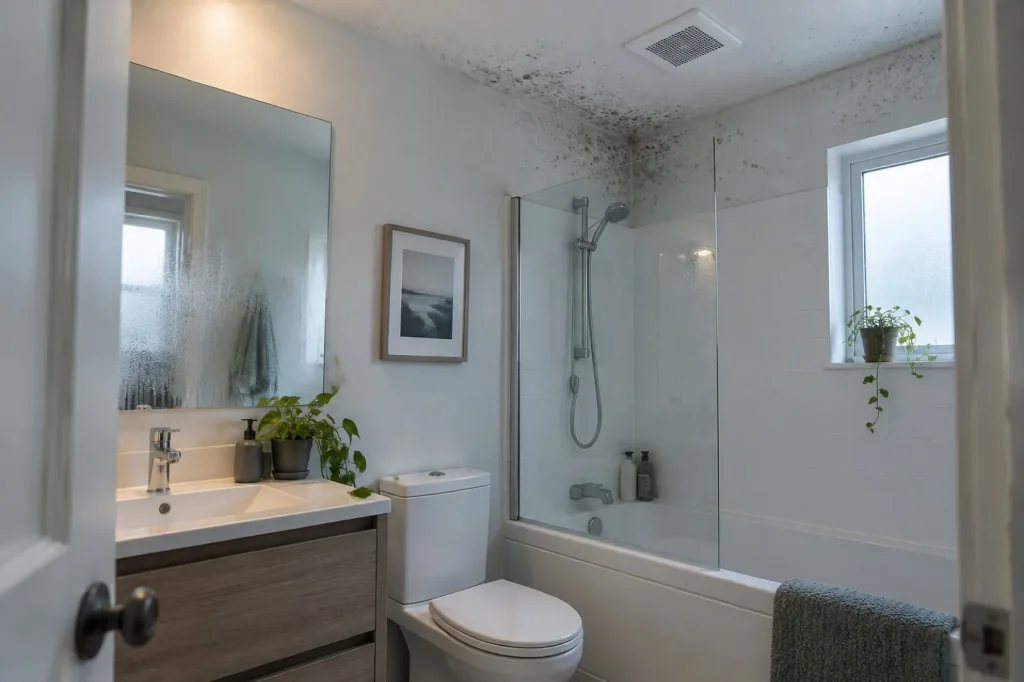
Mold on bathroom ceiling paint is usually condensation, not a leak. Shower vapor meets a ceiling colder than the air’s dew point, typically under a cold attic or roof, and a fan that is weak, ducted into the attic or switched off early leaves it wet. Wash painted drywall with detergent and water, then fix the airflow and the insulation above. Brown rings mean a leak.
Key takeaways
- The spot pattern is the evidence: speckle over the shower means condensation, a ringed brown stain means water from above.
- A ceiling bay with no insulation works out to about 45°F under a 20°F attic, below the 51°F dew point of 70°F room air at 50% humidity, according to the arithmetic on this page.
- Mold needs no droplets: according to Lstiburek's 2020 moisture control guide, it grows on paper faced surfaces at about 80% surface humidity.
- IRC Section M1501.1 (2006 New Jersey edition, published by ICC) bars exhausting into an attic, soffit, ridge vent or crawl space.
- Per Building Science Corporation report RR-0210, growth that has gone below the surface of gypsum board means the board comes out.
On this page
- What you are looking at
- Dew point on a ceiling
- Why ceilings under an attic run cold
- Spot pattern, cause, check
- The exhaust fan problem
- Leak above or condensation?
- Cleaning a painted ceiling
- When the drywall comes out
- Paint choice
- Bigger than the spot
- For contractors
- The decision path
- Questions people ask
Bathroom ceiling mold advice usually starts with a spray bottle. That is the last step. The first is reading where the spots are, because location tells you what wets the paint: condensation on a cold ceiling, a fan venting into the attic, or water from above.
What you are looking at on a bathroom ceiling
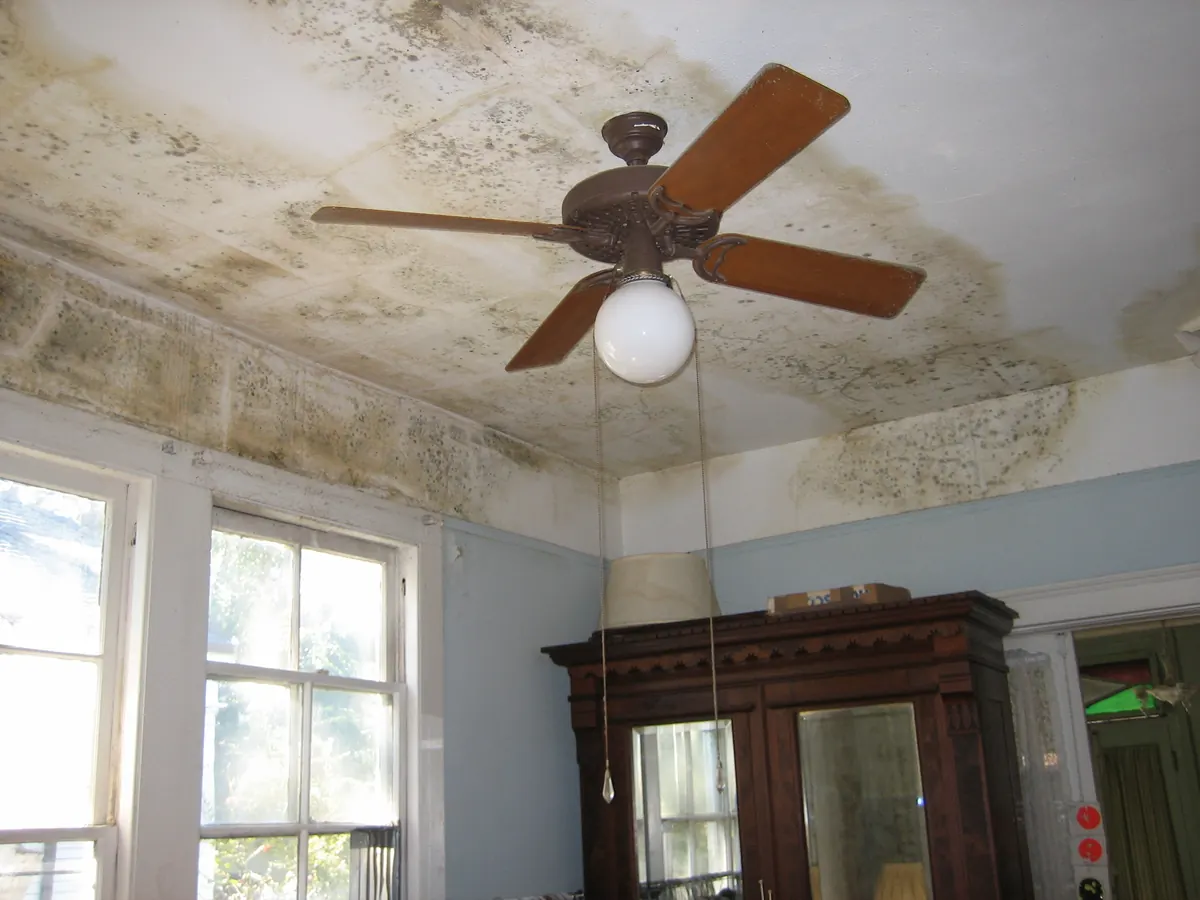
Black spots on bathroom ceiling paint are not all mold. Hold a flashlight flat against the paint so the light rakes across it. Raised, fuzzy dots that smear on a damp white cloth behave like growth. Flat grey stripes at even spacing behave like something else.
| What you see | Usually | Quick check |
|---|---|---|
| Grey black speckle, densest over the tub and in corners | Surface mold fed by condensation | Smears on a damp cloth |
| Straight grey stripes at joist spacing | Ghosting: dust or soot on colder framing | Flat, dry, matches framing |
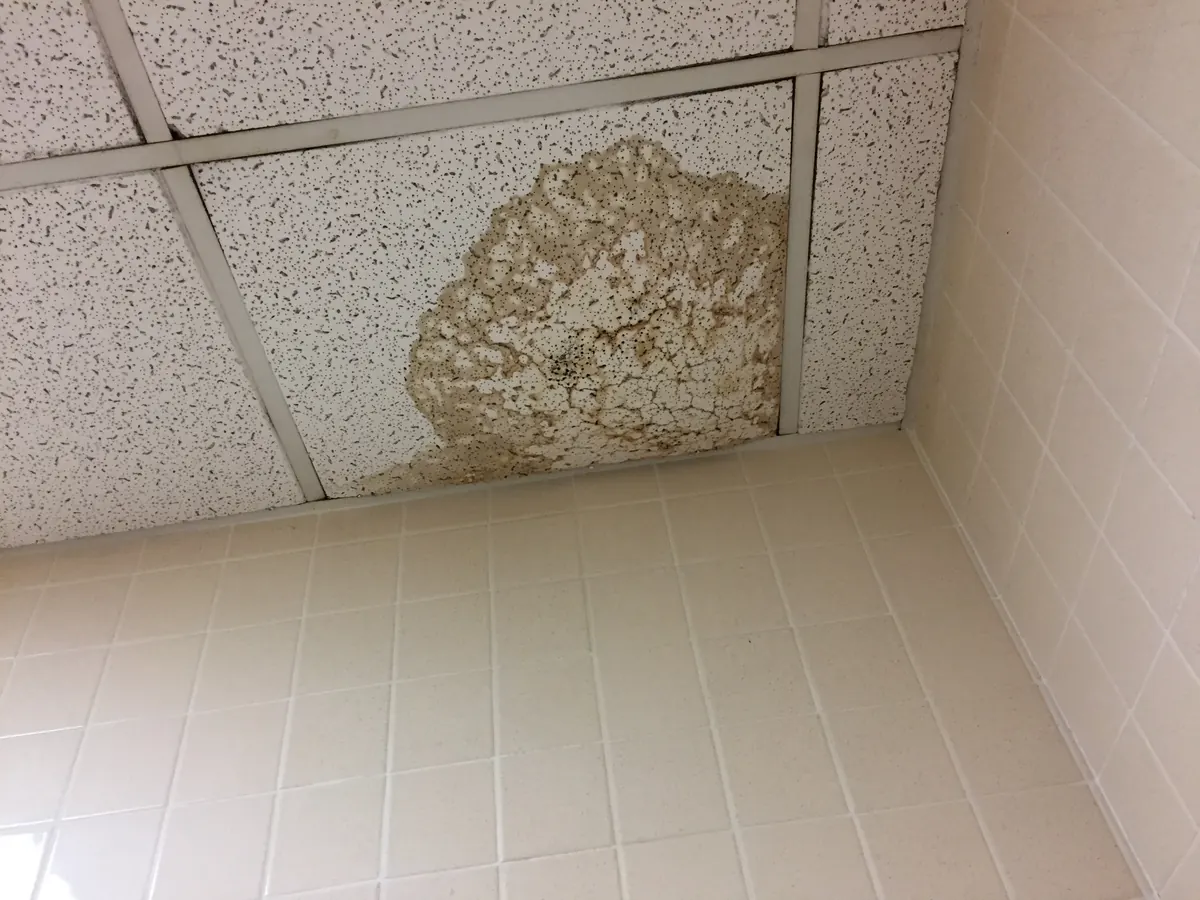
| Brown ring with a hard, darker edge | Water from above | Damp on a dry week |
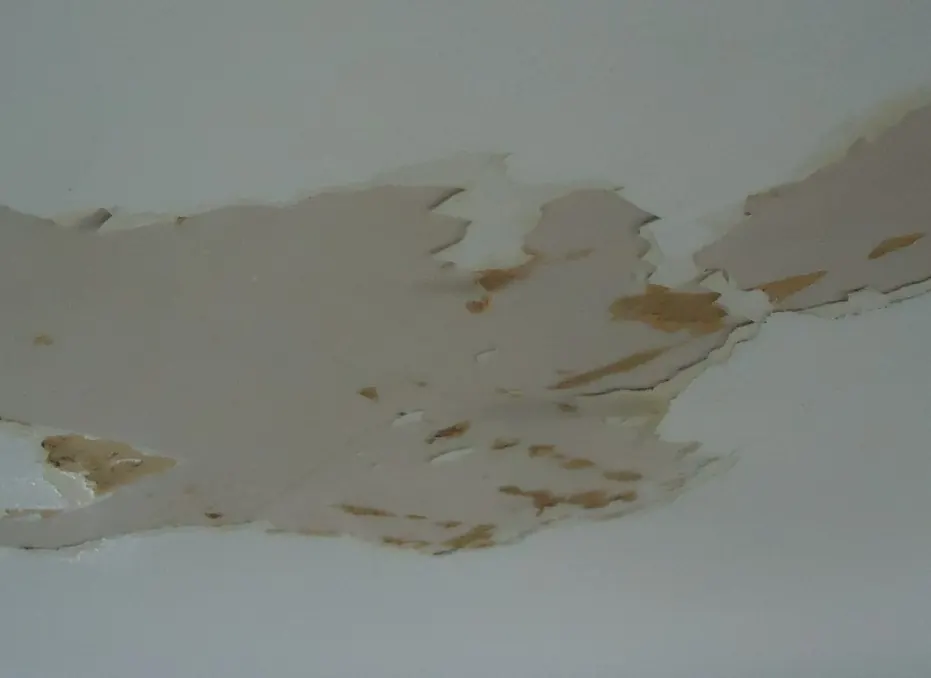
| Paint bubbling or hanging in sheets | Paint failing on wet gypsum | Paper facing exposed |
| Black film near candles or a vent | Soot | Dry smudge, see candle soot |
| Brown ring around the fan grille | Condensation in the duct draining back | Check duct in attic |
Ghosting is the classic false alarm. Joseph Lstiburek's Moisture Control for Residential Buildings (Building Science Corporation, 2020) attributes it to dust and soot settling at thermal bridges, ‘not mold but Brownian motion’. It flags a cold spot, not growth. For the bleach spot test, see mold vs mildew.


Dew point: why the ceiling gets wet first
According to Lstiburek's 2020 moisture control guide, the dew point is the temperature at which air reaches 100 percent relative humidity, and any surface colder than it can collect condensation. A shower drives the dew point toward the room temperature itself, and warm moist air rises to the ceiling, which an attic is pulling heat out of.
Per the National Weather Service vapor pressure equations, room air at 50% humidity has a dew point near 51°F; at saturation it equals the room temperature, so any surface even slightly cooler gets wet. Mold starts earlier still: according to Lstiburek's 2020 moisture control guide, it typically grows on paper faced surfaces at about 80% relative humidity, through condensation inside the paper’s pores. Painted drywall is paper faced drywall with a thin film on it.
Why ceilings under an attic or a roof run cold
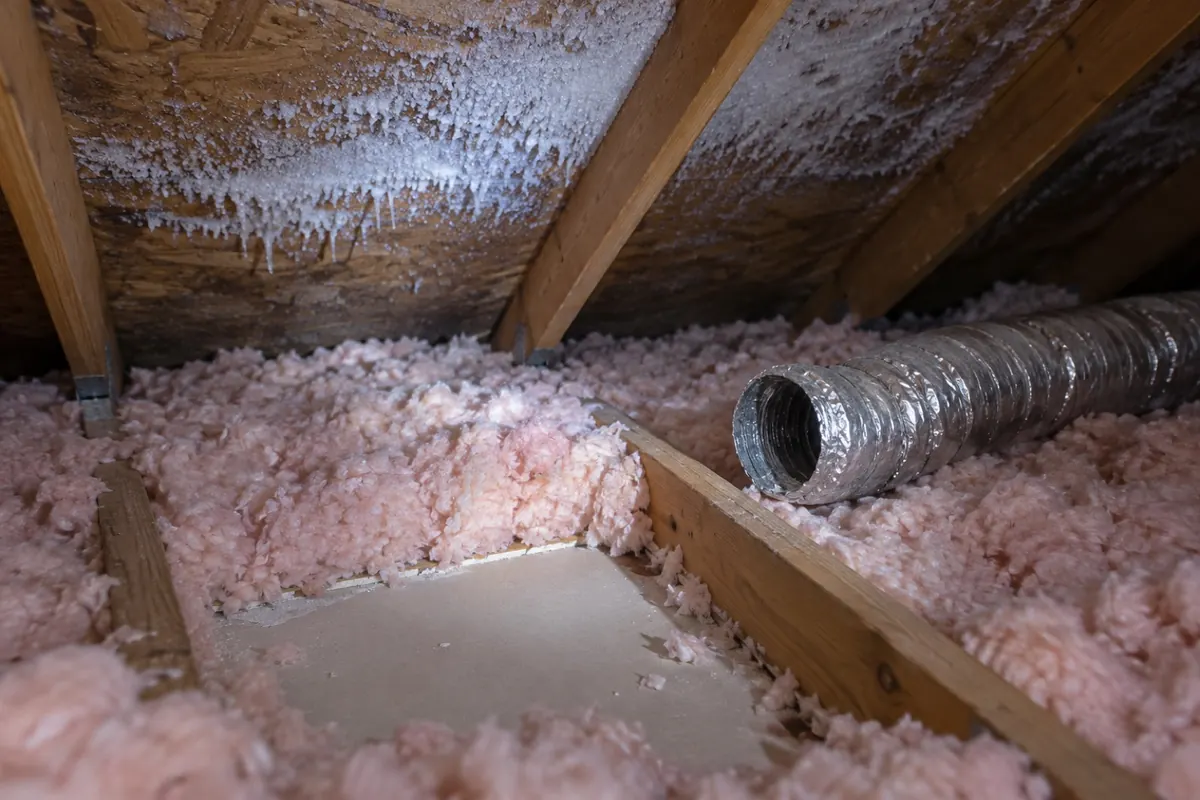
A ceiling under a vented attic is an outside wall laid flat. On a winter night only the insulation on top keeps the drywall warm, and where it is thin, compressed or pushed aside the ceiling cools toward the attic. A bathroom under a cathedral roof has the same problem with less room for insulation.
In Building Science Insight BSI-109 (2018), Lstiburek notes that higher attic insulation and radiant barriers made interior closet ceilings colder, and mold followed. Lstiburek's 2020 moisture control guide adds the eaves, where insulation is compressed and wind washes through it, and corners with little air movement.
To put numbers on it we used the 2021 Seattle Energy Code, Appendix A defaults: R-0.61 room side air film (heat flow up), R-0.45 for half inch gypsum and R-0.17 for the attic side film, with the room at 70°F and attic at 20°F. The model ignores framing and air leaks, so real ceilings do worse.
| Insulation over the bay | Total R | Ceiling surface | Condenses? |
|---|---|---|---|
| Missing or pushed aside | 1.23 | 45°F | Yes, at 50% room RH |
| R-11 | 12.23 | 68°F | Only near saturation |
| R-19 | 20.23 | 68°F | Only near saturation |
| R-38 | 39.23 | 69°F | Only near saturation |
The bare bay is the story. According to the same arithmetic, at 40% room humidity its surface sits near 98% relative humidity, far past Lstiburek’s 80% line, before anyone showers. That is why ceiling mold often has straight edges: it maps the missing insulation. An insulated bay stays within a degree or two of the room, so it gets wet only when a shower nears saturation, and then the fan decides how long it stays wet.
Spot pattern, most likely cause, confirming check
The table to keep. Confirm the cause before buying a fan or cutting drywall.
| Spot pattern | Most likely cause | Confirming check |
|---|---|---|
| Even speckle over the shower, fading toward the door | Vapor condensing; fan weak or off too soon | Tissue at the grille; run the fan on a timer for two weeks |
| Sharp edged strip between two joists | Missing or displaced insulation | Look in the attic over the patch |
| Band where ceiling meets the outside wall | Compressed insulation or wind washing at the eaves | Check baffles and insulation depth at the perimeter |
| Corner growth behind a curtain rail | Low air movement, cold corner | Does leaving the door open change it? |
| Halo around the fan grille | Uninsulated duct condensing and draining back | Inspect duct insulation, sag and termination |
| Grey lines over every joist | Ghosting, not mold | Flat, dry, at framing spacing |
| Ringed stain under an upstairs tub or toilet | Plumbing or roof leak | Moisture reading on a dry week |
| Mold on roof sheathing above the fan | Fan duct dumping into the attic | Follow the duct to a roof or wall cap |

The exhaust fan problem
Fan sizing is covered on our mold in shower page. On a ceiling, three other failures matter more: where the air goes, how long the fan runs, and whether it moves its rated airflow.
Where the air goes
IRC Section M1501.1 (2006 New Jersey edition, published by ICC) reads: ‘The air removed by every mechanical exhaust system shall be discharged to the outdoors. Air shall not be exhausted into an attic, soffit, ridge vent or crawl space.’ Per the DOE Building America Solution Center fan guide, IRC M1504.3 sets the outlet at least 10 feet from a mechanical air inlet or 3 feet from a gravity inlet, and Washington's adopted IRC, WAC 51-51-0303 requires ducts in unconditioned space to be insulated to R-4.
The Building America Solution Center attic check guide explains why: air dumped into the attic condenses on cold rafters and sheathing and can grow mold there, and an uninsulated duct collects condensation in and on itself, which is the ring around the grille. A loose duct means the attic needs a look; see signs of mold in the attic.
How long it runs
| Source | Run time advice |
|---|---|
| DOE Building America Solution Center fan guide | 1 hour after a shower, on a timer |
| Renewal by Andersen | 15 to 20 minutes after showering |
| the National Fenestration Rating Council's consumer guide | Until the mirror is clear |
| Lstiburek's 2020 moisture control guide | Intermittently, according to moisture load |
| EPA's Brief Guide to Mold, Moisture and Your Home | Run the fan or open the window when showering |
Checking airflow: tissue first, flow hood when it matters
The DOE Building America Solution Center fan guide captions a failing fan photo with the rule that a bathroom fan should have enough suction to hold a tissue. That is pass or fail only. The guide notes ducts can push installed airflow below the factory rating, which raters measure with a powered or passive flow hood under ANSI/RESNET/ICC 380. It also cites ENERGY STAR limits of 1 sone for continuous and 3 sones for intermittent fans: a fan nobody can stand to hear gets switched off early.
Leak from the attic or plumbing above, or condensation?
Condensation forms across a whole cold area, leaving soft edged speckle. Liquid water arrives at a point, spreads, and carries dissolved material to the edge as it dries, leaving a ring; each wetting adds another. Map the stain to what is above: an upstairs tub or toilet points to plumbing, a roof vent or valley to the roof, the fan or outside wall back to condensation. Then lift the insulation: a wet top side means water from above, and the job becomes a water damage ceiling job first. Building Science Corporation report RR-0210 treats mold inside a cavity as a separate job that starts by opening the board.
Cleaning a painted bathroom ceiling, step by step
The general method and EPA’s 10 square foot line are on our DIY mold remediation page. This is what changes on a painted ceiling over a tub.
| Step | Why this differs from generic advice |
|---|---|
| 1. Identify the cause first | On a cold ceiling, washing without fixing the fan or insulation buys weeks. |
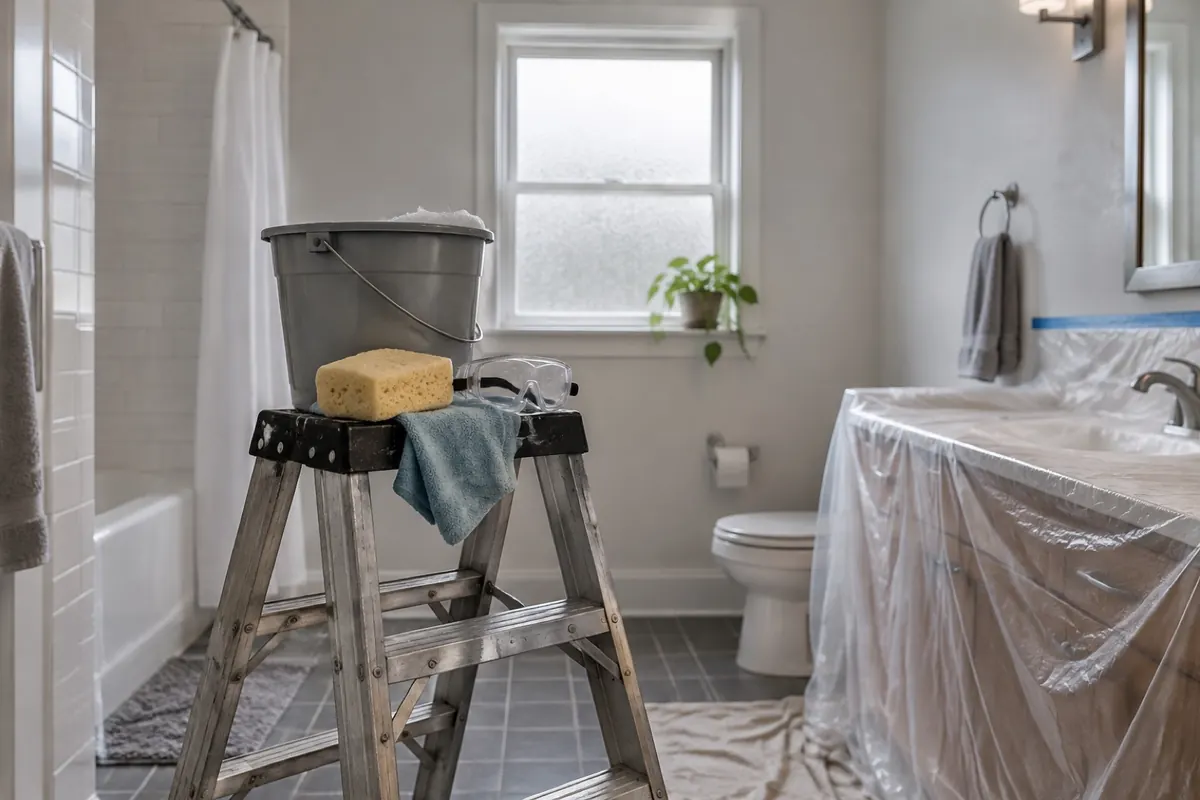
| 2. Goggles on, vanity covered | Overhead work drops water and debris straight down. |
| 3. Detergent and water, sponge damp not dripping | Gypsum soaks water from above; a soaked ceiling sags and stains. |
| 4. Rinse, dry with fan on and door open | The ceiling is the slowest surface in the room to dry. |
| 5. Wait a week before painting | Shows whether growth returns before paint hides it. |
| 6. Prime the stain, then paint | A stain can outlast the growth. |
For bleach, see our page on whether bleach kills mold; CDC's mold page says to remove mold whatever its type, so there is no need to identify it. Before scraping a textured ceiling in an older house, read popcorn ceiling asbestos; EPA's asbestos homeowner page advises leaving undisturbed material alone. In a house built before 1978, treat the paint as possibly leaded until tested.
When the drywall has to be replaced
Building Science Corporation report RR-0210: if mold has penetrated below the surface, as on gypsum board, remove the involved material; for a wall cavity it takes about 1 foot of clean board beyond. EPA's Mold Cleanup in Your Home adds that absorbent ceiling tiles may have to be thrown away.
| Condition | Decision |
|---|---|
| Speckle on intact paint, wipes off | Clean in place |
| Stain remains, board firm | Prime and paint |
| Paper facing exposed and stained | Usually replace |
| Soft or sagging under thumb pressure | Replace |
| Growth back through new primer within weeks | Replace, and find the cause |
| Top side wet or moldy from the attic | Replace |
An open ceiling puts the cause in reach. The DOE Building America Solution Center fan guide describes boxing an attic fan housing in an airtight, insulated cover sealed to the drywall.
Paint choice for a bathroom ceiling
Mildew resistant paint slows growth on a ceiling that is wet an hour a day; it cannot save one below the dew point all winter. Our sibling page on mold killing paint compares the label claims. Paint over mold is likely to peel, per EPA.
Signs it is bigger than the spot
- Straight edges: a hole in the insulation, and maybe more.
- Growth or frost on the attic side above the bathroom.
- A brown ring that grows: liquid water in the cavity.
- Soft, sagging or delaminating board.
- Closets or window sills growing it too: whole house humidity.
- Back within a month of cleaning, or over about 10 square feet.
For contractors: scope, documentation and the lead rule
Document the cause, not just the cleanup: fan model and measured airflow, duct route and termination, insulation over the stain, a stain photo against the framing, year built, and board removed per room.
The lead rule catches ceiling jobs. Per EPA's Renovation, Repair and Painting program page, paid work disturbing paint in homes built before 1978 requires certification. Under 40 CFR 745.83, the minor repair exemption covers 6 square feet or less of painted surface per room, interior; a 2 by 4 foot cutout is 8. According to 40 CFR 745.85, renovators may not use open flame, heat guns at 1,100°F or more, or power sanding without a HEPA shroud.
On coverage, quote the form. New Jersey Manufacturers HO-3 (03/18), one published example, excludes ‘the presence or condensation of humidity, moisture or vapor, over a period of weeks, months or years’ unless hidden within walls or ceilings, and says hidden does not apply to property the insured can access. Policyholders should read their own policy and ask their state insurance department or a licensed professional.
The decision path, in order
- Brown ring or wet above? Treat it as a leak. If not, continue.
- Straight edges? Check the insulation over that bay.
- Fan holds a tissue and vents outdoors? If not, fix the fan or duct, then check the attic.
- Run time? Use a timer at the long end of the range.
- Board firm, growth on paint? Wash, dry, wait, prime, paint. Otherwise replace the section.
- Over 10 square feet, back within a month, or in other rooms? Get a professional assessment.
What this page does not cover. Health effects of mold are out of scope here; see CDC's mold page and EPA and NIH guidance. Fan equipment selection and roof repair belong to HVAC and roofing specialists. More in our mold coverage.
Questions people actually ask
Is it normal to have mold on a bathroom ceiling?
It is common, because the bathroom ceiling is often the coldest surface in the wettest room; Building Science Corporation report RR-0210 lists it as a typical condensation site. Common is not acceptable: recurring growth means the fan, its duct or the insulation above is failing.
What causes mold on a bathroom ceiling?
Usually condensation. Shower vapor meets a ceiling colder than the air’s dew point, typically where attic insulation is thin or missing, and a fan that is weak, vented into the attic or switched off early leaves it wet. A roof or plumbing leak is less common and leaves a brown ring instead of speckle.
How do you get rid of mold on a bathroom ceiling?
Wash painted drywall with detergent and water using a damp sponge, rinse, and dry it with the fan on, as EPA’s cleanup guide describes. Wait a week to confirm it stays gone, then prime and paint. Soft board, or growth into the paper facing, means the section is replaced.
How do I stop mold on my bathroom ceiling?
Change the conditions. Make sure the fan discharges outdoors, as IRC M1501.1 requires, check it pulls air, and run it longer on a timer; DOE’s Building America guide suggests an hour after a shower. Then check the attic insulation over the stain, since a bare bay can sit below the dew point of ordinary room air.
How do you get rid of mold permanently on a ceiling?
Nothing on the paint is permanent. Removal lasts when the ceiling stops getting wet: outdoor fan discharge, enough run time, continuous insulation above and indoor humidity under the 60% upper limit EPA gives. Mold resistant paint helps at the margin, but EPA says not to paint over mold.
Is black mold on a bathroom ceiling dangerous?
Health questions are outside this page’s scope; CDC and EPA publish that guidance. CDC’s position is that whatever the type, mold should be removed, so color does not change the method. Straight grey lines over joists are often ghosting, which Lstiburek’s guide attributes to dust and soot, not mold.
Sources
- Joseph Lstiburek's Moisture Control for Residential Buildings (Building Science Corporation, 2020), via DOE Building America Solution Center. Retrieved 19 October 2026.
- Building Science Insight BSI-109, Lstiburek, 30 December 2018. Retrieved 19 October 2026.
- Building Science Corporation report RR-0210, Lstiburek, Brennan and Yost, 15 January 2002. Retrieved 19 October 2026.
- National Weather Service vapor pressure equations, NWS El Paso. Retrieved 19 October 2026.
- 2021 Seattle Energy Code, Appendix A, A101.3 and Table A101.5. Retrieved 19 October 2026.
- IRC Section M1501.1 (2006 New Jersey edition, published by ICC), M1501.1 and M1506.2; later editions renumber. Retrieved 19 October 2026.
- Washington's adopted IRC, WAC 51-51-0303, R303.5.2. Retrieved 19 October 2026.
- DOE Building America Solution Center fan guide, PNNL for DOE, updated 4 December 2022. Retrieved 19 October 2026.
- Building America Solution Center attic check guide, updated 25 July 2025. Retrieved 19 October 2026.
- Renewal by Andersen and the National Fenestration Rating Council's consumer guide, both undated. Retrieved 19 October 2026.
- EPA's Mold Cleanup in Your Home (4 June 2026) and EPA's Brief Guide to Mold, Moisture and Your Home (18 February 2026). Retrieved 19 October 2026.
- New Jersey Manufacturers HO-3 (03/18), Section I exclusions. Retrieved 19 October 2026.
- 40 CFR 745.83 and 40 CFR 745.85 via Cornell LII, and EPA's Renovation, Repair and Painting program page (17 June 2026). Retrieved 19 October 2026.
- EPA's asbestos homeowner page (25 June 2026) and CDC's mold page (26 September 2024). Retrieved 19 October 2026.
- Dew points and surface temperatures are arithmetic on the equations and R-values above: a simplified model, not measurements. See our methodology.
Codes vary by adopted edition and local amendment; confirm with the building department.