The short answer
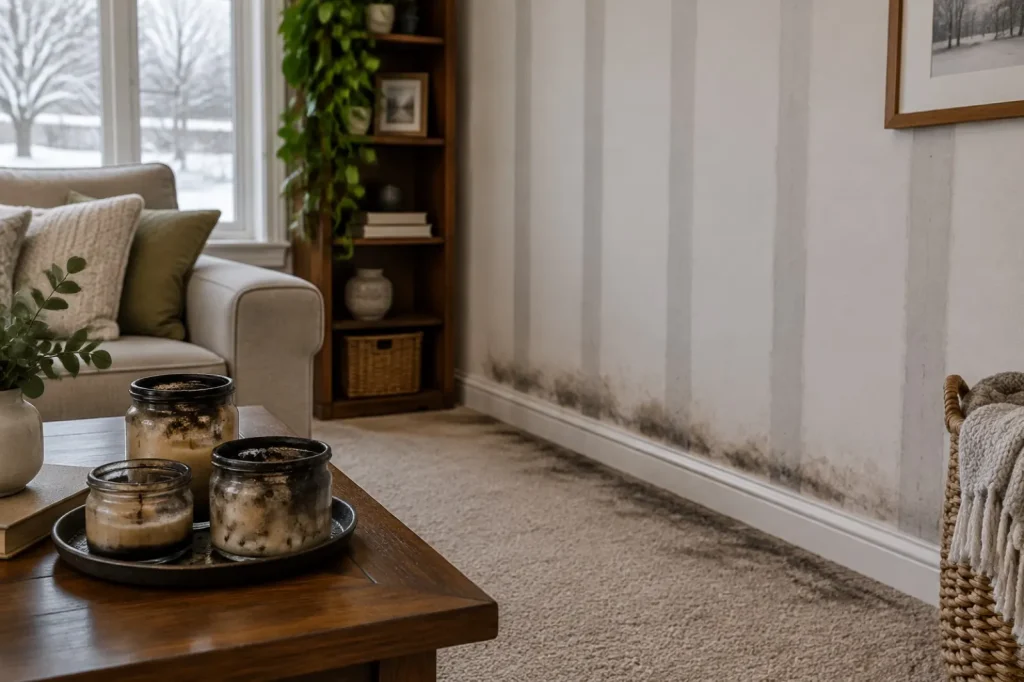
Candle soot is the black carbon a candle flame sheds when it burns incompletely, usually because the wick is long, the flame flickers or the wax is heavily scented. Indoors it settles in lines along cold framing, carpet edges, door undercuts and outlets, a pattern called ghosting. Clean it with a dry chemical sponge first and wash second, because water first smears it into the surface.
Key takeaways
- The EPA’s 2001 candles report gives five names for one problem: black soot deposition, ghosting, carbon tracking, carbon tracing and dirty house syndrome.
- One candle can produce up to 100 times the soot of another, according to research the EPA report cites.
- The house decides where soot lands: cold framing, leaky joints and pressurised rooms pull it into specific lines.
- Cleaning order is fixed: dry vulcanized rubber sponge, ceiling down, no scrubbing, then a mild detergent.
- Both published flame-soot disputes found on the sudden and accidental question, a UK candle complaint and a Texas oil lamp trial, went against the owner.
- A grey HVAC filter plus soot in rooms with no candle means a whole-house job.
On this page
In the 1990s builders kept finding black stripes on new walls. Building scientist Frank Vigil (Vigil in Home Energy (1998)) traced most to soot, usually from candles, delivered by the way air moves through the house. Candle soot damage is a source problem and a delivery problem; fix only one and it comes back.
Scope. Health effects are out of scope; the EPA’s 2001 report says its authors found no studies on health effects of candle soot, and exposure questions belong with a physician or EPA indoor air guidance. General smoke cleaning lives on our smoke damage repair page, and the fire and smoke hub lists the rest.
What you are looking at
Candle soot on walls rarely looks like a smudge above a candle. It looks like a drawing of the hidden framing and air leaks, and each pattern names the force behind it.
| Deposit pattern | Mechanism | Cleaning approach |
|---|---|---|
| Evenly spaced stripes on outside walls and ceilings | Framing runs cooler than insulated bays (InspectAPedia; Vigil in Home Energy (1998)) | Dry sponge each stripe; it returns unless insulation is fixed. |
| Small dots in a grid | Drywall nail or screw heads (InspectAPedia) | Dry sponge; same cause as stripes. |
| Dark band where carpet meets baseboard | Air exits through the joint; carpet filters it (Vigil in Home Energy (1998)) | Vacuum, then extraction; edge soiling may not fully release. |
| Dark strip under a closed door | Pressurised room exhausting under the door (Vigil in Home Energy (1998)) | As above, plus a return air path. |
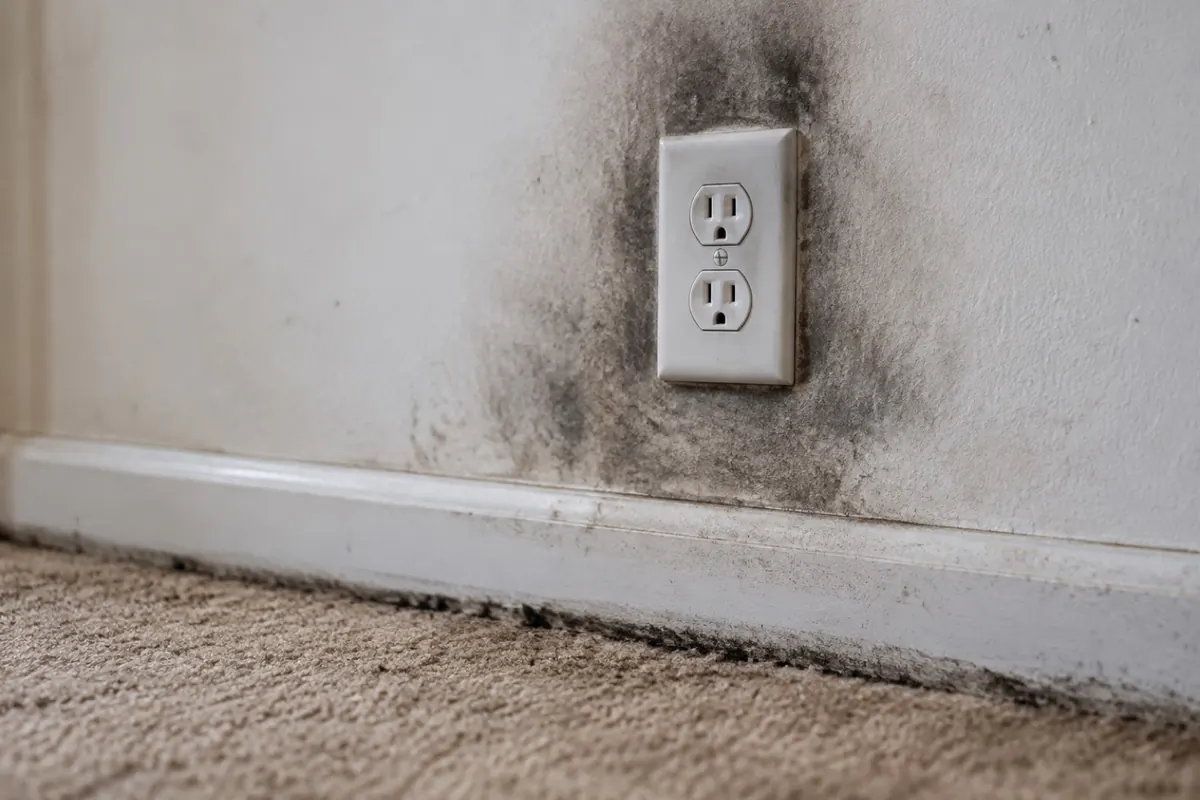
| Halo around outlets on outside walls | Air leaks at electrical boxes (DOE Energy Saver Guide) | Remove plate, dry sponge, fit a foam gasket. |
| Grey film on TVs, blinds, fridge | Electrostatic attraction (EPA's 2001 candles and incense report) | Dry microfibre; follow the maker for electronics. |
| Shadows around pictures, wall-to-ceiling joints | One jar candle did this in a case Vigil reports (Vigil in Home Energy (1998)) | Ceiling line first, then walls. |
| Fan blade edges, grey HVAC filter | Impaction on moving and filtering surfaces (Vigil in Home Energy (1998)) | New filter; a grey one means the system spreads it. |
Look-alikes that are not candle soot
| Look-alike | How it differs | What it changes |
|---|---|---|
| Dust ghosting | Grey, not black, though it darkens over time (Vigil in Home Energy (1998)) | Filtration and sealing over candles. |
| Mold | Easy to tell from soot stains, Vigil notes (Vigil in Home Energy (1998)); follows moisture, not framing | A moisture job: mold on walls. |
| Gas log or pilot soot | Same lines with no candles; a standing pilot alone did it in Vigil’s cases (Vigil in Home Energy (1998)) | Service the appliance first. |
| Oil burner soot | Oily and often sudden; InspectAPedia warns it can signal dangerous operation | A different event: puffback. |
| Vacuum exhaust | Fine dust in a clean house; a leaking vacuum was the source in one of Vigil’s cases (Vigil in Home Energy (1998)) | Fix the vacuum, clean once. |
Why some candles soot and others do not
The EPA's 2001 candles and incense report (EPA-600/R-01-001, January 2001, prepared by Eastern Research Group) explains the chemistry. Soot is incomplete combustion; a complete burn gives a blue flame with negligible soot. Paraffin is mostly saturated hydrocarbon, most fragrance oils are unsaturated, and the lower the carbon to hydrogen ratio the less soot a flame makes. Hence, per the report, candles labelled super scented and those soft to the touch soot more.
The spread is wide. The EPA report cites Fine and colleagues (1999) measuring elemental carbon from below 40 to 3,370 micrograms per gram of candle burned.
Wick, flame and container
The EPA report says a small steady flame emits less than a large flickering one, forced air around a flame causes sporadic sooting, jar candles soot more because the glass disturbs the flame, and blowing a candle out makes more soot than trimming the wick tip. An engineer quoted by Vigil adds that wick length, thickness and strength strongly influence the burn.
Lead is a separate issue. Under 16 CFR 1500.17(a)(13), the CPSC bans candles made or imported on or after 15 October 2003 with metal-cored wicks unless the core holds no more than 0.06 percent lead by weight.
Where the EPA and the candle industry disagree
| Factor | EPA 2001 report | National Candle Association | On a job |
|---|---|---|---|
| Fragrance | Scented candles are the major source of soot deposition | May slightly increase soot; wick and flame disturbance matter most | Ask about scented and jar candles either way. |
| Wick | Keep wicks short | Trim to a quarter inch before every use | A long, curled wick at the loss is evidence. |
| Drafts | Forced air causes sporadic sooting | Keep away from drafts, vents and air currents | A candle by a supply register can feed the ducts. |
| Container | Jar candles soot more | Any candle soots if the flame is disturbed | A blackened jar rim marks a sooting candle. |
Why candle soot lands in lines
Ghosting needs a particle source and a driving force, Vigil writes, and he names three forces: impaction (moving air), gravity and attraction (electrostatic forces and moisture). Gravity is weak for soot. Citing Harvard work by John Spengler, Vigil puts soot at 0.03 to 3 microns, small enough to stay airborne for long periods. Soot goes where air takes it.
Stripes over studs are the cold-surface effect. Physics calls it thermophoresis: suspended particles drift toward the colder side of a temperature gradient. Framing conducts heat out faster than an insulated bay, so in the heating season the drywall over each stud runs cooler and collects more, per InspectAPedia. Vigil ties the geometric stains to thermal bypasses and poor insulation, which is why repainting alone fails.
Ducts can charge the particles
According to Vigil, research by J. David Krause and Kaiss Al-Ahmady found that fast air through lined ducts charges particles, which then plate onto oppositely charged surfaces. According to Vigil, ACCA Manual D suggests 600 to 900 feet per minute in trunk ducts, while houses with soot problems ran 1,500 to 2,000 and up to 4,000, with relative humidity under 55 percent.
Is candle soot covered by insurance?
This section describes standard wording and published disputes. It cannot say what any policy pays; read your policy, contact your state insurance department and talk to a licensed professional.
In the ISO HO 00 03 05 11 form (the ISO HO-3, hosted by the Maine Bureau of Insurance), the personal property smoke peril reads: “This peril means sudden and accidental damage from smoke, including the emission or puffback of smoke, soot, fumes or vapors from a boiler, furnace or related equipment.” Two dwelling exclusions in the same form bear on candles: “wear and tear, marring, deterioration”, and the release of pollutants, defined to include smoke and soot, unless the release is caused by a peril named under Coverage C. The claim turns on whether the soot was sudden and accidental.
| Dispute | Facts | Outcome |
|---|---|---|
| UK Financial Ombudsman, Financial Ombudsman decision DRN-4608329, 2024 | Glass candles used daily over the 2021 festive period in several rooms; repair quote about £58,000 | Decline upheld, per the ombudsman: gradual, not a one-off event |
| Dastoor v. Texas Farmers, Harris County, Texas | Smoke and soot traced to an oil lamp burned constantly in a fireplace | Jury found no breach and no bad faith, per the MDJW insurance newsbrief of September 2015; a trial verdict, not precedent |
| Bacquie v. State Farm, Nassau County, New York | Insurer said wall stains were soot and candle smoke; owner claimed mold | Barred by the mold exclusion, July 2010 order, per a HarrisMartin report |
What gets argued is the fact pattern: one candle failing once, against many candles over weeks. Claim mechanics for smoke losses are on our smoke damage insurance claim page.
Cleaning candle soot, step by step
Candle soot is a dry, fine carbon film, unlike oily puffback residue or kitchen protein film, so order matters more than product. The Bane-Clene sponge directions say the vulcanized latex sponges are used absolutely dry, and “wet cleaning first will push the soot further into the surfaces or fabric.”
| Step | What to do | Why this differs from generic advice |
|---|---|---|
| 1. Stop the source | Stop burning the candles; keep them for testing. | Cleaning while they burn redeposits within days. |
| 2. New HVAC filter | Fit one before cleaning and after. | Vigil shows a white filter greyed in two weeks by one jar candle, 2 to 3 hours, three times a week (Vigil in Home Energy (1998)). |
| 3. Photograph and map | Every pattern, room by room, before touching it. | The pattern is the evidence; cleaning erases it. |
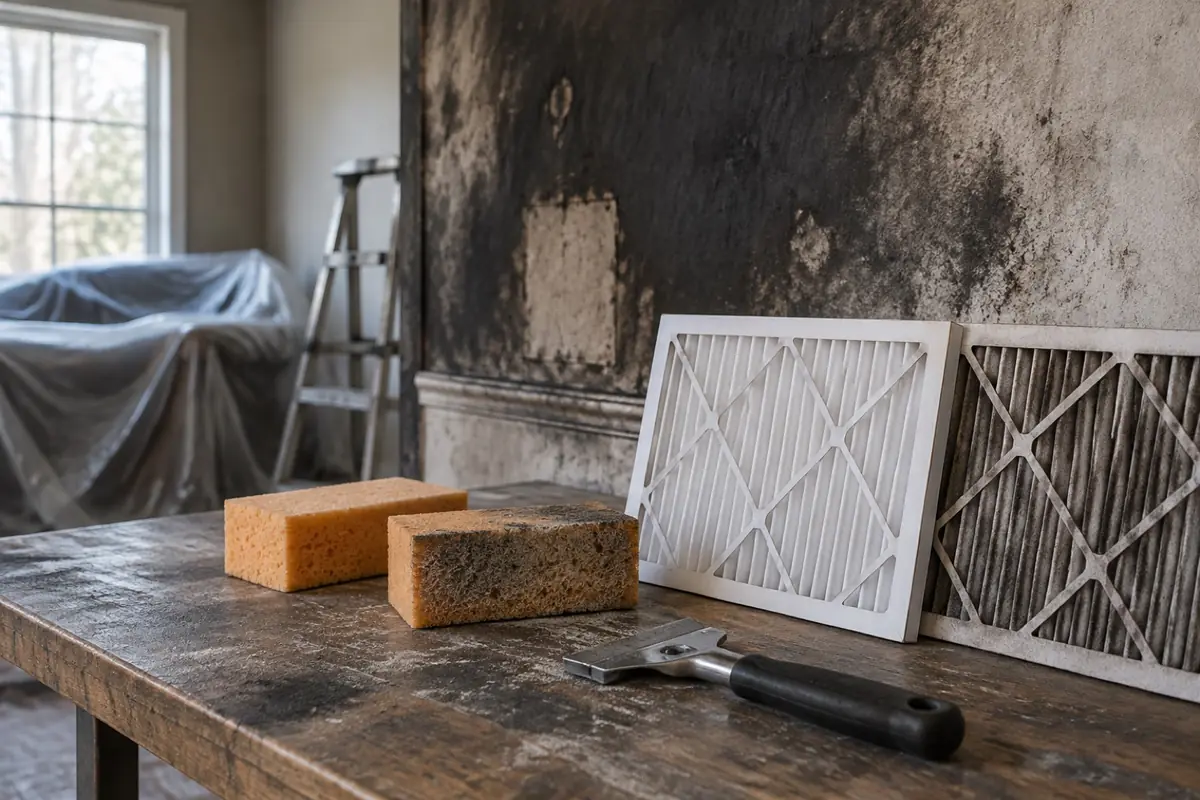
| 4. Dry sponge, ceiling first | Top down, wipe without scrubbing; shave or rinse when loaded (Bane-Clene sponge directions). | Most guides open with soap and water, which sets carbon into flat paint. |
| 5. Detergent second | Mild detergent on what the sponge left. | Degreasers are for oily soot; candle residue rarely needs one. |
| 6. Plastics and fabrics | Dry microfibre on plastics; dry sponge upholstery first. | Charge holds soot there (EPA's 2001 candles and incense report); wet wiping smears it. |
| 7. Fix the delivery path | Gasket outlets, seal baseboards, correct insulation. | The DOE Energy Saver Guide advises foam gaskets; without this, stripes return. |
Paint goes on last, over a clean surface. Primers, odour and porous contents follow the general rules in our smoke repair guide.
Which job is this? A five-question path
Work down the list and stop at the first yes.
- Soot with no candles in use? Find the combustion source: gas logs, pilots, furnace or boiler. The EPA duct cleaning guidance advises servicing fuel-burning furnaces, stoves and fireplaces before each heating season. A sudden oily coating is a puffback.
- Grey HVAC filter or dark supply registers? The system is distributing soot: whole house, ducts included.
- Stripes over framing in several rooms? Whole-room cleaning plus insulation and air sealing.
- Only carpet edges and door undercuts? An air path problem: clean, then add return paths.
- Only near one candle? A spot clean, dry sponge first.
When candle soot is a whole-house cleaning job
| Trigger | Why it means the whole house |
|---|---|
| Soot in rooms where no candle burned | Airflow, not proximity, carries it (Vigil in Home Energy (1998)) |
| Film on the refrigerator, freezer or TV | Charged surfaces pull soot from house air (EPA's 2001 candles and incense report) |
| Heavy candle use over months | In a test Vigil reports, 60 candle hours soiled a model home’s walls, drapes, dishwasher, refrigerator and AC filter (Vigil in Home Energy (1998)) |
| A switch to soft, strongly scented candles | In a Texas case Vigil describes, stains reached walls, fabrics, electronics and outlets within months (Vigil in Home Energy (1998)) |
| Carpet replaced and the lines came back | The air path was never fixed; Vigil reports carpet replaced twice in one house (Vigil in Home Energy (1998)) |
| Fast or leaky ducts | The ducts are the distribution network (EPA duct cleaning guidance) |
Duct cleaning has its own pricing; see air duct cleaning cost. The EPA duct cleaning guidance warns that skipping one component of a contaminated system can recontaminate the whole system.
For contractors: scope, records and the adjuster
ANSI/IICRC S700, the IICRC fire and smoke standard (first edition, 2025), covers assessing the boundaries of residues, HVAC systems and documentation. On candle soot the adjuster’s question is timing. Record facts as found and do not shape them.
| Record | Why the adjuster asks |
|---|---|
| Candle use as reported: number, type, rooms, weeks | Sudden and accidental against gradual |
| Photos of every pattern before cleaning | Shows delivery path and spread |
| Filter and register condition | Decides whether ducts are in scope |
| Other combustion sources checked | Rules out a furnace, pilot or fireplace |
| Candles retained | Allows product testing |
Vigil’s checklist adds blower door, duct leakage and pressure tests, and warns that soot stain cases often become legal disputes.
Questions people actually ask
What is soot in a candle?
Candle soot is mostly elemental carbon released when a flame burns incompletely. The EPA’s 2001 report says a complete burn gives a blue flame with negligible soot, and that a disturbed, flickering flame emits more. Indoors it shows up as black lines along framing, carpet edges and outlets.
Is black candle soot harmful to humans?
Health effects are outside this page’s scope. The EPA’s 2001 report states its authors found no studies on health effects of candle soot; the National Candle Association states it is not harmful. For exposure questions, use EPA indoor air guidance or ask a physician.
How do you stop soot from candles?
The National Candle Association says trim the wick to a quarter inch before every use and keep candles away from drafts, vents and air currents. The EPA’s 2001 report adds that unscented candles soot less and that trimming the wick to extinguish makes less soot than blowing it out.
What candles do not produce soot?
No source reviewed here names a soot-free candle. The EPA’s 2001 report links more soot to heavily scented, soft and jar candles, and the National Candle Association says any candle will soot if its flame is disturbed. A short wick and a still room matter more than the label.
How do you get candle soot off walls?
Start dry. A vulcanized rubber dry cleaning sponge, used completely dry and wiped from the ceiling down without scrubbing, lifts most of the carbon, per the maker’s directions. Wash what remains with mild detergent afterwards. Washing first pushes soot into flat paint.
Does homeowners insurance cover candle soot damage?
Policy wording decides it. The ISO HO-3 smoke peril covers sudden and accidental smoke damage, and a 2024 UK ombudsman decision treated weeks of candle use in several rooms as gradual damage. Read your policy and ask your state insurance department or a licensed professional.
Why does ghosting come back after painting?
Paint changes the colour, not the cause. Lines over studs come from cooler drywall over framing, and stains at baseboards and outlets come from air leaks. Both keep collecting soot while a source burns, so remove the source and fix insulation and air sealing first.
Sources
- EPA's 2001 candles and incense report: Eastern Research Group for US EPA, EPA-600/R-01-001, January 2001, via NEPIS. Retrieved 19 October 2026.
- Vigil in Home Energy (1998): Frank Vigil, Black Stains in Houses: Soot, Dust, or Ghosts?, Home Energy, January/February 1998, via AIVC. Retrieved 19 October 2026.
- ISO HO 00 03 05 11 form: ISO Homeowners 3 Special Form, hosted by the Maine Bureau of Insurance. Retrieved 19 October 2026.
- 16 CFR 1500.17(a)(13): CPSC metal-cored candlewick rule, via eCFR. Retrieved 19 October 2026.
- National Candle Association FAQ: National Candle Association. Retrieved 19 October 2026.
- Bane-Clene sponge directions: Bane-Clene chemical sponge directions. Retrieved 19 October 2026.
- DOE Energy Saver Guide: US Department of Energy, 2022. Retrieved 19 October 2026.
- EPA duct cleaning guidance: US EPA. Retrieved 19 October 2026.
- InspectAPedia: Daniel Friedman, undated. Retrieved 19 October 2026.
- Wikipedia, thermophoresis. Retrieved 19 October 2026.
- Financial Ombudsman decision DRN-4608329: UK Financial Ombudsman Service, 2024. Retrieved 19 October 2026.
- MDJW insurance newsbrief: 23 September 2015, Dastoor v. Texas Farmers Ins. Co., No. 2013-69578. Retrieved 19 October 2026.
- HarrisMartin report: 29 July 2010, Bacquie v. State Farm, No. 22881/2009. Retrieved 19 October 2026.
- ANSI/IICRC S700: IICRC, first edition, 2025. Retrieved 19 October 2026.
- Nothing was tested for this page; figures and outcomes are as stated in these sources. See our methodology.
Building science, cleaning directions and policy wording only. Not legal, insurance or medical advice.