The short answer
Smoke damage repair costs roughly $3 to $8 per square foot for cleaning, and the residue type rather than the floor area is what moves the number. Dry smoke from a fast hot fire cleans at the bottom of that band, wet smoke from a slow smouldering fire sits at the top, and protein residue from a cooking fire looks like almost nothing while costing near the top. Reconstruction of what cannot be cleaned is a separate scope on top.
Key takeaways
- Residue type dictates method. There is no general smoke cleaning procedure that works on all four residues, and applying the wrong one makes damage permanent.
- Dry methods run first, always. Introducing moisture to dry soot smears it into the substrate and converts a cleanable surface into a refinish or a replacement.
- Cleaning runs about $3 to $8 per square foot, rising with residue type. Those are indicative ranges compiled from published contractor and aggregator price guides current in 2026, not survey results.
- Porous material that absorbed residue is replaced, not cleaned, because the result cannot be verified inside the material. Most insulation goes in a skip.
- Semi-porous material is the judgement zone, and it is where scopes get argued.
- If the HVAC system ran during or after the fire, residue is distributed building-wide and duct cleaning is part of the repair scope rather than an upsell.
On this page
- Residue type dictates the method
- The four residues, one at a time
- The cleaning sequence, and why order costs money
- The methods themselves
- What cannot be cleaned
- The semi-porous judgement zone
- What smoke damage repair costs
- Whole-room and whole-house bands
- The HVAC system carries the damage
- Surface by surface, what actually happens
- How a repair programme is sequenced
- The mistakes that cost the most
- How to read a smoke repair quote
- Questions people actually ask
Smoke damage repair is a materials problem before it is a cleaning problem. The same fire deposits different residues on different surfaces, and each of those combinations has one correct method and several that will make things worse. A contractor who arrives with a bucket and a sponge and starts at the nearest wall is not doing the job. This page covers the work itself: what each residue is, what removes it, what order the passes run in, what has to come out regardless, and what the whole thing costs. If your question is about the insurance file rather than the work, our smoke damage insurance claim guide covers scope boundaries, contents pack-out and the recurring disputes. If your question is the smell specifically, our guide to getting smoke smell out of house interiors covers deodorising in sequence.
Residue type dictates the method
Smoke is what is left over when combustion is incomplete. What gets left over depends on what burned, how hot it burned, and how much oxygen it had. Those three variables produce residues with completely different physical behaviour, and that behaviour is what a cleaning method has to match.
The practical consequence is that the first job on site is identification, not cleaning. A technician runs chemical sponge test patches in several rooms and records which residue is present where. Everything after that follows from the answer, including the price.
| Residue | Fire conditions that produce it | Physical behaviour | Method that suits it |
|---|---|---|---|
| Dry smoke | Fast, hot, well-ventilated fire burning paper, wood and other cellulose | Fine, dry, powdery. Sits loose on surfaces rather than bonding, settles into cracks, cavities and fabric weave | Dry sponge and HEPA vacuum first, then wet cleaning only where the surface will take it. |
| Wet smoke | Slow, smouldering, oxygen-starved fire, commonly plastics, rubber and synthetic upholstery | Thick, sticky and smeary. Bonds mechanically to the substrate and spreads under pressure rather than lifting | Solvent-based cleaners and degreasers, worked gently, with a high replacement rate on porous material. |
| Protein residue | Kitchen fires where food, fat or oil burns without a flaming fire spreading | Thin, greasy, amber and close to invisible. Coats every surface in the building including ceilings, carries severe odour | Alkaline degreasers on every surface, including surfaces that look untouched, followed by odour work. |
| Fuel oil soot | Furnace puff-back in an oil-fired heating system | Oily, fine and pervasive. Distributed through the duct network in seconds and deposited on everything the system supplies | Degreasers plus the whole HVAC network in scope, never a room-by-room approach alone. |
The four residues, one at a time
Dry smoke is the one people picture
A fast, hot, oxygen-rich fire burns fuel more completely and leaves a dry powdery residue that has never been wet and never fused to anything. It behaves like very fine dust with a static charge. It lifts off hard surfaces readily and it gets absolutely everywhere, including into cavities, behind skirting, inside light fittings and into the weave of every textile in the room.
The trap is that dry smoke is easy to remove badly. A wet cloth appears to work for the first half of a wall, while it dissolves the particulate into a slurry and drives it into the paint film and the timber grain. That is a permanent stain on a surface that would have cleaned dry.
Wet smoke is the expensive one
A slow, smouldering, oxygen-starved fire burns badly and produces a residue heavy with unburned hydrocarbons. Synthetic materials make it worse: plastics, foam, rubber and modern upholstery all produce thick sticky soot. It bonds to the substrate rather than resting on it, and it responds to pressure by spreading.
Wet smoke is the residue where the replacement rate climbs. Solvent cleaners will lift it from sealed non-porous surfaces given enough labour, and the labour per square foot is several times what dry smoke takes. On porous material the calculation usually falls the other way, because the cleaning hours approach or exceed replacement cost. A smouldering fire in a sofa can leave a house that is structurally untouched and functionally gutted.
Protein residue is the one that gets underscoped
A pan left on a hob produces a fire that may never flame and may never be reported as a fire at all. It produces an amber, greasy, nearly transparent film that coats every horizontal and vertical surface in the building, including ceilings and the tops of door frames. It is easy to walk through a house with protein residue and conclude there is nothing much to clean.
Then the smell arrives, and it does not leave. Protein residue carries one of the most persistent odours in the trade, and because the film is everywhere, the cleaning scope is the whole building rather than the kitchen. Scopes written from a visual inspection routinely miss this by a factor of several, and the giveaway is that a partial clean does not reduce the smell at all.
Fuel oil soot comes out of the heating system
A puff-back happens when an oil-fired burner accumulates unburned fuel and then ignites it in one event, pushing oily soot back through the appliance and into the ductwork. From there the system distributes it through the building in seconds. The damage pattern is distinctive: heaviest at supply registers, fading with distance, present in rooms nobody associates with the boiler.
The oil binder in the residue resists water-based cleaning, so this is degreaser work. More importantly the duct network is not a peripheral part of the loss here, it is the origin of the distribution. A puff-back cleaned room by room without the HVAC being addressed will recontaminate itself on the next heating cycle.
The cleaning sequence, and why order costs money
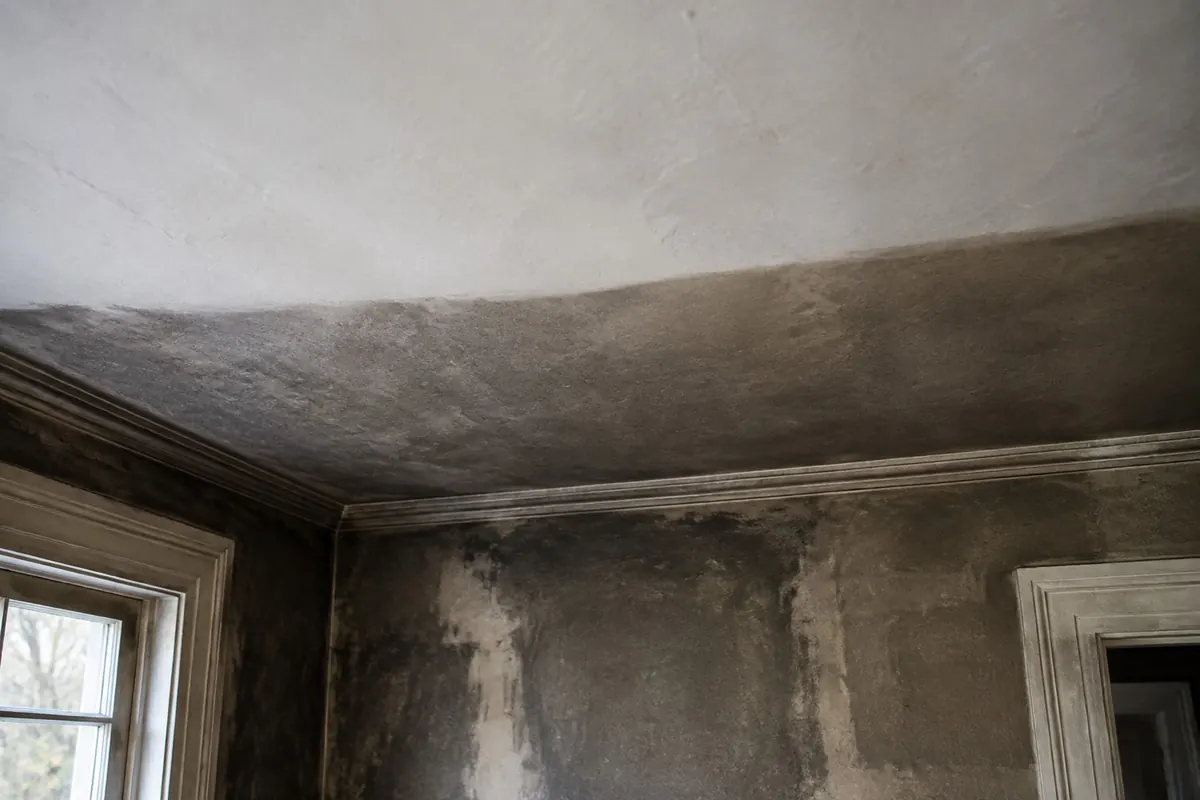
Dry methods run first. This is the single rule that separates a competent smoke repair from an expensive failure, and it is violated constantly by property owners trying to help before the contractor arrives.
The reason is mechanical. Loose particulate sitting on a surface can be lifted off and captured. The same particulate wetted becomes a suspension that moves into every pore, scratch and grain opening in the substrate, and then dries there. At that point the surface is stained rather than dirty, and staining is not a cleaning problem. It is a refinishing problem, or a replacement problem, at many times the cost of the dry pass that would have prevented it.
| Pass | What it does | What it costs to skip or reverse |
|---|---|---|
| 1. HEPA vacuum | Removes loose particulate from surfaces, textiles and cavities with filtration that captures fine soot rather than re-emitting it | A domestic vacuum without HEPA filtration passes the finest particulate straight through and redistributes it through the building. |
| 2. Chemical or dry sponge | Lifts bonded dry residue from painted and porous surfaces without any liquid at all | Skipping to a wet pass on dry smoke smears residue into the substrate and converts cleanable surfaces to refinish or replace. |
| 3. Wet cleaning, matched to residue | Detergent for general soiling, degreaser for protein and oil, solvent for wet smoke, on surfaces that will take moisture | Using water on a porous unsealed surface drives residue deeper and can set the stain permanently. |
| 4. Abrasive or media cleaning | Removes residue from framing and unfinished substrates after demolition, taking a thin layer of the surface with it | Applied to finished material meant to remain, it destroys the finish and creates a refinishing scope. |
| 5. Sealing | Locks down residual odour in cleaned framing and substrates that cannot be cleaned further | Sealing over uncleaned residue traps the source. The odour finds a route out and the sealer has to be removed before cleaning can start. |
Top down, in every room
Within a room the same logic applies vertically. Ceilings are cleaned before walls and walls before floors, because anything dislodged falls downward onto surfaces that have not been done yet. Cleaning a floor first means cleaning it twice. On protein losses this matters more than usual, because the ceiling carries as much film as anything else and it is the surface most often skipped.
If you are a property owner waiting for a contractor: do not wipe anything with a wet cloth, and do not run the heating or air conditioning. Both of those instincts make the job larger. Opening windows to ventilate is fine and helps. Photographing every room before anything is touched is the most useful thing you can do.
The methods themselves
Six methods cover almost all smoke damage repair work. None of them is the best method in general. Each one is correct for a particular combination of residue and substrate and wrong for others.
| Method | Where it belongs | Where it does damage |
|---|---|---|
| HEPA vacuuming | Every surface and every textile, as the opening pass on every residue type | Nowhere. The failure mode is using non-HEPA filtration, which redistributes fine soot. |
| Dry sponge, also called a chemical sponge | Painted walls, ceilings, wallpaper, unsealed timber, anything porous carrying dry residue | Loses effectiveness quickly on wet smoke, where it loads up and smears rather than lifting. |
| Detergent wet cleaning | Sealed non-porous surfaces: glazed tile, glass, metal, laminate, sealed worktops | On unsealed timber, plasterboard facing and masonry it carries residue into the material. |
| Alkaline degreasing | Protein residue and fuel oil soot on washable surfaces, which is most surfaces in a protein loss | Strips some finishes and dulls others, so it needs testing on an inconspicuous patch first. |
| Solvent cleaning | Wet smoke on sealed and non-porous substrates where the bond resists water-based chemistry | Attacks some plastics and finishes, needs ventilation, and is wasted effort on porous material that should be replaced. |
| Abrasive and media cleaning | Exposed framing, joists and subfloor after demolition, where removing a surface layer is acceptable | Anywhere the surface is the finish. It is a demolition-stage tool, not a finishing tool. |
Ultrasonic cleaning is for contents, not structure
Hard contents go through an ultrasonic bath rather than being wiped: glassware, metal, ceramics, tools, many toys, light fittings and hardware. Cavitation reaches surfaces and crevices a cloth cannot, and it processes volume, which matters when a kitchen holds several hundred items. It is wrong for anything bonded, anything that cannot be wetted, and soft goods, which go to specialist laundering instead. Contents handling is covered in our smoke damage insurance claim guide, because the pack-out is usually a claim question.
What cannot be cleaned
Some material is removed rather than cleaned, and this is not a contractor preference. It is a verification problem. Residue that has moved into the body of a material cannot be confirmed gone, because there is no way to inspect the inside of a batt of insulation or the core of a piece of particleboard. A cleaning claim that cannot be verified is not a cleaning claim.
| Material | Verdict | Why |
|---|---|---|
| Fibreglass and mineral wool insulation | Replace, almost always | Open fibre structure absorbs both particulate and odour compounds through its full depth, and it cannot be inspected or confirmed. |
| Blown-in cellulose insulation | Replace | Same absorption problem, and disturbing it during cleaning redistributes the residue through the cavity. |
| Carpet underlay and pad | Replace | Open-cell foam holds residue and odour, and it sits under a surface that would have to be lifted anyway. |
| Mattresses and upholstered furniture with heavy residue | Usually replace | Foam and fibre absorb odour into the body of the item. Cleaning hours approach or exceed replacement value. |
| Heavily charred timber and sheet material | Replace | Char is structurally degraded and holds odour in the carbon layer. Light surface char on framing may be cleaned and sealed. |
| Unsealed plasterboard facing with absorbed residue | Usually replace | Paper facing wicks residue into the gypsum core, which cannot be cleaned through. |
| Food, medicines and cosmetics in affected areas | Dispose | Not a cleaning decision. Porous packaging and direct exposure both rule them out. |
| HVAC filters | Replace | They are consumable by design and by the time the fire is out they are loaded. |
Textiles split into three groups
Washable clothing and household linen usually recover with specialist laundering, often needing several cycles and an ozone or hydroxyl treatment between them. Delicate and dry-clean-only items go to a restoration dry cleaner and the recovery rate is lower. Items with foam interiors or bonded backing, which includes most cushions, mattresses and many blackout curtains, are the group that generally does not come back, because the odour sits inside a layer that cannot be flushed.
The semi-porous judgement zone
Non-porous material cleans. Porous material goes in a skip. Between the two sits a large category where the answer is genuinely arguable, and this is where most of the scope negotiation on a smoke file happens.
| Semi-porous material | Argument for cleaning | Argument for replacement |
|---|---|---|
| Painted plasterboard with light dry residue | The paint film is the surface and it is effectively sealed. Dry sponge lifts residue cleanly | Wet smoke bonds through the film, and protein residue behind the paint on older porous coatings does not come out. |
| Unfinished or lightly sealed timber | Grain-direction cleaning plus sealing handles light dry residue on framing and trim | Residue in open grain cannot be confirmed removed, and the piece carries odour after it looks clean. |
| Hardwood flooring | Sanding and refinishing removes the affected surface layer and is cheaper than replacement | Residue between boards and into the subfloor is not reached by sanding, and there is a finite number of refinishes in a floor. |
| Masonry and unsealed concrete | Media cleaning removes the affected surface and the substrate is not going anywhere | Porosity runs deep, so odour persists and sealing becomes part of the answer rather than an option. |
| Cabinetry with sealed faces and raw interiors | The visible faces clean well and cabinet boxes are expensive to replace | Raw particleboard interiors absorb odour and are the reason the kitchen still smells after the faces are clean. |
| Ceiling tiles, mineral and fibre | Light dry residue on the face can be sponged | The body of the tile is absorbent, cleaning marks them, and they are cheap enough that replacement usually wins. |
The useful test is the fourth factor. If a technician can clean a sample area, show you the result, and you can confirm by looking and by smell that the residue is gone, cleaning is defensible. If the answer depends on trusting that something invisible happened inside a material, replacement is the honest call. That test also survives being reviewed later, which matters when the file is being examined.
What smoke damage repair costs
Cleaning runs roughly $3 to $8 per square foot of affected area, and where a job sits in that band is driven by residue type far more than by anything else. These are indicative ranges compiled from published contractor and aggregator price guides current in 2026. They are not the output of a contractor pricing survey and they are not a quote.
What the per-foot rate actually contains
| Component | What it is | What moves it |
|---|---|---|
| Labour | Technician hours, which are the overwhelming majority of a cleaning line | Residue type first, then surface complexity. Wet smoke can take several times the hours per square foot that dry smoke takes. |
| Chemistry and consumables | Degreasers, solvents, dry sponges, cloths, PPE, containment sheeting | Residue type and the number of surfaces. Protein losses consume degreaser across the whole building. |
| Equipment | HEPA vacuums, air scrubbers, negative air machines, deodorising equipment, billed per unit per day | Duration on site, which tracks the size of the affected area and the odour work still outstanding. |
| Disposal | Bagging, skips and tipping fees for insulation, textiles, charred material and contents | How much material falls on the replace side of the line, which again tracks residue type. |
| Overhead and profit | Fixed cost recovery and margin | Whether the file is priced against a carrier price list and whether general contractor overhead is accepted on it. |
Whole-room and whole-house bands
Per-square-foot rates compare bids well and budget badly, because nobody knows their affected square footage before an inspection. These are whole-job cleaning bands for situations that recur constantly.
Two things routinely surprise people reading those. The first is that a kitchen fire with almost no visible damage lands in the middle of the range, because protein residue makes the whole building the scope. The second is that reconstruction is not in there at all. Replacing insulation, plasterboard, flooring and cabinetry is a separate trade at separate rates, and on losses with significant demolition it commonly exceeds the cleaning figure. Water used in suppression adds a third scope again, which our water damage restoration cost guide covers.
The HVAC system carries the damage
The first question on any smoke loss is whether the heating or air conditioning system ran during the fire or in the days afterwards. If it did, the building has a distribution network full of residue and every room the system supplies is affected regardless of how far it sits from the fire.
- Establish whether it ran. Ask on day one. Occupants frequently run the system after a fire to clear the air, which is the worst available option.
- Seal the registers before structural cleaning starts, so that cleaning a room does not push residue into the return and out somewhere already finished.
- Inspect before pricing. A camera run through supply and return substantiates the line and shows where residue actually sits.
- Clean the air handler, coil and blower, not just the ducts. That is where deposition concentrates and where a cheap scope usually stops.
- Replace the filters, and understand that filter replacement on its own is not duct cleaning and does not substitute for it.
- Do the ducts before any air treatment, because a contaminated duct undoes hydroxyl or ozone work on the first cycle.
Duct cleaning after a fire is one of the situations where the work is clearly indicated, which is not true of routine maintenance cleaning. Our air duct cleaning cost guide covers the pricing, what a legitimate service includes, and the published position on when duct cleaning is and is not warranted.
Surface by surface, what actually happens
| Surface | Typical treatment | When it becomes replacement |
|---|---|---|
| Painted walls and ceilings | HEPA vacuum, dry sponge, then degreaser or detergent if the residue is protein, oil or wet smoke. Seal and repaint where odour persists | Wet smoke bonded through the film, or plasterboard with residue wicked into the core. |
| Glazed tile, glass, metal and sealed worktops | Straight to the appropriate wet clean. These are the surfaces that recover fully on almost any residue | Rarely. Pitting and etching from acidic residue left on metal for weeks is the exception. |
| Hardwood flooring | Dry pass, then assessment. Light residue often cleans; deeper residue means sand and refinish | Residue through to the subfloor, cupping from suppression water, or a floor already refinished to its limit. |
| Carpet | HEPA extraction and hot water extraction on light dry residue | Wet smoke or protein residue, or any residue that reached the underlay, which is replaced regardless. |
| Kitchen cabinetry | Degrease faces, frames and interiors, then deodorise the boxes | Raw particleboard interiors that hold odour after degreasing, which is common on protein losses. |
| Exposed framing after demolition | HEPA vacuum, then media or abrasive cleaning, then seal | Structural char beyond surface depth, which is a structural assessment rather than a cleaning one. |
| Light fittings, switches and outlets | Removal, ultrasonic or manual cleaning of fittings, replacement of devices | Devices with residue inside the body are replaced on principle rather than cleaned. |
| Window treatments | Specialist laundering for washable fabric | Foam-backed, bonded or blackout-lined items, which usually do not recover. |
How a repair programme is sequenced
A smoke repair runs in stages, and the stages have dependencies that cannot be reordered without redoing work. The commonest scheduling error is booking the decorator before the odour has been signed off.
| Stage | What happens | Why it cannot move later |
|---|---|---|
| 1. Assessment and documentation | Residue identification by test patch, room-by-room photography, moisture readings where suppression water was used | Once cleaning starts, the evidence of what was there is gone. |
| 2. Containment and safety | Isolating unaffected areas, negative air where needed, sealing registers, making the structure safe to work in | Without it, cleaning one area contaminates another and the scope grows. |
| 3. Demolition and removal | Removing insulation, underlay, charred material and everything on the replace side of the line | Cleaning around material that is going to be removed is wasted labour, and removal releases more residue. |
| 4. Structural cleaning | The dry-then-wet sequence, top down, room by room, matched to residue | It must follow demolition and precede any air treatment. |
| 5. HVAC cleaning | Ducts, air handler, coil, blower and filters | After surface cleaning and before air treatment, or the system recontaminates cleaned rooms. |
| 6. Odour treatment | Hydroxyl or ozone, then sealing of substrates that still off-gas | Only meaningful once the source has been removed. Treating first buys weeks and the smell returns. |
| 7. Reconstruction | Insulation, plasterboard, flooring, trim, decoration | Closing a cavity before odour is resolved means opening it again. |
The mistakes that cost the most
Wet cleaning before dry cleaning
It earns its own heading because it is the most common and the most expensive. It converts a cleaning line into a refinishing line, and it is usually done by well-meaning occupants in the first day.
Painting over residue
Fresh paint over uncleaned residue does not hold. Soot and greasy films both interfere with adhesion, so the paint fails, and the residue underneath keeps off-gassing through it. The recovery is to strip the new paint, clean properly, seal, and repaint, which is three scopes where there should have been one.
Running the HVAC to clear the air
It does the opposite. The system pulls smoke into the return and deposits it through the duct network and into every supplied room, turning a compartment loss into a building loss. Open windows instead.
Signing off on a cold building
Residue off-gasses faster as temperature and humidity rise. A building walked through in cool weather with the windows open smells fine and then does not, in the first warm week. Odour sign-off should happen with the building closed and at normal temperature.
How to read a smoke repair quote
Six questions separate a defensible quote from a guess.
- Which residue is this priced against, and how was that determined? The answer should reference test patches in named rooms, not a glance from the doorway.
- Which rooms are in scope, and on what evidence? On protein and puff-back losses the answer should be most of the building, and a room-limited scope is a warning.
- Is this cleaning only, or does it include reconstruction? Get them as two figures. They are different trades at different rates.
- What is on the replace list and why? Each line should name the material and the reason, and insulation should be on it.
- Did the HVAC run, and is duct cleaning included? If it ran and duct cleaning is not in the scope, ask why in writing.
- What is the odour sign-off procedure? There should be one, it should happen after cleaning rather than instead of it, and it should involve a closed warm building.
Questions people actually ask
How much does smoke damage repair cost per square foot?
Cleaning typically runs about $3 to $8 per square foot of affected area, with dry smoke at the low end and wet smoke at the high end. Those are indicative ranges compiled from published contractor and aggregator price guides current in 2026. Reconstruction of material that had to be removed is a separate scope at separate rates.
Can smoke damage be cleaned, or does everything have to be replaced?
Most hard, sealed and non-porous surfaces clean successfully. Porous material that absorbed residue is replaced, because there is no way to verify cleaning inside a material. Insulation, carpet underlay and heavily charred timber almost always come out. Semi-porous material is judged case by case.
Why can I not just wipe the soot off with a damp cloth?
Because dry soot wetted becomes a suspension that moves into the paint film, grout line or timber grain and dries there. That is a stain rather than a deposit, and it turns a cleaning job into a refinishing or replacement job. Dry methods run first for exactly this reason.
What is the difference between wet smoke and dry smoke damage?
Dry smoke comes from a fast hot fire, is powdery, sits loose on surfaces and cleans at the bottom of the cost band. Wet smoke comes from a slow smouldering low-oxygen fire, often burning plastics, and is sticky and bonded. It takes solvent chemistry, far more labour, and a higher replacement rate.
The kitchen fire barely marked anything. Why is the quote so high?
That pattern is characteristic of protein residue, which leaves a nearly invisible greasy film across every surface in the building including ceilings, and carries a severe persistent odour. The cleaning scope is the whole building rather than the kitchen, which is why quotes look disproportionate to the visible damage.
Does smoke damage repair include cleaning the ducts?
It should, if the heating or air conditioning system ran during or after the fire, because the system then distributed residue to every room it supplies. If the system did not run, duct cleaning may not be needed. Ask for the answer to be recorded either way.
How long does smoke damage repair take?
A single room with light dry residue can be days. A whole-building protein loss or a puff-back with ducts in scope commonly runs two to four weeks of cleaning and odour work before reconstruction starts. Odour treatment sits at the end and is the stage most often compressed, which is why callbacks happen.
Sources
- IICRC, Institute of Inspection, Cleaning and Restoration Certification, which publishes the industry standards that define the residue classification and method-selection framework described here. The standard texts are sold by IICRC; we describe the framework rather than reproduce it. Retrieved 23 September 2026.
- US Fire Administration, United States Fire Administration, for fire loss and fire prevention material. Retrieved 23 September 2026.
- Per-square-foot cleaning ranges and whole-job bands are compiled from published contractor and aggregator price guides current in 2026. They are indicative rather than survey results. We have not conducted a contractor pricing survey; when we do, its sample and method will be published with it.
- The scope-share chart showing labour, equipment, disposal and odour treatment is ILLUSTRATIVE and schematic. It is not survey data, not carrier data and not a quote.
- Residue classifications, method matching, salvageability guidance and programme sequencing reflect generally described fire restoration practice. No proprietary method, product or carrier procedure is reproduced and no product was tested for this article.