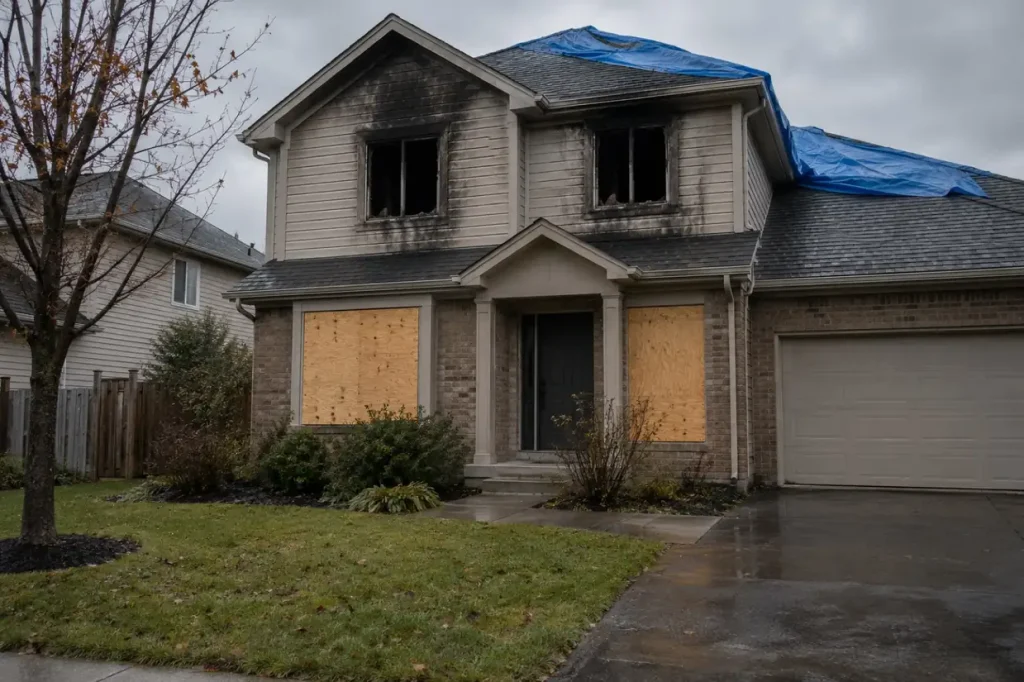
The short answer
What to do after a house fire comes down to four windows. In the first hour, get everyone safe and stay out until the fire department clears re-entry. On day one, call your insurer, secure the property and leave utilities to professionals. In week one, inventory before discarding anything. In month one, replace documents, file the proof of loss and check the tax rules.
Key takeaways
- USFA’s re-entry rule: do not enter unless the fire department says it is safe.
- Do not discard damaged goods until an inventory has been taken, says the Red Cross; the standard HO-3 form makes that inventory a policy duty.
- Food, beverages and medicine exposed to heat, smoke or soot go in the bin, per the Red Cross checklist.
- The ISO HO-3 form pays additional living expense for the shortest time required to repair or replace. Keep receipts from day one.
- Under the same form, sworn proof of loss is due within 60 days after the insurer asks.
- Per IRS Publication 547, a personal casualty loss is deductible only if it is attributable to a federally declared disaster, with a narrow exception for casualty gains.
On this page
According to the USFA residential fire estimates, 2023 saw 344,600 residential building fires, 2,890 deaths and $11.27 billion in dollar loss. That works out, per the USFA figures, to about 944 fires a day and $32,694 of loss per fire, in our arithmetic.
This checklist is built from public guidance, not from anyone’s own claim. Insurance sections quote the standard ISO HO-3 form; your policy may use different wording, so read your declarations and endorsements, and ask your state insurance department or a licensed professional what yours covers. First aid and medical care are out of scope: call 9-1-1.
The first hour: people, pets and the fire department
USFA's After the Fire (FA-46) warns that soot and dirty water may contain things that could make you sick, and that firefighters may have broken windows and cut holes in the roof and walls. The fire department’s release gates everything after it.
| # | Do this | Why, and who says so |
|---|---|---|
| 1 | Call 9-1-1 and let family know you are safe | The Red Cross lists both among its four immediate steps |
| 2 | Stay out until the fire department says it is safe | USFA and the Red Cross both make this the re-entry rule |
| 3 | Do not cross coloured tape or a posted inspector’s sign | Red Cross: get advice on what the sign means first |
| 4 | Find and comfort pets; handle them carefully | USFA: scared animals often bite or scratch |
| 5 | Call the Red Cross or another relief service | USFA: they help with food, clothing, medicine and a place to stay |
| 6 | Write down the fire incident report number | USFA’s worksheet asks for it, with the department’s non-emergency number |
The first day: utilities, the insurer and the board-up
Day one stops the loss growing. Once you are cleared in, the Red Cross guide to checking your home after a fire says: check outside first for loose power lines, gas line damage and foundation cracks; do not force a jammed door, which may be holding the structure up; keep off a sagging floor; check for embers, including the attic; use a flashlight, never a flame.
| # | Do this | Why, and who says so |
|---|---|---|
| 7 | Leave utilities to the fire department and the utilities | USFA: if unsafe they are turned off; do not turn them back on yourself |
| 8 | Smell gas or hear hissing: leave and call from safety | Red Cross; propane and oil tank valves off until checked |
| 9 | Sparks, frayed wire or hot insulation smell: main breaker off | Red Cross; never stand in water to reach the panel, and leave tripped breakers for an electrician |
| 10 | Call your insurer and ask what to do first | USFA; the HO-3 form makes prompt notice a duty |
| 11 | Photograph everything before cleanup | Red Cross, Alaska Division of Insurance and United Policyholders |
| 12 | Board up and tarp; keep every receipt | USFA mentions boarding up; HO-3 pays reasonable cost of protecting property |
| 13 | Tell the police the house will be vacant | USFA checklist |
| 14 | Call the landlord or mortgage lender, and card companies | USFA; HO-3 also lists notifying card companies |
Securing the property is a policy duty, not a favour
The ISO HO 00 03 05 11 form (Maine Bureau of Insurance copy) lists, under Duties After Loss, giving prompt notice to the insurer or agent and protecting the property from further damage by making reasonable and necessary repairs and keeping an accurate record of repair expenses. Its Reasonable Repairs coverage pays the reasonable cost incurred for necessary measures taken solely to protect covered property from further damage. The Alaska Division of Insurance consumer guide adds: make temporary repairs, but wait on permanent ones until the insurer has inspected and the cost is agreed.
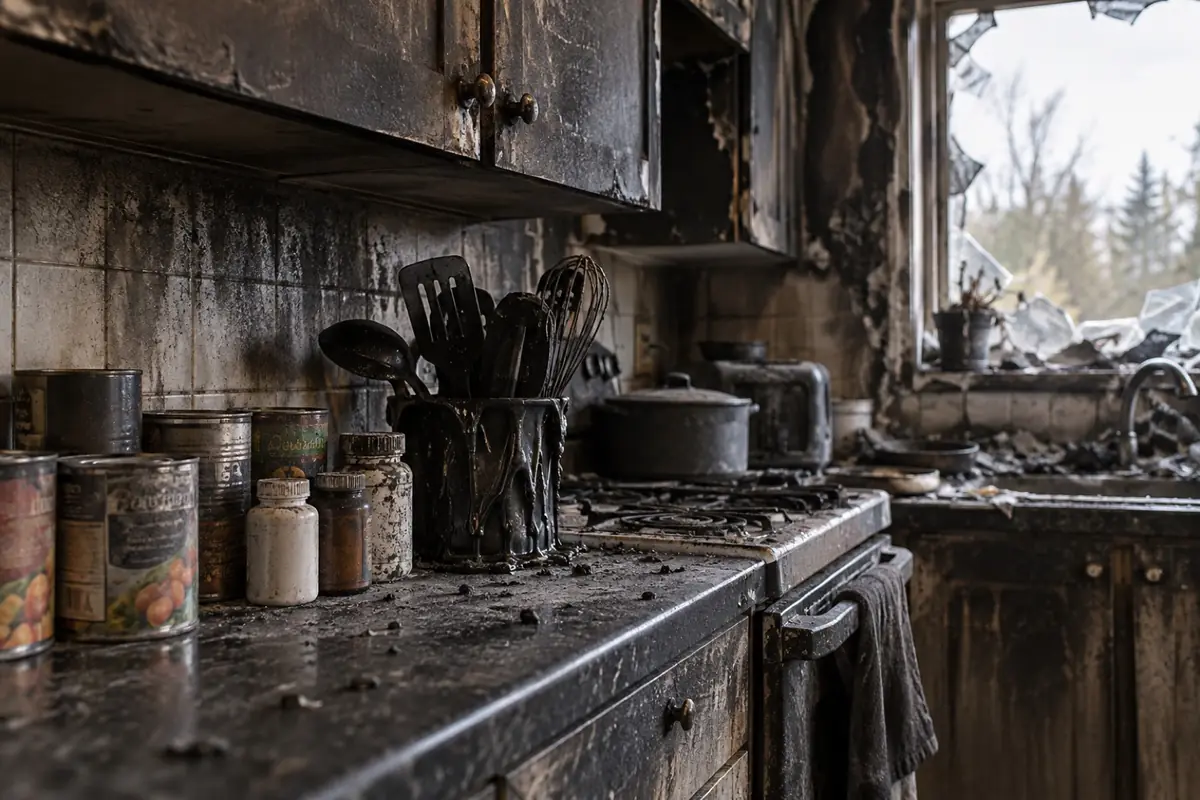
Where you sleep: loss of use, in the policy’s words
Most homeowners policies are built on the ISO form. In the ISO HO 00 03 05 11 form (Maine Bureau of Insurance copy), Coverage D, Loss Of Use, has three parts that share one limit. The trigger is a covered loss that makes the part of the residence premises where you reside “not fit to live in”, and the periods are not limited by expiration of the policy.
| Coverage D part | What the form covers | For how long |
|---|---|---|
| 1. Additional Living Expense | “we cover any necessary increase in living expenses incurred by you so that your household can maintain its normal standard of living” | “for the shortest time required to repair or replace the damage” or to settle elsewhere if you permanently relocate |
| 2. Fair Rental Value | Fair rental value of a part rented to others, “less any expenses that do not continue” | Shortest time required to repair or replace |
| 3. Civil Authority Prohibits Use | Items 1 and 2 when a civil authority bars use because of direct damage to neighbouring premises | “no more than two weeks” |
| 4. Loss Or Expense Not Covered | “cancellation of a lease or agreement” | Not applicable |
The Alaska Division of Insurance consumer guide tells policyholders to save all receipts, including hotel stays, reasonable meals and necessities. The United Policyholders ALE Q&A deck, from a California wildfire webinar, lists qualifying expenses such as temporary rent, extra mileage, security deposits, moving costs and pet boarding, and says mortgage payments are not covered. Renters have their own version of this coverage, explained in our guide to whether renters insurance covers fire damage.
The tax catch on living-expense payments
IRS Publication 547 (2025) says that if insurance payments for living expenses exceed the temporary increase in your living expenses, the excess is income, unless the casualty occurs in a federally declared disaster area. Per the publication’s worked example, charted below: $2,200 paid, $1,950 of extra cost, $250 taxable.
The first week: inventory first, then throw away
The order matters. The Red Cross guide to checking your home after a fire says do not discard damaged goods until an inventory has been taken, and the Alaska Division of Insurance consumer guide says not to throw away damaged property until the adjuster tells you so. The ISO HO 00 03 05 11 form (Maine Bureau of Insurance copy) makes the inventory a duty: an inventory of damaged personal property showing the quantity, description, actual cash value and amount of loss, with bills, receipts and related documents attached.
Building the contents inventory
- Go room by room, closets, drawers, attic and garage included, photographing before moving anything.
- Record quantity, description, age and cost, the fields the form names.
- Keep a claim diary of who you spoke to, when and what was said, as the United Policyholders first-steps checklist advises.
What to throw away, and what to keep
| Item | Action | Source |
|---|---|---|
| Food and beverages exposed to heat, smoke or soot | Throw away | Red Cross |
| Freezer food that still has ice crystals | Can be used | Red Cross; without crystals, discard |
| Medicine exposed to heat, smoke or soot | Throw away | Red Cross; FDA says fire heat can reduce or destroy effectiveness |
| Drywall and insulation soaked by fire hoses | Ask a professional about replacing | Red Cross |
| Pots, pans and flatware | Wash, rinse and polish | Red Cross |
| Burnt money | Keep; handle little, wrap in plastic | USFA: half or more intact can be redeemed |
| Anything else damaged | Keep until inventoried | Red Cross; Alaska: until the adjuster says |
USFA notes that things the flames never touched may still be ruined by smoke and water. Which materials can be saved is in our smoke damage repair guide.
Choosing a restoration contractor
USFA's After the Fire (FA-46) says to ask your insurer for companies you can trust, but the choice and the contract are yours. The FTC advice on scams after disasters (September 2025) and United Policyholders set the checks. The trade standard is ANSI/IICRC S700, the IICRC fire and smoke restoration standard (first edition, 2025); ask whether a firm works to it.
| Check | What to confirm | Source |
|---|---|---|
| Licence and insurance | Check the licence with your state or county; ask for proof of insurance | FTC |
| Written contract | Name, address, phone, licence number, dates, payment schedule, scope; no blank spaces | FTC |
| Who pays for cleaning | Confirm whether you or the insurer pays | USFA |
| Estimate | Get it in writing | USFA |
| Payment | Credit card or check; never wire, gift card, payment app, crypto or cash | FTC |
| Final payment | Not until the work is done and you are satisfied | FTC |
| References | Check carefully; do not rush into signing | United Policyholders |
If the claim itself becomes the problem, the options and costs of hiring help are set out in our page on public adjuster fees, and the usual smoke disputes are in our smoke damage insurance claim guide.
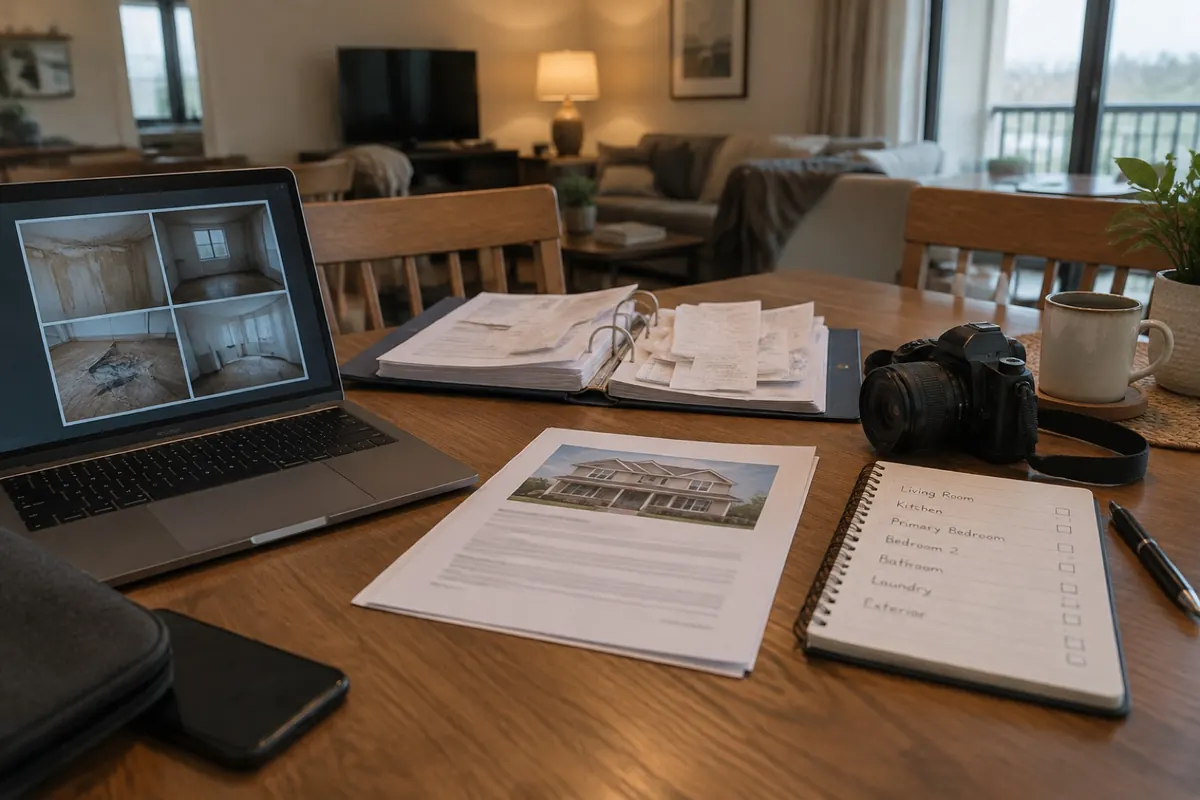
The first month: documents, proof of loss, the clock
USFA's After the Fire (FA-46) lists the documents to replace, from driver’s licence, passports and deeds to wills, medical records and income tax records. Start with the insurance policy: United Policyholders tells survivors to get a complete, current copy.
| Document | Where it is replaced | Source |
|---|---|---|
| Burnt or damaged cash | Federal Reserve Bank, or the Bureau of Engraving and Printing | USFA; Bureau of Engraving and Printing claim page |
| US savings bonds | FS Form 1048 to Treasury Retail Securities | USFA |
| Income tax records | IRS transcripts | IRS transcript page |
| Military discharge papers | National Archives; it lists natural disaster requests | National Archives service records page |
| Licence, registration, passport, vital records, cards | The issuing agency or company | USFA list |
The deadlines printed in the form
The ISO HO 00 03 05 11 form (Maine Bureau of Insurance copy) sets its own clocks. Proof of loss must be sent within 60 days after the insurer’s request, signed and sworn, with the inventory, repair estimates and receipts for additional living expenses. Loss is payable 60 days after the insurer receives proof of loss and an agreement, judgment or appraisal award. A suit must start within two years after the date of loss, and property removed from an endangered premises is covered for no more than 30 days while removed.
Tax relief, and the limit most people miss
USFA's After the Fire (FA-46) tells survivors to check with an accountant or the IRS, and to save receipts to prove losses claimed on a tax return. Per IRS Publication 547 (2025), a fire is a casualty, but for tax years beginning after 2017 an individual’s casualty loss of personal-use property is deductible only if it is attributable to a federally declared disaster, meaning a presidential major disaster or emergency declaration under the Stafford Act.
| Situation, per the IRS | Rule in Publication 547 |
|---|---|
| Personal-use property, ordinary house fire | Deductible only if attributable to a federally declared disaster |
| Exception | Losses may offset personal casualty gains in the same year |
| Federally declared disaster loss | Reduced by $100 per casualty and 10% of AGI |
| Qualified disaster loss | No 10% reduction; $100 becomes $500 |
| Living-expense insurance above extra cost | Taxable, unless in a federally declared disaster area |
For a single house fire with no federal declaration, that usually means no casualty deduction. A fire inside a declared disaster is different.
For contractors: emergency services that survive review
Board-up, tarping and water removal carry out the owner’s duty to protect the property under the HO-3 Duties After Loss clause. Keep that scope visibly temporary: the Alaska guide tells owners to hold permanent repairs until inspection and agreement.
- Photos before work. Every consumer source here tells owners to document before cleanup.
- Pack-out inventory. Owners are told not to discard anything before the inventory; your itemised list with photos becomes part of theirs.
- Storage clock. The form covers property removed from an endangered premises for no more than 30 days while removed. Know what covers storage after that.
- The written estimate and contract. USFA tells owners to ask for one; the FTC lists what it should contain.
Odour equipment is on our ozone generator page; more is in the fire and smoke hub.
Questions people actually ask
What to do immediately after a house fire?
The Red Cross lists four immediate steps: call 9-1-1, let friends and family know you are safe, get anyone seriously injured to professional medical or veterinary help, and stay out of the home until local fire authorities say it is safe to re-enter.
What is salvageable after a house fire?
Often more than it looks, but only after cleaning. USFA says anything you want to reuse will need careful cleaning. The Red Cross says to throw away food, beverages and medicine exposed to heat, smoke or soot, keep frozen food that still has ice crystals, and get professional advice on hose-soaked drywall. Inventory before you discard.
What is the 30/30/30 rule for fire?
It is a wildfire weather warning, not a recovery rule. As reported by The Weather Network, it flags extreme fire behaviour when the temperature is 30 C or higher, relative humidity is 30 per cent or lower and wind is 30 km/h or more. Brett Soderholm of the BC Wildfire Service, quoted there, says it is not a hard-and-fast rule.
What do people need most after a house fire?
A place to stay, food, clothing and medicine, which USFA says relief services such as the Red Cross help find. Next come a copy of the insurance policy, receipts for every expense and a claim diary, all on the United Policyholders first-steps checklist.
What should I do after a house fire with no insurance?
USFA lists who may help: the American Red Cross, the Salvation Army, religious organisations, public agencies such as the health department, community groups, state or municipal emergency services offices and nonprofit crisis-counselling centres. Keep receipts anyway; USFA notes you may need them to prove losses on a tax return.
Does homeowners insurance pay for a hotel after a fire?
The standard ISO HO-3 form covers any necessary increase in living expenses when a covered loss makes your home not fit to live in, for the shortest time required to repair or replace. Whether yours does, and to what limit, depends on your own policy; ask your insurer, your state insurance department or a licensed professional.
Sources
- USFA's After the Fire (FA-46), US Fire Administration, FEMA, January 2019. Retrieved 13 October 2026.
- USFA residential fire estimates, US Fire Administration, 2014 to 2023. Retrieved 13 October 2026.
- American Red Cross home fire recovery page, Red Cross guide to checking your home after a fire and Red Cross cleanup guide, American Red Cross. Retrieved 13 October 2026.
- ISO HO 00 03 05 11 form (Maine Bureau of Insurance copy), Homeowners 3 Special Form, Insurance Services Office, 2010, hosted by the Maine Bureau of Insurance. Retrieved 13 October 2026.
- Alaska Division of Insurance consumer guide, State of Alaska, 27 June 2019. Retrieved 13 October 2026.
- United Policyholders first-steps checklist (2026) and United Policyholders ALE Q&A deck (12 February 2026), United Policyholders. Retrieved 13 October 2026.
- FDA guidance on drugs after a disaster, US Food and Drug Administration. Retrieved 13 October 2026.
- FTC advice on scams after disasters, Federal Trade Commission, September 2025. Retrieved 13 October 2026.
- IRS Publication 547 (2025) and IRS transcript page, Internal Revenue Service. Retrieved 13 October 2026.
- Bureau of Engraving and Printing claim page, US Treasury. Retrieved 13 October 2026.
- National Archives service records page, National Archives. Retrieved 13 October 2026.
- ANSI/IICRC S700, IICRC. Retrieved 13 October 2026.
- The Weather Network, article by Nathan Howes, 14 May 2024. Retrieved 13 October 2026.
- Per-day and per-fire figures and the tax example values are arithmetic on the published numbers above. Our methodology sets out the standing rules.
Public guidance changes and policies differ. This page describes standard policy wording and published guidance; it is not legal, tax or insurance advice about your claim.