The short answer
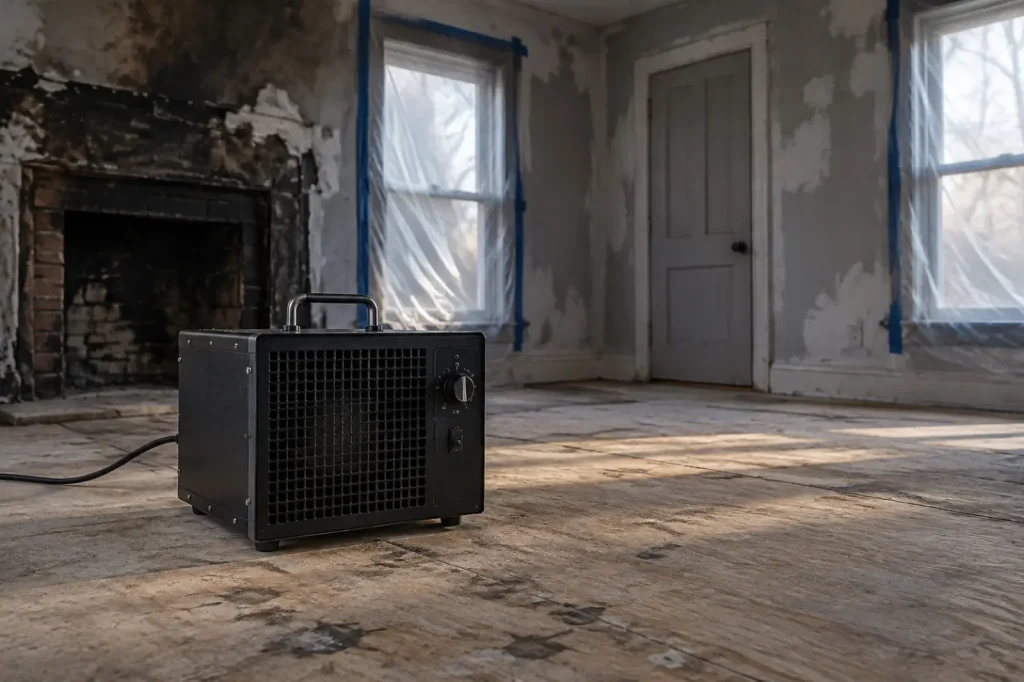
An ozone generator is a machine that makes ozone gas on purpose, with UV lamps or an electrical discharge, so the gas can oxidise odour compounds. Restorers use one as a shock treatment in a sealed, empty building after a fire. EPA says no federal agency has approved them for occupied spaces, OSHA caps workers at 0.1 ppm, and California bars selling them as air cleaners.
Key takeaways
- EPA, in one line: at levels within public health standards, ozone has little potential to remove indoor air contaminants.
- OSHA Table Z-1 sets 0.1 ppm as an 8-hour average; NIOSH sets 0.1 ppm as a ceiling and 5 ppm as IDLH, 50 times the OSHA figure.
- California’s 0.050 ppm limit exempts mold, odor, fire and smoke damage remediation by trained personnel with nobody present.
- Coverage claims do not track output: per the Queenaire and PROLUX sheets, 2,000 mg/h covers 20,000 sq ft and 14,000 mg/h covers 8,000.
- EPA lists rubber, wire coatings, plants, and fabrics or art with susceptible dyes as things ozone can damage.
- Ozone does not remove soot, and EPA says it may not touch contaminants embedded in porous material. Clean first.
On this page
This search returns retail listings for 10,000 mg/h boxes and one federal page warning against them. Both describe the same machine; what differs is the room it runs in. The deodorising sequence itself lives in our guide to getting smoke smell out of a house and is not repeated here.
What the machine does
According to EPA's page on ozone generators sold as air cleaners, ozone is three oxygen atoms, and the third can detach and re-attach to other molecules, altering their chemistry. That reactivity is the whole odour claim. EPA's Residential Air Cleaners technical summary says the machines use UV lamps or electrical discharge to make it. The NIOSH entry describes a colourless to blue gas with a very pungent odour that is incompatible with all oxidisable materials.
In restoration the machine has one legitimate job: a shock treatment of a sealed, unoccupied structure after soot and charred material are gone. The EPA page names it, saying high concentrations, when people are not present, are sometimes used to decontaminate an unoccupied space of odours, with fire restoration as the example, and adds that conditions should be controlled so no person or pet is exposed.
It does not remove particles, so soot is untouched; that is cleaning and HEPA filtration, covered on our page on what an air scrubber is. EPA also reports ozone generators are not effective at removing carbon monoxide or formaldehyde.
What EPA actually says
EPA's page on ozone generators sold as air cleaners, last updated 19 February 2026, is written as a rebuttal of vendor claims, so it reads best as claim against finding. The right column compresses EPA’s own wording.
| Vendor claim | EPA’s finding |
|---|---|
| “Energized oxygen”, “pure air” | A toxic gas with vastly different properties from oxygen |
| Approved for homes | NO federal agency has approved them for occupied spaces |
| Breaks pollutants down to water and carbon dioxide | Misleading: some reactions take months or years, others form irritating by-products |
| Removes odours at safe levels | Not effective on many odour-causing chemicals within health standards |
| Kills airborne mold and bacteria | Would need 5 to 10 times the levels health standards allow |
| Safe if you follow the instructions | Levels well above the standards are possible even then |
| Turn it down if you can smell it | Sense of smell for ozone deteriorates in its presence |
Two findings matter to anyone running a machine for a living. In a laboratory test that mixed ozone with new-carpet chemicals, EPA reports ozone produced aldehydes and the total organic chemicals in the air rose. And EPA's Residential Air Cleaners technical summary lists reaction by-products as ultrafine particles, formaldehyde, ketones and organic acids. On some devices, EPA found, the high setting generated 10 times the medium level.
The exposure limits, side by side
The federal workplace number is in 29 CFR 1910.1000 Table Z-1: ozone, CAS 10028-15-6, 0.1 ppm or 0.2 mg/m3. With no C before it, 29 CFR 1910.1000(a)(2) makes it an 8-hour time weighted average. The NIOSH Pocket Guide entry for ozone sets a 0.1 ppm ceiling, an IDLH of 5 ppm and a conversion of 1 ppm to 1.96 mg/m3.
| Body and limit | As printed | In ppb | Applies to |
|---|---|---|---|
| NIOSH REL | 0.1 ppm | 100 ppb | Ceiling, never exceeded |
| OSHA PEL | 0.1 ppm | 100 ppb | Worker 8-hour average |
| CARB, California 1-hour | 0.090 ppm | 90 ppb | State outdoor standard |
| EPA NAAQS, 2015 | 0.070 ppm | 70 ppb | Outdoor 8-hour standard |
| CARB, California 8-hour | 0.070 ppm | 70 ppb | State outdoor standard |
| CARB device limit | 0.050 ppm | 50 ppb | Any indoor air cleaner sold in California |
| FDA, medical devices | 0.05 ppm | 50 ppb | Indoor medical device output |
Now set those limits against what the EPA page reports machines produced. A unit sold for spaces up to 3,000 square feet, run on high in a 350 square foot room, reached 0.50 to 0.80 ppm, which EPA calls 5 to 10 times higher than public health limits. Against the OSHA figure that is 5 to 8 times, in our arithmetic.
Out of scope. This page does not cover what ozone does to the body; EPA’s page states that when inhaled, ozone can damage the lungs, and health questions belong with that page and a medical professional.
California: the ban and the carve-out
The CARB air cleaner regulation, 17 CCR 94800 to 94808 is the only US rule that tests and caps the ozone an air cleaner emits. Section 94802 bars selling or supplying any indoor air cleaning device in California unless CARB has certified it at an ozone emission concentration not exceeding 0.050 ppm. CARB's ozone generator fact page says CARB adopted the rule in 2007, recommends ozone generators not be used except for approved industrial purposes, and reports that many commercial units emit more than 5,000 mg of ozone per hour.
Most coverage of the ban skips the exemption. The regulation lists six industrial uses, and category D is restoration, so a properly labelled restoration unit can be sold in California while a bedroom ozone purifier cannot.
| Device or party | Requirement | 17 CCR section |
|---|---|---|
| Any indoor air cleaner sold in California | CARB-certified at no more than 0.050 ppm ozone | 94802(a) |
| Ozone purifier marketed for homes | Cannot meet the limit, so cannot be sold as an air cleaner | 94802(a) |
| Unit sold solely for industrial use | Exempt if labelled “For industrial use only. Use only in unoccupied spaces. Health hazard: emits ozone.” | 94803(a) |
| Industrial use, category D | “mold, odor, fire and smoke damage remediation services, carried out by trained personnel, and provided no people are physically present” | 94801(a)(19)(D) |
| Manual for an exempt unit | Must recommend ventilating at least one hour before re-occupancy | 94803(a) |
| Seller of an exempt unit | Must show it is marketed solely for an exempt purpose | 94803(a) |
Outside California, EPA's Residential Air Cleaners technical summary notes, no national rule requires independent measurement of the ozone these devices make. Makers know the line: the Airthereal MA10K-PRODIGI page states the unit does not meet CARB requirements and cannot be shipped to California.
Output specs from named manufacturer sheets
Output is sold in milligrams of ozone per hour. Five units, quoted from their makers’ own sheets or pages, show the spread. They are not recommendations and the figures are the makers’.
| Unit, per the maker’s page | Ozone, mg/h | Coverage, sq ft | Timer | Occupancy or CARB wording |
|---|---|---|---|---|
| PROLUX PLCOZ12K (PROLUX PLCOZ12K spec sheet) | 9,000 to 14,000 | 8,000 | 2 hours or continuous | None on the sheet |
| Airthereal MA10K-PRODIGI (Airthereal MA10K-PRODIGI page) | 2,000 to 10,000 | 20,000+ | Up to 12 hours | “Use only in unoccupied spaces”; “cannot be shipped to California” |
| Queenaire Activator 2000 Series II (Queenaire Activator 2000 Series II page) | Up to 2,000 | 20,000 | 15 minutes to 24 hours | None on the page |
| Newaire HO3-2500, ozone mode (Newaire HO3-2500 spec sheet) | Up to 1,000 | 2,500 | 0 to 60 minutes | “area must be vacated” |
| Queenaire QT Tornado (Queenaire home page) | Up to 600 | Not stated | Not stated | Not stated |
Ignore the coverage column. Per the Queenaire Activator 2000 Series II page, 2,000 mg/h treats 20,000 sq ft; the PROLUX PLCOZ12K spec sheet gives 14,000 mg/h a maximum of 8,000. Per the two sheets, that is 10,000 against 571 sq ft per 1,000 mg/h, a 17.5-fold disagreement in our arithmetic. EPA warned that some makers’ sizing advice has not been precise enough to stay under health limits. Size on sealed volume, run time and a meter.
What ozone damages, from published sources
EPA's page on ozone generators sold as air cleaners says ozone can damage rubber, electrical wire coatings, and fabrics and art work containing susceptible dyes and pigments, and can harm indoor plants. The Canadian Conservation Institute explains the mechanism: ozone breaks apart double bonds between carbon atoms.
| Material | Named by | Before treatment |
|---|---|---|
| Rubber seals, gaskets, elastic | EPA; CCI calls rubber degradation under stress a most studied effect | Remove |
| Electrical wire coatings | EPA | Keep runs short and logged |
| Fabrics and art with susceptible dyes | EPA; CCI cites fading of artists’ colorants | Pack out |
| Indoor plants | EPA | Remove |
| Building materials, furnishings, wiring | EPA technical summary: by-products may damage them | Limit dose and time |
That is why ozone and contents pack-out travel together. Which surfaces can be saved is in our smoke damage repair guide.
Ozone, hydroxyl or thermal fogging
These are the three odour tools that follow source removal. They do different things and fail differently. Where no published source read for this page answers a cell, it says so.
| Ozone generator | Hydroxyl generator | Thermal fogging | |
|---|---|---|---|
| What it releases | Ozone gas (EPA) | Hydroxyl radicals, formed on a UV-lit catalyst in PCO units (EPA) | Heated deodorant fog; Thermo 55 is a petroleum solvent and essential oil blend |
| People present | No; no federal approval for occupied spaces | Makers say yes, e.g. Newaire: “people and pets can remain” | Not stated on the product page; label and SDS govern |
| Soot and particles | Not removed (EPA) | EPA classes PCO as a gas technology | No soot claim made |
| By-products named | Aldehydes, formaldehyde, ultrafine particles | Formaldehyde, acetaldehyde, NO2, CO; ozone from uncoated UV-C | Not stated on the page read |
| Pace | Hours, per maker timers | “Gradual, continuous” (Newaire) | Not stated |
| California sale | Industrial-use exemption only | Certified at 0.050 ppm if it emits ozone | Not an air cleaner |
The trade standard is ANSI/IICRC S700, listed by IICRC as a 2025 first edition covering fire odour management. Its text is sold, not published, so it is not quoted here.
The run sheet: before, during, after
No federal rule sets a run time or re-entry clock for a shock treatment, so this sheet orders the regulators’ conditions and makers’ instructions. A job that cannot tick a row needs a different tool.
| Step | Condition before moving on | Published basis |
|---|---|---|
| 1 | Cleaning and source removal finished | EPA ranks source control most effective |
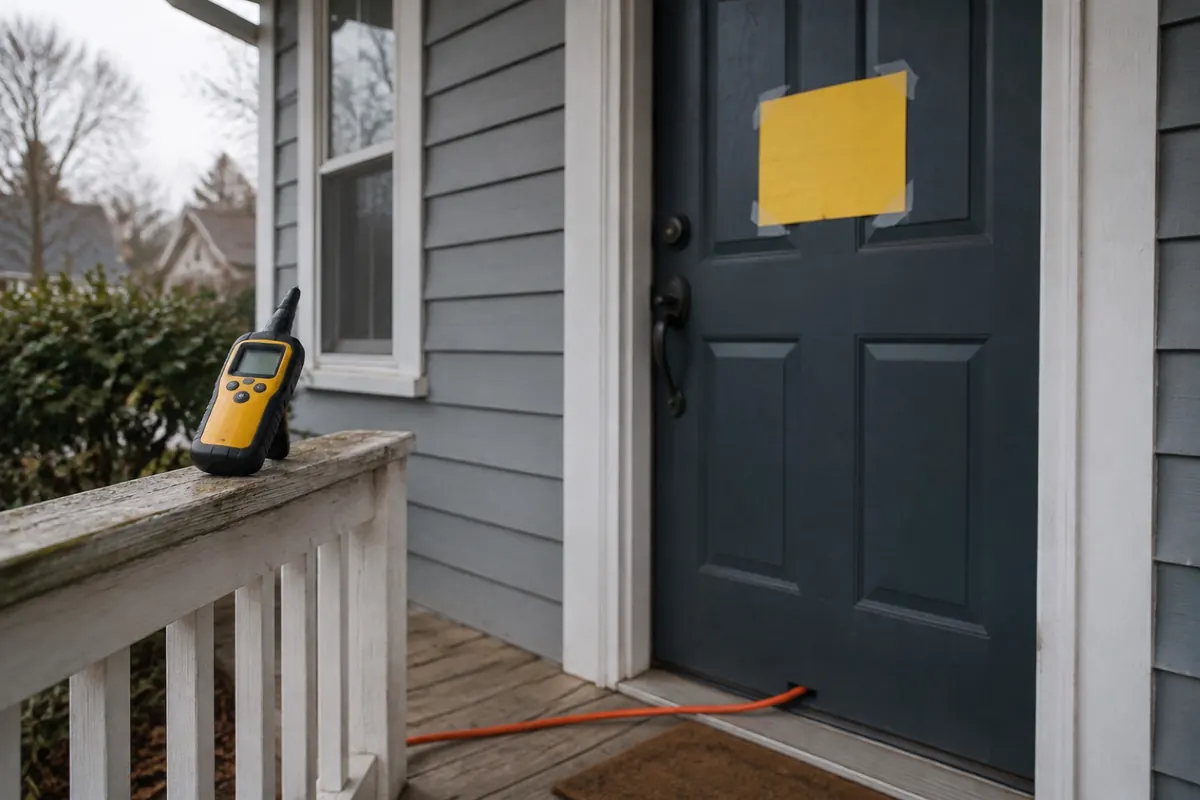
| 2 | All people and pets out; doors posted | EPA; CARB category D |
| 3 | Plants, rubber, art, dyed textiles out | EPA damage list |
| 4 | Openings sealed; HVAC decision logged | EPA: closed spaces raise concentration |
| 5 | Output set from volume, not the box | EPA: sizing advice imprecise, dial non-linear |
| 6 | Started and timed from outside | Running units exceed the OSHA figure |
| 7 | Ventilated before return | CARB: at least one hour; Airthereal: ozone may remain 30 minutes to 4 hours |
| 8 | Cleared with a meter | EPA: smell is no proof of safety |
Which situation are you in
- Occupied home, family staying. No ozone. Hydroxyl, cleaning and filtration carry the job.
- Vacated after a fire, residue removed. The use EPA’s page describes. Follow the sheet.
- Odour back after ozone. The source remains, usually in a cavity, duct or porous contents.
- Mold. EPA says ozone may not affect contaminants embedded in porous material. See our mold remediation process.
For contractors: scope, records and the line item
The duty sits with the employer: OSHA’s 0.1 ppm average covers every technician who opens the door, and the California exemption depends on trained personnel and nobody present. The file below answers what an adjuster or a lawyer asks later.
| Record | Question it answers |
|---|---|
| Photos and contents list | What left, what stayed, why |
| Make, model, stated mg/h | Was output suited to the volume |
| Volume and sealed openings | Dose, and spill to other units |
| Start, stop, ventilation times | Basis for re-entry |
| Clearance reading and meter | Was the space below 0.1 ppm |
| Photo of posted doors | Who could have walked in |
Keep deodorisation as its own estimate line with unit-days and treated area stated. Expect to be asked why ozone and not hydroxyl; the documented answer is occupancy and timeline. Claim handling is in our smoke damage insurance claim guide, owner steps are on what to do after a house fire, and more is in the fire and smoke hub.
Questions people actually ask
What will an ozone generator do?
It makes ozone gas with UV lamps or an electrical discharge, and the gas oxidises some odour compounds. EPA says that within public health standards ozone has little potential to remove indoor air contaminants, and it does not remove particles such as soot. Restorers use it in an empty, sealed building after cleaning.
Is it safe to run an ozone generator in a house?
Not while anyone is inside. EPA states that no federal agency has approved ozone generators for occupied spaces, and CARB advises against using them where people or animals are present. EPA accepts high levels in unoccupied spaces, such as fire restoration, only if no person or pet is exposed.
How harmful is ozone to humans?
Health effects are outside this page’s scope; EPA’s ozone generator page covers them. The published limits are 0.1 ppm as a worker 8-hour average under OSHA Table Z-1, 0.1 ppm as a NIOSH ceiling, and 5 ppm as NIOSH’s immediately dangerous level. EPA reports a generator reaching 0.50 to 0.80 ppm in a small room.
How long should you run an ozone generator in your house?
No federal rule sets a run time. Maker timers run from 2 hours on the PROLUX PLCOZ12K to 12 hours on the Airthereal MA10K-PRODIGI and 24 hours on the Queenaire Activator 2000. Airthereal says ozone may remain 30 minutes to 4 hours, and CARB requires exempt units’ manuals to recommend an hour of ventilation before re-entry.
Are ozone generators banned in California?
Selling one as an indoor air cleaner is, because 17 CCR 94802 requires every indoor air cleaning device sold in California to be certified at 0.050 ppm ozone or less. Units made, marketed and labelled solely for industrial use are exempt, including mold, odor, fire and smoke damage remediation by trained personnel with no people present.
Sources
- EPA's page on ozone generators sold as air cleaners, US EPA, updated 19 February 2026. Retrieved 13 October 2026.
- EPA's Residential Air Cleaners technical summary, third edition, EPA, 2018. Retrieved 13 October 2026.
- EPA's NAAQS table, EPA, updated 4 November 2025. Retrieved 13 October 2026.
- 29 CFR 1910.1000 Table Z-1 and 29 CFR 1910.1000(a)(2), OSHA. Retrieved 13 October 2026.
- NIOSH Pocket Guide entry for ozone, NIOSH. Retrieved 13 October 2026.
- CARB air cleaner regulation, 17 CCR 94800 to 94808, California Air Resources Board. Retrieved 13 October 2026.
- CARB's ozone generator fact page, California Air Resources Board. Retrieved 13 October 2026.
- Canadian Conservation Institute, Agent of Deterioration: Pollutants, Government of Canada. Retrieved 13 October 2026.
- ANSI/IICRC S700, IICRC. Retrieved 13 October 2026.
- PROLUX PLCOZ12K spec sheet, hosted by Sylvane. Retrieved 13 October 2026.
- Airthereal MA10K-PRODIGI page, Airthereal. Retrieved 13 October 2026.
- Queenaire Activator 2000 Series II page and Queenaire home page, Queenaire. Retrieved 13 October 2026.
- Newaire HO3-2500 spec sheet, hosted by Sylvane. Retrieved 13 October 2026.
- ODORx Thermo 55 page, Legend Brands. Retrieved 13 October 2026.
- Ratios are arithmetic on the published figures above. Our methodology sets out the standing rules.
Specifications are the makers’ own and change without notice. This page describes regulations and published guidance, not legal, medical or safety advice for a specific job.