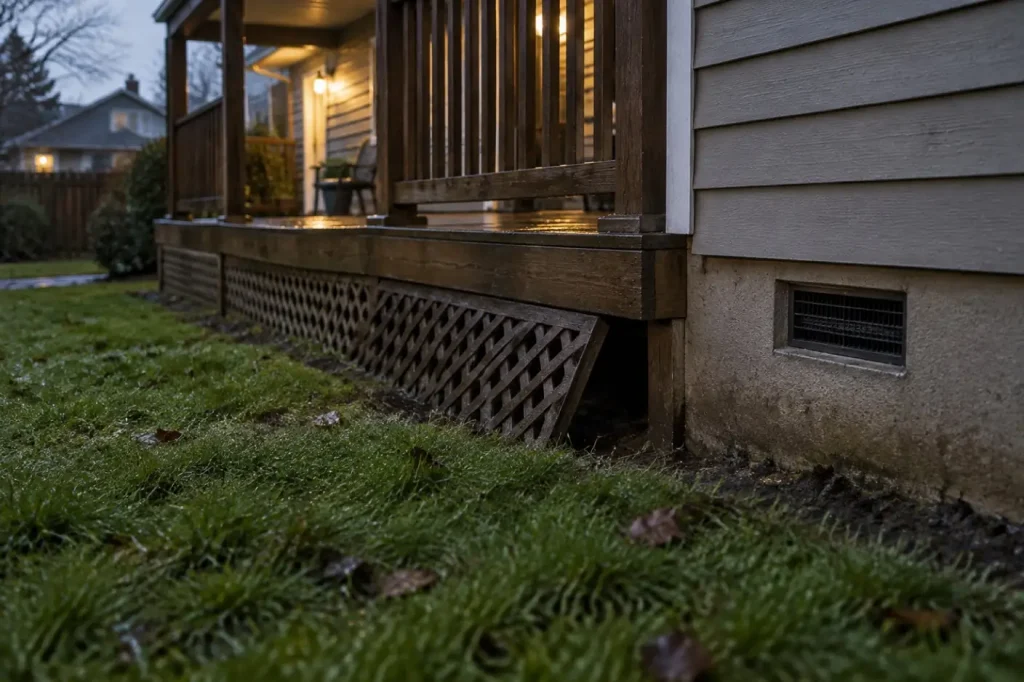
The short answer
Treat any skunk smell in house air as a possible gas leak until you rule it out, because gas odorant and skunk spray are both sulfur thiols. Once it is plainly skunk, the fix is chemical: find the surfaces the oily spray touched, oxidize them with fresh hydrogen peroxide, baking soda and soap, or diluted bleach outdoors, and ventilate the rest.
Key takeaways
- Two thiols carry the smell: according to Wood’s Humboldt State figures, (E)-2-butene-1-thiol and 3-methyl-1-butanethiol make up 56 to 70% of striped skunk secretion.
- Thioacetates are why it returns: water turns them back into thiols, which Wood's chemistry of skunk spray page links to skunky pets on damp evenings.
- Never store or cap Krebaum’s mix. It releases oxygen and can burst a closed container.
- Gas must be smellable at one-fifth of its lower explosive limit under 49 CFR 192.625(a). Unsure? Leave and call from outside.
- Odour that drifted through rooms has no chemical fix; only time and ventilation clear it.
- Furnace filters catch particles, not gases, per EPA's guide to air cleaners.
On this page
The pages ranking for this question are mostly wildlife franchises and recycled remedies. This one treats skunk odor removal as chemistry, backed by regulator and utility guidance. Removing the animal is a pest job for our sister site The Pest Control Brief; this page is about the odour.
First: is it skunk, or is it gas?
Pure natural gas is odourless, according to the Kansas Corporation Commission, so utilities add a sulfur odorant; the Bristol Molecule of the Month page names ethanethiol, 2-propanethiol, 2-butanethiol and t-butylthiol among them. Skunk spray is also thiols, and the Iowa Utilities Commission bulletin says a rotten egg or skunk odour with no obvious source could be a gas leak.
Under 49 CFR 192.625(a), gas must be readily detectable by smell at one-fifth of the lower explosive limit. Per the ILO chemical safety card 0291, methane’s explosive limits are 5 to 15% in air, so the rule targets a smell at about 1% gas, well before ignition is possible. That margin only helps if you act.
| Signal | Points toward | Published guidance |
|---|---|---|
| Strongest near a range, furnace, water heater or meter | Gas | Leave, then call the utility or 911 from a safe place (Kansas Corporation Commission). |
| Hissing or blowing sound | Gas | City Utilities of Springfield: evacuate and call 911. |
| No obvious source and you are unsure | Treat as gas | Iowa Utilities Commission: no spark, leave, call 911, call the gas provider. |
| Strongest outdoors, or a pet just came in | Skunk | Ventilate and work the method below. |
If unsure: no light switches, phones or garage door openers indoors, which the Kansas Corporation Commission lists as ignition sources. Leave and call from outside. City Utilities of Springfield warns odorant can fade, so a faint smell is not proof of safety.
What you are smelling, and where it lives
Wood's skunk secretion page describes the secretion as a yellow oil of thiols and thioacetates, sprayed several feet, and puts human detection of the thiols at about 10 parts per billion according to his page. The oil is the target; the hallway smell is vapour coming off it. So map before you clean: where the smell is strongest tells you the source.
| Pattern | Likely source | Look for |
|---|---|---|
| Strong outside, fading inside over a day or two | Spray near the house that drifted in | An oily spot on siding, a window well or a vent |
| Around one pet, its bed or a doorway | Pet carried the oil inside | Residue on fur, collar, bedding, door jamb at pet height |
| At the floor of several rooms, worse when the furnace runs | Spray or a den under the house | Crawl space vents, porch gaps, return ducts below the floor |
| Returns on humid evenings, weeks later | Thioacetates in a porous surface | The same deck board, mat or coat each time |
| Near a grow tent or a neighbour’s yard | Cannabis | Oswald et al., ACS Omega 2021 names 3-methyl-2-butene-1-thiol as its main odorant |
| At a floor drain or toilet | Plumbing | A plumber, not an odour product |
Why the smell comes back on damp days
Andersen and Bernstein, J. Chem. Educ. 1978 set out skunk thiol structures for chemistry teaching, and Wood’s gas chromatography work (Wood, J. Chem. Ecol. 1990) found seven major components in striped skunk secretion: three thiols, three thioacetates and the alkaloid 2-methylquinoline.
Per Wood's chemistry of skunk spray page, the two top thiols cause the repellent odour; the third is less potent because it is not very volatile. The thioacetates, about 18 to 32% of the secretion according to the same figures, smell much less but convert to thiols on water hydrolysis. Wood offers that as the reason a sprayed pet smells skunky again on damp evenings, and PBS NOVA uses it to explain a pet smelling skunky again after a bath.
Generic advice misses this: a surface that smells fine on a dry afternoon can still hold thioacetates, and rain or steam revives them. Judge success on a humid day.
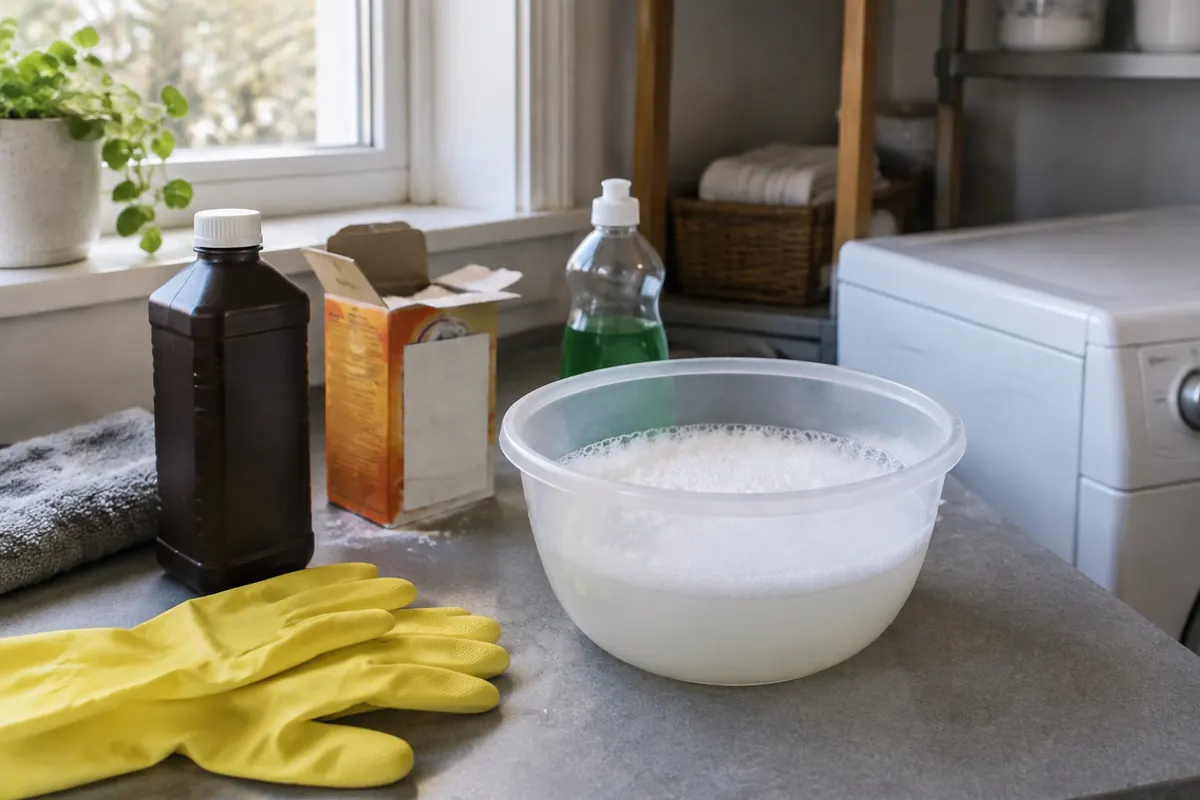
The fix follows from the same chemistry. Wood's chemistry of skunk spray page explains that oxidizing thiols to sulfonic acids removes the odour. Peroxide with baking soda is mild enough for pets, though it may change hair colour; laundry bleach is cheap and effective on objects.
The peroxide formula, and its one hard rule
Paul Krebaum published the recipe in Chemical and Engineering News on 18 October 1993, as reproduced by Wood's deodorizing page: according to that page, one quart of 3% hydrogen peroxide, a quarter cup of baking soda and a teaspoon of liquid detergent. UC IPM Pest Note 74118 gives the same quantities.
| Rule | Source wording | Why it matters |
|---|---|---|
| Never cap or bottle it | Releases oxygen gas, could break a closed container (Wood); unstable, cannot be bottled or stored (UC IPM). | A sealed jug can pressurize and burst. |
| Mix fresh, use at once | Will not work if stored for any length of time (Wood). | The reaction that works also spends it. |
| Five minutes, then rinse | Rinse after 5 minutes; repeat if necessary (Wood). | Contact time does the work. |
| Expect bleaching | May bleach pet hair (Wood). | Test fabric and carpet first. |
| Keep out of eyes; work outside | UC IPM; Wood. | Bathing a sprayed dog in the tub moves the problem indoors. |
| Dilute leftovers | Dilute several fold, pour down the drain (UC IPM). | Do not save it. |
Never stack oxidizers. The Washington State Department of Health lists hydrogen peroxide among things bleach reacts with, and warns that bleach with vinegar gives off chlorine gas and bleach with ammonia makes chloramines. Rinse one product away before using another. For pets, UC IPM Pest Note 74118 advises asking your veterinarian about current washing recommendations.
How to get skunk smell out of house surfaces
| Surface | Method | Why it works | Why this differs from generic advice |
|---|---|---|---|
| Siding, concrete, deck where spray landed | Laundry bleach, 1 cup per gallon, on the exact spot, per Wood; test for bleaching. | Hypochlorite oxidizes thiols to sulfonic acids. | Wood says bleach must contact the spot; spraying air does nothing. |
| Pet fur or skin | Fresh Krebaum mix, 5 minutes, rinse. | Mild oxidation, per Wood. | Tomato juice only masks through olfactory fatigue. |
| Washable clothing and rags | Wash with 1 cup bleach per gallon if the label allows, per Wood. | Oxidizes thiols and wetted thioacetates. | Detergent alone oxidizes nothing. |
| Upholstery | Peroxide mix after a hidden-area test. | Oxidation without hypochlorite’s dye damage. | Fabric sprays perfume the oil. |
| Carpet contact patch | Blot on peroxide mix, dwell, rinse, extract. | Oxidizes residue in the pile. | Steam first adds water and heat, regenerating thiols. |
| Untouched rooms and air | Ventilation and time; carbon filtration if needed. | Nothing to oxidize. | Wood: chemicals will not fix spray trapped in a house. |
Porous concrete, brick and old deck boards hold oil below the surface. Wood notes repeat applications may be needed; recheck on a humid evening.
Skunk smell under house floors, decks and ducts
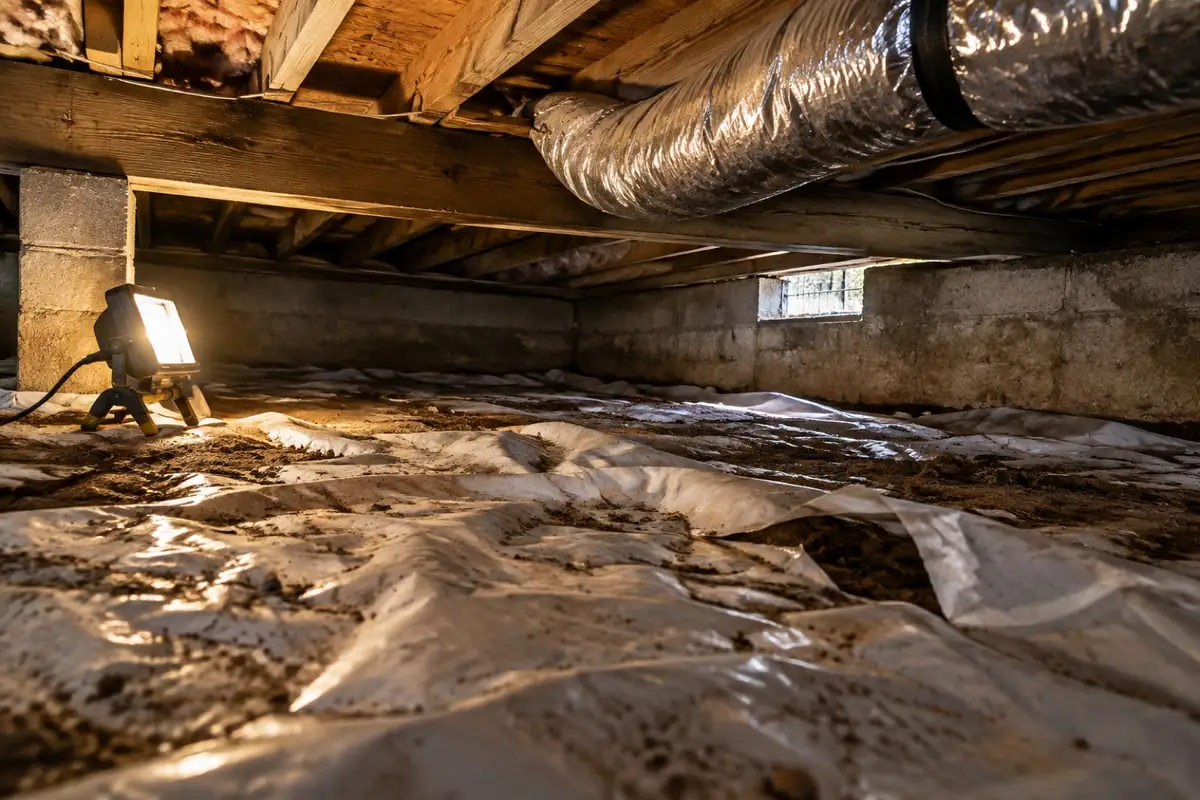
UC IPM Pest Note 74118 notes skunks den under decks, porches and buildings, and males often spray when fighting in breeding season. While an animal is still there, cleaning is pointless; exclusion comes first. The same Pest Note warns that ammonia repellents should not go under an occupied building because fumes can enter, especially if a furnace draws air from beneath. Skunk odour travels that path too: a leaky return duct in a crawl space spreads it to every register.
| Location | Method | Who owns the fix |
|---|---|---|
| Crawl space soil or pier | Bleach solution on the contact spot once the animal is gone; remove soaked debris or vapour barrier | Odour work; exclusion by a wildlife operator |
| Under a deck or porch | Bleach at Wood’s ratio on boards and footings, tested first | Odour work |
| Return duct or air handler below the floor | New filter, sealed leaks, a deep activated carbon filter | An HVAC contractor |
| Outdoor air intake near the spray | Close it until the outdoor spot is treated | Odour work plus HVAC |
EPA's guide to air cleaners says home furnace filters are usually designed for particles, while activated carbon can remove gases if a large amount of material is used. A thin carbon-dusted filter is not a carbon bed, and equipment choice belongs to an HVAC contractor. See our guides to air scrubbers and duct cleaning cost; duct cleaning oxidizes nothing.
Fabrics, carpet and the care label
The care label decides which oxidizer a fabric can take. Under 16 CFR 423.6, a label must say No bleach if all bleaches would harm the item, and Only non-chlorine bleach, when needed if only chlorine bleach would.
| Care label says | Bleach wash? | Peroxide mix? |
|---|---|---|
| Nothing about bleach | Allowed | Allowed; test colour |
| Only non-chlorine bleach, when needed | No | Test a hidden seam first |
| No bleach or Do not bleach | No | No; air outdoors, repeat normal washes |
| Dry clean only | No | No; tell the drycleaner what it is |
Carpet is the awkward middle: its dyes bleach and its pad holds residue no surface treatment reaches. Work only the contact patch. If the same patch smells again on humid days, the oil reached the pad, and replacing pad under that area beats repeat treatment. Whole-house odour on carpet and drywall is a different job, covered in getting smoke smell out of a house.
What does not work, chemically
| Remedy | What actually happens | Source |
|---|---|---|
| Tomato juice | Olfactory fatigue: you stop smelling skunk; a newcomer still does. | Wood's deodorizing page; PBS NOVA |
| Vinegar | An acid, not an oxidizer; with bleach it releases chlorine gas. | Wood; Washington State Department of Health |
| Air freshener, bowls of baking soda | Masks or does nothing; the thiols are unchanged. | Wood’s oxidation requirement |
| HEPA or furnace filter | Captures particles; the odour is a gas. | EPA's guide to air cleaners |
| Ozone generator in an occupied room | No federal agency has approved these for occupied spaces. | EPA's guide to air cleaners |
Ozone is an oxidizer, but professional use means an empty, sealed structure. Our ozone generator guide covers when restorers use it and the conditions that go with it.
The decision path
- Any doubt it is skunk? Leave; call the utility or 911 from outside.
- Animal still under the house? Exclusion first.
- Pet carried it in? Treat the pet outdoors, then bedding and pet-height contact points.
- Visible spot outside? Bleach solution, tested, repeated on porous materials.
- General indoor air only? Ventilate and wait.
- Returns on humid days from one place? Re-treat wet; replace pad or soft goods that keep failing.
- Worse when the furnace runs? Look below the floor; an HVAC contractor seals duct leaks.
- Still there? Call a restoration contractor.
Signs it is bigger than one spray
- Odour indoors with no outdoor source and no pet contact.
- Repeated sprays over weeks, which suggests a den.
- Odour concentrated at registers: the air system is moving it.
- Soaked crawl space insulation or vapour barrier, which usually comes out, as in our musty basement guide.
For contractors
Skunk calls fail when the animal is still there, nobody asked the gas question, or fogging was sold to fix crawl space residue. Scope it as source removal.
| Record | Why |
|---|---|
| Gas ruled out, by whom, when | Documents the call was treated as a possible leak. |
| Exclusion status and date | Odour work before exclusion is repeat work. |
| Photos of each contact spot and access point | Shows the work targeted surfaces, not air. |
| What was oxidized, what was removed and why | Removal lines need a reason. |
| Product, dilution, dwell, test-spot result | Bleaching is the common callback. |
| Policy wording, if a claim is filed | The ISO HO 00 03 05 11 form excludes under Coverage A and B loss caused by discharge or release of waste products or secretions by any animals. Whether a given policy responds is for the carrier and the state insurance department. |
Price the source work: crawl space entry, removal of soaked materials, oxidizer applications and equipment days; see how Xactimate pricing works. More odour work sits under the fire, smoke and odour hub, and urine odour is on our cat urine smell page.
Not covered here. Animal removal and rabies questions belong to wildlife professionals and animal control. Health effects are out of scope; Wood's skunk secretion page notes only that the liquid acts like tear gas in the eyes. Contact Poison Control or a clinician about any exposure.
Questions people actually ask
How do I get skunk smell out of my house fast?
Rule out gas first. Then treat the contact points, such as the pet, its bedding, a door jamb or an outdoor spot near a vent, with fresh peroxide, baking soda and soap, or diluted bleach outdoors. Ventilate the rest. William Wood notes drifted odour has no chemical fix; time and airflow clear it.
Why does my house smell like skunk at night?
Wood’s research found thioacetates in skunk spray that turn back into smelly thiols when damp, so old residue revives on humid evenings. UC IPM notes males spray when fighting in breeding season. A gas leak can smell similar, so if the source is unclear, leave and call the utility.
Can a gas leak smell like skunk?
Yes. Utilities odorize gas with sulfur thiols, and skunk spray is also mostly thiols. The Iowa Utilities Commission says a rotten egg or skunk odour with no obvious source could be a gas leak: do not create a spark, leave, and call 911 and your gas provider.
Why does skunk smell come back after cleaning?
According to Wood’s figures, thioacetates make up about 18 to 32% of striped skunk spray. They smell weakly but become potent thiols when wet, so a clean-looking surface can smell again after rain, a bath or steam. Re-treat it wet and judge it on a humid day.
Does vinegar get rid of skunk smell?
Not chemically. Wood explains the odour is removed by oxidizing thiols to sulfonic acids, and vinegar is an acid, not an oxidizer. Never combine it with bleach: Washington State’s health department warns that bleach plus an acid such as vinegar releases chlorine gas.
How do I get rid of skunk smell under my house?
Make sure the animal is gone, then treat the exact spot with laundry bleach at 1 cup per gallon, per Wood, and remove soaked debris or vapour barrier. UC IPM warns a furnace drawing air from below can carry fumes indoors, so have duct leaks sealed.
Can I store the peroxide and baking soda mixture?
No. Wood warns it releases oxygen gas and could break a closed container, and that it will not work if stored. UC IPM says to dilute leftovers several fold with water and pour them down the drain. Mix it fresh every time.
Sources
- Wood's chemistry of skunk spray page, William F. Wood, Humboldt State University, 1998, archived 2018; percentages read from its figures. Retrieved 30 October 2026.
- Wood's deodorizing page, Wood, updated 2010, archived; Krebaum recipe from C&EN, 18 October 1993, p. 90. Retrieved 30 October 2026.
- Wood's skunk secretion page, Wood, updated 2010, archived. Retrieved 30 October 2026.
- Wood, J. Chem. Ecol. 1990, J. Chem. Ecol. 16:2057, PubMed. Retrieved 30 October 2026.
- Andersen and Bernstein, J. Chem. Educ. 1978, 1-Butanethiol and the striped skunk, 55:159, Crossref. Retrieved 30 October 2026.
- Bristol Molecule of the Month, Simon Cotton, February 2022. Retrieved 30 October 2026.
- PBS NOVA, The Chemistry of Skunk Spray. Retrieved 30 October 2026.
- UC IPM Pest Note 74118, Skunks, updated April 2015. Retrieved 30 October 2026.
- 49 CFR 192.625(a), via Cornell LII. Retrieved 30 October 2026.
- ILO chemical safety card 0291, methane. Retrieved 30 October 2026.
- Kansas Corporation Commission, Natural Gas Safety. Retrieved 30 October 2026.
- City Utilities of Springfield, Natural Gas Safety. Retrieved 30 October 2026.
- Iowa Utilities Commission, Safety Minute, July 2026. Retrieved 30 October 2026.
- Oswald et al., ACS Omega 2021, 6(47):31667, PubMed. Retrieved 30 October 2026.
- Washington State Department of Health, undated. Retrieved 30 October 2026.
- EPA's guide to air cleaners, updated 1 October 2026. Retrieved 30 October 2026.
- 16 CFR 423.6, FTC Care Labeling Rule, via Cornell LII. Retrieved 30 October 2026.
- ISO HO 00 03 05 11 form, ISO 2010, Maine Bureau of Insurance copy. Retrieved 30 October 2026.
- Shares are sums of published ranges, computed at build. Nothing here was tested by us; see our methodology.
If you smell gas or are unsure, leave and call 911 or your gas utility from outside. Never mix cleaning chemicals.