The short answer
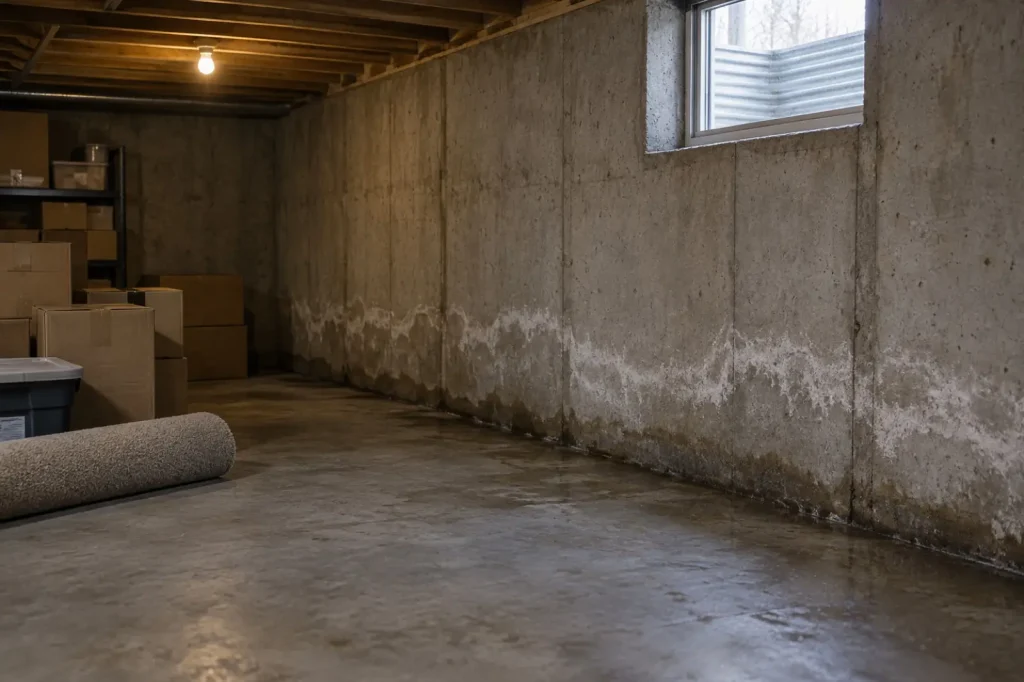
A musty smell in basement air usually means microbial growth on damp material: EPA says mold gives off volatile compounds that are the source of the musty odour. The damp comes from humid air, water wicking through concrete, rain reaching the foundation or a dripping condensate pan. Keep relative humidity below 60 percent, ideally 30 to 50, then find and dry the source.
Key takeaways
- Musty and rotten-egg are different problems. Musty points to microbial growth; a rotten-egg smell points to sewer gas through a dry floor drain trap, which needs water, not a dehumidifier.
- EPA’s number is below 60 percent relative humidity, ideally 30 to 50. ENERGY STAR describes 50 to 75 percent as a space that feels damp with a musty odour that may come and go.
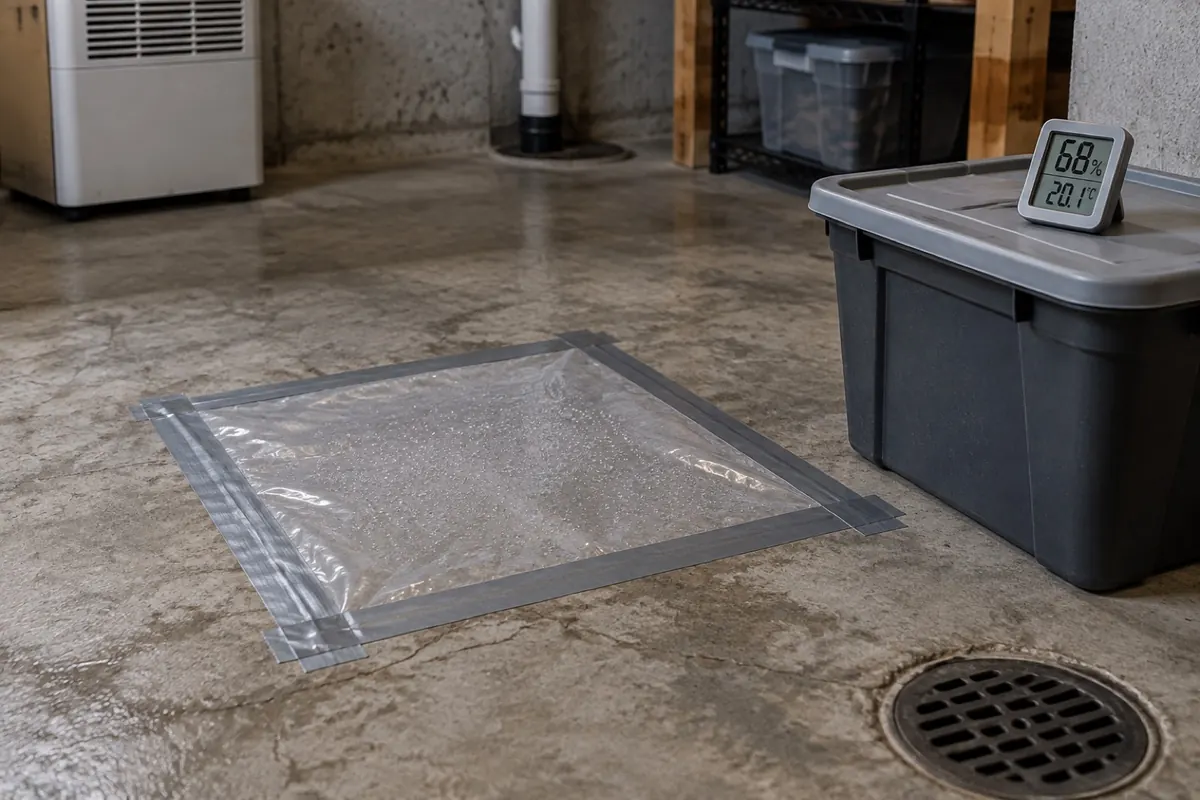
- An 18 inch square of taped plastic tells you whether moisture is coming up through the slab or condensing out of the room air. The slab version is ASTM D4263.
- Cardboard, carpet and pad are food and reservoir at once. EPA lists the underside of carpets and pads among hidden mold sites.
- Most fixes are cheap: downspout extensions cost $2 to $17 each and a portable dehumidifier $150 to $400, according to Fixr and PickHVAC.
On this page
The top results for this search are forums, an air freshener brand and waterproofing firms. Baking soda or vinegar can cover odour but not remove the water that grows it. This page starts from the mechanism, gives two cheap tests that separate the causes, and prices each fix. More is on our mold hub.
Out of scope: this page does not cover health effects of mold or sewer gas. For those, see the EPA’s mold pages and the CDC, and speak to a medical professional.
Sort the smell first
Before buying anything, describe the smell and when it is worst.
| What you smell | Most likely source | Why |
|---|---|---|
| Musty, earthy, stale | Microbial growth on damp material | EPA: mold compounds are the source of the musty smell |
| Rotten egg, sulfur, sewage | Sewer gas through a dry trap, blocked vent or cracked foundation | Wisconsin DHS: hydrogen sulfide smells like rotten eggs |
| Musty, worst after rain | Water reaching the foundation | Drainage, not air, is the first suspect |
| Musty, worst in summer | Humid air condensing on cool concrete | EPA: warm humid air on a cold surface condenses |
| Musty near the furnace or AC | Condensate pan or drain line | EPA lists drain pans as a hidden growth site |
| Musty near boxes, carpet or paneling | Growth on paper, fabric or wood | EPA lists paper, carpet and wood as food for mold |
Sewer gas is the impostor. The Wisconsin Department of Health Services says it enters through a floor drain, a blocked roof vent or foundation cracks, and that flushing drains keeps traps from drying out. The University of Pittsburgh EH&S guideline 03-010 explains why: a trap is a water seal, and its fix is a quart of water into the drain weekly or monthly. If the smell returns, the Wisconsin guidance is to call a plumber.
The causes, ranked by mechanism
No public dataset ranks basement odour causes by frequency, so this list ranks them by how directly each produces the smell: number one is the smell, two to five supply its water.
| Rank | Cause | Mechanism | What you see or measure |
|---|---|---|---|
| 1 | Microbial growth (MVOCs) | Mold produces volatile compounds with strong odours | The smell itself; growth on hidden surfaces |
| 2 | High relative humidity | Damp air keeps porous materials wet enough to grow mold | Hygrometer above EPA’s 60% ceiling |
| 3 | Wet foundation and capillary rise | Concrete and block wick groundwater inward and upward | Damp band at the wall base |
| 4 | Stored cardboard, carpet and pad | Porous organic material holds moisture and feeds growth | Smell strongest at boxes or when carpet is lifted |
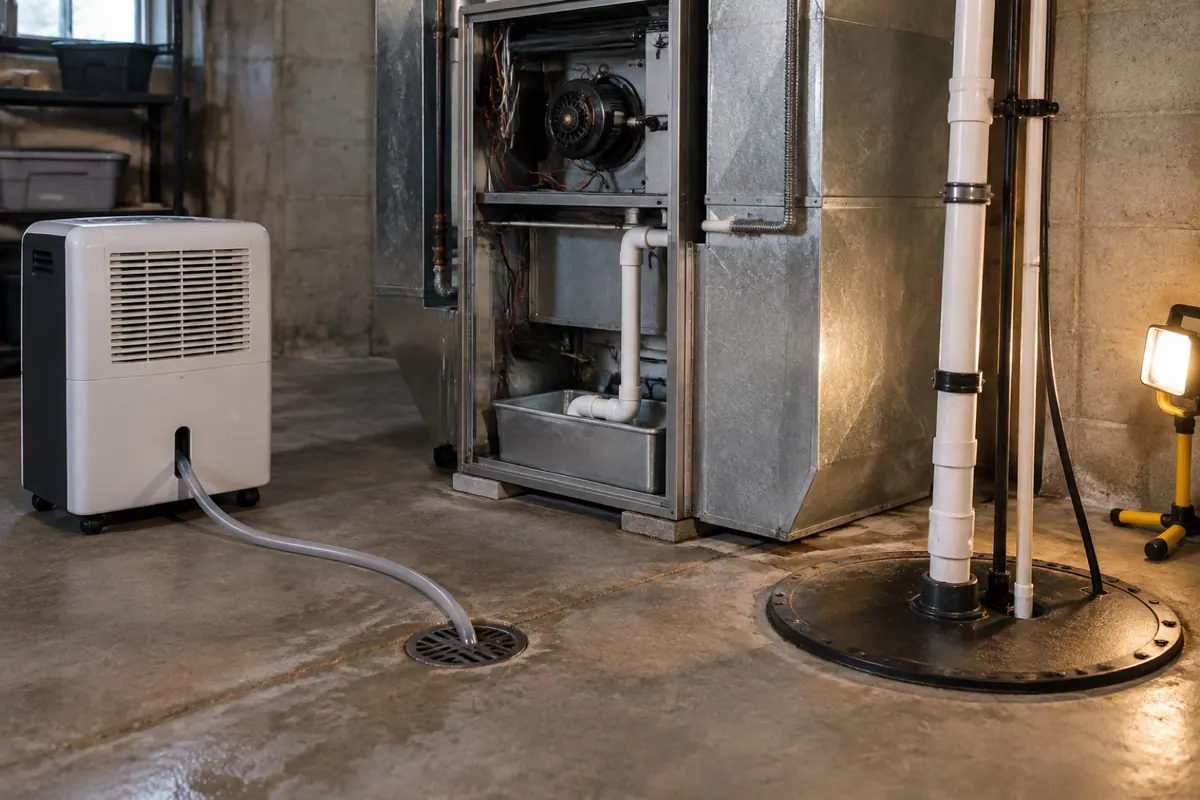
| 5 | HVAC condensate | Standing water in a drain pan is a hidden growth site | Smell when the system runs |
| Rule out | Sewer gas from a dry trap | Water seal evaporates, gas flows back | Rotten-egg, not musty |
Per EPA's page on what mold smells like, a musty smell suggests mold is growing and should be investigated, so a deodoriser only covers it. For cleanup, EPA's Brief Guide to Mold, Moisture and Your Home says a biocide such as chlorine bleach is not recommended as a routine practice.
Stored materials are both food and sponge. The EPA 402-K-01-001 guide says molds grow on wood, paper, carpet and insulation, and lists the underside of carpets and pads, the back of paneling and air handler drain pans as hidden growth sites. A cardboard box on a bare slab is paper on the basement’s dampest surface.
Humidity: the numbers that matter
EPA's Brief Guide to Mold, Moisture and Your Home gives one target: keep indoor humidity below 60 percent relative humidity, ideally between 30 and 50 percent. The ENERGY STAR dehumidifier guide describes each band by what the space smells and looks like, and sizes a dehumidifier to match.
| Hygrometer reading | What the source says it means | Action |
|---|---|---|
| Below 50% | Inside EPA’s ideal range | Humidity is not the driver; look for a local source |
| 50 to 60% | Above ideal, below EPA’s ceiling | Watch summer readings; store nothing on the slab |
| 50 to 75% | ENERGY STAR: slightly to moderately damp, musty odour that may be intermittent | Dehumidify: 20 to 30 pints a day for a small to medium space |
| 75 to 90% | ENERGY STAR: very damp, damp spots on walls and floors | Dehumidify at 25 to 40 pints and find the water |
| 90 to 100% | ENERGY STAR: wet, walls or floor sweat, seepage | 30 to 50 pints, plus a water-entry repair |
Summer is when basements cross the line. EPA’s mold course says that when warm, humid air contacts a cold surface, condensation may form, and basement walls sit against cool soil. ENERGY STAR adds drainage fixes that lower basement humidity: extend downspouts, clear gutters, slope soil away and avoid over-watering foundation plantings.
Wet concrete and capillary rise
The US Department of Energy basement fact sheet (January 2002) splits basement leakage into bulk water, which flows through holes and cracks, and capillary action, where water wicks into the pores of masonry block, concrete or wood. It notes that those pores can absorb water in any direction, even upward. EPA mold course, chapter 2 says soil wicks moisture from moist to dry areas the same way.
The tell is a smell that never quite goes away and a darker band at the base of the wall. Rain makes it worse because it raises the water around the foundation, which is why the drainage fixes come first. Our basement waterproofing cost guide and French drain cost guide cover the larger repairs.
One overlooked fix is already in many basements. An EPA contractor report on basement moisture and radon systems monitored 3 Pennsylvania houses for 18 months with their radon fans cycled on and off, and found significant moisture reductions in basement air and walls, mostly outside summer. Three houses is a small sample: a lead, not a promise.
The plastic sheet test
ASTM D4263, Standard Practice for Indicating Moisture in Concrete by the Plastic Sheet Method, is used to indicate capillary moisture in concrete before coatings go on. The standard is paywalled, so the procedure comes from two summaries: The Construction Specifier describes an 18 inch square taped down for 16 hours, and Tnemec, a coatings maker, says at least 24 hours. A full day satisfies both.
| Test | Setup | Duration | Reading |
|---|---|---|---|
| Slab, ASTM D4263 practice | 18 in square of clear polyethylene, all edges taped | 16 hours (Construction Specifier); at least 24 hours (Tnemec) | Darkened concrete or droplets under the sheet |
| Wall, contractor method | 1 ft square of clear plastic over a dry spot, edges taped | 24 hours | Water behind the plastic means seepage; on the room side means condensation |
| Limit of both | Qualitative only | Shallow surface layer | Says nothing about the middle or bottom of the slab |
The test shows whether moisture is present, not how much, and only near the surface, which is enough here. Water under the sheet means the concrete feeds the room; water on top means the air is wet and the dehumidifier comes first.
The step-by-step check
Stop at the first step that explains the smell.
- Name the smell. Rotten egg: pour a quart of water into every floor drain and unused sink, wait a day, and call a plumber if it returns. Musty: carry on.
- Log humidity. Put a hygrometer, the gauge ENERGY STAR recommends for reading relative humidity, in the basement and read it morning and evening through a humid spell. Above 60 percent is above EPA’s ceiling.
- Note the timing. Worse after rain points to drainage; worse in summer to condensation; worse when the AC runs to the condensate pan.
- Tape the sheets. One on the slab, one on the wall, a full day each. Underside wet: water is coming through concrete. Room side wet: the air is the problem.
- Look where EPA says growth hides. Under carpet and pad, behind paneling and drywall, inside cardboard boxes and in the air handler drain pan.
- Measure what you find. Visible growth under about 10 square feet is, per EPA, usually a homeowner job. Larger, or a smell with no visible source after steps 1 to 5, calls for a mold inspection.
Fixes ranked by cost
Cheapest first, each with the cause it answers. A dehumidifier will not stop water through a crack, and epoxy will not dry humid air.
| Fix | Cause it answers | Published price | Source |
|---|---|---|---|
| Refill dry traps | Sewer gas | A quart of water, weekly or monthly | University of Pittsburgh EH&S |
| Move cardboard and carpet off the slab | Stored materials | Not priced in a published guide | EPA material list |
| Downspout extensions | Rain at the foundation | $2 to $17 each | Fixr, updated 31 January 2025 |
| Portable 30 to 50 pint dehumidifier | Humidity | $150 to $400, plus $5 to $30 a month to run | PickHVAC, updated 21 May 2026 |
| Epoxy crack injection | Bulk water through cracks | $250 to $1,000 per crack | Fixr, updated 6 February 2026 |
| Sump pump | High groundwater | $600 to $2,500 | Fixr, updated 6 February 2026 |
| Whole-house dehumidifier, installed | Chronic humidity | $900 to $2,500 (PickHVAC); $1,000 to $2,800 (Fixr) | Two sources, shown separately |
| Basement mold removal | Established growth | $1,500 to $4,000 | Fixr, updated 29 August 2025 |
| Interior perimeter drain | Persistent seepage | $40 to $120 per linear foot | Fixr, updated 6 February 2026 |
The two whole-house dehumidifier figures disagree, so both are shown. For the bigger jobs, see our sump pump installation cost and crawl space encapsulation cost guides; a basement that opens into a crawl space shares its air.
When it means mold remediation
EPA's Brief Guide to Mold, Moisture and Your Home draws the line at size: if the moldy area is less than about 10 square feet, roughly a 3 by 3 foot patch, most people can handle it themselves. Our DIY mold remediation guide covers that job.
| Situation | What the guidance says | Next step |
|---|---|---|
| Visible growth under about 10 sq ft on a hard surface | Usually a homeowner cleanup, per EPA | Fix the water first |
| Growth on carpet, pad, ceiling tile or cardboard | EPA says porous materials may have to be thrown away | Removal, not cleaning |
| Growth over about 10 sq ft | EPA points to its schools and commercial buildings guide | Hire a contractor with mold experience, as EPA advises |
| Smell persists at 30 to 50% RH with no visible source | Hidden growth possible, per EPA’s odour guidance | Inspection before demolition |
| Smell after a sewage backup | Contaminated water, not humidity | Treat as a sewage loss |
For budgeting, according to Fixr's mold remediation guide, basement mold removal costs $1,500 to $4,000. Our mold remediation cost guide breaks that down by area and material. EPA’s warning applies at any size: if you clean up the mold but do not fix the water problem, the mold will most likely come back.
For contractors
A musty basement call is an investigation before it is a remediation job, and the file should name the source found. Follow the EPA guide: fix the moisture, remove growth rather than just killing it, and discard porous materials that cannot be cleaned. Put the source repair on the estimate, or exclude it in writing.
| Record on site | Why it matters |
|---|---|
| RH and temperature, basement and outdoors, with times | Separates humidity from water entry |
| Plastic sheet results, photographed with a date | Shows whether the slab or the air is wet |
| Square footage of visible growth, by material | EPA’s 10 sq ft line and porous removal decisions |
| Trap, vent and condensate pan condition | Rules out sewer gas and HVAC sources |
| Moisture source and the repair that fixes it | EPA: fix the water problem before cleanup |
Coverage questions belong to the policy, not the technician. Point the owner to their policy wording, their state insurance department and a licensed professional rather than predicting what a claim will pay.
Questions people actually ask
Does a musty smell in the basement mean mold?
Usually. EPA says mold gives off volatile compounds that are the source of the musty smell, and that a moldy smell suggests growth that should be investigated. A rotten-egg smell is different: that points to sewer gas through a dry drain trap.
Can a basement smell musty without visible mold?
Yes, because the growth is often hidden. EPA’s remediation guide lists the underside of carpets and pads, the back of drywall and paneling, and air handler drain pans as hidden sites. If humidity stays at 30 to 50 percent and the smell persists, a mold inspection is the next step.
Why does my basement smell musty even though there’s no water in it?
Water does not have to pool to cause it. Concrete wicks ground moisture upward by capillary action, per a DOE fact sheet, and humid summer air condenses on cool walls, per EPA. A taped plastic sheet on the slab and the wall shows which is happening.
How do you get rid of a musty smell in a basement?
Find and dry the source, then clean. Bring relative humidity below 60 percent, ideally 30 to 50, as EPA advises; move cardboard and carpet off the slab; extend downspouts; and clean the condensate pan. Baking soda covers the smell but not its cause.
Will a dehumidifier get rid of a musty smell in a basement?
It removes the cause when the cause is humid air. ENERGY STAR describes a space at 50 to 75 percent humidity with an intermittent musty odour and suggests 20 to 30 pints a day for a small to medium room. It will not stop water entering through cracks, and existing growth still needs cleaning.
Why does my basement smell musty after rain?
Rain raises the water around the foundation, and concrete wicks it inward. ENERGY STAR lists drainage fixes that lower basement humidity: extend downspouts, keep gutters clear, slope soil away and avoid over-watering plantings. Downspout extensions cost $2 to $17 each, according to Fixr.
Sources
- EPA's Brief Guide to Mold, Moisture and Your Home, US Environmental Protection Agency, last updated 18 February 2026. Retrieved 11 October 2026.
- EPA's page on what mold smells like, EPA. Retrieved 11 October 2026.
- EPA mold course, chapter 2, EPA, last updated 1 December 2025. Retrieved 11 October 2026.
- EPA 402-K-01-001, Mold Remediation in Schools and Commercial Buildings, EPA, September 2008. Retrieved 11 October 2026.
- EPA contractor report on basement moisture and radon systems, Turk and Hughes, December 2007, revised March 2008. Retrieved 11 October 2026.
- US Department of Energy basement fact sheet, Basement Insulation, DOE/GO-102002-0776, January 2002. Retrieved 11 October 2026.
- ENERGY STAR dehumidifier guide, ENERGY STAR. Retrieved 11 October 2026.
- ASTM D4263, ASTM International, scope and significance. Retrieved 11 October 2026.
- The Construction Specifier, Dry concrete for moisture-sensitive floorcoverings. Retrieved 11 October 2026.
- Tnemec, 3 ways to test concrete moisture. Retrieved 11 October 2026.
- Foundation Restoration, Rockwood, Michigan, 29 January 2026. Retrieved 11 October 2026.
- Wisconsin Department of Health Services, Sewer gas, last revised 18 April 2023. Retrieved 11 October 2026.
- University of Pittsburgh EH&S guideline 03-010, Dry sink traps, reviewed 4 November 2020. Retrieved 11 October 2026.
- Fixr's basement waterproofing guide, updated 6 February 2026; Fixr's downspout guide, updated 31 January 2025; Fixr's mold remediation guide, updated 29 August 2025. Retrieved 11 October 2026.
- PickHVAC, Dehumidifier Cost and Running Cost 2026, updated 21 May 2026. Retrieved 11 October 2026.
- No figure here was estimated or invented. Our methodology sets out the standing rules.
Prices are national guide ranges from the dates shown. Local quotes vary; find the source before paying for a fix.