The short answer
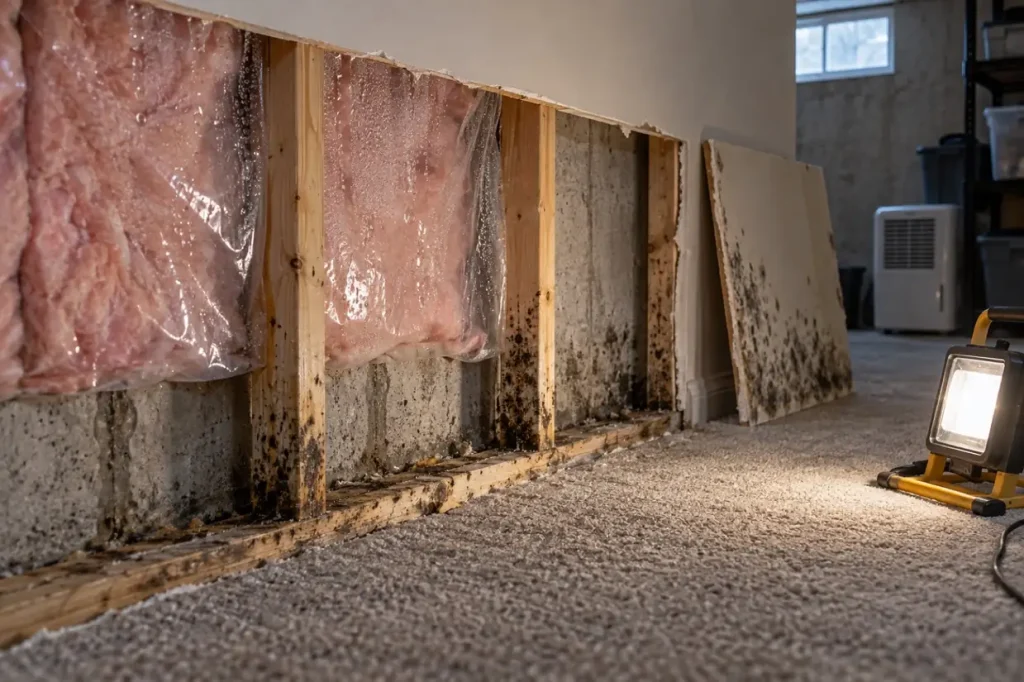
Mold in basement spaces grows where moisture meets something to eat: drywall, framing, carpet and stored boxes against cold concrete. The water usually comes from the ground through the foundation, from summer air condensing on cool walls, or from leaks. EPA’s order is to fix the water, clean hard surfaces, discard moldy porous materials, and follow its commercial guidance above about 10 square feet.
Key takeaways
- Finished basements grow more mold than bare ones for a reason: per Building Science Corporation, an unfinished concrete wall dries inward, and a stud wall with batts and plastic stops it.
- A polyethylene vapor barrier on the inside of a basement wall is the classic failure. EPA says ground moisture may condense when it meets one, and the residential code exempts basement walls from the interior vapor retarder rule.
- Leaving the plastic off is not enough. Per BSC, room air will then reach the cold concrete and condense, so the fix is foam held tight against the wall.
- EPA scales the work by area: under 10 square feet is a small job, over 100 calls for full containment, and moldy drywall and carpet are removed rather than cleaned at medium and large sizes.
- According to Fixr, basement mold removal costs $1,500 to $4,000; HomeAdvisor reports $500 to $3,000. Per the same guides, rates run $10 to $30 and $10 to $25 a square foot.
On this page
Joseph Lstiburek opens Building Science Corporation digest BSD-103 with a distinction worth keeping: cellars were damp places for coal, while basements now hold play rooms and media centres, and they need to be dry. If your question is the smell, our musty basement guide traces it; this page is about the mold and the wall it grows in. More is on our mold hub.
Out of scope: this page does not cover health effects, symptoms or whether it is safe to occupy a basement with mold. For those, see EPA’s mold pages and the CDC, and speak to a medical professional.
Where it grows, and the water behind it
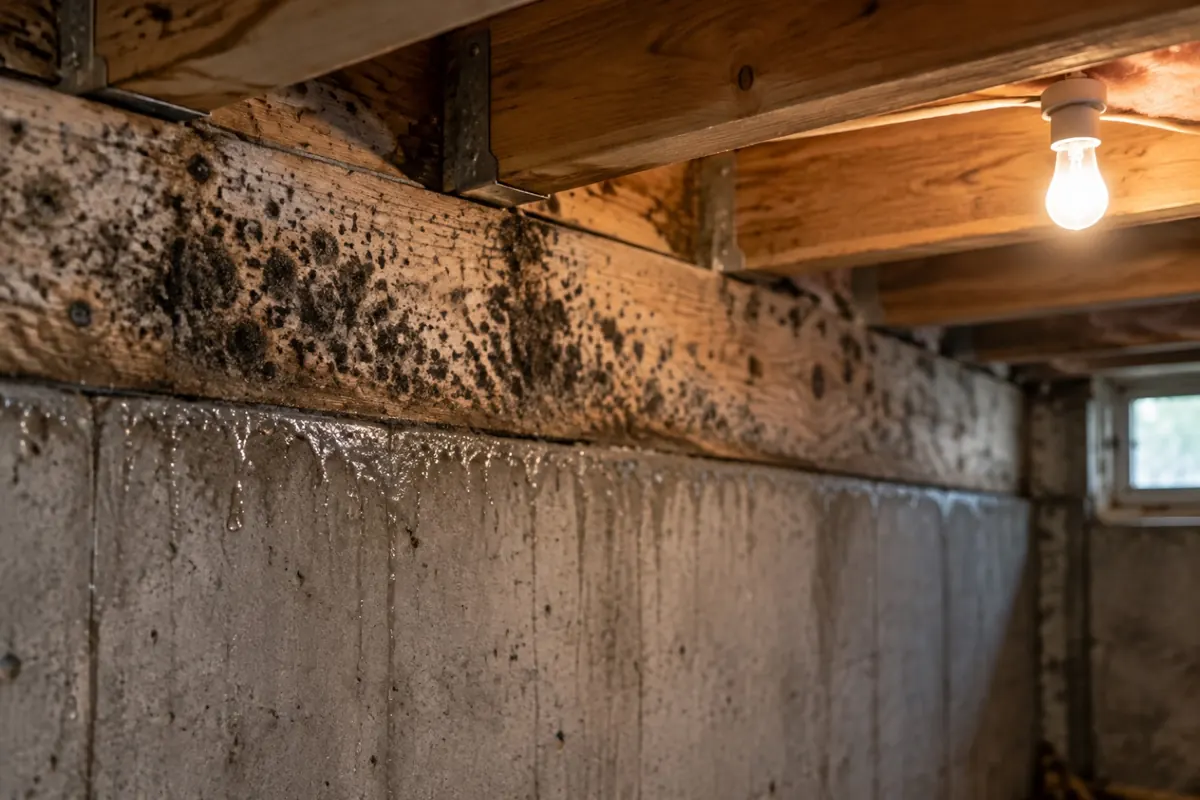
Mold needs water and food, and a basement offers both on surfaces you rarely see. EPA's Brief Guide to Mold, Moisture and Your Home lists the underside of carpets and pads and the back of drywall and paneling among hidden sites, and its photo of a moldy suitcase was taken in a humid basement. The US Department of Energy Building America profile names the sources: room air condensing on walls and floors below the dew point, rain or groundwater wicking through footings and walls, and moisture from fresh concrete.
| Where | Water source | What it feeds on | Source |
|---|---|---|---|
| Back of drywall on a finished wall | Foundation moisture and room air condensing on the concrete | Paper facing, batts | BSC; DOE |
| Bottom plate and drywall base | Capillary rise through the footing and slab | Wood, gypsum, paper | BSC; DOE |
| Rim joist | Cold in summer and winter, so room air condenses | Wood framing | BSC |
| Carpet and pad on the slab | Vapor from the slab under a covering | Pad, backing, dust | EPA |
| Stored boxes, suitcases, books | Humid air and contact with the slab or wall | Paper, cardboard, fabric | EPA |
| New finish in a new house | Freshly poured concrete still drying | Anything enclosed with it | DOE |
Every row is organic material facing cold concrete. Per BSC, summer is the problem season, when warm moist air meets surfaces below its dew point, and the rim joist is cold in winter too. Wet framing can rot; our mold on wood guide covers how to tell.
Why plastic against concrete grows mold
The Building Science Corporation digest BSD-103 describes the common finished basement: frame walls, an insulated cavity, and an interior plastic vapor barrier, an approach it says often leads to odor, mold, decay and corrosion problems. Concrete against the ground is cold, per BSC, and moisture migrates through it. Fiberglass against it gets damp, and the plastic stops the wall drying into the room.
Two federal sources say the same. The US Department of Energy Building America profile says cellulose or fiberglass in contact with basement walls can absorb large amounts of moisture and stay chronically damp, and that plastic on the interior compounds it by trapping moisture. EPA moisture control guidance says water vapor migrating from the ground may condense when it meets a vapor barrier on the inside of a finished basement wall. Section R702.7 of the residential code, read in the 2025 California Residential Code, lists basement walls and the below grade portion of any wall as exceptions to its interior vapor retarder requirement.
Why removing the plastic is not the whole answer
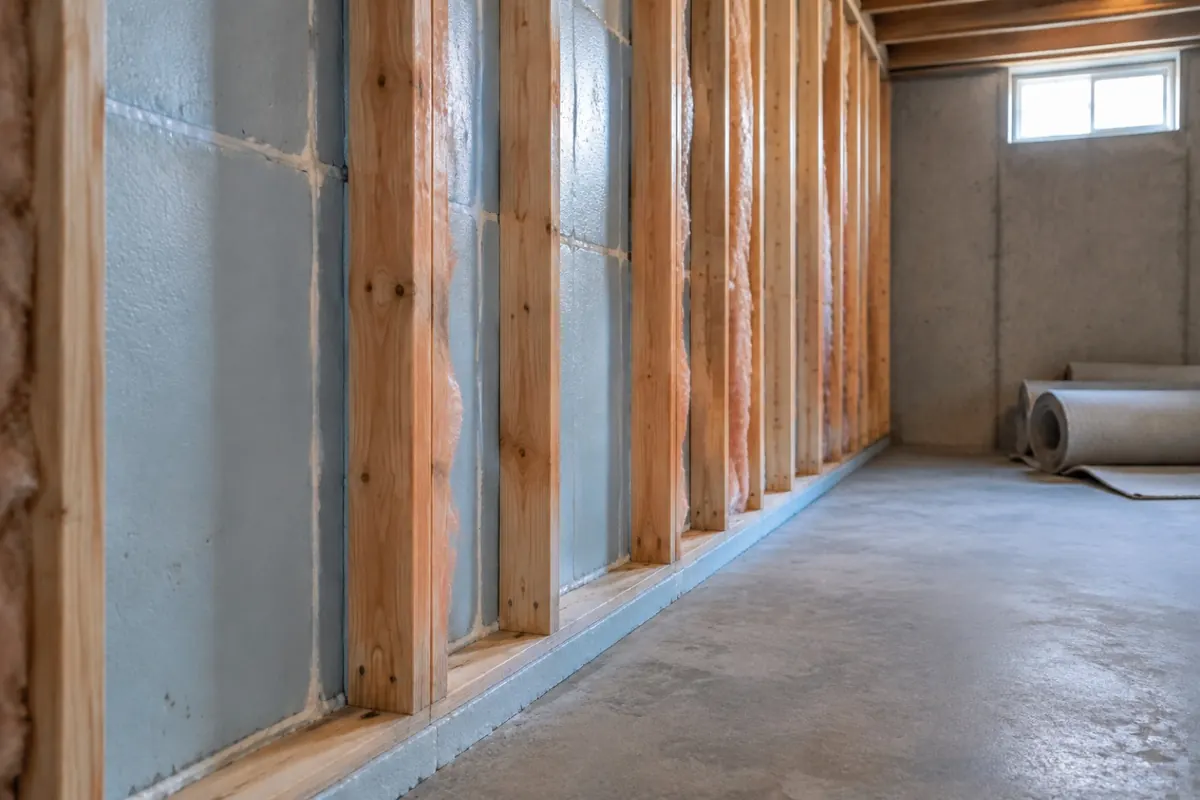
BSC warns that leaving off the plastic will not avoid problems by itself: room vapor then migrates outward and condenses on the inside face of the foundation, and air leaking through a loose insulation layer makes it worse. The fix is insulation that is not water sensitive, sealed tight to the concrete so room air cannot reach it.
Wall assemblies compared
Per the US Department of Energy Building America profile, interior insulation has to be airtight, so vapor cannot condense on the wall, yet semi permeable, so the wall can dry inward. Foam panels must adhere completely to the foundation with no air gaps and sealed seams, and spray foam needs an ignition barrier or half inch gypsum board.
| Assembly | What happens to moisture | What the sources say | Verdict |
|---|---|---|---|
| Stud wall, batts, interior plastic | Traps moisture against concrete; no inward drying | Often odor, mold, decay (BSC) | Avoid |
| Blanket insulation draped on the wall | Not airtight; room air reaches concrete | BSC: prone to the same problems | Avoid |
| Stud wall and batts, no plastic, nothing else | Room air reaches the cold concrete and condenses | BSC: will not avoid problems | Not enough |
| Rigid foam glued tight, seams sealed, stud wall inside | Room air kept off the concrete; dries inward | Recommended (DOE, BSC, EPA) | Use |
| Closed cell spray foam on the concrete | Air barrier and vapor retarder in one layer | DOE: best moisture control of interior options | Use |
| Bare, unfinished concrete | Dries freely to the room | BSC: inward drying, no capillary break needed | Dries well; not a living space |
EPA moisture control guidance adds three details that decide whether a rebuilt wall molds again: keep wood and paper based materials from touching concrete, using a foam spacer as a capillary break; use nothing inboard of the insulation rated under 2 perms, so no vinyl wallpaper; and, per the DOE, leave a 1/2 inch gap between drywall and floor.
Finished against unfinished
The Building Science Corporation digest BSD-103 explains why finishing changes the risk. Capillary breaks over footings were not needed when basement walls were uninsulated and unfinished, because the walls dried inward. In finished basements they matter, because without them moisture migrates through the foundation into the insulation and gypsum board.
| Unfinished basement | Finished basement | |
|---|---|---|
| How the wall dries | Inward, freely | Only as the assembly allows; plastic stops it |
| Where mold shows | On the face of stored items and wood | Hidden behind drywall, under carpet, at the rim joist |
| Capillary break over footing | Not needed, per BSC | Important, per BSC |
| Floor | Bare slab | Carpet or pad over a slab that emits vapor |
| First sign | Visible growth | Often odor; BSC ties odor to these assemblies |
| Typical remediation | Clean concrete and wood surfaces | Open walls, remove drywall, insulation and carpet |
Carpet on a slab
EPA moisture control guidance says concrete must be thoroughly dry before carpet or tile covers it, and that a covering laid on concrete emitting more vapor than the maker allows may fail and promote mold. It recommends measuring emission first, for example with a calcium chloride test that runs 60 to 72 hours, according to the same guide. Per EPA's Brief Guide to Mold, Moisture and Your Home, moldy carpet may have to be thrown away.
Remediation scope by area
EPA 402-K-01-001, EPA’s remediation guide for schools and commercial buildings, is the reference EPA's Brief Guide to Mold, Moisture and Your Home points to above 10 square feet. EPA says its size bands exist to help select techniques, not because research ties a method to a number of square feet.
| Basement material | Small | Medium | Large |
|---|---|---|---|
| Concrete or block | 1, 3 | 1, 3 | 1, 3 |
| Drywall | 3 | 3, 4 | 3, 4 |
| Carpet and backing | 1, 3 | 1, 3, 4 | 1, 3, 4 |
| Wood surfaces | 1, 2, 3 | 1, 2, 3 | 1, 2, 3, 4 |
| Books and papers | 3 | 3 | 3 |
| Upholstered furniture | 1, 3 | 1, 3, 4 | 1, 3, 4 |
EPA moves drywall to removal from medium size up. Our wet drywall guide covers cut heights, and if the basement has a crawl space beside it, our crawl space mold remediation guide covers that space.
What the published prices say
Two national guides publish a basement figure and a per square foot rate, shown separately with totals computed at EPA’s band boundaries.
| Source | What is priced | Range |
|---|---|---|
| Fixr, updated 29 August 2025 | Basement mold removal | $1,500 to $4,000 |
| HomeAdvisor, updated 19 June 2026 | Basement | $500 to $3,000 |
| Fixr | Per square foot | $10 to $30 |
| HomeAdvisor | Per square foot | $10 to $25 |
| Computed from Fixr | 10 sq ft, EPA small band limit | $100 to $300 |
| Computed from Fixr | 100 sq ft, EPA large band start | $1,000 to $3,000 |
| Computed from Fixr | 100 to 300 sq ft, Fixr’s typical basement mold area | $1,000 to $9,000 |
The spread is the point. According to Fixr, most basement mold areas run 100 to 300 square feet, which at its own rate is $1,000 to $9,000, wider than its $1,500 to $4,000 basement range. Price the moisture repair separately. Our mold remediation cost guide breaks pricing down, and the basement waterproofing cost guide prices the water side.
The moisture fix order
EPA's Brief Guide to Mold, Moisture and Your Home puts the principle plainly: if you clean up mold but do not fix the water problem, it will most likely come back. The Building Science Corporation digest BSD-103 gives the outside work its order: drain the site and the ground, collect roof runoff with gutters, and slope grade away from the walls.
| Step | What | Why here | Source |
|---|---|---|---|
| 1. Stop bulk water | Gutters, grade sloping away, leaks, seepage | Nothing else holds while water enters | BSC; EPA |
| 2. Dry what is wet | Extract, dehumidify, remove what cannot dry | EPA: dry within 24 to 48 hours to prevent growth | EPA |
| 3. Remove and clean mold | By EPA size band and material | Cleaning before the fix lets it return | EPA |
| 4. Control summer humidity | Dehumidify or air condition in warm, humid seasons | Condensation is the summer source | EPA; BSC |
| 5. Rebuild the right wall | Foam tight to concrete, no plastic, wood off the concrete | Stops the assembly failing again | BSC; DOE; EPA |
| 6. Recheck after a wet season | Rim joist, wall base, under carpet | Summer exposes a bad assembly | BSC |
Which basement are you in?
- Unfinished, growth on boxes or wood. Move storage off the slab and walls, clean by EPA band, control summer humidity. No demolition.
- Finished, plastic behind the drywall. The assembly is the cause. Open it, remove wet batts and plastic, and rebuild with foam against concrete.
- Finished, no plastic, growth at the wall base. Suspect capillary rise or seepage. Fix the water first, then replace the lower drywall with a gap above the slab.
- Carpet on slab, growth under the pad. Remove carpet and pad, dry and clean the slab, and test vapor emission before any new covering.
- After a flood. Treat it as a water loss first; our basement flood cleanup guide covers that order.
For contractors
A finished basement job is often two jobs. Remediation removes the drywall and carpet that EPA’s Table 2 sends to removal and the wet fiberglass its Table 1 says to discard. The rebuild decides whether you see it again. Put the assembly on the estimate, or exclude it in writing, and say which trade owns the water repair.
| Record on site | Why it matters |
|---|---|
| Wall assembly as found, photographed | Shows whether the cause is the assembly or the water |
| Square feet by material | Sets the EPA band, PPE and containment |
| Moisture readings on framing, with a dry reference | Proves the wood is dry before rebuild |
| Water source and who repairs it | EPA: the mold returns if the water is not fixed |
| Rebuild specification | Foam type and thickness, no interior plastic, spacer at the slab |
Wood moisture is the clearance number for framing. According to the FPL Wood Handbook, chapter 14, wood air dried to 20% or less has a reasonable margin against fungal damage; meter the plates and rim joist before the wall closes. Coverage questions belong to the policy, the state insurance department and a professional, not the technician.
Questions people actually ask
Is it safe to be in a basement with mold?
That is a health question, and this page does not answer health questions; EPA’s mold pages and the CDC are the place to start. What EPA does set out is how to work: gloves, an N95 respirator and goggles even for jobs under 10 square feet, and containment as the area grows.
What do I do if I have mold in my basement?
Find the water first, because EPA says mold cleaned without a moisture fix will most likely come back. Measure the area. Under about 10 square feet most people can clean it, per EPA. Larger, or behind finished walls, follow EPA’s commercial guidance and consider a remediation contractor.
What kills 100% of mold?
Nothing practical, and EPA says it is not the goal. Its guide states that it is usually not possible or desirable to sterilize an area, that a background level of spores will remain, and that those spores will not grow once the moisture problem is solved. Removal and drying beat killing.
Why does mold grow behind basement drywall?
Because the wall behind it is cold and damp. Building Science Corporation says frame walls with insulation and interior plastic often lead to mold, and the DOE says batts against concrete can stay chronically damp. Summer air reaching the concrete through gaps adds condensation.
Should I put plastic on my basement walls before finishing?
Not on the interior. EPA says ground moisture may condense on a vapor barrier inside a finished basement wall, and the code text of R702.7 exempts basement walls from its interior vapor retarder rule. Building Science Corporation and the DOE recommend foam sealed tight to the concrete instead.
Is black mold in a basement worse?
Colour does not change the method. EPA’s remediation guidance is set by area and material, not colour: hard surfaces are cleaned, moldy porous materials such as drywall and carpet are removed at medium and large sizes. Our mold hub links our colour and species guide.
Sources
- Building Science Corporation digest BSD-103: Joseph Lstiburek, Understanding Basements, Building Science Corporation, effective 25 October 2006. Retrieved 13 October 2026.
- US Department of Energy Building America profile: Building America Top Innovations Hall of Fame Profile, Basement Insulation Systems, January 2013. Retrieved 13 October 2026.
- EPA moisture control guidance: Moisture Control Guidance for Building Design, Construction and Maintenance, EPA 402-F-13053, December 2013. Retrieved 13 October 2026.
- EPA 402-K-01-001: Mold Remediation in Schools and Commercial Buildings, EPA, September 2008. Table 2 and Methods 1 to 4. Retrieved 13 October 2026.
- EPA's Brief Guide to Mold, Moisture and Your Home, EPA, updated 18 February 2026. Retrieved 13 October 2026.
- Section R702.7 of the residential code: vapor retarders and exceptions, 2025 California Residential Code, via GoCodebook. Retrieved 13 October 2026.
- Fixr's mold remediation guide, updated 29 August 2025. Retrieved 13 October 2026.
- HomeAdvisor's mold remediation guide, updated 19 June 2026. Retrieved 13 October 2026.
- FPL Wood Handbook, chapter 14: Biodeterioration of Wood, Wood Handbook FPL-GTR-282, USDA Forest Products Laboratory, 2021. Retrieved 13 October 2026.
- Computed scope totals are arithmetic on the published rates, done when this page was built. No figure was estimated or invented; our methodology sets out the rules.
Prices are national guide ranges from the dates shown. Building code adoption varies by state and town; check the edition your building department enforces.