The short answer
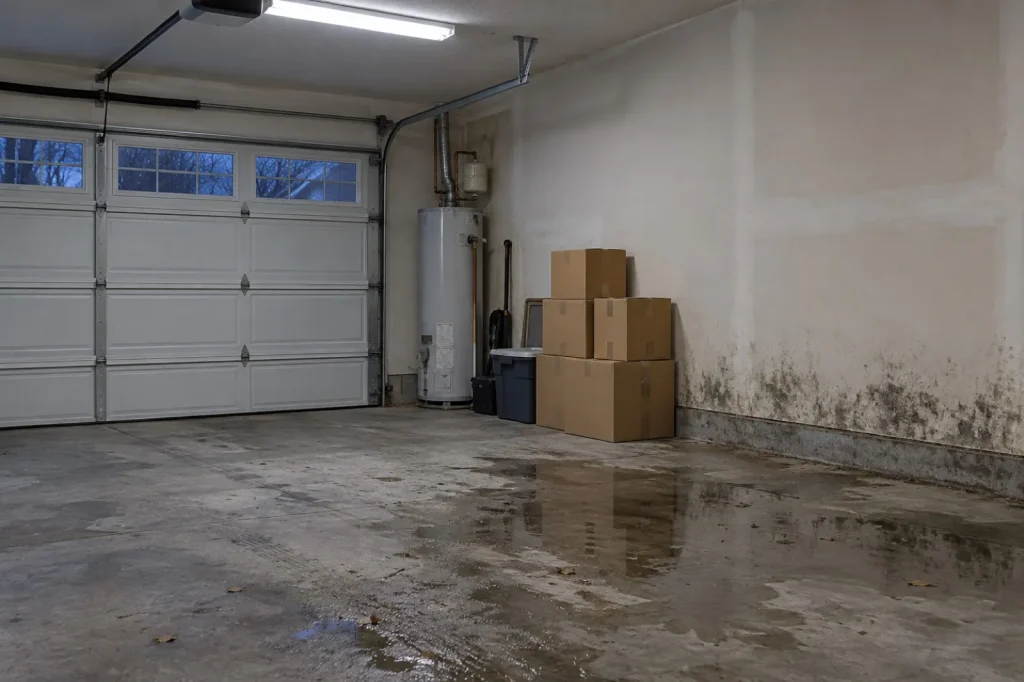
Mold in garage spaces grows where water arrives and cannot leave: snowmelt off the car, condensation on a cold slab or an uninsulated wall, a leaking water heater or washer, and cardboard stacked against all three. Fix the water first, clean sealed surfaces, cut out moldy drywall, and rebuild the wall shared with the house to the same fire separation rule, IRC R302.6.
Key takeaways
- A garage gets wet from the inside: the car empties snowmelt onto the slab every winter evening.
- Drywall on the house side is a fire separation. Under Table R302.6, per the City of Boise IRC handout, it is at least 1/2 inch gypsum, and 5/8 inch Type X under a room above.
- New Jersey FTO 13 goes further: two layers of 5/8 inch Type X on a garage ceiling under living space.
- The Gypsum Association GA-238 wants a 1/4 inch gap between wallboard and floor. Board touching a wet slab wicks.
- Ventilation dries a garage only when the outdoor dew point is lower than the garage’s, per the EPA moisture control guidance.
- Refrigerant dehumidifiers frost in the cold: the GE ADER50 manual says not below 41°F.
On this page
- What you are looking at in a garage
- Where garage moisture comes from
- The cold slab and the dew point
- Garage mold on drywall
- The fire separation rule
- The garage method, step by step
- Stored belongings
- Garage humidity: dehumidifier or vents
- When it is bigger than the spot
- The decision path
- For contractors
- Questions people actually ask
What you are looking at in a garage
Salt, oil, rust and mineral bloom all land on the same slab, so sort what you see before you treat it.
| What you see | Likely cause | Quick check |
|---|---|---|
| Dark speckles along the bottom of painted drywall | Mold on gypsum paper that has wicked water | Pin meter at the base against the same wall higher up |
| White crust on slab or block | Efflorescence, not growth | Water drop and vinegar tests on our mold on concrete page |
| White tide line in the parking bay | Dried road salt brine | Dissolves in water, no fuzzy texture |
| Black fuzz on cardboard, bags or a wood shelf | Mold feeding on paper, textile or wood | Worst on the side touching the wall or slab |
| Orange or brown streaks | Rust from wet steel | Stain only; traces back to metal |
The CDC lists paper, cardboard, wood, dust, drywall and fabric among the things mold grows on. A garage stores all of them, usually on the floor.
Where garage moisture comes from
Each source leaves a different signature, and the fix follows the source, not the cleaner.
| Moisture source | The sign | The fix |
|---|---|---|
| Snowmelt and rain off cars | Wet parking bays, salt lines, growth nearest the car | Squeegee to the door or drain; IRC R309.1, per the City of Pacific, Missouri handout, slopes the floor that way |
| Cold slab condensation | Whole floor damp on warm humid days | Door shut and dehumidify; do not vent with humid air |
| Uninsulated walls and ceiling | Growth on exterior walls and cold corners | Insulate and air seal; the EPA mold course, chapter 2 flags cold corners where condensation forms |
| Water heater or washer | Growth radiating from one corner, rust rings | Repair the leak. The City of Highland bulletin requires a pan in attics and on floor assemblies, not on a slab, so a slab heater may have none; the A.O. Smith manual pipes its pan to a drain. See water heater leak damage |
| Dryer vented into the garage | Lint, ceiling growth, laundry day humidity | Vent outdoors; the EPA mold course, chapter 2 lists this as a common moisture problem |
| Cardboard and fabrics, poor airflow | Items grow first, then the wall behind them | Sealed bins on shelves, off the wall and floor |
Washer leaks are covered on our sibling guide to washing machine overflow. Roof leaks onto a garage ceiling belong with a roofer.
Mold on the garage floor and the cold slab
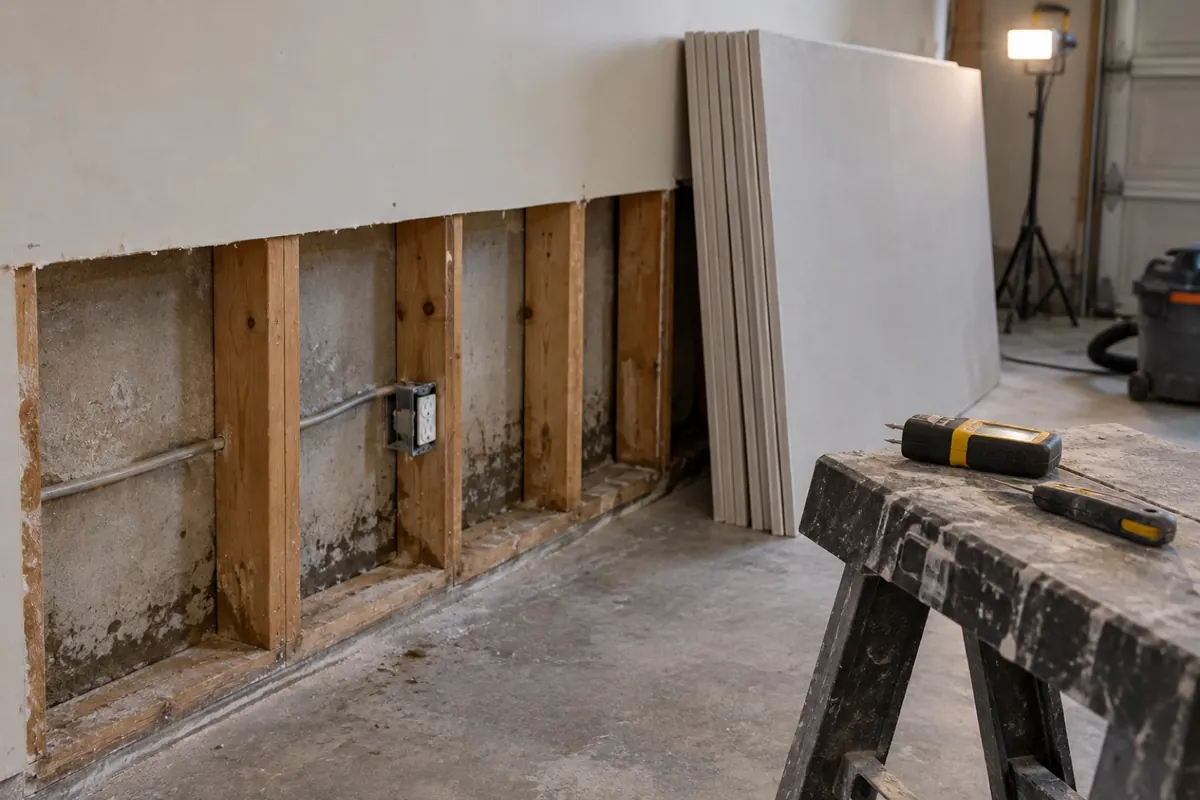
Bare concrete is not food, but the film of dust, salt and oil on it is. The slab lags the weather, so on the first warm humid days of spring it is colder than the air, and the EPA mold course, chapter 2 notes that when warm, humid air contacts a cold surface, condensation may form.
The number that matters is the dew point. Per the National Weather Service formula, air at 70°F and 50% relative humidity has a dew point of about 51°F, and at 70% about 60°F. A slab colder than that gets wet.
Floor cleaners and coatings live on our concrete guide. In a garage add one check: if growth follows the parking bay, blame the car; if it covers the whole slab, blame condensation.
Garage mold on drywall
Garage drywall mold usually starts at the bottom edge, because board run tight to the slab wicks every puddle. The Gypsum Association GA-238 says wall board must be applied with a minimum 1/4 inch gap to the floor, must not go over wet materials, and must not be used if visibly moldy. A dead level growth line a few inches up is the tell.
The general cut height decision is on our wet drywall page. In a garage the question is what you may put back.
| Garage surface | Code minimum | Mold resistant option |
|---|---|---|
| Wall shared with the house | 1/2 inch gypsum, garage side (New Jersey, living space above: 5/8 Type X) | 1/2 inch mold resistant board meets the thickness |
| Ceiling under a habitable room | 5/8 inch Type X, fastened per Table R702.3.5 | 5/8 inch Type X mold resistant, as in the Georgia-Pacific submittal |
| Structure supporting that ceiling | 1/2 inch gypsum | Same thickness |
| Exterior wall within 3 feet of a dwelling | 1/2 inch gypsum, interior side | Same thickness |
| Other garage walls | No table requirement | Any board, held off the slab |
The Georgia-Pacific submittal reports a score of 10 under ASTM D3273 for its Mold-Guard boards, the best possible score, and then says no material can be considered mold proof. Mold resistant board buys margin, not immunity.
The fire separation rule you are cutting into
IRC R302.6 requires the separation in Table R302.6, and the ICC interpretation 04-16 confirms it is not a rated assembly: it simply requires the board on the garage side. Patch a mold cut with whatever is in the truck and the house has lost its separation.
| Rule | IRC model text | Minnesota | New Jersey, living space above |
|---|---|---|---|
| House wall | 1/2 inch gypsum, garage side | Same, carried to the roof sheathing | 5/8 inch Type X, fasteners 12 inches on center |
| Ceiling under a room | 5/8 inch Type X | Same | Two layers of 5/8 inch Type X |
| Door to the house | 1-3/8 inch solid or 20 minute rated, self closing | Same door, no closer in the amended text | 1-3/8 inch solid core wood or steel, no closer required |
| Ducts | No. 26 gage steel, no openings into the garage | Not amended | Not addressed |
| Document | ICC interpretation 04-16; Boise handout 2022 | Rules 1309.0302, 2020 | FTO 13, binding on code officials |
For mold work that means two things: inspection holes in the separation get patched with the same board, and because R302.5.2 bars duct openings into the garage, a dehumidifier or return ducted through the separation is not a fix.
The garage method, step by step
The generic sequence and EPA size bands are on our DIY mold remediation guide. These are the garage steps.
| Step | In a garage | Why this differs from generic advice |
|---|---|---|
| 1. Map the pattern | Growth against car bay, appliance corner, outside walls, storage | A garage has several water sources; a room usually has one |
| 2. Empty the wall line | Pull boxes and shelves; bag moldy cardboard in place | Storage is both the food and the hiding place |
| 3. Close the big door | Keep the vehicle door shut while working and drying | Generic advice says ventilate; here that can wet the slab |
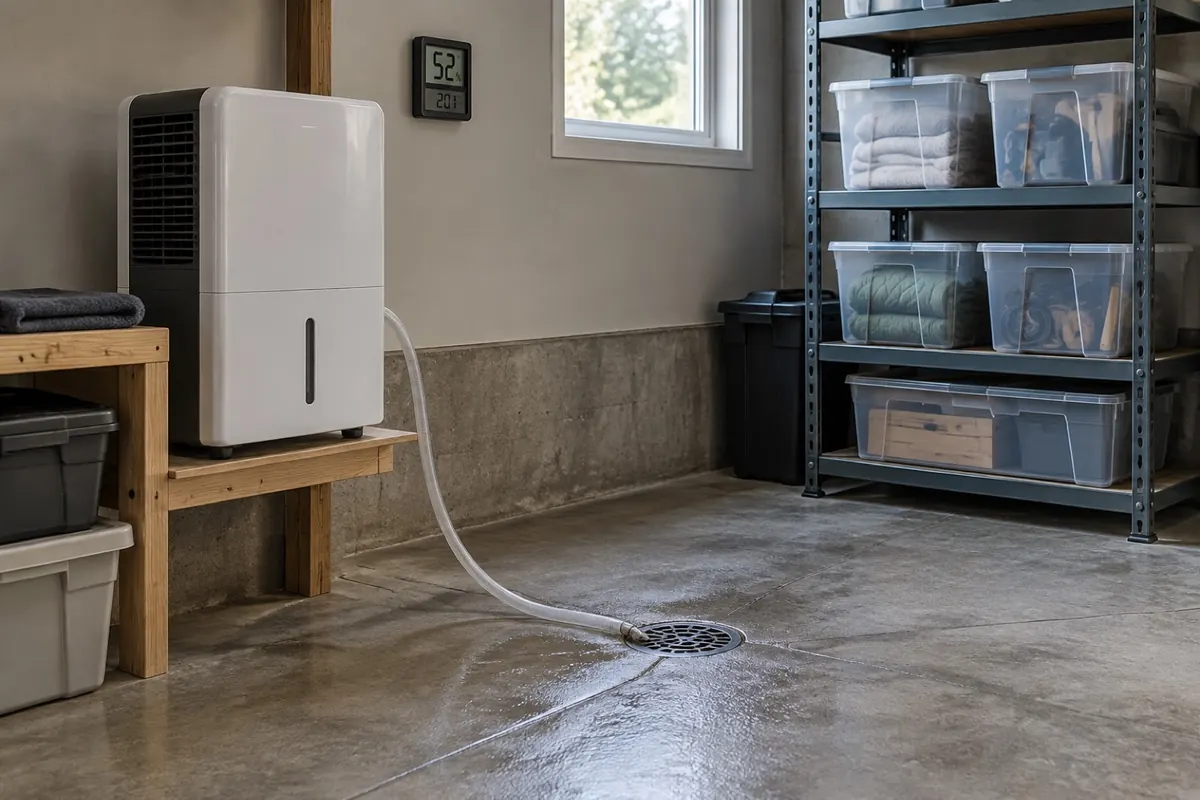
| 4. Cut above the wet line | Cut to full sheet widths where practical; new board 1/4 inch off the slab | The cut must be rebuilt as a fire separation |
| 5. Clean sealed surfaces | Detergent and water on studs, slab and metal, then dry | The EPA's Brief Guide to Mold does not recommend bleach as routine; see does bleach kill mold |
| 6. Rebuild like for like | Same board type and thickness, taped, penetrations fireblocked | No other room has a fire separation on one face |
Stored belongings: keep or bin
| Item | Usual outcome | Reason |
|---|---|---|
| Cardboard boxes | Discard box, decant contents | Paper fibre is food and cannot be cleaned inside |
| Clothing, bedding, bags | Launder by care label | Methods on our mold in closet page |
| Upholstered furniture | Often discard | Fill and frame hold moisture |
| Plastic bins, tools, bikes | Clean and keep | Non-porous; wipe, dry, oil steel |
Store survivors in lidded bins on metal shelving, off the floor and spaced off the wall.
Garage humidity: dehumidifier or ventilation?
The EPA's Brief Guide to Mold says keep humidity below 60%, ideally 30 to 50%, and the CDC says no higher than 50%. The EPA moisture control guidance sets the rule for vents: ventilating air only dehumidifies when the outdoor dew point is lower than the indoor dew point. Dry winter air helps; muggy summer air wets the slab.
Cold limits the other tool. According to the DOE test procedure, portable units are rated at 65°F and 60% humidity. The GE ADER50 manual says keep the unit above 41°F because coils frost below it, and the NewAir AD-400 manual defrosts every 30 minutes between 41°F and 53.6°F. A 65°F label rating is not a 45°F garage floor.
| Garage condition | Better tool | Why |
|---|---|---|
| Humid summer | Dehumidifier, door shut | Outdoor dew point above the garage’s |
| Cold dry winter with snowmelt | Ventilation plus squeegee | Outdoor air is drier; cold frosts the coil |
| Garage below about 41°F | Ventilation or heat first | Below the GE minimum |
| Spring, slab still cold | Dehumidifier, door shut | The condensation case |
| Dryer or water heater adding water | Fix the source | Neither tool keeps up with a leak |
Machine sizing is on our water damage dehumidifier page. Drain it to a floor drain or the door, never a bucket on the slab.
Signs it is bigger than the visible spot
| Trigger | What it suggests |
|---|---|
| Growth at the bottom plate of the house wall | Water in framing that continues into the house |
| Ceiling stains under a bedroom or bath | A leak or condensation above a 5/8 Type X ceiling |
| Musty smell indoors near the garage door | Air crossing the separation at seals or penetrations |
| Board soft or crumbling at the base | Repeated wetting; cut and replace |
| Growth back within weeks | The source is still running |
| Damp insulation behind the board | Cavity condensation; see mold in insulation |
The garage decision path
- Growth or salt? White crust on concrete is usually salt; fuzz on paper, wood or drywall is growth.
- Which source? Car bay, appliance corner, outside walls, or everywhere. Fix that first.
- House wall or ceiling under a room? Rebuild any cut to Table R302.6, like for like.
- Board on the slab? Rebuild with the 1/4 inch gap.
- Weather? Humid: door shut, dehumidifier on. Cold and dry: ventilate.
- Came back? Measure before cleaning again.
For contractors: scoping a garage
Write two zones. The separation zone (house wall, ceiling under living space, supporting structure) gets line items naming board type and thickness, taped joints and fireblocked penetrations; photograph the stamp on the removed and new board. Document the source too: humidity inside and out, plate readings, appliance condition, contents moved. Long term condensation reads differently in a policy than a sudden leak, so describe it and leave coverage to the carrier; our page on homeowners insurance and mold reads the policy language.
Fixr lists garage mold removal at $1,500 to $10,000, wider than its basement range, and $10 to $30 per square foot generally, according to its 29 August 2025 guide.
What this page does not cover. Health effects are outside our scope; see EPA's Brief Guide to Mold and CDC, and ask a physician about any personal concern. Water heater, washer and roof repairs belong with those trades. More guides sit in our mold hub.
Questions people actually ask
How do I get rid of mold in my garage?
Find the water first: car snowmelt, a cold slab, a leaking appliance or damp storage. Bag moldy cardboard, clean sealed surfaces such as studs, slab and metal with detergent and water, and cut out moldy drywall. Rebuild the house wall and any ceiling under a room with the gypsum type the IRC requires.
Can mold in the garage get into the house?
In an attached garage the shared wall, the door and any penetrations are the pathways. IRC R302.5.2 says garage ducts must have no openings into the garage, and the door must be solid or 20 minute rated. Seal gaps in that separation and keep the door shut. Health questions belong with EPA, CDC and a physician.
What humidity should a garage be?
Use the indoor target. EPA says keep relative humidity below 60 percent and ideally 30 to 50 percent, and CDC says no higher than 50 percent. A digital gauge read on a humid day and a cold day tells you whether you need a dehumidifier or ventilation.
Is it worth putting a dehumidifier in a garage?
In humid weather, yes, with the vehicle door shut. In the cold a refrigerant unit loses ground: the GE ADER50 manual says not below 41°F, and DOE rates portable units at 65°F. Below that, ventilating with dry winter air or adding a little heat does more.
Why does my garage floor sweat?
Warm humid air is meeting a slab colder than its dew point. Air at 70°F and 70 percent humidity has a dew point near 60°F, computed from the NWS formula, so a cooler slab collects water. Shut the door on humid days and dehumidify instead of opening it.
Do I have to use fire rated drywall in a garage?
On walls and ceilings separating the garage from the house, yes, to the IRC Table R302.6 minimums: at least 1/2 inch gypsum on the garage side of the house wall and 5/8 inch Type X under a habitable room. New Jersey asks for more. Other garage walls have no separation requirement.
Sources
- EPA's Brief Guide to Mold, US EPA, updated 18 February 2026.
- EPA mold course, chapter 2, US EPA, lessons 2 and 3.
- EPA moisture control guidance, EPA 402-F-13053, December 2013.
- CDC, mold basics, dated 26 September 2024.
- ICC interpretation 04-16, 2015 IRC, issued 19 May 2016.
- City of Boise IRC handout, handout 435, February 2022.
- Minnesota Rules 1309.0302, published 31 March 2020.
- New Jersey FTO 13, NJ DCA, revised March 2009, references updated 2022.
- City of Pacific, Missouri, reproducing 2018 IRC R309.1.
- Gypsum Association GA-238, GA-238-2019, hosted by American Gypsum.
- Georgia-Pacific submittal, ToughRock Fireguard X Mold-Guard.
- DOE test procedure, 10 CFR 430 Subpart B Appendix X1, via eCFR.
- GE ADER50 manual and NewAir AD-400 manual, via ManualsLib.
- City of Highland bulletin, April 2017, and A.O. Smith manual 185874-001.
- National Weather Service formula, vapour pressure equations.
- Fixr, updated 29 August 2025.
- All sources retrieved 30 October 2026. Dew points are arithmetic on the NWS formula; Remediation Insider took no measurements. Our methodology sets out the rules.
Building codes are adopted and amended locally. Check the edition your jurisdiction enforces before rebuilding a garage separation.