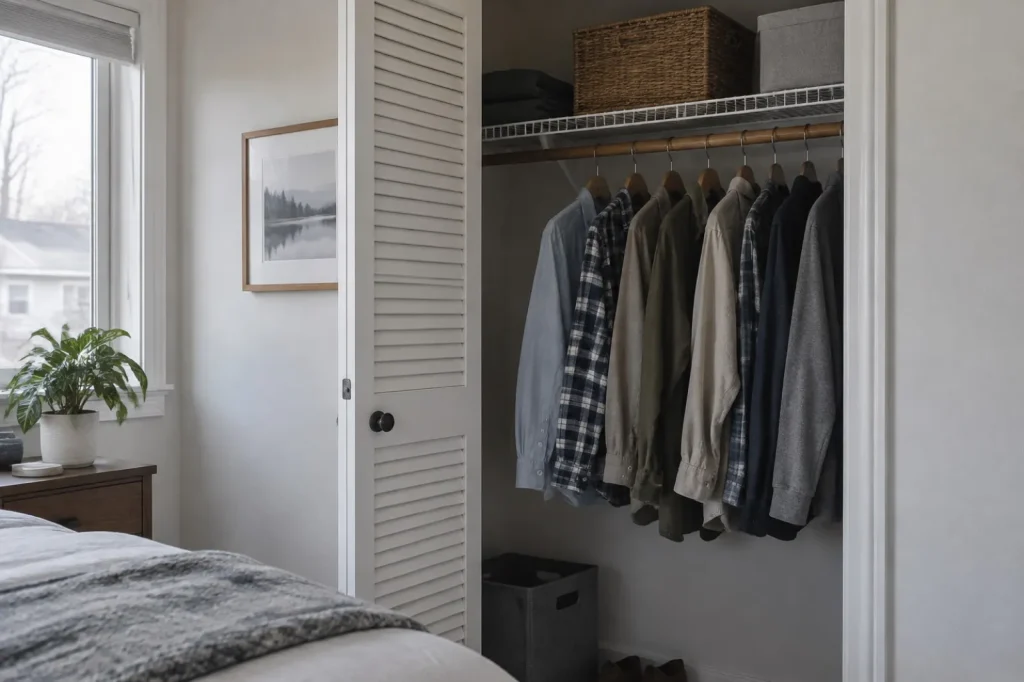
The short answer
Mold in closet spaces is one moisture problem showing up in two places: the closet wall and the things stored against it. Treat them separately. Find and fix the moisture, clean a small wall patch with detergent and water, wash clothes at the hottest water and strongest bleach their care label allows, and hold the closet at or below the 50 percent humidity CDC recommends.
Key takeaways
- The wall is a building material and the clothes are contents: different methods, discard rules and policy sections.
- A care label’s silence is a legal statement. Under the FTC Care Labeling Rule, 16 CFR Part 423, no bleach instruction means every commercially available bleach is safe, and ‘Machine wash’ alone means hot water up to 145°F.
- According to their published recipes, UGA Extension’s soak is 25% bleach, UF/IFAS’s about 3%. Start weak.
- NPS lists leather among the most mold-prone materials, and the FTC rule does not cover footwear at all.
- Desiccant tubs work in a sealed box, not an open closet.
On this page
A closet holds still air around fabric, leather and cardboard in the dark. The shelf, the wool coat and the leather belt each need a different method, and none of it lasts unless the air changes.
What you are looking at in a closet
Per the National Park Service Conserve O Gram 3/4, the first sign is usually a musty odour; growth may be velvety in almost any colour or powdery, and it glows under ultraviolet light. University of Kentucky Cooperative Extension adds that on clothing it is usually black, sometimes white. Location tells you more than colour.

| Where you see it | What it usually means | Check first |
|---|---|---|
| Lower back wall, behind long coats | Condensation on a cold outside wall in still air | Is it an exterior wall? Does growth stop where coats stop? |
| Baseboard of a wall shared with a bathroom | Shower humidity, or water inside the wall | Moisture meter at the baseboard; wet means a leak |
| Clothes and shoes only, wall clean | Damp or soiled items were put away | Which items: worn, freshly washed, or stored for a season? |
| Closet ceiling, spreading from one point | Water arriving from above | Does it grow after rain? |
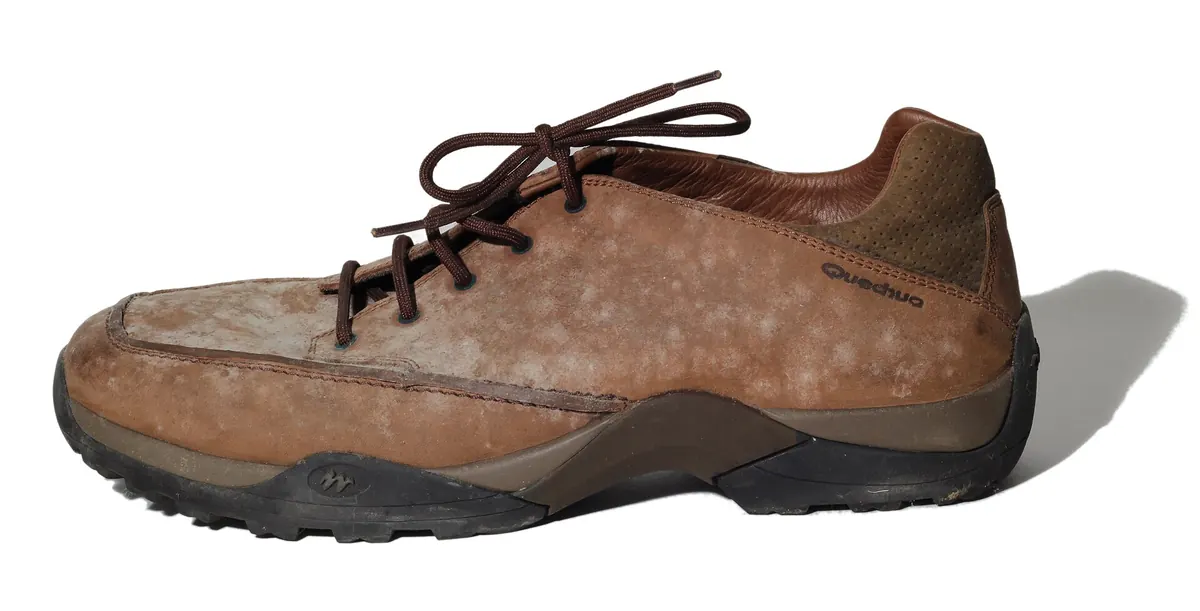
| White powder on dark leather | Often mold bloom; NPS lists leather as highly susceptible | Musty smell, returns after wiping, glows under UV |
Mold or mildew, the cleanup is the same (see mold vs mildew).
Why closets grow mold
The UF/IFAS Extension publication FCS3213 (reviewed September 2002) reports University of Florida research ranking bathrooms, closets and bedrooms as the worst mildew spots, and notes that moisture migrates into closets far more easily than it comes out.
| Cause | How it shows up | The closet fix | Basis |
|---|---|---|---|
| Stagnant air | Musty smell; growth where packed tightest | Louvered door, wire shelving, loose hanging | UF/IFAS FCS3213; UKY |
| Exterior-wall closet | Back wall and garments touching it | Keep items off the outside wall; warm the space | NPS COG 3/4; EPA |
| Closet against a bathroom | Shared wall, worse after showers | Door shut while steam is present; run the bath fan | UF/IFAS FCS3213; USDA 1952 |
| Damp clothing put away | Specific items, wall clean | Dry completely; never hang soiled clothes | UKY; UF/IFAS FCS5232 |
| Storage on the floor | Undersides of boxes and shoes | Raise it; NPS uses 4 inches minimum | NPS COG 3/4 |
Exterior walls. EPA's Brief Guide to Mold, Moisture and Your Home notes condensation forms on cold surfaces such as walls behind furniture; the National Park Service Conserve O Gram 3/4 keeps objects off outside walls and at least 4 inches above the floor.
Bathroom-adjacent closets. UF/IFAS Extension publication FCS3213 says to keep the door of a closet in the bath area closed while shower moisture is present, and to run the exhaust fan about 10 to 15 minutes after showering. USDA's 1952 bulletin Preventing and Removing Mildew said it fifty years earlier: ventilate linen closets in bathrooms.
Damp clothing. University of Kentucky Cooperative Extension says clothes must be completely dry before they are put away, and that perspiration alone can start mildew.
The closet wall and the clothes are two jobs
Closet mold on wall surfaces is a building problem, cleaned in place: EPA's mold cleanup page sets the homeowner line at about 10 square feet, with detergent and water on hard surfaces. Soft drywall is a cut-out (see mold on walls); the generic method is on DIY mold remediation.
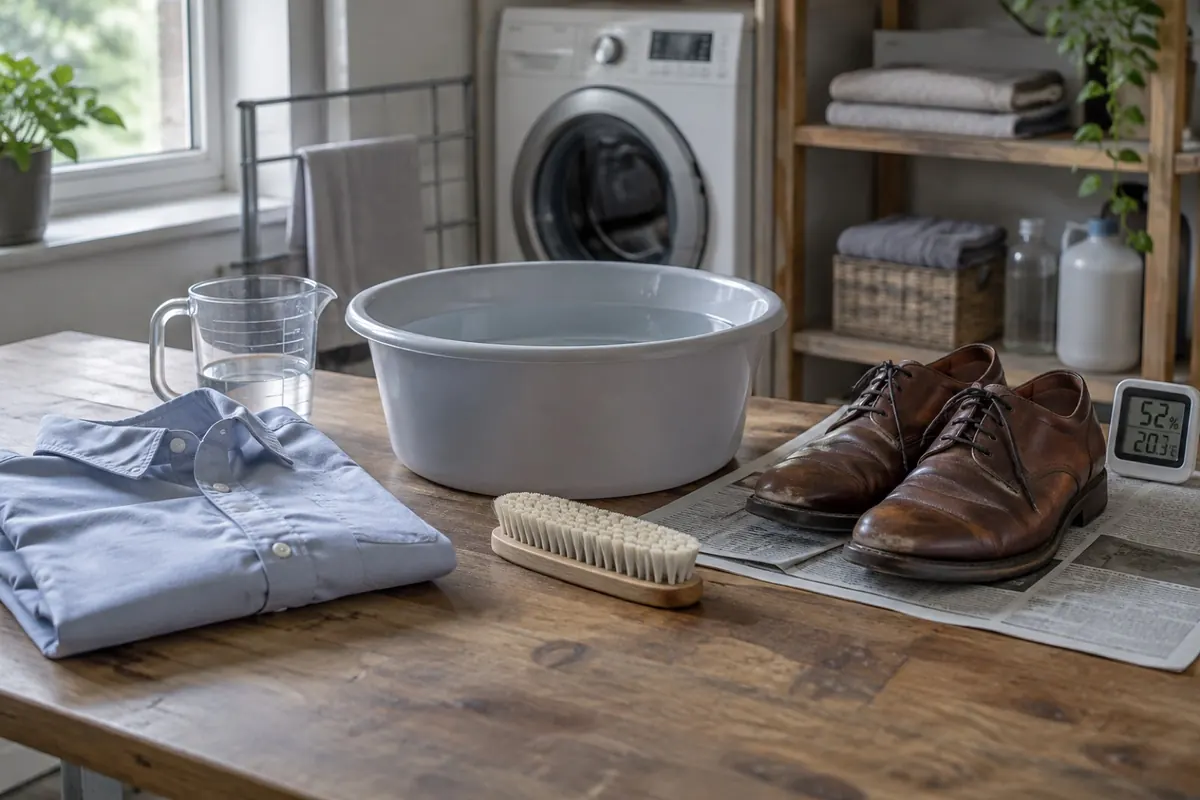
Mold on clothes in closet storage is a contents problem, cleaned by what each item tolerates. Empty the closet before scrubbing the wall. In the base ISO HO 00 03 05 11 homeowners form (Maine Bureau of Insurance copy), the building is Coverage A and clothing is Coverage C, personal property, settled at actual cash value. Your policy, your state insurance department and a licensed professional decide your claim; our page on homeowners insurance and mold reads the standard wording.
Read the care label first
The FTC Care Labeling Rule, 16 CFR Part 423 defines the words on the label. Section 423.6 requires a warning whenever a normal care step would harm the garment, so silence carries meaning, and Appendix A defines the temperature terms.
| Label says | Meaning under 16 CFR 423 | For a moldy item |
|---|---|---|
| Machine wash (no temperature) | Hot water up to 145°F is safe regularly | Hottest cycle is allowed |
| Hot | Initial water 112 to 145°F | Use it |
| Warm | Initial water 87 to 111°F | Lean on detergent and a soak |
| Cold | Up to 86°F | Pretreat; do not raise heat |
| Nothing about bleach | All commercial bleaches are safe | Chlorine permitted |
| Only non-chlorine bleach, when needed | Chlorine may not be used | Oxygen bleach soak |
| No bleach | No bleaches may be used | Detergent, sun, or a cleaner |
| Leather clean | Professional leather or suede cleaner only | Do not wash at home |
Section 423.1 excludes footwear, gloves and hats from wearing apparel, so a shoe may carry no federal care label.
Cleaning moldy clothes and fabrics
The extension method is consistent: brush growth off outdoors, launder, then treat what remains. UF/IFAS Extension Jefferson County adds the step most people skip, a colourfastness test. Strength is where the publications part company.
| Publisher | Recipe, per the publisher | Time | Bleach share |
|---|---|---|---|
| University of Georgia Extension | 1/4 cup chlorine bleach, 3/4 cup water | 10 to 15 min | 25% |
| UF/IFAS FCS5232; UF/IFAS Jefferson County | 2 tbsp liquid chlorine bleach per quart of water | 5 to 15 min | 3.0% |
| UF/IFAS FCS5232 | 1 cup chlorine bleach in the wash | One load | Varies by machine |
| UF/IFAS Jefferson County | 1 to 2 tbsp powdered non-chlorine bleach per pint | 30 min or longer | Not chlorine |
Per the recipes above, the UGA soak is about 8 times stronger than the UF/IFAS one. Start weak and repeat before moving up; fabric that takes no bleach can get the lemon juice, salt and sunlight method both print.
- Silk, wool, spandex: no chlorine bleach, per UF/IFAS Extension Jefferson County; University of Georgia Extension textiles guide adds that ammonia damages silk and wool.
- Acetate, triacetate, modacrylic, acrylic: UGA warns alcohol damages them, so no alcohol wipe.
- Dry-clean only: brush outdoors, bag it, and tell the cleaner it is mildew.
Why this differs from generic advice: here the label sets the chemistry and the washer does the removal. A smelly machine is its own job (mold in a washing machine); bleach chemistry is on does bleach kill mold.
Item by item: clean it or let it go
Keep this open while you empty the closet. The discard column follows NPS’s note that mold can permanently stain textiles and reduce their strength.
| Item type | Cleaning method | When to discard | Basis |
|---|---|---|---|
| Washable cotton, linen, polyester; label silent on bleach | Brush outdoors, hottest label wash, chlorine soak for stains | Fabric tears or thins where growth was | UGA; UF/IFAS; NPS |
| Label: only non-chlorine bleach | Powdered oxygen bleach soak, 30 min or longer | Stain survives repeat soaks on a low-value item | UF/IFAS Jefferson County |
| Wool and silk | No chlorine, no ammonia; dry cleaner | Fibres weakened | UF/IFAS; UGA |
| Dry-clean-only garments | Brush, bag, professional cleaning | Cleaner declines it or stain stays | 16 CFR 423 |
| Leather shoes, belts, bags | Alcohol and water wipe, saddle soap, wax dressing | Leather cracks, stitching rots, growth returns | UF/IFAS; NPS |
| Cardboard boxes, paper bags | Do not clean; remove | Always, once grown on | NPS COG 3/4 |
| Plastic bins, hangers, wire shelves | Detergent and water, dry fully | Cracked bins only | EPA |
Why this differs from generic advice: ‘throw away porous items’ does not fit clothing, which is porous and routinely saved. EPA's Brief Guide to Mold, Moisture and Your Home says porous materials may have to be thrown away, not that they must. A garment’s discard line is fibre damage, not a spot.
Leather shoes, bags and belts
The National Park Service Conserve O Gram 3/4 names leather among the materials particularly susceptible to mold and says it can be stained and weakened. UF/IFAS Extension Jefferson County gives the sequence for shoes, bags and jackets: test colourfastness; wipe with 1 cup denatured alcohol to 1 cup water and dry where air circulates; if growth remains, wash quickly with thick suds of mild soap or saddle soap, wipe and air dry; polish shoes with a wax dressing and air them well.
Why this differs from generic advice: all-surface sprays skip the colourfastness test and wet the leather far more; the extension method keeps it barely damp, then waxes it. Suede and anything labelled ‘Leather clean’ go to a professional.
Storage bins versus cardboard
Cardboard is paper, and the National Park Service Conserve O Gram 3/4 lists paper with cotton, linen and wood as particularly susceptible, and tells museums to discard storage materials that held an infested object.
| Container | Strength | Failure mode | Use it for |
|---|---|---|---|
| Cardboard box | Cheap, breathes | Is itself food for mold | Moves, not storage |
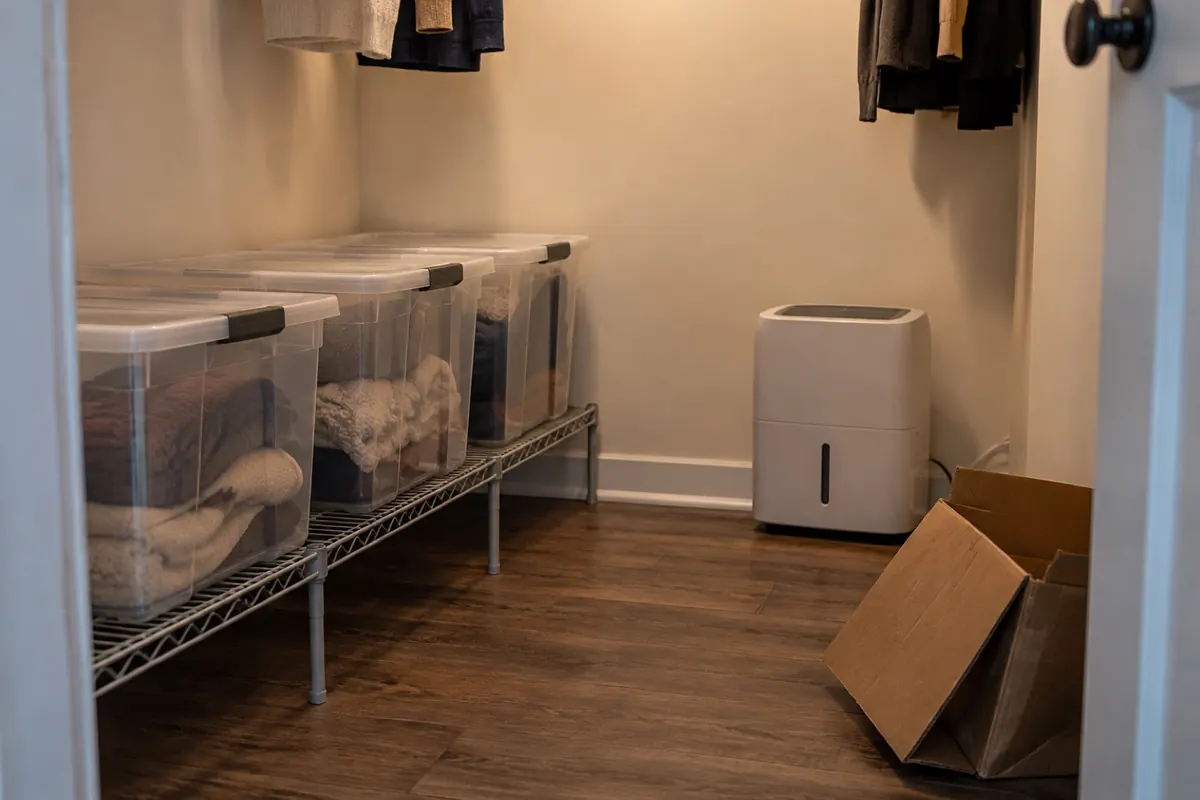
| Lidded plastic bin | Does not feed growth; cleanable | Seals in moisture packed with contents | Fully dry items, raised |
| Bin plus silica gel | NPS: buffers adjust humidity in a sealed space | Gel saturates; renew it | Leather, wool, keepsakes |
| Closed garment bag | Keeps dust off | USDA: closed bag, dampness and heat breed mold | Dry garments only |
| Open wire shelving | UF/IFAS: lets air circulate | Items still need spacing | Folded clothes, shoes |
Why this differs from generic advice: a sealed bin is a microclimate, ideal with dry contents and a desiccant, and a culture dish with a damp sweater.
Air, humidity targets and the louvered door
UF/IFAS Extension publication FCS3213 lists the air fixes: louvered doors keep a closet drier, solid doors stay open if it smells musty, and wire shelving lets air through. A low-wattage bulb placed low, well away from clothing and anything that can ignite, lowers humidity by heat.
Per EPA's Brief Guide to Mold, Moisture and Your Home, keep indoor humidity below 60%, ideally 30 to 50%, checked with a cheap hygrometer. Per the CDC's mold page, the line is stricter: no higher than 50%. Per the National Park Service Conserve O Gram 3/4, germination is less likely at 45 to 55% and humidity should always stay below 65%.
Desiccants and the light bulb: the sources disagree
USDA's 1952 bulletin Preventing and Removing Mildew told readers to hang bags of silica gel in closets, noting it holds half its weight of water while calcium chloride holds twice its weight but liquefies and harms fabric. UF/IFAS in 2002 called desiccants of little use in a closet when the house is humid. NPS in 2007 says silica gel works in a sealed space. Open closet and closed box are different problems.
The closet triage, in order
Eight steps, ordered so nothing gets cleaned twice.
- 1. Look before you touch. Wall, ceiling or items only: the pattern names the moisture source.
- 2. Empty into three bagged piles. Washable, specialist (dry-clean, leather, wool, silk), discard (cardboard, anything rotted).
- 3. Measure. Hygrometer in the empty closet, moisture meter on each wall. Wet wall: a leak. High humidity only: an air problem.
- 4. Clean the wall and shelves. Detergent and water under about 10 square feet, per EPA.
- 5. Wash by label. Hottest temperature and strongest bleach allowed, weakest recipe first.
- 6. Treat leather separately. Alcohol wipe, saddle soap, wax, air dry.
- 7. Change the air. Louvered or open door, wire shelving, nothing on the floor or the outside wall, humidity at or below 50%, per the CDC.
- 8. Return only dry, clean items, and re-check the hygrometer after a week.
Signs it is bigger than the visible spot
- The bathroom-side baseboard reads wet. Water is inside the wall; plumbing comes before cleaning.
- Growth covers more than about 10 square feet. Above the EPA homeowner line; containment and a professional.
- Wall growth returns within weeks. The source is still active.
- A ceiling stain spreads from one point. Water is coming from above; roofs are a roofing job.
- A musty smell with nothing visible. Look behind the wall or under the closet carpet edge.
- The bedroom window grows mold too. That is room humidity.
For contractors: scoping a closet
Write two scopes on one wall. The wall scope: readings on every wall, the outside wall flagged, square footage, photos. The contents scope: an item list with a photo of each care label and a discard reason per item.
The base ISO HO 00 03 05 11 homeowners form (Maine Bureau of Insurance copy) explains why. Its water discharge peril for personal property excludes loss caused by mold, fungus or wet rot unless hidden within walls or ceilings or beneath floors, and it asks for an inventory of quantity, description, actual cash value and amount of loss. Read the policy on the file.
What this page does not cover. Health effects are outside our scope; see CDC's mold page and EPA's Brief Guide to Mold, Moisture and Your Home, and ask a physician about any personal concern. Flood or sewage soaked clothing is also not covered here.
Questions people actually ask
What do I do if I find mold in my closet?
Empty the closet, bagging moldy items, and note where growth sits: an outside wall points to condensation, a bathroom wall to a leak, items only to damp storage. Fix the moisture, clean small wall areas with detergent and water, and wash clothes by their care label.
Can I sleep in my room if my closet has mold?
That is a health question this page does not answer; ask a physician and see CDC and EPA guidance. Practically, shut the closet, bag the moldy items and move them out of the bedroom until washed, and run a dehumidifier while you find the moisture source.
Can mold in a closet make you sick, and what are the signs?
Health effects are outside this publication’s scope. CDC’s mold page and EPA’s Brief Guide to Mold, Moisture and Your Home are the federal starting points, and a physician is the right person for personal questions. This page covers the closet and its contents.
How do I get mold off clothes in my closet?
Brush growth off outdoors, then launder at the hottest temperature the care label allows. For stains on bleach-safe fabric, UF/IFAS Extension prints 2 tablespoons of chlorine bleach per quart of water for 5 to 15 minutes. Never use chlorine on silk, wool or spandex.
Why is there mold on my closet wall but not the rest of the room?
Closets hold still air, and many sit on an outside wall colder than the room, insulated further by the clothes against it, so moisture condenses there first. NPS advises keeping stored items off outside walls. A wet baseboard reading points to a leak instead.
Do moisture absorbers work in a closet?
In a sealed space, yes. NPS says silica gel can adjust humidity inside a sealed cabinet, while UF/IFAS Extension says desiccants are of little use in an open closet when the house is humid. Put them inside lidded bins and control the closet with airflow.
Should I throw away moldy clothes?
Usually not. Clothing is routinely saved by laundering within the care label. Discard when fabric has torn, thinned or rotted where growth was, which NPS notes mold can cause, or when a stain on a low-value item survives repeat treatment. Moldy cardboard always goes.
Sources
- FTC Care Labeling Rule, 16 CFR Part 423, sections 423.1, 423.5, 423.6 and Appendix A, eCFR text. Retrieved 19 October 2026.
- EPA's Brief Guide to Mold, Moisture and Your Home, US EPA, updated 18 February 2026. Retrieved 19 October 2026.
- EPA's mold cleanup page, US EPA, updated 4 June 2026. Retrieved 19 October 2026.
- CDC's mold page, dated 26 September 2024. Retrieved 19 October 2026.
- UF/IFAS Extension publication FCS3213, Virginia Peart, reviewed September 2002, archival. Retrieved 19 October 2026.
- UF/IFAS Extension publication FCS5232, Mary N. Harrison, revised November 2005, archival. Retrieved 19 October 2026.
- UF/IFAS Extension Jefferson County, Mildew Removal, undated. Retrieved 19 October 2026.
- University of Georgia Extension textiles guide, undated. Retrieved 19 October 2026.
- University of Kentucky Cooperative Extension, Linda Heaton, December 2002. Retrieved 19 October 2026.
- USDA's 1952 bulletin Preventing and Removing Mildew, April 1952, Internet Archive; cited for history. Retrieved 19 October 2026.
- National Park Service Conserve O Gram 3/4, August 2007. Retrieved 19 October 2026.
- ISO HO 00 03 05 11 homeowners form (Maine Bureau of Insurance copy): Coverage C perils, Duties After Loss, Loss Settlement. Retrieved 19 October 2026.
- Bleach shares are arithmetic on the published recipes. No test or survey was conducted. See our methodology and the mold hub.
Follow the label in front of you and read your own policy.