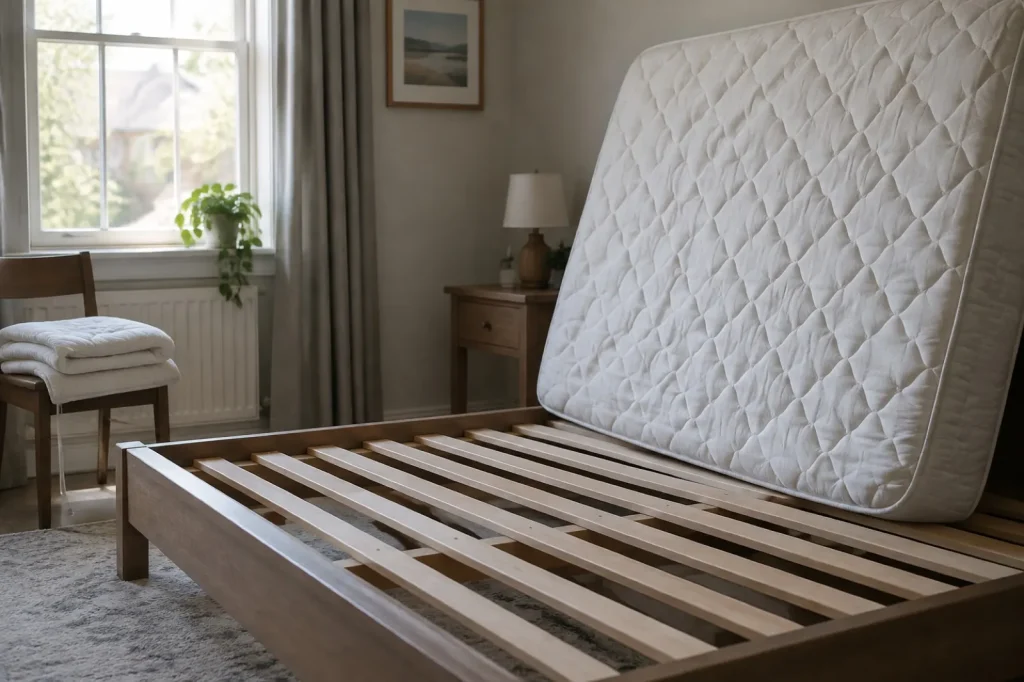
The short answer
Mold on mattress surfaces can sometimes be cleaned, but only if it is small, on the surface and the mattress can be dried completely. Vacuum it, wipe with a barely damp cloth, dry it with moving air and fix the base. Growth inside the core, a musty smell after drying, or any floodwater soaking means it goes: EPA, NC State and FEMA guidance agree.
Key takeaways
- Tempur-Pedic's 10-year mattress warranty excludes liquid damage and stains and can be voided for an unsanitary mattress.
- Purple’s warranty excludes mold occurring after use unless reported to Purple within 30 days.
- Warranties want a firm, solid base; mold advice wants airflow. Where a maker allows slats, gaps inside its limit (under 3 to under 4 inches) satisfy both.
- NC State Extension saves a mattress only after a roof leak or 1 to 2 inches of clean water for a few hours.
- Latex makers say keep latex out of direct sun, contradicting the ‘dry it in the sun’ advice on brand blogs.
- No primary source gives a per-sleeper moisture figure, so this page prints no sweat number.
On this page
- The five-question decision path
- What you are looking at
- Why mattresses mold
- Mold under the mattress and the bed base
- Innerspring, memory foam, latex
- The method, step by step
- What the warranties say
- When it goes: EPA, FEMA, NC State
- Prevention that matches the warranty
- Bigger than the spot
- For contractors
- FAQ
The five-question decision path
Answer in order and stop at the first ‘discard’.
- Did floodwater or sewage reach it? Discard. FEMA and the Red Cross list mattresses under ‘usually’ throw out.
- Was it soaked by clean water for more than a few hours, or deeper than 2 inches? Plan to discard; NC State says mattresses are almost impossible to dry before mold grows.
- Is growth on both faces, the edges, or into the core? Discard. EPA says mold in porous material can be impossible to remove completely.
- A few surface spots, core dry? Clean with the method below, then smell-test after drying.
- Is the base, frame or wall growing too? Fix that first, or it regrows.
What you are looking at on a mattress
Three common marks are not mold. Smell and pattern tell them apart, not colour.
| What you see | Most likely | How to tell | Source |
|---|---|---|---|
| Fuzzy or powdery clusters, musty smell | Mold or mildew | Smell stays once fully dry | NC State |
| Even yellowing of bare foam, no smell | Foam oxidation | Gradual, uniform | IKEA |
| Hard-edged ring on the cover | Dried liquid or sweat | No texture when brushed | Tempur-Pedic calls it a stain |
| Dark spots on the underside following the base | Mold under the mattress | Matching marks on the base | Purple, Casper articles |
| Spots on slats or frame only | Bed frame mold | Mattress underside clean | See the bed frame section |
IKEA's foam yellowing answer says foam naturally yellows when exposed to oxygen, that this is not a defect and cannot be claimed under warranty, and that this applies to memory foam. A yellow core is neither a mold finding nor a claim.
Why mattresses mold
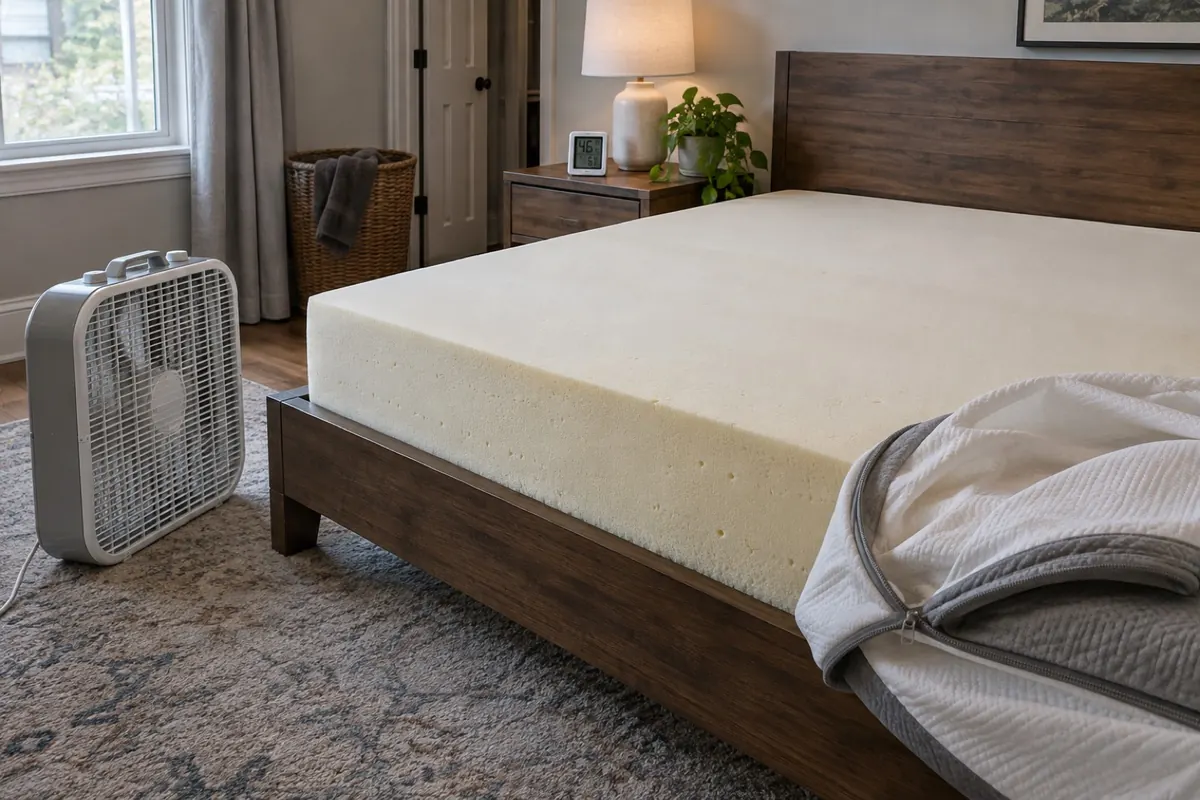
Purple's mold article lists poor air circulation, spills, high bedroom humidity, leaks, very warm rooms and keeping a mattress on the floor; Casper's mold article gives the same list. The mechanics are in EPA 402-K-01-001: condensation forms on cold spots and on walls behind furniture, and the fix is warmer surfaces, more air movement or lower humidity.
Mattress mold from sweat: what the numbers say
Saatva's mold article says a mattress soaks up sweat and body oils. How much water a sleeper adds each night is the figure every mattress blog wants, and we could not find it in a primary source, so this page prints none. The moisture design standard publishes whole-home figures instead: Addendum b to ASHRAE Standard 160-2009 sets design moisture generation by bedroom count, covering every indoor source.
So sweat is one bedroom moisture source, not a measured cause on its own. A protector keeps liquid out of the core; airflow under the bed and room humidity decide whether the rest leaves.
Foam mattresses in humid rooms, leaks and floods
Per EPA's Brief Guide to Mold, Moisture and Your Home, keep indoor humidity below 60 percent, ideally 30 to 50, and dry wet items within 24 to 48 hours. EPA's flood cleanup page adds that things wet for more than two days usually get moldy, and a thick foam core is slow to dry. A slow leak onto a bed is the clean-water case below; a flood is the discard case.
Mold under the mattress, and bed frame mold
Growth on the underside with a clean top points at the base. Purple's mold article warns that a damp mattress put back on a base regrows fast, and Purple and Casper both say get it off the floor. The catch: Tempur-Pedic's 10-year mattress warranty wants a firm, solid-surface, non-spring foundation and says mattresses are not intended to lie flat on the floor or on a platform of untreated wood. A solid platform protects the warranty and blocks airflow; where the maker allows slats, gaps inside its limit do both jobs.
| Maker | Base the warranty expects | Slat gap | Floor |
|---|---|---|---|
| Tempur-Pedic | Firm, solid-surface, non-spring foundation; center support, 5 to 6 legs for queen and up | Not stated | Not intended to lie on the floor |
| Purple | Firm, solid-surface, non-spring foundation; center support | No more than 3.5 in | Flat foundation never on the floor |
| Saatva | Solid surface or slats; center support for queen and up | Less than 4 in | Not addressed |
| Casper | Firm, solid surface | Not stated | Foundation floor damage excluded |
| Latex Mattress Factory | Firm, flat base or slats | Less than 3 in | Not addressed |
Cleaning the frame and slats
Slats are lumber. The Western Wood Products Association fact sheet says mold cannot grow on wood dried below 20 percent moisture content and advises wetting growth gently before wiping. EPA 402-K-01-001 Table 1 cleans finished wood with mild detergent and water. Raw wood belongs on mold on wood; upholstered headboards follow the cleaning codes on mold on furniture.
Innerspring, memory foam and latex: different rules
| Type | What the maker or extension says | Meaning for cleanup |
|---|---|---|
| Innerspring | NC State: dry lightly wetted ones right side up in the sun on blocks with a fan; throw out any submerged in contaminated floodwater | The only published sun-drying method |
| Memory foam (TEMPUR) | Tempur-Pedic: the material should never become wet; never wash it; blot and air dry with a fan | No sprays into the foam |
| Latex | PlushBeds: no solvents or vinegar on latex; a few drops of mild detergent in a cup of water; out of direct sun | No sun, no vinegar |
| Latex | Latex Mattress Factory: no direct sunlight or extreme heat; foam completely dry before reuse | Dry indoors with moving air |
| Covers | Tempur-Pedic: cold wash, no bleach, air dry | Wash the cover apart from the core |
Purple’s and Saatva’s mold articles both say dry the mattress in the sun. PlushBeds use and care page and the Latex Mattress Factory care page say keep latex out of direct sunlight, and NC State’s sun method is written for innerspring. Match drying to the core, not the blog.
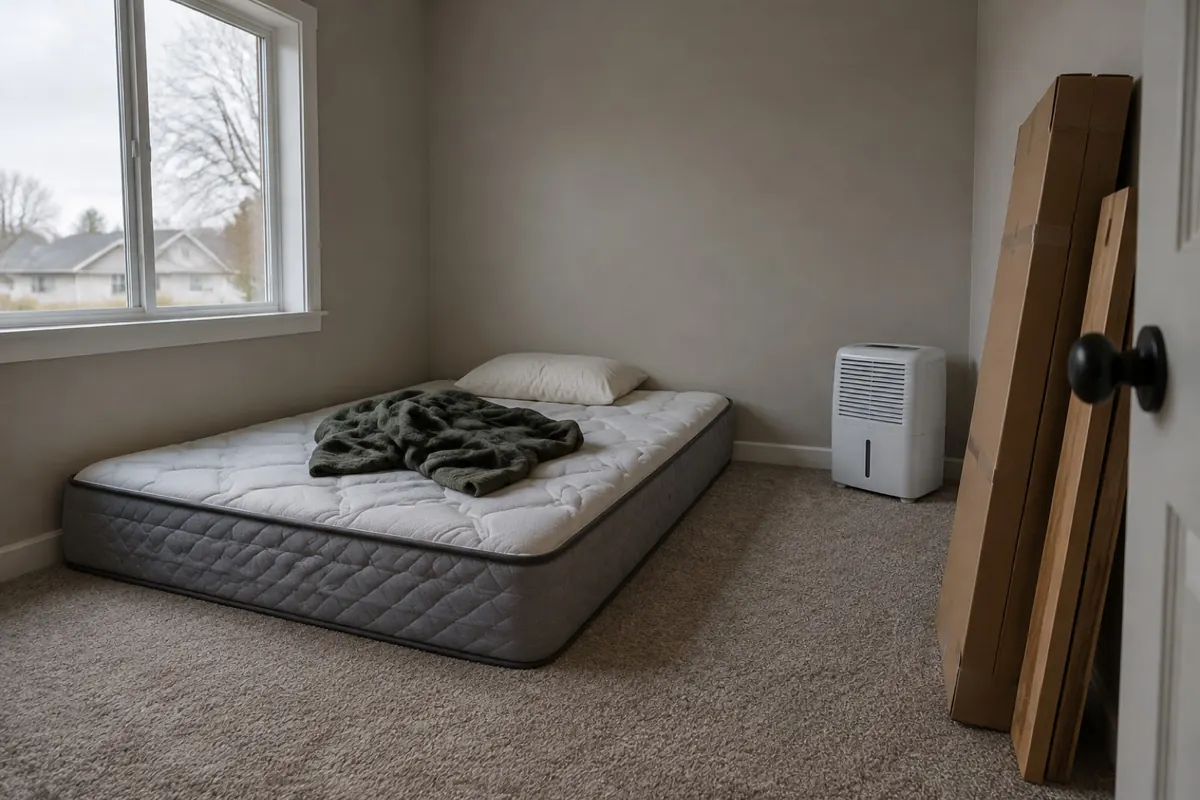
The method for a mattress, step by step
This is the surface-only case from step 4. The generic method and EPA’s 10 square foot line are on DIY mold remediation; kill versus remove is on how to kill black mold.
- Strip, bag, photograph both faces and the law tag. Why this differs from generic advice: the tag decides which warranty applies, and Purple’s clause turns on when mold was reported.
- Lift it on edge and check the underside and base. Why: a moldy underside means the base is the cause.
- Unzip and wash the cover as labelled. Why: Tempur-Pedic washes covers but never the core.
- HEPA vacuum the dry surface. Why: EPA Method 3 is a HEPA vacuum after the material is thoroughly dried, so vacuum before any wiping.
- Wipe, never spray: a barely damp cloth with a few drops of mild detergent. Why: blogs print sprays, but Tempur-Pedic says its material should never become wet.
- Dry with moving air matched to the core. Why: latex makers rule out direct sun.
- Smell-test when fully dry. Why: NC State reads a musty odour as mildew inside.
- Fix the base and room first. Why: EPA’s humidity line is 60 percent, and Purple warns a damp mattress on a base regrows.
| Published recipe | Where | Conflict |
|---|---|---|
| 1 part dish soap or hydrogen peroxide to 3 parts water; or equal parts rubbing alcohol and water | Purple article | Liquid damage exclusions |
| Equal parts rubbing alcohol and warm water | Casper and Saatva articles | Saatva adds sun drying |
| A few drops of mild detergent in a cup of water | PlushBeds care page | None: the gentlest option |
| Never wet the TEMPUR material | Tempur-Pedic care page | None: the strictest rule |
Mattress warranty language on stains and mold
None of these warranties covers mold as a defect. The wording decides what you photograph and when you call.
| Brand | Clause (quoted) | What it means |
|---|---|---|
| Tempur-Pedic (revised September 2022) | Excludes ‘liquid damage, or stains’ and degradation ‘due to liquid exposure’; may be invalidated ‘if the mattress is found to be in an unsanitary condition’ | A moldy mattress can lose all coverage, sagging included |
| Purple | Excludes ‘stains, odors, unsanitary conditions’, ‘damage from liquids’, and ‘Mildew or mold occurring after use of the mattress, unless reported to Purple within 30 days’ | The only clause naming mold; report fast, with photos |
| Casper | Excludes damage ‘including… liquid damage, or stains’ | Mold not named; liquid and stains are |
| Saatva | Does not apply ‘if the mattress has been stained, burned or otherwise abused’ | Any stain can end the claim |
| IKEA (foam) | Yellowing ‘is not considered a defect’ | Discoloration is neither a defect nor mold |
Tempur-Pedic's protector warranty ties mattress claims caused by a protector defect to a protector bought on the same day and sales ticket, and wants claims within 5 days of an incident. Purple's warranty page excludes ‘molds, mildews’ from its protector warranty. A protector keeps liquid out; it does not insure against mold.
When to throw it out: EPA, FEMA and NC State
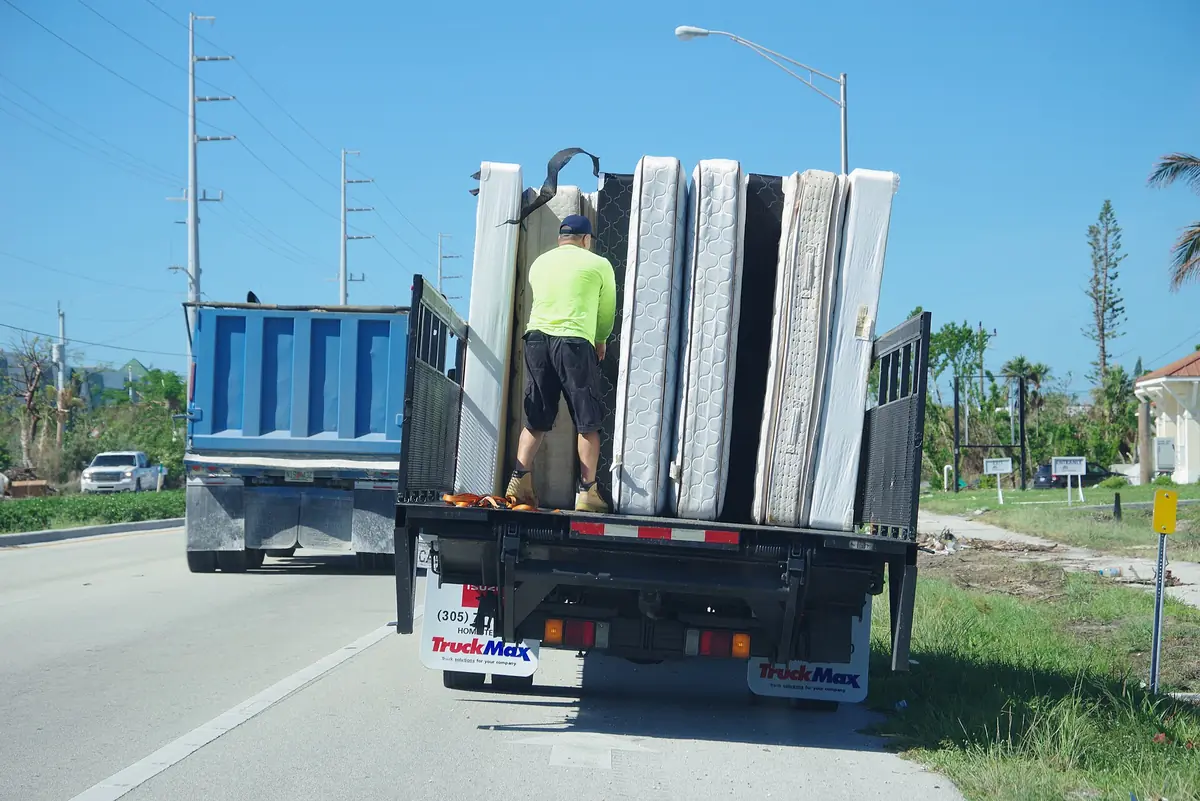

EPA’s tables have no mattress row. The closest, in EPA 402-K-01-001 Table 1, is upholstered furniture, which ‘may be difficult to completely dry within 48 hours’. EPA's mold cleanup page says porous materials may have to be thrown away if they become moldy, and EPA 402 says mold fills empty spaces in porous substances and ‘can be difficult or impossible to remove completely’.
| Situation | Published rule | Source |
|---|---|---|
| Flood-soaked | ‘Usually’ throw out mattresses, pillows, foam rubber; ‘When in doubt, throw it out’ | FEMA L-198 |
| Submerged in contaminated water | Throw out innerspring mattresses and box springs | NC State |
| Clean floodwater, soaked | May need discard: almost impossible to dry in time | NC State |
| Roof leak, or 1 to 2 in of clean water briefly | Salvage: clean, sun-dry on blocks, fan | NC State |
| Musty after drying | Professional sanitising; discard if the odour stays | NC State |
| Mold over 10 sq ft on upholstery | Discard enters the method list | EPA 402 Table 2 |
Repairing Your Flooded Home (FEMA L-198, ARC 4476) puts it plainly: flooded items ‘such as wallboard and mattresses, will hold mud and contamination forever’. Water category comes first; see IICRC water categories and flood damage restoration.
Prevention that does not void the warranty
- Slats inside your maker’s gap limit, on a frame, never the floor.
- Humidity below 60 percent, ideally 30 to 50, per EPA; our dehumidifier guide covers sizing.
- The headboard pulled off the wall: EPA lists walls behind furniture as a place condensation forms.
- A protector bought with the mattress; spills blotted and dried the same day.
Signs it is bigger than the spot
- The base or slats are growing. The moisture is under the bed.
- The wall behind the headboard has spots. A condensation or leak problem in the building.
- Musty smell after full drying. Mildew inside, per NC State.
- Spots return after cleaning. Moisture is still getting in; Purple says deep or widespread growth means replacement.
- Damp carpet under a floor mattress. The floor is feeding it.
- Several items in the room growing. Room humidity is the cause.
For contractors: mattresses on a water or mold job
A mattress is contents: scope it as clean and dry, or discard, with the reason tied to a published rule. This is documentation, not a view on what any policy pays; that is for the policy, the state insurance department and a professional.
| Record | Why the adjuster asks |
|---|---|
| Law tag: brand, model, date | Age, value, which warranty |
| Both faces and underside, before work | Surface versus core |
| Water source and category | Contaminated water means discard (NC State, FEMA) |
| Contact depth and hours wet | NC State’s 1 to 2 in salvage test |
| Base type and slat gap | Whether the base caused it |
| Bagged and sealed | EPA Method 4 seals in plastic |
What this page does not cover. Health effects are outside our scope; see CDC's mold page and EPA's Brief Guide to Mold, Moisture and Your Home, and ask a physician about personal concerns. Pests in bedding belong to thepestcontrolbrief.com.
Questions people actually ask
Can you get mold out of a mattress?
Only when it is small and on the surface. HEPA vacuum the dry surface, wipe with a barely damp cloth, dry it fully with moving air and smell-test it. NC State Extension says a musty odour after drying means mildew is present. Growth in the core, on both faces or after a flood means replacement.
Is it safe to sleep on a mattress with mold?
Health questions are outside this publication’s scope. CDC’s mold page and EPA’s Brief Guide to Mold, Moisture and Your Home are the federal references, and a physician is the right person to ask. This page covers cleaning, warranties and discard rules.
Why is there mold under my mattress?
Usually the base. On the floor or a solid platform there is no air path under the mattress, so moisture stays on the underside. Purple and Casper both list floor placement and poor airflow as causes. Check the base for matching spots and use slats inside the maker’s gap limit, such as 3.5 inches for Purple.
Can sweat cause mold on a mattress?
Sweat is one moisture source, and Saatva says a mattress soaks up sweat and body oils. No primary source we found gives a reliable per-sleeper figure; ASHRAE 160 publishes whole-home rates only. Airflow under the bed, room humidity and a protector decide whether that moisture leads to growth.
Does a mattress warranty cover mold?
Not as a defect, in the warranties reviewed here. Purple excludes mold occurring after use unless reported within 30 days. Tempur-Pedic excludes liquid damage and stains and may void coverage for an unsanitary mattress. Casper and Saatva exclude stains. Read the document for your model and purchase date.
Should I throw out a mattress after a flood?
Almost always. FEMA and the Red Cross list mattresses among items usually thrown out, with ‘when in doubt, throw it out’. NC State Extension says discard any innerspring mattress submerged in contaminated floodwater, and that clean-water soaking may also mean discard because mattresses rarely dry before mold grows.
Sources
- Tempur-Pedic's 10-year mattress warranty, Tempur-Pedic North America, revised September 2022. Retrieved 30 October 2026.
- Tempur-Pedic's protector warranty and Tempur-Pedic's product care page, Tempur-Pedic, undated. Retrieved 30 October 2026.
- Purple's warranty page, undated, and Purple's mold article, Cecilia Gillen, updated 9 July 2025. Retrieved 30 October 2026.
- Casper's warranty page, undated, and Casper's mold article, 11 August 2022. Retrieved 30 October 2026.
- Saatva's warranty page, undated, and Saatva's mold article, Tanya Slavin, 12 June 2023. Retrieved 30 October 2026.
- IKEA's foam yellowing answer, undated. Retrieved 30 October 2026.
- PlushBeds use and care page, undated. Retrieved 30 October 2026.
- Latex Mattress Factory care page, undated. Retrieved 30 October 2026.
- NC State Extension, Kirby and Hammett, 5 June 2014. Retrieved 30 October 2026.
- Repairing Your Flooded Home (FEMA L-198, ARC 4476), FEMA and American Red Cross, August 1992, Town of Kitty Hawk copy. Retrieved 30 October 2026.
- EPA 402-K-01-001, US EPA, Tables 1 and 2. Retrieved 30 October 2026.
- EPA's Brief Guide to Mold, Moisture and Your Home, US EPA, updated 18 February 2026. Retrieved 30 October 2026.
- EPA's mold cleanup page, US EPA, updated 4 June 2026. Retrieved 30 October 2026.
- EPA's flood cleanup page, US EPA, updated 2 September 2026. Retrieved 30 October 2026.
- CDC's mold page, updated 26 September 2024. Retrieved 30 October 2026.
- Addendum b to ASHRAE Standard 160-2009, Table 4.3.2. Retrieved 30 October 2026.
- Western Wood Products Association fact sheet, Mold and Wood Products No. 3. Retrieved 30 October 2026.
- Warranty clauses are quoted. No mattress was tested and no survey was conducted. See our methodology and the mold hub.
Warranty terms change by model and purchase date. Read your own warranty and policy.