The short answer
Mold on wood is usually a surface problem, but rot is not. The USDA Forest Products Laboratory says mold and most sap stains affect strength only slightly, while decay fungi consume the wood. Growth that brushes off is mold, firm wood with deep streaks is stain, and soft or crumbly wood is rot. Dry it below 20 percent moisture, HEPA vacuum and clean it, and replace what is soft.
Key takeaways
- Depth decides the job. Per the FPL, mold often brushes or planes off softwood, sap stain penetrates the sapwood and cannot be surfaced off, and decay changes the wood itself.
- According to the FPL, serious decay needs wood above the fiber saturation point, about 30% moisture content, while air dried wood at 20% or less has a reasonable safety margin.
- Humid air alone will not wet wood enough to rot it, per the FPL, but it will let some molds grow. Rot needs liquid water.
- Decay is hidden before it is serious: according to FPL laboratory tests, toughness fell 6% to more than 50% by the time wood lost 1% of its weight.
- Moldy framing is not automatically scrap. According to the Southern Forest Products Association, clean it and dry it to 19% or less before the wall is closed.
On this page
The pages ranking for this search are forums, a franchise blog and furniture sellers, and most start with vinegar. That skips the real question: is the fungus on the wood, staining it, or eating it? This page answers it from the USDA Forest Products Laboratory (FPL) Wood Handbook, EPA remediation guidance and an EPA registered product label. More is on our mold hub.
Out of scope: this page covers wood, not people. It does not describe health effects, symptoms or who is at risk from mold; for those, see EPA’s mold pages and the CDC, and speak to a medical professional.
Five things that look like mold on wood
The FPL Wood Handbook chapter 14 sorts the fungi on wood into molds, stains and decay, and adds chemical stains because they look alike. Its 2010 edition calls fungi on wood and paint surfaces mildew. Only one of the five weakens the wood.
| What you see | How it looks | Depth | Strength effect | Usual answer |
|---|---|---|---|---|
| Mold | Fuzzy or powdery growth, pale to black; green and yellow common | Surface on softwood; deeper in oak | Slight | Dry, HEPA vacuum, clean, sand |
| Mildew | Black deposits on wood or paint, often with green algae | Surface, or under a clear finish | None; cannot decay wood | Clean, refinish with a mildewcide |
| Sap stain | Blue, grey or brown streaks; radial wedges on the end grain | Into the sapwood | Slight | Keep where looks do not matter, or replace |
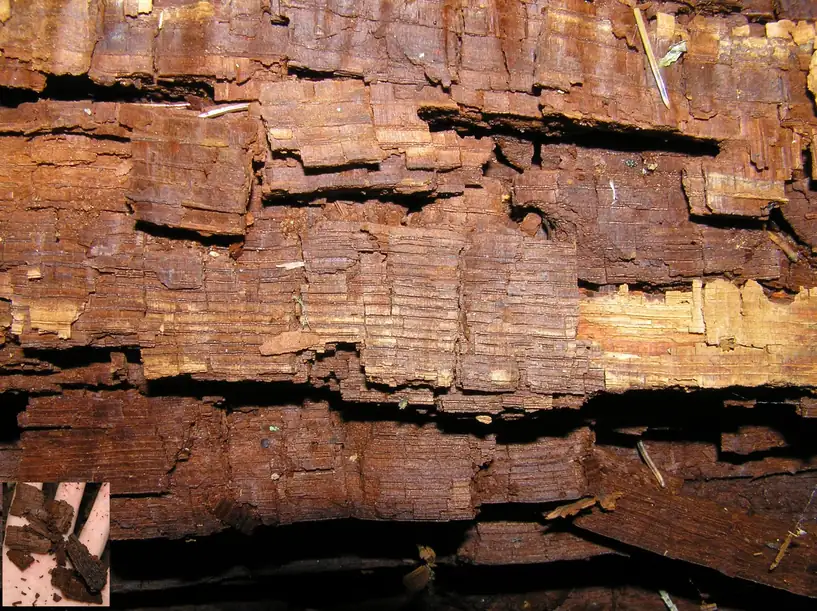
| Decay (rot) | Brown and cubed, or bleached and spongy; white or brown fans | Through the wood | Serious | Fix the water, replace the wood |
| Chemical or iron stain | Grey, brown or pink, or iron stain where iron meets tannins | In the wood | None | Oxalic acid lifts iron stain |
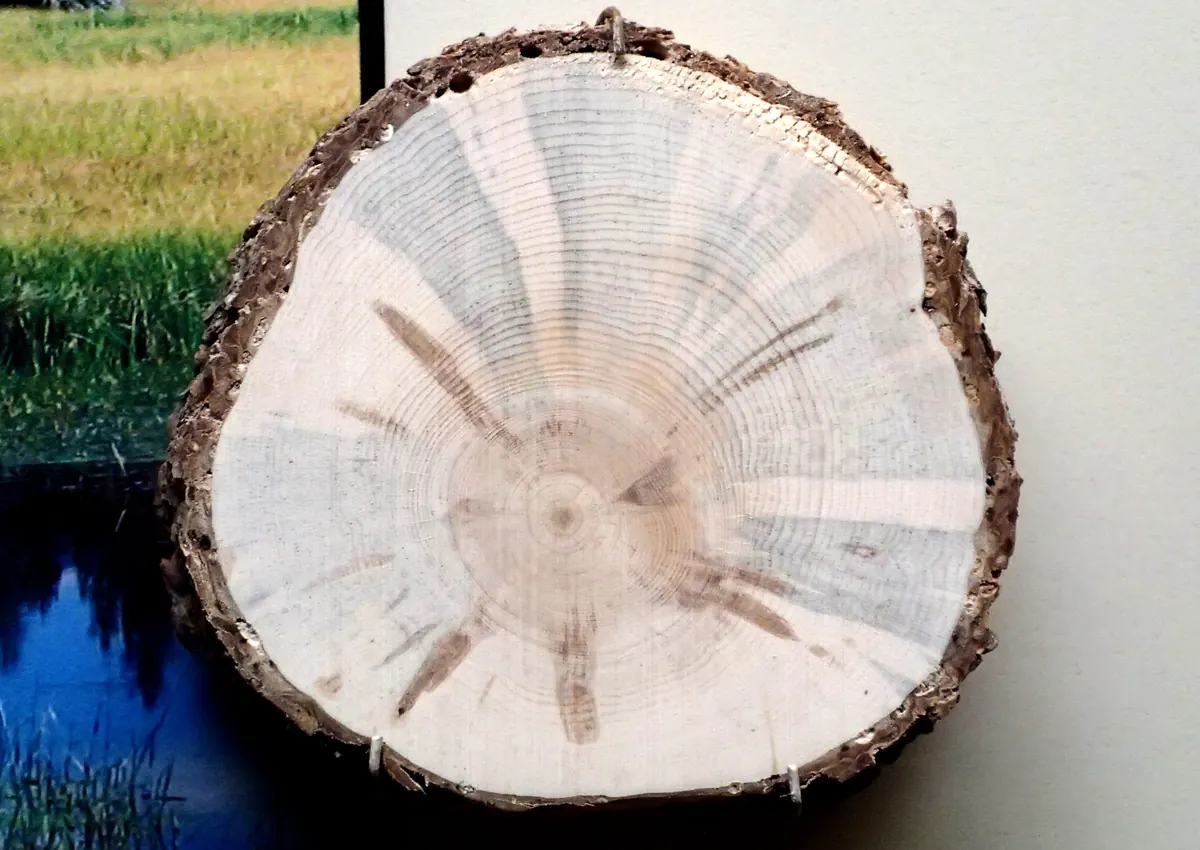

Two traps sit in this table. White growth is not always mold: the FPL says fresh decay fungi can show as fan shaped patches or strands, usually white or brown. And colour is not a species guide; EPA notes molds come in many colours. See our black mold guide and mold vs mildew for those questions.
Depth is the test
The FPL Wood Handbook chapter 14 draws the line between mold and stain on the depth of the discolouration. On softwoods, surface growth often brushes or surfaces off. On large pored hardwoods such as oak, the wood beneath is commonly stained too deeply to surface off, and typical sap stain cannot be removed by surfacing at all.
| Check | What you see | What it points to |
|---|---|---|
| Brush a small patch | Growth lifts, wood beneath looks normal | Surface mold on softwood |
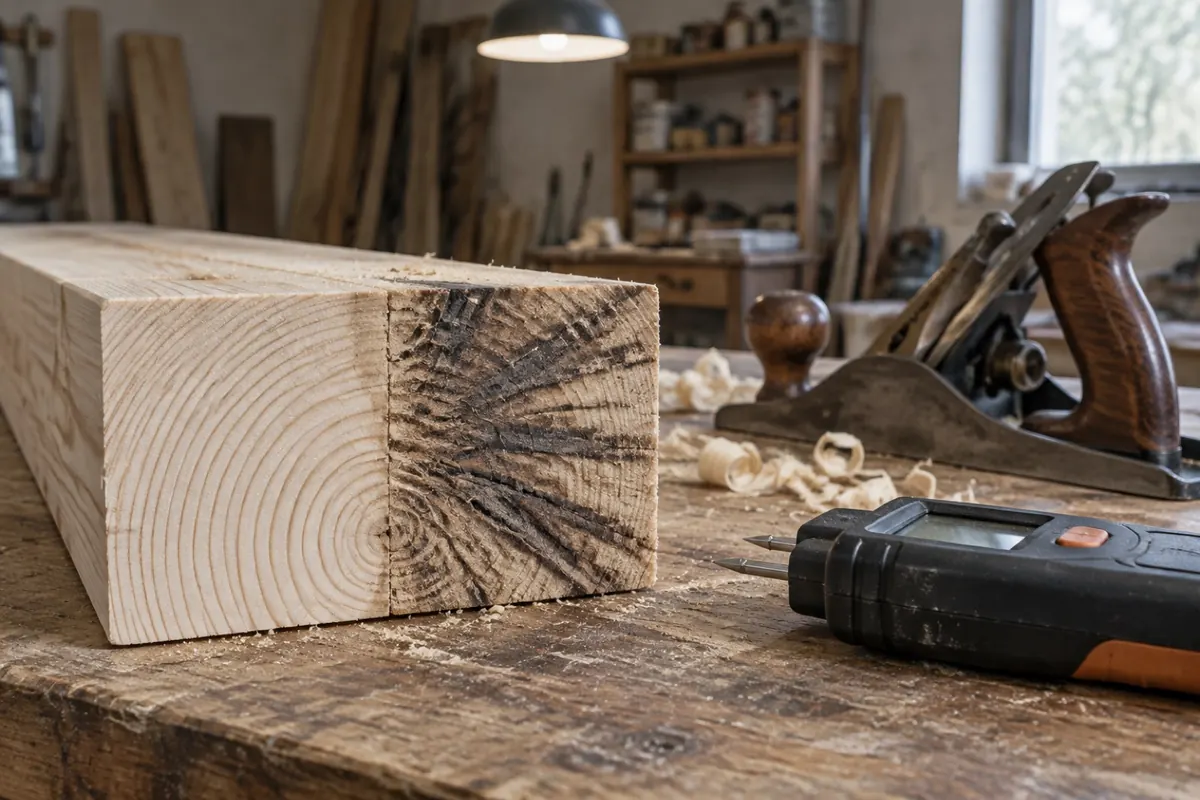
| Plane or sand a test spot | Colour stays below the surface | Sap stain, or mold in oak |
| A drop or two of household bleach | Dark colour fades in 1 to 2 minutes, per the FPL | Mildew; no change suggests dirt or iron stain |
| Look with a 10x loupe | Threads when damp, egg shaped spores when dry | Mildew, not dirt |
| Probe with an awl or ice pick | Point sinks in easily | Decay, even under a sound surface |
| Look across the grain | Brown and cubed, or pale and spongy | Brown rot, or white rot |
The probe matters most: the 2010 Wood Handbook says decay often occurs in the centre while the surface appears sound.

The moisture numbers
Moisture content is the weight of water as a percentage of the dry weight of the wood, per EPA moisture control guidance. The FPL and two lumber associations set the lines, and they agree closely.
Why humid air grows mold but rarely rot
Per the FPL Wood Handbook chapter 14, water vapour in humid air will not wet wood enough for significant decay, but it will permit some mold. Wood in still air settles at an equilibrium moisture content, and according to Table 4-2 of the 2010 handbook, wood at 70 F reaches 13.1% at 70% relative humidity and passes 20% only at about 90%. According to the Southern Forest Products Association, a humidity of 70 to 90% supports mold.
So the water source predicts the fungus: damp air grows mold, while a leak or ground contact pushes wood toward rot.
When it is rot
According to the FPL Wood Handbook chapter 14, decay cuts toughness first, then bending strength, then every strength property. In its laboratory tests toughness fell 6% to more than 50% by 1% weight loss, and at 10% weight loss, when decay is visible only under a microscope, most strength losses can be expected to exceed 50%, per the same chapter. Its rule: wood with visible decay may be assumed greatly reduced in all strength values.
Houses sit in the fast band all year, so moisture is the lever. The FPL notes that so called dry rot fungi carry water into wood through strands; they still need water.
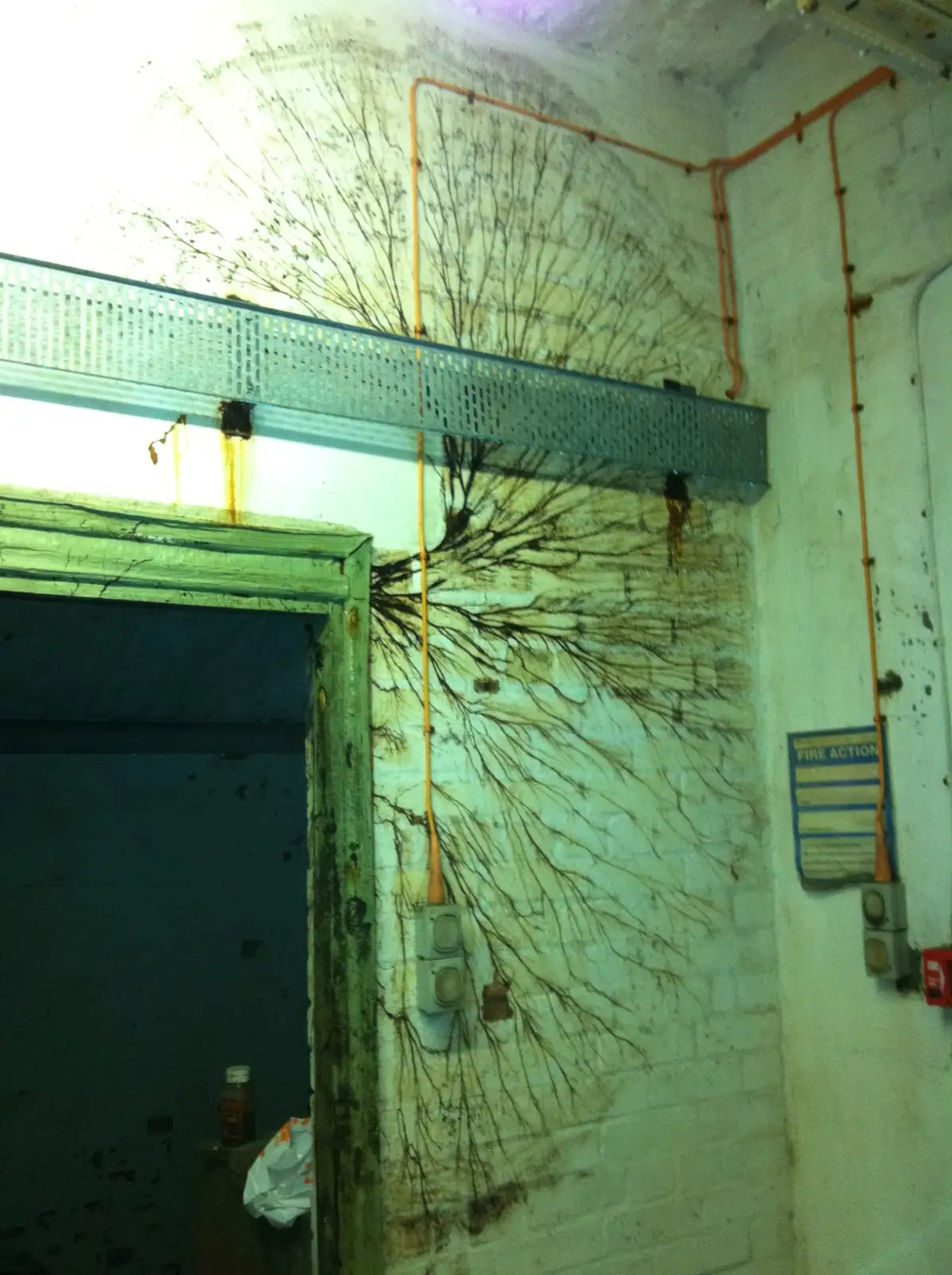

Mold on new framing lumber
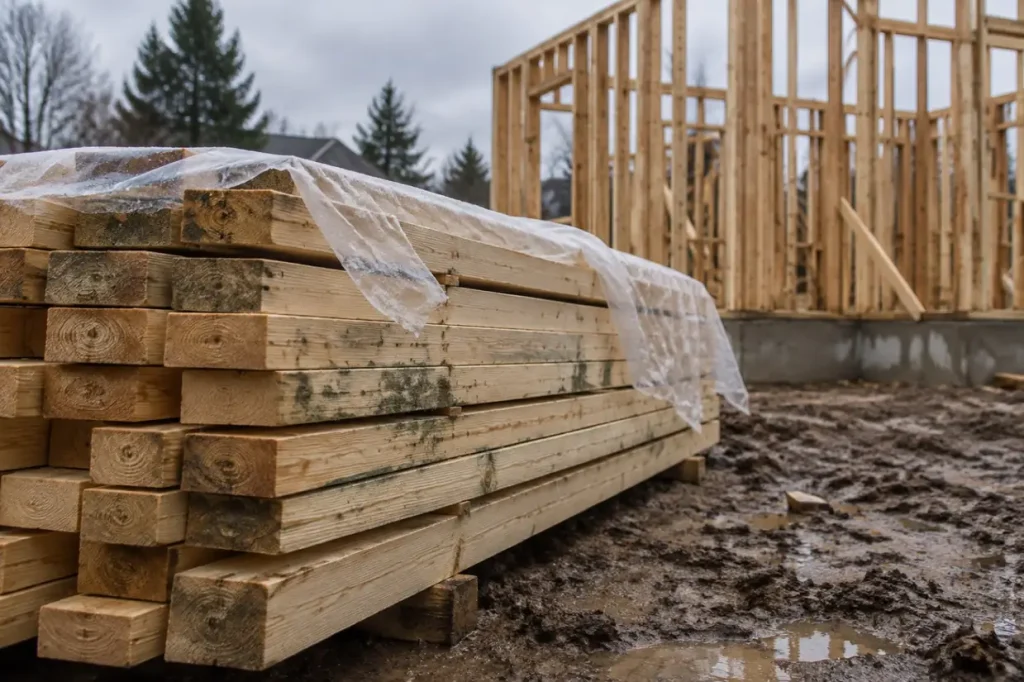
The FPL Wood Handbook chapter 14 explains the new construction problem: unseasoned stock piled in warm, humid weather may be visibly discoloured within 5 or 6 days, and lumber can be infected at any stage if it gets moist enough.
The Southern Forest Products Association says that, discolouration aside, mold has little effect on the structural integrity of framing lumber. The FPL adds the catch: mold and stain make wood more absorbent and wettable, and early decay can hide in stained areas. That is a reason to dry it, not to panic.
| Step | What to do | Source |
|---|---|---|
| Read the grade stamp | S-DRY or KD is 19% maximum, per the WWPA; S-GRN is unseasoned | WWPA |
| Store it off the ground, covered | Vapour permeable cover, short site storage | SFPA |
| Clean what molded | Clean it and let it dry before use | SFPA |
| Meter before enclosure | Framing at 19% or less, per the SFPA; never enclose wet wood | SFPA; FPL |
| Sill plates on slabs | Pressure treated, with a membrane under the slab | FPL |
According to the WWPA fact sheet on cleaning mold (2002), mold cannot grow on wood dried below 20%. What fails is the meter reading nobody takes.
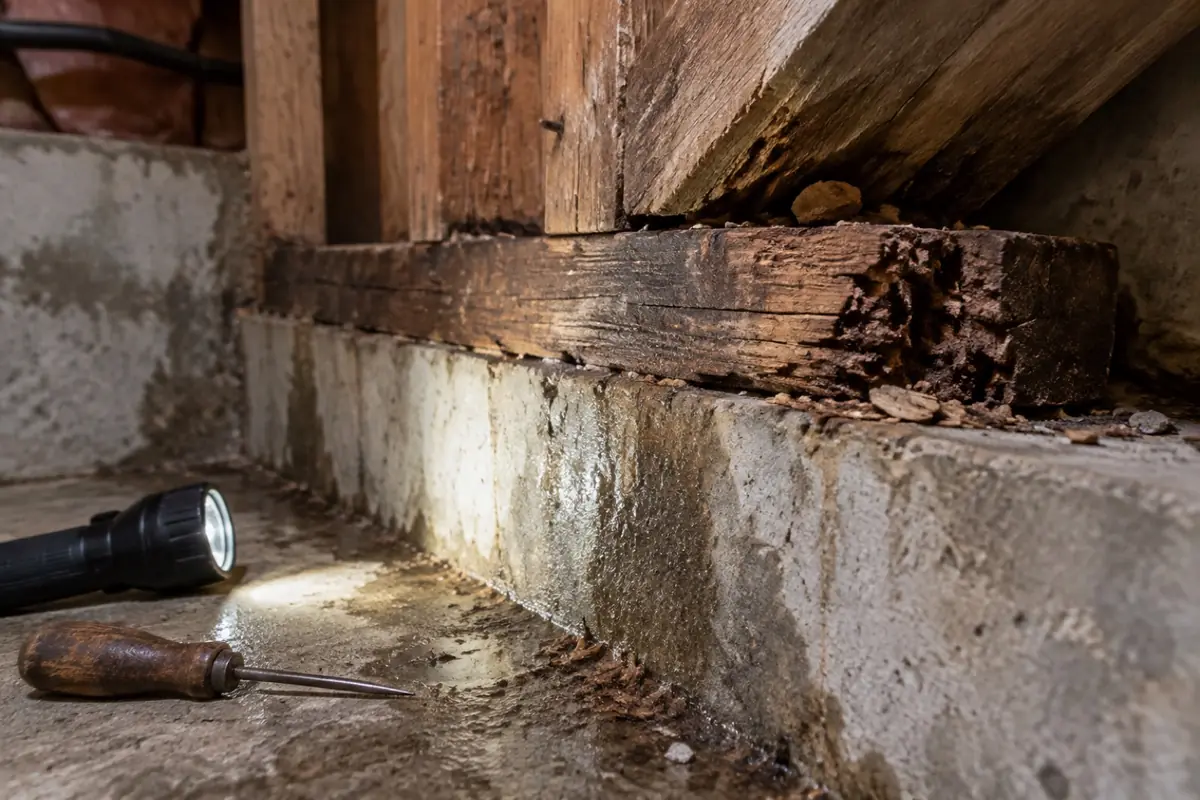
Furniture against structural wood
A dresser and a floor joist can grow the same mold and need different answers: furniture needs conservation, framing needs drying, cleaning and proof that it is sound.
| Question | Furniture and finished wood | Framing and subfloor |
|---|---|---|
| Moisture in service | 6 to 10%, per the FPL | 19% or less at enclosure, per the SFPA |
| Surface | Finished; mildew can grow under a clear coat (FPL) | Bare, so stain and mold reach the wood |
| Cleaning | Brush into a HEPA vacuum, then a wood cleaner | HEPA vacuum, damp wipe, sand or plane |
| Replace when | Decayed, or not worth restoring | Soft, crumbly or cubed |
| Who to call | Furniture restorer or conservator (EPA) | Structural engineer if integrity is in doubt (EPA) |
The National Park Service describes mold cleaning on collections as drying, dislodging, lifting and vacuuming spores with a HEPA filter, brushing mold off wooden furniture while vacuuming, and per the NPS, collections should be kept below 68 F and 55% relative humidity. Our hardwood floor water damage guide covers floors.
Vacuum, wipe, sand or replace
EPA 402-K-01-001 lists wood surfaces as cleanable by wet vacuum, damp wipe and HEPA vacuum at every size, adding removal only above 100 square feet. It says to clean mold up, not just kill it, and not to paint or caulk moldy surfaces.
| Method | Use it on | How | Source |
|---|---|---|---|
| Dry first | All wood | Dehumidifiers, gentle heat, fans; pry wet paneling off the wall | EPA Table 1 |
| HEPA vacuum | Loose growth; final cleanup once dry | Bag contents and filter in sealed plastic | EPA Method 3 |
| Damp wipe | Finished or sealed wood | Water and detergent; EPA specifies wood floor cleaner on wood | EPA Method 2 |
| Sand or plane | Bare framing with colour left | Removes surface growth, not sap stain | FPL |
| Replace | Soft or cubed wood | Fix the moisture; dry lumber, or treated wood if wetting continues | FPL |
Sanding makes dust, so pair it with HEPA vacuuming. EPA's Brief Guide to Mold, Moisture and Your Home puts the do it yourself line at about 10 square feet; our DIY mold remediation guide covers that size, and the mold remediation process covers containment above it.
What borates are for
The Bora-Care label, EPA Reg. No. 64405-1, as EPA accepted it on 3 June 2010, calls the product a termiticide, insecticide and fungicide concentrate, and its target list names brown rot, white rot and wood decay fungi. For mold, it tells users to mix in Mold-Care, a separately registered moldicide.
The label explains the chemistry: an inorganic borate salt, soluble in water, that lasts only if the wood is kept from rain, continuous water and ground contact. The 2010 Wood Handbook agrees that borates are highly leachable, belong above ground, and diffuse into wet wood, which suits remedial treatment.
| Treatment | Labelled or advised for | Conditions | Source |
|---|---|---|---|
| Borate, 40% disodium octaborate tetrahydrate | Termites, beetles, carpenter ants, decay fungi, algae | Bare wood; lasts if kept from rain, standing water and soil | Bora-Care label, EPA Reg. No. 64405-1 |
| Mold-Care moldicide | Mold, mixed with Bora-Care | Per its own label | EPA Reg. No. 6836-212-64405 |
| Household bleach and powdered detergent | Mildew on finished exterior wood | 1 part bleach to 3 to 5 parts water, per the FPL; never with ammonia | FPL chapter 16 |
| Detergent and water | Mold on wood surfaces | Scrub, rinse, dry | EPA; SFPA |
None of these replaces cleaning. EPA 402-K-01-001 says a biocide such as bleach is not recommended as a routine practice, and that background spores will not grow once the moisture problem is solved. Our bleach guide covers bleach on porous wood.
The decision path
Work down the list and stop at the first step that settles it.
- Find the water. Leak, rain, condensation, ground contact or humid air. Nothing below lasts until it stops.
- Meter the wood. Above 19 percent, dry it first. Near 30 percent, decay is possible, so probe.
- Probe it. If an awl sinks in, or the wood is cubed, spongy or crumbly, it is rot: replace it, and call an engineer if it carries load. Skip to step 7.
- Brush a patch. If growth lifts and the wood beneath is clean, it is surface mold: HEPA vacuum, damp wipe, dry.
- Still coloured? Sand or plane a test spot on bare framing. Deep colour is stain, which barely touches strength: leave it where looks do not matter, or replace it.
- Black on paint or varnish? Try the bleach drop. If it fades in a minute or two, it is mildew: clean and refinish with a mildewcide.
- Verify and close up. Final HEPA vacuum, readings at 19 percent or less, then enclose or refinish. On bare wood out of the weather that has had rot, consider a borate, used as its label directs.
For contractors
Scope on wood turns on one distinction. Cleaning is a surface line item: HEPA vacuum, damp wipe, sand. Decay is carpentry: remove and replace, with the moisture repair named. The FPL Wood Handbook chapter 14 says that once the moisture source is gone, only weakened wood needs replacing with dry lumber; if it cannot be removed, use preservative treated or durable heartwood.
| Record on site | Why it matters |
|---|---|
| Moisture readings by member, with a dry reference | Per the FPL Table 13-2 note, test at least 10% of each item, such as six of 60 joists |
| Probe results and photos of each decayed member | Decay turns cleaning into replacement |
| Square feet of affected surface | Sets the EPA Table 2 size band, PPE and containment |
| Moisture source and its repair | FPL: correct the condition that caused the damage |
| Product and EPA registration number | The label is the legal use direction |
Two duties sit outside the cleaning. The Bora-Care label tells applicators to ask the state regulatory agency whether extra qualifications are required, and EPA notes some states restrict who applies biocides in schools. For roof sheathing, our attic mold removal cost guide covers how that scope is priced.
Questions people actually ask
Is mold on wood harmful to the wood?
Usually not by much. The USDA Forest Products Laboratory says mold and stain fungi affect strength only slightly, mainly toughness and appearance, though they make wood more absorbent. Decay fungi are different: they consume the wood, and visible decay means large strength loss. Health questions are outside this page; see the note near the top.
Does mold on wood ever go away?
Not by itself. Drying stops growth, and the FPL says decay will not progress in wood kept air dry, but the growth and staining stay until they are cleaned off. EPA adds that if you clean up mold without fixing the water problem, it will most likely come back.
What kills mold on wood?
EPA’s aim is removal, not killing: dry the wood, HEPA vacuum it, damp wipe it with detergent or a wood cleaner, and sand bare framing if needed. EPA does not recommend biocides such as bleach as a routine practice. Borates are labelled for decay fungi; the Bora-Care label sends mold to a separate registered product.
What does toxic mold look like on wood?
You cannot tell by looking. EPA notes molds come in many colours, including white and black, and its cleanup methods are set by material and area, not colour. What you can judge on wood is depth: growth that brushes off is surface mold, deep streaks are stain, and soft or cubed wood is decay.
What is the white mold on wood?
It may be mold, or it may be decay. The FPL says fresh decay fungi can appear as fan shaped patches, strands or root like structures, usually white or brown. Probe the wood beneath with an awl: firm wood means surface mold, while a point that sinks in or spongy wood means rot.
Sources
- FPL Wood Handbook chapter 14: Arango, Lebow and Glaeser, Biodeterioration of Wood, Wood Handbook FPL-GTR-282, USDA Forest Products Laboratory, 2021, via Forest Service Treesearch. Retrieved 13 October 2026.
- FPL Wood Handbook (2010 edition): FPL-GTR-190, 2010; chapters 4, 13, 15 and 16, copy hosted by the California Air Resources Board. Retrieved 13 October 2026.
- EPA 402-K-01-001, Mold Remediation in Schools and Commercial Buildings, EPA, September 2008. Retrieved 13 October 2026.
- EPA's Brief Guide to Mold, Moisture and Your Home, EPA, updated 18 February 2026. Retrieved 13 October 2026.
- EPA moisture control guidance, EPA 402-F-13053, December 2013. Retrieved 13 October 2026.
- Bora-Care label, EPA Reg. No. 64405-1, Nisus Corporation, accepted by EPA 3 June 2010, EPA Pesticide Product Label System. Retrieved 13 October 2026.
- WWPA grade stamp guide, Western Wood Products Association. Retrieved 13 October 2026.
- WWPA fact sheet on cleaning mold, Cleaning Mold on Wood, Western Wood Products Association, August 2002, copy hosted by Stimson Lumber. Retrieved 13 October 2026.
- Southern Forest Products Association, Managing Moisture and Mold, 2012. Retrieved 13 October 2026.
- National Park Service, Mold on Cultural Resources and Collections, updated 29 September 2022. Retrieved 13 October 2026.
- Photographs are from Wikimedia Commons under the licences in their captions. No figure here was estimated or invented; our methodology sets out the rules.
This page describes published guidance and labels. Get a structural assessment for decayed load bearing wood, and follow the label on any pesticide you use.