The short answer
Black mold vs regular mold is a split the agencies do not make. EPA says “black mold” is not a species, and CDC says all molds should be treated the same for removal. Several common molds grow dark, including Cladosporium, Aspergillus niger and Alternaria. Stachybotrys chartarum, the one people usually mean, needs constant moisture on cellulose. Remediation scope follows area and moisture, not colour.
Key takeaways
- Colour is not an identification. EPA’s mold course says no one can tell whether a mold is producing mycotoxins just by looking at it.
- Stachybotrys is the wet-wall specialist. Its published minimum water activity is 0.94 to 0.95, against 0.77 to 0.78 for Aspergillus niger, another black mold.
- It is not the common one: according to a Danish survey of 5,353 samples, Stachybotrys turned up in 3.9%, Penicillium in 69.5%.
- “Toxic black mold” is not a scientific category. EPA says neither black mold nor toxic mold is a species.
- Testing for species rarely changes the job. EPA says sampling is usually unnecessary when growth is visible.
- Area sets the scope: EPA’s lines are 10 and 100 square feet, and state rules key off area too.
On this page
- What EPA and CDC actually say
- The dark molds you are likely to see
- Why Stachybotrys needs a soaked wall
- How common each one is
- Why “toxic black mold” is a marketing phrase
- What testing can and cannot tell you
- What actually changes the scope
- Which situation are you in?
- For contractors
- Questions people actually ask
Most pages ranking for this query describe how “toxic black mold” looks or smells. Neither EPA nor CDC offers a visual or odour test, and the science explains why: several unrelated molds grow dark, and the one people fear has a very specific moisture habit.
What this page does not cover: health effects. For those, see the CDC and EPA mold pages and a medical professional. This page covers identification, moisture and remediation scope only.
What EPA and CDC actually say
EPA and CDC agree on three points: colour does not identify a mold, you do not need the species, and every mold is removed the same way.
| Source | Exact wording |
|---|---|
| EPA Mold Course, Chapter 1 | “‘Black mold’ is not a species or specific kind of mold, and neither is ‘toxic mold.’” |
| EPA Mold Course, Chapter 1 | “No one can tell whether a mold is producing mycotoxins just by looking at it.” |
| EPA, Brief Guide to Mold | “Molds come in many colors; both white and black molds are shown here.” |
| CDC, Stachybotrys chartarum facts | “It is not necessary to determine what type of mold you may have growing in your home or other building.” |
| CDC, Stachybotrys chartarum facts | “All molds should be treated the same with respect to potential health risks and removal.” |
| CDC, About Mold | “CDC does not recommend mold testing.” |
| CDC, archived 2009 page | “The term ‘toxic mold’ is not accurate.” |
One nuance is worth stating honestly. EPA’s commercial remediation guide, in EPA Table 2, lists a suspected or identified “particularly toxic mold species” as one reason for a more cautious approach, alongside extensive hidden mold and a high chance of mold becoming airborne. That is a judgement layered on the area tiers, not a separate track for dark-coloured growth.
The dark molds you are likely to see
At least four common indoor genera can look black or nearly black. They differ most in how wet the material has to be, measured as minimum water activity (aw). Andersen and colleagues report that aw times 100 equals the equilibrium relative humidity, so aw 0.94 means a surface at about 94% RH.
| Mold | Colony colour, as published | Minimum aw | Where it tends to grow |
|---|---|---|---|
| Stachybotrys chartarum | Greenish-black (CDC) | 0.94 to 0.95 | Gypsum board and wallpaper |
| Cladosporium | Olivaceous-brown to blackish-brown | 0.82 to 0.88 (three species) | Wood and plywood; bathrooms |
| Aspergillus niger | Dark-brown to black conidial heads | 0.77 to 0.78 | Concrete and floor materials |
| Alternaria | Black to olivaceous-black or greyish | 0.85 to 0.89 (A. alternata) | Gypsum board and wallpaper |
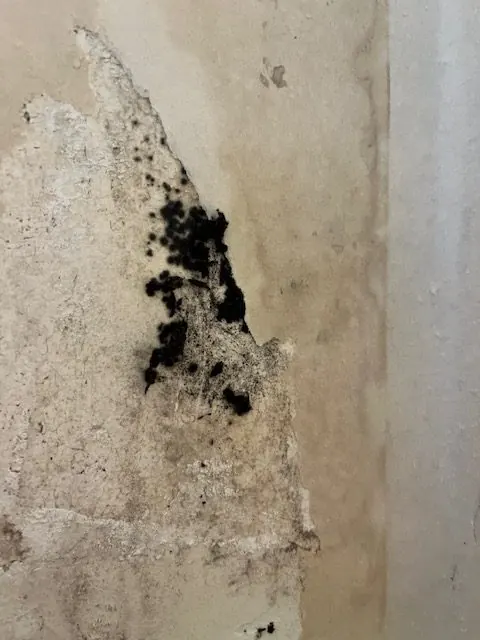

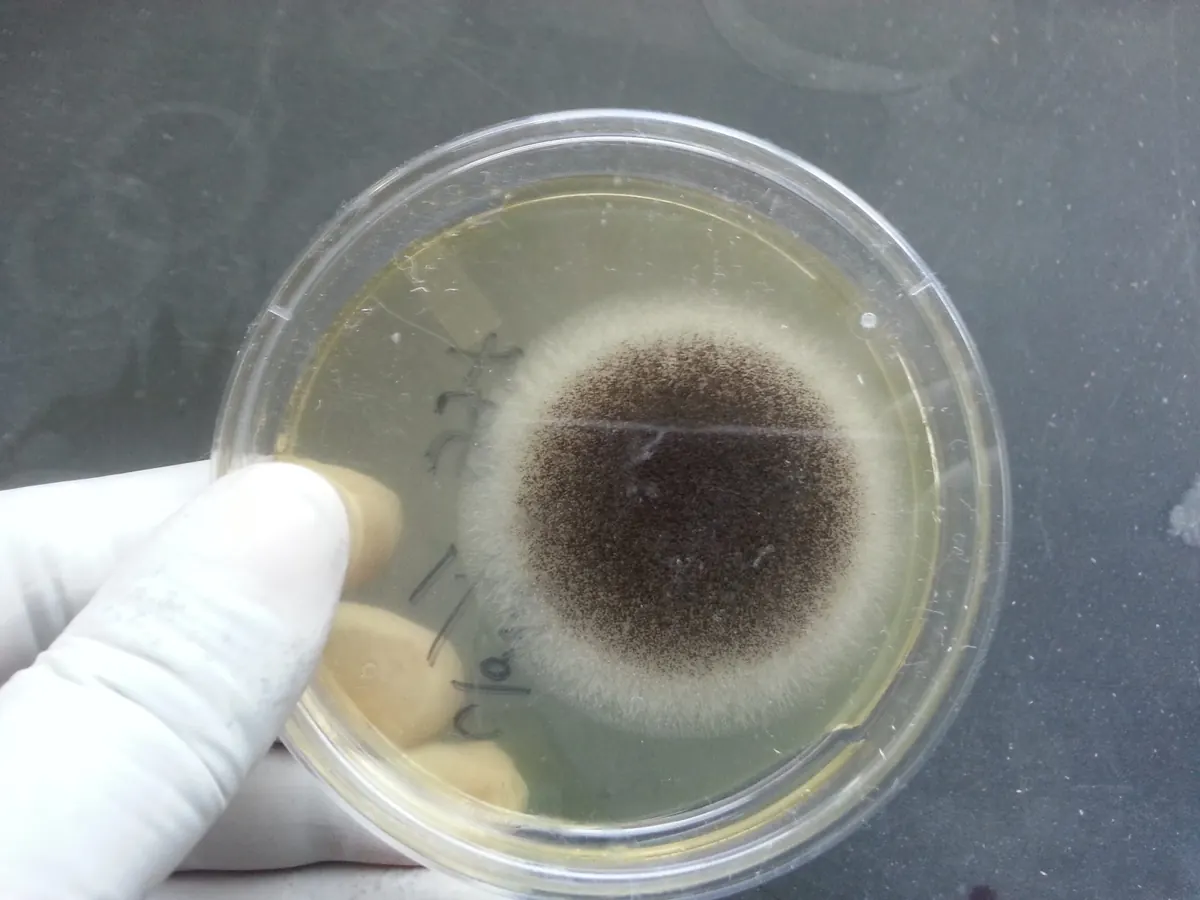
These are descriptions of colonies on culture media, which is how mycologists identify fungi, and Loukou’s review notes that colony colour depends on the medium and its trace metals. Mycology Online calls Cladosporium “mostly olivaceous-brown to blackish-brown but also sometimes grey, buff or brown”. A dark patch on a wall could be any of these.

Why Stachybotrys needs a soaked wall
CDC’s fact page is specific: Stachybotrys “can grow on material with a high cellulose content, such as fiberboard, gypsum board, and paper”, and “constant moisture is required for its growth.” The research agrees. Loukou and colleagues (Journal of Fungi, 2024) classify it as hydrophilic, with a minimum water activity of 0.94 to 0.95, among the highest of the indoor molds in their table.
Laboratory work shows what that means on a building material. According to Nielsen (Technical University of Denmark, 2001), mixtures of common molds were held at 70 to 95% RH, and Stachybotrys appeared only on the three types of gypsum board at 95% RH or above, with very limited growth. On new water-damaged gypsum board, by contrast, one isolate was recognisable after 5 days. None of five isolates grew on chipboard, acoustic ceiling tiles or pinewood.
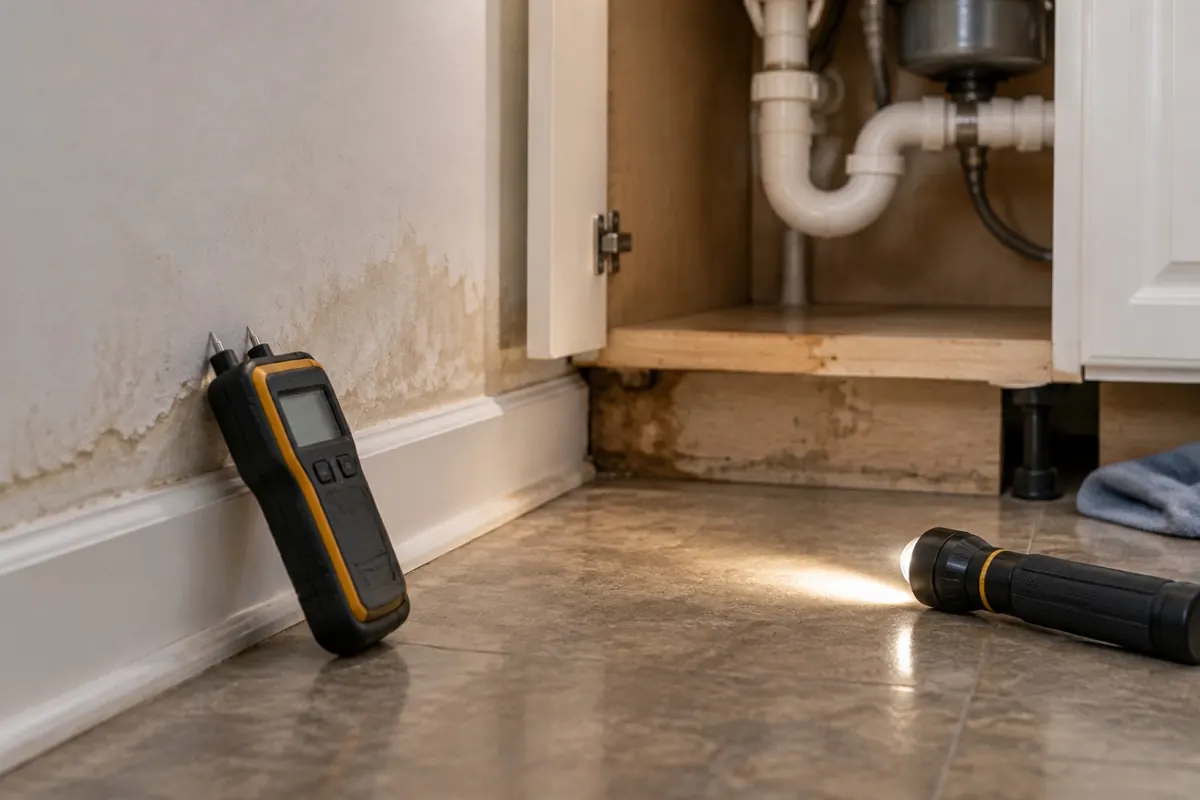
A study by Menetrez and colleagues (Indoor and Built Environment, 2004) reached the same conclusion from the other direction: high humidity without wetting did not start Stachybotrys growth, while porous materials wetted to saturation on a moisture meter grew it in every experiment. Andersen and colleagues (Applied and Environmental Microbiology, 2011) found Stachybotrys associated with gypsum and wallpaper, alongside other fungi that produce cellulases.
A shower wall that wets and dries daily favours other molds; Nielsen reports Cladosporium outgrowing Penicillium under transient humidity, which is why it is common in bathrooms. Stachybotrys points to a wall that stayed soaked. For timing, see how long mold takes to grow after water damage.
How common each one is
The largest published survey of molds on damp building materials, Andersen and colleagues (Applied and Environmental Microbiology, 2011), reports more than 5,300 surface samples from visible growth in Danish buildings. Penicillium and Aspergillus versicolor dominated; Stachybotrys was far down the list.
These are Danish buildings, rich in plaster, wallpaper and concrete. The CDC’s archived 2009 page described Stachybotrys as “less common than other mold species” but “not rare”, which matches the data: rare enough that most dark growth is something else, common enough that a long-wet gypsum wall can carry it.
Why “toxic black mold” is a marketing phrase
The EPA Mold Course, Chapter 1 says the news media use “toxic mold” and “black mold” for molds that may produce mycotoxins, or for Stachybotrys chartarum specifically, and then states that neither term names a species. It adds that some molds, but not all, may produce mycotoxins under some conditions, and that the amount depends on many environmental and genetic factors.
CDC’s archived 2009 page went further: the term “toxic mold” is not accurate, because certain molds are toxigenic, able to produce toxins, while the molds themselves are not poisonous. Our reading: the phrase persists because it is useful in marketing. It names a fear, not a category any agency or standard uses to set work practices.
What testing can and cannot tell you
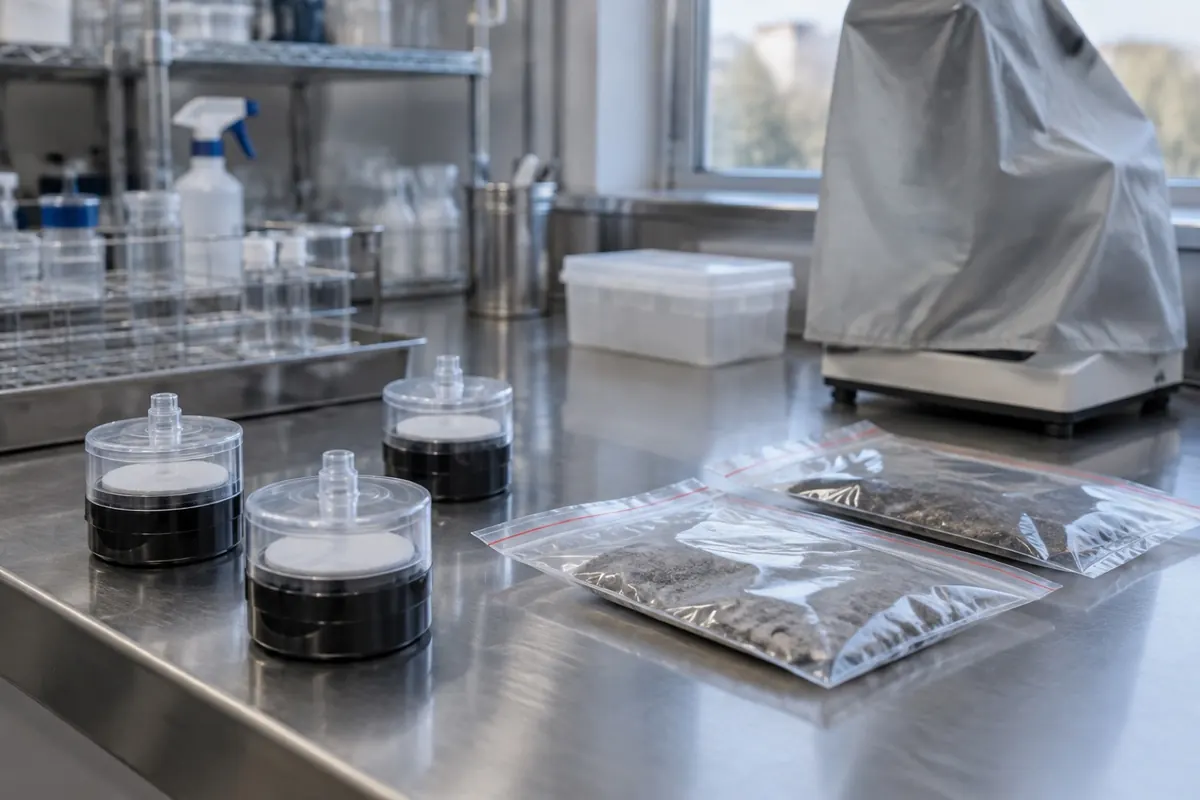
EPA's Brief Guide to Mold is blunt: in most cases, if visible mold growth is present, sampling is unnecessary. The commercial guide, in EPA commercial guide, Chapter 3, lists the exceptions where sampling may be considered: litigation, an unclear source and health concerns.
| Situation | What sampling tells you | Source |
|---|---|---|
| Visible growth already present | Sampling is usually unnecessary | EPA Brief Guide and commercial guide |
| Litigation, unclear source, or health concerns | Sampling may be considered | EPA commercial guide, Chapter 3 |
| Want to know the species for removal | Not needed; all molds are removed the same way | CDC |
| Air sample shows few spores | Not proof the building is clean | ASHRAE position document |
| Hunting for Stachybotrys by air sample | Can miss it; it does not readily become airborne | Andersen et al. 2011 |
| Air sampling at all | Needs a hypothesis-driven plan with enough locations | ASHRAE position document |
The Andersen point matters for anyone buying a test to rule Stachybotrys out. The authors write that Stachybotrys and Chaetomium growing on damp materials do not readily become airborne or lose culturability soon after release, so they may not be detected in air or dust samples. Inspection prices are on our mold inspection cost page. Our guide to at home mold test kits explains what each kind of kit can and cannot show.
What actually changes the scope
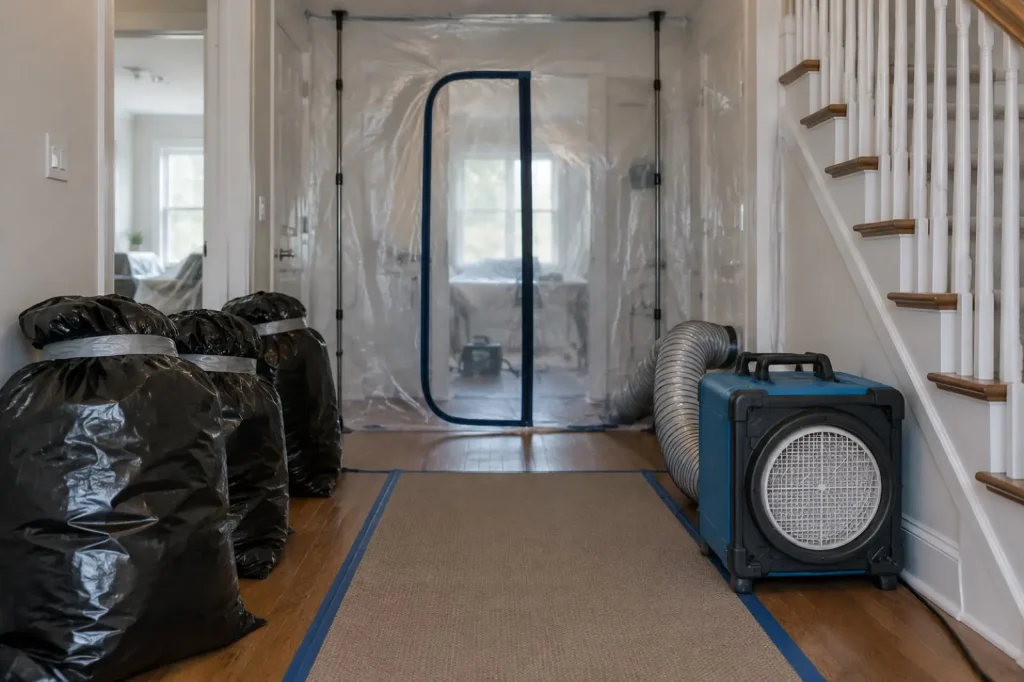
Look at how remediation is sized and colour never appears. EPA’s home guidance, EPA's Mold Cleanup in Your Home, draws its line at about 10 square feet, and EPA Table 2 for schools and commercial buildings sets three tiers by total surface area affected.
| EPA tier | Area affected | Containment and protection |
|---|---|---|
| Small | Under 10 sq ft | No containment; N-95, gloves and goggles at minimum |
| Medium | 10 to 100 sq ft | Limited containment; limited or full protective equipment, by professional judgement |
| Large | Over 100 sq ft | Full containment and full protective equipment, by professional judgement |
The industry standard, ANSI/IICRC S520, now in its 2024 fourth edition, classifies a space by condition rather than species. The definitions below are as reproduced in a February 2024 assessment published by Cal State LA.
| S520 condition | Name | Definition, as reproduced |
|---|---|---|
| Condition 1 | Normal fungal ecology | Settled spores, fragments or traces of growth reflecting a normal fungal ecology for a similar indoor environment |
| Condition 2 | Settled spores or fragments | Primarily contaminated with spores or fragments dispersed from a Condition 3 area; may have traces of growth |
| Condition 3 | Actual growth | Actual mold growth, active or dormant, visible or hidden |
State rules key off area as well; colour appears in none of them. Our state mold licensing guide covers every state.
| State | Area rule | Citation |
|---|---|---|
| New York | “Areas greater than ten square feet” make a regulated project | Labor Law section 930(6) |
| Florida | Assessment and remediation defined as work on mold “greater than 10 square feet” | Florida Statutes 468.8411 |
| Texas | Contractor must notify the state at “25 contiguous square feet or more” | 16 TAC 78.110 |
Which situation are you in?
Use this matrix in place of the colour question. Find the row that matches, then read what actually decides the response.
| What you see | What decides it | What to do |
|---|---|---|
| Dark spots on shower caulk or grout | A recurring surface film on a wall that dries between uses | Clean it; exhaust shower humidity, as ASHRAE advises |
| Dark stain on drywall after a small leak, under 10 sq ft | Area and whether the board is still wet | Fix the leak; EPA home guidance covers small areas; cut out wet porous board |
| Dark growth on paper-faced gypsum after a flood or long leak | The wall stayed soaked; Stachybotrys conditions are plausible | Scope by area; over 10 sq ft, check your state’s rules |
| Growth over 100 sq ft, any colour | Area alone | Full containment under EPA Table 2 |
| Black staining on attic sheathing | Moisture source: condensation or a roof leak | Find the moisture first; scope by area |
| A lab report names Stachybotrys | Confirms a long-wet cellulose material | Same removal; EPA allows extra caution as professional judgement |
If you are weighing doing the work yourself, our DIY mold remediation page covers where the line usually falls, and the mold remediation process page walks through containment and clearance.
For contractors
Homeowners will call it black mold; the scope should not. Write it up the way the frameworks do: affected area in square feet, materials involved, the moisture source and whether it is fixed, and the S520 condition of adjoining spaces. That is what a reviewer or adjuster can check against EPA Table 2 and your state’s area rule.
- Do not price by colour. A dark patch under 10 sq ft and one over 100 sq ft sit in different EPA tiers whatever the species.
- If you sample, say why. EPA’s own reasons are litigation, an unclear source and health concerns; record which applies.
- Keep the moisture record. Stachybotrys on a lab report points to a long-wet cellulose material.
- Check the state line. New York and Florida key off more than 10 square feet; Texas requires notice at 25 contiguous square feet.
Pricing for the work itself is on our mold remediation cost page. Coverage depends on policy wording, so for that question see our page on homeowners insurance and mold remediation, the policy itself and your state insurance department. The mold hub lists every related guide.
Questions people actually ask
Is all mold dangerous or just black mold?
Health effects are outside the scope of this page; the CDC is the right source. What the agencies do say is that colour is not the dividing line. CDC states that all molds should be treated the same with respect to potential health risks and removal, and EPA says black mold is not a species. Remove the growth and fix the moisture, whatever the colour.
How do I know if I have black mold or regular mold?
You cannot tell by colour. Cladosporium, Aspergillus niger and Alternaria can all look black, and EPA says no one can tell whether a mold is producing mycotoxins by looking at it. Only lab analysis identifies a species, and CDC says it is not necessary to determine the type, because the removal approach is the same.
Is shower mold the same as black mold?
Usually not, though no one can confirm the species by eye. Shower walls get wet and dry daily, and Danish research found that Cladosporium outgrows other molds under that kind of transient humidity, which is why it is common in bathrooms. Stachybotrys needs constant moisture on cellulose, such as the paper face of gypsum board that stays soaked.
Can I live in a house with black mold?
That is a health question this page does not answer; ask the CDC and a medical professional. On the building side, the answer does not depend on colour. EPA treats patches under about 10 square feet as small enough for a homeowner, and growth over 100 square feet as a large job needing full containment.
Should I test to find out whether it is Stachybotrys?
Usually no. EPA says sampling is unnecessary in most cases when growth is visible, and CDC does not recommend mold testing. EPA lists litigation, an unclear source and health concerns as reasons sampling may be considered. Air samples can also miss Stachybotrys, which does not readily become airborne, according to Danish researchers.
What is the difference between mildew and black mold?
Mildew is an everyday name, not a technical class used in EPA or CDC remediation guidance, and neither is black mold. EPA notes molds come in many colours, including white and black. On building materials, the practical questions are the same for either: how big the area is, what material it is on and whether the moisture source has been fixed.
Sources
- EPA Mold Course, Chapter 1, US EPA, updated 18 February 2026. Retrieved 11 October 2026.
- EPA's Brief Guide to Mold, EPA, updated 18 February 2026. Retrieved 11 October 2026.
- EPA commercial guide, Chapter 3 and EPA Table 2: Mold Remediation in Schools and Commercial Buildings, EPA; Chapter 5 updated 14 April 2026. Retrieved 11 October 2026.
- EPA's Mold Cleanup in Your Home, EPA, updated 4 June 2026. Retrieved 11 October 2026.
- CDC's Stachybotrys chartarum facts, last reviewed 29 May 2024, and CDC's About Mold page, last reviewed 26 September 2024. Retrieved 11 October 2026.
- CDC's 2009 Stachybotrys page (archived), captured 7 May 2009 by the University of North Texas End of Term web archive. Retrieved 11 October 2026.
- Loukou and colleagues (Journal of Fungi, 2024), Damp Buildings: Associated Fungi and How to Find Them, Table 1. Retrieved 11 October 2026.
- Andersen and colleagues (Applied and Environmental Microbiology, 2011), volume 77, pages 4180 to 4188, Tables 1 and 2. Retrieved 11 October 2026.
- Nielsen (Technical University of Denmark, 2001), Mould Growth on Building Materials, PhD thesis. Retrieved 11 October 2026.
- Menetrez and colleagues (Indoor and Built Environment, 2004), volume 13, pages 183 to 187, abstract via RTI International. Retrieved 11 October 2026.
- ASHRAE position document on mold and dampness, 2012, reaffirmed 2018; copy hosted by Rockwool. Retrieved 11 October 2026.
- Mycology Online: Cladosporium, Mycology Online: Aspergillus and Mycology Online: Alternaria, Adelaide University. Retrieved 11 October 2026.
- ANSI/IICRC S520, fourth edition 2024, IICRC; condition definitions as quoted in a February 2024 assessment published by Cal State LA (Terra Environmental Services report dated 26 February 2024). Retrieved 11 October 2026.
- New York Labor Law section 930, Florida Statutes 468.8411 and 16 Texas Administrative Code 78.110. Retrieved 11 October 2026.
- Our methodology sets out how we source and check every figure.
This page describes published guidance and research, not any particular building.