The short answer
Mold testing means collecting air, surface, bulk or dust samples and having a laboratory count or identify the fungal material in them. EPA says that in most cases, if visible mold growth is present, sampling is unnecessary, and no federal limits exist to judge results against. A test earns its fee for hidden growth, post-remediation clearance, and litigation or sale disputes.
Key takeaways
- EPA, CDC, NIOSH and two state health departments advise against routine testing when mold can already be seen or smelled.
- There is no federal numeric limit for airborne mold, so no result can pass or fail a federal standard. In Texas and New York one licensee may not both assess and remediate the same job.
- A spore trap result means little without an outdoor control taken at the same visit.
- EPA says it does not recommend routine public use of ERMI in homes, schools or other buildings.
- Per the EMSL Analytical 2026 price list, a spore trap costs $68 on two-week turnaround and $328 on three-hour rush.
On this page
- When mold testing is worth paying for
- How to test for mold: sample types
- Culturable versus non-culturable
- ERMI and what EPA says about it
- How to read a spore trap report
- How to test for black mold
- Checking the lab: AIHA-LAP EMLAP
- Published lab fees
- Who tests, and state licences
- Decision path
- For contractors
- Questions people actually ask
When mold testing is worth paying for
EPA's mold testing page states: “In most cases, if visible mold growth is present, sampling is unnecessary.” It adds that “no EPA or other federal limits have been set for mold or mold spores.” NIOSH says “we do not recommend routine air sampling for mold” in building evaluations, and that visual inspection and musty odors find problems more reliably than air sampling.
EPA's schools and commercial buildings guide names where sampling may belong: litigation, an unclear source, occupant health concerns, and checking whether cleanup worked. Without enough samples to answer the question, “it would be preferable not to sample.”
| Situation | Test? | Why | Basis |
|---|---|---|---|
| Visible growth, known leak | No | The answer is known. Spend on repair and cleanup. | EPA, CDC, CDPH |
| Musty odor, nothing visible | Sometimes | Samples can hint at hidden growth, but it still has to be found by looking. | EPA, MDH |
| After remediation | Often | Clearance: indoor air should resemble outdoor air. | EPA, TX, NY |
| Dispute, claim or sale | Often | Chain-of-custody results with an outdoor control are evidence. | EPA, TX |
| “Is my house safe?” | No | MDH says it is unknown what level of mold is safe. | MDH |
| “Is it the toxic kind?” | No | Testing for mold is not testing for mycotoxins; cleanup is the same. | MDH, CDC |
| “Is there any mold here?” | No | MDH: mold particles exist in all occupied buildings, so a proper test finds some. | MDH |
How to test for mold: the sample types
EPA's schools and commercial buildings guide lists air, surface, bulk and water samples; DNA methods such as ERMI add settled dust. Each answers a different question, and the commonest mistake is using one to answer another’s.
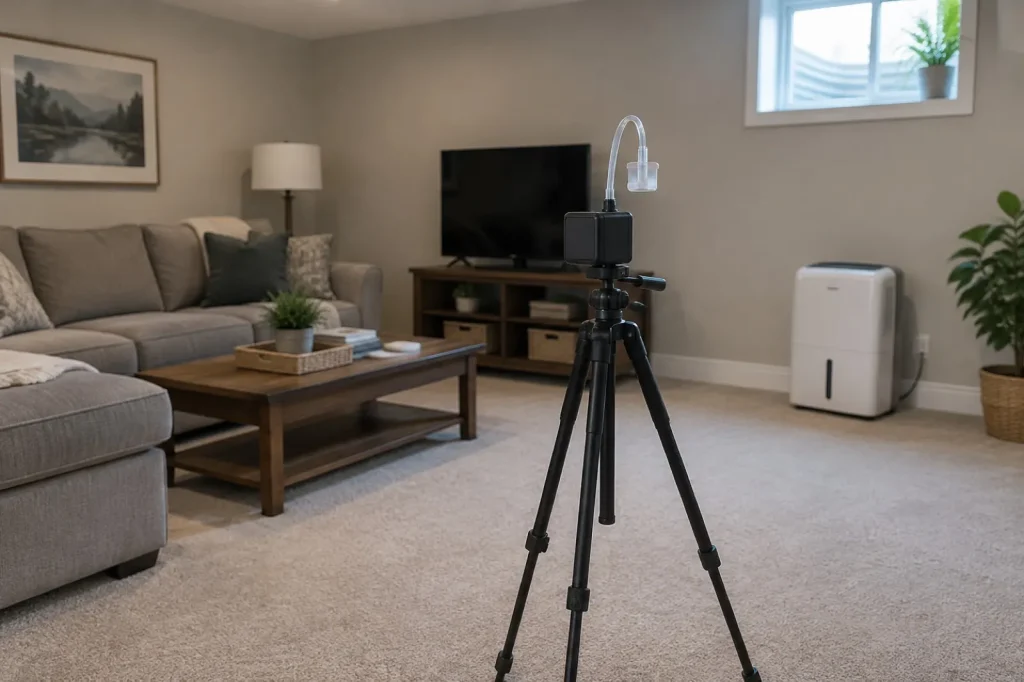
Spore trap air sampling, with an outdoor control
The EMSL sampling guide says to calibrate the pump to 15 litres per minute and not to run slower for longer, which can lose some spores. The Wisconsin State Laboratory of Hygiene gives a typical run of 5 to 10 minutes. EMSL’s first quality-control point: interpretation rests on comparing indoor and outdoor samples.
A 5-minute run collects 75 litres, so on a full-trace read each structure counted stands for about 13 per cubic metre. ASTM D7391 notes the range also depends on how much trace is counted.
Surface samples: tape lift, swab and bulk
A tape lift presses clear tape on a stain; a swab handles rough surfaces; a bulk is a piece of the material. EPA lists telling mold from soot or dirt among sampling’s uses.
| Method | Answers | Cannot tell you | Analysis |
|---|---|---|---|
| Spore trap | Spores, by broad type, in this air for these minutes, against outdoors | Viability, or the air an hour later | Direct microscopy |
| Culturable air | Which living fungi, to species | Anything dead or slow to grow | Culture |
| Tape lift | Is this stain fungal, which genus | The air, or what is behind the surface | Direct microscopy |
| Swab or bulk | What is growing on or in this material | Air levels; patchy growth can be missed | Direct exam or culture |
| Settled dust (ERMI) | Dust DNA ranked against a research set | A validated pass or fail | DNA (MSQPCR) |
Culturable versus non-culturable analysis
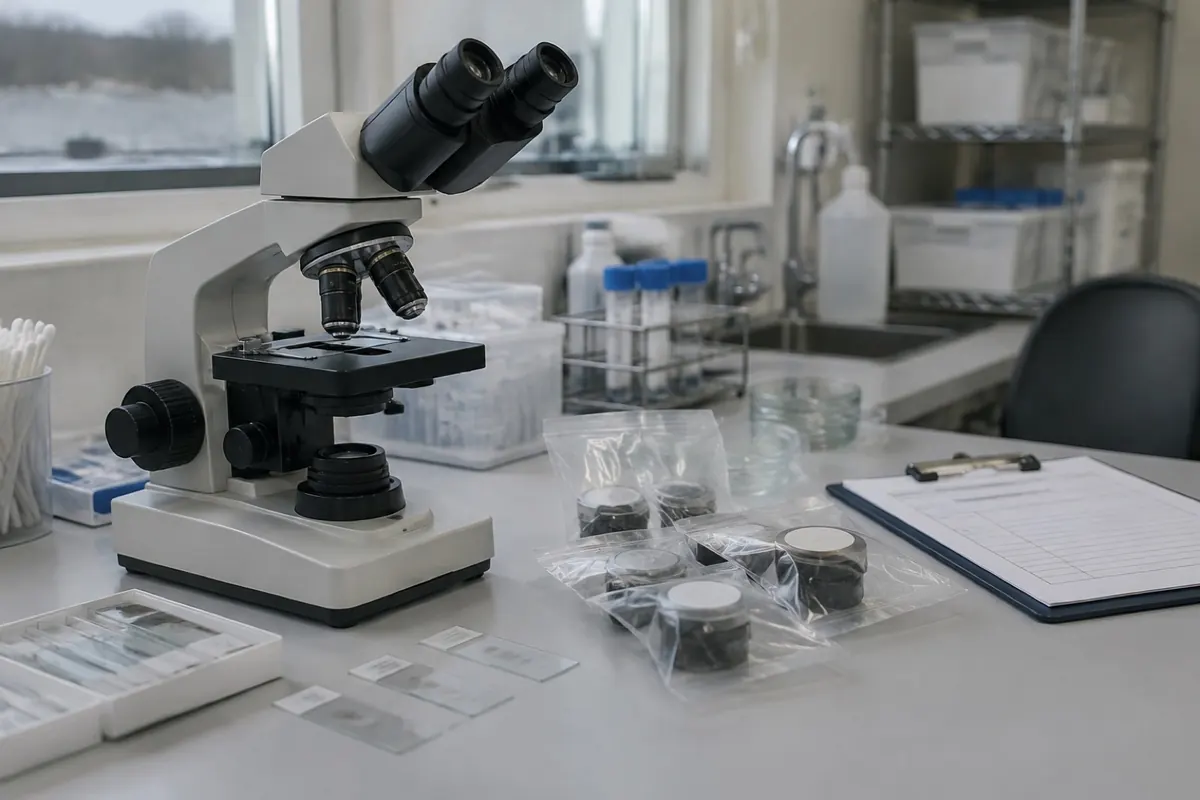
Under ASTM D7391, the spore trap method, “fungal structures are identified and quantified regardless of whether they would or would not grow in culture.” It adds that “the detector in this test method is the analyst, and therefore results are subjective.” Culture grows the sample on agar; the EMSL sampling guide says it shows viability and species but takes 6 to 10 days, and some microbes never grow on the medium.
| Non-culturable (direct exam) | Culturable | |
|---|---|---|
| Counts | All visible structures, alive or dead | Colonies that grow (CFU) |
| Identifies | Genus or spore group, by shape | Genus, and species if ordered |
| Turnaround | Hours to two weeks, priced by speed | 6 to 10 days, per the EMSL guide |
| Blind spot | Viability; look-alike spores grouped | Dead and hard-to-grow fungi |
| Best use | Air screening and clearance | When species matters, as in a dispute |
ERMI, and what EPA says about using it
ERMI, the Environmental Relative Moldiness Index, is a DNA test on settled dust. According to the EPA ERMI fact sheet, EPA measured 36 indicator molds in dust from over 1,000 homes in HUD’s American Healthy Homes Survey to build a scale running from about minus 10 to about 30.
EPA’s statement on use is plain: ERMI “has not been validated for non-research purposes. For this reason, EPA does not recommend the routine public use of ERMI in homes, schools, or other buildings.” EPA also says it “cannot comment on the accuracy of information obtained from others using ERMI,” and its current ERMI page still calls it a research tool.
Labs sell it at a premium. Per the EMSL Analytical 2026 price list, ERMI costs $237 to $1,361 a sample by turnaround, about 3.5 times a two-week spore trap; EnviroBiomics reports $240 to $435. A score can be one data point in a contested file. It is not a clearance standard.
How to read a spore trap report
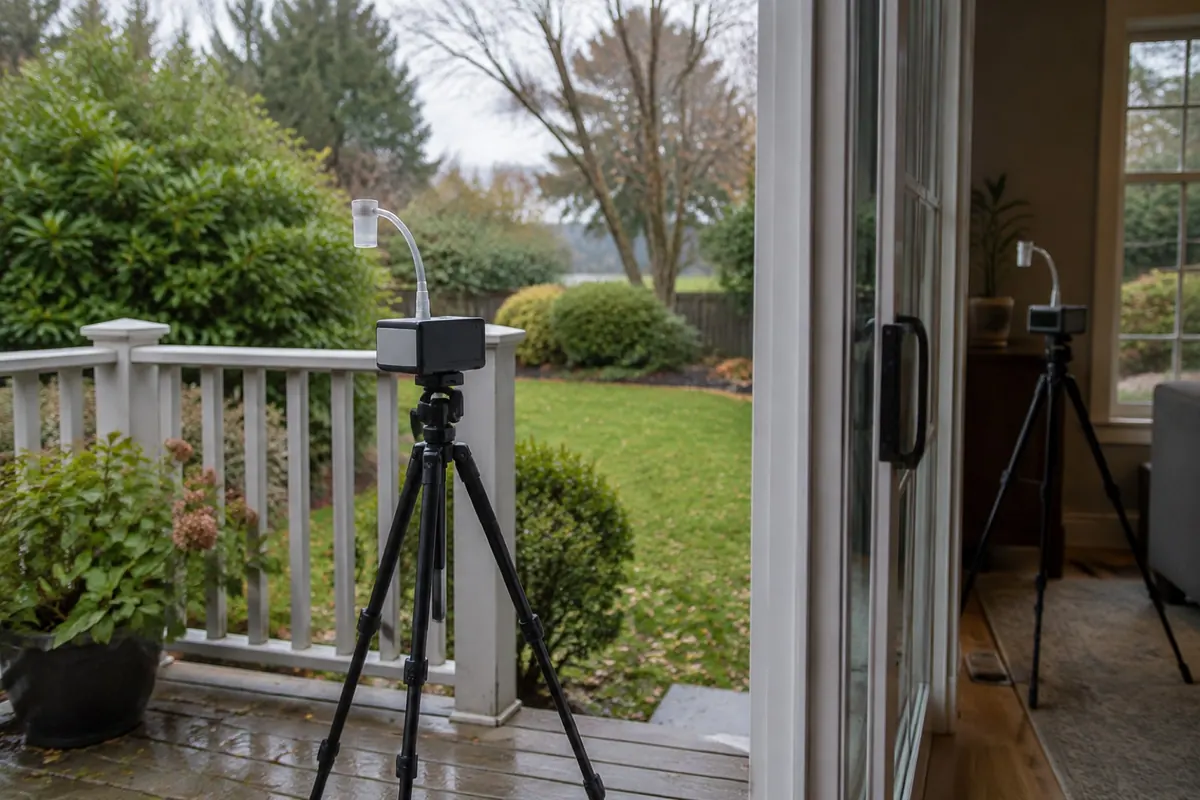
There is no number to compare against. EPA's mold testing page says limits for airborne mold “have not been set,” and the California Department of Public Health says there are no recommended “unhealthy levels.” A report citing a limit is using someone’s rule of thumb. What remains is comparison: EPA’s yardstick is that after cleanup the kinds and concentrations indoors “should be similar to those found outside.”
| Read this | Why |
|---|---|
| Air volume per sample | Turns counts into concentration; short runs mean big multipliers. |
| Outdoor control, same visit | The only baseline. EPA lists omitting it as a pitfall. |
| Spore types, indoor against outdoor | Types rare outside point to an indoor source, even at low totals. |
| Totals, indoor against outdoor | Indoor well above outdoor suggests amplification. |
| Debris or loading notes | EMSL warns an overloaded sample cannot be quantified. |
| Lab and chain of custody | Without them the report is weak evidence. |
For the normal pattern, Shelton and colleagues report on 12,026 air samples from 1,717 US buildings: median culturable fungi of about 540 CFU per cubic metre outdoors against 82 indoors, with indoor at or below outdoor in 85% of buildings. These are culture counts, so read them as a pattern, not a benchmark.
The Minnesota Department of Health adds: “most mold testing simply cannot prove the absence of a problem.” A low count never clears a wet wall.
How to test for black mold
“Black mold” usually means Stachybotrys chartarum, and the methods are the same: a tape lift or bulk under the microscope, or culture to species. Per the EMSL list, species-level culture including Stachybotrys costs $184 a sample. Shelton’s data report it in the indoor air of 6% of buildings and outdoor air of 1%, so finding it indoors means something, while missing it proves little. CDC says “you do not need to know the type of mold.” Identification by appearance is on our black mold versus regular mold page. Testing does not change the fix, which our guide on how to kill black mold sets out surface by surface.
Checking the lab: AIHA-LAP EMLAP
EPA says analysis should follow AIHA, ACGIH or other professional methods. AIHA LAP runs the Environmental Microbiology Laboratory Accreditation Program for labs analysing air (spore trapping), surface (tape, swab, wipe) and bulk samples, to ISO/IEC 17025:2017, with proficiency testing required. Accreditation is method by method. A published EMLAP scope lists spore traps, bulks and swab or tape lifts as separate fields and urges clients to verify current status, “since these can change due to proficiency status, suspension and/or withdrawal of accreditation.” So check three things before sending samples: the lab is in the AIHA LAP directory, its scope lists your sample type, and the scope has not expired.
Published lab fees
The visit is the expensive part, and inspection fees are on our mold inspection cost page. Lab fees are per sample and set by turnaround; the EMSL Analytical 2026 price list prices spore traps and direct exams alike:
| Analysis (EMSL code) | 2 weeks | 1 week | 24 hours | 3 hours |
|---|---|---|---|---|
| Spore trap (M001) | $68 | $72 | $123 | $328 |
| Tape, swab, bulk direct exam (M041) | $68 | $72 | $123 | $328 |
| Culture, genus ID (M005) | $113 | N/A | N/A | N/A |
| Culture, species ID (M006) | $184 | N/A | N/A | N/A |
| ERMI 36 panel (M180) | $237 | $257 | $642 (1 day) | $1,361 |
Per that list, rush costs 4.8 times the two-week rate. Per the same list, two indoor samples and one outdoor control come to $204 at two weeks or $369 at 24 hours, before anyone is paid to collect them. Lab turnaround is one of the delays covered in our guide to how long mold remediation takes.
Who does mold testing, and the state licences
Assessors, industrial hygienists and indoor environmental consultants do the testing; in some states only a licensed assessor may do it for pay. Every state is on our state mold licensing page. Some have no rules: the California Department of Public Health says California “has no state regulations about mold inspection, assessment, or remediation.”
| Texas | New York | Florida | |
|---|---|---|---|
| Licence to assess | Required (Tex. Occ. Code 1958.101) | Required for projects over 10 sq ft (NY Labor Law 930) | Required; covers growth over 10 sq ft (Fla. Stat. 468.8411) |
| Small-job exemption | Remediation under 25 contiguous sq ft; owners on own property (1958.102) | 10 sq ft or less is not a project | 10 sq ft or less is outside the definitions |
| Same firm assesses and remediates? | No, same project (1958.155) | No, same property (936) | Not within 12 months; Division I contractor exception (468.8419) |
| Closing document | Certificate within 10 days with an assessor’s statement (1958.154) | Written passed clearance report (947) | None found in the sections read |
Texas ties testing to sales: a seller must give the buyer each remediation certificate from the 5 years before the sale. New York clearance asks whether the work area is “free from all visible mold,” against criteria set in the plan required by 945.
Decision path: do you need a mold test?
- Can you see growth or find the leak? Skip the test. Fix the water and follow the remediation process.
- Larger than about 10 square feet, or in a state that licenses assessors? Hire a licensed assessor before work starts, and not the firm doing the removal.
- Musty odor, nothing visible? Look first: plumbing walls, windows, attic, HVAC drain pan. Still nothing? An assessment with air samples and an outdoor control can narrow the search.
- Dispute, claim or sale? Test, with chain of custody, an EMLAP lab and a written plan stating what you expect to prove.
- Remediation just finished? Clearance by someone independent of the remediator, read against outdoors.
- Asking “is it safe” or “is it toxic”? No test answers that. Spend the money on the moisture.
See also at-home mold test and mold spores in air.
For contractors: testing on a remediation job
For a remediation firm, testing is about independence and paper. In Texas and New York the clearance comes from someone else’s licence, and New York requires a written report to each paying client (936). Put the outside assessor in the estimate and the schedule.
| File item | Why it is there |
|---|---|
| Assessor’s protocol, before work | Sets scope and clearance criteria (NY 945). |
| Sampling plan with a hypothesis | EPA says sample only with a confirmable theory. |
| Pump calibration and air volumes | EMSL calls flow rate critical. |
| Outdoor control and field blank | EPA lists omitted controls as a pitfall. |
| Chain of custody and EMLAP scope | Proves the lab was accredited for that method. |
| Lab fees as a line item, by turnaround | Rush is a multiple of standard on published lists. |
| Clearance report or certificate | The document the statute names (TX 1958.154, NY 947). |
Coverage depends on the policy; see does homeowners insurance cover mold remediation. Staff training routes are on mold remediation certification, with more on the mold hub.
What this page does not cover. It is about testing buildings, not people. Mold testing for humans or blood work is a question for a physician; see CDC and NIH resources.
Questions people actually ask
How do you test for mold in your house?
Start without a kit: look and smell for dampness at plumbing walls, windows, the attic and the HVAC drain pan. EPA says sampling is usually unnecessary when growth is visible. If a test is needed, a professional takes spore trap samples indoors and outdoors at the same visit, plus tape or bulk samples of stains, for an AIHA-accredited lab.
How do you test for black mold?
The same way as any mold: a tape lift or a piece of the material goes to a lab for direct microscopy, which can identify Stachybotrys spores, or for species-level culture, $184 a sample per the EMSL 2026 list. CDC says you do not need to know the type of mold, and Minnesota’s health department says knowing it does not change the cleanup.
Is it worth paying for a mold test?
Usually not if you can see the mold or know the leak. It is worth it as clearance after remediation, when a musty odor has no visible source, and in disputes, claims or sales. EPA adds that if you cannot take enough samples to answer the question, it is better not to sample.
What is a normal mold spore count?
There is no official one. EPA says no federal limits exist, and California’s health department says there are no recommended unhealthy levels. Results are read against an outdoor sample from the same visit; indoor types absent outside suggest an indoor source.
Can a restoration company test and remediate the same job?
In several states, no. Texas bars one licence holder from assessing and remediating the same project, New York bars it on the same property, and Florida bars an assessor’s company from remediating a structure it assessed within 12 months. Firms offering integrated removal and air testing should use an independent assessor.
Is ERMI testing accurate?
EPA says ERMI was peer reviewed for research but not validated for other purposes, does not recommend routine public use in buildings, and cannot comment on the accuracy of results others obtain. Labs still sell it; EMSL reports list prices of $237 to $1,361 a sample.
Sources
- EPA's mold testing page, US EPA, updated 14 January 2026. Retrieved 18 October 2026.
- EPA's schools and commercial buildings guide, EPA 402-K-01-001, updated 29 April 2026. Retrieved 18 October 2026.
- EPA ERMI fact sheet, September 2021, and EPA ERMI page. Retrieved 18 October 2026.
- NIOSH, reviewed 25 February 2025. Retrieved 18 October 2026.
- CDC, About Mold, 26 September 2024. Retrieved 18 October 2026.
- California Department of Public Health, mold FAQ. Retrieved 18 October 2026.
- Minnesota Department of Health, Testing for Mold, 19 February 2026. Retrieved 18 October 2026.
- ASTM D7391, ASTM International. Retrieved 18 October 2026.
- EMSL Analytical 2026 price list, revision 1.6, 9 January 2026. Retrieved 18 October 2026.
- EMSL sampling guide, EMSL Analytical. Retrieved 18 October 2026.
- Wisconsin State Laboratory of Hygiene, Air-O-Cell collection. Retrieved 18 October 2026.
- AIHA LAP EMLAP page, 4 March 2026, and A published EMLAP scope, LAP-102813. Retrieved 18 October 2026.
- Shelton and colleagues, Applied and Environmental Microbiology, 2002. Retrieved 18 October 2026.
- EnviroBiomics, ERMI product page. Retrieved 18 October 2026.
- Texas Tex. Occ. Code 1958.101, 1958.102, 1958.154, 1958.155. Retrieved 18 October 2026.
- NY Labor Law 930, 936, 945, 947. Retrieved 18 October 2026.
- Fla. Stat. 468.8411 and 468.8419. Retrieved 18 October 2026.
- Volumes, ratios and fee totals are arithmetic on the figures above; see our methodology.
Lab prices change; confirm the fee and accreditation scope with the lab. State rules here are not legal advice.