The short answer
An at home mold test can show that mold spores are in your house, but it cannot tell you whether you have a mold problem. Settle plates grow something almost every time. A tape or swab mailed to an accredited lab can identify a visible stain. If you can see or smell mold, EPA, CDC and California health officials say skip the test and fix the moisture.
Key takeaways
- Mold spores are in all indoor air. A petri dish left open in any home is expected to grow colonies, so a positive plate proves almost nothing.
- Settle plates have no known air volume, so researchers classify them as qualitative: they cannot give a concentration.
- A tape lift or swab analysed by an AIHA-accredited lab is the most useful home kit, and it answers one narrow question: what is this stain?
- Published prices run from $35 for a lab-analysed tape sample to $435 for an ERMI dust test, per the makers’ own pages.
- Air quality monitors measure humidity, not mold. EPA’s target is below 60 percent relative humidity, ideally 30 to 50.
- No kit result is a clearance, a safety certificate or strong evidence in a dispute.
On this page
- Why the petri dish always grows something
- The five kinds of home mold test
- What the makers charge
- What a lab-analysed kit can tell you
- Monitors measure conditions, not mold
- What EPA, CDC and health departments say
- How to test a house for mold without a kit
- Kit, assessor or just fix the moisture?
- For contractors
- Questions people actually ask
Why the petri dish always grows something
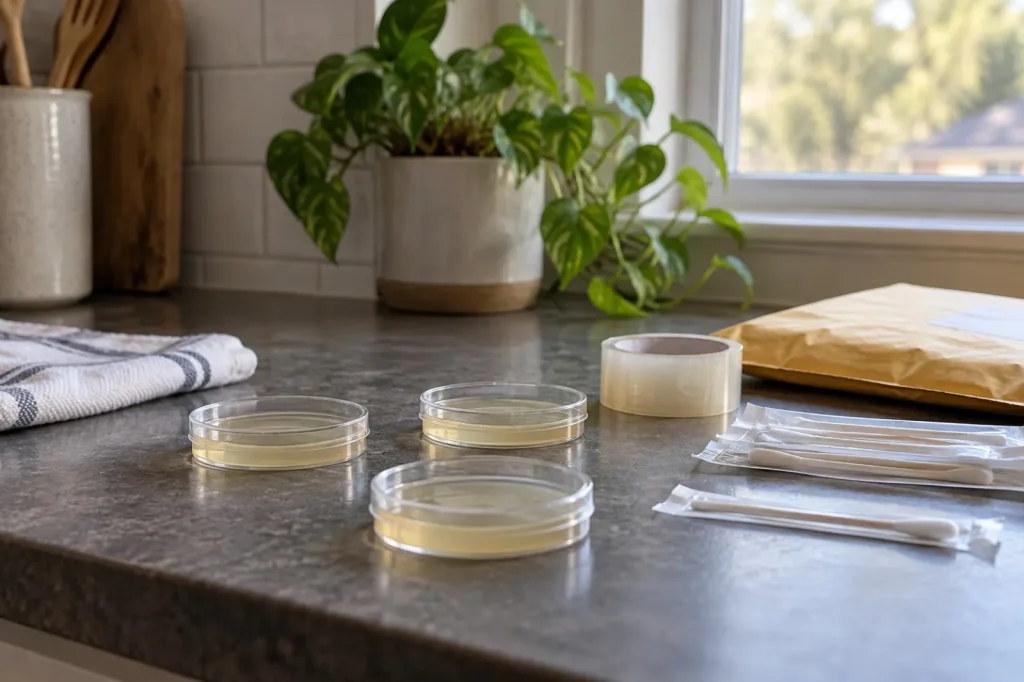
The cheapest kits are settle plates: a dish of growth medium you open, leave and close. Pro-Lab’s published instructions, for example, say to leave the dish open for 1 hour, then incubate it for 48 hours. The problem is what the air contains. CDC says “there is always some mold around” and that outdoor mold comes indoors on clothing, shoes, bags and pets. The Minnesota health department says a mixture of mold particles normally exists in all occupied buildings.
Shelton and colleagues report on 12,026 US air samples and found the same four groups most common indoors and outdoors in every season and region: Cladosporium, Penicillium, nonsporulating fungi and Aspergillus. Those are the colonies a plate will grow.
Microbiologists treat settle plates as a qualitative tool. A 2022 review by Manibusan and Mainelis in the Journal of Aerosol Science notes that passive samplers have no known air volume and give only an estimate of concentration, that only cells growing on that medium are counted, and that agar dries out, limiting plates to about 4 hours or less. The University of Connecticut EHS fact sheet puts it bluntly: “it would be rare not to get mold growth on the petri dishes!”
| Settle plate limit | Why it matters | Source |
|---|---|---|
| Spores are everywhere | Growth is expected in any home, so a positive plate cannot separate normal from problem. | CDC, MDH, UConn |
| No measured air volume | No concentration, so no comparison with outdoors or between rooms. | Manibusan and Mainelis |
| Culture only | Molds that do not grow on that medium are never seen. | Manibusan and Mainelis |
| No outdoor control | There is no baseline to read the plate against. | EPA |
| No accepted standard | No agreed method for running or reading a home plate. | UConn |
| It grows mold indoors | The dish supplies food, moisture and a surface. | UConn |
The five kinds of home mold test
Every mold test for home use falls into one of five types. They measure different things, so the comparison is about the question each can answer, not which brand is best. Lab methods are explained in depth on our mold testing page.
| Kit type | Example | What it measures | Cannot tell you | Useful when |
|---|---|---|---|---|
| Settle plate | Detekt Home, Pro-Lab | Colonies that land and grow on a dish | Concentration, or normal versus problem | Rarely |
| Tape or swab, lab analysed | MycoTest, Pro-Lab surface method | What a visible stain is, by genus | Air levels, hidden growth | You want a stain identified |
| Plates plus lab | ImmunoLytics | Genera and colony counts on plates, plus a swab | Concentration; the maker says not building safety | Seeing which genera grew, cautiously |
| ERMI dust | EnviroBiomics | DNA of 36 molds in settled dust | A validated pass or fail, per EPA | Extra data in a dispute |
| Lateral flow dust strip | Healthful Home | Whether certain molds exceed the strip’s detection level | Below that level, nothing | Quick screen, read cautiously |
| Air quality monitor | Airthings | Humidity, temperature, particles and gases | Mold of any kind | Tracking damp conditions |
What the makers charge
These are list prices on each maker’s own product page. Lab fees, shipping and taxes change the total, and sale prices come and go.
| Product | Listed price | What is included, per the maker |
|---|---|---|
| MycoTest household-supplies kit | $35 | Prepaid label, chain of custody and AIHA-accredited lab analysis of your own tape or swab |
| Healthful Home 5-Minute Mold Test | $35.98 sale, $44.95 list | Lateral flow test on household dust; no lab |
| Detekt Home mold test kit | $39.99 | Six-location plate kit, results in about 72 hours, no lab |
| Pro-Lab mold test kit | $49.95 | Plate and surface methods; instructions name a $40 lab fee |
| ImmunoLytics Quickstart kit | $216 | Five plates and one swab with analysis and a consultation |
| EnviroBiomics ERMI | $240 to $435 | Dust DNA panel by turnaround |
| Airthings Wave Plus | $249.99 | Monitor: radon, CO2, VOCs, humidity; no mold sensor |
| Airthings View Plus | $329.99 | Monitor with particle sensor; no mold sensor |
Two pricing details matter. According to Pro-Lab’s page, its $40 lab analysis fee is described as both “available” and “included” in different places, so confirm at checkout; paid separately it would make $89.95. Per the Healthful Home shop page, its three-pack works out to $28.66 a test on sale.
What a lab-analysed kit can and cannot tell you
A lab kit is only as good as the lab. MycoTest states that its analysis is by an AIHA-accredited lab to ASTM D7391, with results in 1 to 2 business days of receipt. You can check any such claim yourself in the AIHA LAP EMLAP directory. Public labs also take homeowner samples: the Wisconsin State Laboratory of Hygiene accepts a piece of the material, a tape lift or a swab, and notes that tape lifts can only be examined microscopically.
The makers’ own limits are the honest part. ImmunoLytics says its results do not “locate an exact hidden source, or certify building safety.” Healthful Home, in its FAQ, says a negative result indicates only that the area sampled “does not contain mold levels above a certain detectable level.”
| A lab-analysed kit can tell you | It cannot tell you |
|---|---|
| Whether a stain is mold or dirt | Whether the air is normal |
| The genus on a sampled surface | Where hidden growth is |
| Which genera grew on a plate | A concentration, from a plate |
| That a lab looked, with a report | That the house is safe |
| A record for your own files | A clearance after cleanup |
Air quality monitors measure conditions, not mold
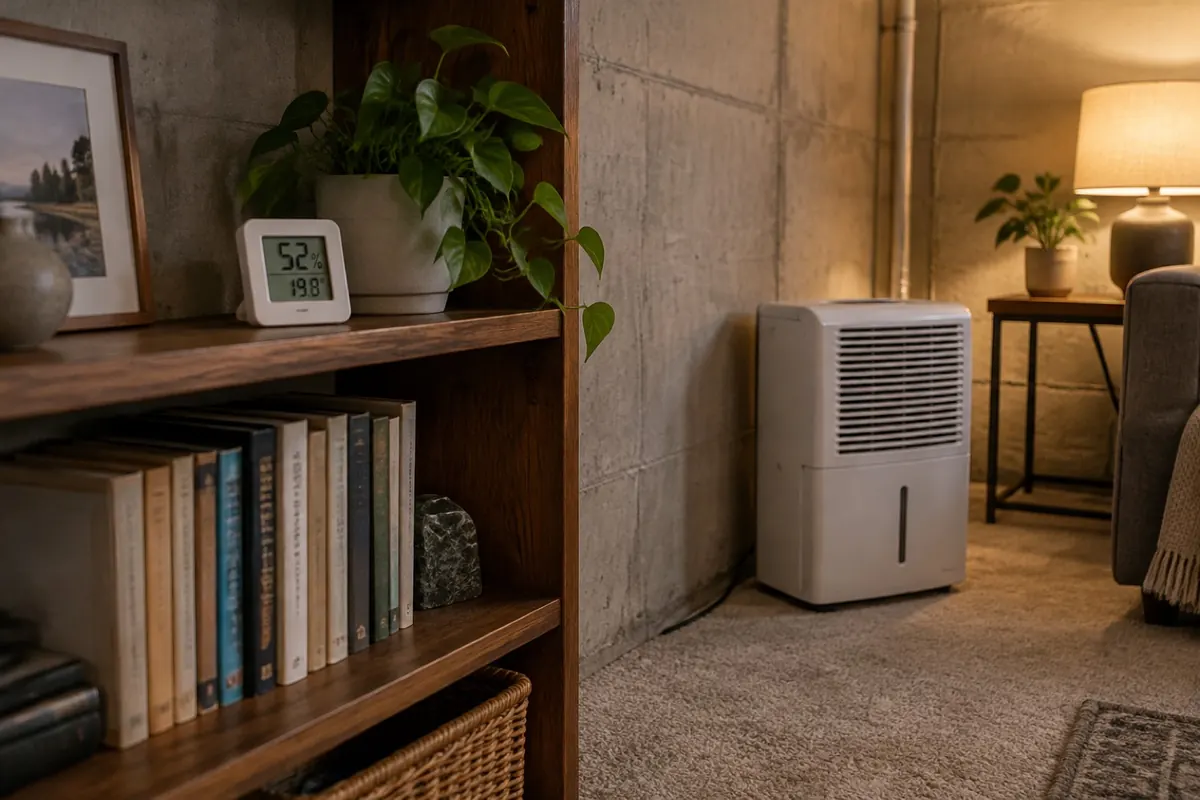
Electronic monitors are sold beside mold kits, but none of the models checked here lists a mold sensor. According to Airthings, the Airthings Wave Plus sells at $249.99 and the View Plus at $329.99; both measure humidity among other things, and Airthings says humidity above 60% encourages mold growth. That matches EPA's Brief Guide to Mold, Moisture and Your Home: keep indoor humidity below 60 percent, ideally 30 to 50 percent.
EPA notes that a humidity meter is a small, inexpensive instrument costing about $10 to $50 at hardware stores. For mold purposes that meter gives the same useful number as a monitor costing about 5 times the top of that range. Our indoor air quality testing page covers the wider measurements.
What EPA, CDC and health departments say about kits
| Body | What it says | Plain meaning |
|---|---|---|
| EPA | “In most cases, if visible mold growth is present, sampling is unnecessary.” | If you can see it, do not test. |
| EPA | Sampling “should be conducted by professionals” with specific experience. | EPA does not endorse DIY sampling. |
| CDC | “CDC does not recommend mold testing.” | Fix the moisture instead. |
| California Department of Public Health | Kits “are commercially available, but we do not recommend their use.” | A direct no to kits. |
| Minnesota Department of Health | Testing “is never a substitute for a thorough visual inspection.” | Look before you sample. |
| University of Connecticut EHS fact sheet | Does “not advocate for the use of mold petri dishes.” | University safety office, same conclusion. |
| AIHA LAP EMLAP | Accredits labs for air, surface and bulk mold analysis. | The quality marker for any mail-in kit. |
No public health body found for this page recommends settle plates. Where they allow testing, it is professional sampling for a defined question.
How to test a house for mold without a kit
The Minnesota Department of Health advises people to investigate on their own first, with two goals: find where mold is growing, and find the moisture source. EPA's Brief Guide to Mold, Moisture and Your Home supplies the checklist:
- Follow the water. Plumbing leaks, roof and window leaks, and anything that got wet and was not dried within 24 to 48 hours, which is EPA’s window for preventing growth.
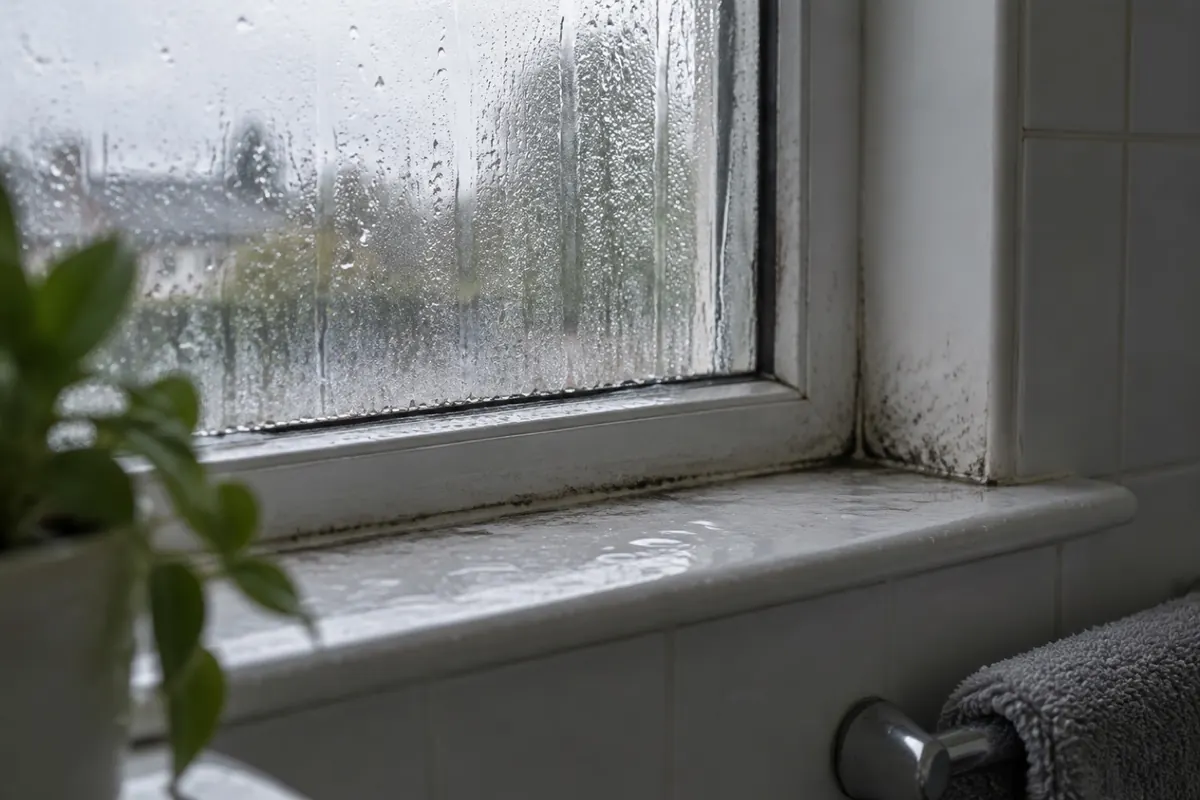
- Look for condensation. EPA names windows, walls and pipes; rust on a drainpipe is one of its examples.
- Use your nose. A musty odor in a basement is covered on our musty smell in basement page.
- Measure humidity. A hygrometer, against EPA’s 60 percent ceiling.
- Identify a stain only if it matters. A single lab-analysed tape lift answers that; our black mold versus regular mold page covers appearance.
Should you buy a kit, call an assessor, or fix the moisture?
| Your situation | Next step | Why |
|---|---|---|
| Visible growth under about 10 sq ft | Fix the moisture and clean it | EPA says you can usually handle it yourself; see DIY mold remediation. |
| Visible growth over 10 sq ft, or lots of water damage | Call a professional | EPA points to its professional guidance; some states license this work (state rules). |
| Musty odor, nothing visible | Look first, then an assessor | Hidden growth has to be found, not just detected. |
| A stain you cannot identify | One lab-analysed tape or swab | Cheapest real answer to a narrow question. |
| Recent leak, nothing visible yet | Dry it within 48 hours | EPA’s prevention window; a hygrometer helps. |
| Sale, lease dispute or claim | Independent assessor | A kit lacks an independent sampler and outdoor controls; see inspection cost. |
| Wanting reassurance the house is “safe” | No test | MDH says it is unknown what level of mold is safe. |
In one line: if you can see it or smell it, skip the kit; if you need to know what a stain is, mail one tape lift to an accredited lab; if money, a sale or a dispute depends on the answer, hire an assessor who is not the remediator.
For contractors: when a customer hands you a kit result
A customer may call with a plate full of colonies. The useful response is to treat it as a reason to inspect, not as a scope of work, and to write down moisture readings, photos and affected area, because those drive the estimate.
| Customer brings | What it shows | What to do |
|---|---|---|
| Settle plate with growth | Spores were in the air, as in any home | Inspect and measure moisture; do not scope from it. |
| Lab tape or swab report | What one stain is | Useful context; still find the moisture and extent. |
| Lateral flow positive | Dust crossed a strip’s detection level | Inspect; the maker says a negative is not a clearance either. |
| ERMI score | Dust DNA against a research scale | EPA does not recommend routine use; do not price from it. |
| High humidity from a monitor | Damp conditions | Find the source; the fix may sit with an HVAC trade. |
Where the job needs an assessor, licensing states such as Texas and New York bar one licensee from both assessing and remediating the same project, so refer out. More on the mold hub.
What this page does not cover. Home kits test buildings, not people. Searches about warning signs of mold toxicity or kits for humans are medical questions; see CDC and NIH resources and a physician.
Questions people actually ask
Can I test for mold in my home myself?
Yes, but EPA says sampling should be done by experienced professionals, and California’s health department does not recommend kits. If you want one answer, mail a tape lift or swab of a visible stain to an AIHA-accredited lab; MycoTest lists $35, according to its product page. Skip settle plates, which grow mold in almost any home.
Are at-home mold tests accurate?
It depends on the type. A lab-analysed tape lift can accurately identify what is on a surface. A settle plate cannot be accurate about a mold problem because spores are present in all indoor air and the plate has no measured air volume. Monitors measure humidity, not mold. None can certify a house as safe.
How do I test my house for mold without a kit?
Follow the water and the smell. EPA says to check for leaks, condensation on windows, walls and pipes, and anything wet that was not dried within 24 to 48 hours. A $10 to $50 hygrometer, the range EPA reports, shows whether humidity sits above its 60 percent ceiling. Minnesota’s health department says visual inspection beats testing as a first step.
Do 5-minute mold tests work?
The Healthful Home 5-Minute Mold Test is a lateral flow strip run on household dust that, per the maker, screens for specific mold types above a detection level. Its own FAQ says a negative result means only that levels are below that level, and that confirming indoor air quality needs a professional inspector.
How do I test for asbestos in home insulation?
Do not sample it yourself. EPA says taking samples yourself is not recommended, and its vermiculite guidance says to assume vermiculite insulation may contain asbestos and leave it undisturbed, because testing may be expensive and give erroneous results. Hire an accredited asbestos professional; our asbestos testing kit page explains the options.
Where can I find a reliable asbestos test kit?
Reliability comes from the lab. NIST’s NVLAP programme accredits labs for asbestos analysis by polarized light microscopy and electron microscopy, and federal AHERA rules require NVLAP labs for school samples. Choose a kit that names an NVLAP-accredited lab, and read EPA’s advice against sampling yourself before cutting into anything.
How do I safely dispose of biohazard waste at home?
For used needles, FDA says to place them in a sharps disposal container immediately and dispose of the container according to your community guidelines, which vary by location. Blood or body-fluid contamination after an incident is a different job; see our biohazard cleanup page.
Sources
- EPA, Mold Testing or Sampling, updated 14 January 2026. Retrieved 18 October 2026.
- EPA's Brief Guide to Mold, Moisture and Your Home, updated 18 February 2026. Retrieved 18 October 2026.
- CDC, About Mold, 26 September 2024. Retrieved 18 October 2026.
- California Department of Public Health, mold FAQ. Retrieved 18 October 2026.
- Minnesota Department of Health, Testing for Mold, 19 February 2026. Retrieved 18 October 2026.
- University of Connecticut EHS fact sheet, Facts About DIY Mold Test Kits. Retrieved 18 October 2026.
- Manibusan and Mainelis, Passive Bioaerosol Samplers, Journal of Aerosol Science 163 (2022), via PubMed Central. Retrieved 18 October 2026.
- Shelton and colleagues, Applied and Environmental Microbiology, 2002. Retrieved 18 October 2026.
- EPA's ERMI fact sheet, September 2021. Retrieved 18 October 2026.
- AIHA LAP EMLAP programme page and Wisconsin State Laboratory of Hygiene homeowner page. Retrieved 18 October 2026.
- Product pages: Pro-Lab, Detekt Home, MycoTest, Healthful Home and its FAQ, ImmunoLytics, EnviroBiomics, Airthings Wave Plus and View Plus. Retrieved 18 October 2026.
- EPA asbestos family page and EPA's vermiculite guidance; NIST NVLAP. Retrieved 18 October 2026.
- FDA, sharps disposal, content current as of 10 August 2023. Retrieved 18 October 2026.
- Per-test and ratio figures are arithmetic on the listed prices. No kit was purchased or run; see our methodology.
Kit prices and claims are the makers’ own and change often. Check the current page and the lab’s AIHA LAP scope before buying.