The short answer
Biohazard cleanup is regulated remediation work covering unattended death, trauma scenes, hoarding, sewage and similar situations. A contained single-room job typically runs $3,000 to $7,000, multi-room or extended work $7,000 to $15,000, and severe hoarding or large-scale work $15,000 to $50,000 or more. Worker protection is governed by OSHA’s Bloodborne Pathogens standard, 29 CFR 1910.1030, and regulated medical waste disposal is licensed at state level. There is no federal licence for the remediation work itself, which is why qualification varies so widely.
Key takeaways
- The absence of a federal licence for biohazard remediation is the central fact about this market. Worker protection and waste transport are regulated; the remediation service itself generally is not.
- OSHA 29 CFR 1910.1030, the Bloodborne Pathogens standard, governs employer obligations for worker protection on this work. It is about the crew, not the customer.
- Regulated medical waste transport and disposal is permitted at state level and requires a permitted hauler. Who hauls the waste, and under what permit, is a question with a checkable answer.
- Cost is driven by whether fluids reached the subfloor or wall cavity, because porous material that did is removed rather than cleaned.
- Volume of contents requiring disposal, regulated waste fees, PPE, crew size and time on site are the other drivers.
- Homeowners policies often cover biohazard cleanup following a covered event, and some states operate victim compensation programmes for trauma scenes. Policy wording and state programmes both vary.
- Three questions separate a qualified firm from a listing: what training do the technicians hold, who hauls the regulated waste and under what permit, and do you carry pollution liability insurance.
Scope of this page. This is a practical guide to how biohazard cleanup work is scoped, priced and qualified. It describes procedure, cost structure and regulation. It contains no graphic description of any scene, and it contains no medical, pathogen or health guidance beyond naming the OSHA standard that governs worker protection. If you have a health question, that belongs with a medical professional. If you are dealing with a death, the relevant authorities and a funeral director come before any conversation about cleaning. Nothing here is legal, medical or insurance advice.
On this page
- What biohazard cleanup covers
- The categories, and why they price differently
- Regulation is the real differentiator
- What the OSHA standard actually governs
- Regulated medical waste is the licensed part
- How a job is actually run
- Porous material is removed, not cleaned
- What biohazard cleanup costs
- What drives the number
- Hoarding is a different kind of job
- How to verify a firm honestly
- Who pays
- Questions people actually ask
Biohazard cleanup is the part of the restoration industry that most people never think about until they have to, and it is the part where a buyer has the least basis for judging what they are being sold. The work is genuinely specialised, the regulation is real but partial, and the pricing looks opaque from outside. This page sets out what the work consists of, what governs it, what it costs, and the specific questions that let you tell a qualified firm from a company that bought the phrase in an advertising auction.
What biohazard cleanup covers
The term covers a group of situations that share one characteristic: material is present that requires handling under regulated procedure rather than ordinary cleaning, and the people doing the handling require protection defined by regulation. They otherwise have very little in common, and they price very differently.
What they also share is that the property owner is usually dealing with something else at the same time. That shapes the market, because it means buyers are not in a position to shop carefully, and it is a reason to know what the questions are in advance rather than in the moment.
The categories, and why they price differently
| Category | What the work consists of | What drives the cost |
|---|---|---|
| Unattended death | Affected area cleaning and disinfection, removal of porous material that absorbed fluids, odour treatment, disposal of contaminated contents | Elapsed time before discovery. Time determines how far material penetrated, and penetration into subfloor or cavity is the main cost step. |
| Trauma scene | Affected area cleaning and disinfection, removal of affected material, restoration of the area to a usable state | Area affected and whether fluids reached porous assemblies. Often smaller in area than an unattended death and shorter in duration. |
| Hoarding | Sorting and removal of contents in volume, cleaning of surfaces underneath, pest and sanitation issues, structural assessment | Volume above everything else. Disposal by the skip-load, crew days, and whether the work must proceed at the occupant’s pace. |
| Sewage | Extraction, removal of porous material, cleaning and disinfection, drying, verification | Area affected and depth of penetration. Overlaps directly with water damage restoration methodology. |
| Infectious disease cleaning | Surface disinfection of a defined area under a defined protocol, usually short duration | Area and the protocol required. Generally the shortest and least expensive category. |
| Industrial and vehicle incidents | Cleaning and decontamination of a defined area, frequently with access or confined-space complications | Access, whether the asset can be taken out of service, and documentation requirements for a commercial client. |
Sewage overlaps with water damage
Sewage sits in both categories and is handled with the water damage methodology plus the biohazard procedure. The water industry treats it as the most contaminated category of water loss, which means porous material that contacted it comes out rather than being dried, containment and protective equipment apply, and the job ends with verification rather than with the water being gone. Our sewage backup cleanup cost guide covers that scope in full, and our water damage restoration cost guide covers the underlying category framework.
Regulation is the real differentiator
Here is the fact that explains almost everything odd about this market. Three separate things are regulated, and the one people assume is regulated is not.
| What | Regulated? | By whom, and what it means for you |
|---|---|---|
| Worker protection on the job | Yes, federally | OSHA 29 CFR 1910.1030, the Bloodborne Pathogens standard, imposes obligations on the employer regarding exposure control, protective equipment and training. It protects the crew. |
| Transport and disposal of regulated medical waste | Yes, at state level | States permit medical waste transporters and treatment facilities. A firm either uses a permitted hauler or it does not, and that is checkable. |
| The remediation service itself | Generally not | There is no federal licence to perform biohazard remediation. Some states impose requirements and most do not, so qualification varies enormously by location. |
| Business licensing and insurance | Varies | Ordinary state and local business licensing applies. Pollution liability insurance is a commercial choice, not a legal requirement, and it is a meaningful signal. |
Read that table again. Worker protection is governed, waste transport is permitted, and the actual remediation service in most of the country is not licensed at all. That absence is the story of this market. It means the phrase on a website carries no regulatory weight on its own, and it means the verification burden falls on the buyer at the worst possible moment.
Why that absence persists
It is partly historical and partly structural. The work sits between cleaning, construction and waste handling, none of which is regulated by a single body, and the volume is low relative to categories like water damage. State-level licensing regimes have grown up in other remediation disciplines, most visibly in mould, and the pattern there is instructive: coverage is patchy and inconsistent between states. Our state mould licensing review documents how uneven that is in a discipline where licensing exists at all, which is the closest available comparison.
What the OSHA standard actually governs
The OSHA Bloodborne Pathogens standard, 29 CFR 1910.1030 is the federal regulation most often cited in this category, and it is worth being precise about what it does. It is an employer obligation standard. It concerns the protection of workers with occupational exposure, and it applies to the firm doing the work rather than to the property or the property owner.
| Element of the standard | What it requires of an employer | What it tells you as a buyer |
|---|---|---|
| Exposure control plan | A written plan identifying exposure and how it is controlled, reviewed and updated | A firm doing this work properly has a written plan. Asking to see one is a reasonable question and the answer is informative. |
| Training | Training for workers with occupational exposure, at hire and periodically thereafter | Ask what training technicians hold and when they last did it. Specific answers are a good sign; vague ones are not. |
| Personal protective equipment | Provision of appropriate protective equipment at no cost to the worker | Appropriate equipment on site is visible. Its absence is visible too. |
| Recordkeeping | Maintenance of records relating to training and exposure | Firms that keep these records tend to keep the rest of the paperwork you may later need. |
The useful consequence for a buyer is indirect but real. A firm that genuinely operates under this standard has a document trail, trained staff and a supply chain for protective equipment and waste. Those things cost money and they show up in a price. A quote that is far below the others is usually a quote from an operation that does not carry them.
Regulated medical waste is the licensed part
Material removed from a biohazard job is generally handled as regulated medical waste, which cannot go in a normal skip and cannot be transported by anybody who happens to have a van. Transport and treatment are permitted at state level, and the permits are held by specialist haulers and treatment facilities rather than by the remediation firm.
| Stage | What happens | Why it costs what it does |
|---|---|---|
| Segregation on site | Regulated waste is separated from ordinary waste at the point of removal and packaged to the required specification | Packaging is specified and consumable. Getting it wrong means the hauler will not take it. |
| Containerisation | Approved containers and labelling, supplied by the hauler or the remediation firm | Containers are charged per unit and the volume is what it is. |
| Transport by a permitted hauler | Collection and transport to a permitted treatment facility, with a manifest | Priced per container or per weight, plus collection. This is a third-party cost passed through. |
| Treatment and disposal | Treatment at a permitted facility, documented | Facility fees, which vary regionally with facility availability. |
| Documentation | The manifest and disposal records | Effectively free, and it is the evidence the waste went where it was supposed to go. Ask for a copy. |
The practical significance is that a portion of your invoice is a pass-through cost the remediation firm does not control, and that the chain produces paperwork. A firm that can tell you immediately who hauls its regulated waste and hand you a manifest afterwards is a firm operating inside the system. General environmental regulation information is published by the United States Environmental Protection Agency, and medical waste specifically is administered through state programmes.
How a job is actually run
The procedure is defined and repeatable, which is the point of using a firm rather than attempting it. Described at the level of process rather than of any particular scene.
| Stage | What it involves | Why it is in that position |
|---|---|---|
| 1. Assessment | Establishing the affected area, whether material penetrated into porous assemblies, what contents are involved, and what access exists | The scope and therefore the price both follow from this. An assessment done by phone is not an assessment. |
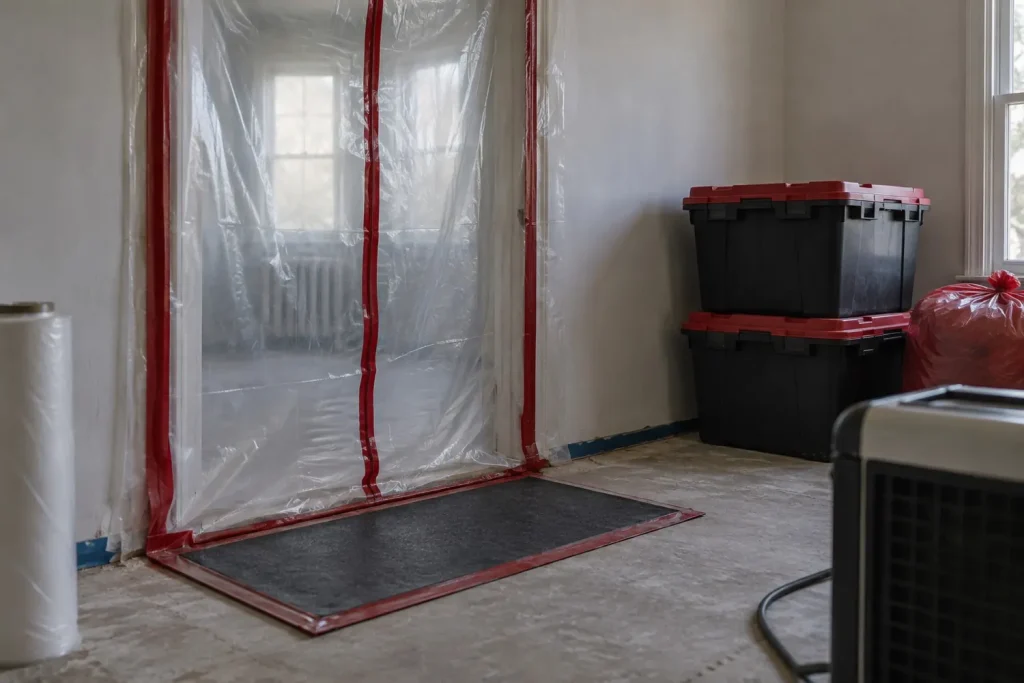
| 2. Containment and controls | Isolating the working area from the rest of the property, establishing airflow control, setting up entry and exit procedure | Prevents the work from spreading the problem into unaffected parts of the building. |
| 3. Removal | Removal of porous material that cannot be cleaned, and of contents requiring disposal, packaged to the waste specification | Removal precedes cleaning, because cleaning around material that is leaving is wasted effort. |
| 4. Cleaning and disinfection | Cleaning of remaining surfaces followed by application of an appropriate disinfectant to label directions | Cleaning first, because disinfectants work on cleaned surfaces. Label directions are not optional. |
| 5. Odour treatment | Air treatment and sealing where required, on the same logic as any other odour remediation | Only meaningful once the source is out. Our odour guidance applies identically here. |
| 6. Verification and documentation | Confirmation that the defined scope was completed, with records and waste manifests | This is what you are left holding, and it matters for insurance and for any later sale of the property. |
| 7. Reconstruction | Replacement of removed material: subfloor, wall finishes, flooring, trim | A separate scope, often by a different contractor, priced separately. |
Porous material is removed, not cleaned
This is the single most important cost mechanism in the category, and it is the same verification principle that governs remediation generally. Material that absorbed fluids cannot be confirmed clean, because there is no way to inspect the inside of a subfloor or the core of a piece of chipboard. Unverifiable cleaning is not cleaning, so the material is removed.
| Material | Treatment | Cost consequence |
|---|---|---|
| Sealed hard surfaces: tile, glazed ceramic, sealed metal, glass | Cleaned and disinfected in place | Low. These are the surfaces that recover fully. |
| Carpet and underlay in the affected area | Removed and disposed of | Moderate, and it is generally not an arguable line. |
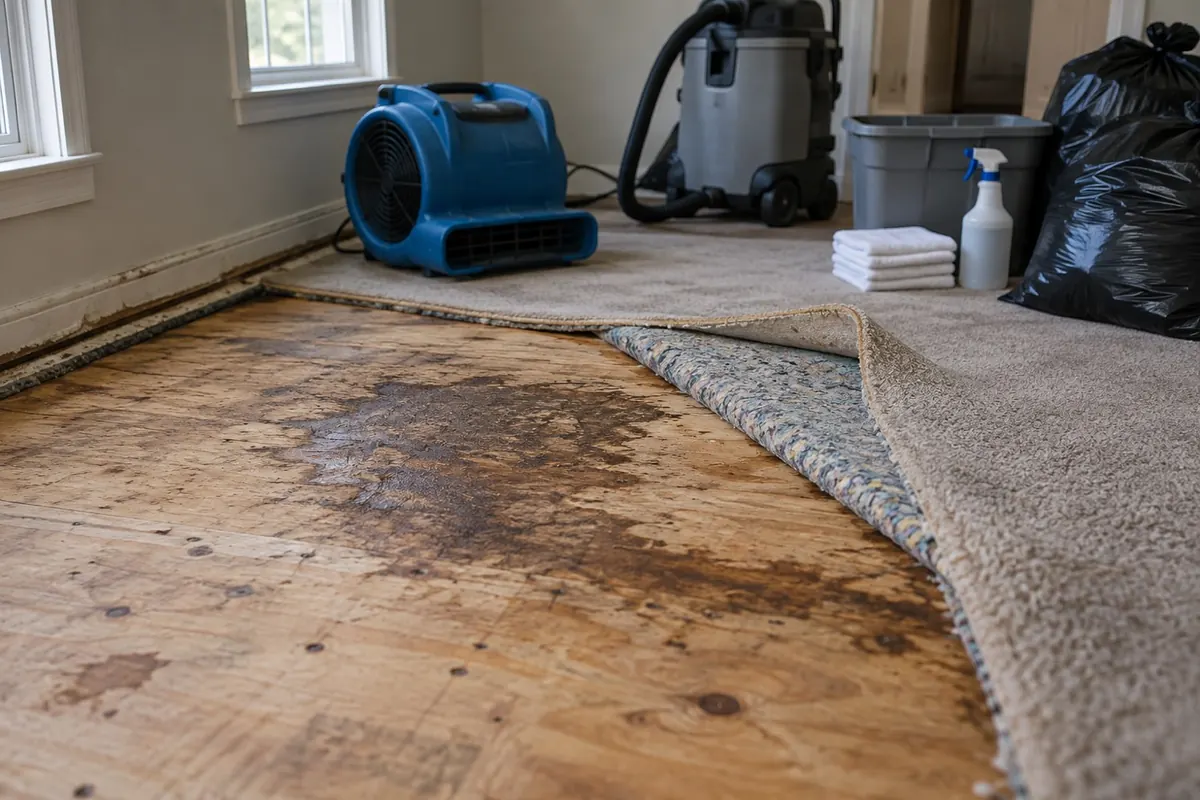
| Timber or engineered subfloor reached by fluids | Cut out and replaced | Substantial step change. This is the boundary between a contained job and an expensive one. |
| Wall cavity material: plasterboard and insulation | Removed to beyond the affected extent | Substantial, and it brings reconstruction into the scope. |
| Upholstered furniture and mattresses in the affected area | Generally removed and disposed of as regulated waste | Moderate to high, driven by volume and by disposal fees rather than by item value. |
| Contents in the affected area | Assessed individually; porous items generally disposed of | Highly variable. Volume is what matters, not value. |
The practical version of this for anyone trying to understand a quote: the question that most affects the number is whether fluids reached the subfloor or the wall cavity. Above that line the job is cleaning. Below it, the job is cleaning plus demolition plus waste plus reconstruction, and the figure roughly steps rather than sliding.
What biohazard cleanup costs
These are indicative bands compiled from published contractor and aggregator price guides current in 2026. They are labelled indicative deliberately: this is a low-volume category with wide regional variation and no published pricing survey we would rely on. They are not a quote and they are not survey results.
Two things about those bands are worth stating plainly. The first is that reconstruction is excluded. Replacing a cut-out subfloor, wall finishes and flooring is a construction scope at construction rates and it is frequently comparable to the remediation figure. The second is that the spread within each band is genuinely wide, because access, regional disposal fees and contents volume all vary by multiples.
What drives the number
| Driver | Effect | Why |
|---|---|---|
| Area affected | Roughly proportional at the cleaning end | More surface is more labour and more consumables. |
| Whether fluids reached the subfloor or wall cavity | Step change rather than a slope | It converts a cleaning scope into a demolition, waste and reconstruction scope. |
| Volume of contents requiring disposal | Substantial, and dominant on hoarding work | Priced by the load, and the loads are the job on high-volume situations. |
| Regulated medical waste fees | Substantial and largely outside the firm’s control | Third-party permitted hauler and treatment facility charges, which vary regionally with facility availability. |
| PPE and crew size | Meaningful and non-negotiable | Protective equipment is consumable and single-use, and the crew size is set by the procedure rather than chosen. |
| Time on site | Substantial on extended jobs | Multi-day work carries repeat mobilisation, containment maintenance and daily waste handling. |
| Access | Meaningful | Upper floors, narrow stairs, no vehicle access and confined spaces all multiply the handling time for removal and waste. |
| Out-of-hours response | Meaningful | This work is frequently urgent and frequently outside business hours, which carries a premium as it does in every restoration discipline. |
Hoarding is a different kind of job
Hoarding remediation sits in this category because of what is often found underneath the contents, and it is unlike the other categories in almost every operational respect. The volume is the job, the timeline is longer, and there is usually a living occupant whose involvement governs the pace.
| Aspect | How hoarding differs | Cost consequence |
|---|---|---|
| Primary driver | Volume of contents rather than area affected | Priced substantially by the skip-load and the crew day rather than by square footage. |
| Duration | Days to weeks rather than hours to days | Repeat mobilisation and extended equipment and container hire. |
| Sorting | Contents are sorted rather than disposed of wholesale, with items of value, documents and personal effects identified | Sorting is slow and it is labour. Skipping it is faster and is generally not acceptable. |
| Occupant involvement | The occupant frequently participates in or must consent to decisions about contents | The pace is set by that process. A firm that promises a fixed rapid timeline may not be planning to accommodate it. |
| What is found underneath | Sanitation issues, pest activity, and sometimes structural or water damage concealed for years | Scope expands on discovery, which is why fixed prices before access are rare and should be treated carefully. |
| Follow-on work | Often structural repair, pest treatment, or remediation of conditions found underneath | Separate scopes, and they can exceed the clearance itself. |
Worth saying plainly: hoarding situations usually involve a person, and the cleanup is one part of something larger. Firms that work in this area regularly tend to have a considered approach to working with occupants and families. That is a reasonable thing to ask about when choosing one, and the answer tells you something the price does not.
How to verify a firm honestly
Because there is no federal licence to check, verification is a matter of asking specific questions and knowing what each answer means. These three are the useful ones.
| Question | A good answer sounds like | What a poor answer tells you |
|---|---|---|
| What training do your technicians hold, and when did they last do it? | Named training programmes, a stated frequency, and a written exposure control plan they are willing to describe | Vagueness here means there is probably no document trail, which means the OSHA obligations are likely being handled informally or not at all. |
| Who hauls your regulated medical waste, and under what permit? | The name of a permitted hauler, and an offer to provide the manifest after the job | If a firm cannot name a hauler, ask where the waste goes. This is the most checkable question in the category and it is the one a marginal operator cannot answer. |
| Do you carry pollution liability insurance? | Yes, with a willingness to provide a certificate of insurance naming the coverage | General liability policies commonly exclude pollution and contamination. Without that cover, a firm that causes a problem on your property may have no means of putting it right. |
Two more worth asking
- Will you provide written documentation of what was done? You may need it for an insurance claim, for a later property sale, or for a disclosure obligation. A firm that produces this routinely will say so immediately.
- Is reconstruction included or separate? Remediation and rebuild are different scopes at different rates, and a quote that does not say which it covers cannot be compared against another one.
A note on the word certified. Several bodies offer training and credentials in this field, and holding one tells you a firm invested in training. It is not a government licence and it does not carry regulatory force. Treat it as evidence of effort rather than as proof of authorisation, and ask which credential, from whom, and held by whom on the crew that will actually attend.
Who pays
Homeowners policies often cover biohazard cleanup where it follows a covered event, and that is the route most of this work is paid through. Whether a particular situation is covered depends on the policy wording and on the facts the insurer establishes, and the answer is not the same in every policy or every state.
- Report it promptly and ask the coverage question directly. Whether biohazard or trauma cleanup is covered, and under which part of the policy, is a question your insurer can answer about your policy.
- Document before anything is removed, photographically and by room, exactly as with any other property claim. Removed material with no record is disputed material.
- Keep the waste manifests and the completion documentation. They substantiate that regulated work was performed by somebody entitled to perform it.
- Ask about state victim compensation programmes if the situation involves a crime. A number of states operate programmes that may contribute to scene cleanup costs, with their own eligibility rules and application procedures. Availability, scope and limits vary by state.
- Get remediation and reconstruction as separate figures, because they are different scopes and are often handled differently on a claim.
Coverage for biohazard cleanup is decided by your policy wording and by the facts your insurer establishes, not by a general article. State victim compensation programmes have their own eligibility criteria, limits and deadlines, and they differ substantially between states. This page describes common patterns so you know what to ask. It is not insurance advice, it is not legal advice, and it creates no expectation of coverage or eligibility.
Our methodology sets out our standing rules for what we publish, how ranges are compiled and labelled, and what we will not claim.
Questions people actually ask
How much does biohazard cleanup cost?
A contained single-room job typically runs $3,000 to $7,000, multi-room or extended work $7,000 to $15,000, and severe hoarding or large-scale work $15,000 to $50,000 or more. Those are indicative bands compiled from published contractor and aggregator price guides current in 2026, and they exclude reconstruction of removed material.
Is there a licence required to do biohazard cleanup?
There is no federal licence for biohazard remediation itself. OSHA’s Bloodborne Pathogens standard, 29 CFR 1910.1030, governs worker protection and applies to the employer, and transport and disposal of regulated medical waste is permitted at state level. Requirements for the remediation service vary by state and in much of the country there are none, which is why verification falls to the buyer.
Does homeowners insurance cover biohazard cleanup?
Policies often cover it where it follows a covered event, and that is how most of this work is paid for. Whether your situation is covered depends on your policy wording and on the facts your insurer establishes. Ask your insurer directly, report promptly, and document before anything is removed.
Why does the price change so much depending on the room?
Because the largest single factor is whether fluids reached the subfloor or the wall cavity. Above that line the work is cleaning and disinfection of surfaces. Below it, porous material has to be removed rather than cleaned, which adds demolition, regulated waste disposal and reconstruction, so the price steps rather than sliding.
Can I clean it up myself?
This is regulated work with defined procedure, protective equipment and a waste disposal chain that requires a permitted hauler. Material removed generally cannot go in ordinary refuse. Beyond the procedural issues, porous material that absorbed fluids has to be removed and the result has to be documented, which is difficult to do yourself in a way that will satisfy an insurer or a later buyer of the property.
How do I check whether a company is qualified?
Ask three questions. What training do your technicians hold and when did they last do it. Who hauls your regulated medical waste and under what permit. Do you carry pollution liability insurance. Each has a checkable answer, and the waste question in particular is difficult for a marginal operator to answer convincingly.
How long does biohazard cleanup take?
A defined-area disinfection can be hours. A contained single-room job is commonly one to three days. Multi-room work with subfloor removal runs longer, and hoarding remediation is measured in days to weeks because volume and sorting govern the pace. Reconstruction of removed material follows afterwards as a separate scope.
Sources
- OSHA Bloodborne Pathogens standard, 29 CFR 1910.1030. Occupational Safety and Health Administration, 29 CFR 1910.1030. The federal standard governing employer obligations for worker protection where occupational exposure exists, including exposure control planning, training, protective equipment and recordkeeping. Described at a general level here; read the standard for its requirements. Retrieved 23 September 2026.
- United States Environmental Protection Agency, United States Environmental Protection Agency, for general environmental regulation information. Medical waste specifically is administered through state programmes rather than federally, which is why transporter and facility permitting varies by state. Retrieved 23 September 2026.
- Cost bands are compiled from published contractor and aggregator price guides current in 2026 and are labelled indicative. This is a low-volume category with wide regional variation and no published pricing survey we would rely on. They are not survey results and not a quote.
- The invoice-composition chart is ILLUSTRATIVE and schematic. It is not survey data, not accounting data from any firm, and not a quote.
- Category definitions, procedural sequence, material treatment and verification questions reflect generally described remediation practice. No proprietary protocol is reproduced and no firm is named.
- Statements about state victim compensation programmes describe that such programmes exist in a number of states with varying eligibility rules, limits and procedures. Availability and terms differ by state and should be checked with the relevant state programme.
This page is general information about how biohazard remediation work is scoped, regulated and priced. It is not legal advice, not medical or health advice, not insurance advice, and not a compliance guide to any regulation. It creates no expectation of coverage or eligibility under any policy or programme. Read your own policy, check the requirements applying in your state, and speak to the appropriate professional.