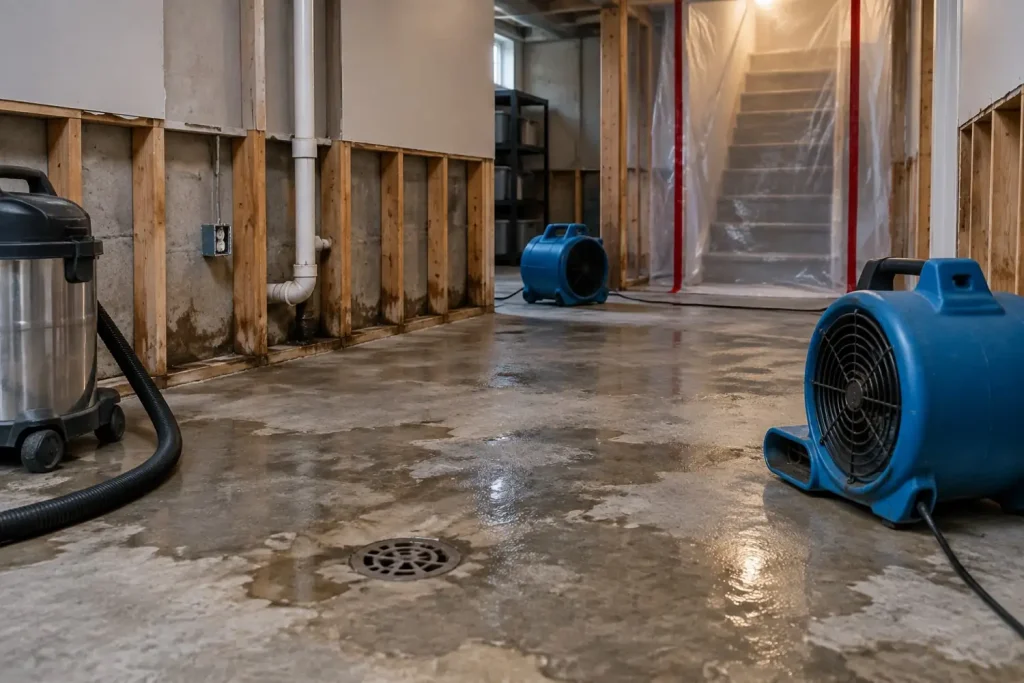
The short answer
Sewage backup cleanup cost runs roughly $2,000 to $4,000 for a small contained area and $7,000 to $14,000 for a full finished basement, at about $7 to $12 per square foot for mitigation. It costs two to three times a clean-water loss of the same size because sewage is Category 3 under ANSI/IICRC S500: porous materials that contacted it are removed rather than dried.
Key takeaways
- Sewer and drain backup is usually excluded from standard homeowners policies unless a water backup endorsement was purchased. Check that first.
- It is a demolition scope sitting on a drying scope. That, not the water volume, is why the number is higher.
- Porous materials that contacted sewage come out. Cleaning cannot be verified inside a material, so removal replaces verification.
- Sealed concrete, tile and hard non-porous surfaces can usually stay, cleaned and disinfected. Cause decides liability, and a municipal main backup is a different problem from a blocked private lateral.
On this page
- What it costs, by scope tier
- Per square foot, and what that includes
- Why it costs more than clean water
- What comes out, and what can stay
- Where the money goes on the invoice
- Insurance: the endorsement question
- Cause decides who is liable
- What to do in the first hour
- How the job is proved finished
- Rebuild, and how to read the estimate
- What reduces the odds of a repeat
- Questions people actually ask
Sewage backup cleanup cost is the figure people search for while standing at the top of a basement stairwell deciding who to call. It is two to three times a clean-water loss of the same footprint, for structural reasons. Below is what the money buys, what your policy probably does not cover, and how to read the estimate.
What it costs, by scope tier
Square-foot rates help compare bids and do not help budget, because nobody knows their affected footprint before an inspection.
- Small contained area. A single bathroom on hard surfaces. Extraction, cleaning, disinfection, limited removal.
- Finished basement. Carpet and pad out, drywall cut to a defined height, insulation removed, containment and verification. Partial or whole level sets the tier.
- Multi-room or commercial. Multiple levels, or business interruption and tenant coordination alongside remediation.
A single contaminated bathroom on tile still carries containment, PPE, antimicrobial application, sealed disposal and verification. Those costs do not scale to nothing on a small area, which is why the floor sits near $2,000 rather than the few hundred dollars a clean-water spill of the same size might cost.
Per square foot, and what that includes
Mitigation on a sewage loss runs roughly $7 to $12 per square foot, consistent with the Category 3 band in our water damage restoration cost guide. That covers mitigation only: extraction, removal, cleaning, drying, disposal and verification. It does not cover putting the room back.
The gap between the bottom bar and the top is the story of this page. Same building, same footprint, same volume of water, roughly triple the mitigation cost, and the difference is what the water had in it.
Fixed costs on a contaminated loss do not divide neatly. Containment, mobilising in protective equipment and running a verification step cost about the same on a small room as on a large one, so small jobs land above the per-foot band and large ones often below it.
Why it costs more than clean water
ANSI/IICRC S500 classifies every water loss by contamination. Sewage is Category 3, the most contaminated class, alongside storm surge, rising surface water and any water standing beyond roughly 72 hours. The category decides whether porous material can be dried where it sits or has to be cut out, bagged and disposed of.
The controlling logic is verification. Cleaning the surface of a porous material does not establish that the inside is clean, and there is no practical way to prove it, so removal replaces verification. That decision turns a drying job into a drying job with a demolition job on top.
| Cost driver | Clean water, Category 1 | Sewage, Category 3 |
|---|---|---|
| Porous materials | Usually dried in place if reached quickly. | Removed, bagged and disposed of. |
| Containment | Rarely needed. | Built, to keep the affected zone separated. |
| PPE and antimicrobial | Basic PPE, limited treatment. | Full PPE per technician, replaced as used, and treatment across all affected surfaces after removal. |
| Disposal and verification | Minimal volume, dry-standard readings. | Sealed disposal with tipping fees, plus post-remediation verification on top of the drying standard. |
| Demolition labour | Little or none. | A full removal scope, where much of the extra cost sits. |
It is a demolition scope sitting on a drying scope
Keep that phrasing in mind while reading an estimate. There are two jobs in the number: getting the building dry, which a clean-water loss also needs, and getting the contaminated material out, which it does not. Line items that look duplicative usually belong to the other job.
What comes out, and what can stay
The removal list is not discretionary and not a sales tactic. It follows from whether a material is porous and whether it contacted the water.
| Material | Removed or retained | Why |
|---|---|---|
| Carpet and carpet pad | Removed. | Pad is highly absorbent and cannot be verified clean. Carpet is rarely worth salvaging once the pad is gone. |
| Unsealed drywall and the insulation behind it | Removed to a defined height above the water line. | Gypsum wicks moisture upward, and insulation cannot be inspected without opening the wall anyway. |
| Particleboard, MDF and upholstered contents | Removed. | Porous throughout, and cleaning cannot be verified inside. |
| Sealed concrete, tile and hard non-porous surfaces | Retained. | Cleanable and verifiable on the surface, which is all there is. Cleaned and disinfected in place. |
| Solid wood trim and framing | Usually retained. | Cleanable and dryable, though trim often comes off to reach the cavity behind it. |
Why the drywall cut goes above the water line
Gypsum draws moisture upward past the visible mark, so cutting at the line leaves wet contaminated material inside the wall. The cut sits above it, commonly at a standard interval that makes rebuild practical. An estimate that removes drywall only to the tide mark is optimistic. Our guide to wet drywall explains how the cut height is set.
Upholstered furniture, mattresses, boxed paper and soft goods that contacted Category 3 water are generally unsalvageable; hard goods can usually be cleaned. Contents handling is frequently priced outside the mitigation scope, so ask whether it is in your figure.
Where the money goes on the invoice
A defensible estimate breaks into recognisable sections, which makes the total easier to read and easier to question.
| Invoice section | What it pays for | What moves it |
|---|---|---|
| Emergency response, extraction and containment | Getting on site, removing standing water and solids, sheeting and negative air to keep the zone separated. | Volume, access, after-hours call, and size of the affected zone. |
| Selective demolition | Cutting out and bagging contaminated porous material. | Footage of affected porous material, which is the biggest single driver. |
| Cleaning, antimicrobial and drying | Cleaning and treating retained surfaces, then air movers and dehumidifiers billed per unit per day. | Affected surface area, and days to reach the dry standard. |
| Disposal and verification | Sealed transport, tipping fees, post-remediation verification and final readings. | Weight or volume removed, local tipping rates, and whether a third-party assessment is required. |
Drying equipment is the most challenged section, because it bills daily. On a sewage loss it is usually not where the money is. Selective demolition and disposal are the larger lines, and the ones worth asking about: how much material, at what cut height, and where are the photographs of it leaving.
Insurance: the endorsement question
This is the single most consequential fact on the page. Sewer and drain backup is usually excluded from standard homeowners policies. Cover generally exists only if a water backup endorsement, sometimes called sewer and drain backup cover, was added. Many homeowners do not have one and find out during the loss.
Check the endorsement before anything else. Find your declarations page and look for a water backup or sewer and drain backup endorsement with its own limit. If it is not there, the remediation is likely out of pocket, which changes what you authorise in the first 48 hours. Your insurer or agent can confirm in a phone call.
Where the endorsement exists, the limit is often modest relative to the loss. Limits are commonly sold in tiers running from a few thousand dollars up to a $25,000 band, with higher limits in some markets. Treat those as indicative: offered limits vary by insurer, state and policy form, and only your declarations page states yours.
| Coverage question | Typical position | What to check |
|---|---|---|
| Is sewer backup covered as standard? | Usually not. | Look for a water backup endorsement on the declarations page. |
| What does the endorsement cover? | Water backing up through sewers or drains, often sump pump failure. | The wording, because pump overflow is not always included. |
| How large is the limit? | Commonly a few thousand dollars up to a $25,000 tier, indicative. | Your declarations page. It is a separate sub-limit. |
| Is the plumbing repair covered? | Generally not. | Fixing the blocked lateral or failed pump is usually maintenance. |
| Is rebuild covered? | Within the endorsement limit, where it applies. | Whether mitigation alone consumes the limit. |
| Is surface flooding covered? | No, that needs a flood policy. | Whether the water came from a drain or from outside. Standard policies exclude flood. |
When the limit is smaller than the loss
A $10,000 endorsement limit against a $14,000 mitigation scope plus rebuild is a common shape, and the homeowner pays the difference. Knowing that early affects whether contents get professionally handled and whether the rebuild happens now or later.
Cause decides who is liable
Two backups that look identical in a basement can have entirely different people paying, and the difference is where the blockage sat.
| Cause | Who is typically responsible | What that means in practice |
|---|---|---|
| Blockage in the private lateral, between house and main | The property owner. | Repair and remediation are the owner’s, subject to any endorsement. |
| Backup in the municipal main | Potentially the municipality. | May support a claim against it, under rules that vary widely. |
| Failed sump pump or ejector pump | The property owner. | Often excluded unless the endorsement includes pump failure. |
Claims against a municipality commonly carry short notice deadlines and statutory limits on recovery, both differing by state and municipality, and some jurisdictions require written notice within weeks. If you think the main was involved, find out the notice requirement immediately rather than after the remediation, and take advice from a lawyer admitted in your state. Nothing here is legal advice.
Document the cause while it is still visible
Whoever pays, the evidence gets collected in the first hours or not at all. Photograph the water level, affected rooms and the fixtures it came through before anything moves, and keep any plumber’s written findings on where the blockage was.
What to do in the first hour
This is a job for people with protective equipment and containment.
- Do not enter the affected area. Keep children and pets out entirely, and keep the door closed.
- Turn off the HVAC system. Running it can distribute contamination through the building.
- Stop using water in the house. Every flush adds volume until the blockage is cleared.
- Photograph from the doorway. Enough to establish the water level and affected rooms, without going in.
- Call a remediation contractor and your insurer. Ask the insurer about your water backup endorsement specifically.
EPA mould cleanup guidance is clear that moisture control is the controlling factor in preventing mould growth, which is why speed matters as well as caution. A contaminated loss left sitting becomes two problems.
How the job is proved finished
On a clean-water loss, finished means dry. On a contaminated loss there are two tests, and an estimate addressing only the first is incomplete.
| Test | What it establishes | Evidence you should receive |
|---|---|---|
| Dry standard | Moisture in retained materials matches unaffected material. | Baseline readings, daily logs, final readings. |
| Post-remediation verification | The area is visibly clean, dry and free of contaminated material. | A written verification, sometimes a third-party assessment. |
| Removal record | That the porous material actually came out. | Dated photographs of removal and disposal. |
Ask who signs the verification before work starts
Third-party verification is a separate cost and appointment, and it holds up the rebuild if nobody booked it. Where the contractor documents their own work, documentation quality is the whole protection. Either is normal; finding out which applies when the rebuild is waiting is not.
Rebuild is a separate scope, and how to read the estimate
Every figure above is mitigation. Putting the basement back, meaning drywall, insulation, flooring, trim, paint and cabinetry, is a separate scope commonly around $20 to $37 per square foot depending on finish level and local construction labour. Our water damage restoration cost guide sets out that split. This is where published averages and real estimates diverge: when someone reads that sewage cleanup costs a few thousand dollars and then receives a five-figure estimate, the published figure was usually mitigation only. Ask for the two as separate numbers, in writing.
Six questions that separate a defensible estimate from a vague one
- Is this mitigation only, or does it include rebuild? Get two figures. The rates differ by roughly three times.
- What is being removed, and to what height? The removal list and cut height should be written down, not decided later.
- Is disposal in the number? Sealed disposal and tipping fees should appear as a line, not a surprise.
- Are contents in or out? Upholstered items and soft goods are frequently priced separately.
- What is excluded? The plumbing repair that caused the backup is almost always outside the scope.
Our IICRC water categories explainer covers what puts a loss in Category 3, which matters if a contractor and an adjuster disagree on your file.
What reduces the odds of a repeat
Backups recur, because the conditions that caused one rarely fix themselves. None of the following is a guarantee.
- A backwater valve on the lateral. Designed to stop flow returning toward the house. Permitting varies locally.
- Knowing the condition of your lateral. A camera inspection finds root intrusion, bellies and collapses first.
- A working sump or ejector pump with a tested backup. Including the alarm, which is the part nobody tests.
- Buying the endorsement. The cheapest item here, and the one most people discover they skipped.
Questions people actually ask
How much does sewage backup cleanup cost?
Roughly $2,000 to $4,000 for a small contained area, $4,000 to $8,000 for part of a finished basement, $7,000 to $14,000 for a full one, and $15,000 to $30,000 or more for multi-room or commercial losses. Indicative mitigation figures, excluding rebuild.
Why is sewage cleanup so much more expensive than a water leak?
Sewage is Category 3 under ANSI/IICRC S500, so porous materials that contacted it are removed rather than dried, because cleaning cannot be verified inside a material. That adds demolition, containment, PPE, sealed disposal and verification to a drying job.
Does homeowners insurance cover sewage backup?
Usually not as standard. Cover generally requires a water backup or sewer and drain backup endorsement, with a separate sub-limit commonly running from a few thousand dollars up to a $25,000 tier. Check your declarations page.
Can I clean up sewage myself to save money?
It is not advisable. The job needs containment, protective equipment, correct removal of porous material and verification, and a partial clean-up leaves contaminated material inside walls. Keep people and pets out, turn off the HVAC, and call a contractor.
What has to be thrown away after a sewage backup?
Carpet and pad, unsealed drywall to a defined height above the water line, insulation behind affected walls, particleboard, MDF and upholstered contents. Sealed concrete, tile and hard non-porous surfaces can usually be cleaned and kept.
Who pays if the backup came from the city main?
It depends on the jurisdiction. A municipal main backup may support a claim against the municipality, though such claims commonly carry short notice deadlines and statutory limits. A blocked private lateral is the owner’s. Take advice from a lawyer admitted in your state.
How long does sewage backup cleanup take?
Removal and cleaning typically take one to three days, with drying equipment running a further three to five days until readings meet the dry standard. With verification and rebuild after that, a finished basement commonly runs a few weeks.
Sources
- Institute of Inspection, Cleaning and Restoration Certification, ANSI/IICRC S500, 5th edition, 2021. Category 3 definition, the removal-over-verification principle for porous materials, drying standard and post-remediation verification. The standard text is sold by IICRC; we describe its framework rather than reproduce it. Retrieved 23 September 2026.
- EPA mould cleanup guidance. United States Environmental Protection Agency, on moisture control as the controlling factor in preventing mould growth. Retrieved 23 September 2026.
- Scope tier ranges, per-square-foot mitigation bands and rebuild rates are compiled from published contractor and aggregator price guides current in 2026, keyed to the S500 categories. Indicative rather than survey results. We have not run a contractor pricing survey; when we do, its sample and method will be published with it. Our methodology sets out the standing rules.
- Endorsement limit tiers are described as commonly offered ranges and labelled indicative. Coverage positions here are general patterns in US homeowners policies, not a reading of any policy. Only your policy documents and insurer establish your cover.
- Responsibility patterns for municipal main versus private lateral backups, including notice deadlines and statutory limits on claims against public entities, vary by state and municipality. Nothing here is legal advice. Health and safety content is limited to practical immediate steps and a direction to professionals.