The short answer
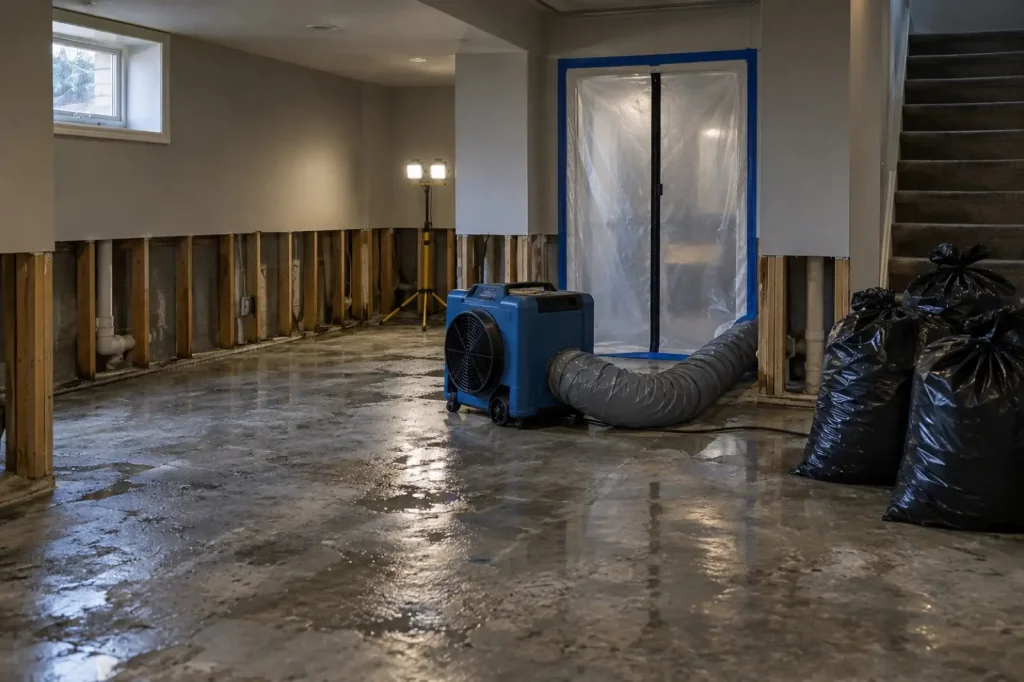
Sewage damage cleanup is a Category 3 job under ANSI/IICRC S500: contain the area, protect workers, remove the porous materials the sewage touched (drywall, insulation, carpet and pad), wash every surviving surface with detergent, apply an EPA-registered disinfectant for its full label contact time, dry the structure, then verify against documented criteria before anything is closed up.
Key takeaways
- Under S500, a waste line backflow from beyond any trap is Category 3 whatever its colour.
- S500: Category 2 and 3 losses are remediated before restorative drying, not dried in place.
- The Minnesota Department of Health: porous materials contacted by sewage should always be removed.
- Published bleach mixes for this work span about 24 to 1 across nine agency and extension documents. The product label governs.
- EPA: no biocide is registered for fiberglass duct board or lined duct.
- CDC’s immunization committee does not routinely recommend hepatitis A vaccination for people handling untreated sewage.
On this page
The EPA sanitary sewer overflow page estimates at least 23,000 to 75,000 sanitary sewer overflows a year in the United States, not counting backups into buildings. This is the protocol for the ones that get inside, built from IICRC’s published S500 text, OSHA, NIOSH, CDC, EPA and five health agencies. What the job costs is in our sewage backup cleanup cost guide.
Is it Category 3?
The IICRC S500 Consensus Body position statement of 16 March 2026 reprints the S500 5th edition definition: Category 3 water “is grossly contaminated and can contain pathogenic, toxigenic or other harmful agents.” Its examples start with sewage and with waste line backflows from beyond any trap, “regardless of visible content or color.”
The statement narrows one example: wind-driven rain and other weather water are not automatically Category 3, and the restorer inspects before deciding. Sewage gets no such latitude. Section 12.2.6 adds that time and temperature can shift a category, so clean water left standing can degrade. Our guide to the IICRC water categories covers the full framework, and a sewage loss that arrived with floodwater also belongs on our basement flood cleanup page.
The protocol, in order
S500 section 10.6.7 says that on Category 2 or 3 intrusions “remediation should occur prior to restorative drying and restorers shall use contamination controls and appropriate worker protection.” That sentence sets the order below.
| Step | What happens | Published basis |
|---|---|---|
| 1. Make the site safe | Structural, gas and electrical checks; children and pets out; no toilets or washers on a flooded septic system | NY DOH; WA DOH; OSHA FS-3276 |
| 2. Determine category, document | Identify the source; photograph and video before moving anything | S500 10.6; NY DOH |
| 3. Hazard assessment, then PPE | Assess, select PPE, certify the assessment in writing | 29 CFR 1910.132(d) |
| 4. Contamination controls | Barriers, pressure differentials, grilles sealed, air handler off | S500 10.6.7; EPA and OSHA guide |
| 5. Remove bulk sewage | Pump or wet vacuum standing water; floating fuel oil comes out first | NY DOH; EPA |
| 6. Remove porous materials | Drywall above the wick line, wet insulation, carpet and pad; bag on site | MDH; Texas A&M; WA DOH |
| 7. Clean with detergent | Hot water and detergent on every surviving surface | WA DOH; EPA six steps |
| 8. Disinfect to the label | Registered product, label dilution, wet for the full contact time | EPA six steps |
| 9. Dry | Fans, dehumidifiers, open cavities | S500; NY DOH |
| 10. Verify, then rebuild | Clean, dry, no debris or odour, framing below 15 percent moisture | EPA and OSHA guide; Texas A&M |
Worker protection and vaccination guidance
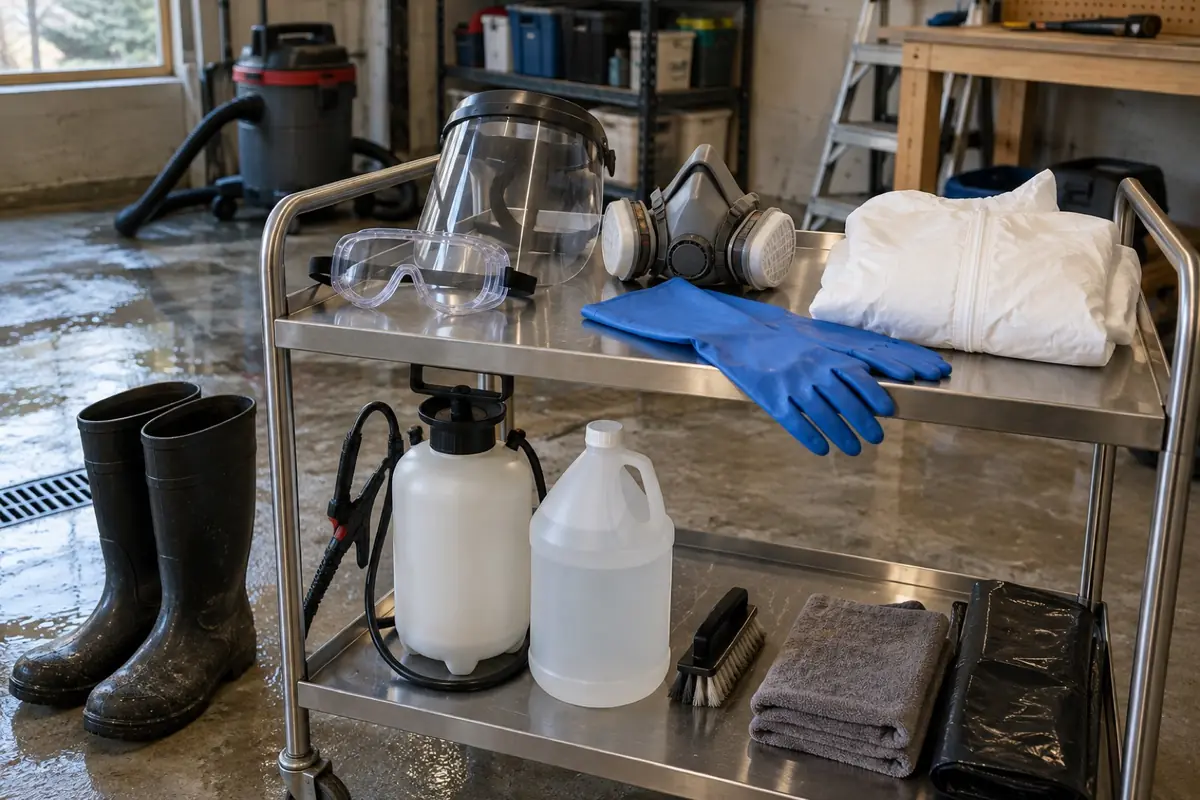
For employers the starting point is regulatory: 29 CFR 1910.132 requires a hazard assessment, PPE chosen from it, and a written certification naming the workplace, the evaluator and the date.
| Area | Published wording | Source |
|---|---|---|
| Eyes and face | Goggles, plus a face mask or splash-proof face shield | CDC |
| Breathing | N95 at minimum; a NIOSH-approved respirator inside a 1910.134 program, never a surgical mask | NY DOH; IDPH; NIOSH |
| Body | Liquid-repellent coveralls | CDC |
| Hands | Waterproof gloves, long enough to overlap sleeves | CDC; EPA and OSHA guide |
| Feet | Rubber boots; steel toe and insole, never sneakers | CDC; OSHA FS-3276 |
| Hygiene | Wash hands at once, cover cuts, change before leaving | CDC |
The NIOSH hurricane and flood key messages (May 2025) add yearly medical evaluation and fit testing for respirator wearers. CDC guidance for workers handling human waste recommends washing contaminated work clothing daily in 1 part bleach to 100 parts water.
Vaccination: worker-protection guidance, not medical advice
These are program recommendations; whether a worker needs a vaccine is for an occupational health provider.
| Source | What it says |
|---|---|
| NIOSH, May 2025 | Tetanus booster for flood responders not vaccinated in 10 years; hepatitis B series where blood or bodily fluid contact is expected |
| CDC's 2020 ACIP hepatitis A recommendations | “HepA vaccination is not routinely recommended for persons handling untreated sewage” |
| CDC worker page, April 2024 | Set policy with local health authorities; keep tetanus current; consider hepatitis A |
| OSHA fact sheet FS-3587, 2013 (shipyard sewage tanks) | Keep tetanus current; consult a physician about hepatitis A |
On the bloodborne pathogens standard, the OSHA interpretation letter of 30 July 2007 says the human waste in sewage is not “other potentially infectious materials” unless visibly contaminated with blood. Jobs with visible blood belong on our biohazard cleanup page.
Containment
S500 names the controls, containment barriers and pressure differentials, and says Category 3 jobs shall use them. Tearing out sewage-soaked drywall makes debris.
- Sheet off the work area and, as the Washington State Department of Health says, keep children and pets out until cleanup is complete.
- Shut the air handler. The NY DOH says not to run central air or the furnace blower if ducts were underwater.
- Set up a decontamination area at the exit and damp-clean exit routes with detergent.
- Bag removed material inside the contained area.
No federal document publishes an area ladder for sewage. The EPA and OSHA mold worker and employer guide has one for mold, useful once a sewage loss has grown mold. S500 requires Category 3 controls at any size.
What comes out and what stays
The EPA and OSHA mold worker and employer guide sorts materials three ways: non-porous (metal, glass, hard plastic) can be cleaned and reused; semi-porous (wood, concrete) can be cleaned and disinfected if sound; porous (drywall, carpet, insulation, ceiling tile) is “very difficult to fully clean.” For sewage the Minnesota Department of Health ends the debate: porous materials contacted by sewage should always be removed.
| Material | Class | Usual decision | What changes it | Basis |
|---|---|---|---|---|
| Drywall | Porous | Remove above the wick line, often 12 to 18 in over water height | Nothing on sewage | MDH; Texas A&M |
| Plaster and lath | Porous | Remove if saturated and soft | Surface wet only: clean, do not saturate | WA DOH |
| Fibrous insulation | Porous | Remove all wet | Nothing | Texas A&M; NY DOH |
| Carpet and pad | Porous | Remove, wrap, haul | WA DOH allows professional steam cleaning; MDH does not | WA DOH; MDH |
| Ceiling tile | Porous | Remove | Nothing | EPA |
| Wood paneling | Porous | NY DOH: discard if underwater | CDPHE: pry out, disinfect, dry, renail | NY DOH; CDPHE |
| Studs and sills | Semi-porous | Keep: clean, disinfect, dry | Rot or structural damage | CDPHE; Texas A&M |
| Concrete | Semi-porous | Wash thoroughly, dry | It soaks in; allow time | CDPHE |
| Linoleum, sealed floors | Hard surface | Detergent, bleach rinse, air dry | Sewage underneath | WA DOH |
| Metal, glass, plastic | Non-porous | Clean and reuse | No bleach on metal | EPA and OSHA guide |
The cut goes above the visible line because, per the Colorado CDPHE sewer backup bulletin, wallboard “acts like a sponge, drawing moisture up above water level.” Texas A&M AgriLife Extension sets the cut at a point above water height, often 12 to 18 inches, discards all wet fibrous insulation, and wants framing under 15 percent moisture before walls close. Our wet drywall guide covers the clean-water decision.
Cleaning, then disinfecting
EPA's six steps for disinfectant use run in this order: confirm the EPA registration number, read the directions, pre-clean with soap and water when the surface is visibly dirty (after sewage it always is), then keep the surface wet for the whole label contact time.
The EPA air duct guidance page states the legal rule: using a pesticide in any manner inconsistent with its label violates federal law. The EPA antimicrobial definitions separate sanitizers, which reduce microorganisms, from disinfectants, which destroy or irreversibly inactivate infectious fungi and bacteria. Sewage work calls for the second.
Why every agency’s bleach ratio differs
The ten mixes below, from nine documents, run from 15 mL to 355 mL per gallon, about 24 to 1. They answer different jobs, and none overrides the label on the bottle.
| Source | Printed mix | Written for | Per gallon |
|---|---|---|---|
| Washington DOH | 1 tablespoon per gallon | Hard surface rinse | 15 mL |
| CDC worker guidance | 1 part bleach to 100 parts water | Daily work clothing wash | 38 mL |
| New York DOH | 1 cup in 5 gallons | Hard surfaces after washing | 47 mL |
| Colorado CDPHE | 1/4 cup per gallon | Cleaning, 1 minute contact | 59 mL |
| OSHA decontamination | 1/4 cup per gallon | Tools and clothing, 10 minute soak | 59 mL |
| Minnesota DOH | 1/4 to 1/2 cup per gallon | Sewage backup damage | 118 mL |
| EPA and OSHA worker guide | 1/2 cup per gallon | Non-porous rinse | 118 mL |
| Texas A&M AgriLife | 1 cup per gallon | Studs and plates | 237 mL |
| Illinois DPH | no more than 1 cup per gallon | Disinfecting, stated as a maximum | 237 mL |
| OSHA decontamination | 1 1/2 cups per gallon | Heavy fecal soil, 3 minute stand | 355 mL |
Never mix bleach with ammonia, ventilate, and, per the EPA and OSHA guide, do not exceed the recommended strength.
HVAC ducts
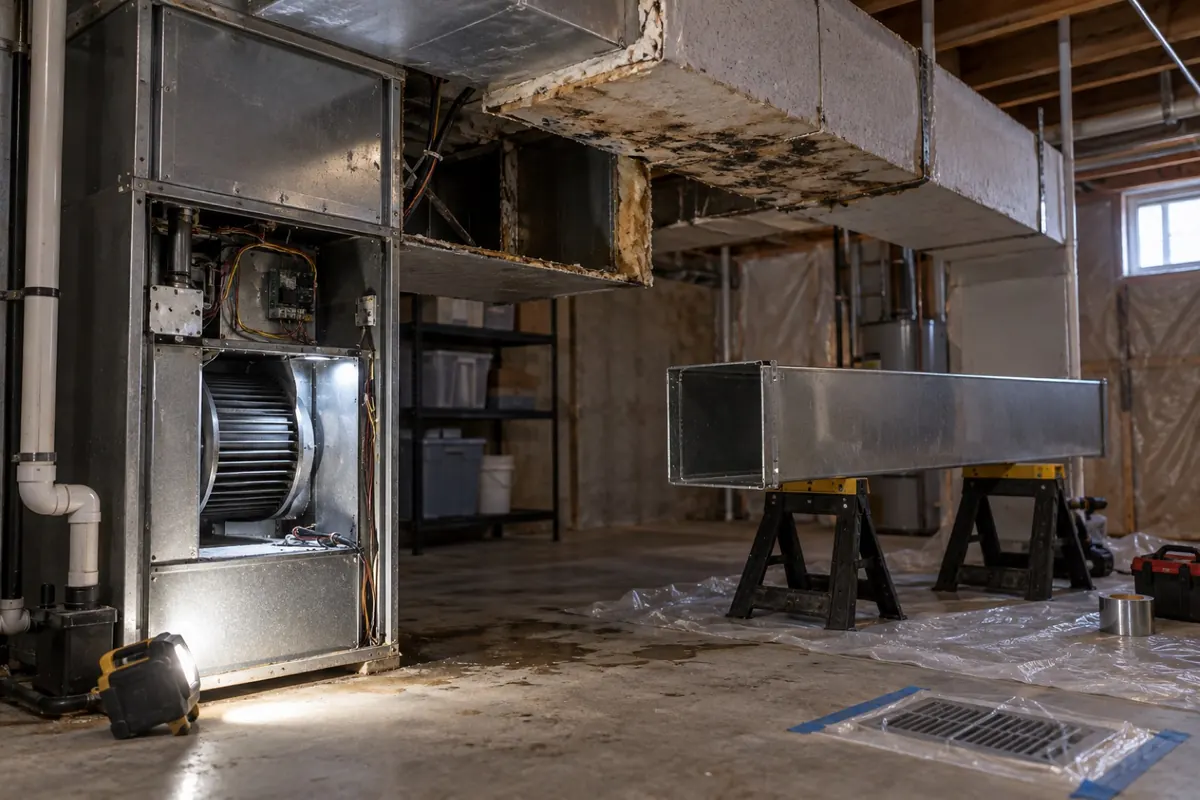
One blower cycle can carry contamination to rooms the sewage never reached. Duct material decides clean or replace.
| Component | Guidance | Source |
|---|---|---|
| Running the system | Not if ducts were underwater; inspect first | NY DOH; CDPHE |
| Filters | Replace disposable filters | NY DOH |
| Bare sheet metal duct | Cleanable; a few products are registered for its interior. Beware a “rinse with water” label step | EPA |
| Duct board or lined duct | No registered biocide exists; replace wet material | EPA, citing NADCA and NAIMA |
| Wet duct insulation | Cannot be effectively cleaned; replace | EPA |
| Method | No steam or wet cleaning on any ductwork | EPA |
Equipment repair is an HVAC contractor’s call; duct service is covered on our air duct cleaning page.
Contents
The Colorado CDPHE sewer backup bulletin test: items that “soak up contamination and are difficult to disinfect” generally go.
| Item | Usual outcome | Source |
|---|---|---|
| Mattresses, pillows, foam rubber | Discard | CDPHE; NY DOH |
| Upholstered furniture | Generally discard; WA DOH allows professional cleaning | CDPHE; WA DOH |
| Stuffed animals, baby toys, cosmetics | Discard | CDPHE |
| Food in contact, including cans | Discard; WA DOH gives a sanitizing method for undamaged cans | NY DOH; IDPH; WA DOH |
| Books and paper | Discard, except valuable documents | CDPHE; NY DOH |
| Clothing and linens | Hot wash, separately | NY DOH; WA DOH |
| China, glass, metal, jewelry | Clean and keep | NY DOH |
| Solid wood furniture | Clean and keep if sound | NY DOH |
Disposal
The OSHA letter of 28 August 1995 says sewage “would not meet the definition of ‘regulated waste’ under most circumstances,” visible blood excepted. Household sewage debris follows health department and hauler rules.
| Waste stream | Rule | Source |
|---|---|---|
| Carpet, pad, building materials | Wrap in plastic; transfer station or sanitary landfill | WA DOH |
| Bagged debris | Heavy sealed bags; double-bag moldy material | CDPHE; EPA and OSHA guide |
| Bulky furniture | Hauler pickup or landfill | CDPHE; NY DOH |
| Items in a claim | Photograph and hold until the adjuster sees them | NY DOH |
| Household chemicals | Leak-proof container, proper disposal | NY DOH |
| Mops and brushes | Disinfect in the bleach solution | WA DOH |
Verification
EPA’s EPA flood cleanup guidance says cleanup must be complete before reoccupying. S500 reserves sampling to the indoor environmental professional, who verifies “the return to a normal microbial ecology.” Most jobs are judged on the checks below.
| Check | Pass condition | Source |
|---|---|---|
| Visual | Clean, dry, free of visible debris | EPA and OSHA guide |
| Framing | Below 15 percent moisture before closing | Texas A&M |
| Odour | No musty odour | CDPHE |
| Final clean | HEPA vacuum once dry | EPA and OSHA guide |
| Records | Photos, video, damage list | NY DOH |
CDPHE warns that an enclosed basement can take several weeks to dry, so set the rebuild date from readings.
For contractors
Record the category basis: source, whether it came from beyond a trap, and photos; that record defends a Category 3 scope. S500 10.6.7 says to retain an IEP when occupants are high-risk, a public health issue exists, contaminants may be aerosolized, or contamination itself is in doubt.
- Duty: a written hazard assessment under 1910.132(d)(2) and a respiratory protection program wherever respirators are required.
- Line items: containment, PPE, removal by material and height, detergent cleaning, disinfectant with EPA registration number, drying days, disposal.
- Coverage: set by policy wording and endorsements. Point owners to their policy, their state insurance department or a licensed professional; our sewage backup cleanup cost guide explains the endorsement question.
What this page does not cover. Health effects of sewage exposure, symptoms, and whether anyone needs a vaccine are medical questions for CDC guidance and an occupational health provider. More water damage guides are on the water damage hub.
Questions people actually ask
How much does sewage backup cleanup cost?
Cost depends on the affected area, how much porous material comes out, and the rebuild, so it has its own page: our sewage backup cleanup cost guide sets out published price ranges and what each estimate line pays for. This page covers the process itself.
What is the best way to clean up a sewage spill?
Keep children and pets out, wear goggles, waterproof gloves and rubber boots, and remove standing sewage first. Take out porous materials it touched, wash hard surfaces with hot water and detergent, then apply a registered disinfectant for its full label contact time and dry the area. Washington’s health department publishes this sequence.
How long do sewer bacteria live on surfaces?
None of the agency guidance here relies on a survival time or safe waiting period. It treats every surface sewage touched as contaminated until cleaned and disinfected. EPA advises discarding items that cannot be cleaned and dried within 24 to 48 hours.
Does Lysol disinfect sewage?
Check the product, not the brand. EPA advises confirming the registration number, reading the use sites, pre-cleaning dirty surfaces and keeping the surface wet for the full contact time. Colorado’s bulletin mentions quaternary ammonium products such as Lysol for fabrics that bleach would fade. No spray works on unwashed sewage residue.
Can carpet be saved after a sewage backup?
Usually not. Minnesota’s health department says porous materials contacted by sewage should always be removed, and Washington’s says saturated wall-to-wall carpet and pad usually cannot be adequately cleaned, though it allows professional steam cleaning if an owner insists. The pad goes in every version of the guidance.
Do sewage cleanup workers need a hepatitis A vaccine?
CDC’s immunization committee wrote in 2020 that hepatitis A vaccination is not routinely recommended for people handling untreated sewage. NIOSH advises flood responders to get a tetanus booster if none in 10 years. Individual decisions belong with an occupational health provider.
Sources
- IICRC S500 Consensus Body position statement, Category of Water Damage and Weather-related Events, 16 March 2026, quoting S500 5th edition (2021); and the ANSI/IICRC S500 page. Retrieved 13 October 2026.
- CDC guidance for workers handling human waste, updated 22 April 2024. Retrieved 13 October 2026.
- CDC's 2020 ACIP hepatitis A recommendations, MMWR Recomm Rep 2020;69(5). Retrieved 13 October 2026.
- NIOSH hurricane and flood key messages, NIOSH 2025-106, May 2025. Retrieved 13 October 2026.
- 29 CFR 1910.132, via Cornell LII. Retrieved 13 October 2026.
- OSHA Cleanup Hazards fact sheet, FS-3276, October 2024. Retrieved 13 October 2026.
- OSHA General Decontamination fact sheet, September 2005. Retrieved 13 October 2026.
- OSHA interpretation letter of 30 July 2007 and OSHA letter of 28 August 1995, on raw sewage and 29 CFR 1910.1030. Retrieved 13 October 2026.
- OSHA fact sheet FS-3587, vessel sewage tanks, March 2013. Retrieved 13 October 2026.
- EPA and OSHA mold worker and employer guide (EPA, OSHA, HUD, NIH). Retrieved 13 October 2026.
- EPA flood cleanup guidance, EPA 402-F-18001, October 2018. Retrieved 13 October 2026.
- EPA air duct guidance, updated 19 February 2026. Retrieved 13 October 2026.
- EPA's six steps for disinfectant use (updated 1 April 2026) and EPA antimicrobial definitions (updated 29 January 2026). Retrieved 13 October 2026.
- EPA sanitary sewer overflow page, updated 13 April 2026. Retrieved 13 October 2026.
- Washington State Department of Health, Sewage Spills: Cleaning Them Up, DOH 821-015, revised 2007. Retrieved 13 October 2026.
- New York State Department of Health, Flood Cleanup and Home Repair, revised July 2024. Retrieved 13 October 2026.
- Minnesota Department of Health, Mold and Moisture, updated 19 February 2026. Retrieved 13 October 2026.
- Illinois Department of Public Health, Cleaning Up After Flood and Sewer Overflows, undated. Retrieved 13 October 2026.
- Colorado CDPHE sewer backup bulletin, Colorado Department of Public Health and Environment, November 2011 (older), hosted by Boulder County. Retrieved 13 October 2026.
- Texas A&M AgriLife Extension, Dry out before Rebuilding, undated. Retrieved 13 October 2026.
Guidance changes and local rules can be stricter. Follow the label of any disinfectant you use. Bleach conversions are arithmetic on the printed measures. Our methodology sets out how we source and label this site.