The short answer
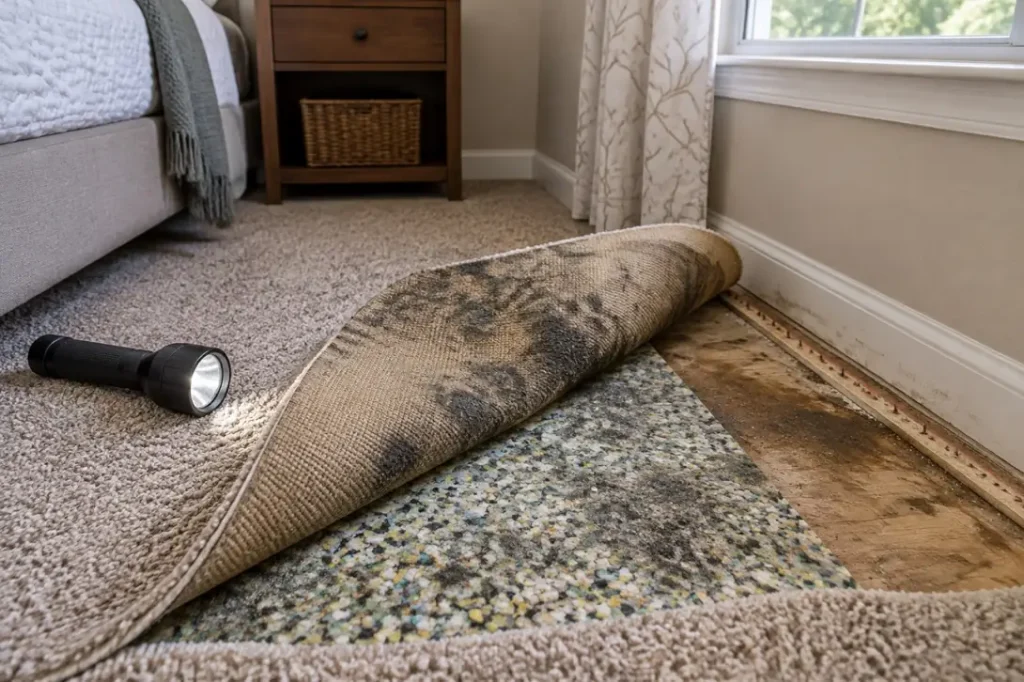
Mold on carpet is rarely just the spot you can see: it usually grows on soil in the fibers and spreads into the backing and pad, where it is hard to remove completely. EPA says moldy carpet may have to be thrown away, and its tables add discard once growth passes 10 square feet. Small growth on synthetic carpet from clean water can be extracted and dried. Sewage means discard.
Key takeaways
- The pad decides it. CRI says a wet cushion is very difficult to dry quickly and generally needs replacing; NC State says pad wet with gray or black water goes, no exceptions.
- EPA Table 2 lists carpet and backing for discard (method 4) in its 10 to 100 sq ft and larger bands.
- Clean synthetic carpet is not food. CRI’s white paper says mold feeds on the soil on it, while natural fibers such as wool are nourishment.
- Category beats fiber: S500 summaries from NC State and Connecticut send Category 3 carpet and all gray water pad to disposal.
- Antimicrobial carpet treatments protect the product. CRI notes no carpet is registered with EPA as a finished treated article.
- According to Fixr, remediation runs $10 to $30 per square foot and replacement pad $0.35 to $1.14.
On this page
What you are looking at
EPA mold course, chapter 3 warns that carpet stains may look like mold, and that a small piece of the suspect material, or a little of it on clear sticky tape, is enough for a laboratory to say. The CRI mold white paper describes colonies as cottony, velvety, granular or leathery, in colors from white to black, and links the musty odor to gases mold releases as it digests its host.
| What it is | How it shows on carpet | Source |
|---|---|---|
| Mold growth | Cottony, velvety, granular or leathery patches in white, gray, brown, black, yellow or green, often with a musty smell | CRI mold white paper |
| Filtration soiling | Dark or grayish lines along walls, stairs and under doors, from air pulling fine soil through the pile | CRI troubleshooting bulletin |
| Wicking | A stain that reappears after cleaning as soil in the pad rises up the fibers while drying | Fixr carpet cleaning guide |
| Old spill or stain | Flat discoloration with no texture or odor | EPA mold course, chapter 3 |
| Growth on the underside | Nothing on top; musty odor; dark spots on the backing or pad when a corner is lifted | EPA's Brief Guide to Mold |
Filtration soiling fools people most: the CRI troubleshooting bulletin says it follows airflow and needs aggressive chemistry, not mold scope. Spots that return after cleaning signal soil or growth below. White fuzz elsewhere is on our white mold page.
Why the pad is the real problem
EPA's Brief Guide to Mold lists the underside of carpets and pads among the places mold hides, and says porous materials such as carpet may need discarding because mold fills the empty spaces and crevices. EPA mold course, chapter 3 adds that backing or padding must be dried with the carpet or mold will likely result. The pad sits on the subfloor, out of the airflow. Does a soaked pad need replacing? The Carpet and Rug Institute FAQ says generally yes: wet cushion is very difficult to dry adequately and quickly.
The backing is the second hiding place. NC State Extension notes that moisture weakens the latex backing and that walking on wet carpet can make it separate. A small spot on top can be a sheet of growth underneath, so lift a corner first. Drying a carpet that has not yet grown anything is a different job, covered on our how to dry wet carpet page.
Fiber type changes the odds
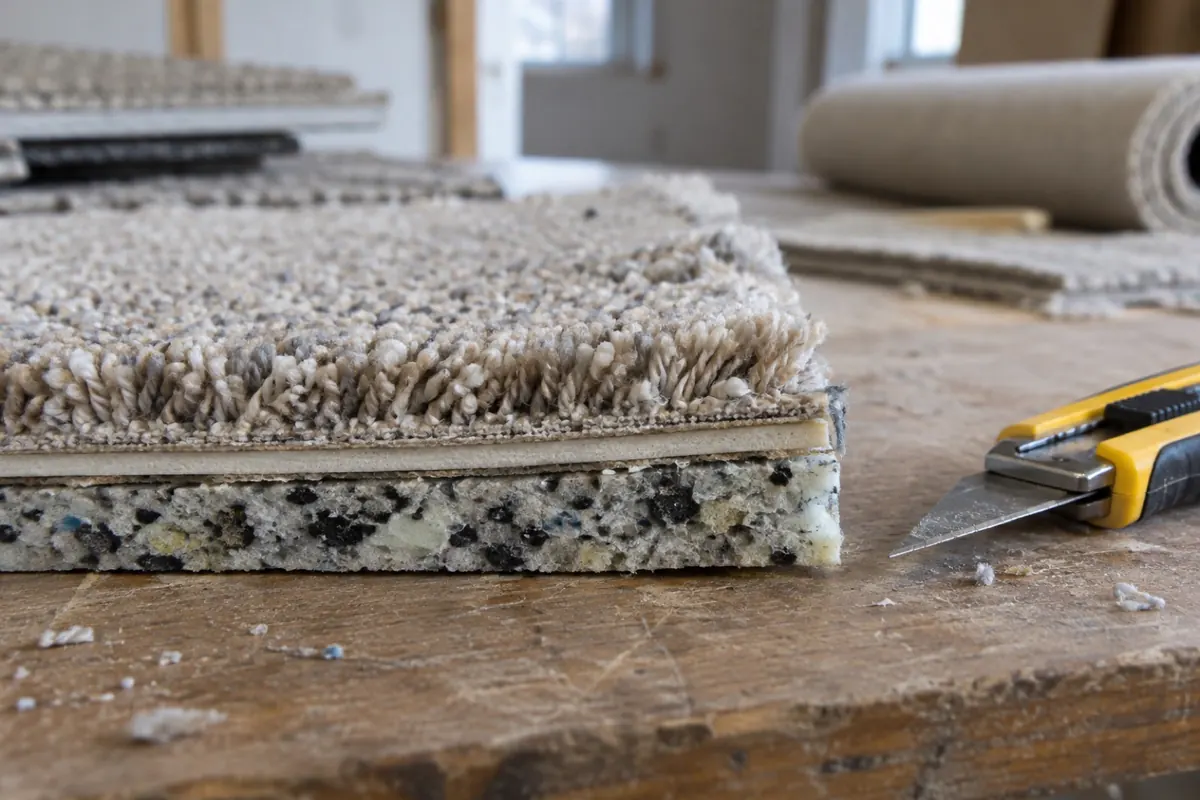
The CRI fiber guide says most US carpet uses one of five pile fibers: nylon, polyester, polypropylene (olefin), triexta and wool. The CRI mold white paper draws the line that matters: when clean and free of foreign organic matter, synthetic carpet materials do not support mold growth, while natural fibers are a food source. The CRI FAQ adds that even wool kept clean and dry should not have a mold problem.
| Fiber | How it takes on moisture | Food for mold? | Cleaning caution | Material cost per sq ft |
|---|---|---|---|---|
| Nylon | Low in moisture absorbency (AFMA) | No, when clean (CRI) | Fixr says it resists mold and mildew | $2 to $5 |
| Polyester | Quick drying; resists stretching and shrinking (AFMA) | No, when clean (CRI) | Standard extraction | $1 to $3 |
| Olefin (polypropylene) | Quick drying; resists mildew and rot (AFMA) | No, when clean (CRI) | AFMA lists it as heat sensitive | $1 to $3 |
| Triexta | Synthetic, similar to polyester (Fixr) | No, when clean (CRI) | Fixr says it resists mold and mildew | $3 to $8 |
| Wool | Absorbs moisture vapor; protein rich (Woolmark) | Yes: natural fibers feed mold (CRI) | No bleach (NC State); suction only vacuum (CRI) | $4 to $20 |
Why this differs from generic advice: “spray it and scrub” assumes a synthetic. On wool, NC State’s bleach rinse for the backing is ruled out, and EPA’s footnote for valuable items applies: consult a restoration specialist.
What EPA says to do with moldy carpet
EPA 402-K-01-001, EPA’s remediation guide, splits carpet into two tables. Table 1 covers clean water damage caught within 24 to 48 hours; Table 2 covers materials with mold growth by area. Its method 1 note says steam cleaning may be an alternative for carpets, and method 4 means sealing the material in plastic bags and disposing of it as normal waste.
| Situation | EPA action | Note |
|---|---|---|
| Clean water, carpet not yet moldy | Dry within 24 to 48 hours: extract, dehumidify, fans (Table 1) | The subfloor must also be cleaned and dried |
| Growth under 10 sq ft | Methods 1 and 3: wet vacuum or steam clean, then HEPA vacuum once dry | Spores remain in porous material but will not grow if completely dried |
| Growth 10 to 100 sq ft | Methods 1, 3 and 4: discard added | Limited containment and PPE |
| Growth over 100 sq ft | Methods 1, 3 and 4 | Full containment and PPE |
| Sewage or contaminated water | Outside the clean water tables | EPA says OSHA requires PPE and containment |
EPA calls the tables guidelines that professional judgment adapts; gear by band is on our DIY mold remediation page.
Water category decides before fiber does
The IICRC S500 standard is sold, but two public bodies publish summaries that cite it. NC State Extension (Sarah Kirby, 2014, reviewed 27 March 2024) says to remove and dispose of carpet saturated with black water, and of pad saturated with gray or black water, no exceptions. Connecticut DAS guidance (revised 7 February 2011) says that for Category 2 or 3 water, replacing saturated carpet and cushion is typically the only recourse, while carpet wetted by gray water, but not its cushion, can be restored with biocide, dwell time and hot water extraction.
| Category | Typical source | Pad | Carpet | Source |
|---|---|---|---|---|
| Category 1, clean | Supply line, tub or sink overflow, rainwater | Restorable if wet under 48 h and only part of it | Clean and dry | NC State Extension |
| Category 2, gray | Dishwasher, washing machine, toilet overflow | Discard, no exceptions | Biocide, dwell time, hot water extraction by a professional | NC State Extension; Connecticut DAS guidance |
| Category 3, black | Sewage, river or surface flooding, seawater | Discard | Discard | NC State Extension; Connecticut DAS guidance; Carpet and Rug Institute FAQ |
Time moves the line. NC State says gray water left untreated beyond 48 hours may become black water as microorganisms multiply, and Connecticut says gray water sources become black water if not attended to rapidly. Mold already showing means time has passed. Definitions are on our IICRC water categories page.
Clean or discard: the decision matrix
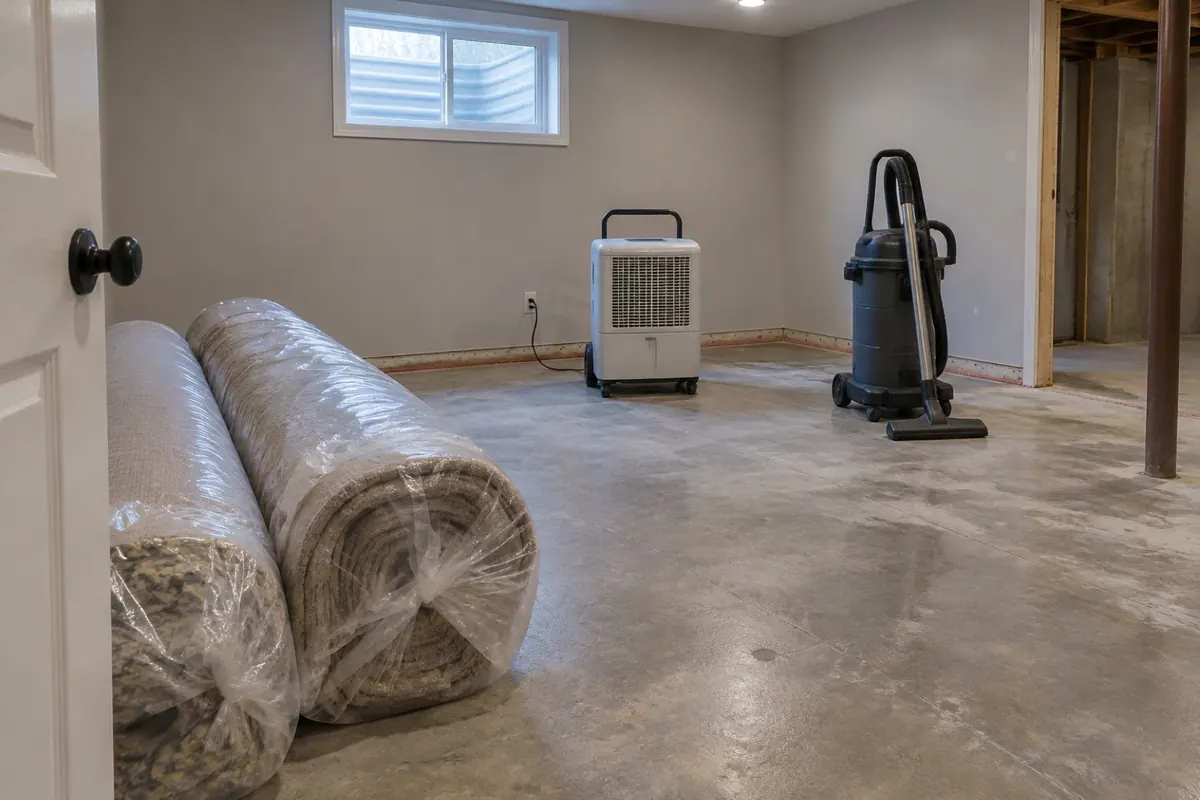
Find the carpet’s row, then the water and time column. Each cell names its source; where sources differ, the stricter reading is shown.
| Carpet type | Clean water, under 48 h, no growth | Clean water, mold visible | Gray water (Cat 2) | Black water (Cat 3) |
|---|---|---|---|---|
| Synthetic, wall to wall over pad | Keep carpet; pad only if partly wet (NC State) | Under 10 sq ft clean, dry, HEPA; larger, discard (EPA Table 2) | Pad out; carpet by pro, biocide and extraction (CT DAS) | Discard carpet and pad (NC State) |
| Wool, wall to wall over pad | Keep; no bleach on wool (NC State) | Wool feeds mold (CRI); specialist or discard (EPA) | Pad out; pro cleaning, no bleach (NC State) | Discard carpet and pad (CRI FAQ) |
| Glue down, no pad | Clean in place if treated within 24 h (NC State) | Under 10 sq ft clean; larger, discard (EPA Table 2) | Restorable with biocide and extraction (CT DAS) | Discard (NC State) |
| Washable throw rug | Machine wash, hot water and biocide (NC State) | Machine wash, hot water and biocide (NC State) | Machine wash, hot water and biocide (NC State) | Hot wash with biocide (NC State); if it cannot be washed at 130 F, discard (CRI FAQ) |
| Valuable area rug | Professional cleaning (NC State) | Specialist (EPA footnote) | Pro cleaning and biocide; discard if not sanitary (NC State) | Pro cleaning; discard if not sanitary (NC State) |
How to get mold out of carpet, when it can stay
For a small patch on synthetic carpet after clean water, the matrix cell where cleaning is the default.
- Stop the water. The CRI FAQ says locate and repair the source. Why it differs: it is often below the pad.
- Lift a corner. Check the backing and pad underside. Why: EPA lists the underside of carpets and pads as a hidden site, and top spots understate it.
- Measure. Count backing and pad. Why: past 10 sq ft, EPA Table 2 adds discard.
- Cut out moldy pad. Why: CRI says wet cushion is hard to dry and generally replaced, and Fixr prices pad far below carpet.
- Extract. EPA method 1 is wet vacuum or steam cleaning, and CRI says extraction cleaning removes spores best. Why: removal, not a spray, is the goal.
- Dry fast. CRI says wet cleaned carpet should be dry within 12 hours. Why: EPA says leftover spores stay dormant only if the material is completely dried.
- HEPA vacuum once dry. EPA method 3. Why: fragments remain in porous material.
- Bag what goes. EPA method 4 seals it in plastic. Why: dragging moldy carpet through a house spreads it.
On sprays: the CRI antimicrobial bulletin says EPA rules let treated carpet claim only protection of the carpet itself against mold odor and staining, and that antimicrobials never replace moisture control. Product labels are covered on our mold killer page, bleach on our bleach page, and vinegar on our vinegar page.
Mold under carpet, on the subfloor
The deck gets the same rule as the carpet: EPA 402-K-01-001 footnotes that the subfloor under carpet must also be cleaned and dried. NC State Extension says plywood should be dried completely before reinstalling and lists a bleach solution of 3/4 cup per gallon left for at least 10 minutes; Connecticut DAS guidance calls for two biocide applications on a subfloor wetted by Category 2 or 3 water. Subfloor repair belongs to our subfloor water damage page; carpet over a slab is covered on our mold on concrete page.
| What you find | What it means | Next step |
|---|---|---|
| Growth on the pad underside | Pad has been wet a while | Remove pad; inspect deck |
| Dark staining on plywood or OSB | Deck wetted through | Clean, dry, measure before new pad |
| Swollen or crumbling particleboard | NC State: it swells and disintegrates when wet for days | Replace the panel |
| Spots return after cleaning | Soil or growth below the face | Lift and inspect |
| Musty odor, no visible spot | Hidden growth, per EPA | Lift a corner, consider sampling |
| Area past 10 sq ft, or gray or black water | EPA Table 2 or S500 summaries apply | Professional scope |
What each outcome costs
According to the Fixr carpet cleaning guide, professional cleaning runs $0.18 to $0.36 per square foot, and according to the Fixr carpet installation guide, pad adds $0.35 to $1.14 (both modified 31 January 2025). According to the HomeAdvisor carpet replacement guide, replacement runs $3 to $11; according to the HomeAdvisor mold remediation guide (updated 19 June 2026), most remediation lands at $10 to $25 per square foot, against $10 to $30 in the Fixr mold remediation guide (29 August 2025). The spread is shown, not averaged.
A new pad costs a fraction of remediating the old one. Whole-job pricing is on our mold remediation cost page.
For contractors
A scope that survives review states the category, time wet, area against EPA’s bands, and pad and deck condition. Line items are pad removal and disposal, carpet removal or detach and reset, antimicrobial with dwell time where restoring gray water carpet, hot water extraction, HEPA vacuuming, subfloor cleaning and drying equipment days.
- Document category and source; Connecticut DAS guidance says category determines what can be saved.
- Photograph the pad underside and deck, not just the top.
- Log moisture readings to completion; Connecticut says a meter should verify drying and areas not dry within 48 hours be documented.
- On sewage losses, EPA states OSHA requires PPE and containment.
- An adjuster will ask why carpet was discarded, not cleaned: cite the category and summaries, and leave coverage to the policy wording.
The category sits in our mold hub.
What this page does not cover. Whether carpet mold affects a particular person’s health is outside this page’s scope; see EPA, CDC and NIH. Coverage questions belong with your policy, your state insurance department and a licensed professional.
Questions people actually ask
Is carpet mold harmful?
Health effects are outside this page’s scope; EPA, CDC and NIH publish that information. For the carpet, growth means moisture and soil have been present long enough, and EPA says moldy carpet may have to be thrown away because mold fills the spaces in porous materials and can be impossible to remove completely.
Can carpet with mold be saved?
Sometimes. Small growth under 10 square feet on synthetic carpet wetted by clean water can be wet vacuumed or steam cleaned, dried and HEPA vacuumed under EPA Table 2. Larger growth adds discard. Carpet soaked by sewage, and pad soaked by gray or black water, go regardless, per NC State Extension.
What will kill mold on carpet?
EPA’s carpet methods remove rather than kill: wet vacuum or steam clean, dry completely, HEPA vacuum, or discard. EPA notes spores left in porous material will not grow if it is completely dried. Disinfectants and labels are covered separately; no spray reaches growth in the pad.
Does Lysol kill mold spores on carpet?
Any spray is limited by its label, which lists the surfaces and organisms it covers; EPA’s course says to follow it. CRI says antimicrobials never replace moisture control. A surface spray does not reach the backing or pad, where carpet mold usually sits.
What color is mold on carpet?
Any color. CRI’s white paper lists white, gray, brown, black, yellow and green, with cottony, velvety, granular or leathery textures. Dark lines along walls and under doors are more often filtration soiling, which CRI attributes to airflow pulling fine soil through the pile.
How do I know if there is mold under my carpet?
Lift a corner at the wettest or smelliest spot and look at the backing and the pad underside. EPA lists the underside of carpets and pads among hidden mold sites, and a musty odor with no visible growth is the usual clue. EPA says a lab needs only a small piece or a tape sample.
Sources
- EPA 402-K-01-001, US EPA: Tables 1 and 2, cleanup methods. Retrieved 19 October 2026.
- EPA's Brief Guide to Mold, EPA mold course, chapter 3 and EPA mold course, chapter 4, US EPA. Retrieved 19 October 2026.
- Carpet and Rug Institute FAQ, CRI cleaning guidance, CRI fiber guide, CRI mold white paper (October 2008), CRI antimicrobial bulletin (19 April 2018) and CRI troubleshooting bulletin (27 July 2017). Retrieved 19 October 2026.
- NC State Extension, Water-Damaged Carpets and Rugs, Sarah Kirby, 11 June 2014, reviewed 27 March 2024; cites IICRC S500. Retrieved 19 October 2026.
- Connecticut DAS guidance, Recommended Water Damage Response Actions, issued 16 August 2006, revised 7 February 2011; cites IICRC S500. Retrieved 19 October 2026.
- American Fiber Manufacturers Association fiber quick guide and Woolmark fiber page. Retrieved 19 October 2026.
- Fixr carpet cleaning guide and Fixr carpet installation guide (modified 31 January 2025), Fixr mold remediation guide (modified 29 August 2025). Retrieved 19 October 2026.
- HomeAdvisor carpet replacement guide (updated 20 June 2026) and HomeAdvisor mold remediation guide (updated 19 June 2026). Retrieved 19 October 2026.
- IICRC S500 is sold; category rules come from the two summaries above. Remediation Insider ran no tests for this page. Our methodology sets out the rules.
Prices are national ranges from the named guides; local quotes vary. Follow the carpet maker’s care instructions for the specific product.