The short answer
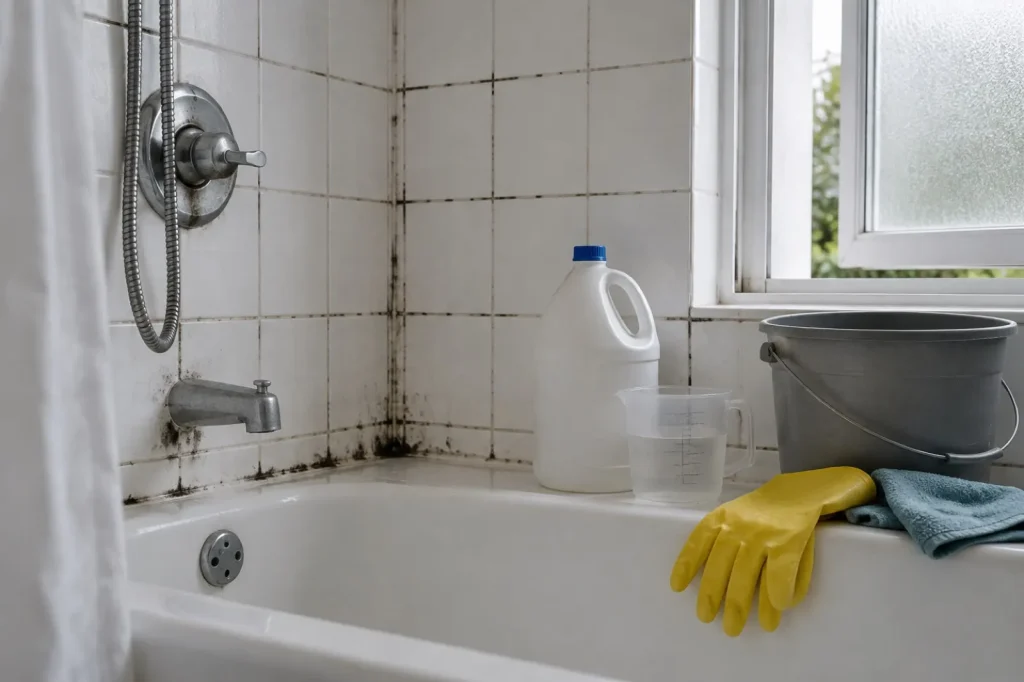
Does bleach kill mold? On hard, nonporous surfaces, yes: in a 2012 University of Arizona study, 2.4 percent sodium hypochlorite left test molds nonculturable within 5 to 10 minutes. But EPA says bleach is ‘not recommended as a routine practice during mold cleanup’, because mold must be removed, not just killed. CDC’s disaster recipe is no more than 1 cup per gallon.
Key takeaways
- EPA and CDC disagree less than it looks: CDC’s recipe sits in disaster material, and a CDC fact sheet says a home with a little mold ‘may not need to use bleach’.
- The bleach label’s indoor mold directions cover hard, nonporous surfaces, which is also where the lab evidence is strong.
- No source read for this page supports the claim that bleach ‘feeds’ mold. The documented problems are organic matter using up chlorine and regrowth from spores below the surface.
- Bleach plus ammonia makes chloramine gas; bleach plus an acid, including vinegar, makes chlorine gas, per Poison Control.
- OSHA’s limit for chlorine is a 1 ppm ceiling, fifty times tighter than its 50 ppm limit for ammonia, per 29 CFR 1910.1000 Table Z-1.
- Registered mold products include fungistats that inhibit growth; Concrobium’s label requires correcting the conditions that caused the mold before applying.
On this page
Government advice on bleach seems to contradict itself depending on which page you land on. This page lines the agencies up, reads the bleach label, and separates evidence from forum lore. Vinegar is compared agent by agent on our does vinegar kill mold page.
EPA and CDC: two answers to the same question
EPA’s position, from EPA's Should I use bleach to clean up mold? page: ‘The use of a chemical or biocide that kills organisms such as mold (chlorine bleach, for example) is not recommended as a routine practice during mold cleanup.’ It adds that ‘it is not enough to simply kill the mold, it must also be removed.’
CDC prints a recipe. CDC's Preventing Mold page says: ‘If you see or smell mold, clean it with a solution of 1 cup household liquid bleach per 1 gallon of water.’ CDC's Mold Clean Up Guidelines frames it as a ceiling: ‘Use no more than 1 cup of bleach in 1 gallon of water.’
Why the two agencies differ
Context. The CDC recipe sits in disaster material, and CDC fact sheet CS295513-A explains that after a hurricane or flood, ‘Bleach and dish detergent might be the only things available.’ It scales bleach to the damage: mud out first, bleach for moderate mold, and with ‘only a little mold and minor water damage you may not need to use bleach.’ EPA writes for routine cleanup, where removal and drying do the work.
| Source | Position | Ratio | Link |
|---|---|---|---|
| EPA, bleach page | ‘Not recommended as a routine practice’; professional judgment may indicate it | None | EPA's Should I use bleach to clean up mold? page |
| EPA, schools guide | Biocides ‘are toxic to humans, as well as to mold’ | None | EPA's Mold Remediation in Schools and Commercial Buildings |
| CDC, Preventing Mold | Disaster toolkit recipe | 1 cup per gallon | CDC's Preventing Mold page |
| CDC, Mold Clean Up | ‘Bleach or dish detergent can be used’ | No more than 1 cup per gallon | CDC's Mold Clean Up Guidelines |
| CDC, disaster fact sheet | Little mold, minor water damage: ‘you may not need to use bleach’ | No more than 1 cup (8 ounces) per gallon | CDC fact sheet CS295513-A |
| Clorox master label | Mold and mildew removal, hard nonporous surfaces | 3/4 cup per gallon, 10 minutes wet | Clorox master label, EPA Reg. No. 5813-114 |
What bleach does in the lab
The clearest positive result is Reynolds and colleagues, J Occup Environ Hyg 2012, from the University of Arizona. According to the authors, the team took 1,330 samples from non-porous surfaces in 160 US homes, then found in controlled lab tests that five-minute exposures to 2.4 percent sodium hypochlorite cut culturable mold by more than 3 to more than 6 log10, with organisms nonculturable after 5 minutes on non-porous and 10 minutes on porous ceramic carriers.
Two other results are the caution. On pine wood blocks, as summarised in Rogawansamy and colleagues, IJERPH 2015, bleach and four other agents held growth back at first, then spores recovered once the agents were rinsed off, a reversible effect described as mycostasis. And in Rabby and colleagues, Int J Microbiol 2025, a 10 percent hypochlorite solution gave only a 0.41 log reduction of Aspergillus niger in five minutes on agar. Method, organism and surface move the result a long way, which is why our vinegar page shows the test surface beside every agent it compares.
The porous-surface argument, sorted
Most ranking pages say bleach ‘cannot penetrate’ porous materials. Some of that is evidence and some is folklore, so each claim is graded against a source.
| Claim | Status | What the evidence says | Source |
|---|---|---|---|
| Bleach kills mold on tile and glass | Supported | Lab carriers went nonculturable in minutes; the label’s indoor mold directions are for hard, nonporous surfaces | Reynolds and colleagues, J Occup Environ Hyg 2012; Clorox master label, EPA Reg. No. 5813-114 |
| Bleach cannot reach mold inside porous material | Partly | Spores in pine recovered; porous ceramic carriers did clear, so ‘porous’ is not one material | Rogawansamy and colleagues, IJERPH 2015 |
| Dirt uses up the chlorine | Supported | CDC lists ‘inactivation by organic matter’; the label says to preclean soiled surfaces | CDC's disinfection guideline; Clorox master label, EPA Reg. No. 5813-114 |
| The water in bleach feeds the mold | Not supported | No source read for this page makes the claim; moisture drives growth, which is why EPA’s method ends with drying | EPA's Mold Cleanup in Your Home |
| Bleach just hides mold by whitening it | Partly | The label sells ‘mold and mildew stain removal’; EPA says dead mold must still be removed | Clorox master label, EPA Reg. No. 5813-114; EPA's Should I use bleach to clean up mold? page |
| Mold always comes back after bleach | Misattributed | EPA: it comes back if the water problem is not fixed | EPA's A Brief Guide to Mold, Moisture and Your Home |
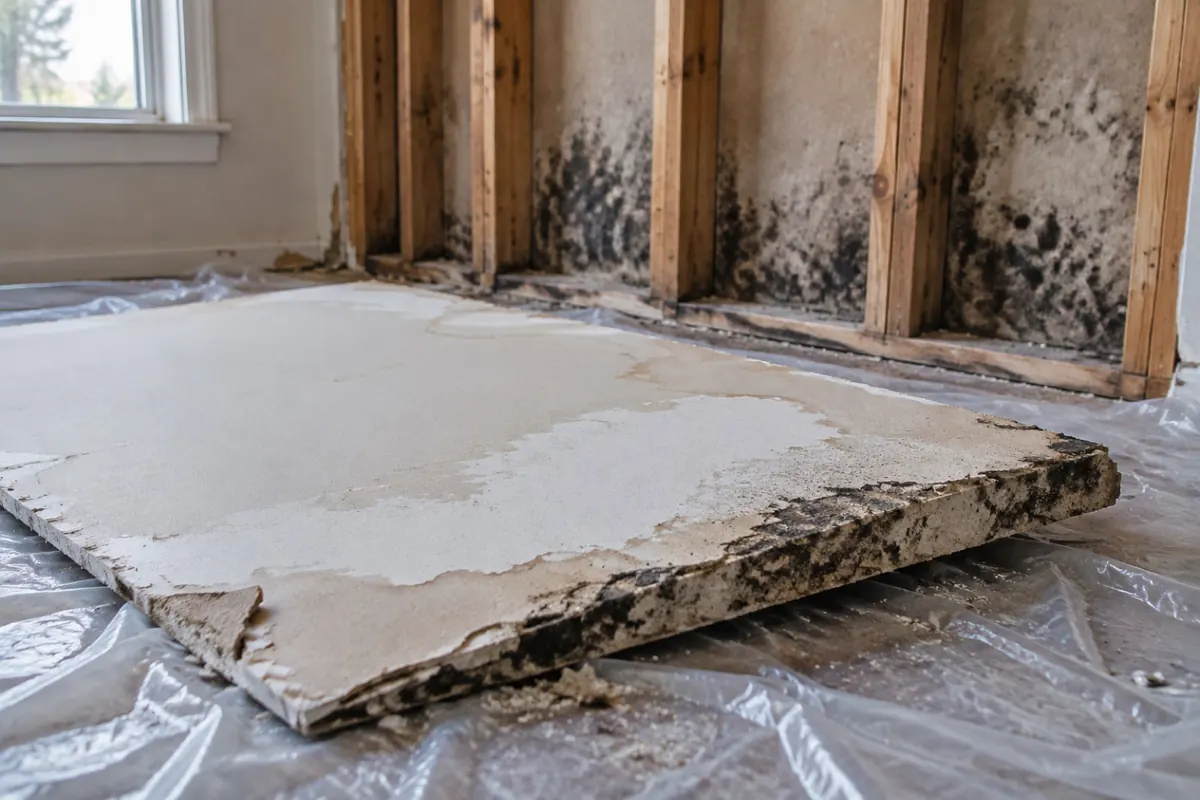
The practical answer is EPA’s, from EPA's Mold Cleanup in Your Home: porous materials such as ceiling tiles and carpet ‘may have to be thrown away if they become moldy’, because the mold may be ‘difficult or impossible to remove completely.’ No spray changes that.
Chemical hazards and exposure limits
Every source agrees on one rule. EPA's Should I use bleach to clean up mold? page: ‘Never mix chlorine bleach solution with other cleaning solutions or detergents that contain ammonia because toxic fumes could be produced.’ CDC's Mold Clean Up Guidelines: ‘You should never mix bleach with ammonia or any other cleanser.’ The OSHA and NIOSH InfoSheet 3512 warns that mixing bleach and ammonia products can be fatal.
| Bleach mixed with | What forms | Source |
|---|---|---|
| Ammonia, including many glass cleaners | Chloramine gas | Poison Control; EPA's Should I use bleach to clean up mold? page |
| Acids, including vinegar and some toilet bowl cleaners | Chlorine gas | Poison Control; CDC's disinfection guideline |
| Toilet bowl cleaners, rust removers, acids, ammonia | ‘Hazardous irritating gases’ | Clorox master label, EPA Reg. No. 5813-114 |
| Any other cleanser | CDC: never mix | CDC's Mold Clean Up Guidelines |
The limits show why. Under 29 CFR 1910.1000 Table Z-1, OSHA’s limit for chlorine is a ceiling of 1 part per million, never to be exceeded, against 50 ppm for ammonia averaged over a shift: 50 times tighter. Per Poison Control, chlorine gas is heavier than air, so it may linger near the ground.
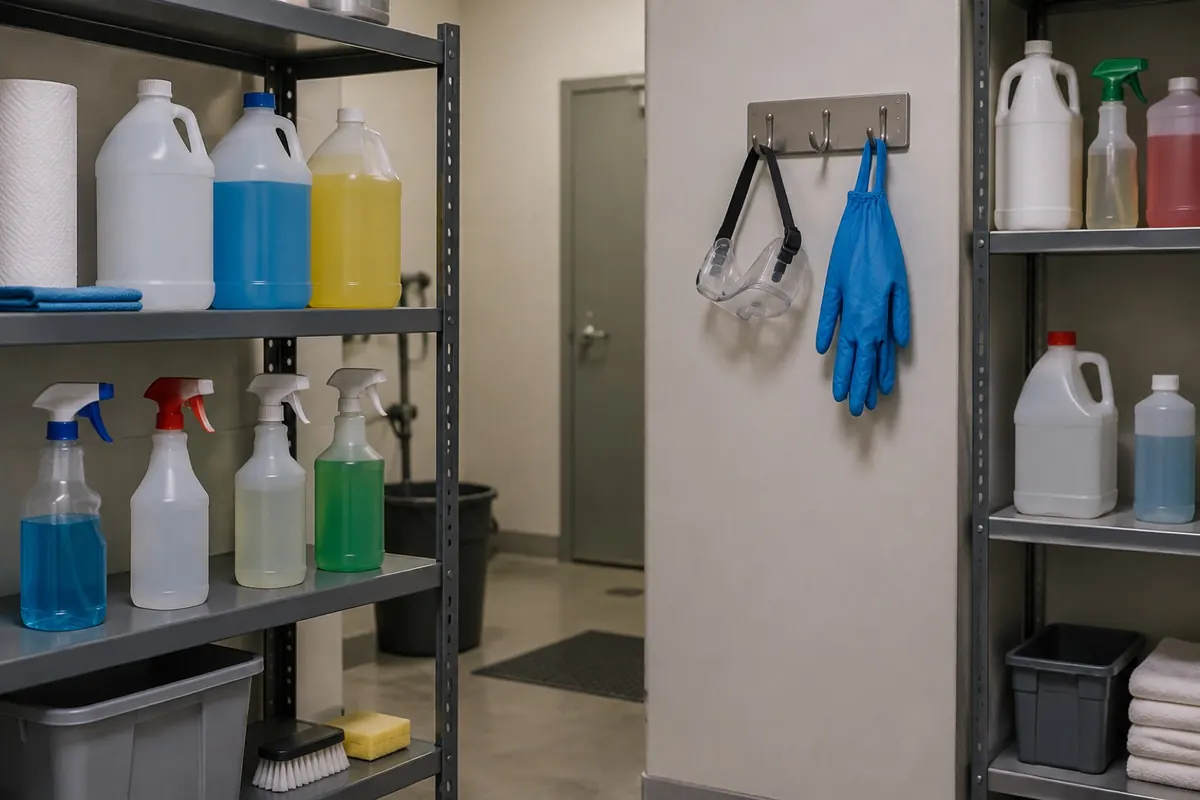
For crews, the OSHA and NIOSH InfoSheet 3512 lists the duties under OSHA’s Hazard Communication standard, 29 CFR 1910.1200: accessible Safety Data Sheets, training before first use including dilution, and warning workers not to mix bleach and ammonia products. EPA's Mold Remediation in Schools and Commercial Buildings adds gloves of natural rubber, neoprene, nitrile, polyurethane or PVC with any biocide.
Which registered products carry mold claims
A mold claim on a US label is a pesticide claim and needs an EPA registration number. These products were looked up in EPA’s Pesticide Product and Label System and read from the stamped label where available. They show the range of chemistries; this is not a market survey or a recommendation.
| Product | EPA Reg. No. | Active ingredient | Mold or mildew claim | Source |
|---|---|---|---|---|
| Clorox bleach (master label CLB I) | 5813-114 | Sodium hypochlorite 6.05% | Mold and mildew stain removal: hard nonporous surfaces, colorfast exteriors, laundry | Clorox master label, EPA Reg. No. 5813-114 |
| Concrobium Mold Control | 82552-1 | Sodium carbonate 0.95% | Fungistat and mildewstat; fix moisture conditions first | Concrobium label, EPA Reg. No. 82552-1 |
| Concrobium Mold Control Plus | 82552-3 | Sodium carbonate 1% | EPA index lists Aspergillus niger, Penicillium, molds | EPA record for 82552-3 |
| Benefect Biocide AD | 84683-2 | Thymol 0.23% | Fungistat and mildewstat for air ducts | Benefect Biocide AD label, EPA Reg. No. 84683-2 |
| Microgen D-125 | 61178-1 | Two quaternary ammonium compounds, 2.37% each | EPA index lists mold, mildew, Aspergillus niger | EPA record for 61178-1 |
| Fiberlock ShockWave RTU | 61178-2-73884 | Quaternary ammonium | Brand bulletin says registered to kill mold | Fiberlock ShockWave RTU bulletin |
‘Fungistat’ and ‘mildewstat’ are the labels’ own words, and both labels describe controlling or inhibiting growth. The Concrobium label, EPA Reg. No. 82552-1 requires users, before applying, to ‘correct conditions favorable to mold growth’, and offers ‘remove visible mold growth’ as optional label text. The Clorox entry is a master label with optional bracketed text, so a retail bottle may not carry every use; read yours. The Clorox and Concrobium labels both state: ‘It is a violation of Federal law to use this product in a manner inconsistent with its labeling.’
If you use bleach: the label method
Bleach is not EPA’s routine method, but it is a registered product and its label is the instruction. Work through the decision path first.
- Over about 10 square feet, hidden in a wall, in the HVAC system, or caused by sewage? Stop: EPA points those jobs to professional help or its professional guide. See our DIY mold remediation limits.
- Porous material, such as drywall, ceiling tile or carpet? Bleach will not save it; plan removal.
- Hard and nonporous, such as glazed tile, glass or sealed plastic? Continue.
- Anything else sprayed there, such as vinegar, an acid toilet cleaner or a glass cleaner? Rinse with water and ventilate first.
- Fix the moisture source, then follow the table.
| Step | Do this | Why, and the source |
|---|---|---|
| 1 | Ventilate; gloves and goggles on | EPA and CDC |
| 2 | Preclean with detergent and water | Organic matter inactivates chlorine (CDC); label requires it |
| 3 | Mix fresh: 3/4 cup per gallon of water | Clorox label; prepare solutions daily |
| 4 | Keep the surface wet for 10 minutes | Label contact time |
| 5 | Rinse well, then dry completely | Label and EPA |
| 6 | Rinse metal promptly; avoid unfinished wood | Label; CDC: corrosive above 500 ppm |
| 7 | Recheck days later: no growth, no musty odour | EPA completion test |
How strong is 1 cup per gallon?
According to the Clorox master label, EPA Reg. No. 5813-114, its bleach yields 5.75 percent available chlorine. On that strength, according to our arithmetic, CDC’s 1 cup per gallon gives about 3,382 ppm and the label’s 3/4 cup per gallon about 2,575 ppm, both far above the 500 ppm level CDC’s disinfection guideline calls corrosive to metals. Household bleach varies; Poison Control says typically 3 to 6 percent.
Do not store the mix: according to CDC's disinfection guideline, dilute hypochlorite in closed, opaque containers can lose up to 40 to 50 percent of its free available chlorine in a month. Bathroom grout and silicone are covered on our mold in the shower page.
For contractors: bleach on a protocol
Bleach on a mold job is a scope decision that needs a reason. EPA's Mold Remediation in Schools and Commercial Buildings does not recommend routine biocide use and notes that ‘some States require that only registered pesticide applicators apply these products in schools.’ Expect an adjuster or auditor to ask what was applied, at what dilution, and why removal was not enough.
| Document this | Why | Source |
|---|---|---|
| Why a biocide was used | EPA does not recommend routine use; record the judgment | EPA's Mold Remediation in Schools and Commercial Buildings |
| Product and EPA Reg. No. | Shows a labelled use | Clorox master label, EPA Reg. No. 5813-114 |
| Dilution and dwell time | From the label, not memory | Clorox master label, EPA Reg. No. 5813-114 |
| SDS and crew training | OSHA Hazard Communication | OSHA and NIOSH InfoSheet 3512 |
| Ventilation, products kept apart | Chlorine has a 1 ppm ceiling | 29 CFR 1910.1000 Table Z-1 |
| Removed versus cleaned | Porous material may have to go | EPA's Mold Cleanup in Your Home |
Sewage and flood losses carry their own scope; see our sewage damage cleanup guide and the mold remediation process.
What this page does not cover. Health effects of mold and of chemical exposure are outside our scope; see EPA, the CDC or NIH, and in an emergency call Poison Control on 1-800-222-1222. Our mold hub lists our other mold guides.
Questions people actually ask
Is bleach or vinegar better for killing mold?
On hard, nonporous surfaces, bleach has the stronger lab record and a registered label; vinegar stopped one of two molds in the main study. Neither is EPA’s routine method, which is detergent and water, then drying. See our does vinegar kill mold page. Never mix the two.
What kills 100% of mold?
No cleaner does on real building materials. EPA says sterilising an area is usually neither possible nor desirable, because background spores stay inactive once moisture is fixed. Bleach can clear hard lab surfaces, but EPA’s goal is removal: scrub hard surfaces, discard moldy porous material and dry everything.
Will mold grow back after bleaching?
Yes, if the moisture remains. EPA says that if you clean up mold but do not fix the water problem, it will most likely come back. On porous material, spores below the surface can also recover once bleach is rinsed off, as a study on pine blocks found. Fix the leak or humidity first.
What gets rid of black mold?
The same methods as any mold. EPA sizes cleanup by area and material, not colour: scrub hard surfaces with detergent and water, remove moldy porous material, dry the area, and above about 10 square feet use professional guidance. Our black mold versus regular mold guide covers identification.
Does bleach kill mold or just hide it?
On a hard surface it can do both: kill surface growth and remove the stain, which the Clorox label markets as mold and mildew stain removal. A white surface is not proof the growth is gone from grout pores or porous backing, and EPA says dead mold must still be removed. Scrub first, then judge.
Does bleach kill mold on wood?
The bleach label’s indoor mold directions are for hard, nonporous surfaces. Its wood use is whitening, and its exterior mold stain directions say to avoid unfinished wood. In a study on pine, treated spores recovered after rinsing. Dry the wood, clean the surface, and replace wood that is soft.
Sources
- EPA's Should I use bleach to clean up mold? page, updated 8 September 2026. Retrieved 13 October 2026.
- EPA's A Brief Guide to Mold, Moisture and Your Home (18 February 2026), EPA's Mold Cleanup in Your Home (4 June 2026) and EPA's Mold Remediation in Schools and Commercial Buildings (29 April 2026). Retrieved 13 October 2026.
- CDC's Preventing Mold page, reviewed 26 August 2026, and CDC's Mold Clean Up Guidelines, reviewed 16 February 2024. Retrieved 13 October 2026.
- CDC fact sheet CS295513-A, When to Use Bleach, 31 August 2018. Retrieved 13 October 2026.
- CDC's disinfection guideline, Chemical Disinfectants, reviewed 28 November 2023. Retrieved 13 October 2026.
- Clorox master label, EPA Reg. No. 5813-114, accepted 28 April 2026. Retrieved 13 October 2026.
- Concrobium label, EPA Reg. No. 82552-1 (accepted 24 February 2023) and EPA record for 82552-3. Retrieved 13 October 2026.
- Benefect Biocide AD label, EPA Reg. No. 84683-2 (accepted 11 June 2012) and EPA record for 61178-1. Retrieved 13 October 2026.
- Fiberlock ShockWave RTU bulletin, ICP Group. Retrieved 13 October 2026.
- Reynolds and colleagues, J Occup Environ Hyg 2012, PubMed abstract. Retrieved 13 October 2026.
- Rogawansamy and colleagues, IJERPH 2015, including its summary of Chakravarty and Kovar 2013. Retrieved 13 October 2026.
- Rabby and colleagues, Int J Microbiol 2025, Table 1. Retrieved 13 October 2026.
- Poison Control, National Capital Poison Center. Retrieved 13 October 2026.
- OSHA and NIOSH InfoSheet 3512, OSHA 3512-02 2012. Retrieved 13 October 2026.
- 29 CFR 1910.1000 Table Z-1, via eCFR. Retrieved 13 October 2026.
- Figures marked computed are arithmetic on the label’s available chlorine. See our methodology.
Product labels change. The label on your container, not this page, is the legal instruction.