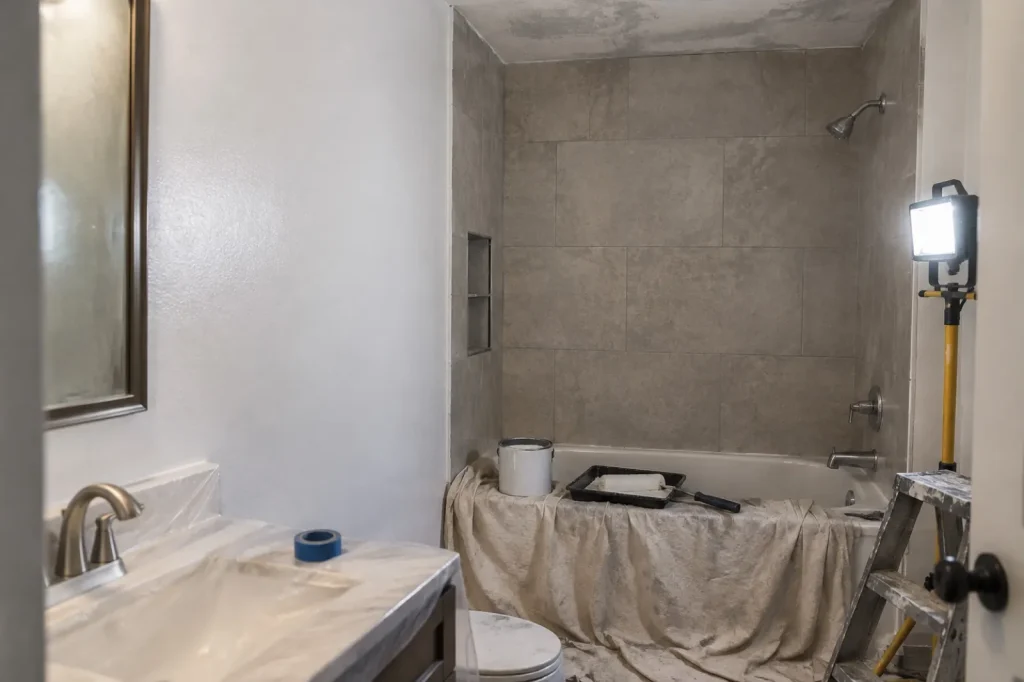
The short answer
Mold killing paint does not remove existing mold, and most paints sold as mold resistant never claim to kill it. Their preservative protects only the dried paint film, which is the EPA treated article exemption. One primer, Zinsser Mold Killing Primer, carries an EPA registered kill claim for non-porous surfaces, but EPA’s homeowner guidance still says to clean and dry mold before painting.
Key takeaways
- Mold resistant paint protects itself. Under 40 CFR 152.25(a) the exemption covers paint treated “to protect the paint coating”, not the wall underneath.
- Of five products read here, only Zinsser Mold Killing Primer claims to kill existing mold, under EPA Reg. No. 87469-1-69587.
- Every other data sheet tells you to remove existing mold first; KILZ’s label says it “MUST be removed”.
- Only Perma-White cites a fungal test (ASTM D5590 and D3273), with no score printed. Benjamin Moore’s only ASTM citation is a flame spread test.
- ASTM says a D3273 rating does not imply any specific period of time for a fungal free coating.
- EPA: “Do not paint or caulk moldy surfaces.”
On this page
- Two products share one name
- The treated article exemption
- Five data sheets, side by side
- What ASTM D3273 and D5590 prove
- What EPA says about painting over mold
- What you are looking at
- Which situation are you in?
- Surface preparation, by the data sheets
- The method, step by step
- When paint is the wrong answer
- For contractors
- Questions people actually ask
Two very different products share one name
The shelf mixes two legal categories. A registered pesticide coating carries an EPA registration number and can make a kill claim for the organisms and surfaces on its label. A treated article is ordinary paint with a preservative in the can that protects the paint film; it needs no registration of its own and may not claim to kill anything beyond itself. Four of the five products read here, sold as mold resistant paint, antimicrobial paint or mold inhibiting primer, are the second kind. The kill versus remove question in general is on how to kill black mold.
| Registered kill-claim coating | Treated article paint | |
|---|---|---|
| Example read here | Zinsser Mold Killing Primer | Perma-White, Emerald, Aura Bath & Spa, KILZ primer |
| EPA registration on the can | Yes: EPA Reg. No. 87469-1-69587 | No product registration needed; the preservative itself is registered |
| What it may claim | Kills listed organisms on the coated surface | Resists mold on its own dried film |
| Legal basis | FIFRA registration and label | 40 CFR 152.25(a) and PRN 2000-1 |
The treated article exemption, read accurately
40 CFR 152.25(a) exempts from FIFRA “An article or substance treated with, or containing, a pesticide to protect the article or substance itself (for example, paint treated with a pesticide to protect the paint coating, or wood products treated to protect the wood against insect or fungus infestation), if the pesticide is registered for such use.”
EPA Pesticide Registration Notice 2000-1 (6 March 2000) sets two conditions: the incorporated pesticide is registered for that use, and “the sole purpose of the treatment is to protect the article or substance itself.” It lists as a non-public health claim “A claim to inhibit the growth of mildew on the surface of a dried paint film or paint coating,” and gives acceptable wording such as “Dried paint film resists mold fungus” and “Provides mildew-resistant dried paint coating.”
The same notice lists claims EPA is likely to treat as needing registration, including “Improves indoor air quality through the reduction of microorganisms” and “Controls allergy causing microorganisms.” It also says terms such as “antimicrobial” and “mildew-resistant” must be clearly qualified as non-public health uses, with the qualifier given equal prominence. Sherwin-Williams’ M-1 additive shows the system from the supply side: Sherwin-Williams M-1 Advanced Mildew Treatment is described as “Registered by EPA to inhibit mildew, mold and algae on dry film” for mixing into latex and oil paints.
| Label wording | What PRN 2000-1 treats it as | What it means for you |
|---|---|---|
| “Dried paint film resists mold fungus” | Acceptable treated article claim | The film resists growth; nothing under it is treated |
| “Antimicrobial”, qualified to the film | Acceptable if clearly qualified | Same: film protection |
| “Improves indoor air quality” via fewer microbes | Likely needs registration | Outside the exemption; the product would need registering |
| “Kills existing mold” with an EPA Reg. No. | Registered pesticide claim | Read the label for surfaces and directions |
Five data sheets, side by side
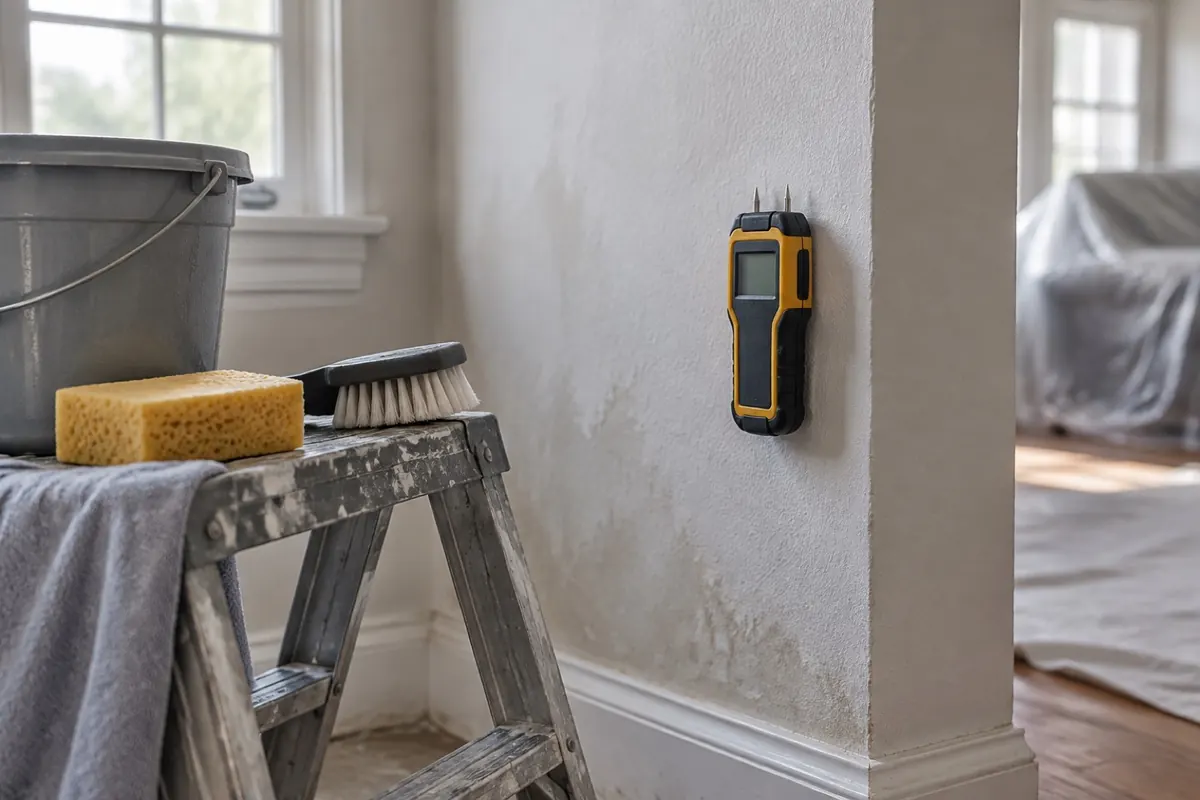
The table below quotes each manufacturer document. On Rust-Oleum’s own site the mold killing primer is listed under its Zinsser brand, and the data sheet is published by Rust-Oleum Corporation, so “Rust-Oleum Mold Killing Primer” and the Zinsser product are one item here. The brush-on KILZ data sheet on behr.com and the US Aura sheet on benjaminmoore.com would not open, so the KILZ aerosol label and Benjamin Moore’s UK sheet are quoted.
| Product | Claim wording | Test standard cited | What it actually protects |
|---|---|---|---|
| Zinsser Mold Killing Primer (Zinsser Mold Killing Primer technical data) | “EPA registered fungicidal protective coating that can be used to paint over and kill all existing mold, mildew” | None for fungal resistance | Kill claim on the coated non-porous surface, plus the paint film |
| Zinsser Perma-White Interior (Perma-White Interior technical data (US)) | “preventing mold & mildew growth on the paint film” | “passes ASTM 5590 and 3273 Standard Testing”, no score printed | The paint film |
| KILZ Mold & Mildew aerosol (KILZ Mold & Mildew aerosol primer label) | “creates a mold and mildew-resistant film that protects the primer” | None | The primer film |
| Sherwin-Williams Emerald Interior (Sherwin-Williams Emerald Interior data sheet) | “agents which inhibit the growth of mold and mildew on the surface of this paint film” | None for fungal resistance | The paint film surface |
| Benjamin Moore Aura Bath & Spa 532 (Benjamin Moore Aura Bath & Spa 532 data sheet) | “antimicrobial additives that inhibit the growth of mould and mildew on the surface of the paint film” | ASTM E-84 only, a flame spread test | The paint film surface |
Per the Zinsser Mold Killing Primer label, the active ingredient is 3-iodo-2-propynylbutylcarbamate at 0.0063% (63 ppm). The label calls the product “for use on non-porous” surfaces, yet the same label prints a porous surface coverage rate and the data sheet lists sub-floors and wall cavities among application sites. Read that as “paintable”, not as permission to coat moldy drywall.
Guarantees also vary by market. Perma-White’s Canadian sheet guarantees the dried film for 10 years when two coats are applied; a UK distributor sheet says 5 years; the US sheet states no term.
What ASTM D3273 and D5590 actually prove
ASTM D3273 (active edition D3273-21) evaluates “the relative resistance of interior coatings to surface fungal growth in a severe interior environment during a 4-week period.” Per the ASTM scope, the chamber needs relative humidity above 93% at 32.5 °C (90 °F), and “Performance at a certain rating does not imply any specific period of time for a fungal free coating.” ASTM D5590 is a four-week agar plate assay; per the ASTM page for its 2017 edition (D5590-26 is now active), it “does not imply that a coating that resists growth under these conditions will necessarily resist growth in the actual application.”
Both are comparative tests of the film. Neither tests whether paint kills mold already on a wall. A “passes” statement with no rating, as on the Perma-White sheet, tells you the test was run, not how the film scored.
What EPA says about painting over mold
EPA's Brief Guide to Mold, Moisture and Your Home is direct: “Do not paint or caulk moldy surfaces. Clean up the mold and dry the surfaces before painting. Paint applied over moldy surfaces is likely to peel.” EPA's remediation guidance, Chapter 3 adds the principle behind it: “It is necessary to clean up mold contamination, not just to kill the mold.” It also says porous materials that are wet and moldy may have to be discarded.
That sits uneasily with Rust-Oleum’s product page, which says you can “Paint directly over existing mold and mildew without extensive pre-cleaning.” The label narrows it: a pre-cleaning step is required for “wet, slimy, heavy soiled, gross filth, overgrowth or loose material,” and “Do not attempt to salvage damaged or structurally unsound building materials.” A registered kill claim answers whether organisms on the surface die. It does not answer removal, which is what EPA asks for.
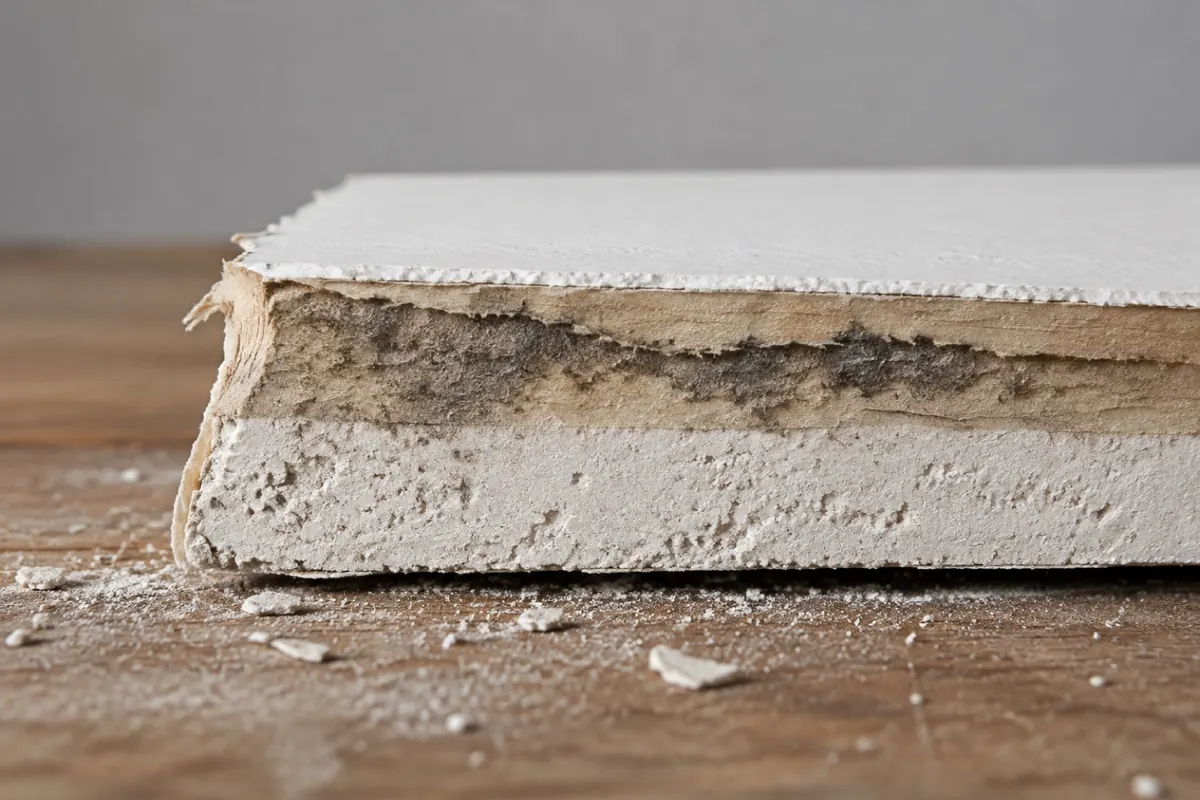
What you are looking at on a painted surface
| What you see | Likely cause | Paint’s role |
|---|---|---|
| Spotting on top of an intact paint film, bathroom ceiling | Surface growth on the film, the case ASTM D3273 models | Clean it; a mildew-resistant topcoat helps next time |
| Drips or residue that wash off in a shower area | Surfactant leaching, which Benjamin Moore’s sheet calls common where moisture concentrates | Wash off before repainting |
| Stain left after cleaning, no fuzz | Stain; Perma-White says mold, water and tannin stains need a stain-blocking primer | Stain blocker, then topcoat |
| Paint peeling or blistering over an old spot | Paint over mold; EPA says it is likely to peel | Strip, clean, dry, recoat |
| Growth returning through new paint, soft wall | Growth in the substrate (see wet drywall) | None: replace material |
Which situation are you in?
- The moisture source is not fixed. Stop. Zinsser’s label says to fix moisture first; no film holds out a leak.
- Growth has gone into drywall paper, ceiling tile or soft wood. Replace the material. Paint is the wrong tool; see mold on walls.
- Active growth on a sound, hard surface. Remove it with a cleaner or registered mildew remover, then dry (every data sheet above).
- Clean and dry, but stained. Stain-blocking primer, then a mildew-resistant topcoat.
- A humid room that keeps spotting. Two coats of a mildew-resistant finish, plus ventilation. Bathroom ceilings are covered on mold on bathroom ceiling.
- Attic sheathing. Coatings there are a remediation step covered on attic mold removal.
Surface preparation, by the data sheets
No competitor page in the current results compares what the manufacturers themselves say to do before their product goes on. They agree more than the marketing suggests.
| Product | Existing mold | Cleaning instruction | Before coating |
|---|---|---|---|
| Zinsser Mold Killing Primer | Pre-clean overgrowth and loose material | EPA-registered mildew remover if mold must be removed | Fix moisture; above 50°F |
| Perma-White Interior | “Remove all existing mold and mildew” | One cup household bleach per gallon of water, or a biocidal wash | Two coats; 50 to 90°F, humidity below 80% |
| KILZ Mold & Mildew aerosol | “MUST be removed before priming” | Mildew remover, rinse with water | Allow to dry |
| SW Emerald Interior | Remove mildew before painting | 1 part bleach to 3 parts water, 10 minutes, rinse; bleach may damage existing paint | Allow to dry; above 50°F |
| BM Aura Bath & Spa | Surface free of mildew | Wash off surfactant leaching | Clean, dry; above 50°F |
The method, step by step
| Step | Why this differs from generic painting advice |
|---|---|
| 1. Fix the water and confirm the surface is dry. | Generic painting skips this. Zinsser’s label puts it first, and EPA says dry before painting. |
| 2. Decide porous or non-porous. | Zinsser’s kill claim is for non-porous surfaces; EPA says moldy porous material may need discarding. |
| 3. Remove the growth, not just the colour. | EPA asks for cleanup, not only kill. Containment and size limits are on DIY mold remediation. |
| 4. Rinse and dry. | SW warns bleach may damage or discolor existing paint; every sheet says let the surface dry. |
| 5. Block stains. | Mildew-resistant paint does not hide stains; both Zinsser sheets name a stain blocker. |
| 6. Apply two coats of the mildew-resistant finish. | Perma-White says two coats are required for its mold resistance; one coat is a different, thinner film. |
| 7. Respect the label clock. | Zinsser says topcoat within 72 hours (3 days); full adhesion takes 7 days. |
When paint is the wrong answer
- Spots return through new paint within weeks.
- The wall is soft, swollen or reads wet on a meter.
- Growth covers more than about 10 square feet, EPA’s line for calling in help.
- There is a musty smell with no visible growth.
- The surface is porous and the stain goes into it.
- Water is still getting in.
For contractors: label duty, line items and documentation
The Zinsser label states “It is a violation of Federal law to use this product in a manner inconsistent with its labeling.” EPA’s Chapter 3 notes some biocides are pesticides and that some states require registered pesticide applicators to apply them in schools; check your state before applying a registered coating for hire. Write any antimicrobial coating as a step after removal and drying, not as the remediation; label reading is on mold killer products.
| Record | Why an adjuster or owner asks for it |
|---|---|
| Product name and EPA Reg. No., or treated article status | Shows whether a kill claim was even possible |
| Photos after removal, before coating | EPA asks for cleanup, not paint over |
| Moisture readings at coating time | Labels require dry surfaces |
| Coats applied and recoat times | Perma-White’s performance needs two coats |
| SDS and label on file | Label directions govern use |
What this page does not cover. Health effects are out of scope; see EPA and CDC. We name products only to quote their published documents; this is not a recommendation. More: mold hub.
Questions people actually ask
Does mold killing paint really work?
Mostly it protects itself. Mold resistant paints carry a preservative that resists growth on their own dried film, which EPA treats as a treated article under 40 CFR 152.25(a). Only a registered product such as Zinsser Mold Killing Primer may claim to kill existing mold, and only on the surfaces and in the way its label allows.
Can you paint over mold with mold killing paint?
EPA’s homeowner guidance says no: do not paint or caulk moldy surfaces; clean up the mold and dry the surface first, because paint over mold is likely to peel. Zinsser’s registered primer label allows coating over existing growth on non-porous surfaces but still requires pre-cleaning of heavy or loose growth and a fixed moisture source.
What is the best paint to kill mold?
No paint removes mold. Among the five documents read here, only Zinsser Mold Killing Primer makes a registered kill claim. For preventing regrowth on a cleaned surface, the useful comparison is the claim wording, whether a fungal test is cited, and whether the data sheet requires two coats, as Perma-White’s does.
Does anti-mold paint really work in a bathroom?
It can slow growth on the paint film in a humid room, which is what ASTM D3273 tests in a chamber above 93 percent humidity. ASTM says a rating does not imply any period free of growth, and the paint does nothing for moisture. Ventilation and drying still decide whether the ceiling spots again.
What is antimicrobial paint?
Usually ordinary paint with a preservative in the can. EPA’s PRN 2000-1 allows the word antimicrobial on such paint only when it is clearly qualified to protecting the product. A paint claiming to kill germs or improve indoor air through fewer microbes is making a claim EPA says needs registration.
Is a mold inhibiting primer different from mold resistant paint?
Legally they can be the same thing. KILZ describes its primer as creating a mold and mildew-resistant film that protects the primer, a treated article claim. Zinsser Mold Killing Primer is different: it carries an EPA registration number and a kill claim. Check the label for a registration number.
Sources
- 40 CFR 152.25(a), via eCFR. Retrieved 19 October 2026.
- EPA Pesticide Registration Notice 2000-1 and the PR Notice 2000-1 PDF, 6 March 2000; page updated 4 November 2025. Retrieved 19 October 2026.
- EPA's Brief Guide to Mold, Moisture and Your Home, updated 18 February 2026. Retrieved 19 October 2026.
- EPA's remediation guidance, Chapter 3, updated 29 April 2026. Retrieved 19 October 2026.
- Zinsser Mold Killing Primer technical data, Rust-Oleum Form GDH-252, Rev. 121021, and the Zinsser Mold Killing Primer label. Retrieved 19 October 2026.
- Rust-Oleum, Zinsser Mold Killing Primer product page. Retrieved 19 October 2026.
- Perma-White Interior technical data (US), PWH-02, Rev. 120922. Retrieved 19 October 2026.
- Perma-White Interior technical data (Canada), Rev. 1/25/24. Retrieved 19 October 2026.
- Perma-White Interior TDS, New Guard Coatings (UK distributor). Retrieved 19 October 2026.
- KILZ Mold & Mildew aerosol primer label, Masterchem Industries, retailer-hosted copy. Retrieved 19 October 2026.
- Sherwin-Williams Emerald Interior data sheet, K37 Series. Retrieved 19 October 2026.
- Sherwin-Williams M-1 Advanced Mildew Treatment product page. Retrieved 19 October 2026.
- Benjamin Moore Aura Bath & Spa 532 data sheet, Benjamin Moore & Co., UK edition, 2021. Retrieved 19 October 2026.
- ASTM D3273 (D3273-21) and ASTM D5590 scope pages, ASTM International. Retrieved 19 October 2026.
- Ratios are arithmetic on the printed figures. Nothing here was invented; see our methodology.
Formulas and labels change. Read the label on the can you buy; it is the legally binding direction for use.