The short answer
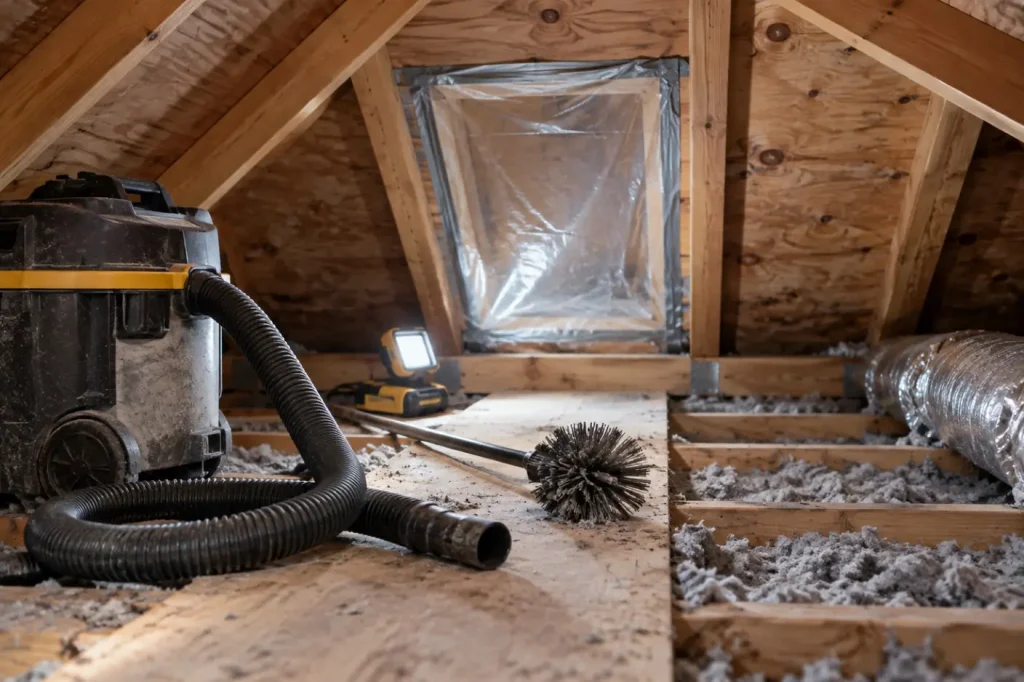
Attic mold removal is a sequence, not a spray. Confirm it is growth rather than old stain, fix the moisture source, seal the hatch, HEPA vacuum and brush, sand or blast the sheathing, bag wet insulation, then correct ventilation and bath fans. Per the 2021 IRC, a vented attic needs net free vent area of 1/150 of its floor, or 1/300 when the vents are balanced.
Key takeaways
- Per the USDA Wood Handbook, surface mold on softwood often brushes or surfaces off, while blue stain penetrates and cannot be removed by surfacing. Stain left after cleaning is not failure.
- Per the 2021 IRC, a 1,500 square foot attic needs about 1,440 square inches of net free vent area, or 720 under the balanced-vent exception.
- Bath fans may not vent into an attic: IRC M1501.1 and M1505.2 send exhaust outdoors, at 50 cfm intermittent or 20 continuous per Table M1505.4.4.
- EPA says to remove mold, not just kill it, and calls routine biocide use, bleach included, not recommended.
- Coatings go on after cleaning. The EPA Reg. No. 63836-2 coating label claims to kill residual mold remaining after pre-cleaning, at 0.33 gallons per 100 square feet of wood.
- No peer-reviewed study found for this page compares dry ice, soda, sanding and brushing on roof sheathing; efficacy claims are vendors’.
On this page
- Mold, stain or something else
- Find the moisture source first
- The removal sequence
- Four ways to clean sheathing
- Antimicrobials and encapsulants
- Insulation: bag it or keep it
- The ventilation and bath fan fix
- DIY or professional
- Clearance: how you know it is done
- For contractors
- Questions people actually ask
Forum threads on this search tend to start with a bleach spray bottle, skipping the two steps that decide whether mold returns: finding the water and fixing the airflow. This page walks the method in order. Prices are on our attic mold removal cost guide, and more mold coverage is on the mold hub.
Out of scope: this page covers building method only. For health effects of mold exposure, see EPA and CDC guidance or a medical professional.
Mold, stain or something else
Start at the hatch with a light, before anyone disturbs anything. What the deck shows, and where, is covered in detail on our signs of mold in the attic page. For method, the USDA Forest Products Laboratory Wood Handbook draws the line that matters: depth.
| What you see | Per the Wood Handbook | Method consequence |
|---|---|---|
| Fuzzy or powdery growth on the surface | Mold; on softwoods it often brushes or surfaces off | Remove by HEPA vacuum and abrasion |
| Dark stain in the grain, smooth to the touch | Blue or sap stain; penetrates sapwood, cannot be removed by surfacing | Leave it, or seal it; do not sand deeper |
| Soft, crumbly or cubed wood | Decay; needs moisture above fiber saturation, about 30% | Probe it; a repair question, not just cleaning |
| Pebble-like grey-brown or silver-gold loose fill | Not wood: per EPA, the look of vermiculite | Stop and test before disturbing |
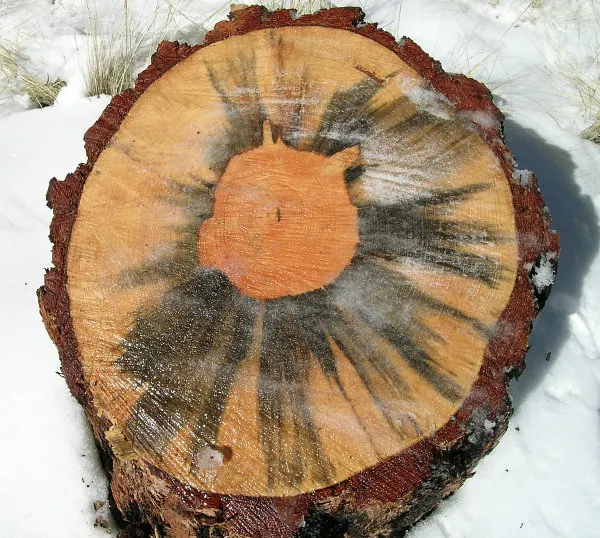

Per the same chapter, mold and stain fungi affect wood strength only slightly. That is why sound sheathing is cleaned in place, and why a probe that sinks means escalating.
Find the moisture source before cleaning anything
EPA's mold remediation guide is blunt: you must have completely fixed the water or moisture problem before remediation counts as finished. In an attic the water is usually one of four things.
| Source | Evidence in the attic | The fix, and its rule |
|---|---|---|
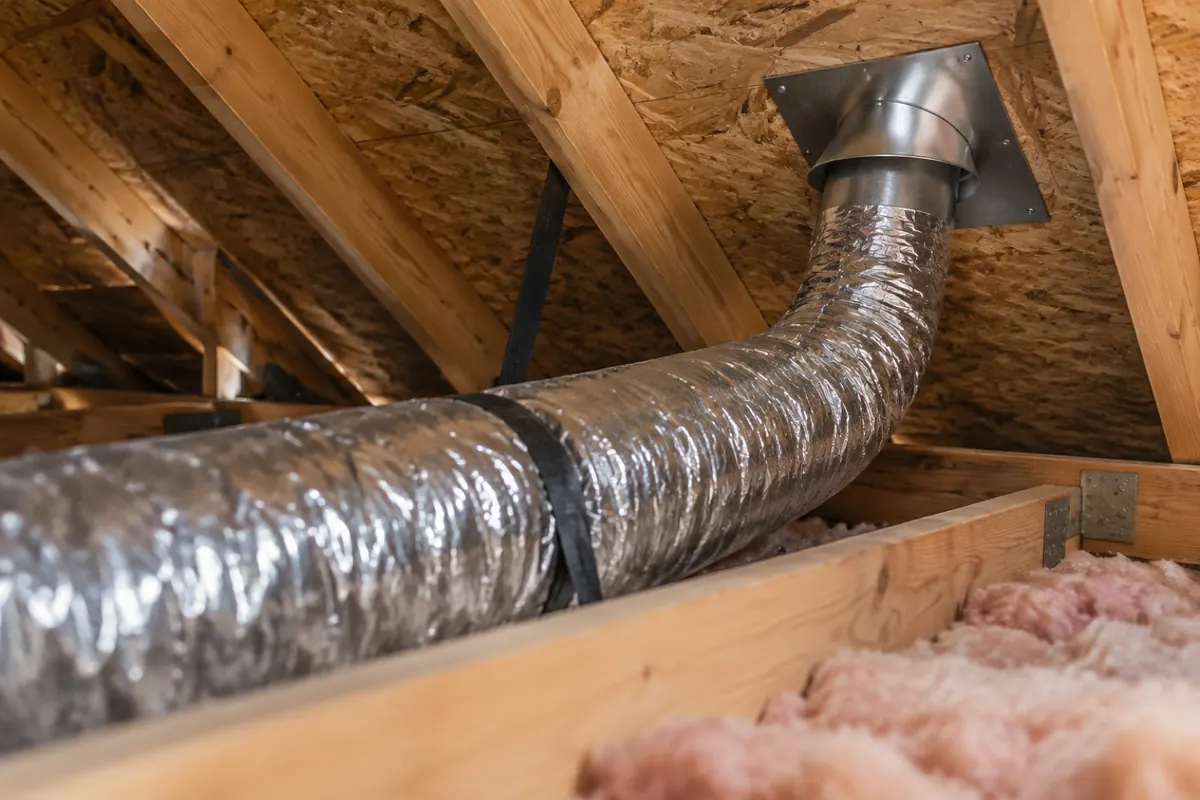
| Bath or kitchen fan dumping into the attic | Duct ends at the hatch or soffit; growth heaviest around it | Duct outdoors: IRC M1505.2 bars discharge into an attic |
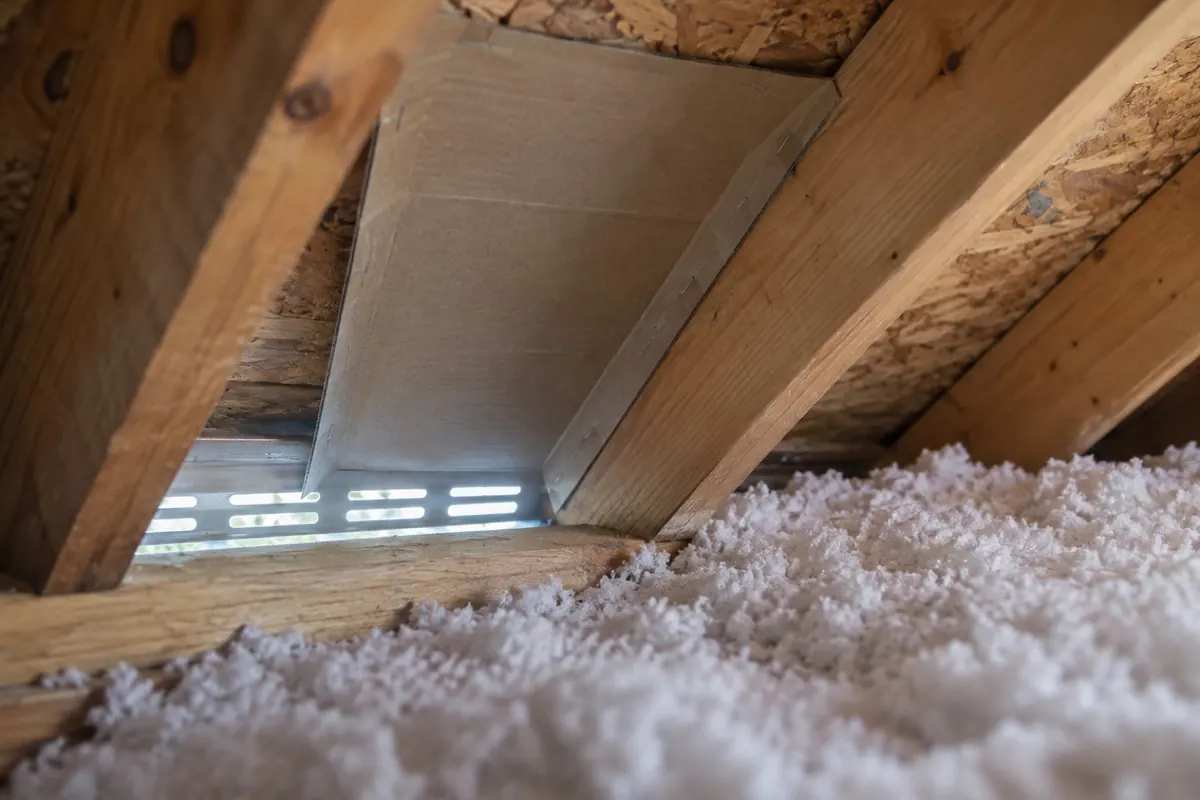
| Blocked eave intake | Insulation packed into the soffit bays | Baffles: R806.3 needs 1 inch of air space |
| Too little or unbalanced venting | Growth across the north or coldest slope | Meet the R806.2 net free area |
| Roof or flashing leak | Localised stain below a penetration | Roof repair, a roofing scope |
| House air leaking up | Dirty insulation at top plates and light housings | Air-seal the ceiling plane |
Measure the wood too. Per the Wood Handbook, fully air-dried wood usually sits at or below 20% moisture, which gives a reasonable margin against fungal damage, and serious decay needs moisture above the 30% fiber saturation point. A pin meter reading on the affected slope, against a dry slope, shows whether the source is still live.
How to remove mold in an attic: the sequence
The order that keeps the work from being redone:
- 1. Identify. Growth, stain, decay or suspect vermiculite. Vermiculite stops the job until it is tested.
- 2. Fix the water. Reroute fans, open intakes, repair leaks; confirm with meter readings.
- 3. Contain. Seal the hatch with 6 mil polyethylene and run a HEPA-filtered fan exhausting outside; EPA’s guide calls for negative pressure in containment.
- 4. Bag wet or contaminated insulation inside containment.
- 5. HEPA vacuum sheathing and framing.
- 6. Abrade or blast the growth off, by the method below that fits the space.
- 7. HEPA vacuum again, then inspect against the clearance criteria.
- 8. Coat, if chosen, on clean, dry wood per the label.
- 9. Correct ventilation to R806 and re-insulate behind baffles.
- 10. Revisit after the next cold season.
Containment and verification in general are on our mold remediation process page; the steps above are the attic version.
Four ways to clean attic sheathing, and what each leaves
EPA's mold remediation guide lists four cleanup methods: wet vacuum, damp wipe, HEPA vacuum and discard. It also says professionals may use methods it does not cover and that a method’s absence does not mean it is not useful. Brushing, sanding and blasting all sit in that gap.
| Method | What it removes | What it leaves | Published evidence | Main hazard |
|---|---|---|---|---|
| HEPA vacuum plus wire brush or scraper | Surface growth and loose debris | Stain in the grain | EPA HEPA vacuum method; Wood Handbook on brushing softwood | Dust; slow on a large deck |
| Sanding | Surface growth and a skin of wood | Fine dust; blue stain beneath | Wood Handbook: stain cannot be surfaced off | Heavy dust, needs containment |
| Dry ice blasting | Surface growth; no blast media to collect | Dislodged debris; carbon dioxide gas | Vendor claim only: Cold Jet cites 99% spore removal on wood | CO2 build-up in a closed attic |
| Soda blasting | Surface growth | Sodium bicarbonate media mixed with debris | Vendor material only (ARMEX) | Volume of spent media to vacuum and bag |
The evidence gap
A PubMed search for dry ice blasting and soda blasting against mold, run for this page, returned no study on building materials. According to Cold Jet‘s remediation page, it achieves 99% mold spore removal on wood when IAQA standards are followed and produces no secondary waste; it cites no test. ARMEX calls its sodium bicarbonate media water soluble and non-toxic, with spent media classified by what it picked up. Judge any method at clearance, not by its brochure.
Dry ice in a closed attic
Dry ice is solid carbon dioxide. Per the NIOSH Pocket Guide, the time-weighted recommended limit is 5,000 ppm, the short-term limit 30,000 ppm and the IDLH 40,000 ppm, 8 times the long-term limit. A sealed hatch under containment is a confined air space, so blast with exhaust running and CO2 monitored.
Antimicrobial and encapsulant coatings, and their limits
EPA's mold remediation guide says the purpose of remediation is to remove mold, that killing it is not enough, and that routine biocide use, chlorine bleach included, is not recommended. EPA's home mold cleanup page adds: do not paint or caulk moldy surfaces, because paint over mold is likely to peel.
| Product type | What the label or EPA says | Limit |
|---|---|---|
| Bleach or household spray | Per EPA, biocides are not recommended as routine practice | Kills without removing; adds water to the deck |
| EPA-registered antimicrobial | Per EPA Reg. No. 63836-2, kills residual mold remaining after pre-cleaning | Federal law: use only as the label directs |
| Fungicidal or encapsulating coating | Per the same label, protects the surface of wood and OSB from fungal growth | Surface only; does nothing about moisture |
| Ordinary paint or primer | Per EPA, likely to peel over mold | Cosmetic; hides the evidence |
The fungicidal coating label, EPA Reg. No. 63836-2 is a federal document worth reading. Its accepted claim is to kill residual mold and mildew remaining after pre-cleaning, its prep step for unpainted wood is to remove loose mold first, and it lists wood, drywall and OSB at 0.33 gallons per 100 square feet. The label also says it is a violation of federal law to use the product inconsistently with its labeling.
Insulation: bag it or keep it
Insulation is the porous layer. EPA's water damage table lists cellulose and fiberglass insulation that got wet as discard and replace, and EPA’s discard method is double-bagging in 6 mil polyethylene, after which the material can usually go out as ordinary construction waste.
| Insulation | Disposition | Basis |
|---|---|---|
| Wet or contaminated cellulose | Bag and replace | Per EPA’s water damage table |
| Wet or contaminated fiberglass | Bag and replace | Per EPA’s water damage table |
| Dry fiberglass away from growth | May stay after HEPA cleaning of its surface | Professional judgment under the porous material principle |
| Loose fill that looks like vermiculite | Do not disturb; test | Per EPA, assume it may contain asbestos |
| Spray foam at the roof deck | Unvented assembly; assess separately | IRC R806.5 governs unvented attics |
Per EPA's vermiculite guidance, a mine near Libby, Montana supplied over 70% of US vermiculite from 1919 to 1990 and was contaminated with asbestos, so EPA says to assume vermiculite insulation may be contaminated. That turns the job into an asbestos scope; see our asbestos insulation page.
The ventilation and bath fan fix
Per the 2021 IRC Section R806, enclosed attics need cross ventilation. The rules that matter after a mold job:
| Requirement | 2021 IRC text, summarised | Section |
|---|---|---|
| Standard vent area | Net free area at least 1/150 of the vented space | R806.2 |
| Reduced vent area | 1/300 if 40 to 50% of it is within 3 feet of the ridge and the rest in the bottom third; in climate zones 6 to 8 also a Class I or II vapor retarder on the warm side | R806.2 exception |
| Eave clearance | At least 1 inch of air space between insulation and sheathing at the vent | R806.3 |
| Bath fan discharge | Outdoors; not into an attic, soffit, ridge vent or crawl space | M1501.1, M1505.2 |
| Bath fan capacity | 50 cfm intermittent or 20 cfm continuous, at 0.25 inch water column | Table M1505.4.4 |
Worked example per the code: a 1,500 square foot attic needs 1,440 square inches of net free area at 1/150, or 720 at 1/300, of which 288 to 360 must be high vents. Vent hardware is a roofing scope.
Per 2021 IRC Chapter 15, bathroom exhaust goes directly outdoors and may not discharge into an attic. A fan ducted to the soffit or left on the joists is the first fix, because every shower feeds the deck. EPA’s moisture guide also advises keeping indoor humidity below 60%, ideally 30 to 50%.
DIY or professional attic mold remediation
EPA's home mold cleanup page says a homeowner can usually handle mold under about 10 square feet. Growth across a slope of sheathing is usually well past that line. Per EPA’s guide, limited containment applies from 10 to 100 square feet, and the minimum protective equipment is an N-95 respirator, gloves and eye protection.
| Situation | Reasonable call | Why |
|---|---|---|
| A few spots near one fan duct, source obvious | DIY with HEPA vacuum and N-95, after the duct is fixed | Small area, known cause |
| Growth across a whole slope | Professional | Above EPA’s 10 square foot line; needs containment |
| Wet insulation over a large area | Professional | Bagging inside containment |
| Suspect vermiculite | Asbestos professional | Per EPA, assume asbestos |
| Blasting chosen | Professional | Equipment, CO2 and media control |
Some states license mold remediators; our state mold licensing guide lists them. The DIY case for small growth is set out on our DIY mold remediation page.
Clearance: how you know attic mold remediation is done
EPA's mold remediation guide gives the finish criteria, and the ANSI/IICRC S520 framework names the goal. Per the summary by Healthy Building Science, S520 Condition 1 is normal fungal ecology, Condition 2 is settled spores from a Condition 3 area, and Condition 3 is actual growth; remediation aims to return the space to Condition 1. IICRC lists the fourth edition, 2024, as current.
| Check | What passes | Per |
|---|---|---|
| Moisture source | Fixed, with readings to show it | EPA |
| Visible growth | None on sheathing or framing | EPA |
| Odor | No moldy odor at the hatch | EPA |
| Sampling, if done | Kinds and levels similar to outdoors | EPA |
| Stain | May remain; not a failure | USDA Wood Handbook |
| Revisit | No new water damage or growth | EPA |
Agree these criteria in writing before work starts.
For contractors: scope, file and the adjuster’s questions
- Scope by area and access: affected sheathing, insulation volume, hatch and headroom.
- Document the source. Photos of the fan termination, soffit bays and meter readings, wet slope against dry slope.
- State the method and why. Brushing, sanding or blasting, plus any coating by product and EPA registration number, applied per the label.
- Separate the scopes: remediation, insulation, ventilation and roof repair.
- Close with clearance. The EPA criteria, photographs and any sampling results in one report.
Adjusters usually ask what caused the moisture and when it started, because policy mold provisions often turn on that. Our guide to whether homeowners insurance covers mold remediation explains the policy language.
Questions people actually ask
Is mold in the attic serious?
For the building, it is a moisture warning more than a structural crisis. Per the USDA Wood Handbook, mold and stain affect wood strength only slightly, while decay needs moisture above about 30%. It is serious if the source keeps running, the wood is soft, or growth covers a whole slope, because each winter adds more.
How do you remove mold from attic plywood?
Fix the moisture source, seal the hatch, then HEPA vacuum the plywood and remove the growth by wire brushing, sanding or blasting, and HEPA vacuum again. Per the USDA Wood Handbook, surface mold on softwood often brushes off but blue stain cannot be surfaced away, so stop at clean wood rather than stain-free wood.
What can I spray in my attic to kill mold?
EPA does not recommend routine biocide use, bleach included, because the goal is to remove mold, not kill it. EPA-registered antimicrobials exist; per the EPA Reg. No. 63836-2 label, one claims to kill residual mold after pre-cleaning, and federal law requires use per the label. Spraying without removal and a moisture fix leaves the problem in place.
Can you get rid of attic mold without removing insulation?
Sometimes. Dry insulation away from the growth can stay if its surface is HEPA cleaned. Wet cellulose or fiberglass is a different matter: EPA’s water damage table says discard and replace, double-bagged in 6 mil plastic. Loose fill that looks like vermiculite must not be disturbed until tested.
How much does attic mold removal cost?
It depends mostly on the affected area, access, and whether insulation comes out and ventilation changes. Published price ranges from named sources, and what drives them, are on our attic mold removal cost guide, which keeps price separate from method.
Does homeowners insurance cover mold in the attic?
It depends on the policy’s mold wording and on the cause, such as a sudden leak against long-term condensation. Read the policy, ask the adjuster and, if needed, your state insurance department or a licensed professional. Our homeowners insurance and mold guide explains the common policy language.
What cleaning products do professionals use for mold removal?
Per EPA, mold comes off hard surfaces with water and detergent, and HEPA vacuums do the final cleanup after materials dry. On attic sheathing, professionals add abrasion or blasting and may finish with an EPA-registered antimicrobial or coating applied per its label. The removal does the work, not the chemical.
Should the same company test and remove the mold?
Separating them means the firm judging clearance did not do the work. Agree the criteria before work starts. EPA’s finish criteria are a fixed moisture source, no visible growth or moldy odor, and, if sampled, mold levels similar to outdoors.
Sources
- 2021 IRC Section R806 (R806.1 to R806.5) and 2021 IRC Chapter 15 (M1501.1, M1505.2, Table M1505.4.4), International Code Council. Retrieved 18 October 2026.
- EPA's mold remediation guide, Mold Remediation in Schools and Commercial Buildings, chapter 3: methods, biocides, containment, PPE, finish criteria. US EPA. Retrieved 18 October 2026.
- EPA's water damage table, chapter 4, Table 1. US EPA. Retrieved 18 October 2026.
- EPA's home mold cleanup page and EPA's mold and moisture guide, US EPA. Retrieved 18 October 2026.
- EPA's vermiculite guidance, US EPA. Retrieved 18 October 2026.
- USDA Forest Products Laboratory Wood Handbook, chapter 14, Biodeterioration of Wood. Retrieved 18 October 2026.
- ANSI/IICRC S520 page, fourth edition 2024, IICRC; condition definitions per Healthy Building Science, 10 December 2012. Retrieved 18 October 2026.
- fungicidal coating label, EPA Reg. No. 63836-2, EPA-accepted label, 1 August 2007. Retrieved 18 October 2026.
- NIOSH Pocket Guide, carbon dioxide. Retrieved 18 October 2026.
- Cold Jet remediation page and ARMEX disposal guide, vendor material. Retrieved 18 October 2026.
- PubMed searches for dry ice and soda blasting of mold, run 18 October 2026.
- Vent areas, coating gallons and ratios are arithmetic on the published figures above. Our methodology sets out the standing rules.
Codes are adopted and amended locally; confirm the edition your jurisdiction enforces. Nothing here says what an insurance policy pays.