The short answer
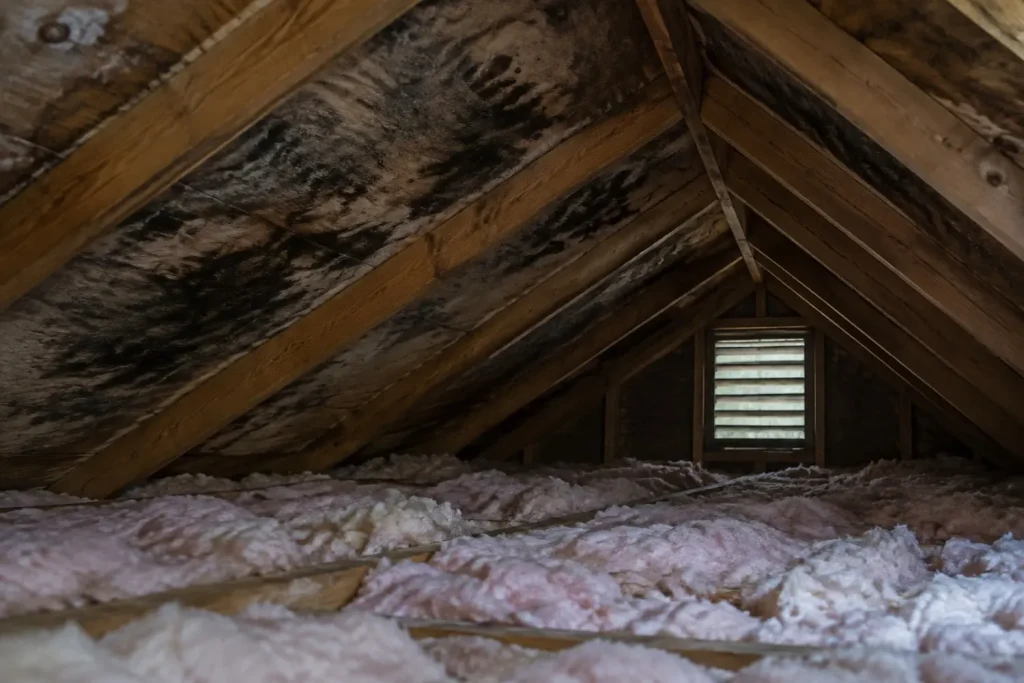
The signs of mold in attic spaces appear in a fairly consistent order: dark patchy or streaked staining on the underside of the roof sheathing, usually worst on the north-facing slope, frost or condensation droplets on nail points in winter, a musty smell when the hatch is opened, damp or compressed insulation, and rusting nail tips. The cause is almost always ventilation and condensation rather than a roof leak.
Key takeaways
- The north-facing slope is the genuinely useful tell in the northern hemisphere, because it stays coldest and condenses first.
- Diffuse staining across a whole slope points at condensation. A localised stain around one penetration points at a leak. That distinction is the diagnosis that matters.
- Not all dark staining is mould. Old water staining and blue-stain fungus that was in the timber before it was installed both look similar and neither needs remediation.
- The three usual causes are bathroom or dryer vents terminating inside the attic, blocked or insufficient soffit and ridge ventilation, and air leakage at hatches, recessed lights and top plates.
- Condensation problems appear in and after winter. Leak problems appear after heavy rain. The timing tells you which one you have.
This page covers detection and cause only. Pricing, tiers and how to read a quote are on our attic mould removal cost page and are deliberately not repeated here. This page also does not cover health effects or symptoms, which are clinical questions; EPA mould cleanup guidance is the federal starting point on cleanup, and a clinician is the right place for a health concern.
On this page
- The signs, in the order they appear
- Why the north slope is the tell
- Frost and droplets on nail points
- The smell at the hatch
- Insulation as the evidence layer
- Staining that is not mould at all
- The cause is ventilation, not the roof
- The three usual culprits
- Leak or condensation, the diagnostic
- What the season tells you
- Inspecting it safely from the hatch
- What to do once you have found it
- Questions people actually ask
Most attics are visited twice a decade, which is why attic growth is usually found by a roofer or a home inspector rather than by the owner. By then it has generally been developing for several winters, and the thing that produced it is still producing it. Detection is half the job. The other half is working out which of a small number of building faults is responsible, because cleaning without fixing that guarantees a repeat.
The signs, in the order they appear
These do not all show up at once, and the earlier ones are the ones worth learning, because they appear while the problem is still a ventilation fix rather than a remediation job.
| Sign | What it looks like | How early it appears | What it usually indicates |
|---|---|---|---|
| Frost or droplets on nail points | Condensation or ice forming on the tips of roofing nails protruding through the sheathing, and on the sheathing itself | Earliest, and only visible in cold weather | Warm moist air reaching a cold surface. The mechanism, caught before the consequence. |
| Darkening on the sheathing underside | Grey or black patches and streaks, often following the pattern of the rafter bays | Early to middle | Sustained surface moisture. The classic attic finding. |
| Musty odour at the hatch | Noticeable in the first few seconds after opening, before the space equalises | Middle | Active growth somewhere in the space, not necessarily where you can see. |
| Damp or compressed insulation | Batts that feel heavy or cold, loose fill that has settled or matted in patches | Middle | Moisture arriving from below, or wetting from above at a specific point. |
| Rusting nail tips and fixings | Orange staining around nail points and on truss plates | Later | Repeated wetting over multiple seasons. A duration signal rather than an intensity one. |
| Staining around vents and penetrations | Concentrated marking at a bathroom fan, a flue, a plumbing vent or a light fitting | Varies | A specific source: either a vent discharging into the space or a flashing failure at that point. |
| Sheathing that feels soft or delaminates | Plywood plies separating, OSB swelling at the edges | Latest | Prolonged saturation. At this stage the sheathing itself is part of the question. |
Why the north slope is the tell
This is the most useful single piece of pattern recognition in an attic, and the explanation is straightforward. In the northern hemisphere the north-facing slope receives the least direct sun. It warms less, stays colder longer, and snow lingers on it. Sheathing there sits at a lower temperature than the south slope through the whole heating season.
Moist air rising from the living space condenses on the coldest surface it reaches, which is the north sheathing, so that is where wetting is most sustained and growth appears first. An attic with heavy darkening on the north slope and a visibly cleaner south slope is describing its own cause: condensation, not a leak.
The exception worth knowing
A slope that is heavily shaded by trees or by a neighbouring building behaves like a north slope regardless of its orientation, for exactly the same reason. If the pattern does not fit the compass, look at what is casting shade on the roof before concluding the rule has failed. In the southern hemisphere the rule inverts and the south-facing slope is the cold one.
Frost and droplets on nail points
This is the earliest visible sign and the clearest explanation of the whole mechanism, so it is worth looking for deliberately on a cold morning. Roofing nails protrude through the sheathing into the attic, and metal conducts heat far better than wood. Each nail tip sits colder than the sheathing around it, and becomes the first place attic moisture condenses.
In a cold snap you will see frost on the nail tips. As it warms, the frost melts and drips, which is why some people report a leak in fine weather after a freeze and cannot find a hole in the roof. There is no hole. The roof is behaving as designed and the attic air is carrying more moisture than the ventilation is removing.
Why this sign is so valuable
Finding frost on nails is finding the cause before the consequence. Nothing has grown, nothing needs cleaning, and the fix is ventilation and air sealing rather than remediation. Checking the attic once during the first hard freeze of the year is the highest-value inspection available to an owner, and it takes about four minutes.
The smell at the hatch
Smell is a real detection tool and it works best in the first few seconds. A closed attic holds its own air, and opening the hatch releases it in a rush before the space equalises. A musty, earthy odour is most obvious immediately and much less obvious two minutes later, once you are acclimatised. The same smell below the house has its own causes, which our guide to a musty smell in the basement ranks.
The important quality of this sign is that it detects growth you cannot see. Sheathing above insulation, surfaces behind stored boxes, and the far ends of a long attic are all out of view from a hatch. A clear musty odour with nothing visible from the opening is not a null result, it is a reason to look properly.
Do not chase the smell with an air freshener
It sounds obvious written down and it happens constantly, usually as a sealed hatch or an ozone device rather than an aerosol. Masking the odour removes the only signal the occupant had while the building fault continues unchanged. The smell is information.
Insulation as the evidence layer
Insulation records what has been happening above it. Batts that feel heavy, cold or compressed have been wet. Loose fill matted or slumped in one area has been wet there. Clean, lofted, dry insulation under a stained slope suggests surface condensation on the sheathing rather than water running down.
| What the insulation shows | Likely reading | What to check next |
|---|---|---|
| Matted or slumped in a defined patch | Repeated wetting at that point | What is directly above it: a penetration, a valley, a vent terminus. |
| Damp and cold across a whole bay | Condensation dripping off the sheathing above | Ventilation path at the eaves and at the ridge. |
| Dry but darkened on the top surface | Dust and air movement, frequently marking an air leak path | The ceiling plane below: hatch, recessed lights, top plates. |
| Disturbed or pushed aside at the eaves | Blocked soffit ventilation, commonly from a previous top-up | Whether baffles are present and whether the soffit vents are clear. |
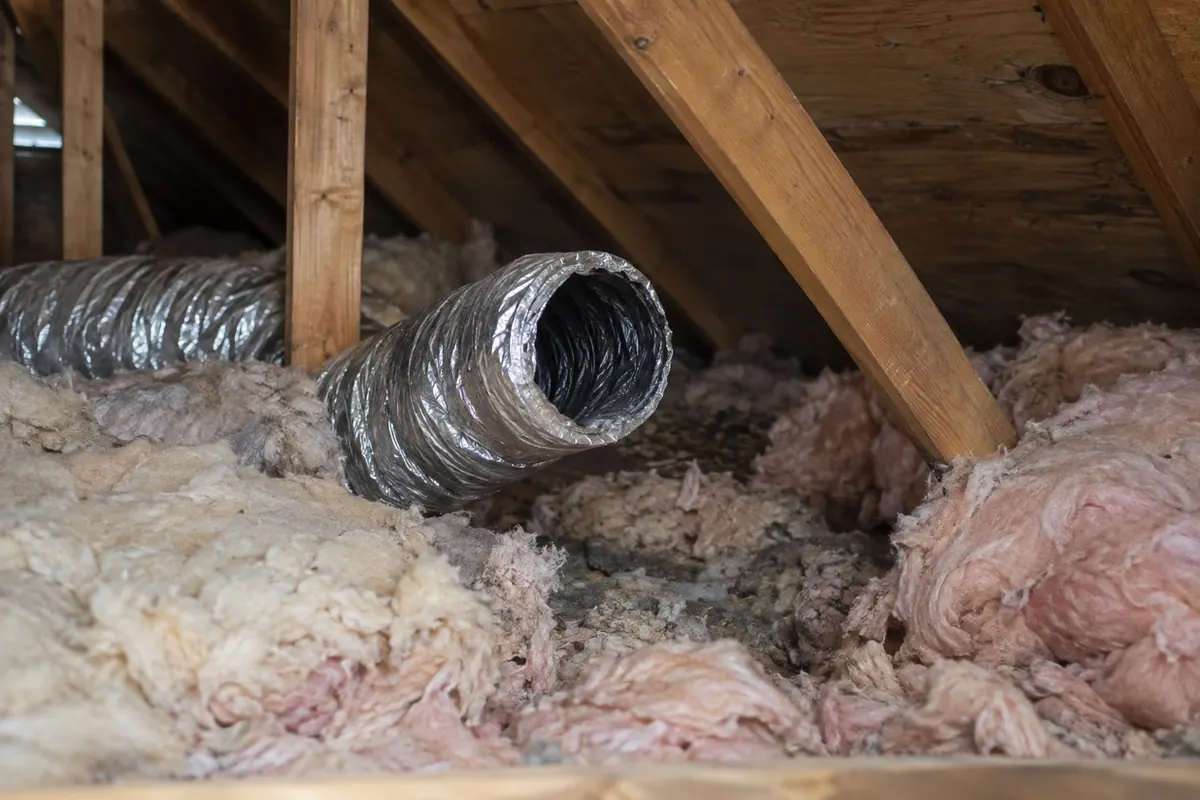
| Visibly wet directly under a fan housing | A bathroom or dryer vent discharging into the space | Where that duct actually terminates. |
Staining that is not mould at all
This section saves people money, and it is left out of almost everything written on the subject. Two dark markings on roof sheathing look convincingly like growth and are not, and neither requires remediation.
Old water staining
A leak that was fixed years ago leaves a permanent mark. Water carries dissolved compounds out of the wood and deposits them at the drying edge, which produces a stain with a distinct outline, often with a darker ring at the boundary and a lighter centre. It does not spread, it does not change, and the material underneath it is sound and dry. A stain with a hard edge and a dry substrate is history, not a current problem.
Blue stain, also called sap stain
This is the one that causes unnecessary remediation quotes. Blue stain is a discolouration produced by fungi that colonise the sapwood of freshly cut timber before it is dried, so it is in the wood when the sheathing arrives on site. It appears as grey, blue or black streaking that follows the grain rather than sitting on the surface, it is uniform across a board including areas never damp, and it stops abruptly at a board edge, because it is a property of that piece of timber rather than of that spot in the attic.
| Characteristic | Surface growth | Old water stain | Blue or sap stain |
|---|---|---|---|
| Edge | Diffuse, irregular, no clear boundary | Hard outline, often a darker ring at the perimeter | Follows the grain and board edges |
| Relationship to boards | Crosses board joints freely, follows the cold slope | Concentrated where water ran or pooled | Confined within individual boards, stops at the joint |
| Texture | Sits on the surface, sometimes slightly raised or fuzzy | Flat, in the wood | Flat, in the wood, part of the grain |
| Distribution | Worst on the coldest slope, frequently both sides of a bay | Localised around a specific source | Scattered on whichever boards happened to carry it |
| Moisture now | Substrate often reads damp in season | Substrate dry | Substrate dry |
| Needs remediation | Assess it | No, but find out whether the leak that caused it was fixed | No |
This distinction is worth insisting on before agreeing to anything. If someone has quoted to treat dark streaking on your sheathing, ask them to show you why it is growth rather than sap stain, and ask for a moisture reading on the substrate. A dry substrate with staining confined to individual boards is a very different conversation from a damp slope with diffuse marking across the bays.
The cause is ventilation, not the roof
The instinct on finding darkened sheathing is that the roof is leaking. Usually it is not. Warm air inside the house holds moisture from showers, cooking, laundry and breathing. That air is buoyant and rises. Wherever the ceiling plane is not airtight it passes into the attic, meets sheathing at outdoor temperature, and gives up its moisture as condensation.
A ventilated attic removes that moisture continuously by exchanging air with outside. When the path is blocked, undersized or short-circuited, the moisture stays, the sheathing stays wet through the heating season, and the surface eventually supports growth. Cleaning it without changing any of that is repainting a wall that is still getting wet.
The three usual culprits
Vents terminating inside the attic
A bathroom extractor or dryer duct that ends in the attic rather than outside is the most concentrated moisture source a house can produce, discharging warm saturated air into the coldest part of the building. It is common, usually because a flexible duct was never connected to its terminal or came adrift. The tell is staining concentrated around the fan housing while the rest looks better.
Blocked or insufficient soffit and ridge ventilation
The standard arrangement moves air in at the eaves and out at the ridge. Insulation pushed into the eaves during a top-up blocks the intake, which is the commonest version of this fault and frequently follows a well-intentioned energy improvement. Baffles exist to hold that path open. A ridge vent never cut through, or covered by a later roof layer, blocks the outlet instead.
Air leakage at the ceiling plane
Every gap between the living space and the attic is a moisture route. The reliable offenders are an unsealed loft hatch, recessed light fittings, the gaps where partition top plates meet the ceiling, plumbing and wiring penetrations, and the chase around a flue. Dark dusty marking on the top of the insulation maps these paths directly, because the moving air deposits dust as it filters through.
Leak or condensation, the diagnostic
This is the contrast that determines everything that follows, because the two problems have different fixes and different trades. Get this wrong and you re-roof a building with a ventilation fault, or ventilate a building with a flashing failure.
| Feature | Condensation | Roof leak |
|---|---|---|
| Distribution | Diffuse across a slope, often bay after bay | Localised, usually traceable to one point |
| Location | Worst on the coldest slope, and near the ridge or eaves depending on which vent is blocked | At a penetration: chimney, vent stack, skylight, valley or a nail hole |
| Timing | During and after cold weather | During and shortly after heavy rain, or with wind from one direction |
| Path | No run marks. Wetting is a surface film across the whole area | Run marks and drip trails from a point downward |
| Insulation below | Broadly damp under the affected slope | Wet in a defined patch under the entry point |
| What it responds to | Ventilation, air sealing, redirecting vent discharges | Roofing repair at the specific point |
Both at once is not rare
A building with a ventilation problem and a failed flashing will show both patterns, and finding the leak does not mean the diffuse staining is explained. The useful habit is to account for every area of marking separately rather than attributing all of it to the first fault found.
What the season tells you
Timing is free diagnostic information and it is routinely overlooked. The two failure modes peak in different weather.
The practical use: if the marking was not there last spring and is there this spring, the winter just gone produced it and the cause is condensation. If it appeared after a specific storm, walk the roof for that storm’s damage. If an owner cannot say when it appeared, which is the usual answer, the pattern on the sheathing is the evidence to fall back on.
Inspecting it safely from the hatch
A great deal can be established from the opening with a decent torch, and the reason to stay there is practical. Most attics are not floored. The surface between joists is ceiling board, it will not carry a person, and stepping off a joist puts a foot through the room below.
| From the hatch you can | You need someone to enter when |
|---|---|
| See the nearest rafter bays and judge the marking pattern | The far end of the attic is out of sight and the near end looks wrong |
| Smell the space in the first seconds after opening | There is a clear odour but nothing visible from the opening |
| See whether frost or droplets are present in cold weather | Moisture readings on the sheathing are needed to settle whether a stain is active |
| Check whether a bathroom fan duct is visibly connected | The duct disappears out of sight and its terminus is unknown |
| Judge whether insulation is lofted or matted nearby | The soffit intake needs checking at the eaves, which is a crawl to the edge |
| Photograph what you can see, with the flash on | Anything requires moving insulation or stored material |
Three things worth doing before you climb the ladder
- Pick the weather. A cold morning shows frost and droplets that a mild afternoon hides entirely. On a hot day, an unventilated attic is genuinely dangerous to work in and the visit should wait.
- Take a proper torch, held low. Light raked along the sheathing shows texture and surface differences that a torch pointed straight at it flattens out completely.
- Know where the bathroom is. Orient yourself before you look, so you can tell whether the marking is above a wet room, above the hall, or across a whole slope.
What to do once you have found it
The order matters, because doing these in the wrong sequence is how people pay twice.
| Step | What it involves | Why this order |
|---|---|---|
| Establish what the marking actually is | Distinguish growth from old water staining and from sap stain, with a moisture reading on the substrate | Two of the three need no remediation at all. |
| Identify the moisture source | Vent terminations, soffit and ridge path, ceiling plane air leakage, or a specific roof defect | Cleaning without this guarantees the marking returns. |
| Fix the source | Redirect vents outside, clear or add ventilation, seal the ceiling plane, repair the roof defect | The building fault is the actual problem. The staining is a symptom. |
| Then address the affected material | Cleaning, or replacement where sheathing has lost integrity | EPA mould cleanup guidance is explicit that moisture control is the controlling factor. Remediation before the fix is temporary. |
| Document and re-check | Photograph the result, note the date, and look again after the next winter | One heating season is the honest test of whether the fix worked. |
Costs are a separate question and they are set out properly elsewhere. Our attic mould removal cost page covers the tiers, what moves the price and how to read an attic quote. Our mould inspection cost page covers what an assessment involves, and our remediation process page covers what the work itself looks like. If the moisture is arriving from below rather than above, our crawl space encapsulation page covers the other end of the same stack effect.
The energy angle, since the ladder is already up
Air sealing the ceiling plane and restoring the ventilation path are the same works that reduce heating loss, so the fix pays back in a way remediation alone never does. Insulation that has been wet has generally lost performance as well, and US Department of Energy, types of insulation sets out how the types differ. Do the air sealing before topping up, because topping up first buries the leaks you were about to seal.
Questions people actually ask
What are the first signs of mold in an attic?
In cold weather, frost or condensation droplets on roofing nail tips and on the sheathing, which is the mechanism visible before anything has grown. After that, dark patchy or streaked marking on the underside of the sheathing, usually worst on the north-facing slope, and a musty smell in the first seconds after the hatch is opened.
Why is the staining worse on one side of the roof?
In the northern hemisphere the north-facing slope receives the least sun, stays coldest and therefore condenses first and most. A heavily shaded slope behaves the same way regardless of orientation. A pattern that follows the cold slope is describing condensation rather than a leak.
Is all dark staining on roof sheathing mould?
No, and this matters financially. Old water staining from a leak that was already fixed has a hard outline and a dry substrate. Blue stain or sap stain was in the timber before it was installed, follows the grain, and stops at board edges. Neither needs remediation.
Does attic mould mean my roof is leaking?
Usually not. Diffuse marking across a whole slope points at condensation from warm moist air rising out of the house, which is a ventilation and air sealing problem. A leak produces localised staining around one penetration with run marks below it.
What causes condensation in an attic?
Three things account for most cases: bathroom or dryer vents terminating inside the attic instead of outside, soffit or ridge ventilation that is blocked or insufficient, and air leakage at the loft hatch, recessed lights and partition top plates.
When is the best time to check the attic?
A cold morning in the heating season, because frost and droplets on nail points are visible then and invisible the rest of the year. Add a look after the first serious storm of the season if you want to catch leak signs too.
How much does it cost to deal with?
That is a separate question and it depends on the extent, the access and whether insulation is being replaced. Our attic mould removal cost page sets out the tiers and what moves the price, which this page deliberately does not restate.
Sources
- EPA mould cleanup guidance. United States Environmental Protection Agency, on moisture control as the controlling factor in growth and on the sequence of fixing the source before cleaning. Retrieved 23 September 2026.
- US Department of Energy, types of insulation. US Department of Energy, on insulation types and their behaviour, referenced on wet insulation and the air sealing sequence. Retrieved 23 September 2026.
- The sign progression, the north-slope pattern, the condensation versus leak diagnostic, the sap stain differentiation and the seasonal pattern are compiled from published building science guidance, home inspection practice and restoration industry material current in 2026. They are indicative rather than measured.
- Pricing, remediation tiers and how to read a quote are set out on our attic mould removal cost page, and assessment pricing on our mould inspection cost page. This page deliberately does not restate either.
- Our methodology sets out the standing rules on what we publish as compiled guidance versus measured data.