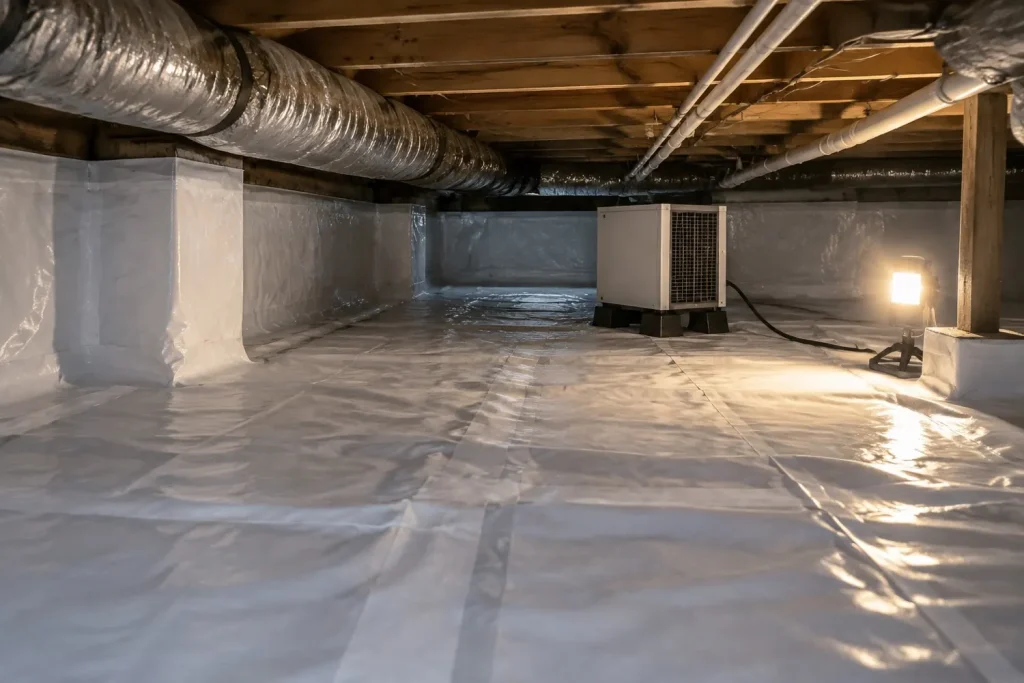
The short answer
Crawl space encapsulation cost runs about $1,500 to $3,000 for a vapour barrier alone, $4,000 to $9,000 with a dedicated dehumidifier, and $8,000 to $15,000 for full encapsulation with drainage and a sump. Add structural repair and the range moves to $12,000 to $30,000. Scope, not floor area, separates those tiers.
Key takeaways
- Price by scope tier, not by square foot. A barrier-only job and a full encapsulation with drainage are different products sharing a name.
- The barrier work itself commonly prices at $3 to $7 per square foot, and a 1,500 sq ft crawl space is the usual published reference case.
- Sealing without moisture control is the expensive mistake. A sealed space with no dehumidification can hold moisture rather than shed it.
- The stack effect is why this matters above the crawl space. Air moves upward, so crawl space air becomes living space air.
- The EPA is explicit that controlling moisture is the controlling factor in preventing mould growth.
On this page
- What each scope tier costs
- The per square foot number, and its limits
- Why a vented crawl space fails in a humid climate
- The stack effect, and why this is not just a crawl space problem
- What actually drives the price
- Barrier thickness, from 6 mil to 20 mil
- The dehumidifier decision
- Drainage, sumps and standing water
- When structural repair comes first
- DIY against professional install
- How to read a crawl space quote
- Questions people actually ask
Published crawl space encapsulation cost figures are almost always a single national average, which is the least useful answer available here. The work sold under that name spans a plastic sheet taped to the ground at one end and a drained, sealed, structurally repaired space at the other. This page prices the tiers separately.
What each scope tier costs
There are four recognisable scope tiers. Most disagreement between quotes is two contractors pricing two different tiers and calling both encapsulation.
| Scope tier | Typical total | What is included | What it does not solve |
|---|---|---|---|
| Vapour barrier only | $1,500 to $3,000 | Ground sheeting, seams taped, light-gauge liner, minimal pier and wall detailing. | Airborne humidity, and water arriving through walls or footing. |
| Barrier plus dehumidifier | $4,000 to $9,000 | Heavier liner, piers and perimeter wall sealed, vents closed, a dedicated dehumidifier with a condensate route. | Bulk water. A dehumidifier is sized for vapour, not a spring under the footing. |
| Full encapsulation with drainage | $8,000 to $15,000 | The above plus interior perimeter drainage, sump basin and pump, sealed rim joist, often a backup pump. | Rot, insect damage or deflected framing already present. |
| Plus structural or joist repair | $12,000 to $30,000 | Sistered or replaced joists, girders, posts, footings, subfloor. | Nothing on the moisture side. Widest quote spread of any tier. |
The per square foot number, and its limits
The barrier work is commonly priced at $3 to $7 per square foot of crawl space floor, covering liner, fasteners, seam tape and the labour to fit it in a space nobody can stand up in. A 1,500 sq ft crawl space is the common published reference case.
On that reference case the arithmetic gives roughly $4,500 to $10,500 for barrier work alone. Two cautions. The band prices the barrier and nothing else, so a house needing drainage never lands inside it. And crawl space floor area is not conditioned floor area above, which homeowners routinely quote instead.
Where the per-foot rate sits inside its band
- Toward $3. Open access, headroom, dry ground, few piers, a simple footprint, lighter liner.
- Toward $7. Low clearance, a hatch rather than a door, ductwork in the way, many piers, an irregular footprint, heavier reinforced liner, and debris or fallen insulation to clear first.
Why a vented crawl space fails in a humid climate
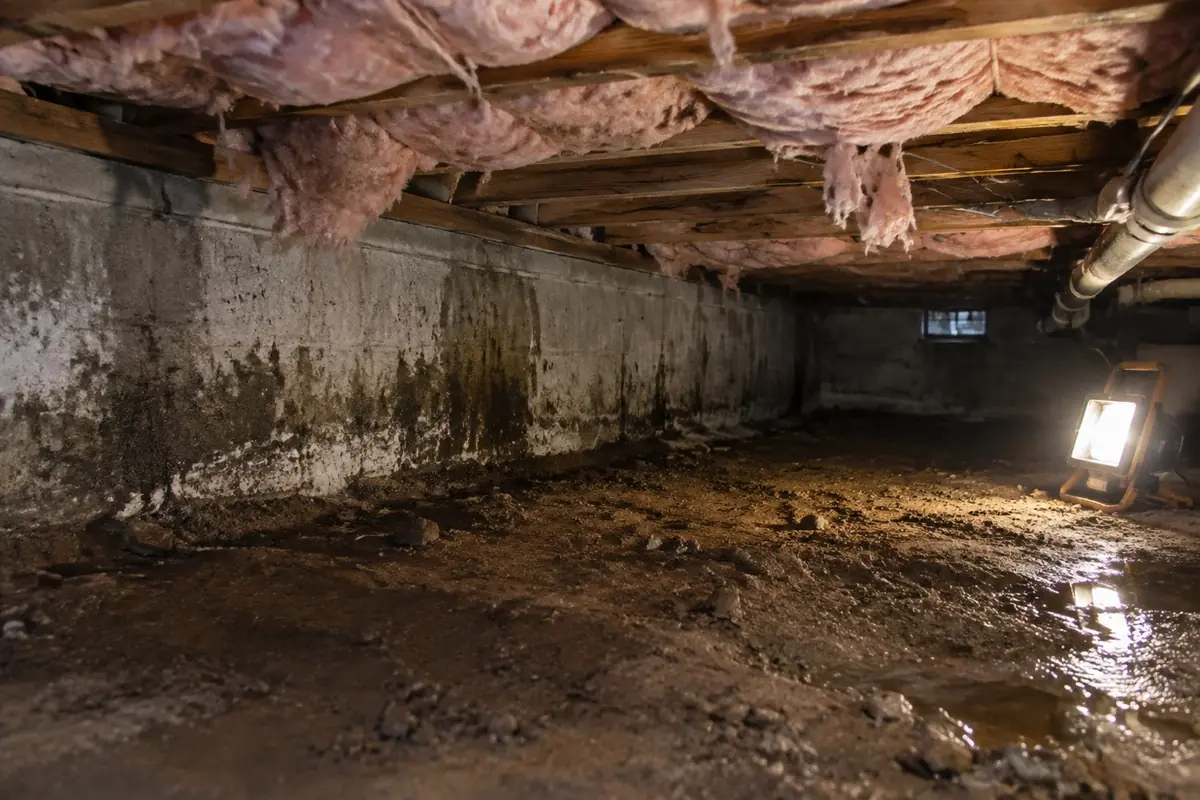
Venting assumes outside air is drier than crawl space air, so exchanging the two dries the space. In a humid summer climate that inverts. Outdoor air carrying a high moisture load enters through the vents and meets surfaces cooler than itself, because they sit in shade, touch the ground, or carry air conditioning ductwork. Air against a surface below its dew point gives up water onto it. Wood moisture content climbs, and wood that stays wet long enough supports fungal growth. Fibreglass batts absorb the moisture, lose performance and fall out.
- Vents admit humid air. Crawl space humidity tracks outdoor humidity instead of staying below it.
- It condenses on cool surfaces. Sweating ducts, damp girders, beading on foundation walls.
- Wood moisture content climbs. Joist readings run well above framing inside the heated house.
- Growth starts, insulation fails. Musty odour upstairs, discoloured joists, batts on the ground.
- It reaches the floor above. Soft subfloor, cupped flooring, cold floors. The complaint that opens the hatch.
Encapsulation inverts the strategy
Encapsulation stops trying to dry the space with outdoor air. The ground is covered so soil moisture cannot evaporate upward, walls and piers are sealed to the liner, vents are closed, and the remaining air is dried mechanically. The space becomes a semi-conditioned part of the building rather than an outdoor void with a house on top. EPA mold cleanup guidance is direct on the point: control the moisture and growth does not start.
This is climate dependent. In a dry climate with a low water table and no summer humidity, a vented crawl space can perform acceptably for decades. The case is strongest in humid summer climates, on wet soil, and where conditioned ductwork runs through the space.
The stack effect, and why this is not just a crawl space problem
A crawl space problem shows up as a whole-house complaint because of air movement. Warm indoor air rises and leaves through upper-level leaks, which lowers pressure at the bottom of the building and pulls replacement air in from the lowest opening available. Over a crawl space, that is the crawl space. Air that was down there a minute ago is in the living space now.
That is why musty odour appears upstairs rather than where the growth is, why modern practice treats a crawl space as part of the building envelope, and why closing the hatch is not a strategy. It also explains the second-order benefit: ductwork that ran through hot humid air now runs through drier air. US Department of Energy guidance on insulation types covers where insulation belongs once sealed.
If a smell rather than a moisture reading brought you here, find the source before buying a scope. Odour upstairs with visible growth on crawl space joists is a remediation question as well as an encapsulation one. Our mould remediation process guide covers the sequencing and our mould remediation cost page covers pricing.
What actually drives the price
Seven variables move a crawl space quote, unequally. Floor area is the one everybody asks about and it is not the largest.
| Driver | Effect on price | Why |
|---|---|---|
| Floor area | Moderate, linear | Liner, tape and labour scale with area. Mobilising does not. |
| Existing moisture damage | Large | Growth, rotted subfloor and fallen insulation all get dealt with before a liner goes down. Most likely to push a mid-tier job into the top tier. |
| Drainage and a sump | Large | Trenching in a low space, plus basin, pump, discharge line and usually a circuit. |
| Barrier thickness | Moderate | A 6 mil sheet and a 20 mil reinforced liner are different products with different service lives. |
| Dedicated dehumidifier | Moderate, discrete | A unit, a circuit and a condensate route: closer to a fixed add than a scaling one. |
| Access and clearance | Large on labour | 18 inches through a 24 inch hatch takes materially longer than 4 feet through a door. |
| Insulation or joist work first | Large | Structural repair is its own trade and tier, and it normally precedes sealing. |
Existing damage is why remote quoting is unreliable. A quote produced without an inspection, or carrying a wide allowance for repairs to be determined, is a starting figure rather than a price.
Barrier thickness, from 6 mil to 20 mil
Liner thickness is quoted in mils, one thousandth of an inch each, running from 6 mil polyethylene sheeting to reinforced liners of 20 mil and above. The difference is not vapour performance but puncture resistance and service life in a space people crawl through.
Thickness is not the specification that matters most
A 20 mil liner with untaped seams and no pier detailing performs worse than a 12 mil liner installed properly. Thickness decides how long the liner survives; continuity decides whether it works at all. Seam overlap, tape, pier and perimeter termination all matter more than the mil number.
The dehumidifier decision
This is the most consequential optional line on a crawl space quote and the one most often cut to hit a price. A sealed space still holds air, that air still holds moisture, and closing the vents removes the only mechanism moving it anywhere. Sealing without mechanical dehumidification or conditioned air can leave a space wetter than it was, which is where the warning about encapsulation making things worse comes from.
| Approach | How it works | Where it fits | Watch for |
|---|---|---|---|
| Dedicated crawl space dehumidifier | A unit sized for the space, draining to a condensate pump, sump or exterior. | The default on any full encapsulation. | Sizing against volume, a condensate route that cannot freeze or clog, and a dedicated circuit. |
| Conditioned air supply from the HVAC system | A small register delivers conditioned air into the space. | Where the system and local code allow it. | Code treatment varies, and it loads a system not sized for it. |
| Exhaust ventilation to outside | A fan moves crawl space air out, drawing replacement air in. | Occasionally specified, mainly in dry climates. | In a humid climate this imports the problem it is meant to solve. |
| Nothing | Sealed space, no moisture control. | Only defensible on a dry site with no water source. | The common failure mode, and the cheapest quote in the stack. |
Humidity target, and how you know it is working
The unit exists to hold the space below the humidity at which fungal growth is supported, and a hygrometer left in the space is how you know it is working. Ask for the target in writing, where the sensor sits, and what happens if the reading does not get there.
Drainage, sumps and standing water
A vapour barrier manages vapour, not water arriving as water. Standing water after rain, soil that never dries or a seep at the footing means the liner holds water underneath it and the space keeps failing. That is the trigger for the drainage tier.
| Component | What it does | Why it lands on the quote |
|---|---|---|
| Interior perimeter drain | Collects water at the footing and routes it to a basin. | Trenching in a low space is slow, and spoil leaves through the access opening. |
| Sump basin and pump | Collects and discharges water outside the foundation. | Pump, basin, check valve, discharge line and usually a dedicated circuit. |
| Backup pump | Keeps discharging during a power outage. | Battery or water-powered. The option that matters when outages coincide with storms. |
| Exterior grading and gutter correction | Moves roof and surface water away from the foundation. | Often the cheapest real fix, and often outside the crawl space contractor’s scope. |
Check the cheap fix before buying the expensive one
Downspouts discharging at the foundation, negative grade against the wall and a blocked gutter are all common causes of a wet crawl space, and all cost less to correct than interior drainage.
When structural repair comes first
The top tier, $12,000 to $30,000 per published contractor guides, exists because sustained moisture damages the structure above it. Once framing has lost section to rot or insects, sealing the space stops the cause without restoring the lost capacity.
| Finding | Typical response | Why it precedes encapsulation |
|---|---|---|
| Rot at joist ends bearing on the sill | Sister or replace the joists, repair the sill. | Bearing points are load paths, and the work needs access a liner obstructs. |
| Sagging girder or failed post | New adjustable posts on proper footings, girder replacement. | Footings need excavation, disturbing ground under any liner laid. |
| Soft or delaminated subfloor | Cut out and replace the affected sheathing. | Best done while the wetting source is still visible. |
| Active fungal growth on framing | Remediate, then control moisture to stop recurrence. | A liner over growth is not remediation. See our remediation process guide. |
| Termite or other insect damage | Pest treatment by a qualified operator, then repair. | A separate trade. Encapsulation does not substitute for it. |
Insulation belongs in the same conversation
Once a space is sealed the thermal boundary moves from the joist bays to the foundation wall, because the crawl space is now inside the envelope. Failed batts come out first, framing is dealt with before anything covers it, the wall is insulated instead of the floor, and the rim joist is sealed. US Department of Energy guidance on insulation types sets out the material options.
Where the quote spread gets widest
This tier carries the widest spread, because how much framing needs work is not knowable until the space is cleared. Expect an allowance rather than a fixed price, and ask who decides when it is exceeded.
DIY against professional install
Material cost for a crawl space liner sits far below the installed price, which makes this look like an obvious do-it-yourself project. For a small, dry, accessible space it sometimes is. Where it is not, the reason is three failure modes that are easy to walk past and expensive to find later.
| Failure mode | What goes wrong | Consequence |
|---|---|---|
| Inadequate seam taping | Seams overlapped but untaped, or taped onto dusty liner so the adhesive never bonds. | The enclosure is not continuous, soil moisture keeps entering, and the liner does very little. |
| Piers and rim joist not sealed | Ground covered but piers, perimeter wall and rim joist left open. | Air and moisture bypass the liner. The most common shortfall in cheap professional scopes too. |
| No moisture control after sealing | Vents closed, liner down, nothing added to dry the air. | A sealed space holding moisture, capable of being worse than the vented condition it replaced. |
| Working in unsafe conditions | Low clearance, poor ventilation, unknown contamination, live wiring. | Not a cost issue. EPA mold cleanup guidance sets out precautions where growth is present, and such a space is not a beginner’s project. |
A reasonable split
- Reasonable to do yourself. Debris clearance, downspout extensions, grading correction, and a hygrometer left in the space to set a baseline before anybody quotes.
- Worth paying for. A continuous sealed enclosure with detailed piers and rim joist, a sized and drained dehumidifier, any interior drainage, and anything load bearing.
- Do not attempt. A space with active fungal growth, contaminated standing water, or framing you suspect is no longer carrying load.
How to read a crawl space quote
Six questions make two quotes comparable. Without them the cheapest number wins, and it is the narrowest scope.
- Which tier is this? Barrier only, barrier plus dehumidifier, full encapsulation with drainage, or plus repair.
- What is the liner specification, and how far does it go? Thickness, reinforcement, whether piers and perimeter wall are sealed, wall termination height, and seam treatment.
- What is the moisture control strategy? If the answer is that sealing alone handles it, ask for the target humidity and how it will be measured.
- What happens to water rather than vapour? If there has ever been standing water, drainage belongs in the conversation.
- What was found on the framing? A written note on joists, sill and subfloor, plus how a repair allowance converts to a real number.
- What is excluded? Pest treatment, remediation of existing growth, grading, electrical work for a pump or dehumidifier circuit, and permits are commonly outside scope.
If the crawl space flooded from a plumbing failure rather than from the ground, the immediate job is drying. Our water damage restoration cost page covers that scope, and our methodology sets out how we compile the ranges used here.
Questions people actually ask
How much does crawl space encapsulation cost?
Indicatively $1,500 to $3,000 for a vapour barrier alone, $4,000 to $9,000 with a dehumidifier, and $8,000 to $15,000 for full encapsulation with drainage and a sump. With structural repair first, $12,000 to $30,000. Bands compiled from published contractor and aggregator guides current in 2026.
What is the cost per square foot?
The barrier work is commonly quoted at $3 to $7 per square foot of crawl space floor, per published contractor guides. On the 1,500 sq ft reference case that is roughly $4,500 to $10,500 for barrier work only.
Is encapsulation worth it, or is it a sales pitch?
It depends on climate and site. In a humid summer climate, on wet soil, or where ductwork runs through the space, the case is strong: venting imports moisture rather than removing it. On a dry site with a well-drained perimeter the spend is harder to justify.
Do I need a dehumidifier as well as the liner?
In most humid climates, yes, or an equivalent conditioned air supply where local code allows it. Closing the vents removes the mechanism that was moving moisture out, so sealing with no replacement can leave the space wetter.
Will encapsulation fix a mould problem on my joists?
No. It removes the cause by controlling moisture, which prevents recurrence, but growth already present has to be remediated separately. The EPA is clear that moisture control is the controlling factor in prevention.
Can I install a vapour barrier myself?
For a small, dry, accessible space with no visible growth, sometimes. The three failure modes to plan around are untaped or poorly bonded seams, piers and rim joist left unsealed, and no moisture control once the vents are closed.
How long does the work take?
A barrier-only job in an accessible space is commonly a one to two day scope. Full encapsulation with drainage and a sump typically runs several days because of the trenching, and structural repair sits on top. Low clearance and a small hatch extend all of those.
Sources
- EPA mold cleanup guidance. United States Environmental Protection Agency, on moisture control as the controlling factor in preventing mould growth, and on precautions where growth is present. Retrieved 23 September 2026.
- US Department of Energy guidance on insulation types. US Department of Energy, Energy Saver, on insulation types and where each is used, including foundation wall and floor applications. Retrieved 23 September 2026.
- Scope tier ranges ($1,500 to $3,000 barrier only; $4,000 to $9,000 with dehumidifier; $8,000 to $15,000 with drainage; $12,000 to $30,000 including structural repair) and the $3 to $7 per square foot barrier band are compiled from published contractor and aggregator price guides current in 2026. Indicative rather than survey results. We compile published guides and public datasets; we have not conducted a contractor pricing survey.
- Liner thickness tiers (6 mil to 20 mil and above) are compiled from published manufacturer and contractor specifications current in 2026. We compare published specifications rather than testing materials.
- Code treatment of crawl space venting, ground cover vapour retarders and conditioned air supply varies by jurisdiction and code edition. Local requirements govern, and nothing here substitutes for local code or an engineer’s assessment of anything load bearing.