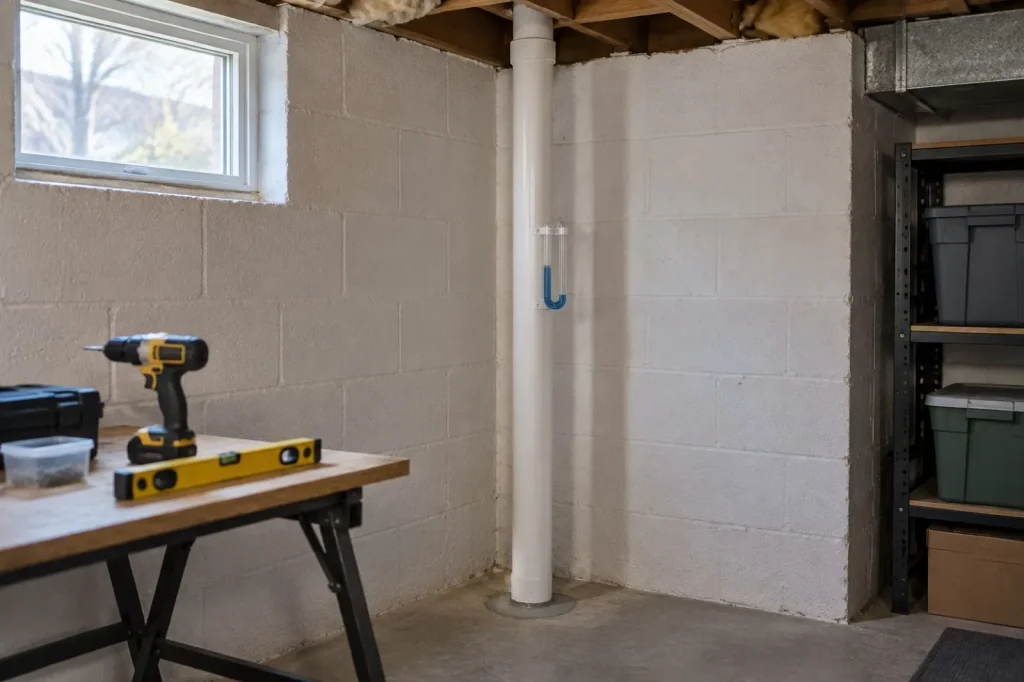
The short answer
Radon mitigation cost for a typical sub-slab system is about $800 to $2,800, according to a 2026 contractor guide, against EPA’s last printed range of $800 to $2,500 from 2006, or about $1,280 to $3,990 in 2025 dollars. Crawl space systems cost more. A fan rated 41 to 72 watts adds about $65 to $113 a year in electricity, per the EIA US average rate.
Key takeaways
- EPA’s $800 to $2,500 range, still quoted as current online, is from the December 2006 Consumer’s Guide. The 2025 edition prints no dollar figure.
- Adjusted by the BLS consumer price index, EPA’s 2006 range is about $1,280 to $3,990 in 2025 dollars.
- Foundation type is the clearest price driver: crawl space and block wall systems start higher than slab systems in every source that prices them separately.
- A RadonAway RP145 fan, rated 41 to 72 watts, costs $65 to $113 a year to run, per the EIA US residential average of 17.99 cents per kWh.
- Fan replacement runs $300 to $600 installed in 2026 contractor pricing; EPA printed $200 to $350 in 2006.
- Colorado’s low-income programme pays up to $7,000 per home, according to its procedures; Minnesota points owners to state housing loans; Oregon offers no state help.
On this page
The figures below are each tied to a named publisher and a date, because the EPA range that still circulates online dates from 2006. How the systems work, and who may install them, is covered in our radon mitigation guide; this page is about money. More cost pages sit under Pricing.
What this page does not cover. The health effects of radon exposure, explained in the EPA Citizen's Guide to Radon; system design and licensing, covered on the mitigation page; and fan model selection.
Every published figure, side by side
Six sources are compared here. They do not agree, and the spread is the useful part: it is roughly the gap between a single-point slab job and a crawl space or multi-point system.
| Source | Date | What it publishes | Basis |
|---|---|---|---|
| EPA Consumer’s Guide | December 2006 | $800 to $2,500, average about $1,200 | Whole job, contractor |
| National Radon Program Services, Kansas State University | Undated | Average $1,200; $800 to $1,500 common | National |
| University of Nevada, Reno Extension | 2022 | About $2,500 slab or basement; about $3,800 or more crawl space | Certified or licensed contractor |
| Minnesota Department of Health | Updated March 2023 | Avoid quotes under $1,000 | Warning, not a range |
| Peerless Environmental (South Carolina contractor) | July 2026, updated September 2026 | Sub-slab $800 to $2,800; crawl space $1,200 to $3,500 | National averages it cites |
| RadonSeal (sealer manufacturer) | Updated August 2026 | Repeats $800 to $2,500, attributed to EPA | Sells an alternative |
According to the University of Nevada, Reno Extension, a slab or basement home averages about $2,500 and a crawl space home about $3,800 or more, the highest of the public sources here. The Minnesota Department of Health gives no range but warns that quotes under $1,000 “are often too good to be true.”
Why EPA’s number is from 2006
The EPA Consumer's Guide, December 2006 edition (EPA 402-K-06-094) said the cost of a contractor fixing a home “generally ranges from $800 to $2500,” with an average of about $1,200, and printed a cost table by technique. The March 2013 edition dropped both. So did the 2016 edition and the 2025 revision of the EPA Consumer's Guide to Radon Reduction, which says only that most homes “can be fixed for about the same cost as other common home repairs.”
The figure still circulates as EPA’s current estimate: RadonSeal attributes it to the Citizen’s Guide, which, in its 2025 revision, prints no dollar figure. Adjusted by the BLS CPI-U, series CUUR0000SA0 annual averages for 2006 and 2025, a factor of 1.60, EPA’s range becomes about $1,280 to $3,990, and the $1,200 average about $1,920. That lands close to the 2022 Nevada figure and the 2026 contractor range.
Cost by technique, from EPA’s last table
The 2006 table is the only government source found that prices each method separately, and it still explains the order of magnitude. Operating cost covers the fan’s electricity and the heated or cooled air the system removes.
| Technique | Installation, 2006 | Operating, per year |
|---|---|---|
| Subslab suction | $800 to $2,500 | $50 to $200 |
| Drain tile suction | $800 to $1,700 | $50 to $200 |
| Sump hole suction | $800 to $2,500 | $50 to $250 |
| Block wall suction | $1,500 to $3,000 | $100 to $400 |
| Submembrane, crawl | $1,000 to $2,500 | $50 to $250 |
| Passive subslab | $550 to $2,250 | Some energy penalties |
| House pressurization | $500 to $1,500 | $150 to $500 |
| Heat recovery ventilator | $1,200 to $2,500 | $75 to $500 |
What moves the price
The EPA Consumer's Guide to Radon Reduction says the number of suction points depends on how easily air moves in the material under the slab and on the strength of the radon source. That is sub-slab permeability, which a soil communication test can check before the quote is final.
| Driver | Effect on price | Source |
|---|---|---|
| Foundation type | Crawl space and block wall start higher | EPA 2006 table; UNR; Peerless |
| Sub-slab permeability | Each extra suction point adds $300 to $600, per Peerless | EPA: points depend on air movement |
| Concealing the pipe | Cosmetic treatment raises the price | EPA 2006 note 2; NRPS |
| Crawl space membrane | Starts higher than slab suction | EPA 2006: $1,000 to $2,500; Peerless: $1,200 to $3,500 |
| Existing sump or drain tile | Lower top end than sub-slab | Peerless: $800 to $1,500; EPA 2006 drain tile: $800 to $1,700 |
| Passive pipe already in | Adding a fan is far cheaper | EPA 2006: about $300; Peerless: $500 to $1,000 |
| Electrical and permits | May be extra; ask if included | EPA contract checklist; MDH |
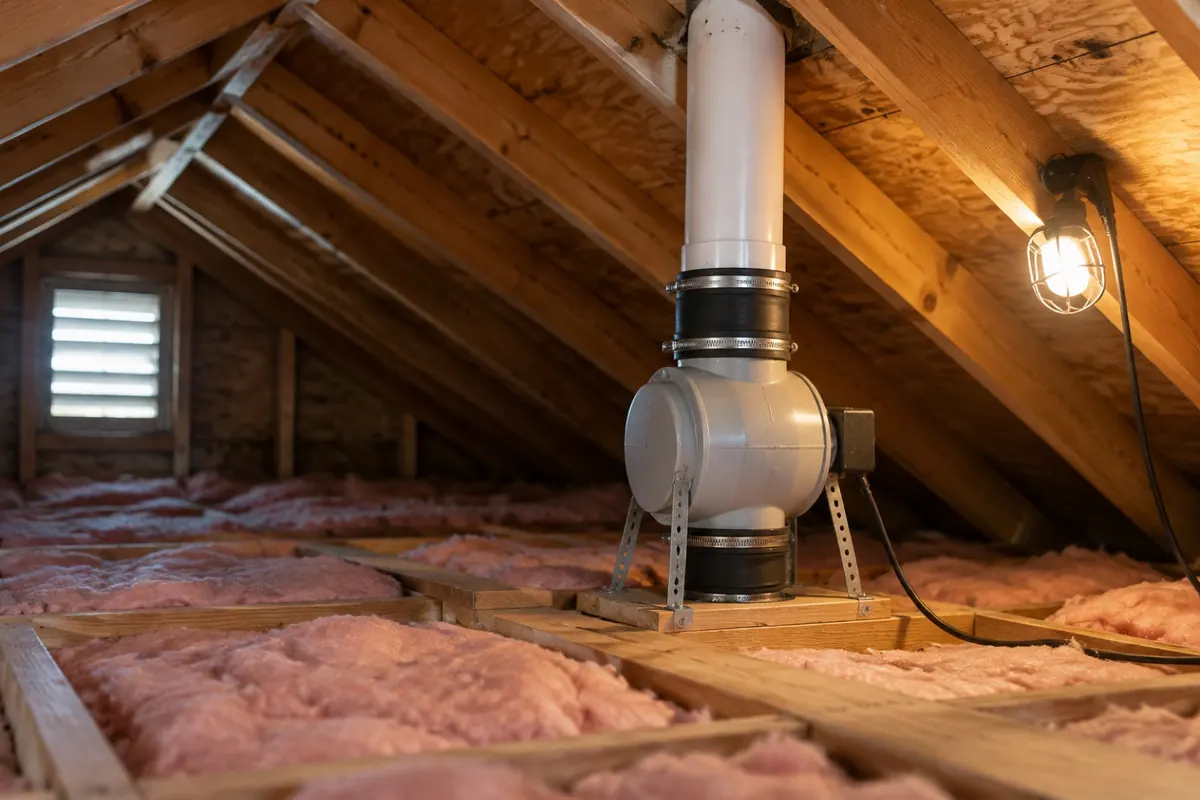
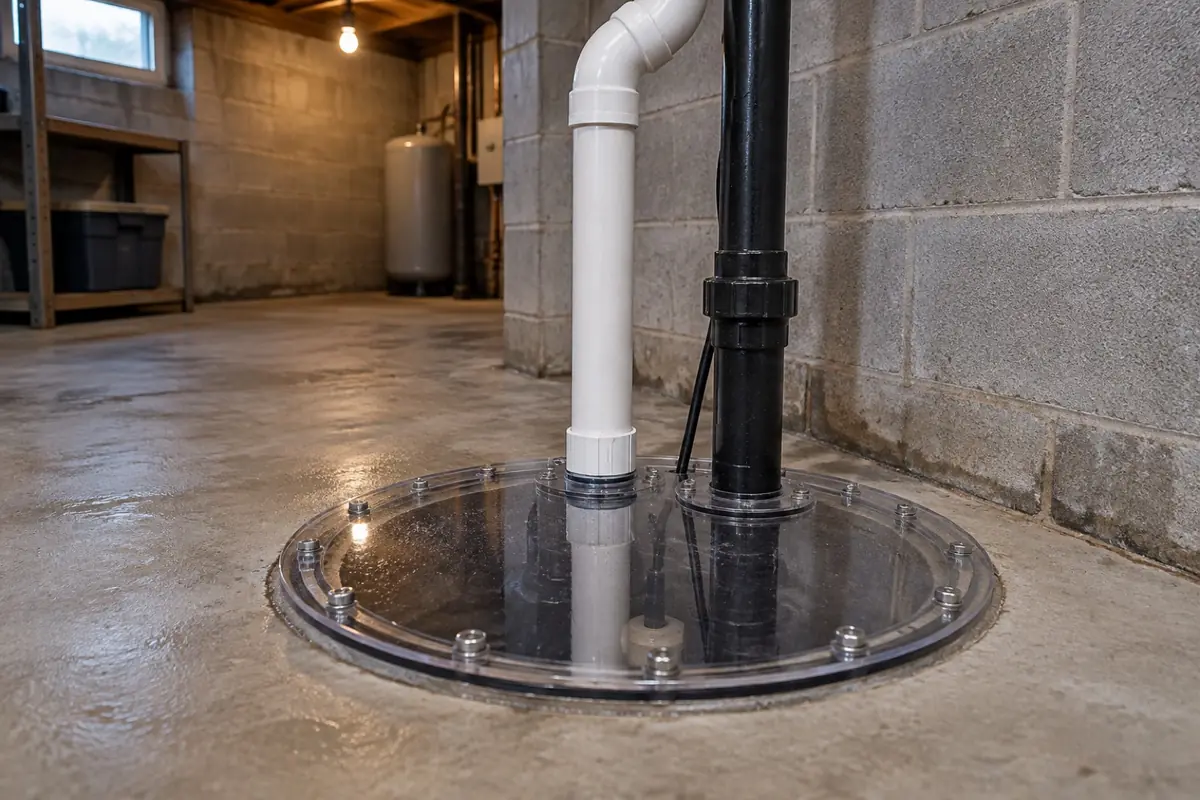
Fan placement matters because the fan may not sit in or below living space, per EPA, so it goes in an attic, a garage or on an outside wall. NRPS notes that part of the cost depends on what is needed to conceal the system. For a crawl space, a radon membrane is not full encapsulation; that larger moisture job is priced on our crawl space encapsulation cost page. Where the suction point is a sump, the pump itself is a sump pump installation line.
Running cost, computed from the spec sheet
The RadonAway RP Series product sheet, dated August 2015, rates its inline fans from 15 to 152 watts. A fan runs 24 hours a day, 365 days a year, so annual kilowatt hours are watts times 8.76. The price is the EIA Electric Power Monthly Table 5.3 US residential average for the 12 months ending July 2026: 17.99 cents per kWh.
| Model | Rated watts | kWh a year | Per year | Per month |
|---|---|---|---|---|
| RP140 | 15 to 21 | 131 to 184 | $24 to $33 | $2 to $3 |
| RP145 | 41 to 72 | 359 to 631 | $65 to $113 | $5 to $9 |
| RP260 | 50 to 75 | 438 to 657 | $79 to $118 | $7 to $10 |
| RP265 | 91 to 129 | 797 to 1,130 | $143 to $203 | $12 to $17 |
| RP380 | 95 to 152 | 832 to 1,332 | $150 to $240 | $12 to $20 |
Location changes it. Using data from EIA Table 5.6.B for residential prices from January to July 2026, the same RP145 at 72 watts costs $189 a year in Maine and $90 in Iowa. Electricity is not the whole running cost: EPA’s 2006 operating range of $50 to $200 for subslab suction includes lost heated or cooled air, and RadonSeal puts that loss at $175 to $350 a year, a figure from a company selling an alternative.
Fan replacement and the ten-year cost
The current EPA Consumer's Guide to Radon Reduction says fans “may last for five years or more,” warranties “tend not to exceed five years,” and the replacement cost “varies.” The 2006 edition put it at $200 to $350 including parts and labor, about $320 to $560 in 2025 dollars. Peerless Environmental reports $300 to $600 installed, every five to ten years. National Radon Program Services gives fan life spans of 10 to 15 years, and the RadonAway sheet a five-year warranty.
| Scenario | Install | Ten years of electricity | One fan swap | Ten-year total |
|---|---|---|---|---|
| Low end, slab | $800 (Peerless low) | $646 (41 W) | $300 | $1,746 |
| High end, slab | $2,800 (Peerless high) | $1,135 (72 W) | $600 | $4,535 |
| Crawl space | $3,800 (UNR) | $1,135 (72 W) | $600 | $5,535 |
Grants and loans
Colorado runs the clearest programme found. According to its Colorado LIRMA procedures, revised 1 July 2026, it pays up to $7,000 per application for owner-occupied homes under county income limits, such as $74,800 for one person in Denver County. The home needs a test above 4 pCi/L within a year from an approved device; consumer-grade monitors are refused, as are rentals, homes listed for sale and homes with an existing system. The contractor is paid after a post-test below 4 pCi/L.
| Programme | Who runs or lists it | What it offers | Who qualifies |
|---|---|---|---|
| Colorado LIRMA | CDPHE | Up to $7,000 per application | Owner-occupied, income limits, test above 4 pCi/L within a year |
| Minnesota housing loans | Listed by MDH | Rehabilitation, emergency and Fix-Up loans | Low-income or general home improvement |
| USDA rural repair | Listed by MDH and CDPHE | Loans and grants | Very low-income rural owners |
| HUD 203k and CDBG | Listed by CDPHE and Oregon | Rehabilitation financing | Programme rules apply |
| Oregon | Oregon Health Authority | None | “does not have or offer financial assistance” |
No federal radon mitigation grant for homeowners appeared in the EPA guides read for this page. Insurance is a separate question for the policy and the state insurance department.
Radon in a home sale
The EPA Home Buyer's and Seller's Guide to Radon, revised March 2024, suggests the contract say “when radon mitigation measures will be taken, and who will pay for them.” The MDH radon in real estate page puts it plainly: buyers and sellers “can negotiate radon testing, radon mitigation system installation, and who is responsible for the costs.” EPA tells sellers that test and repair records “could be a positive selling point.”
| State | Rule at sale | Source |
|---|---|---|
| New Jersey | Seller gives the buyer test results and evidence of mitigation at contract | N.J.A.C. 7:28-27.3 |
| Minnesota | Seller discloses known radon tests, levels and any system before the purchase agreement | MDH radon in real estate page |
| Florida | Radon notice on at least one sale or rental document | Fla. Stat. 404.056(5) |
| Iowa | Tester may share results under five years old with a buyer who made an offer and paid for the test | Iowa Code 136B.2 |
New construction changes the arithmetic. EPA’s 2006 guide put adding a fan to a passive pipe at about $300; Peerless lists $500 to $1,000 in 2026.
Check a quote in eight lines
EPA advises more than one estimate and lists what a contract should hold. These eight lines turn that into a checklist.
| Line | It should say | Why |
|---|---|---|
| Credential | State license number or NRPP or NRSB ID | EPA contract checklist |
| Total price | Taxes and permit fees included | EPA contract |
| Suction points | Number and location | Drives price, per EPA |
| Fan location | Attic, garage or exterior | EPA install rules |
| Warning device | Gauge or alarm | EPA requires one |
| Post-mitigation test | Who runs it, within 30 days | EPA Consumer’s Guide |
| Guarantee | Target level, length, transferable on sale | EPA contract |
| Price check | Under $1,000 deserves questions | MDH |
For contractors: the line items
Credentials are a fixed cost: according to their fee pages, NRPP charges $275 for a two-year mitigation specialist certification and NRSB $125 a year. Minnesota charges $250 a year to license a mitigation professional and adds $75 per job for the state system tag, per the statute (Minn. Stat. 144.4961), a per-job line item. According to its procedures, Colorado’s LIRMA requires $1,000,000 in general liability, auto and workers’ compensation cover, a five-year warranty on fan and workmanship, and bids within seven business days.
Restoration jobs touch radon systems after basement water losses. Price resealing a sump lid, reconnecting a pipe or a post-rebuild retest as separate lines. A basement flood cleanup or waterproofing scope that disturbs the system should name who restores it.
Questions people actually ask
Is radon mitigation worth it?
EPA recommends fixing a home at 4 pCi/L or higher and says most homes cost about the same as other common repairs. Based on data from the sources here, ten years of ownership runs about $1,746 to $4,535 for a slab home, including a fan swap. EPA also tells sellers that test and repair records can be a positive selling point.
Is it hard to sell a house with radon?
EPA advises sellers to test before listing, fix high levels and keep the records. Some states require disclosure: New Jersey sellers must hand over test results and mitigation evidence at contract, and Minnesota sellers must disclose what they know. EPA’s buyer guide suggests the contract state who pays for mitigation, so cost becomes a negotiating line.
Will insurance pay for radon mitigation?
This page does not say what any policy pays. Check the policy wording, ask the state insurance department, and talk to a licensed professional. Public help exists in some states: according to its procedures, Colorado’s LIRMA pays up to $7,000 for qualifying low-income owners, and Minnesota’s health department lists state housing loans that can cover a system.
In what month is radon highest?
EPA’s guides do not name a month. The Citizen’s Guide says levels vary from day to day and season to season, which is why a short-term test is less likely than a long-term test to show the year-round average. Testing season does not change the installation price; foundation type and suction points do.
What is the monthly cost of a radon mitigation system?
For a RadonAway RP145 rated 41 to 72 watts, about $5 to $9 a month in electricity, per the EIA US average of 17.99 cents per kWh. Lost heated or cooled air adds to that; EPA’s 2006 table put operating cost for subslab suction at $50 to $200 a year.
Sources
- EPA Consumer's Guide, December 2006 edition, EPA 402-K-06-094, revised December 2006, via the Internet Archive. Retrieved 13 October 2026.
- EPA Consumer's Guide to Radon Reduction, EPA 402/K-10/005, 2025 revision; EPA Citizen's Guide to Radon, 2025 revision. Retrieved 13 October 2026.
- EPA Home Buyer's and Seller's Guide to Radon, EPA 402/K-24/001, revised March 2024. Retrieved 13 October 2026.
- National Radon Program Services, Kansas State University, undated. Retrieved 13 October 2026.
- University of Nevada, Reno Extension, Kelly, C., 2022. Retrieved 13 October 2026.
- Minnesota Department of Health, updated 15 March 2023; MDH financial assistance page, updated 28 March 2023; MDH radon in real estate page. Retrieved 13 October 2026.
- Peerless Environmental, published 2 July 2026, updated 16 September 2026. Retrieved 13 October 2026.
- RadonSeal, modified 19 August 2026. Retrieved 13 October 2026.
- RadonAway RP Series product sheet, P/N 02008, dated 8/15, distributor copy. Retrieved 13 October 2026.
- EIA Electric Power Monthly Table 5.3 and EIA Table 5.6.B, released 24 September 2026. Retrieved 13 October 2026.
- BLS CPI-U, series CUUR0000SA0, annual averages 2006 and 2025, via the BLS API. Retrieved 13 October 2026.
- CDPHE assistance page and Colorado LIRMA procedures, revised 1 July 2026; Oregon Health Authority. Retrieved 13 October 2026.
- N.J.A.C. 7:28-27.3; Fla. Stat. 404.056(5); Iowa Code 136B.2; Minn. Stat. 144.4961; NRPP and NRSB fee pages. Retrieved 13 October 2026.
- Inflation adjustments, electricity costs and ten-year totals are arithmetic on the figures above. No price was estimated or invented. Our methodology sets out the standing rules.
Prices vary by house and market. Get written estimates from more than one qualified mitigator.