The short answer
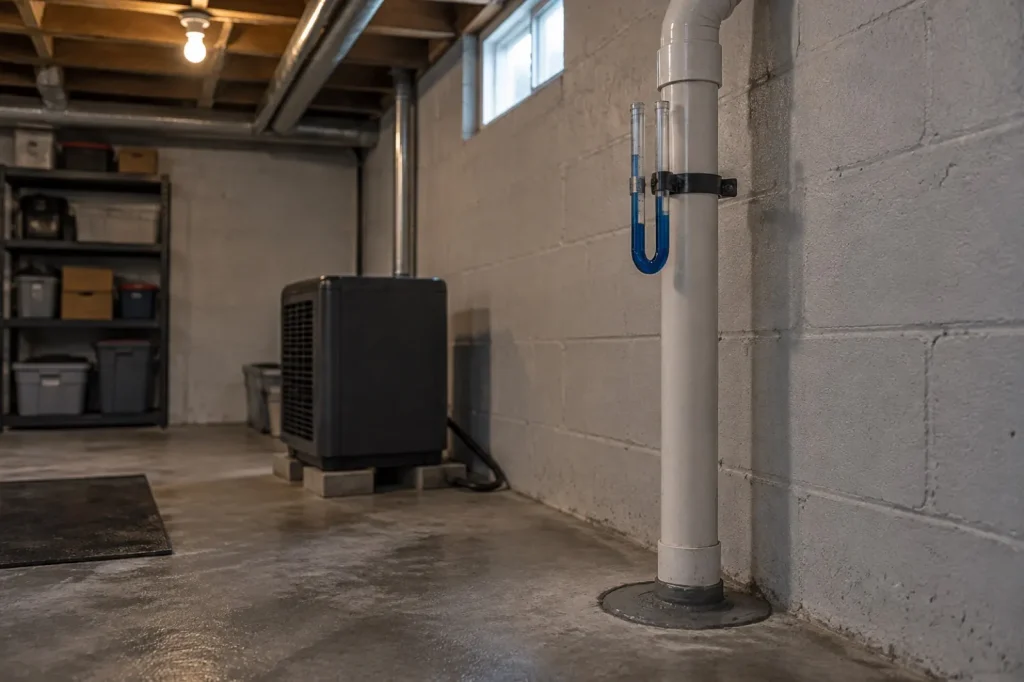
Radon mitigation is the work of lowering indoor radon, and EPA’s guidance sets the trigger: fix the home at 4 pCi/L or higher, and consider fixing between 2 and 4 pCi/L. The usual method is sub-slab depressurization, a sealed pipe and a fan that runs continuously, pulling soil gas from under the floor and venting it above the roof. Then retest within 30 days.
Key takeaways
- EPA’s action level is 4 pCi/L from one long-term test or two short-term tests averaged; between 2 and 4, EPA says consider fixing.
- EPA calls active subslab suction the most common and usually the most reliable method, typically cutting radon 50 to 99 percent.
- Sealing cracks alone is not a fix: EPA says it has not been shown to lower radon significantly or consistently.
- The fan never sits in or below living space, and the exhaust goes above the roof, 10 feet or more above the ground.
- Retest no sooner than 24 hours after the fan starts and within 30 days, then at least every two years.
- ANSI/AARST SGM-SF-2023 covers existing homes and CCAH-2020-0523 new homes. Ten of the eleven states checked here regulate installers.
On this page
This page reads the documents that define a correct job: EPA’s consumer guides in their current revisions, the ANSI/AARST standards index, the two national certification bodies and state licensing law. Price has its own page, our radon mitigation cost guide; related rules sit under Standards.
What this page does not cover. The health effects of radon exposure are explained in the EPA Citizen's Guide to Radon, and this page does not restate them. Radon in well water and fan model selection are also out of scope.
Where EPA draws the line
The EPA Citizen's Guide to Radon, revised in 2025, says: “Fix your home if your radon level is 4 picocuries per liter (pCi/L) or higher.” The EPA Consumer's Guide to Radon Reduction says how to reach that number, from “one long-term test or the average of two short-term tests,” and adds the line most summaries drop: “You also may want to consider fixing if the level is between 2 and 4 pCi/L.” The EPA Home Buyer's and Seller's Guide to Radon, revised March 2024, puts it flatly: “Consider fixing when the radon level is between 2 and 4 pCi/L.”
| Result | What EPA says | Where |
|---|---|---|
| Below 2 pCi/L | No action band; most homes can be brought here, and EPA suggests testing again in future. | Citizen’s Guide |
| 2 to 4 pCi/L | “Consider fixing.” | Consumer’s Guide; Home Buyer’s Guide |
| 4 or higher, long-term test | Fix the home. | Citizen’s Guide |
| 4 or higher, two short-term tests averaged | Fix; the higher the results, the more certain. | Consumer’s Guide; Citizen’s Guide |
| First short-term test above twice 4 | Take a second short-term test immediately. | Citizen’s Guide |
For scale, the Citizen’s Guide puts the average indoor level at about 1.3 pCi/L and outdoor air at about 0.4. It also shows why one reading near 4 is weak evidence: two short-term tests averaging 4.1 pCi/L leave about a 50 percent chance, per EPA, that the year-round average is somewhat below 4.
How sub-slab depressurization works
The EPA Consumer's Guide to Radon Reduction calls active subslab suction, “also called subslab depressurization,” the most common and usually the most reliable method. One or more pipes go through the slab into the crushed rock or soil beneath, and a vent fan draws the gas out “while simultaneously creating a negative pressure or vacuum beneath the slab.” How many suction points a house needs depends on how easily air moves under the slab and on the strength of the source; often one is enough.
Before designing, EPA expects a visual inspection and, where needed, two field checks. Chemical smoke puffed at cracks, drains and sumps shows which way air moves. A soil communication test puts a vacuum hose in one small hole in the slab and smoke in another: if the smoke is drawn down, one suction point can reach both. EPA also notes contractors may recommend a check of combustion appliances for backdrafting.
Install rules you can check from the floor
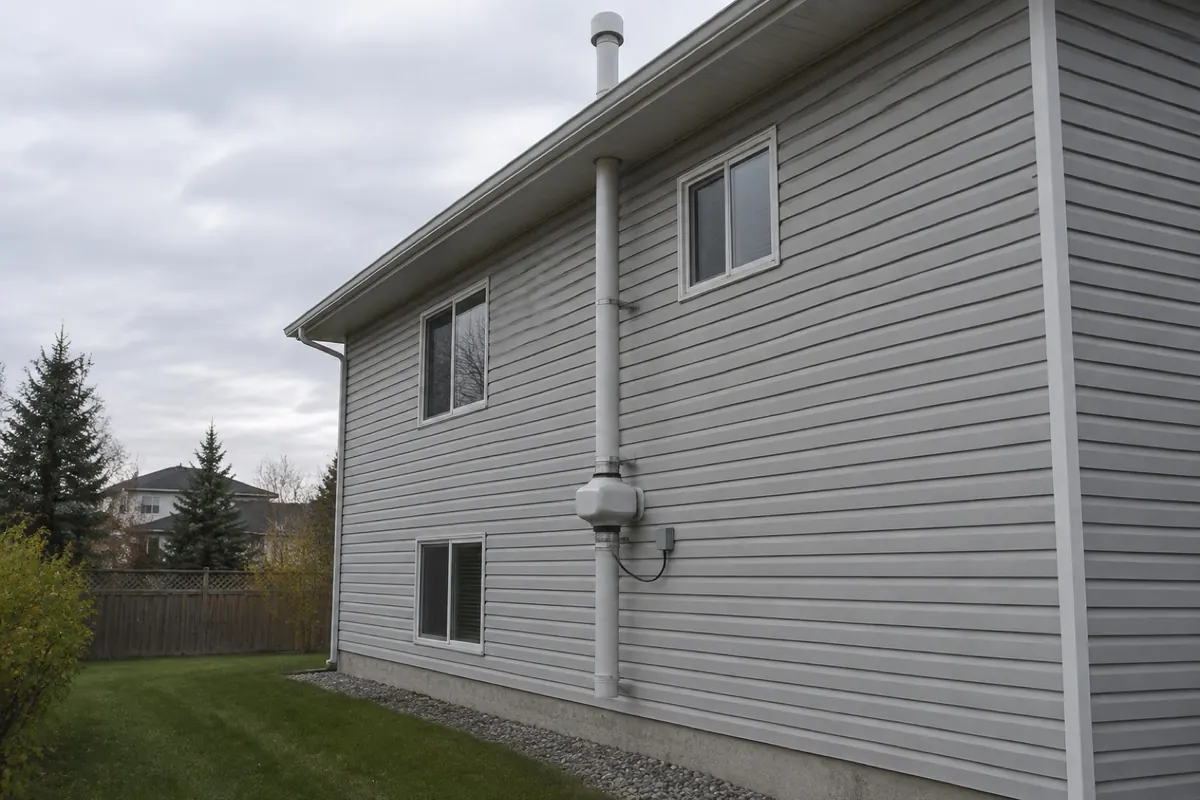
The Consumer’s Guide ends with a contractor checklist. Pennsylvania wrote a more detailed version into 25 Pa. Code 240.308, for homes three stories or less. Side by side, they let an owner or general contractor check a finished system without buying the standard.
| Item | EPA Consumer’s Guide | 25 Pa. Code 240.308 |
|---|---|---|
| Exhaust height | Above the roof, 10 ft or more above ground | Above the roof edge; 12 in above the roof for roof penetrations |
| Openings | 10 ft from windows and doors unless 2 ft above them | Same, plus 5 ft from a wall rising above the roof |
| Discharge | Not specified | Vertical and upward; no rain caps |
| Fan | Not in or below a livable area | Not below grade, in conditioned space, or in a basement or crawl space under heated rooms |
| Sealing and labels | Sealing a basic part; system clearly labeled | Joints, penetrations and sump pits sealed; label with installer certification number and install date |
EPA also requires a warning device, usually a manometer, placed where it can be seen or heard, and says the fan “should NEVER be turned off.”
Matching the system to the foundation
EPA groups methods by foundation, and a house with a basement under one part and a crawl space under another may need two.
| Variant | Foundation | EPA typical reduction | EPA note |
|---|---|---|---|
| Active subslab suction | Basement or slab | 50 to 99 percent | Works best if air moves easily under the slab |
| Drain tile suction | Basement with a drain loop | 50 to 99 percent | Partial or complete loops |
| Sump hole suction | Basement with a sump | 50 to 99 percent | Sump capped but still drains |
| Block wall suction | Hollow block walls | 50 to 99 percent | Often paired with subslab |
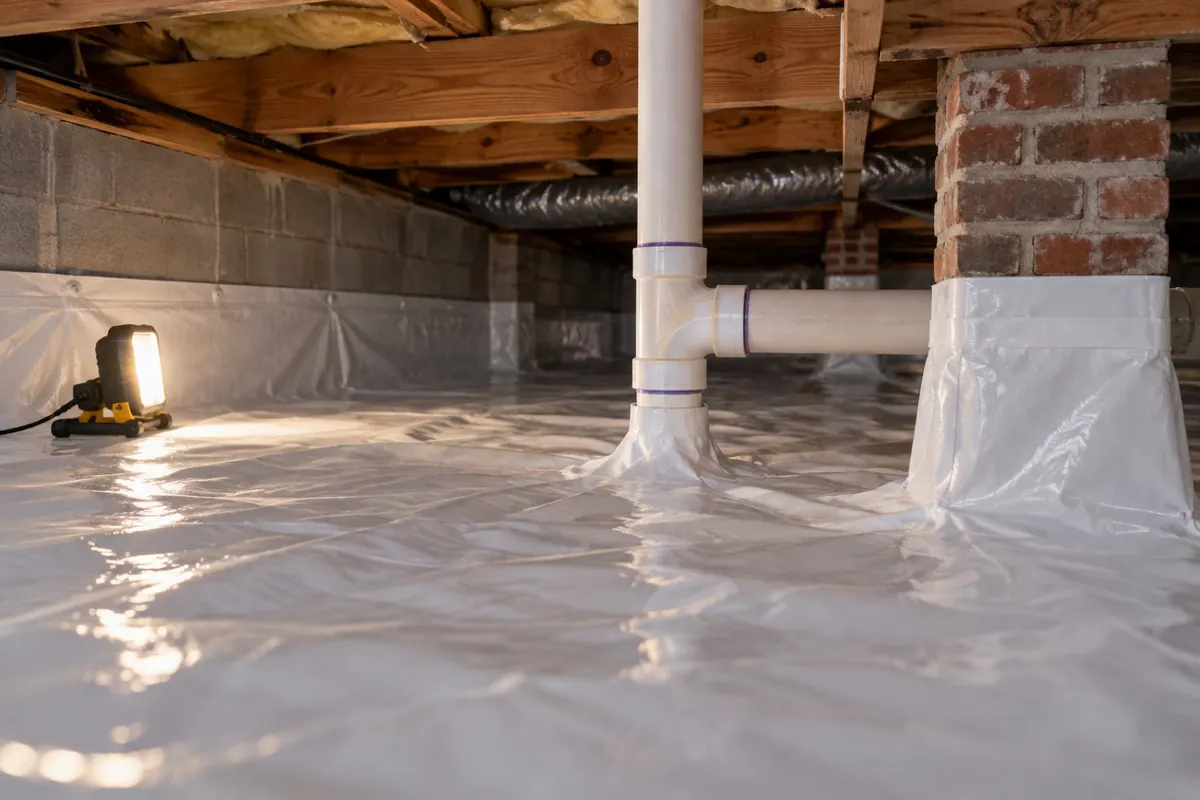
| Submembrane depressurization | Earth floor crawl space | 50 to 99 percent | EPA’s most effective crawl space method |
| Passive subslab suction | New construction | 30 to 70 percent | A fan can be added later |
Submembrane suction draws from under a high-density plastic sheet laid over the earth floor; full encapsulation for moisture is a separate scope, priced on our crawl space encapsulation cost page. A sump used as the suction point keeps draining; the pump is covered under sump pump installation cost.
Three things do not work alone, per EPA. Sealing alone fails because “normal settling of your home opens new entry routes.” Opening windows is temporary: levels most often return within about 12 hours of closing up. House pressurization should come only after the common techniques have failed.
The ANSI/AARST standards behind the work
Since about 2012, says EPA's radon standards of practice page, EPA has taken part in the industry’s ANSI/AARST consensus process, under the federal preference for voluntary consensus standards. The AARST standards index describes its Consortium on National Standards as an ANSI-accredited developer owned by AARST. The standards are free to read online; PDFs are sold. Each lists 1 December 2023 as its compliance date.
| ANSI/AARST standard | Building type | What it governs |
|---|---|---|
| SGM-SF-2023 | Existing homes | Reducing soil gas entry, including radon and chemical vapors |
| CCAH-2020-0523 | New one and two family homes | Rough-in, post-construction test, activation if required |
| MAH-2023 | Homes | Measuring radon to decide if mitigation is needed, real estate or not |
| SGM-MFLB-2023 | Multifamily, school, commercial | Adds only what SGM-SF does not cover |
Two catches. The 2025 Consumer’s Guide still names ASTM E2121 as the example standard, while EPA’s standards page lists ANSI/AARST. And a standard binds only where law adopts it: the Colorado DORA notice of 16 August 2022 says AARST standards “have been adopted into law” for Colorado licensees.
Testing after installation
The EPA Consumer's Guide to Radon Reduction sets the window: a post-mitigation test “should be done within 30 days of system installation, but no sooner than 24 hours after your system is in operation with the fan on.” The contractor may test, but EPA recommends an independent measurement too, to remove any conflict of interest.
| When | What |
|---|---|
| 12 hours before | Windows and doors closed, kept closed |
| 24 hours after fan on | Earliest start of the test |
| Test length | Two to seven days |
| 30 days after install | Test completed |
| Every 2 years | Retest |
| After a remodel | Retest the lowest lived-in area |
Colorado ties payment to it: under the Colorado LIRMA procedures, revised 1 July 2026, the contractor is paid only if the homeowner’s test, run in that same window, comes back below 4 pCi/L.
Who may install it
EPA's page on finding a mitigation professional, updated 30 December 2025, sets the floor: states taking EPA radon grants may list only providers credentialed by a state process, such as a license, or by one of two national programmes, the National Radon Proficiency Program and the National Radon Safety Board. NRPP says it is accredited under ISO/IEC 17024 and requires work to the ANSI/AARST standards.
| State | What the text requires | Source |
|---|---|---|
| Colorado | License required from 1 July 2022 | Colorado DORA notice of 16 August 2022 |
| Florida | Certified individual and certified business | Fla. Stat. 404.056 |
| Illinois | License before providing services | Ill. Admin. Code tit. 32, 422.50 |
| Iowa | Credential required; own building exempt | Iowa Code 136B.1 |
| Kansas | State certification programme | K.S.A. 48-16a03 |
| Maine | Registration of firms and individuals | 22 M.R.S. 773 |
| Minnesota | Annual license; state tag on each system | Minn. Stat. 144.4961 |
| New Jersey | Certification required to mitigate | N.J.A.C. 7:28-27.3 |
| Ohio | Contractor and specialist licenses | Ohio Admin. Code 3701-69-02 |
| Pennsylvania | Certification; no advertising without it | 25 Pa. Code 240.111 |
| Oregon | No state mitigation regulation | Oregon Health Authority mitigation page |
The details differ. Pennsylvania’s 240.112 requires an approved course, an exam and a year of mitigation experience or three in a related trade. Minnesota charges $250 a year for a mitigation professional license and $75 per system tag, per the statute (Minn. Stat. 144.4961).
The radon mitigation decision path
Seven steps, in the order a homeowner meets them, drawn from the EPA guides and the install rules above.
- Confirm the number with a long-term test or two short-term tests averaged, in the lowest level used regularly.
- Place it in EPA’s bands: 4 or higher, fix; 2 to 4, consider fixing.
- Check the installer against the state list, or ask for an NRPP or NRSB credential.
- Name the foundation: slab or basement, block walls, crawl space, or a mix.
- Read the proposal for credential, insurance, a warning device, a post-test and any reduction guarantee.
- Walk the finished system: fan outside living space, exhaust above the roof, labels, gauge, seals.
- Test in the window, then every two years and after any renovation.
Doing it yourself is legal in places: Iowa Code 136B.1 and Ohio Admin. Code 3701-69-02 exempt owners of the building. But the EPA Consumer's Guide to Radon Reduction warns that without the right knowledge “you could actually increase your radon level,” and a DIY system must meet the same discharge, fan and testing rules.
For contractors: where restoration meets a radon system
Restoration crews rarely install radon systems but often disturb them, in basements after a water loss, in crawl spaces and on cut or cracked slabs. A basement flood cleanup that leaves a sump lid open leaves a system that no longer works as installed.
| On the job | Do | Why |
|---|---|---|
| Water loss, active system | Photograph gauge and labels; keep the fan running | EPA: fan must run continuously |
| Sump is the suction point | Reseal the lid after pumping | 240.308 requires sealed sump pits |
| New drywall over the pipe | Keep floor labels visible | 240.308 requires a label on each floor |
| Crawl space liner replaced | Bring back a credentialed mitigator | The sheet holds the pressure field |
| Rebuild finished | Recommend a retest | EPA: retest after remodeling |
| Selling mitigation | Subcontract in licensing states | Ohio allows subcontracting to a licensed firm |
Look for the package Pennsylvania requires the mitigator to leave on site, marked “Radon Mitigation Information”: contracts, warranties, operating instructions and what to do if the warning device shows failure. It names who to call. Coverage questions go to the policy, the state insurance department and a licensed professional. Groundwater problems belong to the basement waterproofing scope.
Questions people actually ask
Does radon mitigation actually work?
EPA’s Consumer’s Guide says some systems can cut indoor radon by up to 99 percent, and lists a typical reduction of 50 to 99 percent for active subslab, drain tile, sump, block wall and submembrane suction. Passive systems are listed at 30 to 70 percent. Proof for a given house is the post-mitigation test, run no sooner than 24 hours after the fan starts and within 30 days.
What is the average cost of radon mitigation?
EPA’s current guides print no dollar figure, saying only that most homes can be fixed for about the same cost as other common home repairs. Dated, named price ranges from state programmes, extension services and EPA’s older editions, plus the fan’s running cost, are compared on our radon mitigation cost page.
Is it safe to live in a house with radon?
This page does not assess health risk; EPA’s Citizen’s Guide to Radon is the reference. EPA’s action guidance is clear: fix the home at 4 pCi/L or higher on a long-term test or two short-term tests averaged, and consider fixing between 2 and 4 pCi/L. EPA says most homes can be brought to 2 pCi/L or below.
Can I remediate radon myself?
EPA does not forbid it but warns you could raise radon levels or create other hazards, and points do-it-yourselfers to their state radon office for training. Iowa and Ohio law exempt owners working on their own building. A DIY system still has to meet the same discharge, fan location and post-mitigation testing rules.
Should I buy a house with a radon mitigation system?
EPA’s Home Buyer’s and Seller’s Guide tells buyers to ask for the seller’s test results and any information about the system, and to test if the home has not been tested. In New Jersey, N.J.A.C. 7:28-27.3 requires the seller to hand over test results and evidence of mitigation when the contract is signed. A working gauge and a fresh test matter most.
Sources
- EPA Consumer's Guide to Radon Reduction, EPA 402/K-10/005, 2025 revision. Retrieved 13 October 2026.
- EPA Citizen's Guide to Radon, EPA 402/K-12/002, 2025 revision. Retrieved 13 October 2026.
- EPA Home Buyer's and Seller's Guide to Radon, EPA 402/K-24/001, revised March 2024. Retrieved 13 October 2026.
- EPA's page on finding a mitigation professional, updated 30 December 2025, and EPA's radon standards of practice page. Retrieved 13 October 2026.
- AARST standards index, AARST Consortium on National Standards. Retrieved 13 October 2026.
- NRPP and NRPP certification types page. Retrieved 13 October 2026.
- NRSB certification types page, National Radon Safety Board. Retrieved 13 October 2026.
- Pennsylvania Code: 25 Pa. Code 240.111, 240.112 and 25 Pa. Code 240.308. Retrieved 13 October 2026.
- Ohio Admin. Code 3701-69-02, N.J.A.C. 7:28-27.3 and Ill. Admin. Code tit. 32, 422.50, via Cornell’s Legal Information Institute. Retrieved 13 October 2026.
- Fla. Stat. 404.056; Iowa Code 136B.1; Minn. Stat. 144.4961; 22 M.R.S. 773; K.S.A. 48-16a03 and 48-16a04. Retrieved 13 October 2026.
- Colorado DORA notice of 16 August 2022; Colorado LIRMA procedures, revised 1 July 2026; Oregon Health Authority mitigation page, undated. Retrieved 13 October 2026.
- No system was installed, inspected or tested for this page. Our methodology sets out the standing rules.
Radon rules change and states differ. Confirm current requirements with your state radon office.