The short answer
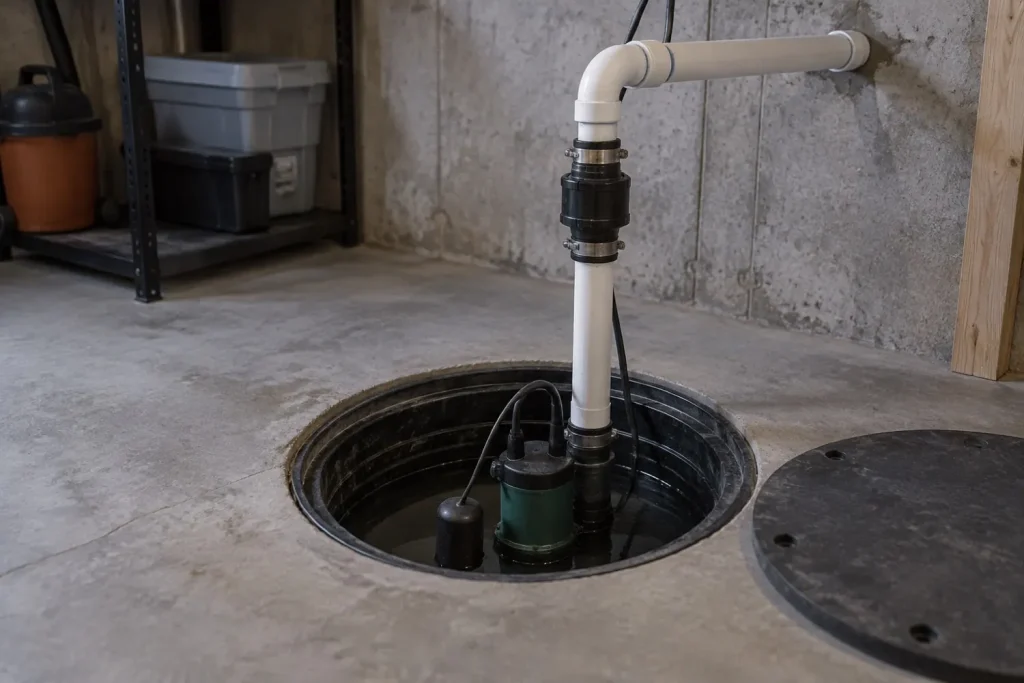
Sump pump installation cost runs about $600 to $1,200 to replace a pump in an existing basin, $1,500 to $3,000 for a new basin and pump in an existing slab, and $2,500 to $5,000 for a new installation requiring a slab cut and a discharge run. A battery backup adds $900 to $2,000 and a water-powered backup $1,200 to $2,500. Read those against the cost of the loss they prevent: a sewage or groundwater event in a finished basement runs $7,000 to $14,000 in mitigation alone, before anything is rebuilt.
Key takeaways
- A failed sump is not a plumbing inconvenience. It is a water loss, and it should be priced against the mitigation and reconstruction bill it prevents rather than against other appliances.
- The backup is the actual argument. The most common time a sump is needed is a heavy storm, which is also the most common time the power fails. A primary pump with no backup has a correlated failure mode.
- Horsepower is selected from lift height and inflow rate, not from a preference for bigger. An oversized pump short cycles and wears out faster than the right one.
- The single most common failure is a stuck float switch, which is a mechanical part in a wet basin doing the same motion thousands of times.
- Pumps are consumables, not fixtures. Knowing the age of yours is most of the maintenance conversation.
On this page
- What each installation scope costs
- Prevention cost against loss cost
- Submersible against pedestal
- Cast iron against thermoplastic
- Sizing by lift and inflow, not by horsepower
- The correlated failure nobody prices in
- Battery against water-powered backup
- The discharge line and the check valve
- How sump pumps fail
- Maintenance that actually matters
- What insurance does and does not pay
- How to read a sump pump quote
- Questions people actually ask
Sump pump installation cost is usually written up as a plumbing purchase, sitting somewhere between a water heater and a garbage disposal in the household ledger. That framing is why people buy the cheapest one that fits the hole. We write about restoration, and from that side of the transaction a sump pump is a piece of loss prevention equipment whose failure creates a claim. The price only means anything next to the price of the flood.
What each installation scope costs
The spread comes from how much of the system already exists. Dropping a new pump into a basin that is already cut, plumbed and wired is a different job from creating the basin, and the difference is concrete work rather than pump.
| Scope | Typical range | What it includes | When it applies |
|---|---|---|---|
| Replace a pump in an existing basin | $600 to $1,200 | Pump, labour, new check valve, reconnection to the existing discharge | The basin, the pit and the discharge line are all serviceable and only the pump has reached the end of its life. |
| New basin and pump in an existing slab | $1,500 to $3,000 | Basin, pump, gravel bed, slab patch, discharge connection, electrical where a circuit is available | There is somewhere sensible to put a pit, and a discharge route already exists or is short. |
| New install with slab cut and discharge run | $2,500 to $5,000 | Slab cut, excavation for the basin, basin and pump, patch, a full discharge line to a permitted outlet, dedicated electrical | Nothing is in place. This is the common figure when a sump is installed alongside an interior perimeter drain. |
| Battery backup addition | $900 to $2,000 | Secondary pump, deep cycle battery, charger and controller, separate float, tie into the discharge | Any property where a power cut during a storm would mean water on the floor, which is most of them. |
| Water-powered backup addition | $1,200 to $2,500 | Backup pump driven by municipal water pressure, backflow prevention device, supply connection, discharge tie-in | Municipal water supply available, adequate pressure, and local rules that permit the connection. |
Why a sump rarely arrives on its own
A sump pump is the discharge end of a drainage system. If water is arriving at the basement floor in enough volume to need pumping, something has to collect it and deliver it to the basin, and that is usually an interior perimeter drain. Quotes that price a sump in isolation for a property with no drainage are sometimes correct and are often the start of a larger scope. Our french drain cost page covers the collection side, and the two are generally bought together.
Prevention cost against loss cost
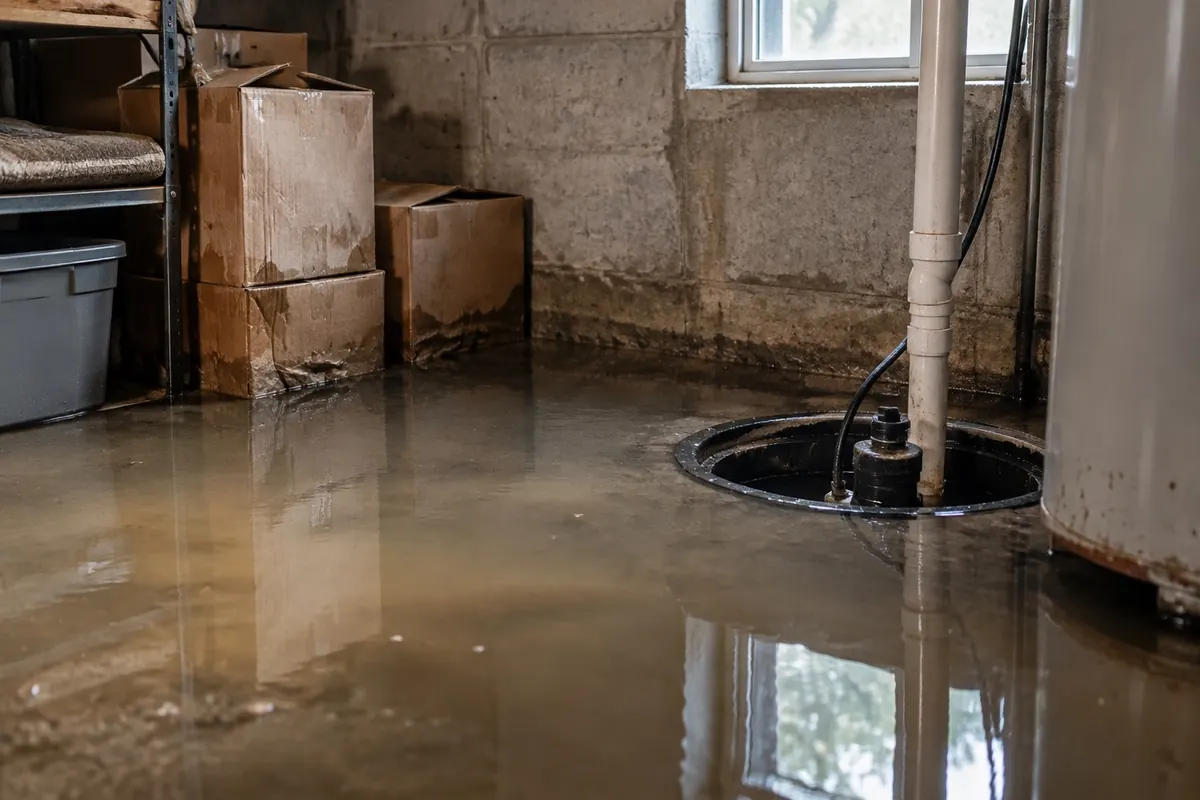
This is the comparison that makes the purchase legible, and it is almost never put on the page. On one side is a one-off installation, amortised over a service life measured in years. On the other is a mitigation invoice, a reconstruction invoice, a deductible, a claim on the record, and a period where part of the house cannot be used.
| Event | Typical mitigation | Typical total with rebuild | Prevention that addresses it |
|---|---|---|---|
| Groundwater rise, unfinished basement | $1,500 to $4,000 | $2,000 to $6,000 | Primary pump sized correctly, discharge kept clear. |
| Groundwater rise, finished basement | $2,500 to $6,000 | $6,000 to $16,000 | Primary pump plus a backup, because the finish is what makes it expensive. |
| Power failure during a storm, pump idle | $2,500 to $7,000 | $7,000 to $22,000 | Battery or water-powered backup. This is the failure the backup exists for. |
| Sewage backup into a finished basement | $7,000 to $14,000 | $15,000 to $40,000+ | A sump does not stop this. A backwater valve is the relevant device, and it is a different purchase. |
| Frozen or blocked discharge outlet | $2,500 to $6,000 | $6,000 to $16,000 | Outlet cleared before winter, correct slope, freeze-resistant outlet fitting. |
The comparison is not an argument that a pump always pays
Being honest about it: a basement that has never taken water, in a building with good grading on well-drained soil and no history in the neighbourhood, may go its whole life without needing a sump. Fitting one there is insurance against a risk that may be genuinely small. The comparison above is useful where there is a known history, a high water table, or a finished basement worth protecting. It is an argument for pricing the decision properly, not an argument that everyone should buy.
Where the backup pays for itself in one event
The place the arithmetic stops being close is the backup. A battery backup at $900 to $2,000 sits against a loss in a finished basement that our cost page puts at $7,000 to $14,000 in mitigation before anything is rebuilt. It has to prevent one event in its lifetime to be worth having, and the event it prevents is the exact scenario it was designed for: the primary pump idle because the power is out during the storm that filled the pit.
Submersible against pedestal
Two configurations dominate, and they trade off in predictable ways.
| Attribute | Submersible | Pedestal |
|---|---|---|
| Where the motor sits | In the basin, under the water | On a shaft above the basin, out of the water |
| Noise | Quieter, because water and the basin lid damp it | Noisier, because the motor is in the open |
| Purchase price | Higher | Lower |
| Service life | Generally shorter, motor is sealed and works wet | Generally longer, motor stays dry |
| Servicing | Pump has to come out of the pit | Motor is accessible without lifting anything out |
| Basin requirement | Needs a basin wide and deep enough to submerge | Works in a narrower pit |
| Handling solids | Better, depending on the model | Generally poorer |
| Typical use | Finished basements, higher flow, the common choice | Unfinished basements, tight pits, budget replacements |
The practical reading: submersible is the default for a finished basement because the noise difference is noticeable through a floor and the pit can be covered properly, which also controls the humidity and radon path that an open pit creates. Pedestal keeps its place where the pit is too narrow for a submersible, where the basement is unfinished so noise does not matter, and where being able to service the motor without reaching into water is genuinely worth something.
Cast iron against thermoplastic
Housing material is the specification most often glossed over on a quote and it correlates strongly with how long the unit lasts.
| Housing | Behaviour | Trade-off |
|---|---|---|
| Cast iron | Conducts heat from the motor into the surrounding water, which keeps the motor cooler during long runs | Heavier and more expensive. Generally the choice where the pump runs frequently or for extended periods. |
| Thermoplastic | Lighter, cheaper, corrosion resistant | Retains motor heat, which matters most during sustained running. Adequate for intermittent duty. |
| Cast iron core with plastic components | A middle position that appears frequently in mid-range units | Read the specification rather than the marketing: which part is cast iron matters. |
Duty cycle is the question the material is answering
If a pump kicks on for twenty seconds a few times a day, the housing material is close to irrelevant. If it runs for minutes at a time through a wet week, motor heat becomes the limiting factor and the cast iron body earns its cost. The decision therefore follows from the site rather than from a general ranking of materials, which is why asking a contractor how often they expect the pump to run is a better question than asking which brand they prefer.
Sizing by lift and inflow, not by horsepower
Horsepower is the number on the box, and it is the wrong place to start. A pump is specified by how much water it has to move, and how high it has to lift it to reach the discharge. Manufacturers publish that relationship as a flow curve, because flow falls as lift rises.
| Input | What it means | How to establish it |
|---|---|---|
| Total lift head | The vertical distance from the water level in the basin to the highest point in the discharge line | Measured, not estimated. A long horizontal run and every elbow add friction on top of the vertical figure. |
| Inflow rate | How fast the basin fills under the conditions that matter | Observed during heavy rain: time how long the basin takes to fill between pump cycles. |
| Discharge pipe diameter | A narrower line restricts flow regardless of pump capacity | Read from the existing line, or specified with the new one. |
| Duty expectation | Intermittent cycling or sustained running | Follows from site history and season. |
Why bigger is a real mistake, not just a waste of money
An oversized pump empties the basin faster than it refills, cuts out, and cuts back in again shortly after. That short cycling puts far more starts on the motor and the switch than steady operation does, and starts are what wear both out. The result is a more expensive pump with a shorter life doing a job a correctly sized unit would have done for longer. Where the pit is small, the fix is often a larger basin rather than a smaller pump.
Undersized is the failure that shows up once
The opposite error hides completely until the day it matters. A pump that keeps up with ordinary seasonal inflow and cannot keep up with a sustained storm works perfectly for years and then loses the race once. Because the symptom only appears under the worst conditions, there is no gradual warning, which is the argument for sizing against observed heavy-rain inflow rather than against a typical week.
The correlated failure nobody prices in
Here is the structural problem with a single pump. The conditions that make a sump necessary are heavy or sustained rainfall, storm systems and rapid snowmelt. The conditions that most commonly cause residential power cuts are heavy or sustained rainfall, storm systems and wind. These are not independent events. They are largely the same event.
A single pump on mains power is therefore not a system with one failure mode operating at random. It is a system whose failure mode is most likely to trigger at precisely the moment its function is most needed. Ready.gov flood guidance notes that flooding is among the most common and widespread weather-related hazards, and that conditions can develop quickly. A pump that only works when the grid works is protection against the calm-weather version of a problem that arrives in storms.
| Scenario | Single mains pump | With backup |
|---|---|---|
| Ordinary seasonal groundwater | Handles it | Handles it |
| Heavy rain, power intact | Handles it if correctly sized | Handles it, backup idle |
| Heavy rain, power out | Does nothing. The basin fills and overflows. | Backup takes over, within its capacity and runtime |
| Primary pump fails mechanically, power intact | Does nothing until someone notices | Backup takes over, and a backup alarm signals the problem |
| Extended outage over several days | Does nothing | Battery runtime is finite; water-powered runs as long as mains water pressure holds |
| Discharge line frozen or blocked | Pump runs and moves nothing | Backup also moves nothing, because the blockage is downstream of both |
Battery against water-powered backup
Two backup technologies exist and they fail in opposite ways, which is the useful way to choose between them.
| Attribute | Battery backup | Water-powered backup |
|---|---|---|
| Power source | Deep cycle battery, charged from mains | Municipal water pressure |
| Runtime limit | Finite. Ends when the battery is flat. | Effectively unlimited while mains water pressure holds |
| Performance in an extended outage | Degrades, then stops | Unaffected by the power cut |
| Works on a private well | Yes | No, because the well pump needs power too |
| Ongoing cost | Battery replacement periodically | Metered water consumed while running, which can be substantial |
| Installation requirement | Space for the battery, a charger, a second float | A supply connection and a backflow prevention device, subject to local plumbing rules |
| Maintenance | Battery condition has to be checked and the terminals kept clean | Mechanical, with fewer consumable parts |
| Common objection | The battery is dead when it is finally needed | It uses treated water to move groundwater, and some jurisdictions restrict it |
The choice usually follows the water supply
A property on a private well cannot sensibly use a water-powered backup, because the well pump is on the same electrical supply that just failed. That single fact decides the question for a large share of rural properties. On municipal water, the trade is between a battery that is simple and has a runtime limit and a water-powered unit that runs indefinitely and consumes metered water to do it.
The battery is the part that gets neglected
A battery backup is only a backup while the battery holds charge. Deep cycle batteries degrade whether or not they are used, and a system installed and never checked can present as healthy on its indicator and deliver a fraction of its rated runtime. Systems with a self-test and an audible alarm are meaningfully more useful than those without, because the failure mode being guarded against is inattention over several years.
The discharge line and the check valve
Two components downstream of the pump cause a disproportionate share of failures, and neither is expensive.
| Component | Function | Failure and consequence |
|---|---|---|
| Check valve | Stops water in the vertical discharge falling back into the basin when the pump stops | A failed valve lets the column drain back, so the pump immediately refills and restarts. The pump cycles repeatedly on the same water and wears out early. |
| Discharge pipe run | Carries water away from the building to a permitted outlet | Too short a run returns water to the soil beside the foundation, which drains back to the basin. The pump runs continuously and the water never leaves. |
| Outlet fitting | The termination point, ideally sloped and protected | Buried, submerged or unprotected outlets block and freeze. The pump runs against a closed line. |
| Air relief hole | A small hole below the check valve that prevents an air lock | Omitted, and the pump can run without moving water because air is trapped at the impeller. |
| Freeze protection | Prevents ice forming at the exposed end of the line | The commonest winter failure. A frozen outlet turns a working pump into a decoration. |
The discharge route is also a permitting question rather than purely a practical one. Many jurisdictions prohibit discharging sump output into a sanitary sewer, because clean groundwater arriving in volume overloads treatment capacity during exactly the storms that produce it. Where there is no fall to daylight and no storm connection, the answer is generally a dry well or a long surface run, and that cost belongs in the quote. Rules vary by jurisdiction, so confirm the permitted route locally.
How sump pumps fail
Pumps rarely fail in interesting ways. The list is short, well known, and dominated by one item.
| Failure | Why it happens | Whether maintenance catches it |
|---|---|---|
| Float switch stuck | The most common failure. A moving mechanical part in a wet, silty basin, sometimes obstructed by the pump cord or by debris. | Yes. Pouring water into the basin to force a cycle tests exactly this. |
| Check valve failed | Wear, or debris holding it open | Partly. A pump that restarts within seconds of stopping is the signature. |
| Discharge frozen at the outlet | Exposed outlet in a cold climate, or a buried termination | Yes, if the outlet is cleared and checked before winter. |
| Basin silted up | Fines carried in with the groundwater settle and reduce the effective volume, and abrade the impeller | Yes, on an annual clean-out. |
| Pump seized from disuse | A pump that never runs can stick. Summer is the usual period of inactivity. | Yes. This is the reason to exercise it rather than wait. |
| Motor or bearing failure | End of service life, or accelerated by short cycling and sustained running | Partly. Age is the best predictor available. |
| Power cut | Storms | No. This is what a backup is for. |
| Pump undersized for the event | Specified against typical conditions rather than heavy-rain inflow | No. It presents as working right up until the day it does not. |
The reason this list matters to a restoration publication is what sits at the end of it. A basement that takes water because a float switch stuck does not stay a pumping problem. Wet carpet, pad, insulation and the bottom of the drywall become a mitigation scope within days, and the EPA mold cleanup guidance is explicit that controlling moisture is the controlling factor in preventing mould growth. Our water damage restoration cost page covers what happens from that point.
Maintenance that actually matters
Sump maintenance is short enough that the main obstacle is remembering it exists.
- Test by pouring water in. Fill the basin with a bucket until the float rises and the pump starts. This tests the switch, the motor and the discharge in one action, which is more than lifting the float by hand does.
- Check that it stops. The pump should cut out and stay out. Restarting within seconds points at the check valve.
- Clear the outlet before winter. Walk to the end of the discharge line and confirm it is open, above ground level and not sitting in a puddle that will freeze.
- Clean the basin. Remove accumulated silt and debris annually, and make sure the cord cannot foul the float.
- Test the backup separately. Unplug the primary and confirm the backup takes over. A backup that has never been tested is an assumption.
- Know the age. Write the installation date on the basin lid. A pump is a consumable, and age is the most useful predictor of failure available without instruments.
The best time to replace a pump is while the old one still works. A planned replacement is a scheduled $600 to $1,200 job at a time you choose. An emergency replacement is the same work at a worse hour, and it usually happens with water already on the floor, which means the pump is no longer the only invoice. Those replacement figures are indicative ranges compiled from published price guides current in 2026.
What insurance does and does not pay
The coverage position around sump failure is narrower than most property owners assume, and it is worth checking before rather than after.
| Situation | Typical position | Note |
|---|---|---|
| Sudden accidental discharge from a plumbing supply line | Generally covered under a standard homeowners policy | This is the classic covered water loss and it is not a sump scenario. |
| Sump pump failure or overflow | Commonly excluded unless a specific endorsement is purchased | Sump and water backup endorsements are often sold separately and with their own sub-limit. |
| Surface flooding entering the building | Excluded from standard homeowners policies | Flood cover is a separate policy. |
| Sewer or drain backup | Commonly excluded without a backup endorsement | Frequently bundled with sump failure cover. |
| Gradual seepage over time | Generally excluded as maintenance | This is where a slowly silting drain or a long-neglected pump lands. |
The practical consequence is that the pump and its backup are often the property owner’s own risk rather than a transferred one. Our coverage guide sets out what is and is not typically paid, and our basement waterproofing cost page covers the wider method decision that a sump sits inside.
How to read a sump pump quote
Six questions separate a specified job from a fitted appliance.
- What lift head did you measure, and what is the flow at that head? The answer should reference the manufacturer’s curve, not a horsepower figure.
- Submersible or pedestal, cast iron or thermoplastic, and why? The reasoning should be about duty cycle and pit size.
- Is a check valve included, and where is the air relief hole? Both are cheap, both are commonly missed.
- Where does the discharge terminate, and is that permitted here? Get the distance and the outlet detail, and confirm local rules, because they vary.
- Is a backup included or quoted separately? If separately, ask for battery and water-powered options priced against each other.
- What is the electrical arrangement? A dedicated circuit, and whether a ground fault device is required, is a code question with a local answer.
Questions people actually ask
How much does sump pump installation cost?
Roughly $600 to $1,200 to replace a pump in an existing basin, $1,500 to $3,000 for a new basin and pump in an existing slab, and $2,500 to $5,000 for a new installation involving a slab cut and a discharge run. A battery backup adds $900 to $2,000 and a water-powered backup $1,200 to $2,500. These are indicative ranges compiled from published price guides, not quotes.
Is a battery backup sump pump worth the money?
The arithmetic is usually straightforward where the basement is finished. A backup at $900 to $2,000 sits against a finished basement water loss that our cost page puts at $7,000 to $14,000 in mitigation alone before reconstruction. It only has to prevent one event to pay for itself, and the event it prevents, a power cut during a storm, is the exact scenario that idles a mains pump.
How long does a sump pump last?
Pumps are consumables rather than fixtures, and service life depends heavily on how often the unit runs, whether it short cycles, and how much silt passes through it. Age is the most useful predictor available without instruments, which is the argument for writing the installation date on the basin lid and planning a replacement while the old unit still works.
What is the most common sump pump failure?
A stuck float switch. It is a moving mechanical part in a wet, silty basin, and it can be obstructed by debris or by the pump’s own cord. It is also the failure most easily caught, because pouring water into the basin until the pump starts tests the switch, the motor and the discharge in a single action.
Submersible or pedestal, which should I choose?
Submersible is the usual choice for a finished basement because it is quieter, handles higher flow and allows a sealed pit lid. Pedestal keeps its place where the pit is too narrow, where noise does not matter, and where servicing the motor without reaching into water is worth something. Service life generally favours pedestal because the motor stays dry.
Can a sump pump discharge into the sewer?
Many jurisdictions prohibit discharging sump output into a sanitary sewer, because clean groundwater in volume overloads treatment capacity during storms. Permitted routes are usually gravity to daylight, a surface discharge well away from the building, a dry well, or a storm sewer connection where one is allowed. Rules vary, so confirm locally before the work is scoped.
Does homeowners insurance cover sump pump failure?
Commonly not under a standard policy. Sump failure and water backup are frequently excluded unless a specific endorsement has been purchased, and those endorsements usually carry their own sub-limit. Policy language governs, and it varies by insurer and by state, so the only reliable answer comes from reading the policy.
Sources
- Ready.gov flood guidance. United States Department of Homeland Security, on flooding as a common and widespread weather-related hazard and on how quickly conditions develop. Retrieved 23 September 2026.
- EPA mold cleanup guidance. United States Environmental Protection Agency, on moisture control as the controlling factor in preventing mould growth. Retrieved 23 September 2026.
- Installation cost tiers ($600 to $1,200 pump replacement; $1,500 to $3,000 new basin in existing slab; $2,500 to $5,000 new install with slab cut; $900 to $2,000 battery backup; $1,200 to $2,500 water-powered backup) are compiled from published contractor and aggregator price guides current in 2026. Indicative rather than survey results. We compile published guides and public datasets; we have not conducted a contractor pricing survey.
- Loss cost comparisons ($7,000 to $14,000 mitigation and $15,000 to $40,000 and above with reconstruction for a Category 3 finished basement loss, and the other scenario bands) are the figures published on our water damage restoration cost page, compiled on the same basis. They are illustrative of typical outcomes rather than a forecast for any individual property.
- Pump configuration, housing material and backup technology characteristics are compiled from published manufacturer specifications current in 2026. We compare published specifications rather than testing units.
- Discharge rules, backflow prevention requirements for water-powered backups, and electrical requirements vary by jurisdiction and code edition. Local requirements govern. Insurance positions vary by insurer, policy and state, and policy language governs.