The short answer
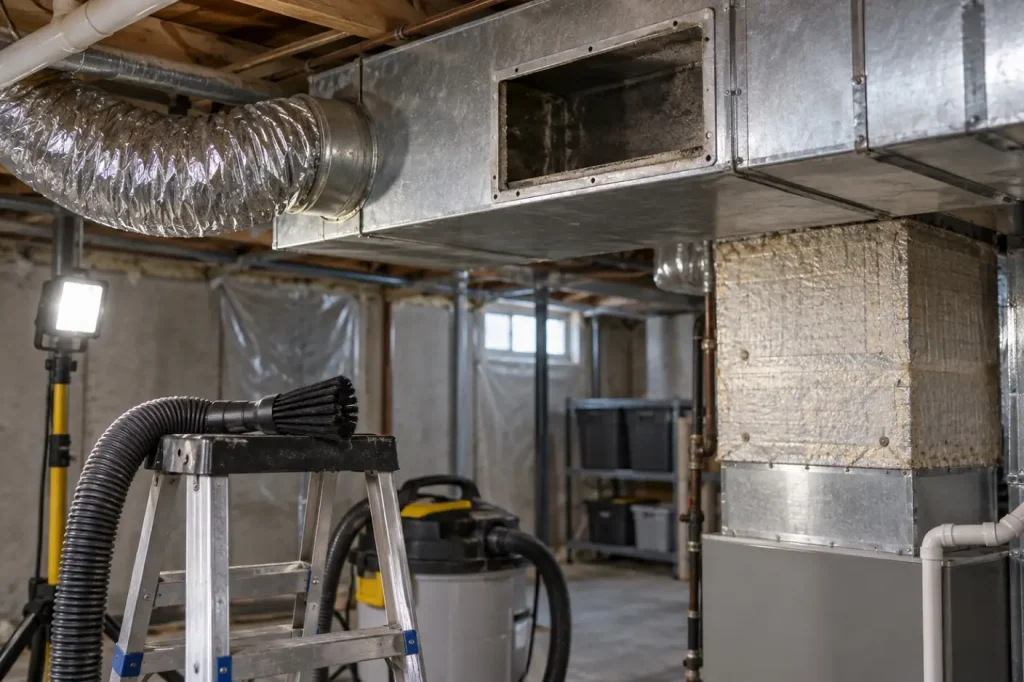
Mold in air ducts is decided by the duct material, not by a spray. EPA says substantial visible growth inside hard surface ducts such as sheet metal is a reason to clean, but insulated duct material that gets wet or moldy cannot be effectively cleaned and should be removed and replaced. Fix the coil, drain pan or condensation source first, or EPA warns growth will recur.
Key takeaways
- Bare sheet metal is cleanable. Wet or moldy duct board, fiberglass liner and flex insulation are replacement items under EPA’s duct guidance.
- EPA says no biocide is currently registered for fiberglass duct board or fiberglass-lined ducts.
- EPA names the cooling coil and drain pan as moisture sources; in hot-humid attics, supply ducts are the usual cold surface that condenses.
- Spots on a register face do not prove mold inside the duct.
- NADCA’s ACR standard is in a 2025 edition, released 24 September 2025.
- EPA says not to run an HVAC system you suspect is contaminated with mold.
On this page
- What you are looking at
- The EPA rule, word for word
- Duct material decides the outcome
- Where the water comes from
- Which situation are you in?
- The method, step by step
- Sprays, foggers and sealants
- What NADCA’s ACR standard covers
- What testing can and cannot prove
- What it costs
- Signs it is bigger than the vent
- For contractors
- Questions people actually ask
What you are looking at: black mold in air vents, or something else
Most reports start at a register. The useful question is whether the mark sits on the register face, in the boot behind it, or deep in the run. Pull the register and shine a light into the boot: a clean boot behind a spotted register points to condensation on the register itself.
| What you see | Possible cause | How to tell |
|---|---|---|
| Spotted dark growth on the register face | Surface growth from condensation on a cold register | Sweats in cooling season; boot behind is clean |
| Grey streaks on the ceiling around a register | Dust carried by air leaking past the register edge | Dry, powdery, follows the airflow line |
| Black film that smudges, in many rooms | Soot (see candle soot) | Oily smear, appears house-wide at once |
| Orange or brown spots on steel louvres | Corrosion from repeated condensation | Hard, does not wipe away |
| Growth on the duct wall or liner past the boot | Mold on the duct system | The case EPA’s duct guidance covers; confirm by lab |
The EPA rule, word for word
EPA’s guidance Should You Have the Air Ducts in Your Home Cleaned? (updated 19 February 2026) lists this as a reason to consider cleaning: “There is substantial visible mold growth inside hard surface (e.g., sheet metal) ducts or on other components of your heating and cooling system.” Under it: “If you have insulated air ducts and the insulation gets wet or moldy it cannot be effectively cleaned and should be removed and replaced.” And: “If the conditions causing the mold growth in the first place are not corrected, mold growth will recur.”
EPA, Mold Remediation in Schools and Commercial Buildings, Chapter 3 adds: “Do not run the HVAC system if you know or suspect that it is contaminated with mold.” The duct page also says EPA neither establishes duct cleaning standards nor certifies, endorses or approves duct cleaning companies.
Duct material decides the outcome for mold in HVAC ducts
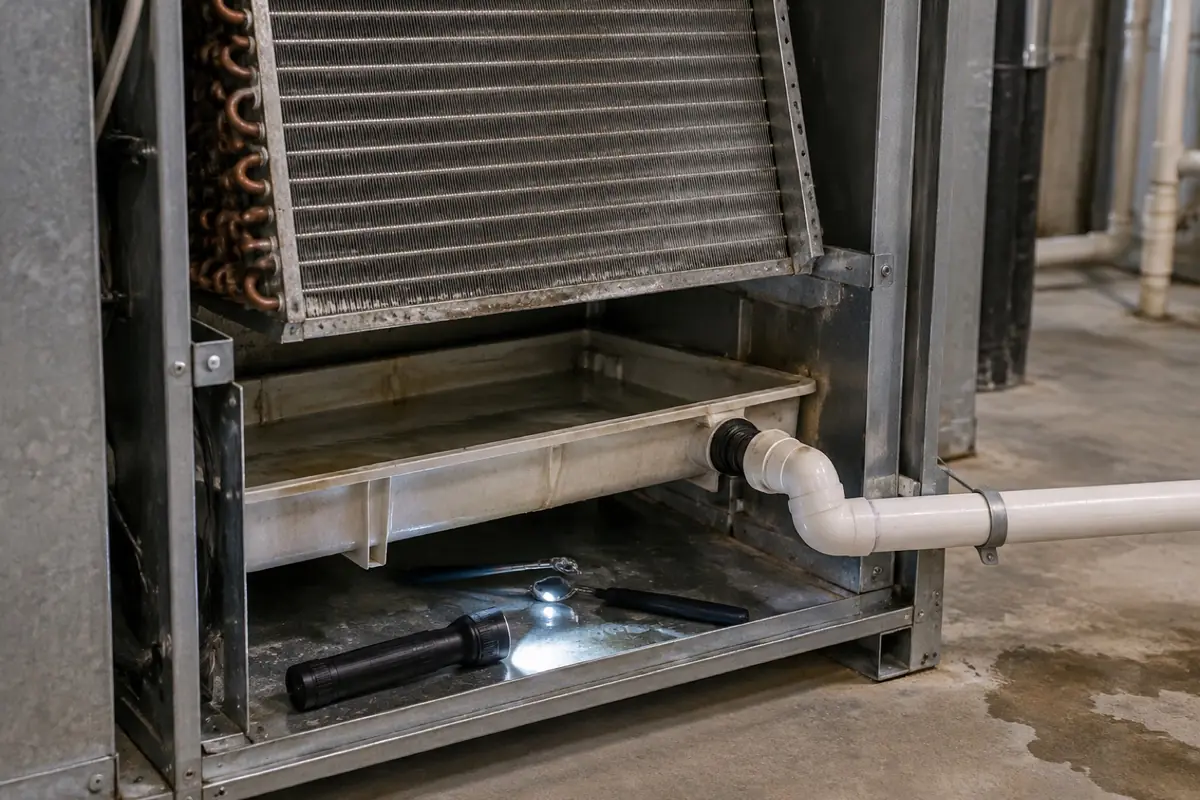
EPA says many homes have fiberglass duct board or sheet metal lined with fiberglass, that flex duct use has grown since the early 1970s, and that treating mold on bare sheet metal “is much easier.” Once fiberglass liner is contaminated, EPA says, cleaning is not sufficient to prevent regrowth.
| Duct type | Can it be cleaned when moldy? | Usual source |
|---|---|---|
| Bare sheet metal | Yes: brush and HEPA vacuum; a registered biocide is possible after cleaning (EPA) | Coil carry-over, condensation on uninsulated runs |
| Sheet metal with fiberglass liner | Not the liner: replace wet or moldy liner (EPA, NAIMA AH-122) | Wet coil section, condensate carry-over |
| Fiberglass duct board | No when wet or moldy: replace sections (EPA) | Condensation, nearby pan or leak |
| Flexible duct | Replace: EPA says replacing accessible flex can be more economical than cleaning | Sweating jacket in attic or crawl space |
| Rubber, plastic or polyester liner | Dry if only wet; replace if microbially contaminated (NADCA) | Coil or humidifier carry-over |
| External wrap on metal duct | Replace if wet or visibly moldy (EPA: any insulation) | Condensation on the cold metal beneath |
| Panned joist return cavity | Framing is cleaned as wood, not as a duct product | Leaks, humid crawl or attic air |
The NADCA white paper on interior insulation applications quotes NAIMA AH-122: “NAIMA recommends that fibrous glass insulations that have become wet in service should be removed and replaced to reduce the risk of mold growth.”
Where the water comes from
EPA’s duct page says condensation on or near cooling coils “is a major factor in moisture contamination of the system,” and that substantial standing water or debris in the condensate pan indicates a problem requiring immediate attention.
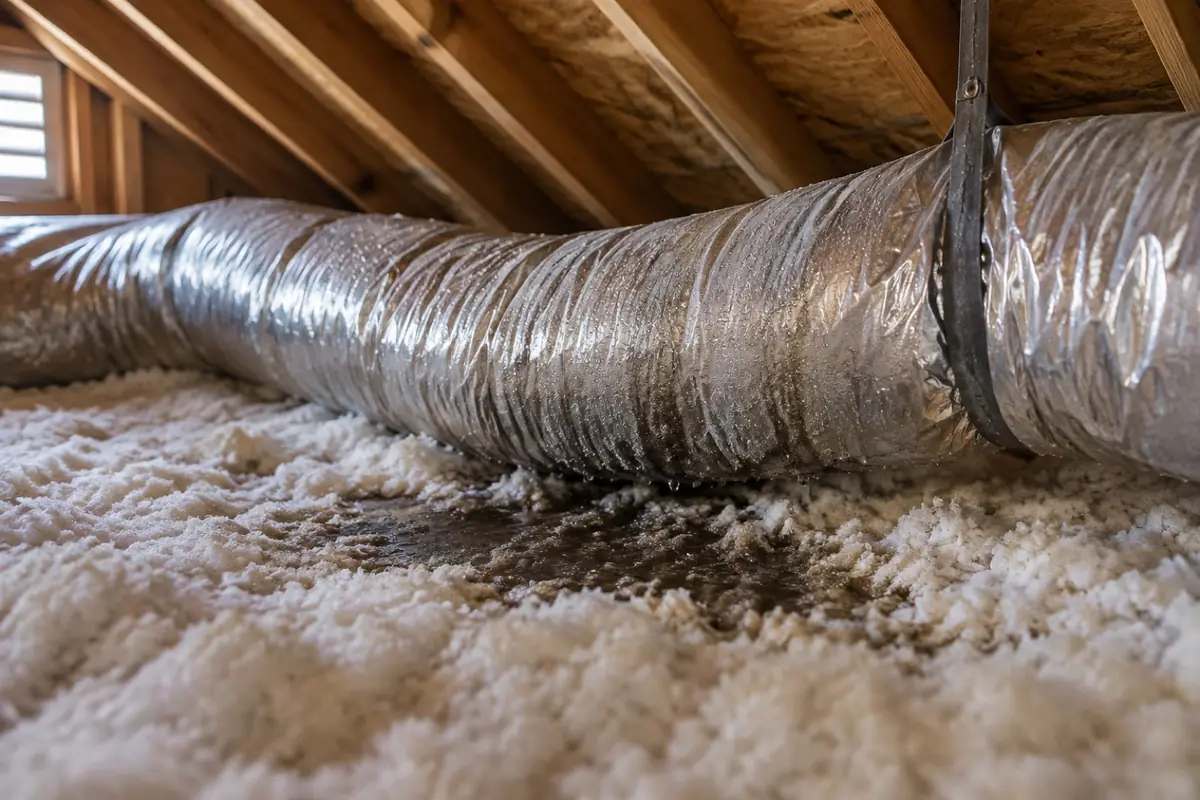
In attics, Building Science Corporation, Vented and Sealed Attics in Hot Climates (Rudd and Lstiburek, 1998) says “the most offending cold surfaces are usually supply ducts” when humid air meets them in hot-humid climates. EPA says ducts in attics and crawl spaces must be sealed and insulated to keep condensation out. For the attic itself, see signs of mold in the attic.
| Source | What to check | Points to it |
|---|---|---|
| Cooling coil | Coil face, insulation just downstream | Growth heaviest near the coil |
| Drain pan | Slope to drain, standing water, debris | Water or sludge in the pan |
| Attic or crawl supply ducts | Sweating jacket, wet insulation | Growth only on branches in unconditioned space |
| Furnace humidifier | Pad, drain, maintenance | Growth in the supply plenum near it |
| Flood or sewage | Water line on floor ducts or returns | NADCA: evaluate before reuse |
| Indoor humidity | Hygrometer in occupied rooms | EPA: keep below 60 percent |
Which situation are you in?
Stop at the first line that matches.
- Spots on the register face, boot clean. Clean or replace the register and fix why it sweats.
- Growth on bare sheet metal past the boot. System off, fix the source, clean by source removal.
- Growth on, or water in, duct board, liner or flex insulation. Replace the affected sections.
- Growth at the coil, pan or blower. The air handler is the first scope item; ducts are assessed after.
- Floodwater or sewage reached the ducts. NADCA says a qualified person must evaluate before reuse; replacement may be necessary.
- Musty smell, nothing visible. Inspect the air handler and accessible runs with the system off before paying for sampling.
The method for a moldy duct system, step by step
The generic small-area method is on DIY mold remediation. Ducts break it three ways: the fan spreads spores, most surface is out of reach, and insulated parts cannot be cleaned.
| Step | Why this differs from generic advice |
|---|---|
| 1. Stop the fan. | Generic advice says ventilate; here the fan spreads what you disturb, and EPA says not to run it. |
| 2. Identify every duct material. | EPA warns a system may combine sheet metal, flex, board and lined duct. Walls never need this step. |
| 3. Check for asbestos first. | EPA tells providers to inspect insulation and register boots for asbestos before disturbing them. |
| 4. Fix the coil, pan or condensation source. | In ducts the cause is usually mechanical, not a single leak. |
| 5. Remove wet or moldy insulated material. | EPA says it cannot be effectively cleaned, so it is cut out. |
| 6. Brush bare metal with contact vacuuming. | EPA wants HEPA equipment if the vacuum exhausts indoors, and soft bristles on any fiberglass that stays. |
| 7. Keep water out. | EPA says steam and other moisture methods should not be used on any kind of duct work. |
| 8. Inspect before restart. | EPA says every portion should be visibly clean, with the provider showing each component. |
Sprays, foggers, biocides and sealants
EPA’s duct page says biocides are regulated under federal pesticide law, must be registered for a specific use, and that using one inconsistently with its label violates federal law. A small number are registered for the inside of bare sheet metal ducts, but “No products are currently registered as biocides for use on fiber glass duct board or fiber glass lined ducts.” EPA adds that a “rinse with water” direction can be wrong in a duct because moisture can stimulate growth. Label reading in general: mold killer products.
| Treatment | EPA position | Where it can go |
|---|---|---|
| Registered duct biocide | After cleaning, uninsulated areas only, label shown to owner | Bare sheet metal |
| Hard-surface sanitizer | May be legal in unlined ducts if every label direction is followed | Bare sheet metal, if labelled |
| Any biocide on fiberglass | None currently registered | Nowhere |
| Ozone | Considerable controversy, per EPA | EPA lists possible problems |
| Sealant or encapsulant | Never on wet liner, active growth or debris | After cleaning; damaged liner or fire damage |
NADCA’s NADCA position paper on chemical product applications in HVAC systems agrees that source removal “remains the single best method,” and says coatings that claim only to protect their own film fall under the FIFRA treated articles exemption, the rule explained on mold killing paint.
What NADCA’s ACR standard covers, and what it does not
The current edition is ACR, The NADCA Standard: 2025 Edition, released on 24 September 2025 according to the NADCA press release, 24 September 2025. NADCA calls ACR “a performance standard that also provides minimum procedural requirements.” The 2025 text is free behind a download form, so this list is what NADCA says it contains: containment and engineering controls; component inspections; a scope of work with safety plans; negative air pressure requirements; source removal, ambient air cleaning, wet cleaning, power washing and steam cleaning; and cleanliness verification by the Surface Comparison Test and NADCA Vacuum Test.
On mold, the NADCA white paper on interior insulation applications quotes an earlier ACR edition, Section 4.17: “It is recommended that porous materials with mold growth (Condition 3) be properly removed and replaced.”
| Question | EPA consumer guidance | NADCA material |
|---|---|---|
| Moldy fiberglass liner or board | Replace | Replace (ACR 4.17 as quoted; NAIMA AH-122) |
| Water-based cleaning | No steam or moisture methods on any duct work | 2025 ACR includes wet, power washing and steam procedures |
| Biocides | Registered products, uninsulated areas | Follow the label; state pesticide license may apply |
| Standard setter | EPA sets no duct cleaning standard | ACR is the industry standard |
What testing can and cannot prove
EPA, A Brief Guide to Mold, Moisture and Your Home says sampling is usually unnecessary when growth is visible, and that with no EPA or federal limits for mold, sampling cannot check compliance with any federal standard.
| Test | Can show | Cannot show |
|---|---|---|
| Tape lift from the duct | Mold or look-alike; EPA says some labs charge about $50 | How far growth runs into unseen ducts |
| Settling plate in a room | Nothing useful | EPA calls it inappropriate: some growth on a plate is normal |
| Air sample at a register | Spores in that air, then | Where growth is, or whether ducts are the source |
| Post-cleaning surface sample | Whether a surface was adequately cleaned (EPA) | Anything about insulation that should be replaced |
| Camera inspection | Extent of visible growth | Lab identity of the deposit |
What it costs
Routine cleaning prices are on air duct cleaning cost. The Fixr mold remediation cost guide (updated 29 August 2025) reports vent-only mold removal at $100 to $500 and HVAC mold removal, including ducts, at $3,000 to $10,000. The HomeAdvisor mold remediation cost guide (updated 19 June 2026) reports the same $3,000 to $10,000 for an HVAC or AC system. Neither prices duct board or flex replacement, so get that quoted.
Per the Fixr figures, the bottom of the HVAC range is 6 times the top of the vents-only range: the price gap between a register problem and a system problem.
Signs it is bigger than the vent
- Growth on the boot or duct wall, not just the register face.
- Standing water or debris in the condensate pan.
- Wet spots on insulation near the cooling coil.
- Duct board, liner or flex that is wet, visibly moldy or smells (EPA’s replacement triggers).
- Attic or crawl space ducts sweating in cooling season.
- Growth on several branches at once, pointing to the air handler.
- Floodwater or sewage reached registers or returns.
- Old insulation or register boots that could contain asbestos.
For contractors: scope, documentation and the adjuster’s questions
Scope by component and material. The NADCA commercial consumer FAQ says a state pesticide applicator license is often required for HVAC cleaners who use antimicrobial products; see state mold licensing for remediation rules. EPA’s duct page says that as of 1996, 7 states required duct cleaners to hold special licenses.
| Document | Why it gets asked for |
|---|---|
| Photos of each duct material and the source | Justifies replace versus clean |
| Lab result on any disputed deposit | EPA: lab analysis may be needed to confirm |
| Line items: air handler, metal cleaned, sections replaced | Mirrors EPA’s clean or replace split |
| Biocide label and registration number | EPA: show the owner the label |
| Asbestos result for boots and insulation | EPA: check before disturbing |
| EPA post-cleaning checklist, completed | Covers coils, pans, humidifiers and fans |
Coverage depends on policy wording and the moisture cause; see homeowners insurance and mold remediation, the policy itself and the state insurance department.
What this page does not cover. Health effects and symptoms are out of scope; see EPA and CDC. Equipment sizing and duct design belong to an HVAC contractor. More: mold hub.
Questions people actually ask
What do I do if I have mold in my air ducts?
Turn the system off, as EPA advises. Identify the duct materials, find and fix the moisture source, usually the cooling coil, drain pan or sweating attic ducts, then have bare metal cleaned by source removal and wet or moldy insulated material replaced. Ask the contractor to show you the growth they report.
Can mold in air ducts be cleaned, or do ducts need replacing?
It depends on the material. EPA treats visible growth inside sheet metal ducts as a reason to clean, but says insulated duct material that gets wet or moldy cannot be effectively cleaned and should be removed and replaced. EPA also notes replacing accessible flex duct can be more economical than cleaning it.
Is there a spray to kill mold in air ducts?
Only for bare metal. EPA says a small number of products are registered for the inside of bare sheet metal ducts and none for fiberglass duct board or lined ducts. Any biocide goes on after cleaning, on uninsulated areas, exactly as labelled. A spray does not replace removal.
Does homeowners insurance cover mold in ductwork?
No single answer fits every policy: it turns on the policy’s wording and on what caused the moisture. Read the mold or fungi language in your own policy, ask your insurer in writing, and contact your state insurance department or a professional if it is unclear. Photograph the source and duct materials first.
How common is it to have mold in your air ducts?
No federal survey counts it. EPA says many insulated duct systems have run for years without significant mold growth, and that keeping them reasonably clean and dry is generally adequate. EPA also notes microorganisms are always present in air, so spores in a duct are not the same as growth.
How long does it take to remove mold from air ducts?
None of the standards or price guides cited here publishes a duration. It depends on whether the job is cleaning bare metal or replacing insulated sections, how many runs are reachable, and whether the air handler needs work first. EPA advises asking for an estimate of hours or days and a written scope.
Sources
- U.S. EPA, Should You Have the Air Ducts in Your Home Cleaned?, updated 19 February 2026. Retrieved 19 October 2026.
- EPA, Mold Remediation in Schools and Commercial Buildings, Chapter 3, updated 29 April 2026; also Photos 4B and 4C. Retrieved 19 October 2026.
- EPA, A Brief Guide to Mold, Moisture and Your Home, updated 18 February 2026. Retrieved 19 October 2026.
- NADCA, ACR, The NADCA Standard: 2025 Edition landing page. Retrieved 19 October 2026.
- NADCA press release, 24 September 2025. Retrieved 19 October 2026.
- NADCA standards and resources page. Retrieved 19 October 2026.
- NADCA position paper on chemical product applications in HVAC systems, undated PDF. Retrieved 19 October 2026.
- NADCA white paper on interior insulation applications, undated PDF, quoting NAIMA AH-122 and ACR Section 4.17. Retrieved 19 October 2026.
- NADCA commercial consumer FAQ. Retrieved 19 October 2026.
- Building Science Corporation, Vented and Sealed Attics in Hot Climates, Rudd and Lstiburek, 1998. Retrieved 19 October 2026.
- Fixr mold remediation cost guide, updated 29 August 2025. Retrieved 19 October 2026.
- HomeAdvisor mold remediation cost guide, updated 19 June 2026. Retrieved 19 October 2026.
- The cost ratio is arithmetic on Fixr’s figures. Nothing here was invented; see our methodology.
Prices are national ranges, not quotes. Work on a specific system should follow inspection by a qualified HVAC contractor or remediator.