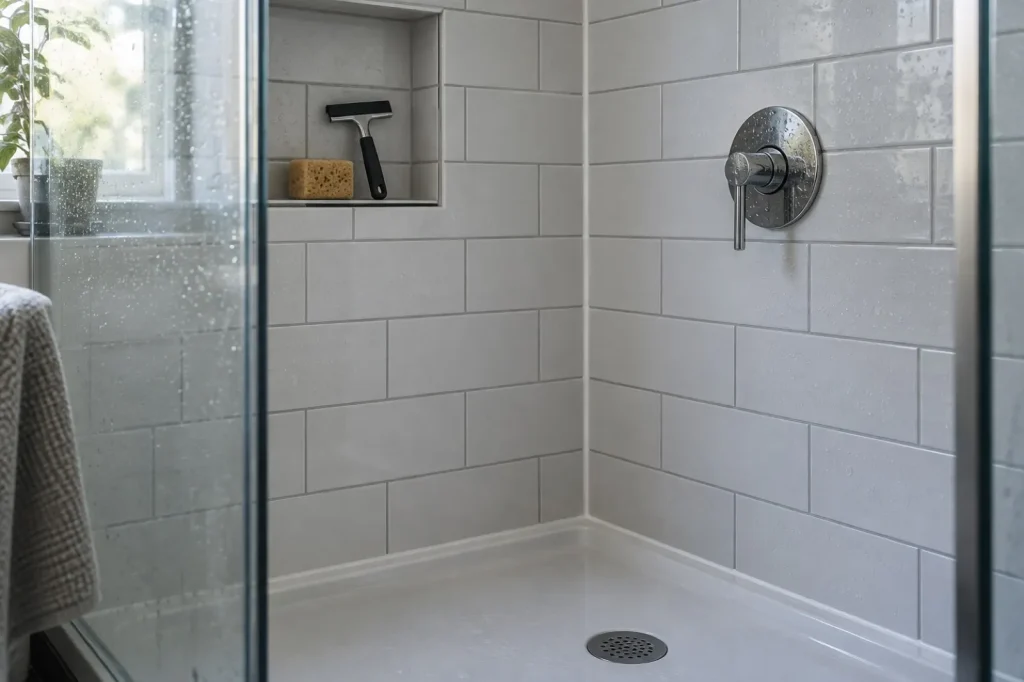
The short answer
Mold in shower grout and caulk is surface growth fed by daily wetting and soap film. EPA says more ventilation and more frequent cleaning usually keep it to a minimum. Scrub tile and grout with detergent and water. If the stain is inside the silicone, cut the bead out and replace it. If it spreads beyond the shower, look for a leak.
Key takeaways
- Three layers grow mold for different reasons: tile surface, joints, and the wall behind. Only the first is purely cleaning.
- Soap is food: most of 13 bathroom fungi studied by Hamada and Abe (Mycoscience, 2009) grew on soap-type media.
- Cement grout may absorb water up to the ANSI A118.6 limit of 18%, according to Custom Building Products TDS 178.
- Pink slime is usually the bacterium Serratia marcescens, per North Dakota State University Extension.
- EPA says not to caulk over mold; a stained silicone bead is replaced, not bleached.
- The IRC bathroom fan minimum is 50 cfm intermittent or 20 cfm continuous, per DOE's Building America Solution Center.
On this page
Most ranking advice explains how to scrub it off: right for the tile face, wrong for the joint or the wall behind. This page separates the three.
What this page does not cover. Health effects of mold are outside our scope; see CDC's mold page and the EPA mold pages, or ask a clinician. Shower pan and drain repairs are plumbing work; this page covers only the mold side.
Three layers, three jobs
The glazed tile face sheds water: Loukou and colleagues (Journal of Fungi, 2024) list ceramic products among hydrophobic, more mould-resistant materials. The joints do not. Behind both sit a waterproofing layer and a framed wall, where growth stays hidden until it reaches the next room.
| Layer | What you see | What feeds it | Usual fix |
|---|---|---|---|
| Tile face and glass | Film that wipes off | Soap residue, standing water | Clean; dry after use |
| Grout | Dark lines that return | Water held in porous grout | Clean and seal; regrout if cracked |
| Silicone | Black spots inside the bead | Fungi grow into sealant | Cut out and replace |
| Wall behind | Stain outside the shower, musty smell | Water past the waterproofing | Find the leak; remediate |
Why showers grow mold
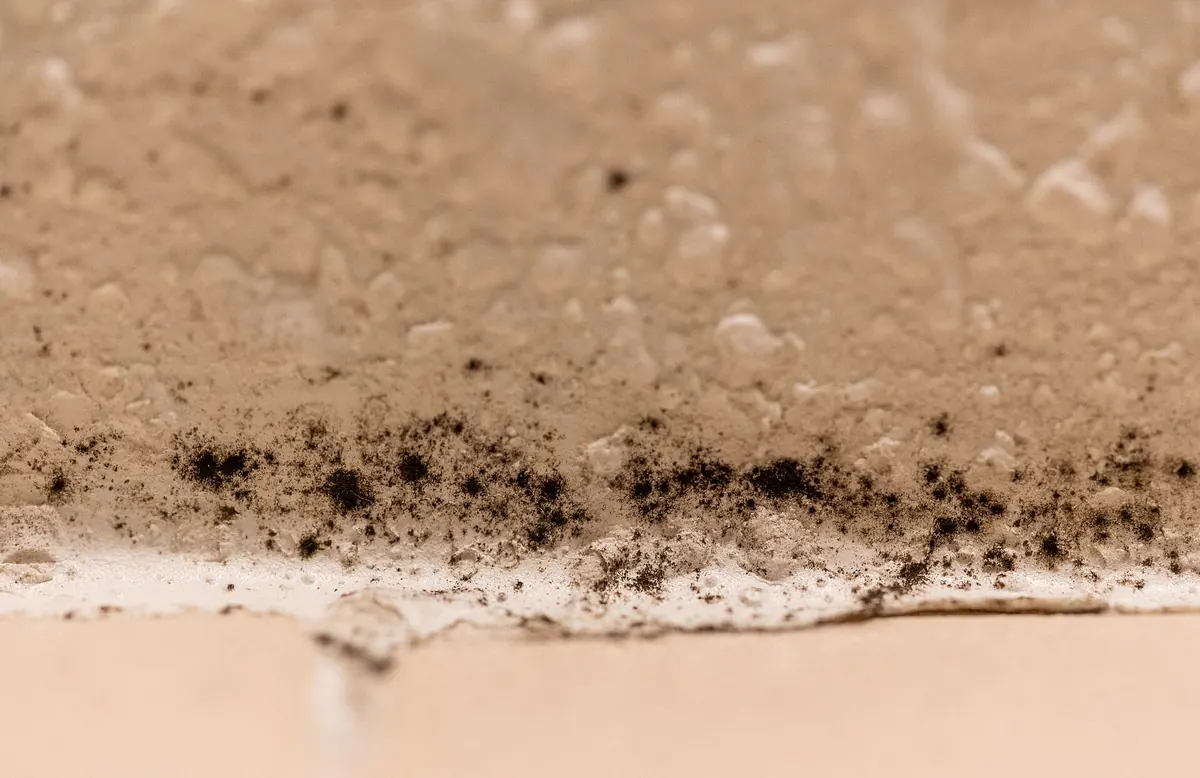
EPA's Mold Cleanup in Your Home says places that are often or always damp are hard to keep completely free of mold. A shower adds two things to the damp: food and porous joints.
Surface water, daily
Fungi use water available at a surface, not water locked inside a material, according to Loukou and colleagues (Journal of Fungi, 2024), and most building fungi grow best at 20 to 25 degrees C. A shower wall is soaked to the surface every day at that temperature.
Soap and body film
Hamada and Abe (Mycoscience, 2009) grew 13 fungi common in bathrooms and report that most grew on media with 0.01% and 0.05% sodium fatty acid, which is soap. Six, including Exophiala and Phoma, were common in bathrooms but not in house dust. The authors found these fungi exploit surfactant but grow poorly in dry or hot conditions. The GE Supreme Silicone Kitchen and Bath data sheet agrees from the other side: its mold-free claim still requires regular cleaning, because soap residue can cause secondary growth.
Porous grout, soft corners
According to Custom Building Products TDS 178, the ANSI A118.6 requirement for grout water absorption is under 18%, with a typical result of 15%. The same sheet says grout is not for movement joints or changes of plane, where caulk is used. That is why the corners and the tray joint are silicone, and why they blacken first.
What grows, and what it needs
Shower growth is a community. The chart converts each published minimum water activity into equilibrium relative humidity, which Loukou and colleagues (Journal of Fungi, 2024) define as aw times 100.
| Organism | Where | Published condition | Source |
|---|---|---|---|
| Serratia marcescens (bacterium) | Pink film on grout, drains | Phosphorus or fatty residue; standing water | North Dakota State University Extension |
| Exophiala, Phoma and four others | Bathroom specialists | Most failed at 33 C or 10% salt | Hamada and Abe (Mycoscience, 2009) |
| Aureobasidium, Cladosporium, Fusarium | Bathrooms and house dust | Most grew at 33 C and 10% salt | Hamada and Abe (Mycoscience, 2009) |
| Cladosporium cladosporioides | Dark spotting | Minimum aw 0.84 to 0.87 | Loukou and colleagues (Journal of Fungi, 2024) |
| Stachybotrys chartarum | Soaked paper-faced board | Minimum aw 0.94 to 0.95 | Loukou and colleagues (Journal of Fungi, 2024) |

The wettest-condition organisms at the top of the chart are the ones found behind a leak. Colour identifies none of them; see our black mold versus regular mold page.
Pink film is a bacterium
Pink or orange slime on grout and drains is usually Serratia marcescens, a bacterium, per North Dakota State University Extension. It grows on phosphorus or fatty residue such as soap, shows up more with windows open in summer, and survives in standing water once tap water chlorine dissipates. NDSU advises scrubbing, then a bleach solution left 10 to 20 minutes, then drying tubs and showers after use.
Two cautions. CDC's mold page says no more than 1 cup of laundry bleach per gallon of water, never mixed with ammonia. On sealed grout, the Aqua Mix SameDay Grout Sealer TDS 212 says to avoid cleaners containing ammonia, acids or bleach.
Surface stain or failing wall?
EPA's Brief Guide to Mold, Moisture and Your Home places hidden mold on the back side of drywall and inside walls around leaking pipes, and says to suspect it when a building smells moldy but no source shows. A shower leaking behind tile produces exactly that.
| What you notice | What it points to | Next step |
|---|---|---|
| Growth wipes off, returns in days | Surface film, humidity | Clean, dry, run the fan |
| Grout stays dark after scrubbing | Growth in porous grout | Seal; regrout if cracked |
| Spots under the silicone surface | Growth in the bead | Replace the bead |
| Bead lifting from tile or tray | Lost adhesion | Replace now |
| Musty smell, nothing visible | Possible hidden growth | Investigate before opening |
| Stain or soft board outside the shower | Water leaving the shower | Leak repair, then remediation |

The ceiling below is often where a failing shower shows first; see our page on early signs of water damage on a ceiling. A leaking pan or drain is a job for a plumber or tile installer; mold work follows once the water stops. Painted board above the tile is covered on our mold on walls page.
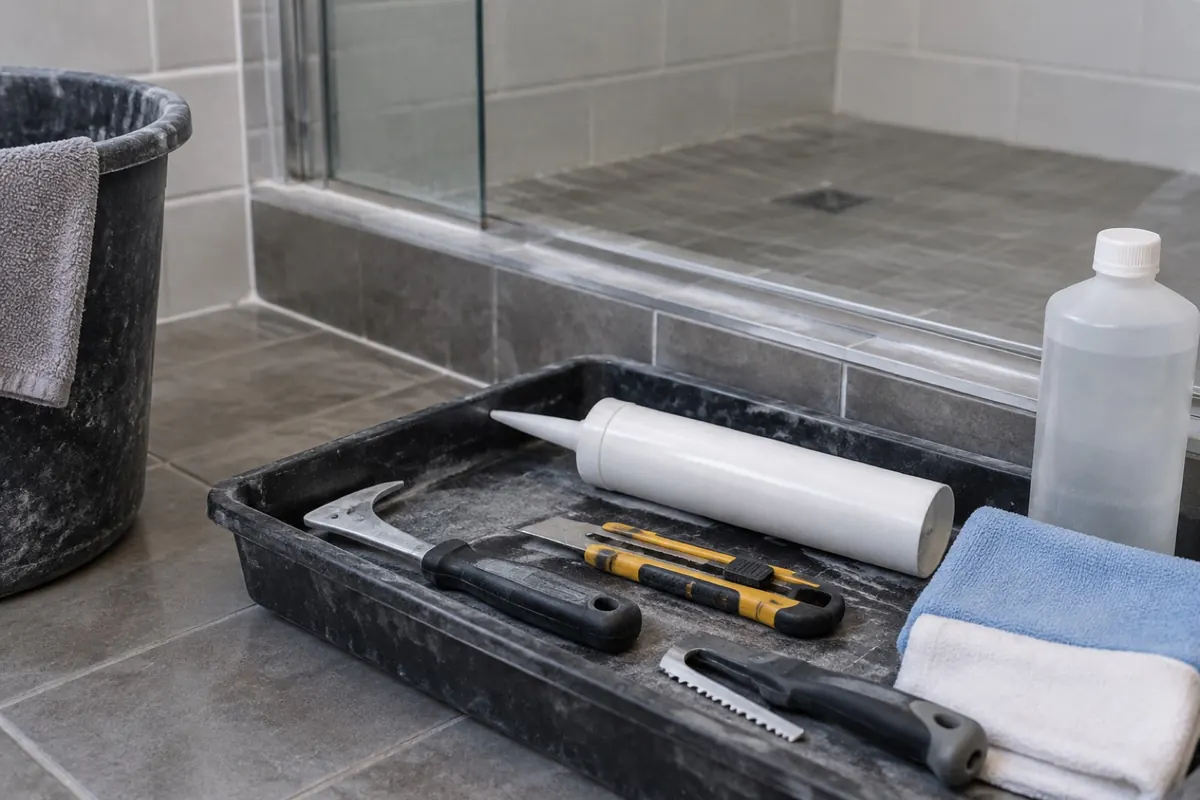
Cleaning, per EPA
EPA's Mold Cleanup in Your Home: scrub mold off hard surfaces with detergent and water, and dry completely. For recurring bathroom growth, run a fan or open a window and clean more often. New York City's 2008 mold guidelines call mold on grout and in shower stalls a common occurrence that occupants control with household cleaners.
Killing is not the goal. EPA's Brief Guide to Mold, Moisture and Your Home says biocides such as chlorine bleach are not recommended as routine practice, since remaining spores will not grow once the moisture is fixed. Where a product is used, its label sets the method.
| Method | Source | Limit |
|---|---|---|
| Detergent and water, then dry | EPA's Mold Cleanup in Your Home | Will not reach growth inside silicone |
| Household cleaners, often | New York City's 2008 mold guidelines | Controls growth; does not dry the room |
| Mold and mildew spray, 5 minutes wet | CloroxPro Tilex label | Hard nonporous surfaces only |
| Bleach, 1 cup per gallon at most | CDC's mold page | EPA: biocides not routine |
| Disinfecting wipes, 4 minutes wet | Clorox Disinfecting Wipes label | Label directions do not mention mold |
EPA's Brief Guide to Mold, Moisture and Your Home recommends gloves, goggles without vent holes and, optionally, an N-95 respirator during cleanup.
When caulk and grout come out
EPA's Mold Cleanup in Your Home says not to caulk moldy surfaces; EPA's remediation guide, Chapter 3 repeats it. New silicone over a stained bead seals the growth in.
Silicone is no permanent barrier. Zotti and colleagues (University of Genoa, 2011) report holding silicones, all with antifungal additives, at 80% RH with Phoma taken from a bathroom; after eight months fungi grew on every dish, one type only delaying the start. Ahn and colleagues (Journal of the Korea Institute of Building Construction, 2024) report that fungal growth weakens sealant and breaks adhesion, losing waterproofing, and that antifungal agents leach out over time.
| What you find | Action | Why |
|---|---|---|
| Spots inside the silicone | Replace | EPA: never caulk over mold |
| Bead lifted or split | Replace | Adhesion loss ends waterproofing (Ahn) |
| Grout cracked or missing | Regrout | Open joints pass water |
| Grout sound but stained | Clean, then seal | Sealer slows absorption (TDS 178) |
| Drops soak into sealed grout | Reseal | Water drop test (TDS 212) |
| Stain back days after replacement | Look behind | Water from inside the wall |
The GE Supreme Silicone Kitchen and Bath data sheet requires clean, dry surfaces with old sealant and soap residue removed. According to the sheet, its 30-minute water-ready claim needs a bead of 3/16 inch or less at 65 F and 50% humidity or more; otherwise no water for 8 hours, and no cleaning for 24. Grout waits longer: Custom Building Products TDS 181 allows 3 days before water on shower walls and 7 on floors.
A premixed grout floor needs 2.3 times the wall wait on that Custom Building Products TDS 181: tell the occupant before starting.
Fan and humidity rules
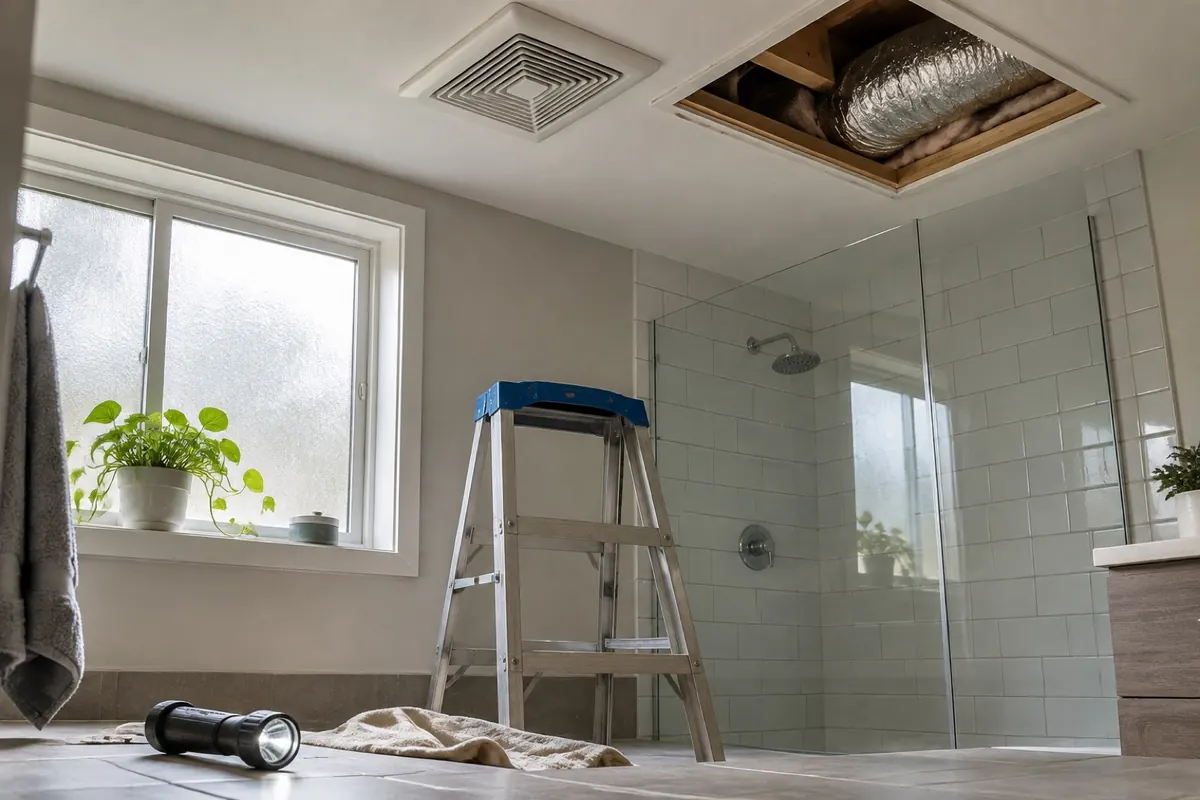
The exhaust fan is the one part of this job set by code. DOE's Building America Solution Center gives the 2021 IRC and ASHRAE 62.2 bathroom requirement as at least 50 cfm intermittent or 20 cfm continuous, vented outdoors, not into an attic or crawlspace.
| Requirement | What it says | Source |
|---|---|---|
| IRC 2021 and ASHRAE 62.2, per DOE | 50 cfm intermittent or 20 cfm continuous | DOE's Building America Solution Center |
| Washington adopted IRC | Same rates; delivered airflow tested as installed | Washington's adopted IRC text, WAC 51-51-1505 |
| 2012 IECC fan efficacy | 1.4 cfm/W under 90 cfm; 2.8 cfm/W at 90 cfm or more | Building America code compliance brief |
| IRC M1504.3 outlet, per DOE | Outdoors, at least 10 ft from a mechanical air inlet | DOE's Building America Solution Center |
| Washington duct table | 50 cfm fan: 25 ft of 4 inch flex or 70 ft smooth, 3 elbows | Washington's adopted IRC text, WAC 51-51-1505 |
Run time matters as much as rating: DOE advises 1 hour after a shower, on a timer. EPA's Brief Guide to Mold, Moisture and Your Home sets indoor humidity below 60% and ideally 30 to 50%; CDC's mold page says 50% or lower. EPA prices a humidity meter at about $10 to $50. Still high an hour after a shower, fan on? The fan or its duct is the problem.
When it is remediation
EPA's Mold Cleanup in Your Home says most people can handle under about 10 square feet themselves; beyond that, or after sewage, see EPA’s commercial guide or a professional. In EPA Table 2, ceramic tile can be damp wiped at small and medium sizes, while wallboard above 10 square feet is removed and bagged, with full containment above 100. New York City's 2008 mold guidelines remove or clean wallboard at least 6 inches past visible growth.
Owner method and gear are on our DIY mold remediation page; the professional sequence is in our mold remediation process guide.
Which layer is it in? The decision path
- Wipe a test patch with detergent and water. Gone for a week with the fan running? Surface film. Stop.
- Press a black spot in the silicone. Colour inside the bead, or a lifting bead: cut it out and replace it.
- Scrub one grout joint. Lightens: clean and seal. Cracked or sandy: regrout first.
- Hold tissue to the fan grille as a rough check. If it does not cling, have airflow measured against the 50 cfm minimum.
- Read humidity an hour after a shower. Above EPA’s 60% with the fan on: fix ventilation before cleaning again.
- Check the next room and the ceiling below. Stain, soft board or musty smell: plumber for the leak, then remediation.
- Measure the area. Under 10 square feet of hard surface, EPA says most owners can do it. Wet or moldy wallboard: follow EPA Table 2.
For contractors
Write a cause statement first: surface growth, failed joint, or water past the waterproofing. Record moisture readings in the adjacent wall and ceiling below against a dry reference, check the fan, and price joint work by linear foot. Refer pan and valve leaks to a plumber; mold work waits for dry.
Adjusters ask how long it leaked. A commercial policy quoted in a 2023 Tenth Circuit opinion excludes continuous or repeated seepage of water over 14 days or more. Policies differ; the owner’s policy, state insurance department and a qualified professional decide. Our page on insurance and mold remediation covers published policy language.
Questions people actually ask
Is mold in a shower harmful?
That is a health question outside this page; CDC and EPA publish guidance and a clinician can advise. On the building side, EPA treats recurring shower growth as a ventilation and cleaning matter, and NYC guidance calls grout and shower stall mold a common occurrence controlled with household cleaners.
How do I get rid of black mold in my shower?
Scrub tile and grout with detergent and water and dry them, as EPA advises. If black spots are inside the silicone, cut the bead out and replace it, since EPA says not to caulk over mold. Then run the fan an hour after each shower, per DOE.
Do Clorox wipes kill mold?
The Clorox Disinfecting Wipes label retrieved for this page directs disinfecting hard, nonporous surfaces kept wet for 4 minutes and does not mention mold or mildew. The Tilex mold and mildew spray label does, with 5 minutes wet. Neither reaches growth inside silicone or grout pores.
What causes mold in a shower?
Daily wetting, soap and body film, and porous joints. A 2009 Mycoscience study reports that most of 13 bathroom fungi grew on soap-type media. Cement grout may absorb up to 18% water under the ANSI A118.6 limit, according to Custom Building Products.
Why is the mold in my shower pink?
It is usually Serratia marcescens, a bacterium, according to North Dakota State University Extension. It feeds on soap residue and standing water once chlorine dissipates. Scrubbing removes it, and drying the shower after use helps prevent it.
Can you clean mold out of shower caulk?
Only off the surface. A 2011 University of Genoa trial reports that fungi grew on every antifungal silicone tested within eight months at 80% RH. If colour is inside the bead, remove all of it, dry the joint and apply new sealant per its data sheet.
Sources
- EPA's Mold Cleanup in Your Home, US EPA, updated 4 June 2026. Retrieved 13 October 2026.
- EPA's Brief Guide to Mold, Moisture and Your Home, US EPA, updated 18 February 2026. Retrieved 13 October 2026.
- EPA's remediation guide, Chapter 3 and EPA Table 2, EPA 402-K-01-001. Retrieved 13 October 2026.
- New York City's 2008 mold guidelines, NYC Department of Health, November 2008. Retrieved 13 October 2026.
- CDC's mold page, CDC, 26 September 2024. Retrieved 13 October 2026.
- North Dakota State University Extension, news release, 9 August 2010. Retrieved 13 October 2026.
- Hamada and Abe (Mycoscience, 2009), Mycoscience 50(6): 421 to 429, abstract via FAO AGRIS. Retrieved 13 October 2026.
- Loukou and colleagues (Journal of Fungi, 2024), Journal of Fungi 10(2): 108, Table 1, via Europe PMC. Retrieved 13 October 2026.
- Zotti and colleagues (University of Genoa, 2011), Boll. Mus. Ist. Biol. Univ. Genova 73. Retrieved 13 October 2026.
- Ahn and colleagues (Journal of the Korea Institute of Building Construction, 2024), vol. 24 no. 1. Retrieved 13 October 2026.
- Custom Building Products TDS 178 (22 March 2023), Custom Building Products TDS 181 (30 October 2023) and Aqua Mix SameDay Grout Sealer TDS 212 (23 March 2023). Retrieved 13 October 2026.
- GE Supreme Silicone Kitchen and Bath data sheet, Henkel, revised 15 August 2025. Retrieved 13 October 2026.
- CloroxPro Tilex label and Clorox Disinfecting Wipes label, Clorox SmartLabel. Retrieved 13 October 2026.
- DOE's Building America Solution Center (updated 4 December 2022) and Building America code compliance brief, US DOE and PNNL. Retrieved 13 October 2026.
- Washington's adopted IRC text, WAC 51-51-1505, Washington State Legislature. Retrieved 13 October 2026.
- US Court of Appeals for the Tenth Circuit, a 2023 Tenth Circuit opinion, No. 22-8059, filed 23 June 2023. Retrieved 13 October 2026.
- Ratios are arithmetic on the figures above; nothing was tested by Remediation Insider. See our methodology and the mold hub.
Follow the current label and data sheet for your product and the code edition your jurisdiction adopted.