The short answer
A mildew remover is usually an oxidizer, chlorine bleach or an oxygen bleach, that lifts the stain after the surface growth is cleaned off. The right one depends on the material: bleach suits tile, grout and colourfast canvas, diluted alcohol suits leather and upholstery, and paper needs drying and dry methods, not liquids. Some stains survive every method; labels say so.
Key takeaways
- Mildew removal is two jobs: growth off, then colour. The Concrobium label says staining may be irreversible.
- According to their own quantities, published bleach recipes differ about 8-fold: from 3% bleach in the UF/IFAS clothing mix to 25% in the Forest Products Laboratory wood and UGA fabric mixes.
- Bleach is wrong for several materials: no chlorine on silk, wool or spandex (UF/IFAS), and MasterCraft lists bleach as not recommended for boat vinyl.
- Gray weathered wood is often mildew. USDA’s Forest Products Laboratory names a uniform gray as its most common discoloration.
- Oxalic acid removes iron stain on wood, not mildew; per USDA it is toxic and needs gloves.
- Cornell’s library tutorial advises against bleach or cleaning agents on moldy books. Dry them first.
On this page
Search results for this term are product grids. A grid cannot tell you that the cleaner that brightens grout is wrong for a vinyl boat seat, or that a library tutorial says to keep liquids off moldy books. This page sorts the job by material, from labels, extension services, the USDA Forest Products Laboratory, a university library and fabric makers. For what mildew is, see mold vs mildew; for kill claims and contact times, see our mold killer label guide.
Out of scope. This page covers cleaning methods and product labels, not health effects of mold exposure; for those, see the EPA and CDC mold pages and a medical professional.
Growth and stain are two jobs
Mildew sits on the surface. The Forest Products Laboratory GTR-109 says mildew fungi on wood live only on the surface, do not tunnel into it and do not reduce its strength; they are objectionable because they discolour it. That is why removal comes in two steps: get the growth off, then decide what to do about the colour it left.
Registered products say the same. The Concrobium label warns that mold stains may remain visible after treatment, that staining may be irreversible in some cases, and not to expect it to whiten stains.
| What you see | What it usually is | First move | Source |
|---|---|---|---|
| Fuzzy or powdery growth on the surface | Living or dormant growth | Brush or vacuum off, then clean | UF/IFAS, Cornell |
| Dark spots left after cleaning | Stain left in the material | An oxidizer suited to the material | Tilex, UF/IFAS |
| Uniform gray on bare wood | Commonly mildew, per USDA | Bleach solution or a wood brightener | FPL GTR-109 |
| Blue-black marks around nails on wood | Iron stain, not mildew | Oxalic acid | FPL GTR-109 |
| Pink stain on vinyl or plastic | Pigment from microorganisms | Prompt cleaning; prevention | MasterCraft, EPA PPLS |
The chemistries that lift mildew stains
Three oxidizer families do most stain removal. Chlorine bleach is the strongest decolouriser; household bleach is a 5% sodium hypochlorite solution, per the Forest Products Laboratory GTR-109. Oxygen bleaches act more slowly: PubChem lists sodium percarbonate as disodium carbonate with hydrogen peroxide, and the UGA and UF/IFAS guides offer sodium perborate or powdered non-chlorine bleach where chlorine is unsafe.
| Chemistry | Where the sources use it | Where not | Source |
|---|---|---|---|
| Chlorine bleach (sodium hypochlorite) | Mildew stains on tile, grout, colourfast canvas, painted exteriors, bare wood | Silk, wool, spandex; fabric, carpet, paper, aluminum per Tilex; boat vinyl per MasterCraft | UF/IFAS, Tilex, MasterCraft |
| Oxygen bleach (sodium perborate, percarbonate) | Washable fabric that cannot take chlorine; old stains soaked overnight | UF/IFAS soak: 30 minutes or longer | UGA, UF/IFAS, PubChem |
| Hydrogen peroxide, 3% | Carpet, as 1 part to 5 parts water | Test colour first | UGA |
| Oxalic acid | Iron stain and graying on bare wood, as a brightener | Toxic; keep off skin and plants | FPL GTR-109 |
| Diluted alcohol, 1 to 1 | Leather, upholstery, mattresses | Damages acetate, triacetate, modacrylic and acrylic fibres | UF/IFAS, UGA |
Oxalic acid is the outlier. The Forest Products Laboratory names it for iron stain, the blue-black mark tannins form with iron, at 1 to 4 oz per quart of hot water, and as one way to brighten weathered wood. It is not a mildew remover.
How to remove mildew, surface by surface
This is the table to keep. Each row is the method published by the source named; follow its label or guide for the full directions, and spot test anything coloured first.
| Surface | Method | Source | Do not |
|---|---|---|---|
| Shower grout | Spray a label-listed product, wait until stains disappear, rinse | Tilex, Crescent | Old grout may hold stains the product cannot reach |
| Silicone caulk | Same label direction | Tilex, Crescent | Labels say embedded mildew may not come out |
| Vinyl shower curtain | Label-listed spray, rinse promptly | Crescent lists vinyl curtains | Rinse vinyl immediately |
| Fabric curtain, clothing | Brush outdoors, sun, then lemon and salt, oxygen bleach or 2 Tbsp chlorine per quart | UF/IFAS | No chlorine on silk, wool, spandex |
| Upholstery, mattress | Vacuum, then 1 cup alcohol to 1 cup water; dry well | UF/IFAS, UGA | Alcohol damages acetate and acrylic fibres |
| Leather | Diluted alcohol 1 to 1, air dry, then saddle soap and polish | UF/IFAS | Test colourfastness first |
| Books and paper | Dry with moving air; HEPA vacuum once dry; work outdoors or in a hood | Cornell | No bleach or cleaning agents on books |
| Painted siding | Registered house wash mixed with bleach, wait, rinse | Mildew Check, Jomax | Pretest; cover plants |
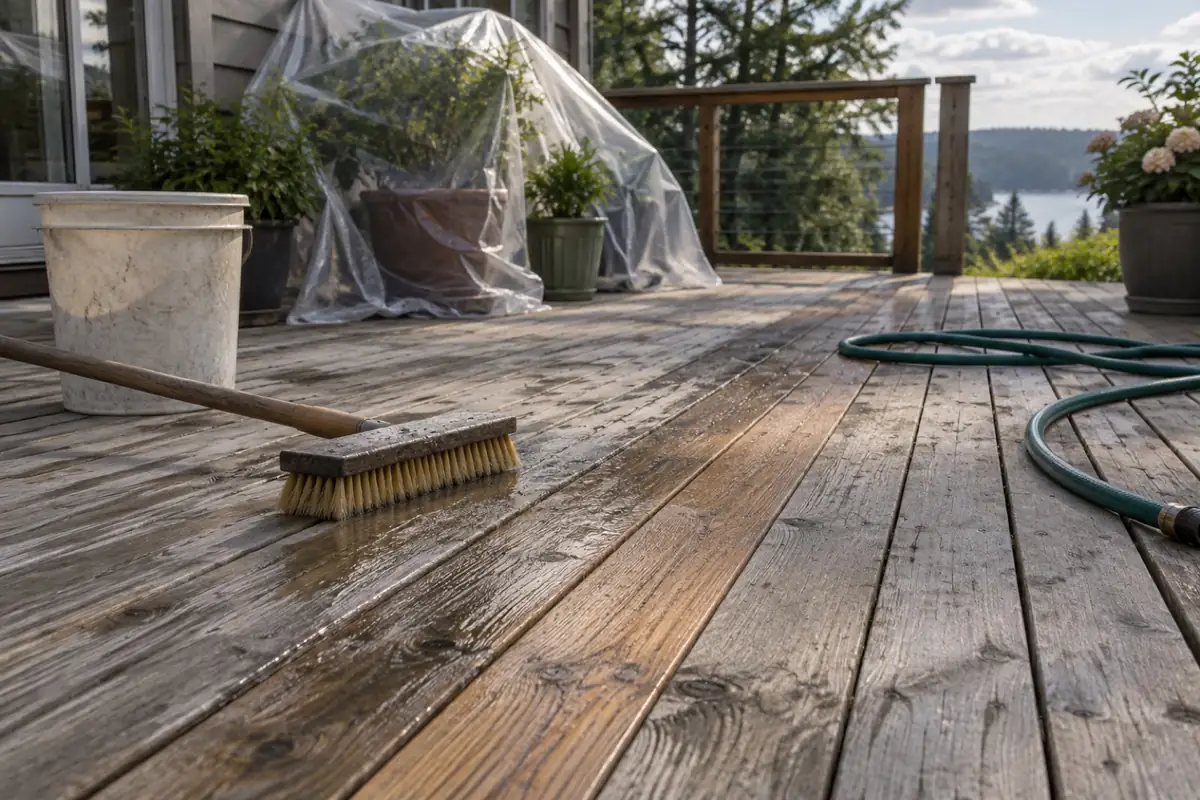
| Bare wood deck | Bleach 1 to 3 with some detergent, rinse, 2 warm windy days to dry before finishing | FPL | No liquid or ammonia detergent; keep the silver fibres |
| Boat canvas | 1 cup bleach, 1/4 cup dish liquid per gallon, 15 min, rinse | Sunbrella | For Sunbrella fabric |
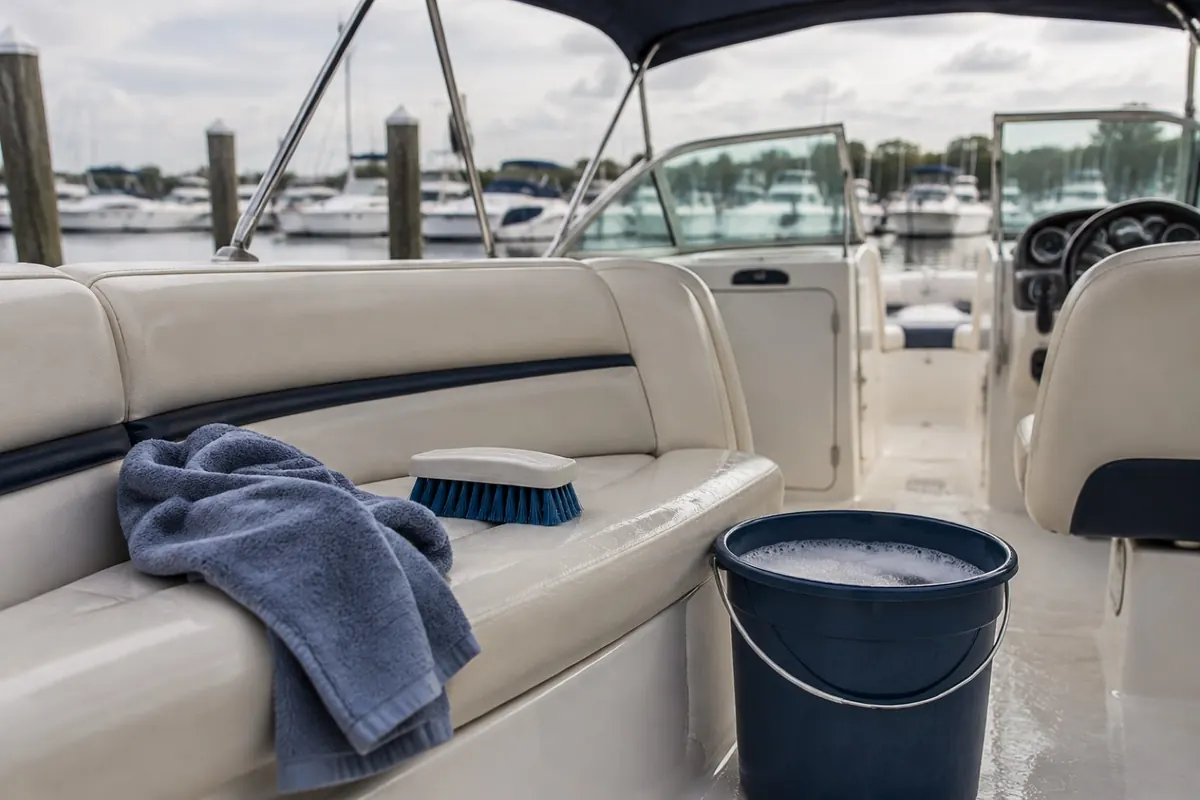
| Boat vinyl seats | Soft brush, warm soapy water, rinse, dry | MasterCraft | Bleach is on its not recommended list |
Grout, caulk and shower curtains
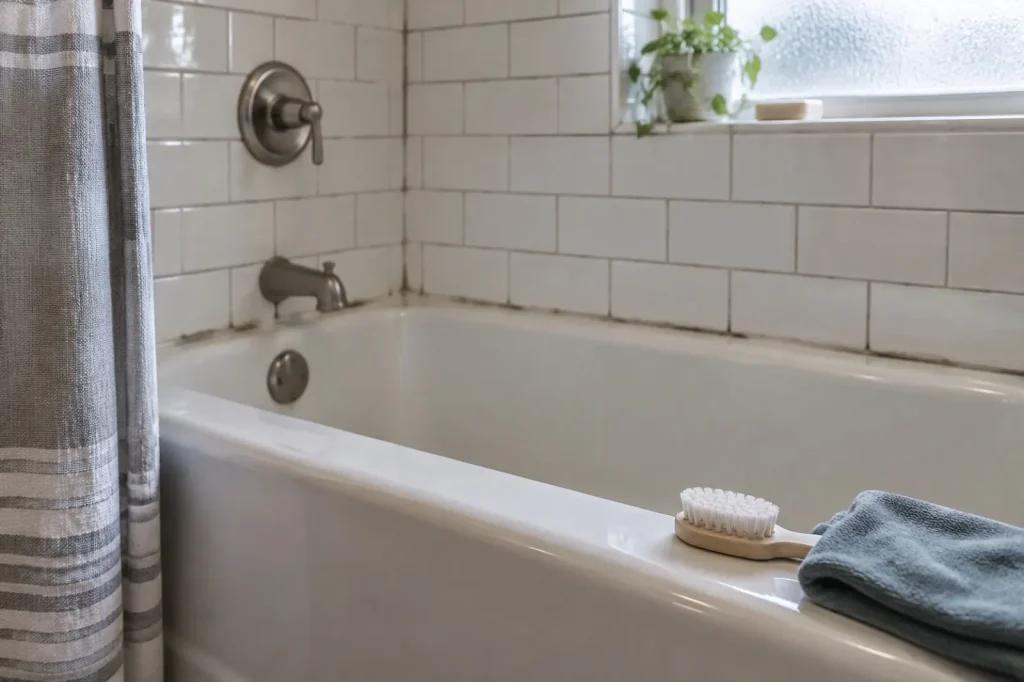
The Tilex label directs: spray, wait until stains disappear and rinse; heavy buildup may need two cleanings, and mildew embedded in old grout or silicone caulking may not come out. Rinse rubber, plastic and vinyl immediately, it says, and keep it off fabric, carpet and paper. The Crescent label lists vinyl curtains among its surfaces. When a joint stays dark after two cleanings, the fix is the joint itself; see mold in shower.
Fabric, upholstery and leather
UF/IFAS Extension starts every fabric with brushing outdoors and sun. For washables it offers lemon juice and salt, powdered non-chlorine bleach at 1 to 2 tablespoons per pint soaked 30 minutes or overnight, or chlorine bleach at 2 tablespoons per quart for 5 to 15 minutes. Leather gets 1 cup denatured alcohol to 1 cup water, drying in moving air, then saddle soap.
Painted siding and decks
Per the Mildew Check label, mix 5.5 parts product to 1 part fresh 5.25% bleach, pretest 20 minutes for colour and adhesion, and discard the mix after 2 hours. The Jomax label limits its bleach wash to exterior painted, non-porous surfaces, 5 minutes then rinse. For bare decks, the Forest Products Laboratory deck guide gives bleach with 3 parts water and some detergent, warns against liquid or ammonia detergents, and says not to scrub off the silver fibres left by weathering, because they absorb stain well. For structural wood, see mold on wood.
Books, paper, boats
Cornell University Library says chemical treatment is no longer viewed as effective for moldy books and advises against spraying or swabbing them with bleach or cleaning agents. Dry them with moving air, freeze to stabilise if needed, then HEPA vacuum once dry, wearing N95 masks and gloves. UF/IFAS, by contrast, suggests a bleach solution for stubborn paper stains; for anything of value, follow the library guidance. On boats, Sunbrella allows bleach on its canvas, while the MasterCraft vinyl care page lists bleach as not recommended for vinyl and says never to cover wet vinyl.
Published bleach recipes disagree, by a lot
The bleach share in published recipes spans roughly 8-fold. According to the quantities printed, the UF/IFAS clothing recipe is about 3% bleach by volume; the UGA fabric soak and both Forest Products Laboratory wood recipes are 25%. We could not reconcile the two fabric recipes, so start with the more dilute one and spot test.
| Source and use | Bleach | Water | Bleach share |
|---|---|---|---|
| UF/IFAS, clothing | 2 Tbsp | 4 cups | 3% |
| UF/IFAS, painted interior walls | 0.75 cup | 16 cups | 4.5% |
| Sunbrella, boat canvas | 1 cup | 16 cups | 5.9% |
| UF/IFAS, bathroom and basement | 4 cups | 36 cups | 10% |
| UGA, washable fabric soak | 0.25 cup | 0.75 cups | 25% |
| FPL decks, 1 part to 3 water | 1 cup | 3 cups | 25% |
| FPL GTR-109, wood | 4 cups | 12 cups | 25% |
Registered mold and mildew removers, and their directions
A mold and mildew remover that also claims to kill or control growth is a pesticide and carries an EPA Reg. No. Not every mildew spray does. The RMR-86 safety data sheet, for a hypochlorite stain remover, describes its use as removal of mold stains and mildew stains and shows no EPA registration number in its regulatory section.
| Product | EPA Reg. No. | Active and % | Stain direction | Surfaces |
|---|---|---|---|---|
| Tilex Mold & Mildew Remover | 5813-24 | Hypochlorite 2.4% | Spray, wait until stains disappear, rinse | Bath surfaces; not wood or painted (optional text) |
| Crescent Mold & Mildew Remover | 68777-3 | Hypochlorite 2.40% | Spray, penetrate, wipe, rinse | Grout, tile, vinyl curtains; not wood or painted |
| Mold Armor Killer + Quick Stain Remover | 4091-23 | Hypochlorite 4.0%, carbonate 1.0% | Apply, wait 10 min, rinse | Hard non-porous; rinse vinyl within 15 min |
| Jomax House Cleaner and Mildew Killer | 69587-1 | o-Phenylphenol, sodium salt 0.25% | Mix with bleach and water, 5 min, rinse | Exterior painted siding, decks; not interior |
| Mildew Check Multi-Purpose Wash | 56601-2 | IPBC 0.23% | 5.5 parts to 1 part bleach, no water | Siding, decks, stucco, brick |
| Wet & Forget | 84115-1 | Quat 9.9% | 13 oz per 5 gal, 10 min, air dry | Siding, decks, roofs |
| Concrobium Mold Control | 82552-1 | Sodium carbonate 0.95% | Apply, wipe, dry; does not whiten | Wood, wallboard, fabric |
Outdoor products are slow by design. The Wet & Forget label says growth or stains may take 6 to 12 months to come clean in the worst case, and that cedar or redwood decks may need brushing.
When the stain outlives the growth
A stain that survives cleaning is not proof the mildew is still alive. Several sources say plainly that some colour stays: the Concrobium label says staining may be irreversible, Cornell University Library says stains near a book’s joints, head and tail are unlikely to be fully removed, and the Forest Products Laboratory GTR-109 warns that wood left unfinished for several years may not regain its colour.
| What you see | What the source says | Next step |
|---|---|---|
| Dark grout or caulk after two cleanings | Embedded mildew may not come out, per Tilex | Replace the joint |
| Spots on fabric after one bleach soak | Old stains may need an overnight soak, per UF/IFAS | Oxygen bleach overnight if the fibre allows |
| Shadow on paper near the spine | Cornell: unlikely to be removed | Accept it, or consult a conservator |
| Deck still silver after cleaning | Empty fibres, per FPL; colour may not return | Leave them; they take stain well |
| Faint mark after a fungistat | Concrobium: does not whiten | Follow with a stain remover suited to the surface |
| Siding still streaked after an outdoor wash | Wet & Forget: up to 6 to 12 months | Wait before re-treating |
If dark growth comes back, it is a moisture problem. EPA recommends keeping indoor humidity below 60 percent, ideally 30 to 50, per EPA's Brief Guide to Mold.
Mixing and material rules
The Crescent label names the combinations that release hazardous gases with bleach: ammonia products, toilet bowl cleaners, rust removers, vinegar and acids. Oxalic acid is an acid, so keep it and bleach apart. The Forest Products Laboratory deck guide adds that the detergent in a bleach wash must not contain ammonia, and EPA’s brief guide gives the same bleach and ammonia warning. Bleach hazards in full are on our does bleach kill mold page.
Protect what is nearby: the Mildew Check label says to wet and cover shrubs, rinse them after, and keep the solution off clothing, lawn furniture and cars.
For contractors
Mildew stain work sits between cleaning and remediation, and the scope should say which. Surface growth on non-porous material is a cleaning task; EPA's homeowner cleanup page notes porous items such as carpet and ceiling tile may have to be discarded. Write stain treatment as a separate line with a stated outcome, because the labels themselves concede that some stains are permanent.
| What to scope or record | Why |
|---|---|
| Stain treatment as its own line item | Labels say staining may persist after growth is gone |
| Spot test record per material | Every guide here requires a colourfastness test |
| Product and EPA Reg. No. used | Ties the work to a public label |
| Porous items listed for disposal | EPA: porous materials may have to be thrown away |
| Contents sent out: books, leather, textiles | Methods differ by material, per the sources above |
| Moisture source and humidity reading | Stains return where moisture does |
Questions people actually ask
Does vinegar actually kill mildew?
Vinegar carries no EPA registration, so no vinegar bottle can make a registered claim to kill mildew. UGA Extension does include white vinegar with washing soda in a wash for light mildew on tile and glass, as a cleaner. Our vinegar page covers what the studies found; for heavy staining, an oxidizer does the colour work.
Is mildew the same as mold?
Mildew is a fungus. The USDA Forest Products Laboratory describes mildew on wood as stain fungi, different from decay fungi, that live only on the surface and do not weaken it. Our mold vs mildew page explains the terms; the cleanup depends more on the material than on the name.
What do professional mold removers use?
On cleanable surfaces, mostly detergent, physical removal and drying, because EPA guidance puts removal ahead of biocides. Registered products are used where judgement calls for them, and each must be used as its label directs. Stain removal comes after, with an oxidizer matched to the material, and porous items may be discarded instead.
What kills mold permanently naturally?
Nothing does, natural or not. Sun and air drying are the first step for fabrics in the UF/IFAS guide, and lemon juice with salt is its non-bleach stain option, but growth returns wherever a surface stays damp. EPA’s long-term answer is moisture control: indoor humidity below 60 percent, ideally 30 to 50.
How do you remove mildew from a fabric shower curtain?
Brush the growth off outdoors and let it air in the sun, then treat what is left with lemon juice and salt or a non-chlorine bleach soak, per UF/IFAS. Use chlorine bleach only if the fabric tolerates it, at 2 tablespoons per quart of warm water for 5 to 15 minutes, then rinse and launder.
Is a mold and mildew spray safe on boat seats?
Usually not a bleach one. MasterCraft lists bleach as not recommended for its vinyl upholstery and advises a soft brush with warm soapy water, rinsing and drying. Sunbrella allows a bleach and dish liquid mix on its canvas. The Tilex and Crescent labels say to rinse vinyl immediately after contact.
Sources
- UF/IFAS Extension, Jefferson County, Mildew Removal, undated.
- UGA Extension, Textiles, Remove Stains From Mildew, Mold, undated.
- Cornell University Library, Library Preservation and Conservation Tutorial, Mold.
- Forest Products Laboratory deck guide, Mark Knaebe, Finishes for Wood Decks, revised July 2013.
- Forest Products Laboratory GTR-109, Williams and Feist, Water Repellents and Water-Repellent Preservatives for Wood, January 1999.
- Sunbrella mildew cleaning post and MasterCraft vinyl care page, both undated; PubChem, sodium percarbonate, CID 159762.
- Tilex label (5813-24, accepted 4 June 2024), Crescent label (68777-3, dated 30 June 2025), Mold Armor label (4091-23, 12 April 2023).
- Jomax label (69587-1, 2013), Mildew Check label (56601-2, 2010), Wet & Forget label (84115-1, 2012), Concrobium label (82552-1, 24 February 2023), EPA record for X-14.
- RMR-86 safety data sheet, RMR Solutions, issued 1 December 2016.
- EPA's homeowner cleanup page (updated 4 June 2026), EPA's Brief Guide to Mold (updated 18 February 2026) and EPA's commercial remediation guide.
- All retrieved 18 October 2026. Bleach shares are our arithmetic on printed quantities; nothing was tested. See our methodology.
Follow the label or care guide for your material; test a hidden spot first. More guides on the mold hub.