The short answer
What is a biohazard? In US regulation it is an infectious agent, or material carrying one, that presents a risk to people: OSHA’s sign rule limits the term to agents posing a risk to human well-being. On a property job that means blood, other potentially infectious materials, contaminated sharps and the regulated waste they create, each with its own labelling and disposal rules.
Key takeaways
- OSHA’s 29 CFR 1910.145 defines biohazard narrowly: only infectious agents presenting a risk or potential risk to the well-being of man.
- The working definitions sit in 29 CFR 1910.1030: blood, other potentially infectious materials (OPIM), contaminated sharps and regulated waste.
- EPA’s medical waste rules expired on 21 June 1991; the EPA medical waste page names states as the primary regulators.
- California’s California Medical Waste Management Act counts trauma scene cleanup waste as medical waste and makes commercial practitioners register.
- For DOT, specimens are Category B (UN3373), regulated medical waste is UN3291, and sewage is excepted, per 49 CFR 173.134.
Scope. This page explains how regulators define and classify biohazards and their waste. It does not describe how any agent affects the body; for health questions, use CDC (cdc.gov) or a medical professional. Cost and hiring live on our biohazard cleanup guide. Nothing here is legal advice.
On this page
- What is a biohazard, according to the regulators
- The OSHA definitions that do the real work
- The four waste categories
- The biohazard symbol and its labelling rules
- Regulated medical waste is a state matter
- Moving it: DOT Category B and regulated medical waste
- Biohazards in property cleanup
- Who may clean what
- Is it a biohazard on this job? A decision path
- For contractors: the file an adjuster asks for
- Questions people actually ask
What is a biohazard, according to the regulators
The biohazard definition, and so its meaning on a job site, varies by agency: all agree on a living agent, or something carrying one, that can harm people, but cast the net at different widths. The CDC NIOSH training module at CDC describes biological hazards as pathogens transmitted to individuals through routes of exposure, and groups examples by route: blood and body fluids, fecal to oral, contact and airborne. OSHA’s 29 CFR 1910.145 is tighter, limiting the term to infectious agents that present a risk to people. The NIH Waste Disposal Guide defines its medical pathological waste stream as waste containing or contaminated with infectious or pathogenic agents, plus pathological waste and sharps.
| Source | How it defines the hazard | Why it matters |
|---|---|---|
| CDC NIOSH module (reviewed 10 June 2022) | Pathogens transmitted through routes of exposure | Explains the concept. Imposes no duty. |
| OSHA 1910.145(e)(4) | Only infectious agents with a risk or potential risk to people | Decides when the sign or tag is used at work. |
| OSHA 1910.1030(b) | Blood, OPIM, contaminated sharps, regulated waste | Sets an employer’s duties on a cleanup. |
| NIH Waste Disposal Guide (2022) | Waste with infectious or pathogenic agents, pathological waste, sharps | A clear model of waste sorting. |
| California H&SC 117690 | Medical waste, expressly including waste from trauma scene cleanup | Makes cleanup debris regulated waste. |
| WHO fact sheet (24 October 2024) | Infectious, pathological and sharps waste among seven hazardous types | Shows how small the hazardous fraction is. |
The WHO health-care waste fact sheet reports that about 85% of health care waste is general and non-hazardous; the other 15% may be infectious, chemical or radioactive. A contaminated room is rarely contaminated wall to wall either.
The OSHA definitions that do the real work
For restoration work, the definition with legal weight is in OSHA’s Bloodborne Pathogens standard, 29 CFR 1910.1030. It applies to all occupational exposure to blood or other potentially infectious materials: reasonably anticipated skin, eye, mucous membrane or parenteral contact arising from an employee’s duties. Four definitions then decide what on a site is regulated.
| Term in 1910.1030(b) | What the regulation says | On a cleanup |
|---|---|---|
| Blood | Human blood, its components, and products made from it | Any human blood, wet or dried. |
| OPIM | Listed body fluids, any fluid visibly contaminated with blood, all fluids that cannot be told apart, unfixed human tissue | An unidentifiable fluid is treated as OPIM. |
| Contaminated sharps | Any contaminated object that can penetrate skin: needles, scalpels, broken glass, broken capillary tubes | Needles in a hoard; glass at a trauma scene. |
| Regulated waste | Liquid or semi-liquid blood or OPIM; items that would release it if compressed; items caked with dried blood or OPIM that can release it in handling; contaminated sharps; pathological and microbiological wastes with blood or OPIM | Decides what goes in the red bag. |
Estimators should know the regulated waste definition by heart, because it tests condition, not origin. A pad that would drip if squeezed is regulated waste; a dry, stable stain that will not flake may not be, though many firms bag it anyway. Paragraph (d)(4)(iii)(C) then hands disposal to federal, state and local rules.
The four waste categories
The rules work in categories, not example lists. Four cover nearly everything a contractor meets; where they overlap, the stricter rule wins.
| Category | Defined in | Examples given | Typical container |
|---|---|---|---|
| Blood and OPIM | 29 CFR 1910.1030(b) | Blood, listed body fluids, unfixed human tissue | Closable, leak-resistant, red or labelled |
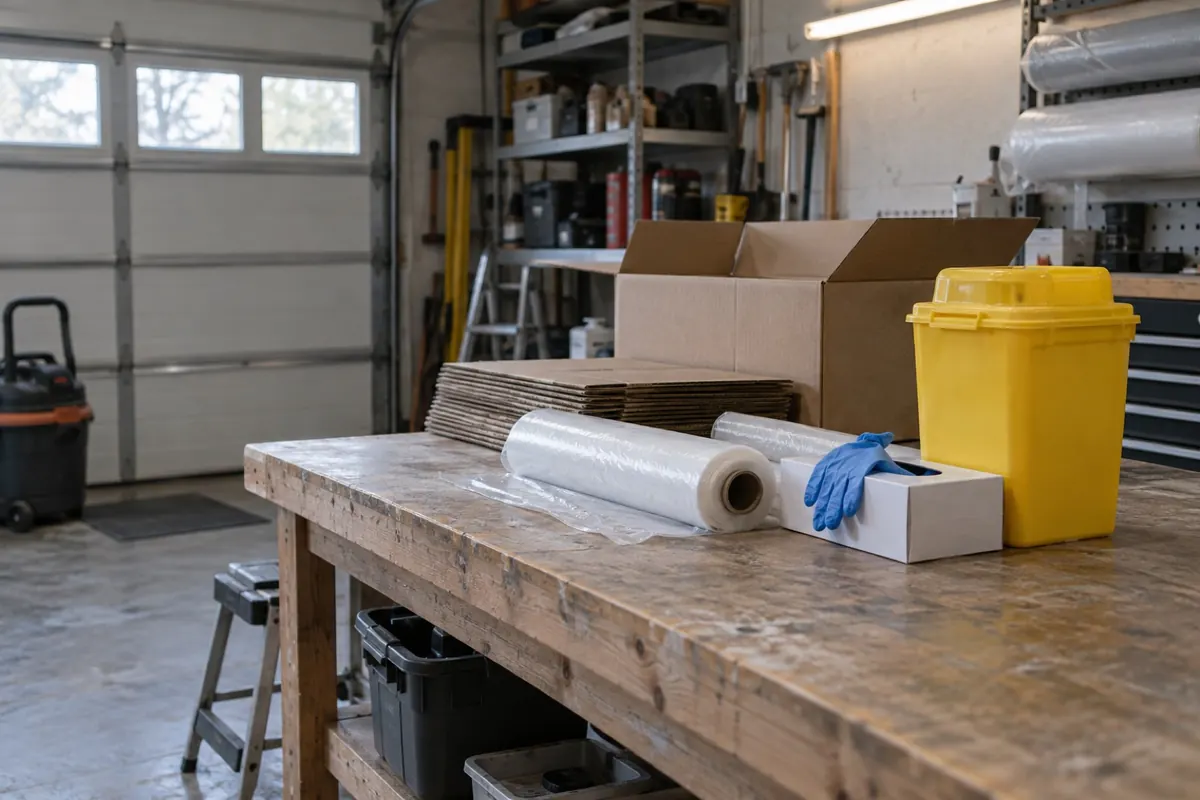
| Sharps | 1910.1030(b); 49 CFR 173.134(a)(6) | Needles, syringes, scalpels, broken glass, broken rigid plastic | Closable, puncture-resistant sharps container |
| Microbiological | 1910.1030(b); NIH guide | Cultures and media; waste with infectious agents | Autoclave bag or medical waste box |
| Pathological | 1910.1030(b); NIH guide; WHO | Human or animal tissue and organs | Packed apart from other medical waste (NIH) |
The NIH Waste Disposal Guide shows the categories in practice: sharps containers filled to three quarters and snapped shut, pathological waste packed separately, and some waste converted to general waste by autoclaving for 60 minutes at a minimum of 121 degrees Centigrade. Decontaminated is a state reached by a validated process, not a feeling.
The biohazard symbol and its labelling rules


The Science History Institute reports that work on the symbol began in 1966, led by Charles Baldwin, an environmental health engineer at Dow Chemical, under a contract from an institute of the National Institutes of Health, with Robert Runkle there. Dow artists drew more than 40 designs, six went to final testing, and Baldwin’s brief was a mark that was memorable and meaningless, carrying no earlier association. Baldwin and Runkle published it in Science, 13 October 1967. The institute says CDC and OSHA adopted it soon after and ISO made it a global standard in 1986.
Two OSHA rules govern its use at work. The ANSI Z535 family of safety colour and sign standards enters through 29 CFR 1910.145, which cites ANSI Z535.1-2006(R2011) as the colour specification for its danger, caution and safety instruction signs.
| Rule | What it requires | Where you see it |
|---|---|---|
| 29 CFR 1910.1030(g)(1)(i) | Labels on regulated waste containers and on fridges, freezers and containers holding blood or OPIM. Fluorescent orange or orange-red, contrasting symbol and lettering. Red bags or containers may substitute. | Red bags, sharps containers, waste boxes |
| 29 CFR 1910.145(e)(4) | Signs mark the actual or potential presence of a biohazard on equipment, containers, rooms or materials. | Doors, storage areas |
| 29 CFR 1910.145(f)(8) | Tags use the symbol configuration shown in the rule; Appendix A recommends fluorescent orange or orange-red. | Contaminated equipment |
| 49 CFR 173.134(c)(1) | For regulated medical waste on a private or contract carrier, a BIOHAZARD marking under 1910.1030 can replace the DOT infectious substance label. | Boxes on a hauler’s truck |
Regulated medical waste is a state matter
No single federal rulebook covers disposal. The EPA medical waste page explains why: the Medical Waste Tracking Act of 1988 produced EPA rules that took effect on 24 June 1989 in New York, New Jersey, Connecticut, Rhode Island and Puerto Rico, and expired on 21 June 1991. EPA says state environmental and health departments are now the primary regulators. Three states show the spread.
| State | Law and agency | A rule that changes the job |
|---|---|---|
| California | Medical Waste Management Act, H&SC 117600 to 118360; CDPH | Trauma scene cleanup waste is medical waste (117690). Generators of 20 pounds or more a month may hold biohazardous waste above 0 C for seven days (118280). |
| Florida | Section 381.0098, F.S.; Chapter 64E-16, F.A.C.; Department of Health | A permit at 25 pounds or more in any 30-day period; storage capped at 30 days; transporters register with the county health department. |
| New York | 6 NYCRR Part 364; NYSDEC | Transporting regulated medical waste needs a Part 364 permit or registration, manifests and liability insurance evidence. |
Storage clocks are the practical difference: a week’s wait for pickup is legal in one state, a breach in another. Across the clocks below the spread runs from 7 to 90 days, a factor of 12.
Moving it: DOT Category B and regulated medical waste
Transport is federal even where disposal is not. Under 49 CFR 173.134, infectious substances are Division 6.2. Category A covers a form capable of causing permanent disability or life-threatening harm on exposure. Category B covers the rest, shipped as Biological substance, Category B, UN3373, and the rule states that this does not include regulated medical waste, which is UN3291 and is packed under 49 CFR 173.197 in rigid UN standard packagings at the Packing Group II performance level.
49 CFR 173.199 sets the Category B package: triple packaging, a drop test from at least 1.2 metres with no leak from the primary receptacle, and, for air, no more than 1 litre per primary receptacle and 4 litres per outer package. A restoration firm meets it when it ships a sample to a lab. The same 49 CFR 173.134 excepts sanitary waste, sewage and household medical waste moved under state rules from Division 6.2.
DOT’s regulated medical waste definition covers waste from medical treatment or biomedical research. Trauma scene debris is neither, which is why California writes it into state law directly. Ask the permitted hauler how a cleanup load is manifested before the job.
Biohazards in property cleanup
So what makes a house a biohazard? Not the event, but the material it left behind. Four situations account for most building work, described here by regulated scope only.
| Situation | Regulated material | Framework |
|---|---|---|
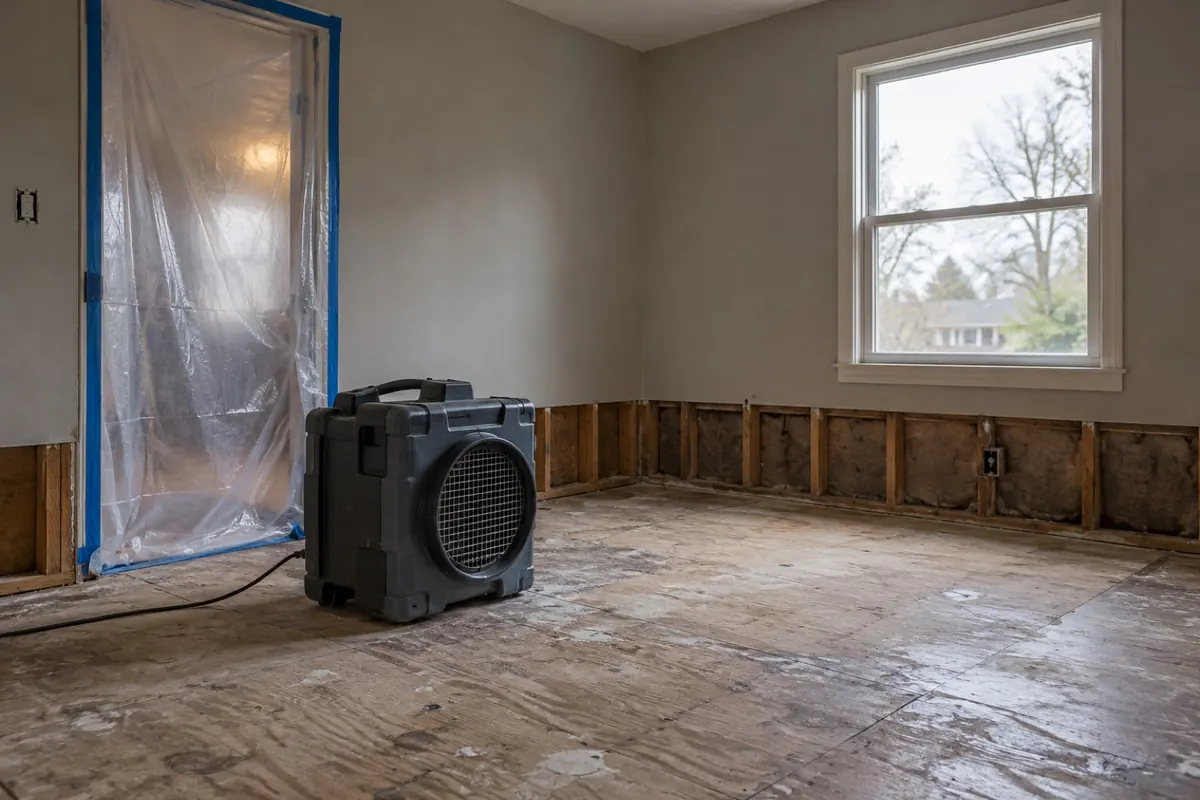
| Trauma scene | Blood and OPIM on surfaces and in porous materials; possible sharps | OSHA 1910.1030; state medical waste law; ANSI/IICRC S540 |
| Unattended death | Body fluids in porous materials and assemblies | As above; California names death scenes expressly |
| Sewage backup | Category 3 water; sanitary waste | IICRC S500 categories; excepted from DOT Division 6.2 |
| Hoarding | Possible sharps, animal waste, sometimes blood or OPIM | 1910.1030 where blood, OPIM or sharps are reasonably anticipated |
ANSI/IICRC S540, the Standard for Trauma and Crime Scene Cleanup, second edition, 2023, covers the first two rows; IICRC’s page says it sets criteria for inspecting blood and OPIM and assumes the scene has been released by the authorities. Sewage is a water category problem first, explained on our water categories page; the job itself is in our sewage damage cleanup guide, and backflow into a basement on our basement flood cleanup page.
Who may clean what
29 CFR 1910.1030 binds employers whose employees have occupational exposure. It requires a written Exposure Control Plan reviewed at least annually, training at initial assignment and at least annually after, and hepatitis B vaccination made available within 10 working days of initial assignment, with training records kept for 3 years. It does not reach a homeowner cleaning their own home, though the waste still falls under state and local disposal rules.
| Who | Situation | What governs it |
|---|---|---|
| Homeowner | Small spill or found sharps at home | No OSHA duty. FDA: a sharps container, then local disposal options. |
| Restoration employer | Reasonably anticipated contact with blood or OPIM | 29 CFR 1910.1030 in full |
| Commercial trauma cleaner, California | Removing blood and body fluids from a serious injury, illness or death scene | CDPH registration, H&SC 118321 onward |
| Any firm with regulated waste | Bags leaving the property | State medical waste law and a permitted hauler |
| Crew on a sewage loss | Category 3 water | IICRC S500 practice; 1910.1030 only if blood or OPIM is anticipated |
In California, according to the California Medical Waste Management Act as compiled by CDPH in 2017, registered practitioners pay an annual fee of $200. The waste leaves immediately after the removal phase for a permitted facility, or goes into a dedicated freezer at the practitioner’s premises for up to 14 days. A second state is compared on our biohazard levels page, and careers on our biohazard cleanup jobs page.
Is it a biohazard on this job? A decision path
Work through it in order and stop at the first step that applies to the room.
- Is the scene released? If police or a regulator still control it, nobody cleans.
- Is human blood, an unidentifiable fluid or tissue present? It is blood or OPIM; employees need the full 1910.1030 programme.
- Can anything pierce skin? Treat it as a contaminated sharp: puncture-resistant container, never recapped or pressed down.
- Would the material drip if squeezed, or flake in handling? It meets the regulated waste definition.
- Is the source sewage? Follow the Category 3 scope; add BBP controls only if blood or OPIM is also anticipated.
- Which state? Check trauma registration and the storage clock.
- Who hauls it? Name the permitted hauler and facility before the first bag is filled.
For contractors: the file an adjuster asks for
Adjusters ask for the same items on biohazard scope: the current Exposure Control Plan (1910.1030(c)(1)), crew training records (kept 3 years under (h)(2)), the waste manifest or tracking form proving delivery to a permitted facility, any state registration and the disinfectant’s EPA registration number. Bill waste disposal as its own line, backed by the hauler’s invoice.
On products, the EPA disinfectant lists say EPA registers antimicrobial pesticides and approves label language; it does not approve products for biohazard cleanup. List S collects registered products effective against HIV, hepatitis B and hepatitis C, and replaced the retired Lists C, D, E and F. Follow the label, including contact time.
Questions people actually ask
What are biohazards? Some examples
Under OSHA’s Bloodborne Pathogens standard, the common property examples are human blood, unidentifiable body fluids and other potentially infectious materials, unfixed human tissue, and contaminated sharps such as needles or broken glass. Waste categories add microbiological waste, such as cultures, and pathological waste, such as tissue.
Is blood a biohazard?
Yes. OSHA’s 29 CFR 1910.1030 treats human blood, its components and products made from it as potentially infectious at work. Liquid blood, items that would release it if compressed, and items caked with dried blood that can flake off all count as regulated waste and need a red or labelled container.
What makes a house a biohazard?
Regulated material, not the event: blood or body fluids after a trauma or unattended death, contaminated sharps, or Category 3 sewage water. Porous materials that absorbed fluids are usually removed. ANSI/IICRC S540 sets trauma scene scope, IICRC S500 covers sewage, and state law governs the debris.
What is a biohazard bag?
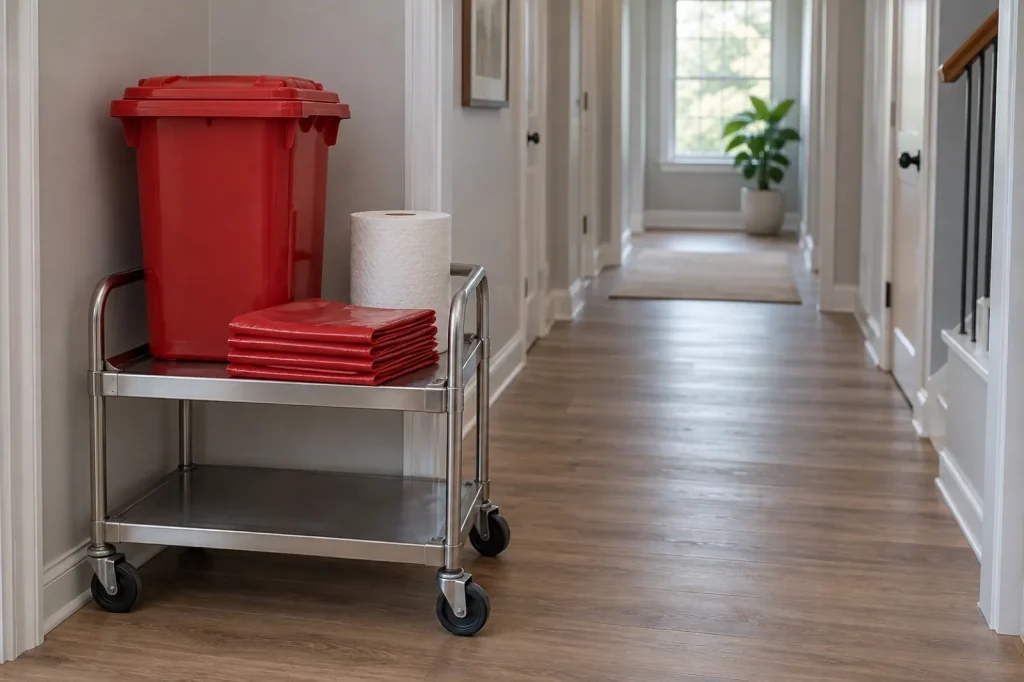
A closable, leak-resistant bag for regulated waste. OSHA allows red bags in place of labels; otherwise the bag carries a fluorescent orange or orange-red biohazard label. Bags are closed before removal, and California requires them to travel inside a rigid container with a tight-fitting cover.
How do you dispose of biohazard waste at home?
For needles and sharps, FDA’s two steps are: use a sharps disposal container and stop at about three quarters full, then use local options such as drop-off sites, household hazardous waste collection or mail-back programmes. Your local health department sets the route for other household medical waste.
Which biohazard cleaning products are EPA approved?
EPA registers disinfectants rather than approving them for biohazard cleanup. Its List S names registered products with label claims against HIV, hepatitis B and hepatitis C, replacing retired Lists C, D, E and F. Check the label’s EPA registration number against List S and follow its contact time.
What certifications should a biohazard cleanup company have?
No federal licence covers the cleanup itself. Look for what the law requires: an OSHA Bloodborne Pathogens programme with current training records, state registration where required, as in California for trauma scenes, and a permitted medical waste hauler. ANSI/IICRC S540 is the industry benchmark.
What does the biohazard symbol mean?
It warns of the actual or potential presence of a biological hazard, which OSHA’s 1910.145 limits to infectious agents that present a risk to people. The Science History Institute says it was developed at Dow Chemical from 1966, published in Science in 1967, and made an ISO standard in 1986.
Sources
- 29 CFR 1910.1030, Bloodborne pathogens, via eCFR. Retrieved 18 October 2026.
- 29 CFR 1910.145, accident prevention signs and tags, via eCFR. Retrieved 18 October 2026.
- 49 CFR 173.134, 49 CFR 173.197 and 49 CFR 173.199, PHMSA hazardous materials rules, via eCFR. Retrieved 18 October 2026.
- CDC NIOSH training module, Biological Hazards, CDC, reviewed 10 June 2022. Retrieved 18 October 2026.
- EPA medical waste page, US EPA, updated 20 April 2026. Retrieved 18 October 2026.
- NIH Waste Disposal Guide, Medical Pathological Waste, NIH Division of Environmental Protection, 2022. Retrieved 18 October 2026.
- WHO health-care waste fact sheet, World Health Organization, 24 October 2024. Retrieved 18 October 2026.
- Science History Institute, The biohazard warning symbol, Patrick H. Shea, 26 June 2025. Retrieved 18 October 2026.
- Baldwin CL, Runkle RS. Biohazards symbol: development of a biological hazards warning signal. Science, 13 October 1967; 158(3798):264 to 265. Retrieved 18 October 2026.
- California Medical Waste Management Act, CDPH compilation, January 2017; fees and clocks may have been amended since. Retrieved 18 October 2026.
- Florida Department of Health, Biomedical Waste Program (undated). Retrieved 18 October 2026.
- NYSDEC transporter page, NYSDEC (undated). Retrieved 18 October 2026.
- EPA disinfectant lists, US EPA, updated 24 August 2026. Retrieved 18 October 2026.
- FDA sharps guidance, US FDA, current as of 10 August 2023. Retrieved 18 October 2026.
- ANSI/IICRC S540, IICRC public page; the standard itself is sold by IICRC. Retrieved 18 October 2026.
- Symbol image: Silsor, Wikimedia Commons, public domain. Storage ratios are arithmetic on the figures above. See our methodology and the standards hub.
Regulations summarised, not legal advice. Confirm state clocks, fees and thresholds with the agency.