The short answer
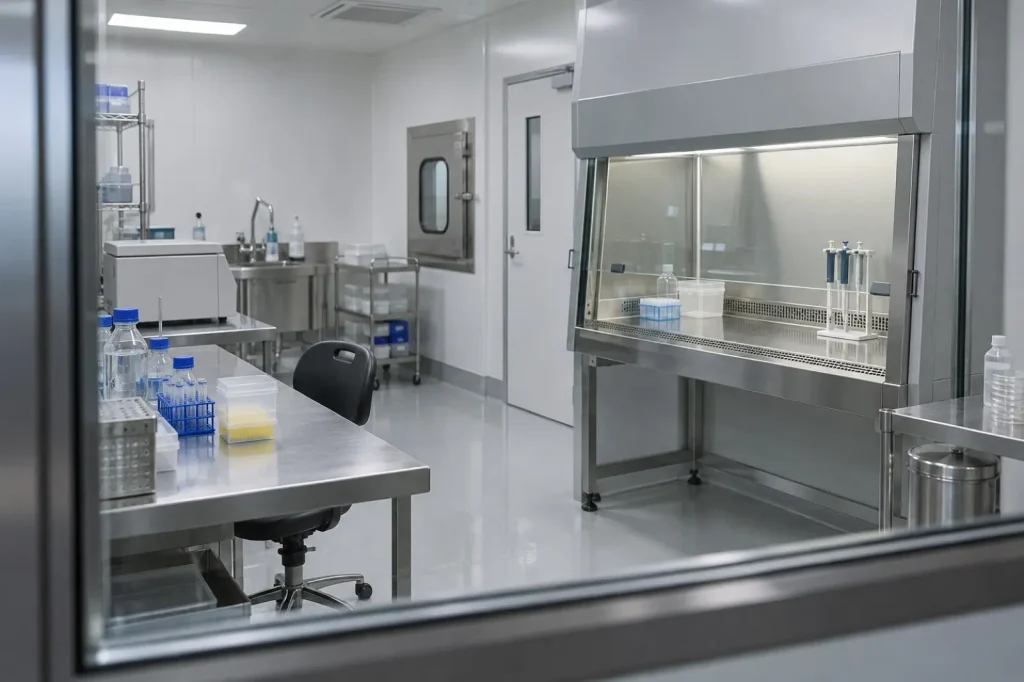
Biohazard levels, properly called biosafety levels, are the four laboratory containment tiers, BSL-1 to BSL-4, set out by CDC and NIH in Biosafety in Microbiological and Biomedical Laboratories, 6th edition. Each level adds practices, equipment and facility controls to the one below. They classify labs, not germs and not cleanup jobs: agents have risk groups, and property cleanup falls under OSHA and state rules.
Key takeaways
- The BMBL 6th edition defines four biosafety levels, and CDC says each builds on the controls of the level before it.
- BMBL’s own examples: Bacillus subtilis at BSL-1; hepatitis B virus, HIV, Salmonella and Toxoplasma at BSL-2; Mycobacterium tuberculosis at BSL-3; Marburg virus at BSL-4.
- Counting BMBL’s numbered requirements, the list grows from 28 at BSL-1 to 57 for a BSL-4 cabinet lab.
- BMBL states that biosafety levels are not to be confused and equated with risk groups, which the NIH Guidelines (April 2024) assigns to agents.
- WHO’s 4th edition manual dropped the risk group to biosafety level shortcut, calling it a misconception.
- No cleanup job is a BSL job. Property work is classified by OSHA 29 CFR 1910.1030, ANSI/IICRC S540, and registration laws in states such as California and Georgia.
Scope. This page explains classification systems. It does not describe what any agent does to the body; for health questions use CDC (cdc.gov) or a clinician. Definitions, the symbol and waste rules are on our what is a biohazard page.
On this page
- You are probably looking for one of three systems
- The four biosafety levels, side by side
- Biohazard level 2 (BSL-2) in detail
- BSL-3 and BSL-4: containment becomes the building
- Animal biosafety levels
- Risk groups are not biosafety levels
- How many labs run at the top levels
- How property biohazard cleanup is classified instead
- For contractors: the words to use on a scope
- Questions people actually ask
You are probably looking for one of three systems
The phrase biohazard level does not appear in the BMBL, the NIH Guidelines or the WHO manual. Like biohazard safety level, it is how people search for three different numbered systems, and restoration searchers in particular tend to land on laboratory pages while looking for cleanup rules. Start with the row that matches your question.
| If your question is about | You want | Who publishes it | Numbered as |
|---|---|---|---|
| How a laboratory is built and run | Biosafety levels (BSL) | CDC and NIH, BMBL 6th edition | BSL-1 to BSL-4 |
| Lab work with infected animals | Animal biosafety levels (ABSL) | CDC and NIH, BMBL Section V | ABSL-1 to ABSL-4 |
| How dangerous a specific organism is | Risk groups (RG) | NIH Guidelines Appendix B; WHO | RG1 to RG4 |
| Cleaning blood or body fluids from a property | OSHA Bloodborne Pathogens; ANSI/IICRC S540 | OSHA; IICRC | No levels |
| Sewage in a building | IICRC water categories | IICRC S500 | Category 1 to 3 |
| Who may do trauma cleanup in a state | State registration law | For example CDPH (California), Secretary of State (Georgia) | No levels |
Sewage has its own numbered scheme, the three IICRC water categories, explained on our water categories page. It is unrelated to biosafety levels.
The four biosafety levels, side by side
The BMBL 6th edition is the reference. Its Section IV sets standard microbiological practices, special practices, safety equipment (primary barriers) and facility design (secondary barriers) for each level, and the CDC Quick Learn on biosafety levels puts the principle in one line: each level builds on the controls of the level before it. The table uses BMBL’s own agent examples.
| Level | Agents it suits (BMBL wording, condensed) | BMBL examples | What changes at this level |
|---|---|---|---|
| BSL-1 | Well-characterised agents not known to consistently cause illness in healthy adults | Bacillus subtilis, Naegleria gruberi, infectious canine hepatitis virus | Standard practices; door, handwashing sink, cleanable benches. No special barriers. |
| BSL-2 | Agents linked to human illness of varying severity, moderate hazard | Hepatitis B virus, HIV, Salmonella, Toxoplasma | Restricted access during work; trained, supervised staff; splash or aerosol work in a biosafety cabinet (BSC). |
| BSL-3 | Agents with potential for respiratory transmission that may cause serious or potentially lethal infection | Mycobacterium tuberculosis, St. Louis encephalitis virus, Coxiella burnetii | All infectious work in a BSC; two self-closing doors; sealed surfaces; ducted inward airflow. |
| BSL-4 | Dangerous, exotic agents with high individual risk by aerosol and no available vaccine or therapy | Marburg virus, Congo-Crimean hemorrhagic fever virus | Class III cabinet or positive-pressure suit; exit shower; separate building or isolated zone. |
One way to see the step up is to count. Section IV lists its requirements as numbered items under four headings. Counting the top-level items gives 28 at BSL-1, 38 at BSL-2 and 47 at BSL-3, then 57 for a BSL-4 cabinet lab and 55 for a suit lab. The count is ours and blunt: one item can be a sentence or a page. The direction is the point.
Biohazard level 2 (BSL-2) in detail
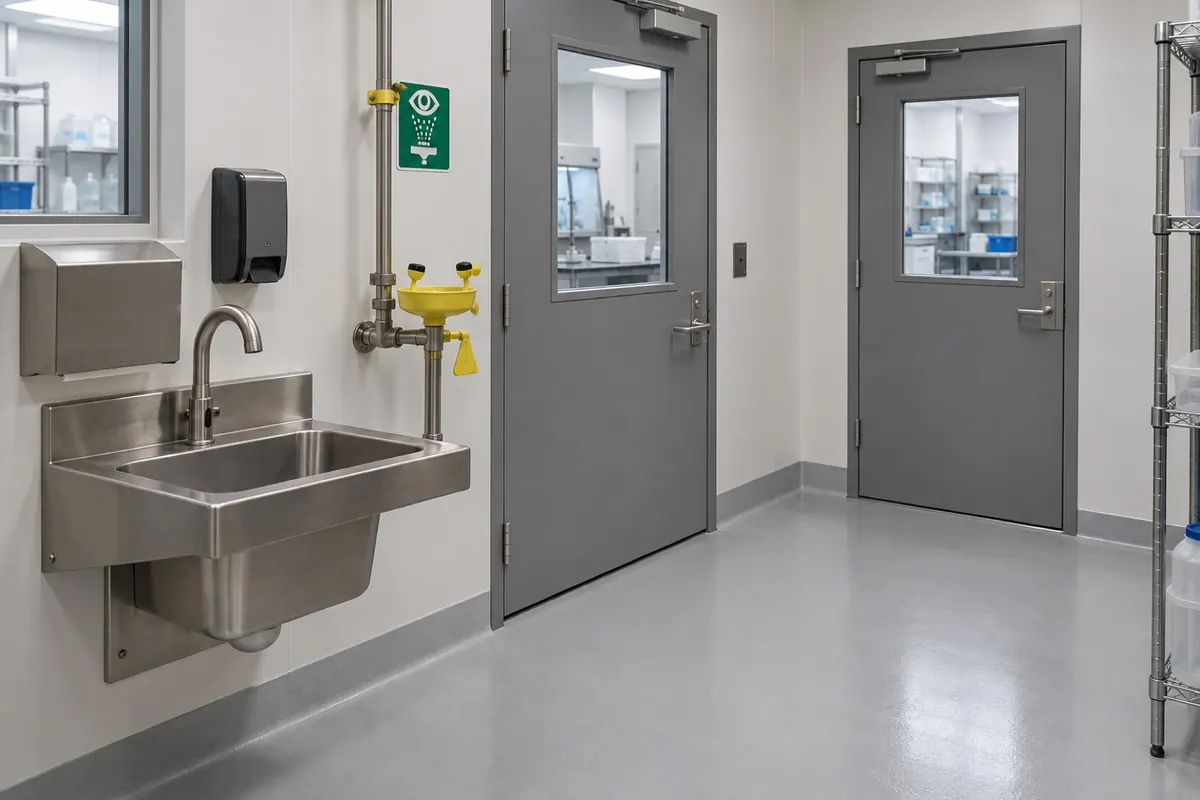
Biohazard level 2 is the most searched level, and the one that touches restoration work most. The BMBL 6th edition says BSL-2 differs from BSL-1 in three ways: staff receive specific training and are supervised by competent scientists, access is restricted while work is under way, and any procedure that may create infectious aerosols or splashes is done in a BSC or other containment equipment.
BMBL also notes that work with human-derived specimens such as blood, body fluids and tissues, where an agent may be present but unknown, can often be done safely under conditions typically associated with BSL-2, and it tells staff handling human material to refer to the OSHA Bloodborne Pathogens standard. That sentence is the bridge between the lab world and a trauma scene. In a building, the rule that applies to blood is the OSHA standard, not a lab level.
| BSL-2 element | What BMBL Section IV says |
|---|---|
| Entry sign | A sign with the universal biohazard symbol at the entrance when infectious materials are present, naming the biosafety level, a responsible person and PPE requirements |
| Waste | A method for decontaminating all laboratory waste is available, such as autoclave, chemical disinfection or incineration |
| Doors and sink | Self-closing, lockable doors; a handwashing sink near the exit |
| Eyewash | Readily available in the laboratory |
| Cabinets | BSC performance checked at least annually |
| Ventilation | No specific requirement; new builds consider inward airflow without recirculation |
BSL-3 and BSL-4: containment becomes the building
At BSL-3 the BMBL 6th edition moves the protection into the building. Access is through two consecutive self-closing doors, the handwashing sink is hands-free, floors, walls and ceilings are sealed for decontamination, windows are sealed, and a ducted ventilation system draws air from clean toward potentially contaminated areas, designed so the flow will not reverse at the containment barrier on failure. No work with open vessels happens on the bench.
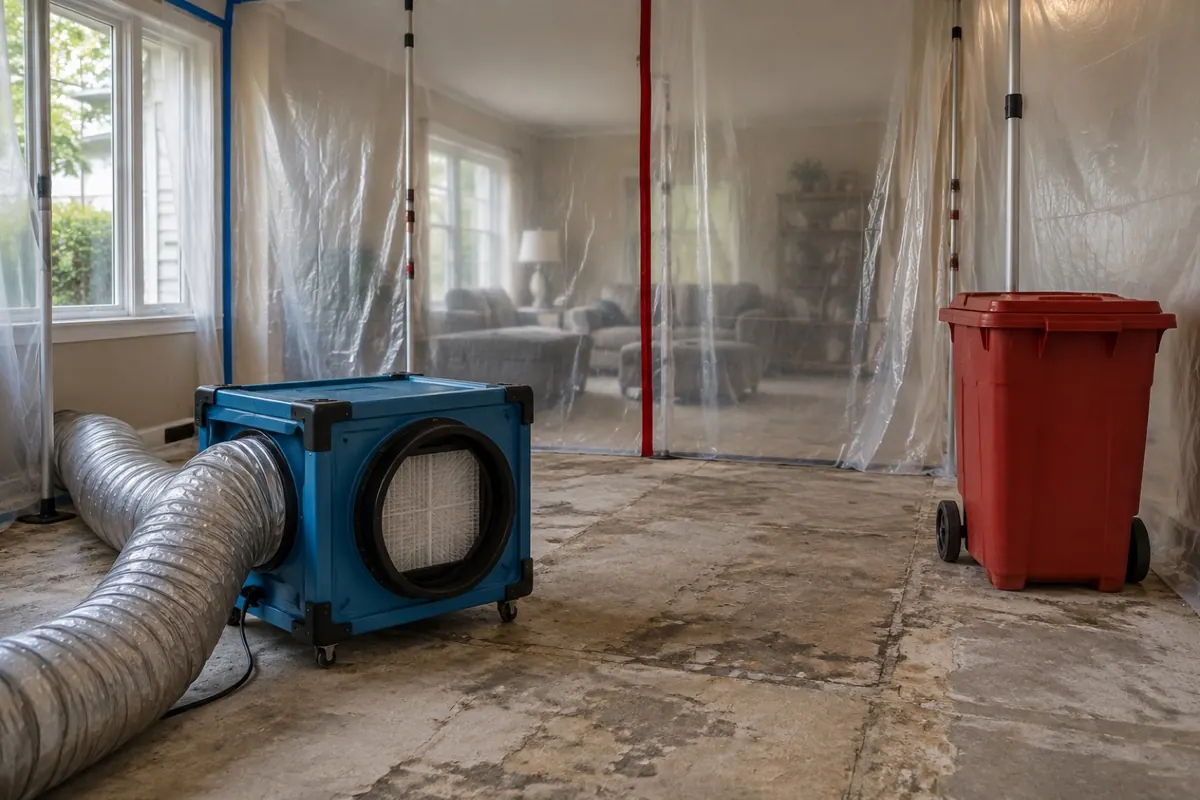
BSL-4 comes in two models. In a cabinet laboratory, agents are handled in a Class III BSC; in a suit laboratory, staff wear a positive-pressure supplied-air suit. Everyone leaving takes a personal body shower, suit-lab staff pass a chemical shower first, and the facility may be a separate building or an isolated zone. A Class III cabinet takes supply air through a HEPA filter and exhausts through two in series. The nearest restoration analogue is negative air with HEPA filtration, covered on our air scrubber page, but no cleanup standard borrows the BSL label.
Animal biosafety levels
Section V of the BMBL 6th edition sets four animal biosafety levels for work with infected laboratory animals, plus ABSL-3Ag for certain agriculture work. Each builds on the one below, as BSLs do.
| Level | BMBL summary |
|---|---|
| ABSL-1 | Well-characterised agents not known to consistently cause illness in healthy adults; minimal hazard |
| ABSL-2 | Agents linked to human illness, moderate hazard; a BSC for procedures that may create aerosols or splashes |
| ABSL-3 | Aerosol potential and serious or potentially lethal outcomes; all procedures in BSCs, inward airflow, hands-free sinks |
| ABSL-4 | Dangerous, exotic agents; Class III cabinet or positive-pressure suit facility with HEPA supply and exhaust |
Risk groups are not biosafety levels
Risk groups classify organisms; biosafety levels classify the room and the work. The BMBL 6th edition is blunt: its four levels are not to be confused and equated with agent risk groups, and an agent listed in Risk Group 3 does not mean the work must happen in a BSL-3 lab. Risk group is one input to a risk assessment that also weighs the procedure, the quantity and the people.
| Group | NIH Guidelines (April 2024) | WHO classical definition |
|---|---|---|
| RG1 | Not associated with illness in healthy adult humans | No or low individual and community risk |
| RG2 | Associated with human illness that is rarely serious; interventions often available | Moderate individual risk, low community risk |
| RG3 | Serious or lethal human illness; interventions may be available | High individual risk, low community risk |
| RG4 | Likely to cause serious or lethal human illness; interventions not usually available | High individual and community risk |
WHO went further. The WHO Laboratory Biosafety Manual, 4th edition, published 21 December 2020, says earlier editions’ risk group and biosafety level framing led to the misconception that an agent’s risk group directly corresponds to a laboratory’s level. It replaces the tiers with core requirements, heightened control measures and maximum containment measures, the last described as what used to be called BSL-4. The NIH list is also not exhaustive: agents missing from Risk Groups 2 to 4 are not automatically Risk Group 1.
How many labs run at the top levels
Few labs work at the top. One federal source splits labs by level for the entities it registers: the Federal Select Agent Program 2024 report reports 230 registered entities in 2024, of which 77% had BSL-3 or ABSL-3 labs, 28% had BSL-2 or ABSL-2 labs and 3% had BSL-4 or ABSL-4 labs. Three percent of 230 is about 7 entities.
How property biohazard cleanup is classified instead
Property cleanup has no levels. The governing rule for crews is 29 CFR 1910.1030, which applies to occupational exposure to blood or other potentially infectious materials and contains no tiers; its only lab-specific part, paragraph (e), covers HIV and HBV research laboratories and production facilities. The industry standard is ANSI/IICRC S540, the Standard for Trauma and Crime Scene Cleanup, second edition, 2023, which IICRC says covers procedures regardless of surface, item or location and assumes the scene has been released.
| Framework | What it classifies | Force |
|---|---|---|
| OSHA 29 CFR 1910.1030 | Blood, OPIM, sharps and regulated waste an employee may contact | Federal regulation for employers |
| ANSI/IICRC S540 (2023) | Inspection, work plans and procedures for trauma and crime scenes | Consensus standard |
| IICRC S500 categories | Water by contamination; sewage is Category 3 | Consensus standard |
| California Trauma Scene Waste Management Act | Who may remove trauma scene waste commercially | State law, CDPH registration |
| Georgia, Chapter 46A of Title 43 | Who may clean trauma scenes commercially | State law, Secretary of State registration |
Two states show what registration looks like. California’s Act, in the CDPH compilation, covers anyone who removes blood, body fluids and residues from a serious injury, illness or death scene as a business. Georgia’s Georgia HB 417 (2020), effective 1 January 2021, covers homicide, suicide and deaths with advanced decomposition, and excludes motor vehicle accidents and OSHA-regulated workplaces.
| Requirement | California | Georgia |
|---|---|---|
| Registers with | Department of Public Health | Secretary of State |
| Fee | $200 a year (2017 compilation) | $100, valid 3 years, renewable |
| Background check | None in Chapter 9.5 | Fingerprint check before registering and every 3 years |
| Bond or insurance | None in Chapter 9.5 | $25,000 bond; $100,000 liability per occurrence |
| Waste handling | Removed at end of removal phase; freezer storage up to 14 days | Defined as potentially infectious material or regulated biomedical waste |
| Local control | CDPH is the sole enforcement agency | Counties and cities may not require their own |
Cost and how to check a firm are on our biohazard cleanup guide; sewage jobs are on our sewage damage cleanup guide; careers on our biohazard cleanup jobs page.
For contractors: the words to use on a scope
A short checklist keeps the paperwork honest. Each line has a reason an adjuster or client will recognise.
- Do not write BSL on an estimate. BSLs describe laboratories. Name the framework instead: OSHA 1910.1030 controls, S540 procedures, S500 Category 3.
- Describe the material. Blood, OPIM, sharps or Category 3 water, in the regulation’s own terms.
- Cite the state. Note California CDPH or Georgia Secretary of State registration where it applies.
- Show the waste route. Hauler, facility and manifest belong in the file.
- Keep lab language for lab losses. Water damage inside a BSL-3 suite is a different job; BMBL has the laboratory supervisor enforce access under institutional policy.
Questions people actually ask
What is the difference between biosafety levels 1, 2, 3 and 4?
Each level adds controls to the last. BSL-1 relies on standard practices and a basic lab. BSL-2 adds trained, supervised staff, restricted access and cabinets for splash work. BSL-3 adds two-door entry, sealed surfaces and inward airflow. BSL-4 adds Class III cabinets or positive-pressure suits, exit showers and an isolated building or zone, per the CDC and NIH BMBL.
What is a level 3 biohazard?
Usually the searcher means BSL-3, the containment level BMBL sets for agents with a potential for respiratory transmission that may cause serious or potentially lethal infection, such as Mycobacterium tuberculosis. All infectious work happens in a biosafety cabinet, behind two self-closing doors, with ducted airflow drawn inward. It is a lab design, not a cleanup grade.
What are level 4 biohazards?
BMBL reserves BSL-4 for dangerous and exotic agents that pose a high individual risk by aerosol and have no available vaccine or therapy, naming Marburg virus and Congo-Crimean hemorrhagic fever virus as examples. Work happens in a Class III cabinet or a positive-pressure suit. The Federal Select Agent Program reports that 3% of its 230 registered entities had BSL-4 or ABSL-4 labs in 2024.
What are risk groups 1, 2, 3 and 4?
Risk groups rank organisms, not labs. The NIH Guidelines define RG1 agents as not associated with illness in healthy adults, rising to RG4 agents likely to cause serious or lethal illness with no usual interventions. BMBL warns that risk groups must not be equated with biosafety levels, and WHO’s 2020 manual moved away from that shortcut.
Is there a biosafety level 5?
No. The CDC and NIH BMBL, 6th edition, defines four biosafety levels, BSL-1 to BSL-4, plus four animal levels and an agriculture variant, ABSL-3Ag. WHO’s 2020 manual describes maximum containment measures as its top tier, matching what was called BSL-4. Any level 5 seen online is not drawn from either document.
Is biohazard cleanup rated by level?
No. OSHA’s 29 CFR 1910.1030 governs worker protection on blood and body fluid work without tiers, ANSI/IICRC S540 sets trauma scene procedures, and sewage uses IICRC water categories. States such as California and Georgia add registration for commercial trauma cleaners. A firm quoting a level 2 cleanup is using marketing language, not citing a regulatory class.
Sources
- BMBL 6th edition, Biosafety in Microbiological and Biomedical Laboratories, CDC and NIH, 6th edition, 2020, Sections III, IV and V. Retrieved 18 October 2026.
- CDC Quick Learn on biosafety levels, CDC Quick Learn lesson (undated). Retrieved 18 October 2026.
- NIH Guidelines (April 2024), NIH Guidelines for Research Involving Recombinant or Synthetic Nucleic Acid Molecules, Section II-A and Appendix B. NIH’s server refused automated access, so the April 2024 PDF was read from the Internet Archive copy of that URL. Retrieved 18 October 2026.
- WHO Laboratory Biosafety Manual, 4th edition, publication page dated 21 December 2020; text read from the WHO IRIS PDF via the Internet Archive. Retrieved 18 October 2026.
- Federal Select Agent Program 2024 report, CDC and USDA APHIS, page reviewed 4 September 2025. Retrieved 18 October 2026.
- 29 CFR 1910.1030, Bloodborne pathogens, via eCFR. Retrieved 18 October 2026.
- ANSI/IICRC S540, IICRC public page; the standard is sold by IICRC. Retrieved 18 October 2026.
- California Medical Waste Management Act, Health and Safety Code 117600 to 118360, CDPH compilation, January 2017; fees may have changed. Retrieved 18 October 2026.
- Georgia HB 417 (2020), as passed House and Senate, Georgia Governor’s signed legislation archive. Retrieved 18 October 2026.
- Requirement and entry counts were made from the BMBL and NIH texts for this page, as described in each caption. See our methodology and the standards hub.
Classification systems summarised, not legal, medical or biosafety advice. Lab entry rules come from the facility; cleanup rules from OSHA and the state.