The short answer
Green mold is a colour label, not a species. Indoors it is usually Penicillium or Aspergillus, sometimes Trichoderma, with Cladosporium reading olive to near black. Before treating it, rule out algae, moss and copper corrosion, which only look similar. If it is mold, the colour changes nothing: fix the moisture, clean or remove the material, and match the method to the surface.
Key takeaways
- No mold is named for being green. The University of Adelaide mycology unit describes Penicillium in shades of green, Aspergillus as one of five colour families, and Trichoderma as white, then yellowish to deep green.
- CDC says you do not need to know the type of mold to remove it.
- Green film that grows only where daylight reaches is more likely algae or cyanobacteria, which EPA says use sunlight to make food.
- According to Fixr, green mold remediation costs $700 to $6,000, the same range it lists for Aspergillus and Cladosporium.
- On food, per the USDA FSIS fact sheet Molds on Food, discard soft or porous items and cut at least 1 inch around mold on hard cheese and firm produce.
On this page
- What you are looking at
- Which fungi turn green
- Five questions before you clean
- Green mold vs algae, moss and copper
- Where green mold grows indoors
- Why colour does not set the method
- Removal, surface by surface
- Green mold on food
- Signs it is bigger than the spot
- For contractors
- Questions people actually ask
What you are looking at
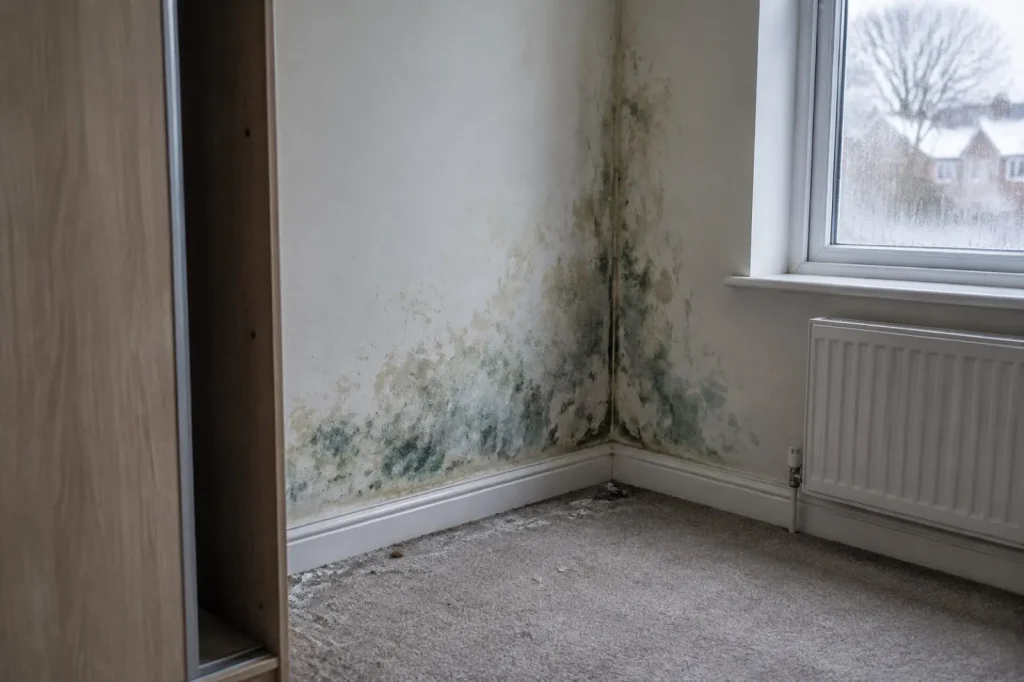
No organism is called green mold. The EPA mold course, chapter 1 says molds come in many colours, and the USDA FSIS fact sheet Molds on Food explains why: the spores give mold the color you see. A colony can be white while it spreads and green once it sporulates; Penn State Extension describes Trichoderma as dense white growth followed by extensive green sporulation.
The first question is whether it is mold at all. Only the first two rows are a fungus on a building material.
| Green growth | Where | Test | What it is | Source |
|---|---|---|---|---|
| Green mold colony | Indoor paper, wood, dust, fabric | Fuzzy or powdery; grows in the dark; stains when wiped | Fungus: Penicillium, Aspergillus or Trichoderma | Adelaide; FPL |
| Olive to near-black speckling | Window frames, cold wall corners | Reads olive brown, not grass green | Fungus, often Cladosporium | Adelaide |
| Flat green film | Shaded siding, fences, decks | Only where daylight reaches; no fuzz; absent from dark cavities | Algae or cyanobacteria | EPA |
| Dark roof streaks | Asphalt shingles | Brown to black, not green | Roof algae (Gloeocapsa magma) | ARMA |
| Blue-green crust | Copper roofing, gutters, pipes, fixtures | Only on copper or brass; hard, not fuzzy | Patina or corrosion | CDA; MDH |
| Fuzzy green dots | Bread, cheese, fruit | On food only | Food mold; follow USDA FSIS | FSIS |

Which fungi turn green
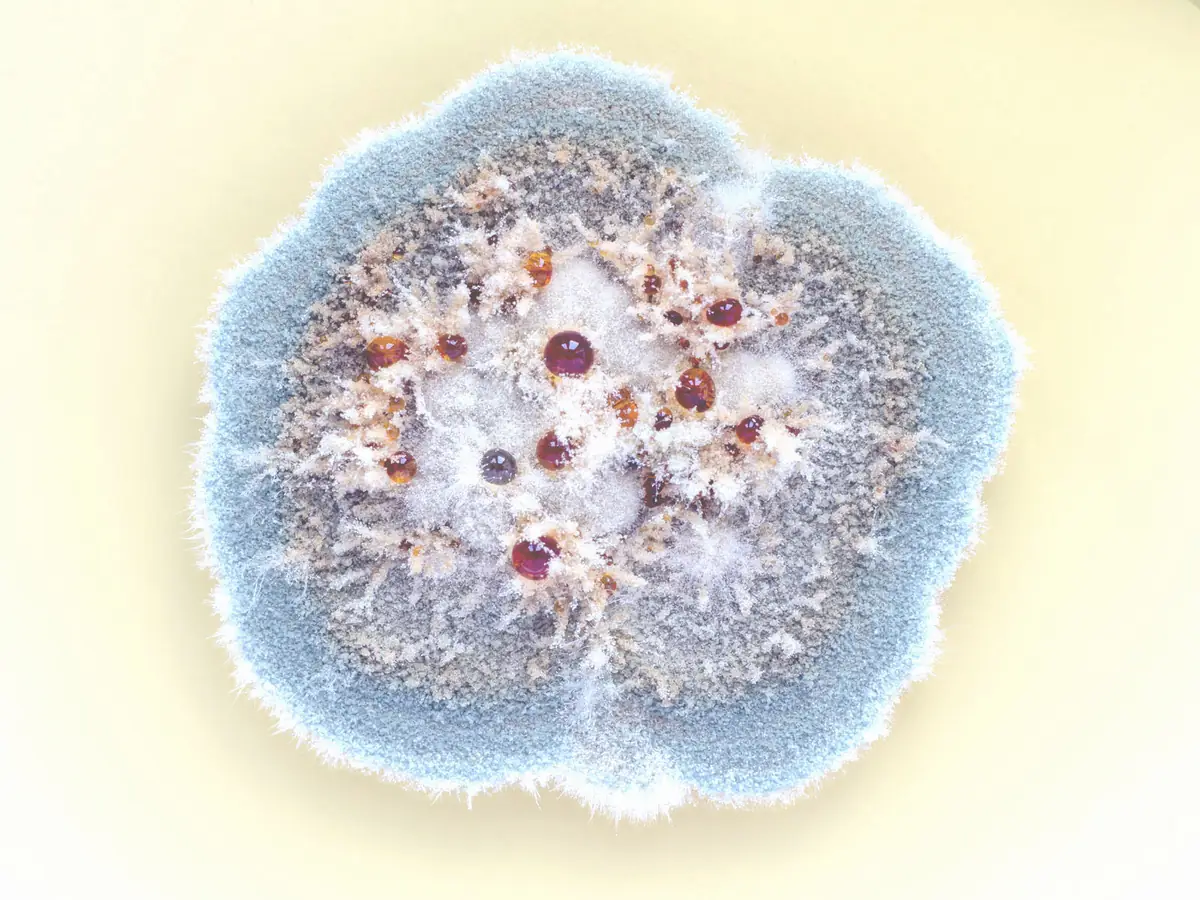
These four genera are the ones whose laboratory descriptions use the words green or olive. Colours are quoted from the University of Adelaide mycology unit, which describes cultures on agar; on a wall, colour shifts with material, moisture and age.
| Genus | Colony colour, per the lab description | Habitat note | What it means on site |
|---|---|---|---|
| Penicillium | Usually fast growing, in shades of green, sometimes white | Very large, ubiquitous; common contaminant on many substrates | Default suspect for blue-green growth on damp materials and food |
| Aspergillus | White, yellow, yellow-brown, brown to black, or green | About 250 species | Green is one of its colours; the same genus can read black |
| Trichoderma | White and downy, later yellowish green to deep green | Very common in soil and decaying wood | Green on wood that stays wet; meter the wood |
| Cladosporium | Mostly olivaceous brown to blackish brown | The most frequently isolated airborne fungi | Reads olive; often called black by eye |
Adelaide's Cladosporium description explains why one patch is reported as green by one person and black by another, and Adelaide's Trichoderma description gives the clue that matters on site: soil and decaying wood.
Five questions before you clean anything green
- Is it on food? Follow the USDA FSIS rules in the food section. Why this differs from generic advice: food safety rules, not building rules, apply.
- Is it on copper or brass? A hard blue-green crust confined to the metal is patina or corrosion. Indoors, treat it as a leak or water chemistry question. Why: no cleaner fixes corrosive water.
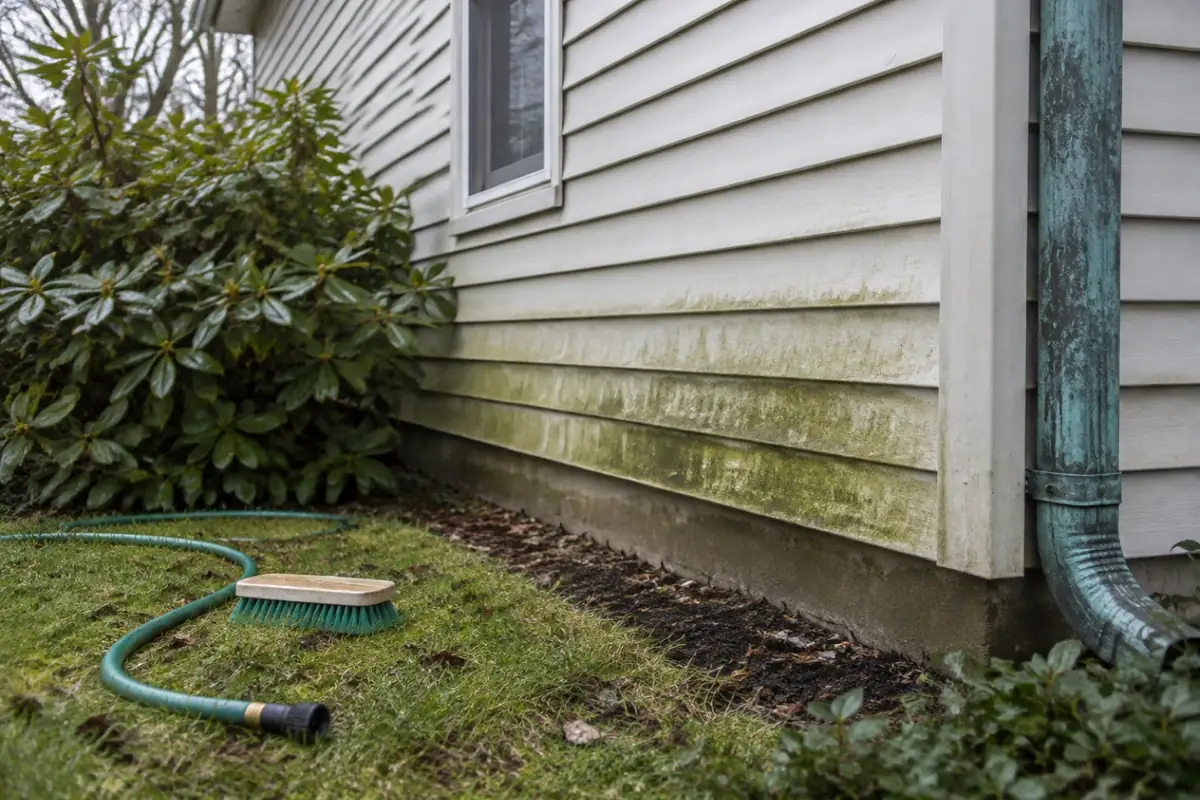
- Is it outside, and only where light reaches? A flat film on shaded siding or deck boards points to algae. Why: EPA says cyanobacteria use direct sunlight to make food; mold needs no light.
- Is it fuzzy, powdery or speckled on an indoor material? Treat it as mold and skip the species hunt. Why: CDC says you do not need to know the type.
- How big is it, and what is it on? Under about 10 square feet, EPA says most people can handle it; the line and method are on DIY mold remediation. Why: the material, not the colour, sets the method.
Green mold vs algae, moss and copper
Green mold vs algae on siding and decks
The EPA's cyanobacteria overview describes cyanobacteria, also called blue-green algae, as organisms that use direct sunlight to produce their own food. That is the field test: a film that stops where the light stops behaves like a photosynthetic organism. Mold grows in the dark.
According to the Polymeric Exterior Products Association, small mold or mildew spots on vinyl siding take a commercial cleaner and larger areas a solution of 30% vinegar and 70% water; it warns against undiluted chlorine bleach and aiming a pressure washer upward. Deck boards are covered on our sibling mold on deck page.
Roofs and copper
The Asphalt Roofing Manufacturers Association says roof algae discoloration is usually brown to black, mostly Gloeocapsa magma, and should not be confused with moss, which stays localized. Green clumps on shingles are more likely moss; neither is indoor mold. The Copper Development Association explains that copper weathers from salmon pink through browns to a blue-green or gray-green patina from airborne sulfur compounds. Indoors the meaning flips: the Minnesota Department of Health lists pinhole leaks and blue green stains on fixtures as signs of corrosive water.
Where green mold grows indoors
The USDA Forest Products Laboratory Wood Handbook, chapter 14 says that among the brighter mold colours on wood, green and yellowish hues are common. EPA says mold can feed on almost any organic material, such as paper, cloth and wood. Location tells you more than colour, because each spot has a typical water source.
| Location | Usual green growth | Water behind it | First move |
|---|---|---|---|
| Exterior wall behind furniture | Green or olive speckling on paint | Cold surface, still humid air | Dry the wall; see mold on walls |
| Window frames and sills | Olive dots, often Cladosporium | Condensation on cold glass | See mold on window sills |
| Framing, sill plates, subfloor | Green fuzz on softwood | Humid crawl or basement air, or a drip | Meter the wood; see mold on wood |
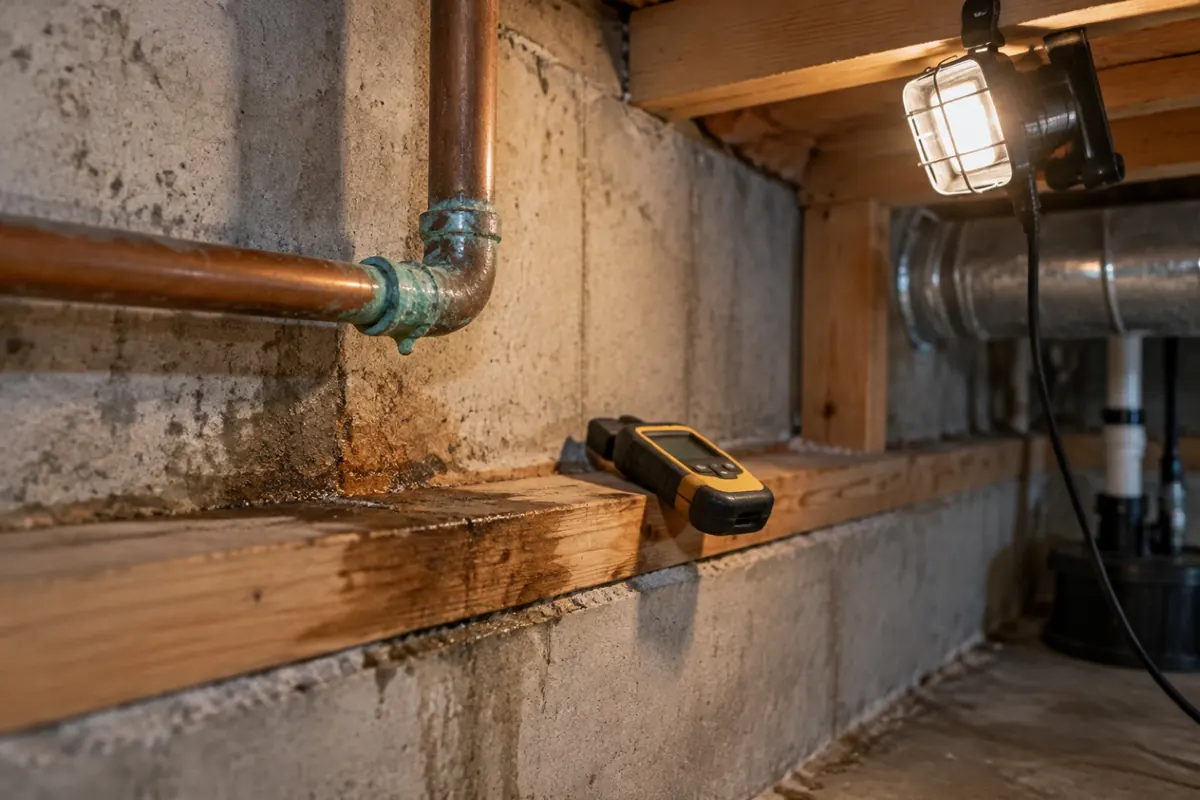
| Under a copper fitting | Blue-green crust, mold below | A slow leak at the joint | Fix the leak first |
| Fridge gaskets, bread bin | Green dots on food and seals | Food plus humidity | See mold in refrigerator |
Green mold on walls
The EPA brief guide to mold and moisture says condensation on windows, walls or pipes can be a sign of high humidity. That is the pattern behind speckling on the coldest bedroom wall: low corners, behind wardrobes, along the floor line. EPA also says not to paint or caulk moldy surfaces.
Why colour does not set the method
CDC says you do not need to know the type of mold, and the EPA mold course, chapter 1 says no one can tell by looking whether a mold produces mycotoxins. The full argument is on our black mold vs regular mold page. Published prices agree.
Fixr reports a national range of $1,500 to $9,000 and $10 to $30 per square foot.
Removal, surface by surface
Once it is confirmed as mold, the method follows the material. The EPA's Mold Cleanup in Your Home gives the baseline: scrub mold off hard surfaces with detergent and water, and dry completely. The surface pages carry the full method; this table routes you.
| Surface | Method in one line | Why this differs from generic advice | Full method |
|---|---|---|---|
| Painted drywall | Scrub, dry; cut out soaked paper facing | EPA says paint over mold is likely to peel | Mold on walls |
| Softwood framing | HEPA vacuum or brush, then wipe or sand | The FPL says surface growth on softwoods often brushes off | Mold on wood |
| Window frames | Wipe, dry, then stop the condensation | It returns every cold spell until the glass stays dry | Mold on window sills |
| Hard non-porous surfaces | Detergent and water; dry completely | EPA’s own instruction; nothing about colour in it | EPA |
| Carpet, ceiling tile, cardboard | Bag and discard if moldy | EPA says porous materials may have to be thrown away | EPA |
| Exterior vinyl siding | Cleaner for spots; vinegar solution for areas | PEPA warns against undiluted bleach | PEPA |
The EPA mold course, chapter 6 sets minimum gear for areas under 10 square feet: gloves, goggles and an N-95 respirator, which it says filters out 95 percent of airborne particulates. To stop regrowth, the EPA brief guide says to keep indoor humidity below 60 percent, ideally 30 to 50, and to dry wet items within 24 to 48 hours.
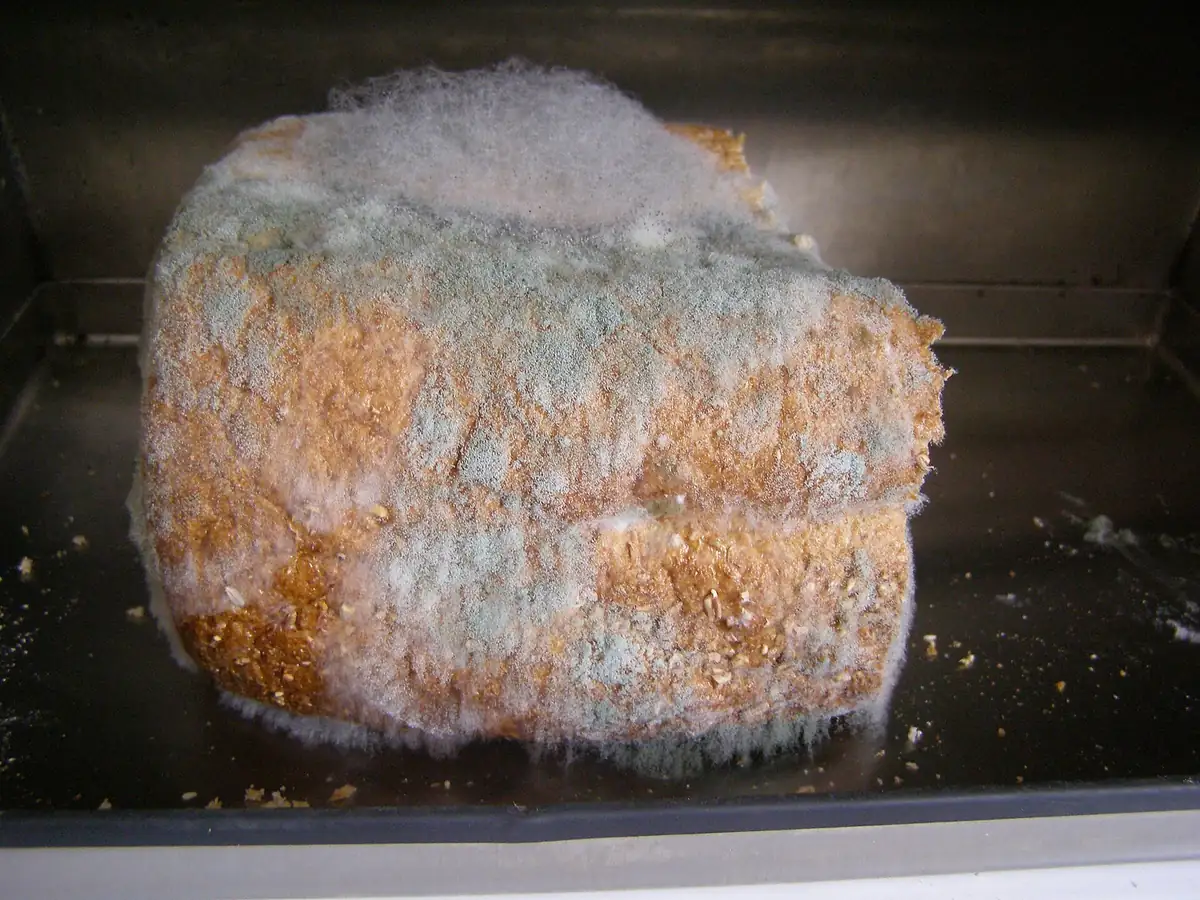

Green mold on food
Much of the search interest in green mold is about bread, cheese and fruit, a separate subject from buildings. The USDA FSIS fact sheet Molds on Food names Penicillium, Aspergillus and Cladosporium among molds on foods, describes fuzzy green dots on bread, and says root threads can run deep. Its rules do not change with colour.
| Food | FSIS handling | FSIS reason |
|---|---|---|
| Bread and baked goods | Discard | Porous foods can be contaminated below the surface |
| Hard cheese | Cut at least 1 inch around and below | Mold generally cannot penetrate deep |
| Firm fruit and vegetables | Cut at least 1 inch around and below | Hard for mold to penetrate dense foods |
| Soft fruit and vegetables | Discard | High moisture; contaminated below the surface |
| Jams and jellies | Discard | The mold could be producing a mycotoxin |
| Hard salami, dry-cured ham | Scrub surface mold off; use | Normal for these shelf-stable products |
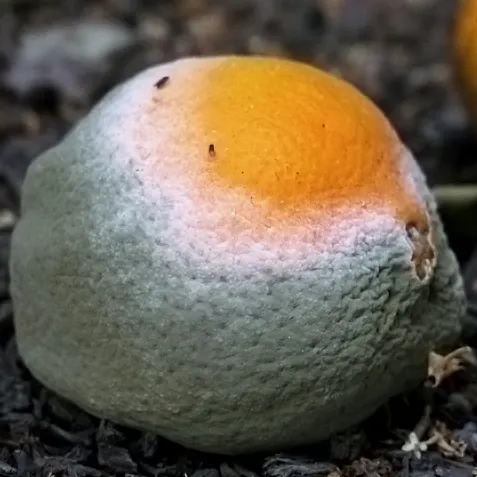

FSIS also says not to sniff moldy food and to clean the spot where it was stored. For the appliance itself, see mold in refrigerator.
Signs it is bigger than the spot
| What you see | What it usually means | Next step |
|---|---|---|
| Blue-green crust at a copper joint, damp patch below | A slow leak; MDH lists pinhole leaks as a corrosion sign | Fix the leak; open the cavity if the wall is wet |
| Growth back within weeks on the same wall | An active moisture source, usually condensation | Log humidity against the EPA ceiling first |
| Green growth on framing that stays damp | Wood above the FPL 20% safety margin | Meter it; probe for softness |
| Fan-shaped sheets or strands on wood | Decay fungus, as the FPL describes fresh decay growth | Structural assessment, not a wipe |
| Green on the back of drywall or under pad | Hidden growth beyond the visible spot | Scope the cavity; porous items likely go |
| More than about 10 square feet | Beyond EPA’s homeowner-scale guidance | Professional assessment and written scope |
The USDA Forest Products Laboratory Wood Handbook, chapter 14 explains the framing rows. Humid air alone permits some mold fungi but cannot wet wood enough for significant decay, which per the handbook needs wood above its fiber saturation point of about 30%; fully air-dried wood at 20% or less gives a margin of safety. Fuzz along a whole run of joists says the air is damp. A soft spot under one patch says something drips.
For contractors
Green growth produces two disputed scopes: work priced on growth that was not mold, and estimates that treat colour as a hazard tier. A photo screening out algae and corrosion takes minutes, and a colour premium has no support in Fixr’s own table, where green and Aspergillus share one range.
| Document | Why it belongs in the file |
|---|---|
| Photo showing where the growth stops | Separates light-limited algae outside from mold inside |
| Any copper corrosion near the area | Ties the growth to a leak and the water-source line item |
| Humidity and wood moisture readings | Anchors the dry standard to EPA and FPL targets |
| Measured area of growth | Places the job against EPA’s 10 sq ft line |
| Lab result only if someone asks for one | CDC says the type is not needed; colour is not a scope item |
On claims, the ISO HO 00 03 sample form hosted by the Insurance Information Institute excludes mold, fungus or wet rot, but gives back such loss when hidden within walls or ceilings or beneath floors and caused by accidental discharge or overflow from a plumbing, heating or air conditioning system or household appliance. A leaking copper fitting is where that wording gets read. Forms vary, so the owner’s policy, their state insurance department and a licensed professional decide, not the estimate.
What this page does not cover. Health effects of mold exposure are outside our scope; CDC and EPA publish that guidance.
Questions people actually ask
What is green mold?
Green mold is a colour description, not a species. The University of Adelaide mycology unit describes Penicillium in shades of green, Aspergillus as sometimes green, and Trichoderma turning yellowish to deep green, while Cladosporium reads olive brown. Hundreds of species fit the label, and only a lab can name one.
Is green mold dangerous?
This page does not assess health effects; CDC and EPA publish that guidance. EPA says no one can tell by looking whether a mold produces mycotoxins, and CDC says you do not need to know the type to remove it. Fix the moisture, then clean or remove the material as with any mold.
Is green mold worse than black mold?
Colour does not rank mold. EPA says black mold is not a species, and Cladosporium, often called black by eye, is olive brown per the University of Adelaide. According to Fixr, green and Aspergillus remediation both cost $700 to $6,000, with black only slightly higher.
How do I tell green mold vs algae?
Check where it stops. EPA says cyanobacteria, also called blue-green algae, use direct sunlight to make their food, so a flat film limited to lit exterior surfaces behaves like algae. Fuzzy or powdery growth on an indoor material, or anything growing in the dark, should be treated as mold.
What kills green mold on walls?
Removal matters more than killing. EPA says to scrub hard surfaces with detergent and water, dry completely, never paint over mold, and discard moldy porous materials. Soaked drywall facing usually has to be cut out, and the moisture source, often condensation on a cold wall, must be fixed first.
Can you cut green mold off bread or cheese?
Not off bread. USDA FSIS says to discard moldy bread because porous foods can be contaminated below the surface. For hard cheese and firm fruits or vegetables, FSIS says to cut off at least 1 inch around and below the spot, keeping the knife out of the mold.
Why is mold green?
The spores carry the colour. USDA FSIS says the spores give mold the color you see, and Penn State Extension describes Trichoderma as dense white growth followed by green sporulation. A patch can start white and turn green as it matures, so colour tracks growth stage, not hazard.
Sources
- EPA mold course, chapter 1 (updated 18 February 2026) and EPA mold course, chapter 6 (updated 1 December 2025), EPA. Retrieved 30 October 2026.
- EPA's Mold Cleanup in Your Home, EPA, updated 4 June 2026. Retrieved 30 October 2026.
- EPA brief guide to mold and moisture, EPA, updated 18 February 2026. Retrieved 30 October 2026.
- EPA's cyanobacteria overview, EPA, updated 23 June 2026. Retrieved 30 October 2026.
- CDC, Mold, updated 26 September 2024. Retrieved 30 October 2026.
- USDA FSIS fact sheet Molds on Food, last updated 22 August 2013, Internet Archive capture of 4 October 2026. Retrieved 30 October 2026.
- University of Adelaide mycology unit: genus pages for Penicillium, Aspergillus, Cladosporium and Trichoderma. Retrieved 30 October 2026.
- Penn State Extension, Green Mold of Mushrooms, updated 23 December 2025. Retrieved 30 October 2026.
- USDA Forest Products Laboratory Wood Handbook, chapter 14, Biodeterioration of Wood, USDA Forest Service, 2021. Retrieved 30 October 2026.
- Asphalt Roofing Manufacturers Association, Algae Discoloration of Roofs, archive capture of 19 October 2026. Retrieved 30 October 2026.
- Polymeric Exterior Products Association, How to Clean Vinyl Siding, undated. Retrieved 30 October 2026.
- Copper Development Association, natural weathering, archive capture of 13 October 2025. Retrieved 30 October 2026.
- Minnesota Department of Health, Copper in Drinking Water, updated 25 September 2024. Retrieved 30 October 2026.
- Fixr, mold remediation cost guide, updated 29 August 2025. Retrieved 30 October 2026.
- ISO HO 00 03 sample form hosted by the Insurance Information Institute, form HO 00 03 10 00, ISO 1999. Retrieved 30 October 2026.
- Real photographs are Wikimedia Commons files under the licences in their captions; scene illustrations are generated. Nothing here was tested or inspected by us. See our methodology and the mold hub.
Identification from colour is provisional. When the genus genuinely matters, a laboratory sample is the reliable answer.