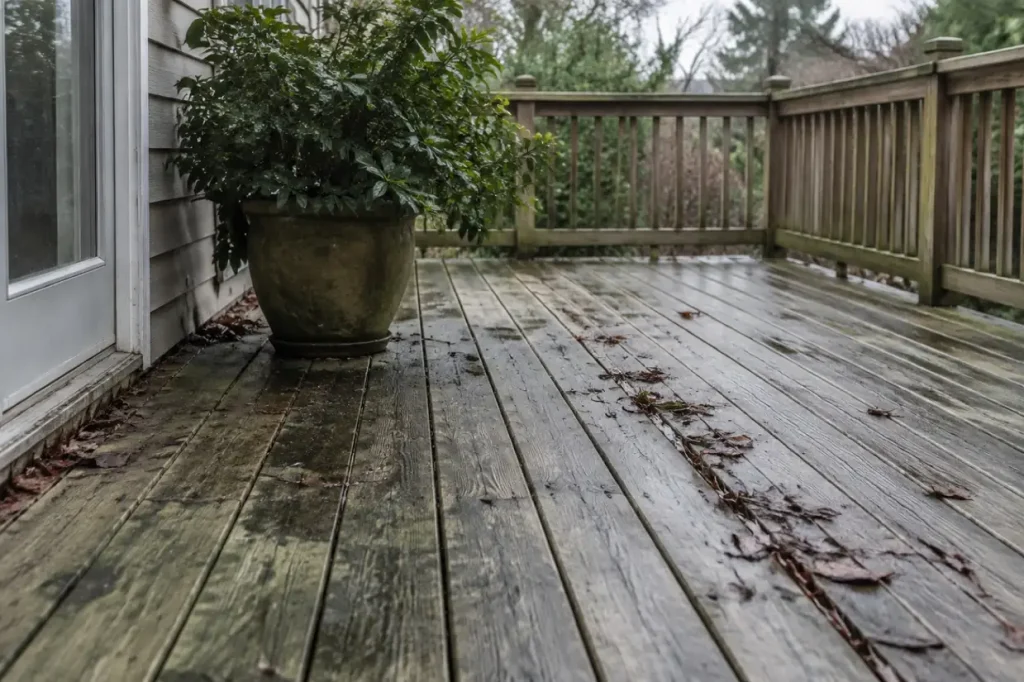
The short answer
Mold on deck boards is a surface film problem, but the cure depends on the board. Bare wood takes a dilute bleach or oxygen bleach wash; capped composite and PVC take soap, a soft brush and only the cleaner the manufacturer names, because Trex, TimberTech and Fiberon all tie warranty coverage to following their care guide. Soft or cubed wood is rot, not mold.
Key takeaways
- Composite decks mold because of the wood flour and the dirt on top: according to a 2007 test by Laks and colleagues, lab samples with 70% wood flour were fully covered in seven weeks; 30% samples barely grew.
- The makers disagree on pressure: according to their guides, Trex allows up to 3,100 psi on its capped lines, TimberTech 1,500 psi and only to rinse.
- TimberTech says not to use composite deck cleaners such as Olympic Deck Cleaner on its capped boards; Trex’s own bulletin recommends Olympic for its early boards.
- Per the Wood Handbook, chapter 16, a drop of household bleach turns mildew pale within 1 to 2 minutes; dirt, tannin and iron stains do not change.
- Oxalic acid brighteners remove tannin and iron stains but, per the FPL, not mildew.
- Trex settled a mold class action in 2013 covering uncapped boards bought from 2004 to 2013.
On this page
- What you are looking at on a deck
- Wood decks: mold or rot?
- Mold on composite decking
- PVC decking
- What each maker allows
- Chlorine, oxygen bleach and oxalic acid
- Pressure washing limits
- How to clean mold off a deck
- When it is rot, not mold
- Prevention and slip risk
- For contractors
- Questions people actually ask
What you are looking at on a deck
Most dark marks on a deck are not mold. Run the bleach drop test from the US Forest Products Laboratory before buying anything.
| What you see | What it is | Test or tell |
|---|---|---|
| Black or gray specks, worst in shade and near planters | Mildew (mold) | Bleaches out in 1 to 2 minutes under a drop of 5% bleach, per the FPL |
| Green film on the shady side | Algae, often with mildew | FPL notes mildew often grows with algae; see our green mold sibling |
| Brown or red streaks on cedar or redwood | Tannin (extractive) bleed | Does not bleach; oxalic acid lifts it |
| Blue black rings around nails or screws | Iron stain from steel reacting with tannin | Does not bleach; oxalic acid lifts it |
| Silvery gray surface | Weathering | Uniform, no specks, no texture |
| Dark wood broken into small cubes | Brown rot | Dark colour and cubical checking, per FPL; probe it |
| Pale, bleached patches | White rot | Bleached look, per FPL; probe it |
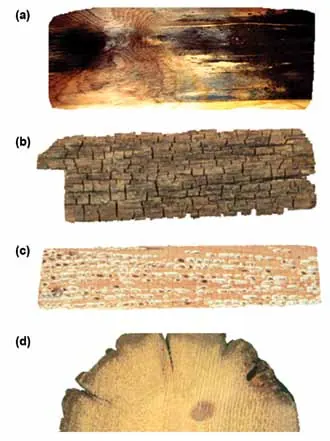
Whether to call it mold or mildew is covered on our mold vs mildew page. On a deck the useful split is cleanable film against structural decay.
Wood decks: mold on the surface or rot in the board
The Wood Handbook, chapter 14 says mold and stain fungi affect wood strength only slightly, and that on softwoods the surface growth often brushes or surfaces off. The risk is indirect: they make wood more absorbent, and wetter wood invites decay fungi.
Decay has a moisture threshold. Per the same chapter, serious decay occurs only above the fiber saturation point, an average 30% moisture content, while air dried wood at 20% or less has a reasonable margin of safety. Decay is slow below 50°F and above 95°F. Humid air alone supports mold but not significant decay; rain, condensation and wet soil do.
The Wood Handbook, chapter 16 adds that people often replace decking because of weathering, not decay. General wood guidance is on our mold on wood page.
Mold on composite decking
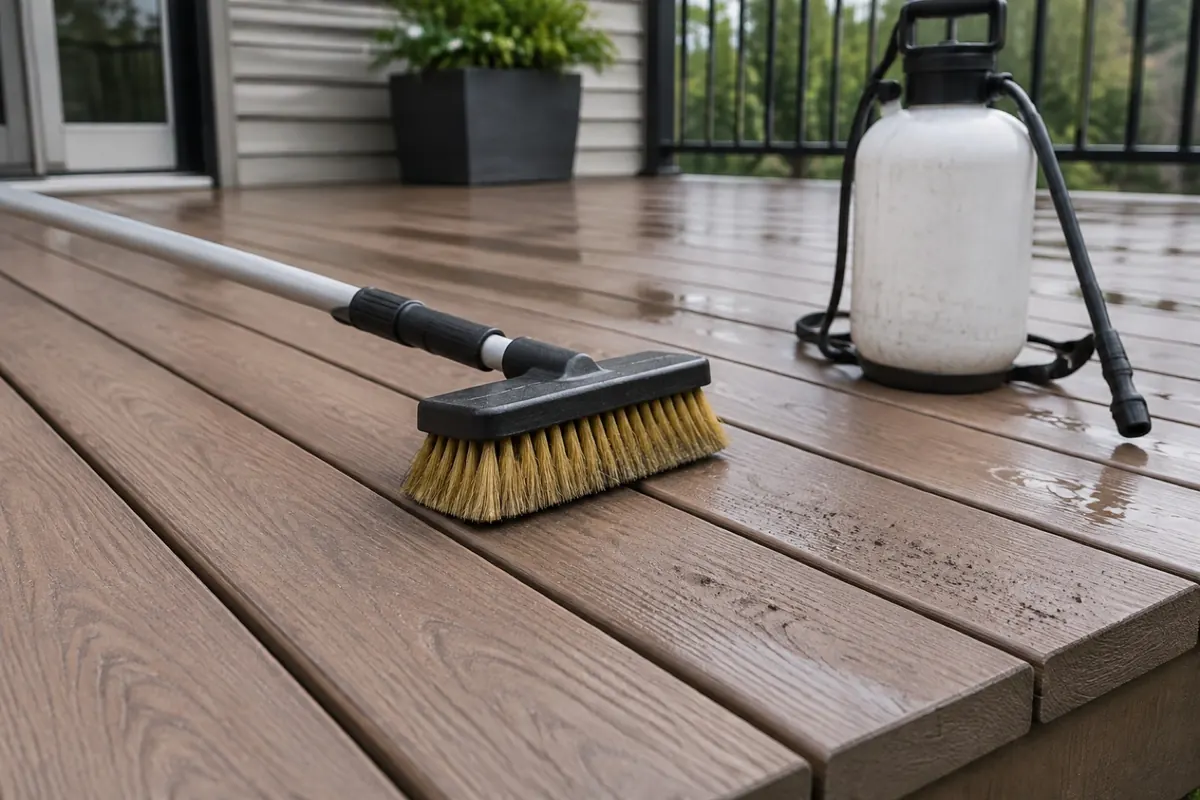
Composite boards are wood flour bound in plastic. The flour absorbs water and feeds mold, which is why the amount of it at the surface matters. In tests reported by Laks and colleagues (2007), mold susceptibility was proportional to wood content, and a rough surface grew more because it exposed more wood and trapped more debris.
Manufacturers responded with caps. According to Mankowski and colleagues (2015), capped boards appeared in 2010 and held more than 80% of the composite decking market by 2014, but capped boards still absorb moisture at cut ends and edges, and many are not capped on the bottom.
Older uncapped boards are where the mold fight happened. The Trex settlement page records Mahan v. Trex, a mold and color fading settlement for non-shelled Trex composite bought from 1 August 2004 to 27 August 2013. Per the class notice, a mold claim needed proof of cleaning with a detergent and bleach deck cleaner and photos of growth over at least one third of the surface. Final approval came on 16 December 2013; the claim deadline was 27 May 2014.
PVC decking
PVC boards carry no wood flour, so growth sits on pollen, dirt and the biofilm on top. The TimberTech 2026 cleaning guide cleans its Advanced PVC with its bleach free DeckCleaner and a stiff natural fibre brush; the Fiberon care guide names Simple Green, Krud Kutter and DeckMAX wipes for Paramount PVC; and Trex’s 2011 bulletin applies its deck wash advice to composite and PVC boards alike.
What each maker allows: cleaners side by side
Each maker’s guide decides what may touch its boards, so identify the board before buying a cleaner. TimberTech asks for photos of the board ends and underside if you are not sure.
| Decking | Approved for mold | Prohibited or cautioned | Source |
|---|---|---|---|
| Trex Transcend, Enhance, Select (capped) | Hose, warm soapy water, soft bristle brush | Bleach or acid lightens the surface; per the guide, over 3,100 psi may void the warranty | Trex care and cleaning guide |
| Trex early generation (uncapped) | Deck wash with detergent and sodium hypochlorite; Olympic Premium Deck Cleaner; Expert Chemical; UltraMean as a non chlorine option | Pressure washing voids the warranty for damage it causes; never mix ammonia or phosphoric acid with bleach | Trex Mold Technical Bulletin |
| TimberTech composite and Advanced PVC (capped) | TimberTech DeckCleaner, bleach free, diluted 1:3 | Composite deck cleaners such as Corte Clean, Thompson’s Oxy Action, Olympic Deck Cleaner; stiff natural brush on composite | TimberTech 2026 cleaning guide |
| TimberTech discontinued uncapped lines | Wash Safe, Super Deck Composite, Thompson’s Oxy Action | TimberTech DeckCleaner is not recommended on these | TimberTech care guide |
| Fiberon capped composite | Mild household or composite cleaner; Collier 30-Seconds Outdoor Cleaner for mold | Mixing cleaners; sand; colored ice melt | Fiberon care guide |
| Fiberon Paramount PVC | Simple Green, Krud Kutter, DeckMAX wipes | Sunblock and insect repellent can stain | Fiberon care guide |
| Bare or stained wood | 1 part bleach to 5 water with powdered detergent, or a sodium percarbonate cleaner | No stronger than 1 to 3; no liquid detergent or ammonia with bleach | Wood Handbook, chapter 16 |
Two of these documents contradict each other on one product. Olympic Deck Cleaner is on TimberTech’s do not use list for capped boards, and Trex’s 2011 bulletin recommends Olympic Premium Deck Cleaner for early boards. Both can be right because the boards differ; a cleaner is approved for a board, not for composite in general.
| Warranty | Mold language | Cleaning condition |
|---|---|---|
| Trex limited warranty | Does not cover mold and mildew not properly cleaned | Residential terms: Transcend 50, Select 35, Enhance 25 years |
| Fiberon residential warranty, effective 1 November 2025 | Excludes spotting or staining caused by mold, mildew or other fungal growth | Following the care instructions is a condition precedent |
| TimberTech Advanced PVC warranty, purchases from 12 June 2026 | Excludes environmental conditions such as mold and mildew | Excludes failure to follow the care guidelines |
Chlorine bleach, oxygen bleach and oxalic acid
The Wood Handbook, chapter 16 and the FPL deck cleaner review, written with FPL’s Sam Williams, sort deck cleaners into three chemistries. They do different jobs, and only two of them touch mold.
| Chemistry | Removes | Does not remove | Watch for |
|---|---|---|---|
| Chlorine bleach (sodium hypochlorite) | Mildew | Dirt, tannin, iron stains | Whitish tone and raised fibres on wood; never with ammonia |
| Oxygen bleach (sodium percarbonate) | Mildew, dirt, weathered gray | Tannin and iron stains | Reported gentler on low density woods such as western redcedar |
| Oxalic acid brightener | Tannin bleed, iron stains | Mildew | Concentrate is toxic; rinse well |
| Sodium hydroxide stripper | Mildew embedded in a finish | Nothing gently; it pulps wood | FPL: last resort only |
On wood the FPL sequence is mildew first, stain second: a percarbonate or chlorine wash, then oxalic acid if tannin shows. For iron stain the Wood Handbook, chapter 16 gives a saturated solution of about 1 pound of oxalic acid per gallon of hot water. Bleach chemistry is on our does bleach kill mold page, and product label reading on our mildew remover guide.
Pressure washing limits, maker by maker
The spread is the finding. According to the Trex care and cleaning guide, its capped lines take up to 3,100 psi with a fan tip no closer than 8 inches; per the TimberTech care guide, 1,500 psi and for rinsing only. Fiberon’s documents disagree with each other: per the Fiberon care page, under 3,000 psi at 10 inches, and per the Fiberon care guide, under 2,500 psi at 12 inches. Use the lowest number for your board.
On wood, the Wood Handbook, chapter 16 says power washing erodes the softer earlywood faster than latewood, leaving ridges, and to keep the pressure low.
How to clean mold off a deck
The general method is on our DIY mold remediation guide. These are the deck steps.
| Step | On a deck | Why this differs from generic advice |
|---|---|---|
| 1. Identify the board | Capped, uncapped, PVC or wood; check cut ends | The approved cleaner changes with the board |
| 2. Run the bleach drop test | One drop on a hidden spot | Tannin and iron stains need acid, not bleach |
| 3. Clear the gaps | Pull debris from gaps; Fiberon warns gaps under 3/16 inch clog | The food source sits between boards |
| 4. Apply to a dry deck | Pump sprayer, small sections, never let it dry | Trex says a wet deck dilutes the cleaner |
| 5. Scrub with the right brush | Soft nylon on composite, natural fibre on TimberTech PVC | A stiff natural brush dulls composite, per TimberTech |
| 6. Rinse, low pressure | Hose, or the lowest maker limit along the grain | Residue leaves film; chlorine salts gray wood |
| 7. Repeat if needed | Trex says heavy mold can need two or more cleanings | Spores remain after spots fade |
Cover nearby plants and wet them before and after, as the Trex Mold Technical Bulletin instructions direct, and never combine products. Vinegar comes up often; our vinegar page covers it, and Trex names it only for hard water spots.
When it is rot, not mold: escalation triggers
| Trigger | What it suggests |
|---|---|
| Wood soft, crumbly or broken into cubes | Brown rot past fiber saturation |
| Fan shaped fungal growth or strands on the wood | Active decay fungus, per FPL |
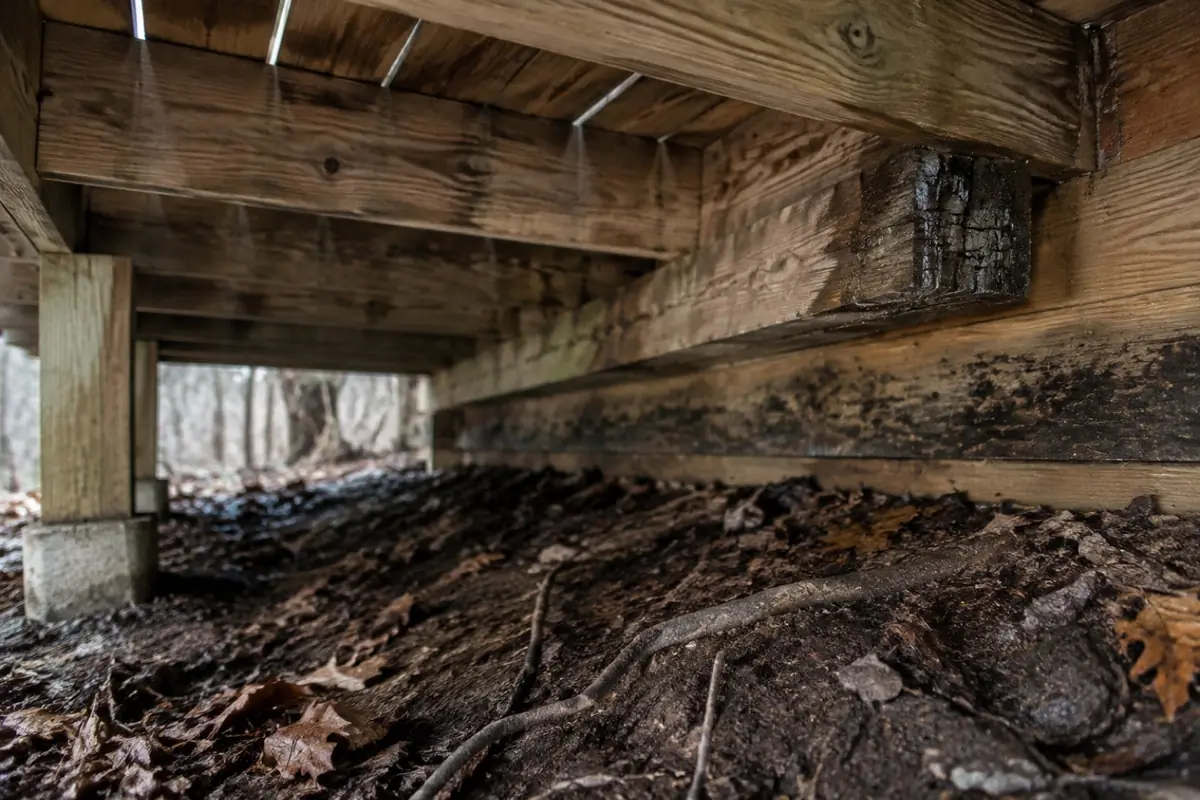
| Dark staining on joists, beams or the ledger | Structure staying wet below the boards |
| Composite swelling or cupping at cut ends | Core wetting where the cap is open |
| Mold back within weeks after two cleanings | Shade, poor airflow or clogged gaps |
| Rusting screws with blue black rings | Iron stain; FPL says it recurs while iron remains |
Structural repair of joists and ledgers is a deck builder’s job; get it inspected before more cleaning.
Prevention, and the slip hazard
- Ventilate underneath: the Fiberon care page asks for at least 6 inches of ventilation under the deck.
- Keep board gaps clear so rain flushes pollen, as TimberTech and Fiberon advise.
- Turn downspouts and dryer vents away from the deck, per Fiberon.
- Lift planters on stands; trapped water stains and feeds growth.
- Clean on schedule: Fiberon’s guide says at least once a year, its web page twice; the Trex care and cleaning guide says spring and fall for early boards.
- On wood, refinish with a finish containing a mildewcide, as the FPL recommends.
Mildew and algae make boards slick, and TimberTech warns decks can be slippery in freezing weather. Do not grit a composite deck with sand: Fiberon says it damages the surface.
For contractors: scoping a deck
Record the brand, line and whether the board is capped, and scope the cleaner by name from that maker’s guide; a generic composite cleaner can breach a warranty condition. Note psi, nozzle and distance. For crews, 29 CFR 1910.22(a)(3) requires walking surfaces kept free of hazards such as spills, snow and ice, which covers a slick, half rinsed deck.
According to Fixr, deck pressure washing runs $0.30 to $0.40 per square foot; the Fixr deck repair guide puts mold removal at $200 to $600 and rot repair at $300 to $5,000. The gap is the case for catching decay early.
What this page does not cover. Health effects are outside our scope; see the EPA and CDC mold pages and ask a physician about any personal concern. Deck framing, ledger flashing and structural repair belong with a deck builder. More guides sit in our mold hub.
Questions people actually ask
How do you get rid of mold on a deck?
Identify the board first. On bare wood, the FPL suggests one part household bleach to five parts water with powdered detergent, or an oxygen bleach cleaner, then a gentle rinse. On capped composite or PVC, use soap and a soft brush or the cleaner the manufacturer names, because warranties tie coverage to the care guide.
Can I use bleach on composite decking?
Only where the maker allows it. Trex’s 2011 bulletin recommends a detergent and bleach deck wash for early boards and warns it lightens the surface. TimberTech’s cleaner is bleach free and it lists composite deck cleaners it does not want on its capped boards. Fiberon names a chlorinated cleaner. Check your board’s guide.
Why does my composite deck have black spots?
Usually mildew feeding on pollen, dirt and the wood flour in the board. In the 2007 Laks study, mold growth rose with wood content and surface roughness. Clogged gaps, shade and planters make it worse. A drop of bleach that fades the spot in a minute or two confirms mildew rather than a stain.
Should I pressure wash a moldy deck?
Carefully, and within your maker’s limit. According to the care guides, Trex allows up to 3,100 psi on its capped lines, Fiberon 2,500 to 3,000 psi depending on the document, and TimberTech 1,500 psi for rinsing only. Trex says not to pressure wash early boards. On wood the FPL says keep pressure low to avoid ridges.
Is mold on a deck the same as rot?
No. The FPL says mold and stain fungi barely affect strength, while decay needs wood above its fiber saturation point, about 30 percent moisture content. Soft, crumbly or cubed wood is rot and needs repair, not cleaning. Surface mold that bleaches out is a cleaning job.
How do I keep mold off my deck?
Keep it dry and clean. Clear the gaps between boards, ventilate underneath (Fiberon asks for at least six inches), point downspouts and dryer vents away, raise planters, and clean at least once or twice a year as your maker directs. On wood, refinish with a mildewcide finish.
Sources
- Trex care and cleaning guide, Trex Company.
- Trex Mold Technical Bulletin, 19 September 2011, with the settlement’s required cleaning instructions.
- Trex settlement page and class notice, Mahan v. Trex, N.D. Cal. CV 09-00670-JSW.
- Trex limited warranty, copyright 2024.
- TimberTech care guide and TimberTech 2026 cleaning guide, TimberTech (AZEK).
- TimberTech Advanced PVC warranty, V201092026.
- Fiberon care page and Fiberon care guide, MKT LIT CARE-MAINTENANCE 2/19.
- Fiberon residential warranty, FIB-0291-LIT, effective 1 November 2025.
- Wood Handbook, chapter 14, C.A. Clausen, and Wood Handbook, chapter 16, R.S. Williams, FPL-GTR-190, USDA Forest Products Laboratory, 2010.
- FPL deck cleaner review, Ross, Daisey, Jourdain and Williams, The Paint Dealer, April 1998, via the federal web archive.
- Laks and colleagues, Mold growth on wood-plastic composites, CWPA Proceedings 2007.
- Mankowski and colleagues, Durability of capped wood plastic composites, AWPA Proceedings 2015.
- 29 CFR 1910.22, via eCFR.
- Fixr and Fixr deck repair guide, both updated 31 January 2025.
- All sources retrieved 30 October 2026. Remediation Insider ran no cleaning trials for this page. Our methodology sets out the rules.
Care guides and warranties change by product line and date. Use the current document for your exact board.