The short answer
Mold in washing machine parts almost always grows in three places a spin cycle never dries: the fold of the rubber door boot, the detergent drawer and its duct, and the sump and pump filter. Front-loaders are the usual host because they use less water and seal shut. Scrub the boot, soak the drawer, clean the filter, run the brand’s cleaning cycle, then leave the door open.
Key takeaways
- Front-loaders seal and use less water: 14 gallons a load for an ENERGY STAR full-size washer against 20 for a standard one, according to ENERGY STAR.
- Brands disagree on bleach. Whirlpool and LG publish a diluted chlorine bleach gasket wipe; Samsung Australia warns bleach may deform the seal; GE uses soapy water and vinegar.
- A cleaning cycle reaches the drum, not the boot fold or the pump filter. Those are hand jobs on every brand’s instructions.
- LG’s fix for an existing musty smell: Tub Clean once a week for three weeks, then a service request.
- The Whirlpool Duet mold litigation settled in 2016 after a 2014 jury found for Whirlpool. Neither outcome was a defect finding.
- Supply hose failures caused more than half of washer water claims, averaging $5,308 after the deductible, according to IBHS.
On this page
What you are looking at inside the washer
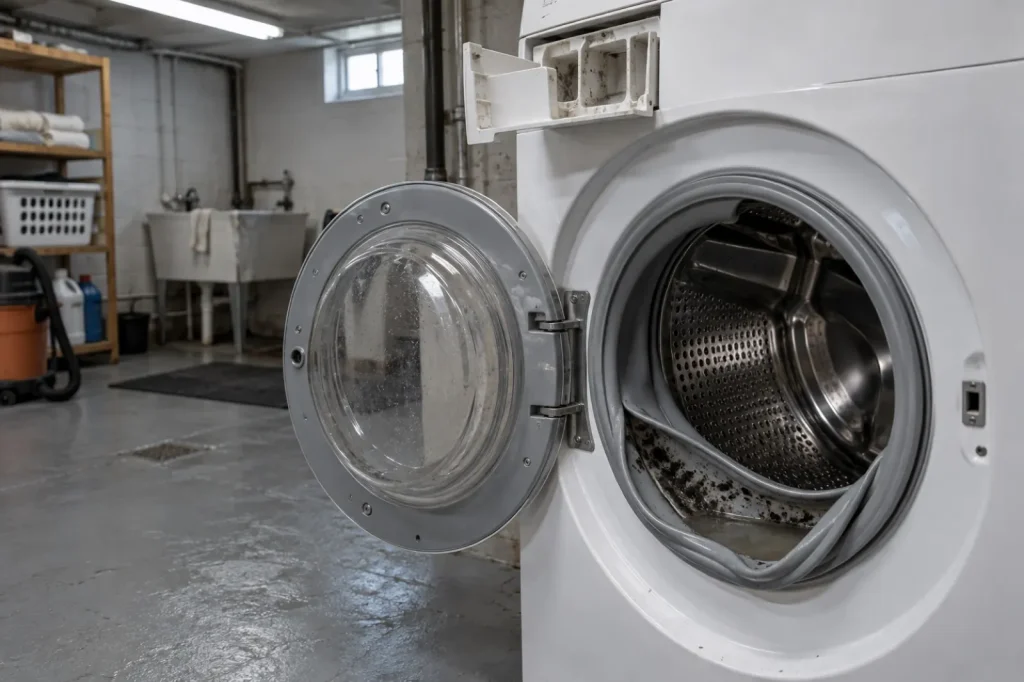
Whirlpool's gasket guide says softener and detergent residue builds up on the gasket and can show as black gunk on the seal. LG’s help article is titled after stains and mold in the door gasket, and the Sixth Circuit opinion of 18 July 2013 records that Whirlpool engineers expected owners to notice black mold on the bellows or inside the detergent dispenser. The dark ring in the boot fold may be growth, residue or both, and the cleaning answer is the same.
| What you see | Where | What it usually is | Basis |
|---|---|---|---|
| Black or grey speckling in the boot fold | Door gasket, bottom | Growth on trapped water and residue | LG; Sixth Circuit record |
| Grey or black slime in drawer corners | Dispenser | Soap residue colonised by growth | GE |
| Dark film that wipes off in one pass | Gasket lip and folds | Detergent and softener buildup | Whirlpool |
| Standing water in the fold after a cycle | Bottom of the boot | The condition that feeds growth | LG: moisture cannot dry with the door closed |
| Musty laundry, nothing visible | Sump, pump filter, drain hose | Buildup out of sight | Samsung: uncleaned pump filter causes odors |
| Wet or swollen flooring beside the machine | The floor | A leak, a different problem | IBHS; see the leak section |
Why front load washer mold is more common than top-loader mold
The Sixth Circuit opinion of 18 July 2013 put it plainly: all washers can develop some mold or mildew, but front-loaders promote it more readily “because of the lower water levels used and the higher moisture content within the machines, combined with reduced ventilation.”
Add the door. LG says that when it stays closed, moisture cannot dry and mold may form inside the gasket. Then the soap: Whirlpool product help says use only HE detergent, because non-HE detergent or too much of it causes excessive suds, and GE says use the minimum recommended amount. Even the cleaning cycle reflects the design: Samsung puts Self Clean at about 4 hours on a front-loader against about 1 hour on a top-loader, and reminds front-load owners after 40 washes rather than 20. Top-loaders do grow mold, but they lack the boot fold and their lids tend to stay up.
The five wet places, and why a cycle misses three
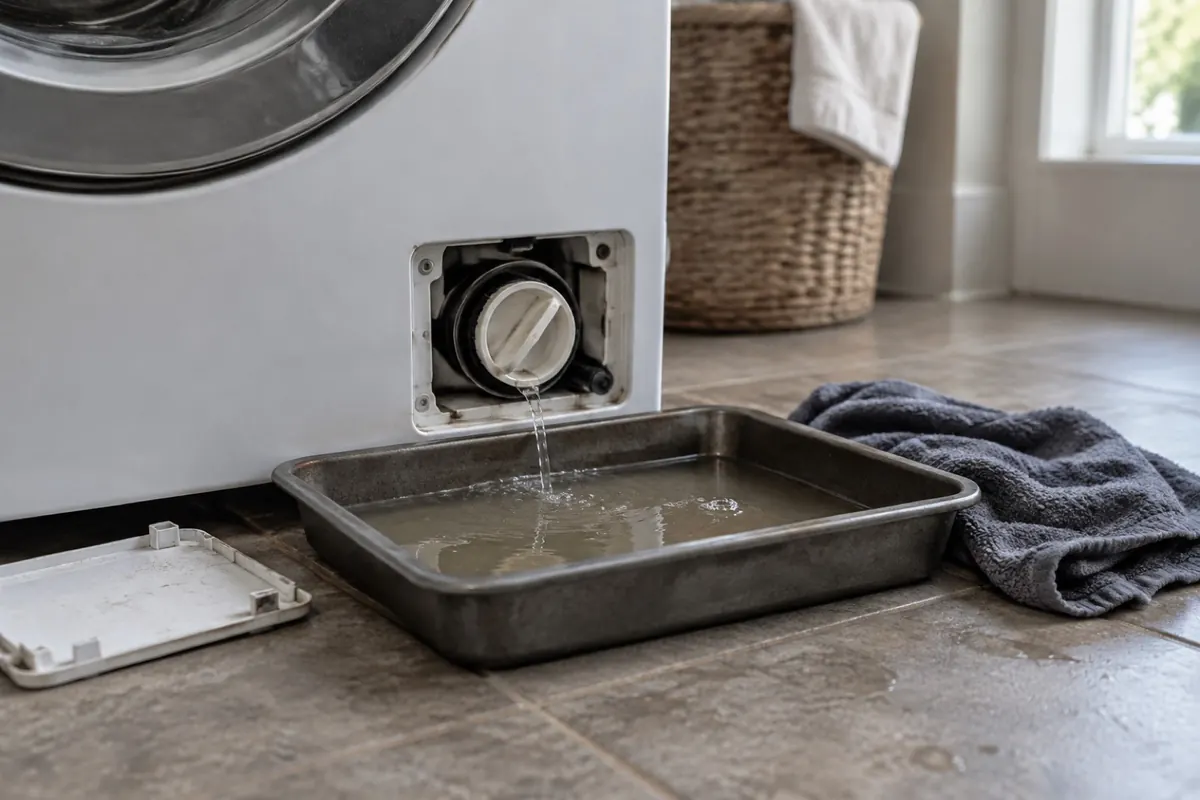
The Sixth Circuit opinion lists where the plaintiffs’ experts found residue and growth: the sump area, the pump strainer and drain hose, the door gasket area, the air vent duct and the detergent dispenser duct. When Whirlpool had owners lift the gasket, the opinion says, the common finding was water, detergent and softener deposits with mold or mildew on them.
| Part | Why it stays wet | Cycle reaches it? | What reaches it |
|---|---|---|---|
| Door boot fold | Rinse water pools at the bottom | Partly; residue survives | Hand scrub, towel dry |
| Drawer and duct | Wet residue, drawer shut | No | Remove, soak, brush |
| Sump and pump filter | Holds water between cycles | No | Open and clean the filter |
| Drain hose | Residue film inside | Partly | Cycle plus a clear filter |
| Drum and outer tub | Thin residue film | Yes | The brand’s cleaning cycle |
Washing machine gasket mold: what each manufacturer says
Each brand’s cycle, frequency and gasket method, from its own support pages. The brands do not agree on bleach.
| Brand | Cycle name | Frequency | Gasket method | Source |
|---|---|---|---|---|
| Whirlpool (front load) | Clean Washer, with affresh or liquid chlorine bleach | Cycle monthly; gasket deep clean monthly or every 30 cycles | 3/4 cup (177 mL) liquid chlorine bleach in 1 gallon (3.8 L) warm water, wipe, leave about 5 minutes, scrub, rinse, towel dry | Whirlpool product help; Whirlpool's gasket guide |
| LG (front load) | Tub Clean, with a tub cleaner per its package | Monthly; weekly for 3 weeks if a musty smell exists | 5 g oxygen bleach in 5 L warm water, at least monthly; the maintenance article also gives 3/4 cup chlorine bleach per gallon or vinegar, never both | LG's gasket help article; LG's front load maintenance article |
| Samsung (US) | Self Clean, Self Clean+ or Pure Cycle; no cleaner needed | Monthly; reminder after 40 washes front, 20 top | Not on the US pages; Samsung Canada says pull back the boot, wipe the folds with warm water and mild soap, dry | Samsung's US cleaning page; Samsung Canada |
| Samsung (Australia) | Drum Clean or Drum Clean+ (fixed 70 C) | Monthly | Non-abrasive household detergent; warns chlorine bleach or other cleaners may deform the seal | Samsung Australia |
| GE | Hottest, longest cycle with two cups of white vinegar | Not stated | Hot soapy water and a rag; toothbrush and white vinegar on stubborn spots; dry with the door open | GE Appliances Factory Service |
Two warnings cross brands. LG says never use bleach and vinegar together. Whirlpool says not to use thickened, easy-pour or no-splash bleach in Clean Washer, because excess suds may form. Whether either chemical kills growth or only removes it is covered in does bleach kill mold and does vinegar kill mold.
The method, part by part
Clean the parts a cycle cannot reach first, then run the cycle to flush what you loosened.
- 1. Unplug and drain. LG starts with the washer off and unplugged, the bottom panel open and the remaining water drained into a shallow pan. Why this differs: generic advice skips the filter, which holds standing water.
- 2. Clean the pump filter. Twist it out, brush it in warm water, refit it fully tight, per LG; Samsung says an uncleaned filter causes odors. Why this differs: no cycle opens it.
- 3. Pull the drawer. GE soaks a removable dispenser in equal parts hot water and white vinegar; LG brushes the tray, its underside and the housing. Why this differs: the duct behind it is named in the court record.
- 4. Scrub the boot fold by hand. Fold it back, remove coins and lint as Whirlpool directs, then use your brand’s method. Why this differs: a cycle wets the fold without scrubbing it, and bleach can deform some seals.
- 5. Run the cycle empty. Samsung says never run Self Clean with laundry in the tub. Why this differs: the cycle is the final flush, not the fix.
- 6. Dry it and leave it open. Towel the boot and glass and leave door and drawer open, as LG and Samsung instruct. Why this differs: a shut door put the water there.
Growth that has spread onto drywall or flooring is a building job; the general method and size threshold are on DIY mold remediation, and the mold hub covers other rooms.
The Duet litigation: what the court record says
The multidistrict case ran from 2008 to 2016. Its most quoted lines are plaintiffs’ evidence, and the only trial ended in Whirlpool’s favour.
Describing the record at class certification, the Sixth Circuit opinion of 18 July 2013 recounts internal Whirlpool documents stating that 35% of Duet customers had complained about odor, according to the opinion, and over 1.3 million complaint calls by late 2006. It quotes a 2004 engineering memo saying mold growth “occurs under all/any common laundry conditions.” These were allegations, not findings.
| Date | Event | Source |
|---|---|---|
| September 2003 | Owners begin calling about mold, two to three calls a day | Sixth Circuit |
| 18 July 2013 | Liability-only class affirmed on remand from the Supreme Court in light of Comcast v. Behrend | Sixth Circuit |
| Late October 2014 | Ohio jury clears Whirlpool after a three-week trial; class of about 150,000 Ohio buyers, according to Reuters | Reuters via Carrier Management |
| 18 April 2016 | Settlement signed with Whirlpool and Sears | Approval order |
| 11 May 2016 | Preliminary approval | Approval order |
| 23 September 2016 | Final approval | Class counsel |
| 11 October 2016 | Claim deadline | Class counsel |
According to the preliminary approval order, about 5,500,000 Whirlpool, Kenmore and Maytag front-loaders made from 2001 through 2010 fall in the class, and the defendants deny any wrongful act. The tried case was an issues class, according to Skadden, certified only to decide whether the machines had a defect making them more prone to mold. The jury said no. This page reports only the Whirlpool case, whose court documents were read for it.
| Who qualified | What the settlement offered |
|---|---|
| Every class member | A 5% cash rebate on certain new Whirlpool-built washers or dryers, per the order |
| Persistent odor or mold within 5 years of purchase | One of: $50 cash, a 20% rebate, or up to $500 of documented repair or replacement cost, per the order |
When the washer floods the floor instead
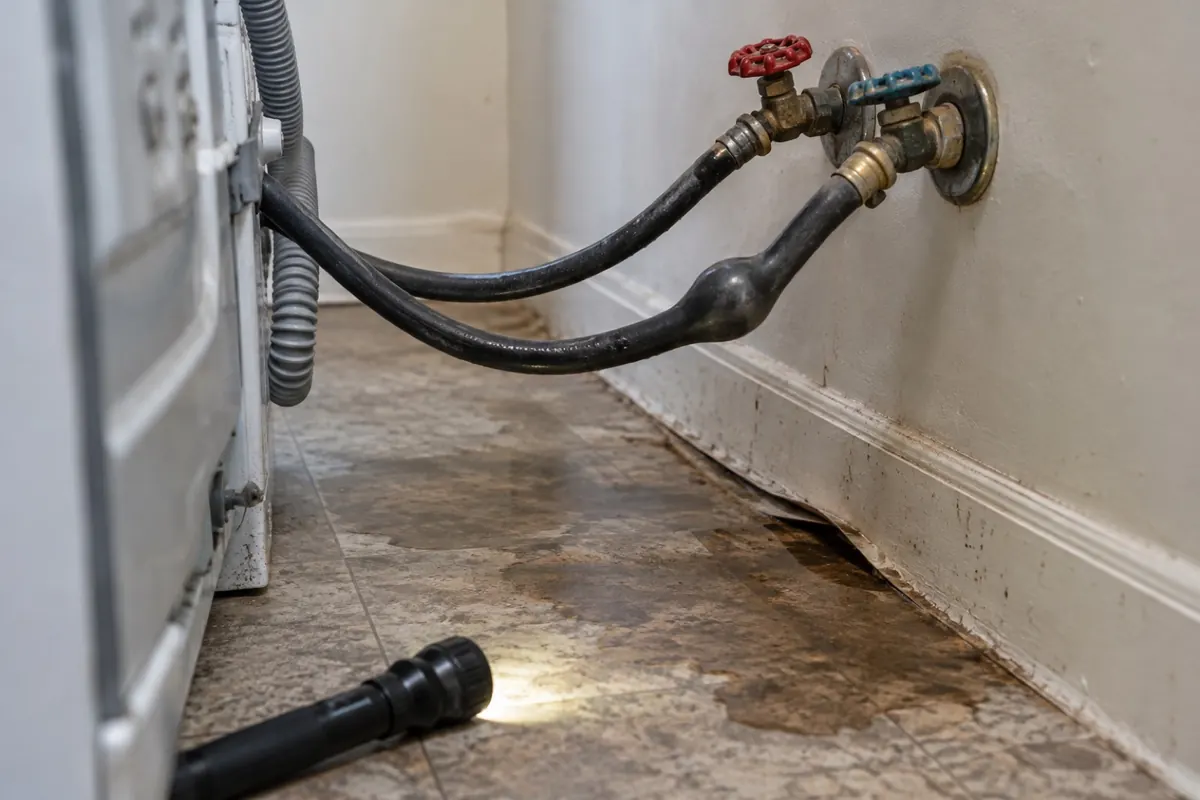
The IBHS washing machine claims study reviewed 525 washer claims from a multi-company homeowners’ insurance sample. According to IBHS, washer failures rank among the top 10 sources of residential water losses, averaging $5,308 after the deductible; supply hoses caused more than half, and overflows and drain line failures another 28%, the study reports.
IBHS also reports an average hose age at failure of 8.7 years, and says about 6% of failures happened in unoccupied homes, where claims ran nearly two and a half times more severe.
| IBHS guidance | 2012 release | Later guidance page |
|---|---|---|
| Replace supply hoses | Rubber hoses every three years | Every five years, even with no visible wear |
| Hose type | Consider braided steel | Reinforced steel braided over rubber |
| Valves | Off when away for an extended period | Off when not in use; consider a single-lever ball valve |
| Inspection | Not stated | Monthly, hot and cold lines |
Under a laundry the water goes down. Vinyl and laminate hold it against the deck; drying it is on subfloor water damage. EPA says dry water-damaged areas within 24 to 48 hours, and how long mold takes to grow after water damage explains why. Coverage questions are on homeowners insurance and water damage.
Which situation are you in
| Situation | Likely source | Do this | Escalate if |
|---|---|---|---|
| Musty laundry, nothing visible | Pump filter, sump, drain hose | Clean the filter, run the brand cycle | Smell survives LG’s three weekly Tub Cleans |
| Black ring in the boot fold | Trapped water and residue | Hand scrub per brand, dry, door open | Returns within weeks, or the boot is torn |
| Slime in the drawer | Drawer and duct | Remove, soak, brush | Growth visible in the duct |
| Water on the floor after cycles | Boot, filter cap, drain hose | Stop using it, find the leak, dry the floor | Flooring soft, lifting or stained |
| Burst hose | Supply hose | Shut both valves, extract, call for drying | Water under flooring or in another room |
| Growth on the wall or floor behind it | Long-running leak | Treat as a building mold job | Over about 10 sq ft, per EPA |
Escalation triggers
- The smell is in the room, not just the laundry: suspect the floor, wall or subfloor.
- Flooring beside or behind the washer is soft, cupped or lifted.
- A boot tear or a weeping filter cap. LG says filter care matters partly to keep the unit from leaking.
- Original hoses on a machine eight or more years old, the band IBHS flags.
- Growth returns within weeks of a full clean. LG’s answer is a repair request.
For contractors: the laundry room loss
Growth inside the appliance is owner maintenance. A leak into the floor assembly is a water loss: expect questions on source and duration.
| Item | What to record | Why the adjuster asks |
|---|---|---|
| Source | The failed hose, cap or boot tear, photographed in place | Sudden discharge and long-term seepage are treated differently |
| Duration | Staining, rot and growth extent on the deck | Forms exclude repeated seepage over a stated period |
| Hose and machine age | Hose type, date stamp, model | Hose age drives failures in the IBHS study |
| Moisture map | Deck readings, adjacent rooms | Sets drying and tear-out scope |
On duration, the Eighth Circuit, Croxdale v. Travelers (2026) quotes a generic Travelers form excluding loss from constant or repeated seepage or leakage “that occurs over a period of 14 days or more,” and an Iowa endorsement substituting “weeks, months, or years.” Wording varies; owners should read their policy and ask their state insurance department or a licensed professional, and contractors should record evidence of duration.
What this page does not cover. Health effects of mold exposure are outside our scope; see the CDC mold page and EPA's brief guide to mold and speak to a doctor. Replacing a boot or pump is for the manufacturer or an appliance technician.
Questions people actually ask
Is mold in a washing machine harmful?
To the machine and your laundry, yes: Samsung and LG tie buildup to odors that transfer to clothes, and growth in the boot fold returns if it is not dried. Personal health questions belong with a doctor; CDC and EPA publish general mold guidance. Either way, clean the boot, drawer and pump filter and keep the door open.
Can a moldy washing machine be fixed?
Usually. Every major brand publishes a routine: hand clean the boot, soak the drawer, clean the pump filter, run the cleaning cycle. LG says run Tub Clean weekly for three weeks if a musty smell exists. A torn boot, or growth back within weeks, is a repair call.
Will mold wash out in the washing machine?
Not with ordinary loads. A normal cycle wets the boot fold and drawer without scrubbing them and never opens the pump filter. Brands publish a separate drum cycle, such as Whirlpool’s Clean Washer, LG’s Tub Clean and Samsung’s Self Clean, plus hand cleaning for the rest.
How do I tell if there is mold in my washing machine?
Pull back the bottom of the door boot and look in the fold, check the detergent drawer’s corners, and smell clean laundry straight from the drum. A musty smell with nothing visible usually points at the sump or pump filter, which Samsung says cause odors when not cleaned.
My washer smells musty. What is causing it?
It seals shut and uses little water, so moisture and residue stay in the boot fold, drawer and sump. Whirlpool blames detergent and softener residue and says use only HE detergent; GE adds use the minimum dose, remove wet clothes promptly and leave the door ajar.
Should I use bleach or vinegar on the washer gasket?
Follow your brand. Whirlpool and LG publish a chlorine bleach wipe of 3/4 cup per gallon of warm water, LG’s gasket article uses oxygen bleach, GE uses soapy water and vinegar, and Samsung Australia warns bleach may deform the seal. LG says never combine bleach and vinegar.
Sources
- Whirlpool product help, Removing Odors or Smells, Front Load Washer, and Whirlpool's gasket guide, Whirlpool. Undated. Retrieved 19 October 2026.
- LG's gasket help article, LG Electronics USA, dated 29 October 2025. Retrieved 19 October 2026.
- LG's front load maintenance article, LG Electronics USA, dated 10 September 2026. Retrieved 19 October 2026.
- Samsung's US cleaning page and Samsung's US mold and mildew page, Samsung Electronics America. Undated. Retrieved 19 October 2026.
- Samsung Canada (updated 2 July 2026) and Samsung Australia (updated 11 September 2026). Retrieved 19 October 2026.
- GE Appliances Factory Service, How do I remove mold from my washing machine? Undated. Retrieved 19 October 2026.
- ENERGY STAR, Clothes Washers. Retrieved 19 October 2026.
- Sixth Circuit opinion of 18 July 2013, No. 10-4188, via FindLaw. Retrieved 19 October 2026.
- Court’s preliminary approval order, MDL No. 2001, Doc. 551, 11 May 2016, and class counsel's case page. Retrieved 19 October 2026.
- Reuters report, 2 November 2014, and Skadden, January 2015. Retrieved 19 October 2026.
- IBHS washing machine claims study (archived October 2012), IBHS washing machine guidance (archived November 2017) and IBHS 2012 plumbing release (9 October 2012). Retrieved 19 October 2026.
- Eighth Circuit, Croxdale v. Travelers (2026), No. 25-2454, filed 24 June 2026. Retrieved 19 October 2026.
- EPA's brief guide to mold (updated 18 February 2026) and the CDC mold page. Retrieved 19 October 2026.
- No washer was tested for this page; the owner’s manual governs. Our methodology sets out the standing rules.
Some front-loaders are not rated for bleach. Check your model’s manual before using any cleaner.