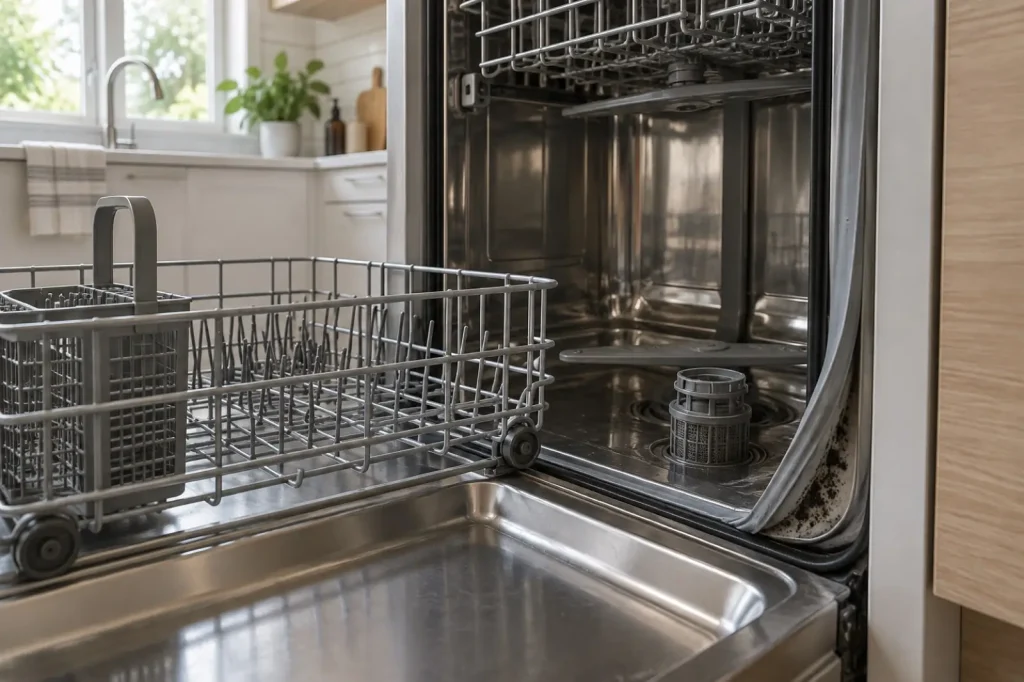
The short answer
Mold in dishwasher tubs concentrates on the rubber door seal, then the side nozzles, door and drain: according to a 2016 Ljubljana study, 57% of seals in 30 home machines carried fungi. Scrub the seal, remove and rinse the filter, clear the sump and spray holes, run your brand’s cleaning cycle, and check the floor for a leak.
Key takeaways
- The seal is the hot spot: positive in 57% of machines against 7% for the spray arms, according to the 2016 Ljubljana study in PLOS ONE.
- Across 189 dishwashers, a 2011 Fungal Biology study reports fungi in 62%, and black yeasts (Exophiala) in 56% of those.
- GE publishes a 1/2 cup per gallon bleach wipe for mildew; Samsung Canada says avoid bleach in stainless interiors.
- Filter intervals run from every two weeks (Whirlpool, KitchenAid, daily use) to every other month or more (GE).
- A sanitize rinse is not a cure: the study authors swabbed right after a cycle and still found fungi.
- Dishwasher discharge is gray water per the NC State Extension summary, so a leak into the cabinet is a water loss.
On this page
What you are looking at inside the dishwasher
Most marks called dishwasher mold are one of seven things, and GE publishes a note on nearly every colour. Check where it sits and whether it wipes off.
| What you see | Where | What it usually is | Source |
|---|---|---|---|
| Black speckling that survives a wipe | Fold of the lower door seal | Fungal growth on trapped water and food film | Ljubljana study; GE mildew article |
| Clear or white goop | New gasket, tub floor | Food-grade lubricant; washes out in a few cycles | GE white grease |
| Red, pink or orange stain | Tub and plastic parts | Tomato staining; fades over time | GE interior staining |
| Green stain | Tub and parts | Dyed gel detergent | GE |
| White film | Everywhere | Hard water or excess detergent | GE |
| Grey or brown film | Tub floor and walls | Calcium or iron build-up | GE |
| Grey sludge, sour smell | Filter and sump | Decomposing food | Bosch; KitchenAid; Samsung AU |
GE's white grease article says the goop on a new gasket keeps a stiff seal seated and need not be removed, and GE's interior staining article says citric acid will not shift tomato stains. A slimy pink film that does wipe away belongs on our orange mold page; other rooms and appliances are indexed in the mold hub.
Where dishwasher mold grows: the field data
Two University of Ljubljana studies are the published record. a 2011 Fungal Biology study by Zalar and colleagues sampled 189 dishwashers in private homes in 101 towns, 102 of them in Slovenia and the rest across Europe, the Americas, Israel, South Africa, East Asia and Australia. The authors report fungi in 62% of machines, with the black yeasts Exophiala dermatitidis and Exophiala phaeomuriformis most often, and conclude that heat, moisture and alkaline pH make dishwashers an alternative habitat for them.
the 2016 Ljubljana study in PLOS ONE, by Zupančič and colleagues, then asked where inside. In autumn 2013 the team swabbed nine user-accessible sites in 30 home dishwashers from four manufacturers, aged 1 to 8 years, right after a wash had finished. The paper reports fungi in 83% of machines irrespective of site, and Exophiala dermatitidis in 47%, primarily on the rubber seals.
The ranking cuts against most cleaning guides, which lead with the spray arms: per the 2016 paper they were the least contaminated site, while the seal, which no cycle scrubs, led. The filter was not swabbed separately, but the drain beside it was positive in 43% of machines according to the same table. The authors name the tap water feeding the machine as the most probable route in, and a 2019 follow-up in BMC Microbiology found bacteria on the seals of all 30 machines it examined. Front-load washers share the pattern of a wet seal no cycle reaches; see mold in washing machine parts.
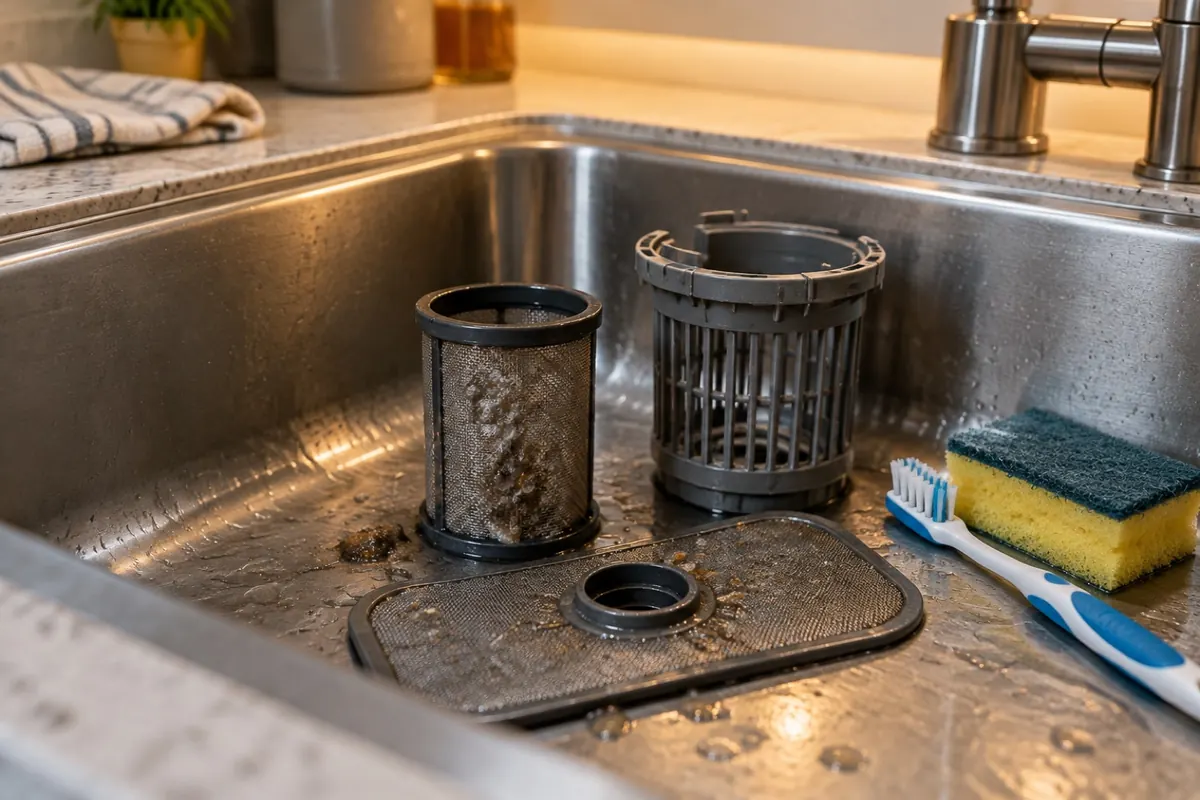
Dishwasher filter cleaning: six brands side by side
All six brands publish filter instructions. Whirlpool and KitchenAid, both Whirlpool Corporation brands, publish the same article word for word; the others disagree on frequency, brushes and bleach.
| Brand | Filter type | Cleaning frequency | Method | Source |
|---|---|---|---|---|
| Bosch | Removable filter with mesh screen | Every few months | Remove lower rack and spray arm, twist out filter, wash with mild soap and a soft brush | Bosch care and filter pages |
| Whirlpool | Manual triple filter: upper assembly plus lower filter; some self-clean | Monthly; every two weeks with daily use | Upper assembly 1/4 turn counterclockwise; rinse; soft brush, no wire brush or scouring pad | Whirlpool filter article |
| KitchenAid | Same text as Whirlpool | Same; whole machine about every 30 days | Same; wipe door seals with a soft cloth and warm water | KitchenAid filter, interior articles |
| GE | Fine (mesh plate) and Ultra Fine filters on most newer models; some self-clean | Every other month or more | Twist Ultra Fine out, rinse with warm soapy water and a sponge; brushes can damage it | GE filter article |
| LG | Filter under the lower basket | Per the manual’s cleaning chart | Rinse in running water without excessive force | LG filter, maintenance articles |
| Samsung | Coarse filter over a Micro/Fine cylinder | Regularly | Turn handle counterclockwise, rinse both, dry; Canada adds an overnight vinegar soak | Samsung Australia, Canada |
| Brand | Cycle or cleaner it names | Bleach position |
|---|---|---|
| Bosch | Bosch cleaner on the hottest, longest cycle, a few times a year | No chlorine cleaners on the stainless exterior |
| Whirlpool | affresh every 30 days, or 2 cups (500 mL) vinegar upright on the lower rack, no detergent | Not addressed |
| KitchenAid | affresh monthly or the same vinegar cycle | Not addressed; vinegar used too often could damage the machine |
| GE | Vinegar, citric acid or a dishwasher cleaner | Mildew wipe: 1/2 cup chlorine bleach per gallon, or 1/2 cup ammonia, never mixed |
| LG | Machine Clean with citric acid or a cleaner | Not addressed |
| Samsung | Self Clean, empty; or 8 oz vinegar on Sanitize | Avoid bleach in stainless steel interiors |
GE alone publishes a bleach recipe for dishwasher mildew, warning that bleach and ammonia make toxic fumes; Samsung Canada says bleach can damage stainless interiors. Never mix bleach with vinegar or ammonia. For the chemistry, see does bleach kill mold.
How to clean dishwasher gasket mold and the parts behind it
This order reaches the hot spots first. Wear gloves; Samsung Australia warns a hand can catch at the filter.
| Step | What to do | Why this differs from generic advice |
|---|---|---|
| 1. Power off, pull the lower rack | Breaker off if water is on the floor (Whirlpool) | The worst sites are under the rack, not on the walls |
| 2. Seal first | Lift the lower lip, wipe the fold with a soft cloth and mild soap, dry it | The seal led at 57% per the 2016 study; cycles wet it, never scrub it |
| 3. Filter | Your brand’s removal, running water, soft brush or sponge | Wire brushes and scouring pads damage the mesh, per Whirlpool and GE |
| 4. Sump | Sponge debris and standing water under the filter or pump cover (Bosch, GE) | The drain was positive in 43% per the same study |
| 5. Nozzles, arms | Clear holes with a toothpick (Bosch) or paper clip (GE) | Side nozzles (50%) matter more than arms (7%), per the study |
| 6. Door and cups | Wipe inner door and both dispensers, lids open | The door (47%, per the study) drips into the seal |
| 7. Brand cycle | Your brand’s cleaner or vinegar cycle, empty | Finishes the drum; never reaches the seal fold |
| 8. Refit | Lock the filter; Whirlpool says a freely turning upper assembly is not locked | Running without filters can damage the pump (Whirlpool, Samsung) |
GE's door gasket article notes some gaskets stop about three inches short at the bottom by design, so the gap is not a tear, and GE's food or mildew odor article says a dishwasher does not normally retain odors, so one that persists is abnormal. A seal that stays black is a replacement part; Whirlpool's leak troubleshooting guide describes pressing in an OEM gasket and closing the door for several hours to seat it.
Black mold in dishwasher seals: why a hot cycle is not enough
Heat seems like it should settle this, but the 2016 team swabbed straight after a wash. The paper describes dishwasher fungi that tolerate low and high pH, 60 C or 80 C, drying, salt and jet pressure.
The seal fold is also the coolest, least sprayed spot in the tub. “Black mold” is a colour, not a species; see black mold vs regular mold. Either way, physically remove the film and dry the seal.
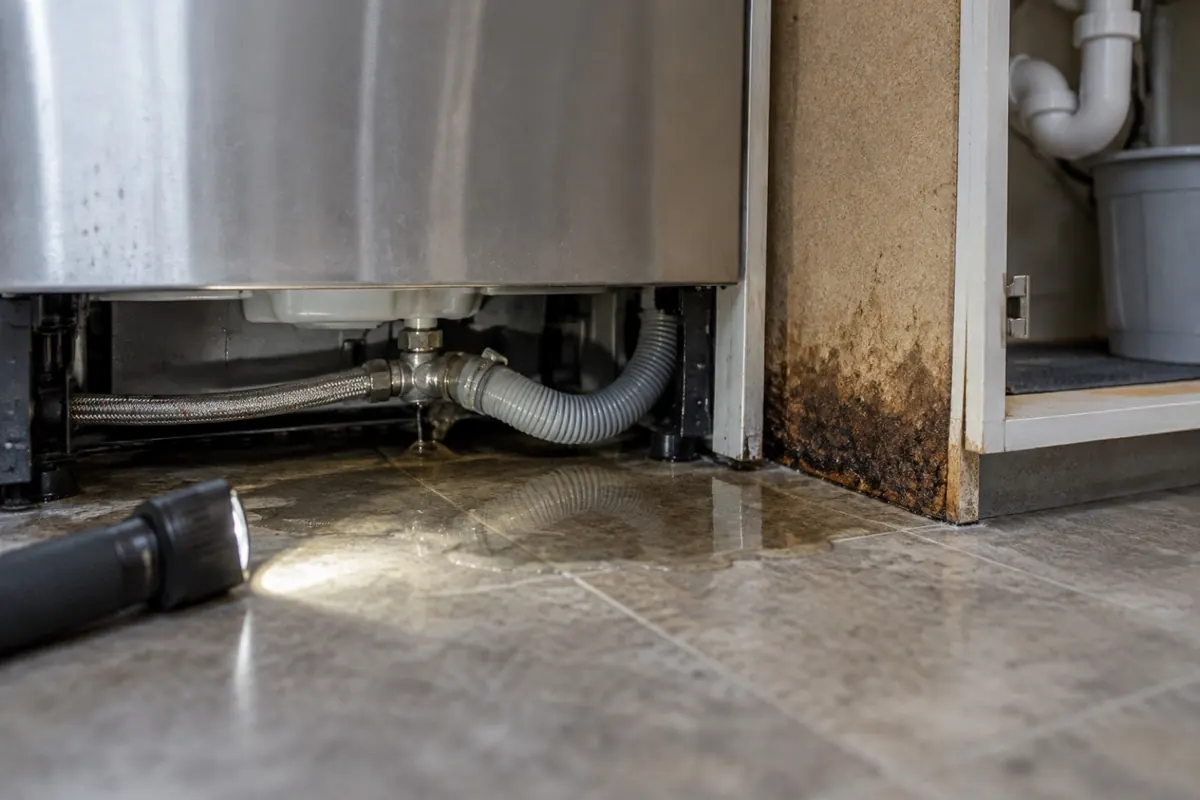
When the dishwasher leaks: the floor and the cabinet
Growth on the seal is a chore. Growth the dishwasher causes on the cabinet panel, sink base or subfloor is a water loss. The machine sits in a closed bay, fed by a supply line and drain hose behind the kick plate, so leaks are slow and hidden, and the sink base often shows it first: see mold under sink and water damaged cabinets.
| Where water shows | Likely source | What gets wet | Source |
|---|---|---|---|
| Front edge of the door | Gasket, over-sudsing, spray arm misdirecting water | Floor in front, toe-kick | Whirlpool |
| Bottom, front center | Pump seal, sump or overfill | Floor under the machine | Whirlpool |
| Behind or under the cabinet | Supply hose, inlet valve, drain line | Subfloor, side panels, sink base | Whirlpool; GE |
| Sink air gap | Clogged sink or air gap | Sink cabinet | GE |
| Door hits the counter | Latches but cannot seal | Front edge | GE |
| Suds | Dish soap, spilled rinse aid, washed sponges | Floor in front | GE; Whirlpool |
NC State Extension lists dishwasher discharge as gray water and says gray water untreated past 48 hours may become black water; our IICRC water categories page explains the standard. EPA's brief guide to mold says dry water-damaged materials within 24 to 48 hours, and points growth over about 10 square feet to its larger guidance.
Which situation are you in
- Speckling on the seal, door or cups; floor dry. Run the eight steps. This is maintenance.
- Musty smell, nothing visible. Clean the filter and sump. Dirty water sitting in the tub between uses points, per GE, to the drain hose high loop or air gap.
- Seal still black, cracked or flattened. Replace it with the OEM gasket.
- Water on the floor or a damp toe-kick. Stop, shut water and power, and locate the leak with the table above.
- Swollen cabinet panel, stained sink base, cupped flooring, growth outside the tub, or a smell that returns within weeks. Escalate: this is a water loss needing moisture readings and a drying plan, sized against EPA’s 10 square foot line.
Prevention that the sources support
| Habit | Who says so | Why it helps here |
|---|---|---|
| Filter on your brand’s interval | Whirlpool, KitchenAid, GE, Bosch | Starves the sump and drain |
| Run at least once a week | GE mildew article | GE says this usually prevents mildew |
| Scrape, do not rinse | GE deep clean guide | Rinsed dishes can fool the sensor into a lighter wash |
| Inlet water at least 120 F | GE deep clean guide | Detergent dissolves fully |
| Automatic detergent only | GE; Whirlpool | Dish soap suds push water out |
| Inspect the gasket for tears | GE | A worn seal leaks |
| Softener at 15 grains or more | KitchenAid | Mineral film holds water |
| Indoor humidity below 60% | EPA brief guide | The seal fold dries faster |
Propping the door open is widely repeated, but none of the six brand pages cited here states it.
For contractors
A moldy seal is not a remediation scope. The job starts where the dishwasher put water into the cabinet bay, sink base or subfloor; document the source before the machine is pulled.
| Item | What to record | Why an adjuster asks |
|---|---|---|
| Source | Photo of the leak point, hose and valve condition | Failed part versus installation |
| Appliance | Model and serial; Whirlpool says they are on the tub frame | Ties the loss to the unit |
| Category | Gray water per NC State; note elapsed time | Past 48 hours it may be treated as black |
| Moisture map | Toe-kick, both side panels, sink base, floor, subfloor | Defines what is wet |
| Growth | Location and approximate area | Scope against EPA’s 10 sq ft line |
| Line items | Pull and reset dishwasher, remove toe-kick and panels, dry, clean, replace | Each is its own estimate line |
Coverage turns on policy wording. Owners should read their policy and ask their state insurance department or a licensed professional; contractors should record when the leak started.
What this page does not cover. Health effects of mold or yeast exposure are outside our scope; the study authors describe these species as of medical interest, and questions about a household member belong with a doctor, starting from CDC's mold page. Pumps and inlet valves are for an appliance technician.
Questions people actually ask
Is it safe to use a dishwasher with mold in it?
Clean it before the next load. The Ljubljana studies found fungi concentrated on the door seal, side nozzles, door and drain, and only one species on washed dishes. Scrub the seal, clean the filter and sump, and run your brand’s cleaning cycle. Questions about a person’s health belong with a doctor; CDC publishes general mold guidance.
How do I get rid of black mold in my dishwasher seal?
Lift the lip of the lower door seal and wipe the fold with a soft cloth and mild soap, then dry it, as KitchenAid describes. GE adds a mildew wipe of 1/2 cup chlorine bleach per gallon, but Samsung says avoid bleach in stainless interiors, so follow your brand. A seal that stays black or is torn needs an OEM replacement.
Why does my dishwasher keep getting moldy?
The same places stay wet and fed between cycles: the seal fold, the sump and the drain. The 2016 study reports fungi in 83% of 30 machines swabbed right after a wash, and names the household water supply as the likely route in. Clean the filter on your brand’s interval, run the machine weekly as GE advises, and check for standing water.
How often should I clean my dishwasher filter?
Whirlpool and KitchenAid say once a month, or every two weeks for a large family or daily use. GE says every other month or more depending on usage, and Bosch says every few months. LG points to the chart in your manual and Samsung says regularly. Clean it sooner if dishes come out gritty or the machine smells.
Does the sanitize cycle kill mold in a dishwasher?
Do not rely on it. Samsung Canada says its Sanitize rinse reaches 163 F, but the Ljubljana researchers swabbed machines right after a cycle and still found fungi, describing species that tolerate 60 C to 80 C. The seal fold is also the least sprayed part of the tub, so scrubbing the seal and filter does the work.
Can a leaking dishwasher cause mold under the cabinet?
Yes. Whirlpool lists the supply hose, inlet valve and drain line as sources of leaks behind or under the cabinet, where water reaches the subfloor and side panels unseen. EPA says dry water-damaged materials within 24 to 48 hours. A swollen panel or damp toe-kick means a water loss, not an appliance clean.
Sources
- the 2016 Ljubljana study in PLOS ONE: Zupančič J, Novak Babič M, Zalar P, Gunde-Cimerman N, PLOS ONE 11(2): e0148166, 2016; full text via Europe PMC. Retrieved 30 October 2026.
- a 2011 Fungal Biology study: Zalar P, Novak M, de Hoog GS, Gunde-Cimerman N, Fungal Biology 115(10), 2011; abstract via PubMed. Retrieved 30 October 2026.
- Zupančič J et al., BMC Microbiology 19: 300, 2019 (a 2019 follow-up in BMC Microbiology); abstract via PubMed. Retrieved 30 October 2026.
- Bosch: Bosch's cleaning and maintenance page, Bosch's filter guide, Bosch's smelly dishwasher page. Undated. Retrieved 30 October 2026.
- Whirlpool: Whirlpool's filter article, Whirlpool's food odors article, Whirlpool's leak troubleshooting guide, Whirlpool's leaking underneath article. Undated. Retrieved 30 October 2026.
- KitchenAid: KitchenAid's filter article, KitchenAid's interior cleaning article, KitchenAid's odor article. Undated. Retrieved 30 October 2026.
- GE Appliances: GE Appliances' filter article, GE's interior cleaning article, GE's food or mildew odor article, GE's white grease article, GE's interior staining article, GE's preventing leaking article, GE's door gasket article, GE's deep clean guide. Undated. Retrieved 30 October 2026.
- LG: LG's filter article (dated 05/06/2023), LG's maintenance article (dated 09/10/2026). Retrieved 30 October 2026.
- Samsung: Samsung Canada (updated 15 July 2026), Samsung Australia (updated 27 August 2026). Retrieved 30 October 2026.
- NC State Extension, Water Damaged Carpets and Rugs. Retrieved 30 October 2026.
- EPA's brief guide to mold (updated 18 February 2026). Retrieved 30 October 2026.
- CDC's mold page. Retrieved 30 October 2026.
- No dishwasher was tested; see our methodology.
Some dishwashers are not rated for bleach or vinegar. Check your model’s manual first.