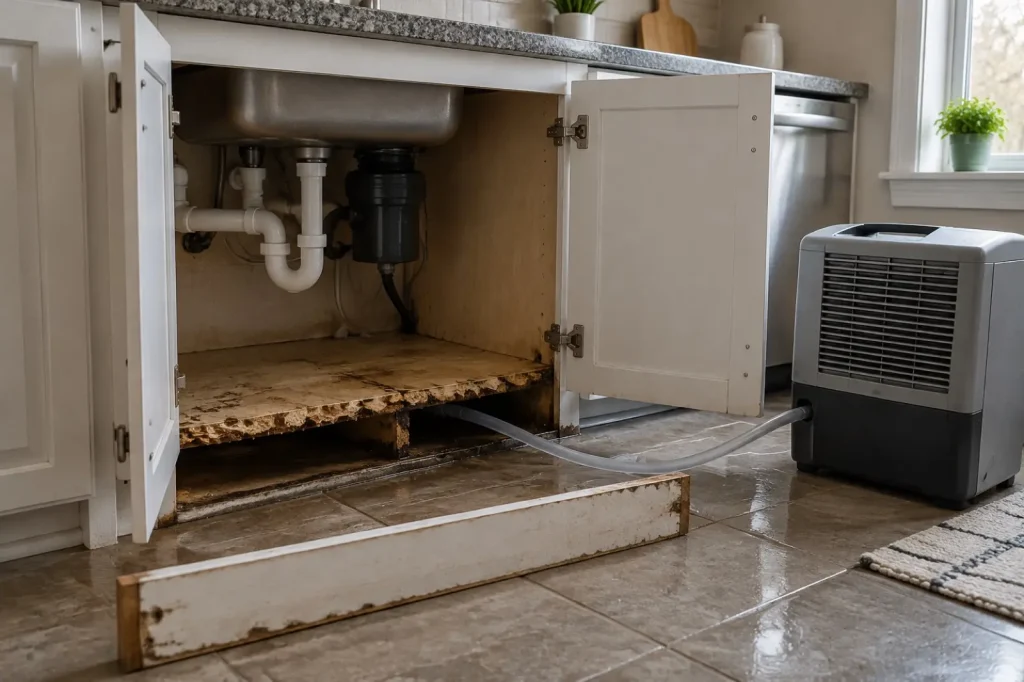
The short answer
Water damaged cabinets are judged by the box material, not the door. FEMA damage guidance treats particleboard and MDF base cabinets wet by shallow flooding as replacements, while wood and plywood bases may need only cleaning, sanitizing and repairs at the base. Swollen particleboard does not shrink back, so dry the cabinet first, then measure what stayed swollen.
Key takeaways
- Look at a cut edge before anything else. The core decides the outcome, and a wood door can hang on a particleboard box.
- A Forest Products Journal study of ten commercial particleboards reports that humidity alone swelled boards 5.5 to 15%, and a third to a half of that never came back.
- KCMA A161.1-2022 lets sink bases skip the back panel, so a sink base leak reaches the wall cavity directly.
- Door edges carrying the KCMA seal are tested on a wet sponge for 4 to 24 hours. A slow leak runs for days.
- The Dri-Eaz DriForce InterAir manual says to assume moisture under and behind cabinets if water flowed through, and to remove cabinets if you cannot reach the spaces.
- Stone tops crack most often at the sink cutout during removal, according to the SlabWise removal guide.
On this page
- What you are looking at
- Particleboard water damage and the other box materials
- The sink base and toe kick
- Repairable or not: material by exposure
- Drying under and behind cabinets
- Repair or replace, part by part
- The stone countertop problem
- Mold behind cabinets
- Signs it is bigger than the cabinet
- The decision, in order
- For contractors
- Questions people actually ask
What you are looking at
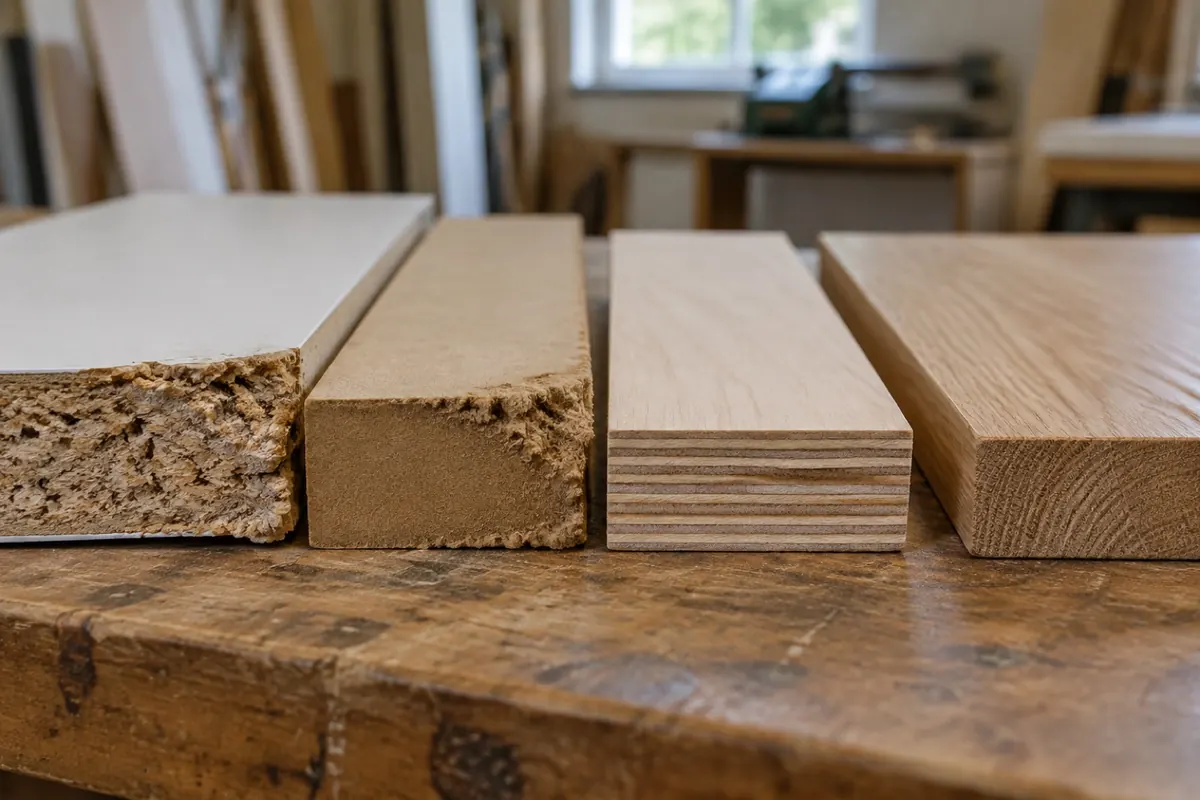
Kitchen cabinet water damage shows at the bottom first, but the bottom is also where the materials hide. Open the sink base, empty it and look at the raw edge of the cabinet floor or a shelf hole. The Composite Panel Association defines particleboard as cellulosic particles of various sizes bonded with resin, and MDF as fibres bonded the same way: chips you can see against a smooth, uniform core. Plywood shows layers. an HP-1 mill certificate lists both veneer core and composite core hardwood plywood, so a panel sold as plywood may have a particleboard or MDF centre.
| What you see | What it usually is | What it tells you |
|---|---|---|
| Bottom edge of a side panel mushroomed or crumbly | Swollen particleboard or MDF | A swollen cabinet base; the swell will not fully dry out |
| Melamine or vinyl skin bubbling or lifting | Core swelling under a printed face | NC State Extension: printed vinyl and low pressure laminates come unglued and cannot be repaired |
| Veneer lifting at seams | Swollen composite core | NCSU: veneered seams come apart when cores swell |
| Sagging or soft cabinet floor | Wet floor panel | Water stood there; check the void below it |
| Doors rubbing or not closing | Swelling, or humidity | According to the Aristokraft humidification guide, 70 to 80% indoor RH swells doors too |
| Gap at a mitered door corner | Joint movement | Humidity swings open joints too; measure before blaming water |
| Dark staining on the underside or back edge | Wet wood, possible growth | Read the mold section below |
Particleboard water damage and the other box materials
The Composite Panel Association lists kitchen cabinets, shelving and countertops among particleboard’s common uses, and CPA's MDF page calls MDF widely used for cabinets. Both are pressed under heat, per CPA. The 1973 Forest Products Journal study reports that ten commercial boards cycled from 40 to 93 and back to 40% RH swelled 5.5 to 15% by board type, a third to a half of it was nonrecoverable, and most swelling happened above 80% RH. That is humidity, not standing water.
NC State Extension reaches the same verdict in field terms: if the particleboard under a veneer has swollen, the damage is permanent. CPA notes that makers can add moisture resistance at manufacture and classifies panels under ANSI A208.1 and A208.2 (CPA standards list), so boards vary, but none of the published guidance treats a swollen edge as dryable. Hardwood plywood behaves better: the HP-1 standard tests the glue bond with a three cycle soak (Type II, per an HP-1 mill certificate). APA publishes thickness swell data for wood panels through wetting cycles. Solid wood swells and shrinks back, and NCSU warns the cycle can loosen joints and warp boards.
The sink base and toe kick
Two construction facts make the sink base the usual failure. KCMA A161.1-2022, the performance standard behind the KCMA seal, lets kitchen sink bases skip the back panel, so a leak inside the cabinet meets the wall cavity directly. It also sets the toe space at least 2 inches deep and 3 inches high, and behind that recessed board sits a closed void under the cabinet floor. Water that runs off the cabinet floor lands in a space nobody looks at. For flood losses, the FEMA IS-285 Substantial Damage Estimator guidance draws its cabinet line at water 4 to 12 inches above the finished floor, the zone of the toe kick, floor panel and lower side panels. Tracing the leak itself is covered on mold under sink.
Repairable or not: material by exposure
Find your box material on the left and the exposure across the top.
| Box material | Splash, wiped promptly | Leak: water standing on the cabinet floor | Flood 4 to 12 in, short | Sewage or contaminated water |
|---|---|---|---|---|
| Particleboard, melamine or vinyl faced | Usually fine | Swollen edges stay swollen (FPJ, NCSU): replace the part or box | Replace, per FEMA | Outside EPA clean water guidance: remove |
| MDF | Usually fine if the edge is sealed | Fibre cores swell (NCSU): replace swollen parts | Replace, per FEMA | Remove |
| Hardwood plywood, veneer core | Fine | Often dries; check glue lines and face veneer | Clean, sanitize, repair at the base, per FEMA | Professional scope with PPE and containment (EPA) |
| Hardwood plywood, composite core | Fine | Judge by the core at a cut edge | FEMA does not separate it; treat by its core | Remove |
| Solid wood face frames and doors | Fine | Dries; joints may loosen (NCSU) | Cleanup, sanding, new finish, per the Nebraska guide | Professional scope (EPA) |
The right-hand column follows EPA Table 1, which says its drying guidance is for clean water and that sewage or chemical contamination requires PPE and containment and an experienced professional. Our water categories page explains the categories behind that line.
Drying under and behind cabinets
Generic advice says open the doors and run a fan, which dries the part that matters least. This method follows published equipment and agency guidance.
- Extract standing water first. The Dri-Eaz manual says its air system is not for liquid water. Why it differs: airflow over a puddle in the void takes days.
- Pull the toe kick. It opens the void under the floor. If it is fixed, use the Dri-Eaz wall method: 3/16 in. holes, placed behind trim that goes back over them. Why it differs: the void, not the shelf, is the reservoir.
- Inject air into the void and the wall behind. The Dri-Eaz DriForce InterAir manual delivers air under and behind cabinets; its standard setup gives 25 to 30 air exchanges per hour per cavity. Why it differs: a fan in the room cannot reach a closed void.
- Dehumidify the room. EPA Table 1 says to remove moisture from wood immediately with dehumidifiers, gentle heat and fans. Why it differs: without a dehumidifier the water just moves to the room air.
- Do not overdry solid wood doors. According to the Aristokraft humidification guide, cabinets belong at 30 to 55% RH, and weeks below 20% shrink doors and panels. Why it differs: the doors were never the wet part.
- Measure, then decide. According to KCMA, cabinet wood is dried to 10% moisture content or less at manufacture; an unaffected cabinet on the same job is the better reference, as our structural drying page explains. Why it differs: swelling is measured after drying, not during.
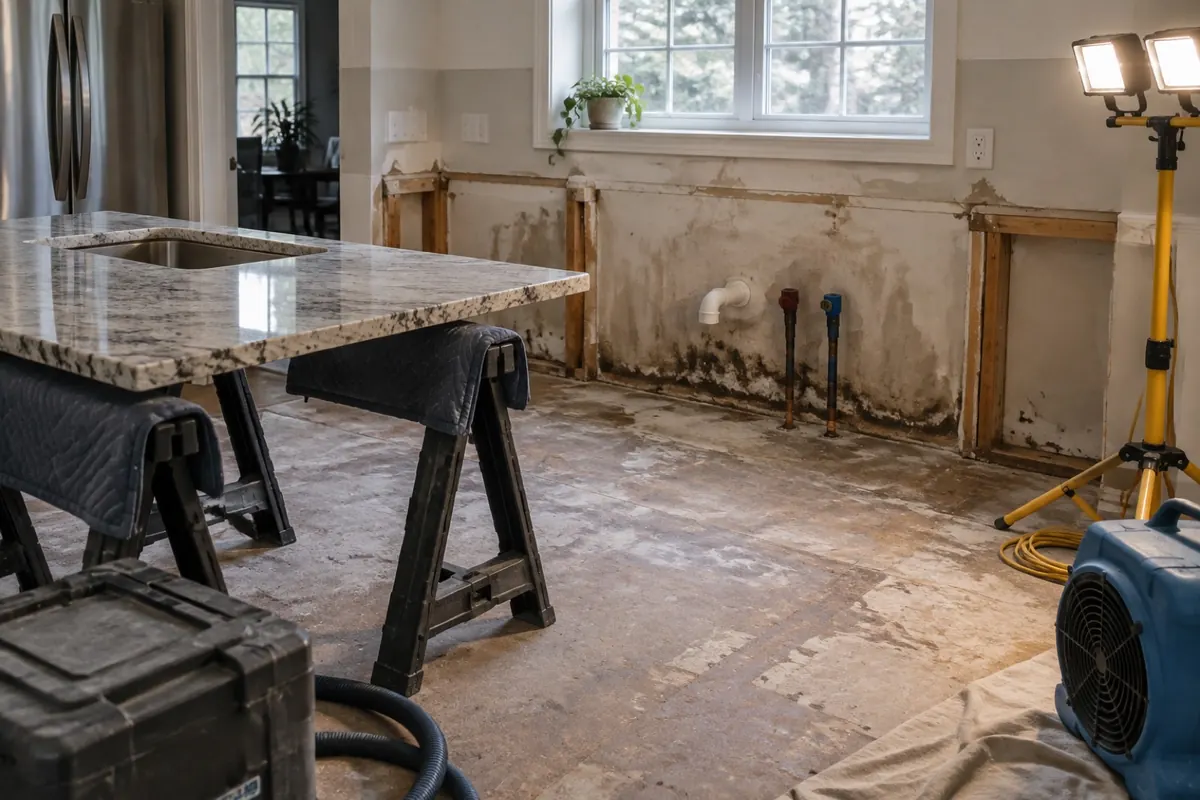
The same Dri-Eaz manual sets the escalation point: moisture under and behind cabinets is hard to detect, so assume it is there if water flowed through, and if you cannot reach every interior space, the cabinets may need to come out.
Repair or replace, part by part
Cabinets fail by component, so they can often be repaired by component. Doors carry the clearest published rules.
| Part | Repair route | Replace when | Basis |
|---|---|---|---|
| Toe kick board | Remove to dry, then refit | It is swollen particleboard or MDF | FPJ and NCSU on permanent swell |
| Cabinet floor panel | Replace the panel once the box is dry | Side panels are swollen too | FEMA: repairs at the cabinet base for wood and plywood |
| Side panels | None once swollen | The bottom edge has swelled | Swell does not recover (FPJ) |
| Solid wood face frame | Dry, sand, refinish | Joints open or wood splits after drying | Nebraska guide; NCSU |
| Doors and drawer fronts | Adjust hinges, acclimate, refinish | Warped at least 1/4 in. after a full seasonal cycle; or a laminate or vinyl face has lifted | Aristokraft warped door guidelines; NCSU |
| Upper cabinets | Usually untouched by floor water | Only if water reached them | FEMA: matching uppers does not change SDE damage |
KCMA A161.1-2022 explains why a door that looked fine for years swells after a leak. According to the standard, its door edge test stands a door on a sponge in water with 0.5% dish detergent for 24 hours for solid wood or painted doors, and only 4 hours for edgebanded or thermofoil doors, with no swelling or delamination allowed. That is 6 times longer for doors without seams, and both are far shorter than a slow leak.
The stone countertop problem
Replacing a base cabinet usually means lifting the top. With stone that is the riskiest step. The SlabWise removal guide, citing the Natural Stone Institute, puts granite and quartz at 13 to 20 lb per square foot, which by our arithmetic puts a 30 by 36 inch sink base section at about 98 to 150 lb. It says sink cutouts are the most common break, with inside corners, cooktop cutouts and spans past about 60 inches, and reports professional removal at $150 to $400 for a typical kitchen, citing Angi.
| Top | Removal risk | What to plan for |
|---|---|---|
| Granite or quartzite slab | Cracks at the sink cutout; one section can reach 300 lb (SlabWise) | Photograph existing chips first; cut caulk and adhesive fully |
| Engineered quartz | Same process; SlabWise calls it slightly more flexible | Fabricator handling if it is to be reset |
| Postformed laminate | Light, but CPA ties particleboard to postformed laminate tops | A wet particleboard core swells like the cabinet |
| Any stone cut on site | Silica dust | OSHA 29 CFR 1926.1153: PEL 50 micrograms per cubic metre, action level 25 |
Mold behind cabinets
EPA Table 1 sends anything wet for more than 48 hours, or already growing mold, to its remediation table. Behind cabinets the growth is where nobody looks: the underside of the cabinet floor, the back of the toe kick and the wall behind an open sink base. Pull the toe kick and look with a light before the floor goes back. The method for wood is on mold on wood, the size rules on DIY mold remediation, and the sink cabinet itself on mold under sink.
Out of scope. Health effects of mold exposure are not covered here; see EPA and CDC.
Signs it is bigger than the cabinet
- The flooring runs under the cabinets and is cupped or soft at the toe kick. See subfloor water damage.
- The wall behind the sink base is wet or stained above the cabinet floor line.
- Swelling appears on cabinets that share no plumbing with the leak.
- Musty odour persists after the box reads dry.
- Water came from a dishwasher or refrigerator line and ran along the whole run of base cabinets.
- The water was a backup or floodwater rather than a supply line.
The decision, in order
| Which situation are you in? | Do this | Because |
|---|---|---|
| Sewage, backup or floodwater | Porous parts out; professional scope | EPA Table 1 covers clean water only |
| Particleboard or MDF sides swollen after drying | Replace the cabinet | Permanent swell (FPJ); FEMA replaces these |
| Wood or plywood box, wet floor panel | Dry the void and wall, replace the floor panel | FEMA: repairs at the cabinet base |
| Only the toe kick swollen | Replace the board | It is a separate part |
| Doors swollen or warped | Wait a seasonal cycle, then measure | MasterBrand: replace past 1/4 in. |
| Stone top over a cabinet to replace | Price detach and reset against crack risk | Sink cutouts crack most (SlabWise) |
For contractors
The cabinet decision is a material call, and the file should prove the material. MasterBrand's Aristokraft warranty gives a limited 5 year residential warranty that excludes liquid left on cabinets for an unreasonable time and warping after the first 365 days, so a leak claim rarely becomes a warranty claim. Coverage is a policy question: see does homeowners insurance cover water damage, the policy itself, the state insurance department and a licensed professional. More water material types are on the water hub.
| Document | Why a reviewer asks |
|---|---|
| Photo of a cut edge per cabinet | FEMA splits replace from repair on particleboard or MDF against wood or plywood |
| Water height above finished floor | FEMA’s 4 to 12 inch band |
| Readings: floor, sides, void, wall, unaffected cabinet | Proves dry against a reference, not a guess |
| Swelling at panel edges after drying | Permanent swell is the replacement reason (FPJ) |
| Door warp gap | MasterBrand’s 1/4 in. threshold |
| Countertop condition before detach | Pre-existing cracks and chips, before anyone lifts it |
| Which cabinets the water reached | FEMA: matching uppers does not count toward SDE damage |
Questions people actually ask
How can I fix water-damaged kitchen cabinets?
Stop the leak, extract standing water, pull the toe kick and dry the void under the cabinet floor and the wall behind with dehumidification. Then judge each part: swollen particleboard or MDF is replaced, wood and plywood are cleaned and repaired at the base, and doors are refinished or replaced depending on warp.
What does water damage look like on cabinets?
Look low. Mushroomed or crumbly bottom edges on side panels, bubbling melamine or vinyl skins, lifting veneer seams, a sagging sink floor and doors that rub or will not close are the usual signs. Dark staining under the cabinet floor or on the wall behind an open sink base suggests the water went further.
Can wood recover from water damage?
Solid wood and good plywood often do. NC State Extension says solid wood can usually be restored unless it sat in water for several days to a week, though drying can loosen joints and warp boards. Particleboard is different: a Forest Products Journal study found a third to a half of its swelling never recovers.
Does water damage eventually go away?
The water goes; the damage may not. Wood dries back toward normal size, but swollen particleboard and MDF keep part of their swell after drying, and lifted laminate does not re-bond. MasterBrand asks that a door warped less than 1/4 in. acclimate through a full seasonal cycle before replacement, because humidity alone moves wood.
Can a swollen cabinet base be fixed?
Rarely, if it is particleboard or MDF. NC State Extension calls swollen particleboard damage permanent, and the Forest Products Journal study found part of the swell never recovers even after drying. A swollen toe kick or floor panel can be replaced on its own; swollen side panels usually mean replacing the cabinet.
Is it worth removing a granite countertop to replace one cabinet?
Sometimes. A SlabWise guide reports professional removal at $150 to $400 for a typical kitchen, citing Angi, but slabs crack most often at the sink cutout, the part over the cabinet you are replacing. Photograph existing damage and agree in writing who carries the crack risk before anyone lifts it.
Sources
- FEMA IS-285 Substantial Damage Estimator guidance: Cabinets and Countertops, 25% to 50% Damaged, FEMA Emergency Management Institute. Read via the Internet Archive copy of 6 May 2025; the live page now returns not found.
- Nebraska interior inspection guide, adapted from FEMA P-784.
- Forest Products Journal study: Hygroscopic Thickness Swelling and Related Properties of Selected Commercial Particleboards, Forest Products Journal 23(7):26-30, 1973 (abstract).
- NC State Extension: Flood Damaged Furniture, Sarah Kirby, June 2014.
- Composite Panel Association, particleboard and MDF product pages, and the CPA standards list (ANSI A208.1-2022, A208.2-2022).
- APA: Moisture-Related Dimensional Stability publication summary.
- an HP-1 mill certificate: Capital Testing certificate for States Industries to ANSI/HPVA HP-1-2020, reissued March 2024.
- Kitchen Cabinet Manufacturers Association, KCMA A161.1-2022, Performance and Construction Standard for Kitchen and Vanity Cabinets.
- MasterBrand Cabinets: MasterBrand's Aristokraft warranty, Aristokraft humidification guide and Aristokraft warped door guidelines.
- Dri-Eaz DriForce InterAir manual, model F211, copy hosted by the retailer Sylvane.
- United States Environmental Protection Agency, EPA Table 1, Mold Remediation in Schools and Commercial Buildings, updated September 2026.
- SlabWise removal guide, SlabWise Editorial Team, updated 10 July 2026, citing the Natural Stone Institute and Angi.
- Occupational Safety and Health Administration, 29 CFR 1926.1153, Respirable crystalline silica in construction.
- All retrieved 19 October 2026. Derived figures are arithmetic on the published numbers. See our methodology.
Cabinet construction varies by maker. Confirm the material at a cut edge and the terms in the owner’s policy before scoping repair or replacement.