The short answer
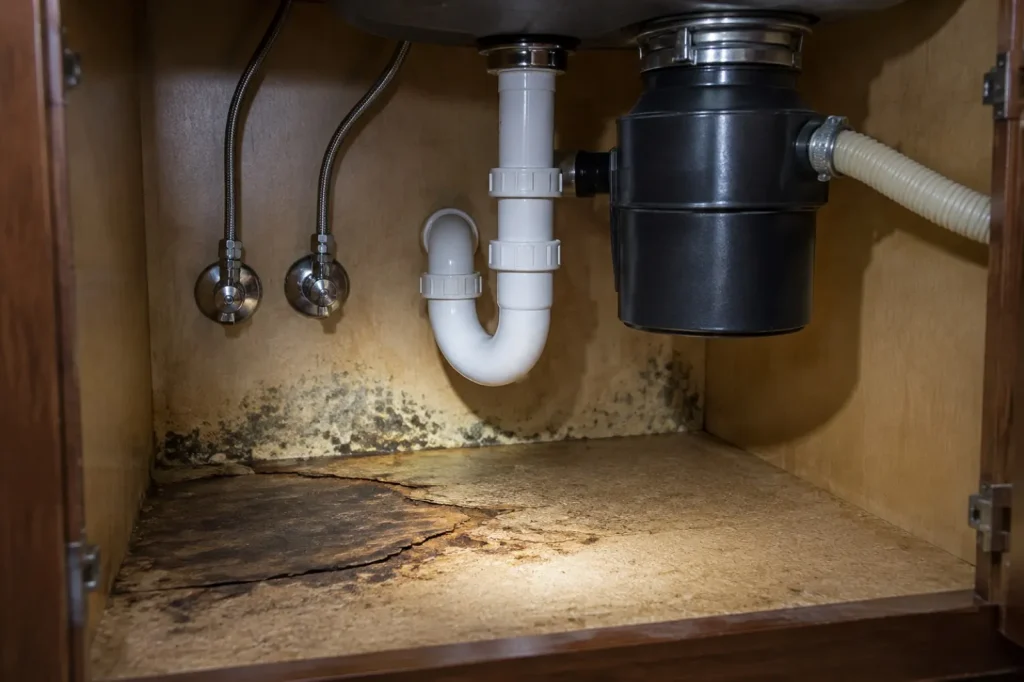
Mold under sink cabinets is a leak problem first and a cleaning problem second. Empty the cabinet, dry it, then find which joint is wet with dry paper towels or tissue: supply nuts, P-trap slip joints, the dishwasher hose, the disposal or the faucet base. Fix that, clean hard surfaces, and replace a cabinet floor that has swollen, because swollen particleboard does not recover.
Key takeaways
- Sink cabinets hide slow leaks. Family Handyman's hidden leak guide notes supply leaks sit at the back of the cabinet and can go unnoticed for a long time.
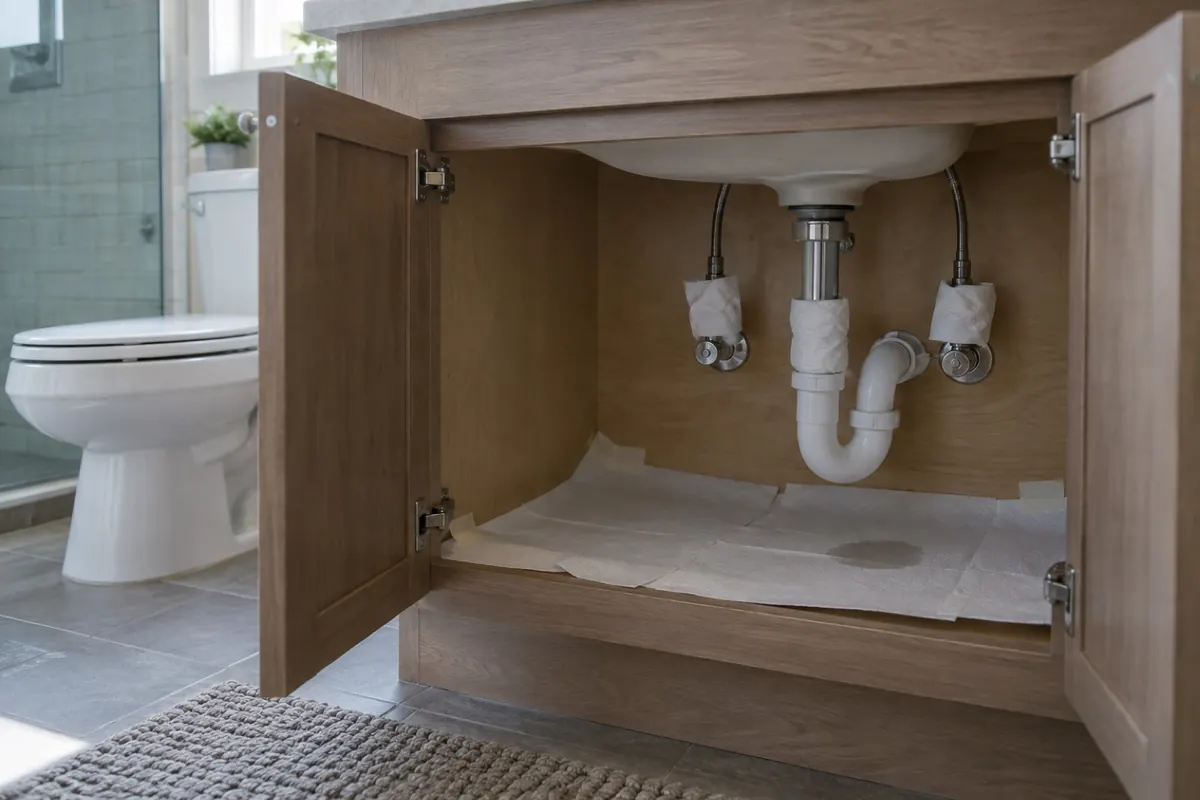
- Find the leak with paper, not fingers: InSinkErator’s test is a taped sheet of newspaper on the cabinet floor, a full sink, then the disposal running.
- Particleboard and MDF are mostly bonded with urea formaldehyde resin, which moisture breaks down, per the USDA Wood Handbook. Plywood shows minimal irreversible swelling.
- NC State Extension says once particleboard has swollen the damage is permanent. A swollen sink base floor is a replacement, not a cleaning job.
- A slow drip is a mold problem; a supply line can turn sudden and flood the kitchen, Rytech Restoration warns.
- The only published claims data found here is for whole-house shutoffs: a 96% drop in water claim events, according to a LexisNexis Risk Solutions study of Flo by Moen homes.
On this page
What you are looking at under the sink
Mold under kitchen sink cabinets and bathroom vanities starts in the same place. The sink base is the one cabinet that holds pressurised water lines, a drain, often a disposal and a dishwasher hose, and a stack of bottles that hide all of it. The signs below are the ones plumbing sources list, each pointing at something different.
| What you see | What it usually means | Source |
|---|---|---|
| Spotting or fuzz on the cabinet floor or back panel | Growth fed by a leak or by water left after one | EPA: moisture control is the key to mold control |
| Floor panel swollen, soft or crumbling at the edge | Particleboard or MDF that has taken on water; permanent | NC State Extension; Wood Handbook |
| Black, swollen particleboard right under the sink rim | Seepage under the rim or faucet base, not a pipe | Family Handyman |
| Loose laminate near the sink, loose faucet base, failing caulk | Rim or faucet base leak | Family Handyman |
| Dank odor, puddles or stains, nothing dripping now | Drain leak that only shows when the sink empties | Family Handyman |
| Loose or damaged flooring in front of the cabinet | Water has left the cabinet | Family Handyman |
| Stain on the ceiling below | Water has gone through the floor | Family Handyman |
InSinkErator's leak troubleshooting page adds a list of sources people miss when the plumbing itself is dry: water filters, the dish sprayer, the faucet, the dishwasher drain hose, the sink and countertop seam, and countertop joints. Colour of the growth tells you little; the related searches for black, white and green mold under the sink all lead to the same leak question. Telling growth from mildew is on our mold hub, mold.
The leak points, and which kind of damage each causes
The split that matters for mold is slow against sudden. A slow leak keeps the cabinet floor wet for weeks and is what grows mold. A sudden one floods the kitchen and becomes a water damage job. The same fitting can do both.


| Leak point | Typical sign | Slow (mold) or sudden (flood) | Source |
|---|---|---|---|
| Supply line and compression nut at the shutoff | Wet tissue at the nut; drip at the back of the cabinet | Slow at first; can worsen suddenly because it is under household water pressure | Family Handyman; Rytech |
| Shutoff valve stem | Drip from the valve stem | Slow | Family Handyman |
| P-trap slip joints | Wet only while the sink drains; puddles, dank odor | Slow and intermittent | Family Handyman |
| Basket strainer | Drip under the sink outlet when the bowl holds water | Slow | Family Handyman |
| Dishwasher drain connection | Wet towel at the connector or clamp after a dishwasher drain | Intermittent, timed to the dishwasher | Moen; Family Handyman |
| Disposal sink flange or mounting assembly | Wet at the top of the unit, may drip down to the bottom | Slow | InSinkErator; Moen |
| Disposal discharge elbow | Wet at the side outlet; per Moen a failed gasket can exit at the bottom plate | Slow | Moen; InSinkErator |
| Disposal body, bottom or motor joint | Wet from the unit itself once other points are ruled out | Slow; InSinkErator says contact them | InSinkErator; Rytech |
| Faucet base and sink rim | Water seeps under the rim or base; swollen board under the rim | Slow; it gradually destroys cabinets and countertops | Family Handyman |
The sudden kind is expensive. According to the IBHS 2012 plumbing claims release, the average plumbing supply system failure in its study of closed claims cost more than $5,000 after the deductible.
Repairing the fitting itself is plumbing work, which our sister publication The Plumbing Brief covers; this page stops at finding the wet joint and dealing with the damage.
Finding the wet joint: the paper test
Family Handyman's hidden leak guide puts it bluntly: do not rely on your sense of touch to find tiny undersink leaks. Every source here uses dry paper, because paper shows a drip as a mark and keeps the record after the water has gone.
| Step | What it isolates | Why this differs from generic advice | Source |
|---|---|---|---|
| 1. Empty the cabinet and dry every surface | Old water from new | Generic advice starts with cleaning; that destroys the evidence | InSinkErator |
| 2. Tape a flat sheet of newspaper over the cabinet floor | Where drips land | Shows the drop point, which is often not under the fitting | InSinkErator |
| 3. Wipe each supply connection and shutoff with dry tissue, taps off | Pressurised side | Supply joints leak with nothing running | Family Handyman; Rytech |
| 4. Stopper and fill the sink; leave it full | Strainer, flange, faucet base | A full bowl loads the rim and strainer seals | InSinkErator |
| 5. Wrap towels at the flange, discharge elbow and dishwasher connector, then release the water | Drain side, disposal joints | Each towel names one joint | Moen |
| 6. Run the dishwasher and check its hose connection | Dishwasher drain | This joint is only wet during a drain | Family Handyman |
| 7. Leave the paper down for a few days if nothing shows | Intermittent leaks | Slow leaks are the ones that grow mold | InSinkErator |
Why the cabinet floor material decides it
Most sink base floors are particleboard or MDF. The USDA Wood Handbook, chapter 11 (2021) says urea formaldehyde resins are used mainly in particleboard and MDF for interior products, “because moisture exposure leads to a breakdown of the bond-forming reactions.” Plywood behaves differently: unlike most panels made from particles, the handbook says, it undergoes minimal irreversible thickness swelling if wetted. NC State Extension draws the practical line: if the particleboard has swollen, the damage will be permanent.
| Material or condition | Threshold or behaviour | What it means under a sink | Source |
|---|---|---|---|
| Particleboard | UF bond breaks down with moisture; swelling permanent | Swollen floor panel is replaced | Wood Handbook; NC State Extension |
| MDF and fibre cores | UF bonded; fibre cores swell | Same call as particleboard | Wood Handbook; NC State Extension |
| Plywood | Minimal irreversible thickness swelling | Dry it, then inspect and clean | Wood Handbook |
| Solid wood | Mildew continues while moisture content is above 20 percent, per NC State | Measure before closing up | NC State Extension |
| Room air | Below 60 percent relative humidity, ideally 30 to 50, according to EPA | Run the room dry while the cabinet dries | EPA |
| Time | Dry within 24 to 48 hours, according to EPA | Past that, assume growth on porous board | EPA |
How to repair or replace the cabinet itself, including whether the box can stay, is covered on water damaged cabinets. This page only decides whether the floor panel is cleanable.
Mold in sink cabinet floors: clean it or cut it out
EPA's brief guide to mold gives the two rules that apply here: scrub mold off hard surfaces with detergent and water and dry completely, and absorbent or porous materials may have to be thrown away if they become moldy. A sealed laminate or vinyl liner over a sound floor is a hard surface. Raw or swollen particleboard is porous.
| What you find | Call | Why |
|---|---|---|
| Spotting on a laminate or vinyl liner, floor flat and firm | Clean and dry | Hard, non-absorbent surface, per EPA |
| Spotting on bare plywood, floor firm | Clean, dry, measure | Plywood resists lasting swelling |
| Floor swollen, soft or blistered anywhere | Replace the panel | Swollen particleboard is permanent |
| Growth on the back panel or through to the wall | Open the back and look | The leak has gone past the cabinet |
| Floor soft and the subfloor below wet | Treat as a floor job | Water ran down into the floor |
| Growth over about 10 square feet | Professional scope | EPA’s size threshold |
The general cleaning method, protection and size rule are on DIY mold remediation, and whether a product kills or only removes growth is on how to kill black mold. Under a sink the difference is small: until the leak is fixed and the board is dry or gone, any cleaner only buys time.
The decision path, step by step
- 1. Close the shutoffs if anything is actively dripping. Supply side leaks can worsen without warning, per Rytech.
- 2. Empty, dry and photograph. Photos before cleaning are the duration evidence an adjuster asks for.
- 3. Run the paper test. Name the joint before anything is tightened or replaced.
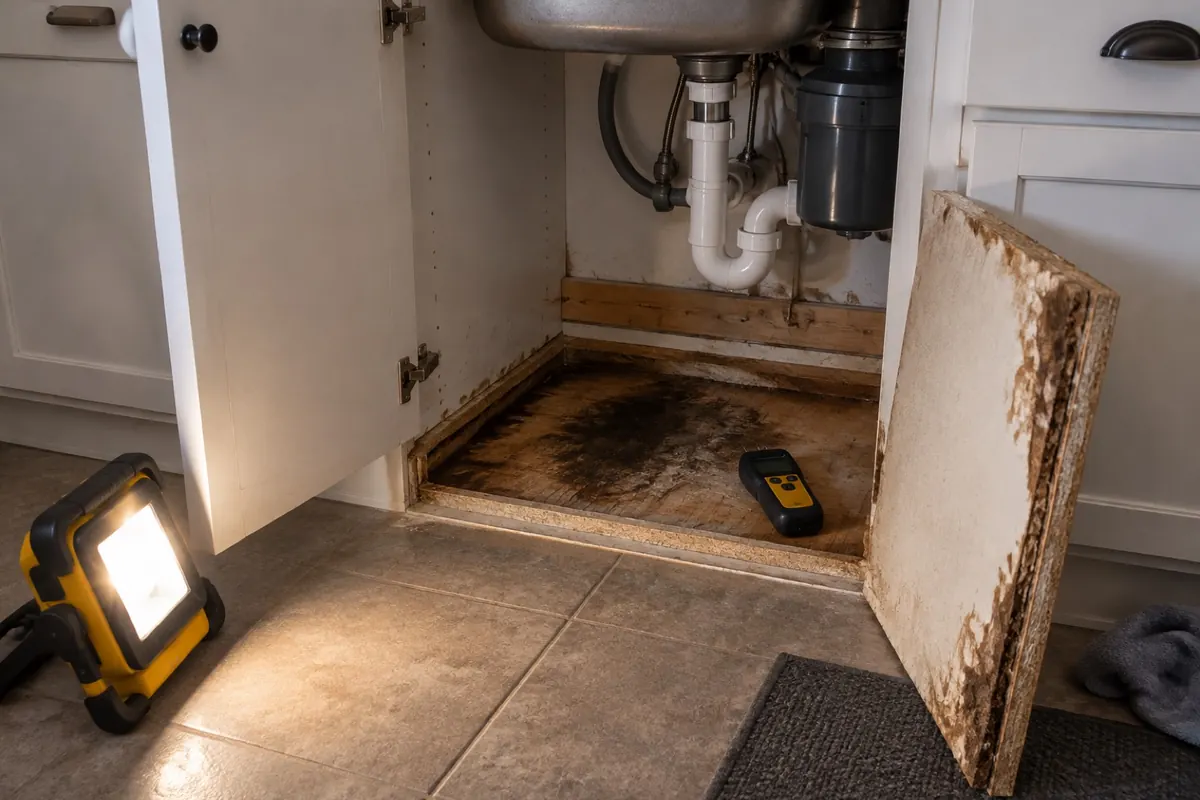
- 4. Press the cabinet floor. Soft, swollen or blistered means the panel is replaced.
- 5. Look behind and below. Back panel, wall cavity, flooring in front, ceiling below; Family Handyman says water can run down the pipes into the floor and framing.
- 6. Size it. Inside the cabinet only, clean or replace. Through to the wall or floor, or over about 10 square feet, it is a remediation scope.
- 7. Keep it dry. Leave the doors open and the cabinet empty until the floor, or its replacement, reads dry.
Escalation triggers
- A stain on the ceiling below a sink on an upper floor.
- Loose or cupped flooring in front of the cabinet.
- Growth on the wall side of the back panel.
- A floor that is soft beyond the cabinet footprint, which belongs on subfloor water damage.
- No wet joint after days of paper: InSinkErator points at the countertop seams, filters and sprayer.
Leak detectors and automatic shutoffs: what the data shows
IBHS advice is to install a house leak detection system as a backup, according to the IBHS 2012 plumbing claims release. The published claims evidence is narrower than marketing suggests. The LexisNexis Risk Solutions study, released 5 May 2020, covered whole-house in-line water shutoff systems, not cabinet alarms. It reports that across 2,306 Flo by Moen homes, water claim events fell 96% against a same-area control group whose claims rose 10%, with 72% lower claim severity one year after installation.
| Device | What it does under a sink | Published claims evidence found |
|---|---|---|
| Battery leak alarm on the cabinet floor | Sounds or sends an alert when water reaches it | None found in this review |
| Fixture shutoff valve with a floor sensor | Closes that sink’s supply | None found in this review |
| Whole-house in-line shutoff with monitoring | Closes the main on a leak | 96% fewer water claim events, according to the LexisNexis study |
Coverage for a sink leak turns on policy wording, covered on homeowners insurance and water damage. As one example, the Eighth Circuit, Croxdale v. Travelers (2026) quotes a generic Travelers form that excludes loss from constant or repeated seepage or leakage “that occurs over a period of 14 days or more,” with an Iowa endorsement reading “weeks, months, or years.” A slow sink leak is the textbook case. Owners should read their own policy and ask their state insurance department or a licensed professional.
For contractors: the sink base job
| Item | What to record | Why |
|---|---|---|
| Source | The wet joint, photographed with the paper test marks | Separates sudden discharge from long-term seepage |
| Duration | Growth extent, staining, swelling, rot | Seepage exclusions are written around duration |
| Floor panel | Material, swelling, firmness | Particleboard replacement is a line item, not cleaning |
| Beyond the box | Back panel, wall cavity, subfloor, ceiling below | Sets the real scope |
| Licensing | Your state’s mold rules for the job size | Some states license mold remediation |
Which states license mold work is on state mold licensing, and how common indoor leaks are in American homes is in our household water leak report.
What this page does not cover. Health effects of mold exposure are outside our scope; see the CDC mold page and EPA's brief guide to mold and speak to a doctor. Plumbing repair belongs to a plumber.
Questions people actually ask
What should I do if I find mold under my sink?
Empty the cabinet, dry it and photograph it before cleaning. Then find the wet joint with dry paper towels or tissue: supply nuts, P-trap slip joints, dishwasher hose, disposal and faucet base. Once the leak is fixed, clean hard surfaces with detergent and water as EPA advises, and replace a cabinet floor that has swollen.
Is mold under the sink dangerous?
For the cabinet, yes: it means water has been sitting long enough to feed growth, and swollen particleboard does not recover. For your health, this page does not give advice; CDC and EPA publish general mold information and a doctor can answer personal questions. The practical answer is the same: find the leak first.
How common is mold under sinks?
No national count of under-sink mold was found for this page. What is documented is why it happens: sink cabinets hold supply lines, drains, a disposal and a dishwasher hose, and Family Handyman notes supply leaks at the back of the cabinet can go unnoticed for a long time behind stored bottles.
Can I just clean mold off particleboard under the sink?
Only if the board is firm and flat and the growth is on a sealed liner. NC State Extension says swollen particleboard damage is permanent, and the USDA Wood Handbook says moisture breaks down the resin bond in particleboard and MDF. Soft or swollen board under a sink is replaced.
How do I get rid of mold in a sink cabinet for good?
Stop the water. Find the wet joint with the paper test, have it repaired, replace any swollen floor panel, clean hard surfaces and let the cabinet dry with the doors open. Keeping indoor humidity below 60 percent, as EPA advises, helps, but no cleaner outlasts a leak.
Do water leak detectors under the sink prevent claims?
The published evidence found is for whole-house shutoffs: a LexisNexis Risk Solutions study of Flo by Moen homes reports 96% fewer water claim events. No published claims data for battery alarms on a cabinet floor was found. A floor sensor only reacts when water reaches it.
Sources
- Family Handyman's hidden leak guide, Family Handyman, updated 3 October 2024. Retrieved 19 October 2026.
- InSinkErator's leak troubleshooting page, InSinkErator. Undated. Retrieved 19 October 2026.
- Moen's disposal leak test, Moen Solutions. Undated. Retrieved 19 October 2026.
- Rytech Restoration, How to find the source of the leak under your sink, 7 March 2023 (a restoration company). Retrieved 19 October 2026.
- USDA Wood Handbook, chapter 11 (2021), USDA Forest Service Forest Products Laboratory, FPL-GTR-282. Retrieved 19 October 2026.
- NC State Extension, Flood-damaged furniture, Sarah Kirby, 6 June 2014. Retrieved 19 October 2026.
- EPA's brief guide to mold, US Environmental Protection Agency, updated 18 February 2026. Retrieved 19 October 2026.
- IBHS 2012 plumbing claims release, 9 October 2012, and IBHS plumbing risk page (archived 2016), Insurance Institute for Business and Home Safety. Retrieved 19 October 2026.
- LexisNexis Risk Solutions study, 5 May 2020. Retrieved 19 October 2026.
- Eighth Circuit, Croxdale v. Travelers (2026), No. 25-2454, filed 24 June 2026. Retrieved 19 October 2026.
- CDC mold page, US CDC. Retrieved 19 October 2026.
- No sink, cabinet or detector was tested for this page. Our methodology sets out the standing rules.
Leak points and cabinet materials vary by installation. Turn off power to a disposal before reaching near it.