The short answer
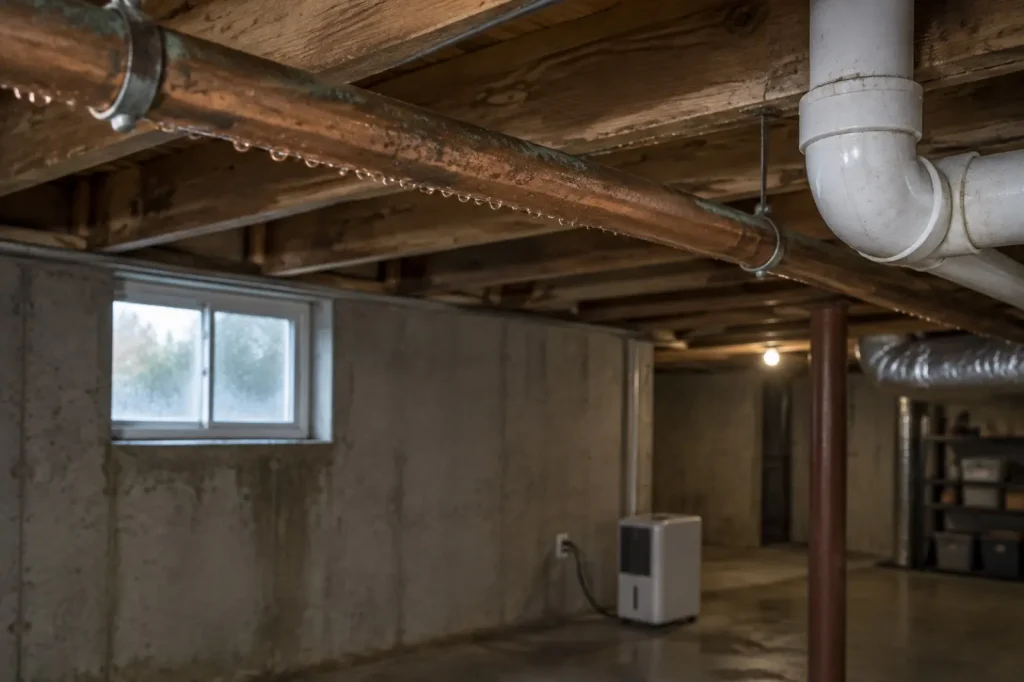
Mold on pipes almost always starts with condensation: a cold water line below the dew point of the room air collects water, and mold grows on the dust, insulation facing or nearby wood rather than on the pipe itself. Clean the surface, then stop the sweating with sealed closed-cell insulation and humidity below 60%, as EPA advises.
Key takeaways
- At 70 F and 65% humidity the dew point is 57.7 F, per the NWS formula, so any pipe colder than that sweats.
- A 55 F pipe in a 70 F room starts to sweat at about 59% relative humidity, just under EPA’s 60% ceiling.
- EPA says it directly: ‘Cover cold surfaces, such as cold water pipes, with insulation.’
- The pipe is rarely the food: EPA says mold grows on ‘virtually any organic substance’, which on a pipe means dust, paper facings and labels.
- Closed-cell elastomeric and polyethylene sheets report 0.2% water absorption or less, according to the Armacell and Jones Stephens data sheets.
- Old white pipe wrap is a different problem: OSHA presumes thermal insulation in buildings from 1980 or earlier contains asbestos.
On this page
- First: old white pipe wrap
- What you are looking at
- Why cold pipes sweat
- When the pipe is coldest
- What the mold is growing on
- Leak or condensation: the towel test
- Pipe insulation and mold resistance
- Cleaning mold off pipes
- Fixing the humidity
- The decision path
- Signs it is bigger than the pipe
- For contractors
- Questions people actually ask
Before you touch anything: do not disturb old white pipe wrap
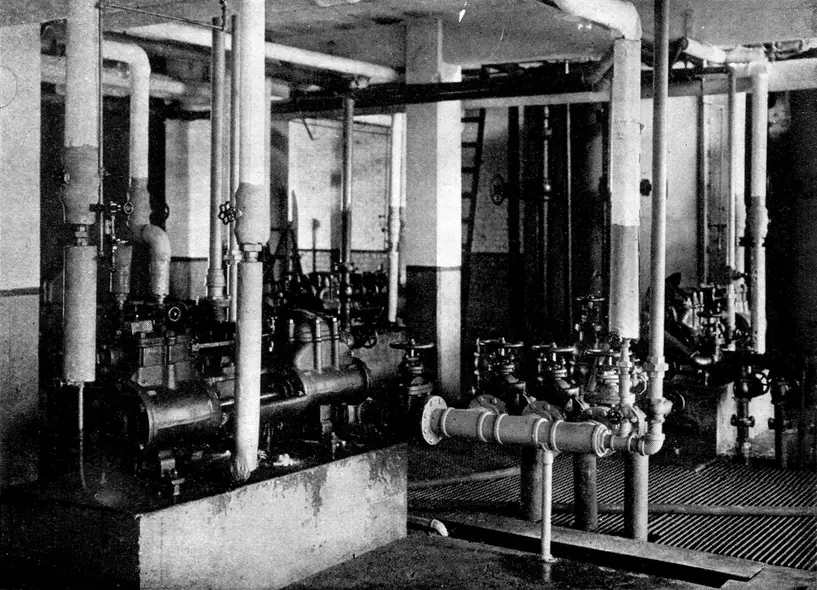
Do not disturb old white pipe wrap. Chalky white or grey lagging, canvas-jacketed sections and plastered elbows on older heating and hot water pipes may contain asbestos. Under 29 CFR 1926.1101(b), ‘presumed asbestos containing material’ means ‘thermal system insulation and surfacing material found in buildings constructed no later than 1980’. EPA's asbestos guidance for homes says you generally ‘can’t tell whether a material contains asbestos simply by looking at it’, and: ‘Don’t saw, sand, scrape, or drill holes in asbestos-containing materials.’ Do not wipe growth off it. Read our page on asbestos pipe insulation first.

What you are looking at on and around the pipe
Mold on water pipes is usually a grey, black or green film on the dusty top of a cold line, or spotting on its insulation jacket. Look-alikes collect in the same place.
| What you see | Most likely | How to tell | Where it points |
|---|---|---|---|
| Beads of water along a bare cold line | Condensation | Wipe dry; it returns in humid weather | Humidity, bare pipe |
| Dark speckled film on top of a pipe | Mold on settled dust | Smears on a damp cloth; worst on top | Long-term condensation |
| Spots on a paper or white jacket | Mold on the facing | Follows seams and wet patches | Wet jacket; check under it |
| Blue-green crust at a copper joint | Copper corrosion | Hard, crystalline; Penn State links bluish-green stains to copper | A possible slow leak |
| White crust on concrete or block nearby | Efflorescence | Powdery mineral; see white mold | Water through masonry |
| Chalky white lagging on old pipes | Possible asbestos | Only a lab can tell | Stop: see the warning above |
Corrosion that is ‘severe enough to cause leaks in the plumbing system’ is the case Penn State Extension flags, and that is a plumbing repair: pipe and joint repair belongs to our sister site The Plumbing Brief. Sweating refrigerant or air conditioning lines are an HVAC matter for The HVAC Brief.
Why cold water pipes sweat: the dew point, worked out
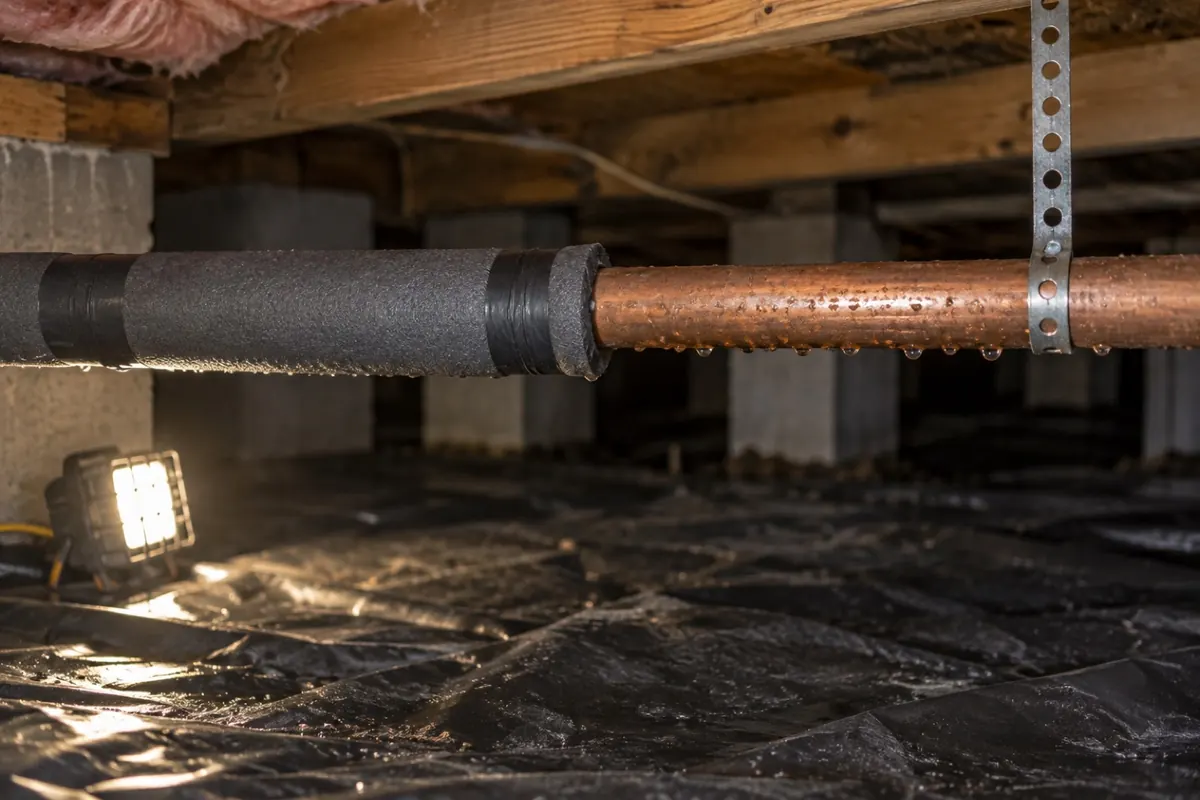
Condensation on cold water pipes is the dew point at work: cool air to its dew point and the excess vapour condenses on the cold surface. The National Weather Service vapor pressure formula gives saturated vapour pressure as 6.11 × 10 raised to (7.5T / (237.3 + T)) millibars, with T in Celsius, and relative humidity as actual over saturated vapour pressure. Solving for the temperature at which the actual vapour pressure saturates gives the dew point.
Worked example, per the NWS formula: a basement at 70 F and 65% relative humidity has a dew point of 57.7 F. Any pipe surface colder than 57.7 F collects water. Per the same formula, a 55 F pipe in that 70 F basement sweats once relative humidity passes about 59%. EPA’s advice to keep humidity below 60% puts the dew point at 55.5 F, and its ideal of 50% or less puts it at 50.5 F.
| RH, per the NWS formula | Dew point at 65 F | Dew point at 70 F | Dew point at 75 F |
|---|---|---|---|
| 40% | 40.1 F | 44.6 F | 49.1 F |
| 50% | 45.9 F | 50.5 F | 55.1 F |
| 60% | 50.8 F | 55.5 F | 60.2 F |
| 70% | 55.0 F | 59.8 F | 64.5 F |
| 80% | 58.7 F | 63.5 F | 68.4 F |
| 90% | 62.0 F | 66.9 F | 71.9 F |
When the pipe is coldest: the water main through the year
A cold line is only as cold as the water in it. The EnergyPlus engineering reference documents a correlation ‘developed by Craig Christensen and Jay Burch’ of the National Renewable Energy Laboratory: mains temperature equals the average annual outdoor temperature plus 6 F, plus a seasonal swing that lags the air. We ran it for an illustrative climate, 52 F average and a 40 F spread between the warmest and coldest months, with a 70 F basement.
| Month, per the EnergyPlus correlation | Water-main temperature | Room RH at which the pipe sweats (70 F room) |
|---|---|---|
| Jan | 49.4 F | 48% |
| Feb | 48.4 F | 46% |
| Mar | 49.8 F | 49% |
| Apr | 53.5 F | 56% |
| May | 58.3 F | 66% |
| Jun | 63.1 F | 79% |
| Jul | 66.5 F | 89% |
| Aug | 67.6 F | 92% |
| Sep | 66.1 F | 87% |
| Oct | 62.4 F | 77% |
| Nov | 57.5 F | 64% |
| Dec | 52.8 F | 54% |
With these inputs the main runs from 48 F to 68 F, per the correlation. The pipe sweats most easily from December to April; whether it does depends on the room’s humidity in those months. Standing water warms toward room temperature, so sweating tracks water use. Private wells do not follow this curve.
What the mold is actually growing on
A pipe offers mold little to eat. EPA's schools and commercial buildings guide says molds ‘can grow on virtually any organic substance, as long as moisture and oxygen are present’. A sweating pipe supplies the moisture; the food is dust, paper jackets, labels and the wood and drywall the drips land on. ASTM C1338, the fungi resistance test for insulation, notes that ‘the type of membrane used to face these products can sometimes affect fungi sustenance in the presence of high humidity’.
| Surface | Does it feed mold? | EPA Table 1 action |
|---|---|---|
| Bare copper, steel or PVC pipe | Little; the dust on it can | Non-porous: ‘damp wipe with water and mild detergent’ |
| Fiberglass pipe insulation | Facing and dust can | ‘Discard and replace’ |
| Closed-cell foam insulation | Surface dust can | Treat as a hard surface; replace if soaked or torn |
| Joist or subfloor under the drip | Yes, wood is organic | ‘Dehumidifiers, gentle heat, and fans’ |
| Drywall below or behind the line | Yes, paper facing | Dry in place only with ‘no obvious swelling’ and intact seams |
That is why the drip line matters more than the pipe. Insulation in walls and attics is a different job, covered on mold in insulation.
Leak or condensation? The paper towel test
Wet pipes have two causes, and they need different fixes.
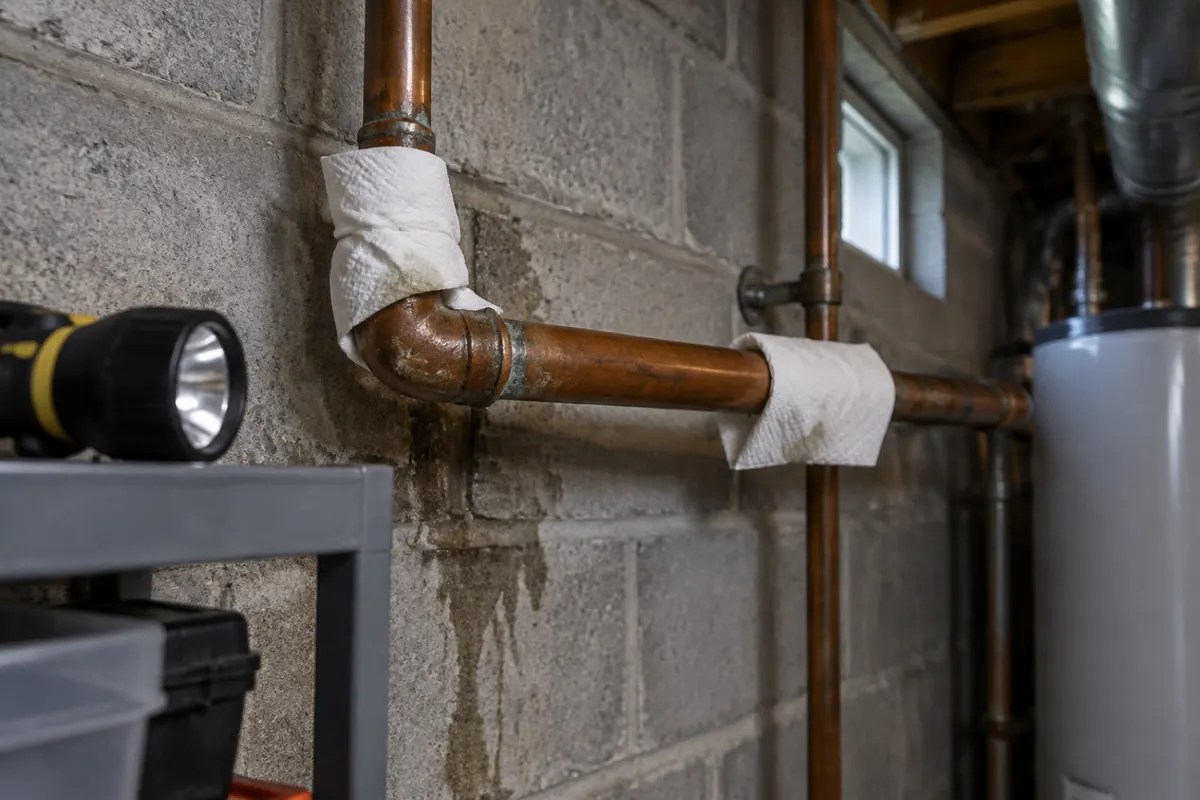
- Dry everything. Wipe the pipe, fittings and valve bodies completely dry.
- Wrap two towels. One around the suspect joint or valve, one around a straight run of the same line a few feet away.
- Check after an hour, then after a day. Note when water was last used and whether the air was humid.
- Read the result. Both towels damp evenly along their length: condensation. Only the joint towel wet, or a wet spot at the bottom of a fitting: a leak. Wet on a hot line in use: almost certainly a leak, because a hot pipe sits above the dew point.
A leak goes to a plumber first; condensation is a humidity and insulation job.
Pipe insulation types and which resist mold
Insulation stops sweating by keeping the outer surface above the dew point, but only if moist air cannot reach the cold pipe underneath. ASTM C1338 covers ‘the ability of new insulation materials and their facings to resist fungal growth’. Each manufacturer below reports a fungal result in its own terms.
| Insulation type | Fungi or mold result, per the data sheet | Water and vapour data | Best use |
|---|---|---|---|
| Elastomeric closed-cell foam (Armacell AP ArmaFlex data sheet) | Mold growth and fungi resistance rows read ‘Passed’ (UL 181, ASTM G21/C1338) | 0.2% water absorption by volume; permeability 0.05 perm-in; ‘built-in vapor retarder’ | Cold water lines in damp basements and crawl spaces |
| Polyethylene closed-cell foam (Jones Stephens poly pipe insulation sheet) | ‘No Growth’ under ASTM G21 and UL 181; ASTM C1338 not stated | Under 0.20% absorption by volume; permeability under 0.05 | Budget residential lines, dry to moderate rooms |
| Fiberglass with ASJ Max jacket (Owens Corning SSL II with ASJ Max data sheet) | Jacket ‘does not support mold growth as tested in accordance with ASTM C1338’ | Jacket 0.01 perm; core sorption under 5% by weight | Commercial and mixed hot and cold runs, sealed jacket |
| Fiberglass with ASJ jacket (Johns Manville Micro-Lok data sheet) | ‘Does not breed or promote’ fungi or bacteria; test not named | Jacket 0.02 perms max; sorption under 5% by weight | As above; joints must be sealed on cold pipes |

Foam sheets give material permeability (perm-inch); fiberglass sheets give jacket permeance (perms), because the jacket does the vapour work. Johns Manville is explicit: ‘Pipes operating below ambient temperatures require all joints to be sealed with the factory-applied, self-seal lap and butt strips.’ A split seam lets humid air condense under the insulation.
The Jones Stephens sheet gives the small-pipe version: on a 50 F line up to 1-1/8 inch inside diameter, 3/8 inch of polyethylene for its ‘normal’ 85 F and 70% condition, and 3/4 inch for ‘severe’ 90 F and 80%, per the sheet.
How to clean mold off pipes, step by step
For a few feet of pipe, the method is short. EPA’s guide treats growth under about 10 square feet as a job you can usually handle yourself; our DIY mold remediation page covers that rule and protective gear.
| Step | What to do | Why this differs from generic advice |
|---|---|---|
| 1. Rule out asbestos | Old white wrap: stop and test | Generic mold advice skips this; pipe lagging is the classic case |
| 2. Stop the drip first | Towel test; leak to a plumber | Cleaning a sweating pipe in humid weather re-wets it in hours |
| 3. Cut away moldy insulation | Bag it; do not reuse | EPA: fiberglass insulation ‘Discard and replace’ |
| 4. Damp wipe the bare pipe | Water and mild detergent, then dry | EPA’s action for non-porous surfaces |
| 5. Treat the drip zone separately | Wood, drywall, slab below | The pipe was never the food source |
| 6. Dry the pipe and the air | Dehumidify first | Wrapping a wet pipe traps water under insulation |
| 7. Re-insulate with sealed seams | Closed-cell or jacketed, joints taped | Johns Manville requires sealed joints on cold pipes |
Fixing the humidity so the pipes stop sweating
EPA's brief guide to mold and moisture sets the target: ‘keep indoor humidity below 60 percent (ideally between 30 and 50 percent)’. The arithmetic shows why the ideal matters for pipes: at 70 F, per the NWS formula, a 55 F line sweats from about 59%.
| Room, per the NWS formula | 50 F pipe sweats above | 55 F pipe sweats above | 60 F pipe sweats above |
|---|---|---|---|
| 65 F room | 58% | 70% | 84% |
| 70 F room | 49% | 59% | 71% |
| 75 F room | 41% | 50% | 60% |
A dehumidifier sized for the space is the usual fix; sizing and running one is on water damage dehumidifiers. For crawl spaces see crawl space mold remediation, and in a basement see mold in basement.
The decision path for a wet, moldy pipe
- Old white or grey wrap? Stop. Treat it as presumed asbestos and have it tested before anyone touches it.
- Towel test. Leak: plumber first. Condensation: carry on.
- Measure the room. If the pipe is below the dew point in the table above, it will keep sweating.
- Bare pipe with dust mold? Damp wipe, dry, insulate with sealed seams.
- Moldy fiberglass insulation? Discard, clean the pipe, replace with new sealed insulation.
- Wood, drywall or slab below wet or growing? That is now the main job.
- Bring humidity down toward EPA’s 30 to 50% range; recheck in the next humid week.
Signs it is bigger than the pipe
- Drips have stained or softened the subfloor, joists or sill.
- Growth on drywall or ceiling below a pipe chase.
- A musty smell through the basement, not just at the pipe.
- Water inside closed-cell insulation when you cut it open.
- A towel test that points to a joint, or blue-green crust at fittings.
- Humidity above EPA’s 60% ceiling that a dehumidifier cannot pull down.
For contractors: scope and documentation
| Item | What to record | Why it matters |
|---|---|---|
| Building age and wrap type | Photos; PACM presumption if 1980 or earlier | OSHA presumes TSI in older buildings until tested |
| Cause | Towel test result; leak or condensation | Repair trade and scope differ |
| Psychrometrics | Room temperature, RH, computed dew point, pipe surface temperature | Shows condensation, not a sudden event |
| Affected materials | Insulation removed (linear feet), wood and drywall readings | EPA discards fiberglass; wood is dried |
| Corrective work | Insulation type, seam sealing, dehumidification | Without it the loss recurs |
Whether gradual condensation damage is covered depends on policy wording; point the owner to the policy, the state insurance department and a licensed professional rather than a verdict.
What this page does not cover. Health effects of mold or asbestos, which EPA, NIH and CDC address; plumbing repair; and mold inside the water supply. More mold guides sit in our mold hub.
Questions people actually ask
Why are my cold water pipes sweating?
The pipe surface is colder than the dew point of the room air, so water vapour condenses on it. At 70 F and 65% humidity the dew point is 57.7 F, per the National Weather Service formula, and in this page’s worked example the water main stays below that from November to April. Insulation and lower humidity stop it.
How do I stop condensation on cold water pipes?
Insulate the cold lines with closed-cell foam or a jacketed insulation and seal every seam, then bring humidity down. EPA advises covering cold water pipes with insulation and keeping indoor humidity below 60 percent, ideally 30 to 50. A dehumidifier usually does the second part in a basement.
How do you clean mold off pipes?
Rule out asbestos wrap first. Stop the drip, cut away and bag any moldy fiberglass insulation, then damp wipe the bare pipe with water and mild detergent and dry it, which is EPA’s action for non-porous surfaces. Clean the wood or drywall below separately, and re-insulate only once the pipe and air are dry.
Does pipe insulation get moldy?
The insulation’s facing and the dust on it can. ASTM C1338 tests insulation and facings for fungal resistance; Owens Corning says its ASJ Max jacket does not support mold growth under that test, and Armacell lists ASTM G21/C1338 for AP ArmaFlex. Wet or moldy fiberglass is discarded, as EPA’s table directs.
Is it a leak or condensation on my pipe?
Dry the pipe, wrap one paper towel around the joint and one on a straight run, and check after an hour and a day. Both damp evenly means condensation; only the joint towel wet means a leak. Water on a hot line in use is almost always a leak, because a hot pipe sits above the dew point.
Is the white wrap on my old pipes mold?
Do not assume so, and do not disturb it. Chalky white lagging on older pipes may be asbestos thermal insulation, which OSHA presumes is asbestos in buildings from 1980 or earlier until tested. EPA says you cannot tell by looking. Have it sampled by an asbestos inspector before any cleaning.
Sources
- National Weather Service vapor pressure formula, NWS El Paso, saturated and actual vapour pressure. Retrieved 30 October 2026.
- EnergyPlus engineering reference, Site:WaterMainsTemperature, citing Hendron and others, SimBuild 2004. Retrieved 30 October 2026.
- EPA's brief guide to mold and moisture, updated 18 February 2026. Retrieved 30 October 2026.
- EPA's schools and commercial buildings guide (chapter 1) and EPA Table 1 (chapter 4). Retrieved 30 October 2026.
- ASTM C1338, fungi resistance of insulation materials and facings, scope and significance. Retrieved 30 October 2026.
- Armacell AP ArmaFlex data sheet, AP ArmaFlex black and white tube, retailer-hosted copy. Retrieved 30 October 2026.
- Jones Stephens poly pipe insulation sheet, Poly Pipe Insulation submittal. Retrieved 30 October 2026.
- Johns Manville Micro-Lok data sheet, MECH-34, 8 February 2021. Retrieved 30 October 2026.
- Owens Corning SSL II with ASJ Max data sheet, Pub. No. 20547-GG, October 2026. Retrieved 30 October 2026.
- 29 CFR 1926.1101(b), PACM and TSI definitions, via Cornell LII. Retrieved 30 October 2026.
- EPA's asbestos guidance for homes. Retrieved 30 October 2026.
- Penn State Extension, Corrosive Water Problems, updated 29 May 2025. Retrieved 30 October 2026.
- Dew points, thresholds and water-main temperatures are our arithmetic on the formulas above. Our methodology sets out the standing rules.
Insulation data are the manufacturers’ published values; confirm the current sheet for the product you buy.